



Red Bull photo contest winners
In Focus has a collection of some of the most excellent Red Bull Illume Photo Contest winners. And as you’d expect, they are about as Red Bull as you can get. Great shots.

This site is made possible by member support. 💞
Big thanks to Arcustech for hosting the site and offering amazing tech support.
When you buy through links on kottke.org, I may earn an affiliate commission. Thanks for supporting the site!
kottke.org. home of fine hypertext products since 1998.
Beloved by 86.47% of the web.
In Focus has a collection of some of the most excellent Red Bull Illume Photo Contest winners. And as you’d expect, they are about as Red Bull as you can get. Great shots.
The world according to @darth orig. from Aug 30, 2013
* Q: Wha? A: These previously published entries have been updated with new information in the last 24 hours. You can find past updates here.
“Darth” is a pseudonymous Twitter user with a terrific sense of humor, a loyal and highly interactive following, and a special gift for fast, funny, topical, reference-heavy, and often bespoke Photoshop work.
Here are five of @darth’s photos just from the last week.
Reactions to John Lewis at the fiftieth anniversary of the March on Washington for Jobs and Freedom:
*poster* RT @MikeIntaglietta: CC @darth RT @HayesBrown: John Lewis: National Treasure. http://t.co/ZTg86i2iEE
— darth NSA Red Panda™ (@darth) August 28, 2013
When the hashtag “#NSAromcom” started floating around, @darth made many many posters to match Twitter users’ proposed titles:
*poster* RT @ryanbeckwith: Eternal Sunshine of the Spotless Data Mining #NSAromcom pic.twitter.com/CQccHpqchz
— darth NSA Red Panda™ (@darth) August 24, 2013
This poster, featuring a relatively rare appearance by @darth him/her/itself, was just a response to Reuters’ Margarita Noriega tweeting that summer was ending:
@margafret wait is that sci-fi pic.twitter.com/Uf2kZlC17V
— darth NSA Red Panda™ (@darth) August 25, 2013
I don’t even know what happened here, but it’s beautiful and funny for reasons I can’t explain or understand:
“wait…what just happened..” RT @LisaMcIntire: CAN YOU IMAGINE BEING CALLED “A GREAT MORAL FORCE” BY JOAN DIDION??? http://t.co/8EnPip9sHa
— darth NSA Red Panda™ (@darth) August 23, 2013
But this one is pretty easy for just about anyone to get:
@burritojustice @NortonI @stevesilberman @mat pic.twitter.com/OWM5gpoxpm
— darth NSA Red Panda™ (@darth) August 25, 2013
Update: I challenged @darth to make a poster for the movie “The World According to @Darth,” using The World According to Garp as a reference. In less than thirty minutes, the poster was born, complete with tiny, perfect textual details that you have to see at full size to fully appreciate.
ok tim RT @tcarmody: I wish @darth would make a poster for “The World According to @Darth” http://t.co/KhKiPbwxbg pic.twitter.com/MPlMEXsua3
— steak and dartatoes™ (@darth) August 30, 2013
Dan Lewis is the director of new media communications at Sesame Street, which I’m sure is hard work but sounds like the best job in the world.
For years, he’s also run a daily email newsletter called “Now I Know,” featuring little science and history vignettes. For example, did you know… Abraham Lincoln signed the legislation creating the US Secret Service the day he was fatally shot… in order to investigate counterfeit money schemes. (Which is why the Secret Service was part of the Treasury department before being absorbed into Homeland Security.)
Now Dan has put those stories in a book, also called Now I Know, available for preorder for October 18. It’s like a newer, less snarky iteration of Cecil Adams’ The Straight Dope. Or, even better, Cliff Clavin’s CliffsNotes.
PS: Tell me on Twitter: did Notorious B.I.G. really coin (and not just popularize) “and if you don’t know, now you know” with “Juicy”? I swear, as a younger teenager pretty much immersed in hip-hop, I remember that that specific phrase being in the air or even in a song or by a comic or DJ well before 1994. But it’s in that weird window of 1990s history where Google gets all tangled and useless. You know, this is the sort of question I should probably be asking Dan Lewis.
Irish poet Seamus Heaney has died at 74. The Guardian has a brief account of his life; The Telegraph grapples more directly with the work There’s also his long, insightful interview with The Paris Review, from 1997.
.
“Heaney’s volumes make up two-thirds of the sales of living poets in Britain,” the BBC wrote in 2007, calling him “arguably, the English language’s greatest living bard.”
One of his best-known poems, “Digging,” compares his trade to that of his father and grandfather, who were farmers and cattle-raisers. These are its last two stanzas:
The cold smell of potato mould, the squelch and slap
Of soggy peat, the curt cuts of an edge
Through living roots awaken in my head.
But I’ve no spade to follow men like them.Between my finger and my thumb
The squat pen rests.
I’ll dig with it.
One of Heaney’s great later achievements was his translation of Beowulf, which I bought and read along with his Selected Poems when I was in college.
Previous translators struggled with the first word of Beowulf (“Hwaet!”) for decades. “Hark!” “What!”, and so on. Heaney’s version: “So.” <3
— Ellie Cumbo (@EllieCumbo) August 30, 2013
Heaney’s take on the Anglo-Saxon most reminds me of the first of Ezra Pound’s Cantos, a weird mix of old epic and contemporary free-verse imagery and meters, a translation of a translation of Homer that begins “And then” and ends “So that:”
When Swinburne died, W.B. Yeats is said to have told his sister, “Now I am King of the Cats.” When Robert Frost died, John Berryman asked, “who’s number one?”
I note this not to pose the question “who’s number one?” now that Heaney has died, but to observe that just as champion boxers and sprinters often have outsized competitive personalities that seem like caricatures compared to other athletes, even among writers, and even when they resist, as Heaney did, being drawn into literary feuds or political debate, great poets are often magnificent and terrible and troubling and glorious and weird.
Standing between harm and others orig. from Aug 29, 2013
* Q: Wha? A: These previously published entries have been updated with new information in the last 24 hours. You can find past updates here.
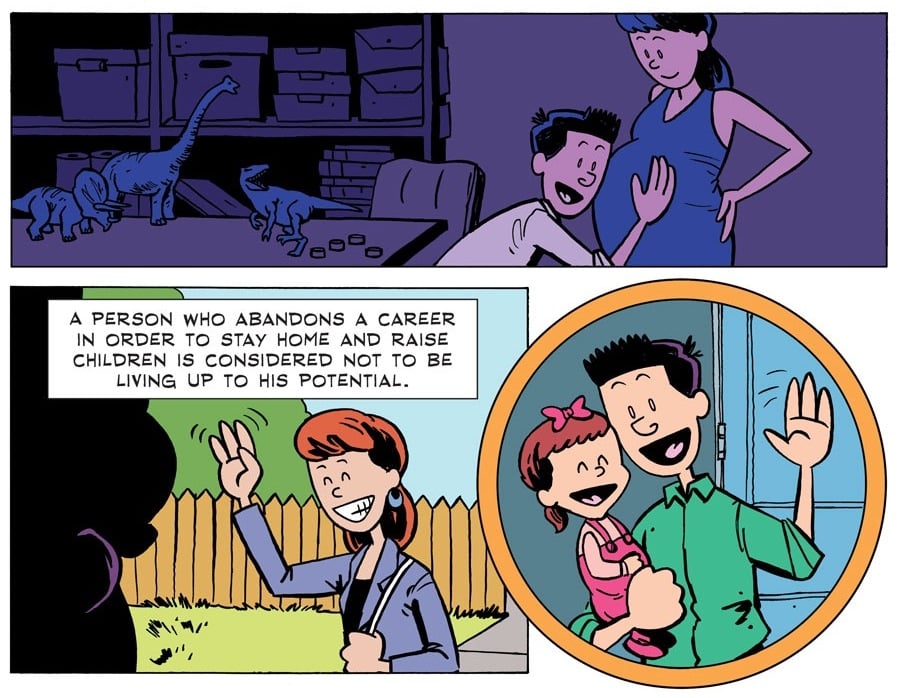
Bill Watterson famously quit cartooning after ten years during which his Calvin and Hobbes was a critical and commercial success you could only compare to Charles Schultz’s Peanuts. (Gary Larsen, GB Trudeau, and Berkeley Breathed are great, but come on.)
You could say Watterson retreated from public view after his retirement, but he was rarely available to the public even during the height of his fame. One exception was his 1990 commencement speech to his alma mater Kenyon College.
Thoreau said, “the mass of men lead lives of quiet desperation.” That’s one of those dumb cocktail quotations that will strike fear in your heart as you get older. Actually, I was leading a life of loud desperation.
When it seemed I would be writing about “Midnite Madness Sale-abrations” for the rest of my life, a friend used to console me that cream always rises to the top. I used to think, so do people who throw themselves into the sea.
I tell you all this because it’s worth recognizing that there is no such thing as an overnight success. You will do well to cultivate the resources in yourself that bring you happiness outside of success or failure. The truth is, most of us discover where we are headed when we arrive. At that time, we turn around and say, yes, this is obviously where I was going all along.
Zen Pencils cartoonist Gavin Aung Than took a series of quotes from Watterson’s speech and illustrated them, consciously imitating Watterson’s style for a new inspirational cartoon titled “Bill Watterson: A Cartoonist’s Advice.” It features a cartoonist who (like Watterson) gives up a commercial illustration job to embrace his artistic dreams and raise a family as a stay-at-home dad. Although the events and much of the scenery is inspired in part by Watterson’s story, first as a young illustrator and later as a popular cartoonist who refused to compromise, Gavin writes:
The comic is basically the story of my life, except I’m a stay-at-home-dad to two dogs. My ex-boss even asked me if I wanted to return to my old job.
My original dream was to become a successful newspaper comic strip artist and create the next Calvin and Hobbes. That job almost doesn’t exist anymore as newspapers continue to disappear and the comics section gets smaller and smaller, often getting squeezed out of newspapers entirely. I spent years sending submissions to syndicates in my early 20s and still have the rejection letters somewhere. I eventually realised it was a fool’s dream (also, my work was nowhere near good enough) and decided webcomics was the place to be. It’s mouth-watering to imagine what Watterson could achieve with webcomics, given the infinite possibilities of the online medium.
See also Robert Krulwich’s remarkable commencement speech at Berkeley about horizontal loyalty and refusing to wait, which seems to dovetail well here.
Alyssa Rosenberg writes about Watterson’s speech and Gavin’s accompanying cartoon’s implications for feminism, especially arguments over balancing life and work:
“A person who abandons a career in order to stay home and raise children,” Watterson noted,” is considered not to be living up to his potential.” I’m sure that choice of pronouns is deliberate. … [The cartoon] is a powerful alternate vision of what it might look like to have it all.
I played football in high school, specifically offensive line, defensive line, and linebacker. So did my older and younger brothers, and my older brother coaches linemen and defense at a high school in Michigan. I started out first in middle school and high school as a defensive specialist, which makes sense given John Madden’s theory of linemen.
Madden used to say that offensive linemen were overwhelmingly big kids who grew up to be big men, who’d always been told not to pick on but to protect kids smaller than them. Defensive linemen, on the other hand, were little kids who grew up fighting with other little kids (and often bigger kids) but who grew up to be big men. That’s what I was: a skinny kid who became a fat adolescent who became a big, strong teenager. (Now I’m a strong, fat writer, so that’s how that turned out.)
Madden said the problem is that offensive linemen still need to be as tough and aggressive as defensive linemen, but they always hold something back. Some of this is part of the rules of football: offensive linemen literally can’t do everything a defensive lineman can do to them. So what Madden would do is take a tackling dummy and let his offensive linemen beat the hell out of it. Punch it, tear it, throw it across the room, it doesn’t matter. Help them get to a point where they’re no longer worried about being over-aggressive.
College football reporter Spencer Hall writes:
You should know this about offensive line coaches: they are large, demanding men with Falstaffian appetites, jutting jaws, and no governors on their speech engines. They eat titanic portions. They cram their lips full of dip in film study like they are loading a mortar. They drink bottled water like parched camels, and in their leisure time would consider a suitcase of beer to be a personal carry-on item for them, and them alone. They are terrifyingly disciplined in the moment, and nap like large breed dogs when allowed.
Now, even if Madden’s amateur psychobiography of linemen were true when he was coaching, it’s not true any more. In the 1990s, coaches got really good at taking tall but relatively slender athletes from every position, bulking them up, and sticking them at offensive line.
In high school, we played this guy named Jon Jansen, who ended up becoming a star offensive tackle for the Washington Redskins, then coming home to Detroit and playing one year for the Lions before becoming an announcer. In high school, he weighed almost 100 pounds less than he did as a pro. He was listed then at 6’8”, 230 lbs, and played tight end and middle linebacker. He was FAST. They moved him all over the field, catching touchdowns and uprooting people. It was chaos.
He went to Michigan, they redshirted him for his freshman year, and came back weighing 300 lbs and playing offensive line. Jansen told Bob Costas that he thought between 15 to 20 percent of NFL players were using illegal performance enhancing drugs, noting that the NFL didn’t then test for human growth hormone. I remember when I was still in high school reading a long profile of the University of Nebraska’s offensive linemen that attributed their huge gains in mass and strength to weightlifting and creatine. Draw your own conclusions about what was happening in pro and college football at the time.
This is all to say that what offensive linemen do in football is not well understood. When the NFL finally started to act on widespread concussions and the resultant uptick in chronic traumatic encephalopathy — if you never have, please read about the life and death of Dave Duerson — they focused on open-field helmet-to-helmet hits and defensive players targeting quarterbacks, running backs, and receivers (so-called “skill positions”). They ignored the constant battering that offensive linemen take, how repeated brain injury poses the greatest risk for long-term problems, how linemen are rewarded for staying on the field and playing through pain, and the ways in which they’re encouraged to both be more aggressive and prioritize someone else’s safety over their own.
Kurt Vonnegut said that his chief objection to life in general was that it was “too easy, when alive, to make horrible mistakes.” This is what offensive line coaches live with: the notion that for every five simple circles drawn on a board, there are a nearly infinite number of possible threats looming out in the theoretical white space. Offensive plays give skill players arrows. Those arrows point down the field toward an endzone, a stopping point, a celebration. Those five simple circles stay on the board in the same place, and are on duty forever.
They are rough men in the business of protection.
Today, Hall has one of the most beautiful, thoughtful, human pieces on offensive linemen I’ve ever read, and which I’ve been quoting here throughout. It’s called “The Business Of Protection,” and subtitled “It Is Never, Ever About You.” It’s a story about Vanderbilt University’s offensive line coach Herb Hand, who suffered a sudden and life-threatening brain hemorrhage waiting in line at a hotel breakfast bar on a recruiting trip. But Hand’s story manages to become equally about football, fatherhood, the brain, the heart, how we defend ourselves from what’s horrible in the things we love, and how we defend the people closest to us from ourselves.
When Hand had to have the impossible conversation — the one where you, with cellphone, stuck in a hospital far away from home, might have to say the last words you ever say to your children — he did what he was trained to do. He told them that he loved them, and that everything would be okay. The second part of that might not have been true at the time. The emergency room doctor certainly didn’t think so, and neither did Hand. But standing between harm and others is what linemen do, even if there’s little hope to be had in the face of numbers, size, and speed. There is a dot on the board, and a shield held against whatever slings and arrows lurk in the ether. It stands against harm until it cannot any longer.
Update: While I was writing this post, the NFL and 4500 former players (about one-third of the 12000 still living) reached a mediation agreement to settle a number of lawsuits over concussions for $765 million.
This figure includes legal fees, medical exams, the cost of noticing former players, and $10 million for research and education on the long-term effect of brain injuries, leaving $675 million to compensate former players who’ve suffered cognitive injuries (or, if dead, their families). The settlement applies only to players who’ve retired by the time court approves its terms. Current players will need a separate agreement to be compensated for existing and future injuries, and the NFL admits no liability.
As Buzzfeed sportswriter Erik Malinowski notes on Twitter: “Holy crap, what a bargain… ESPN pays $1.9 billion *every year* for Monday Night Football. 4,500 ex-players will get 40% of that (once) for decades of head trauma.”
Three years ago, I came across a post on the Sharpie blog — I don’t know how or why I was following Sharpie’s blog, but such were the mysteries of our universe in those long-ago days — announcing a new kind of pencil: a mechanical pencil with liquid graphite ink, with leads that could not break, whose writing was initially erasable but over time (about three days) would become semi-permanent.
Seriously: the Sharpie liquid pencil shows that somewhere, engineers are always quietly perfecting something old & great. http://j.mp/aFQHBE
— Tim Carmody (@tcarmody) August 9, 2010
Sharpie eventually had to back off some of its claims for the liquid pencil — the original promo material said pencil would become permanent like a Sharpie Marker, which isn’t quite true — but they brought them to market, and sell them for about $3 apiece. (Sadly, the reviews aren’t very good.)
People love pencils. They love them. It’s partly childhood nostalgia, partly how a craftsman comes to care for her tools, and partly the tactile experience. It’s also a blend of appreciation for both their aesthetic and functional qualities, and (especially these days, but not only these days), a soupçon of the disruptive passion that comes from willfully embracing what poses as the technologically obsolete.
Over at The Atlantic, Rebecca Rosen has a story about Pencil Revolution, which she quite rightly calls “The World’s Best Website About Pencils.” She lists ten representative posts, from which I’ll select my favorite five:
A review of artisanal pencil-sharpener David Rees’s book, How to Sharpen Pencils: A Practical & Theoretical Treatise on the Artisanal Craft of Pencil Sharpening for Writers, Artists, Contractors, Flange Turners, Anglesmiths, & Civil Servants (“a must-read for anyone interested in pencils”)
A confession of having stolen an Ikea pencil (and a link to a Flickr group of other such pencil thieves)
A review of the Staedtler Norica HB pencil:
I found these at Staples (in the US) a few weeks ago and bought a pack. At $10 for three dozen, it was a pretty good deal. Less than $3.50 for some quality pencils is something I’d find it difficult to pass up. But three dozen is…a commitment to make to the Pencil Gods, when the pencil might just be terrible. I mean, they are pencils. One can’t just throw them away if they turn out to be awful. Luckily, these pencils are not awful at all. Unluckily, having a Big Box means that I’ve given most of them away already.
I feel like there’s something powerful about pencils that I feel viscerally but don’t fully understand. There’s the manuscript part: as much as I love to type, there’s something super powerful in that alignment of the eye and the hand. But that’s pens and chalk and crayons and markers too, and I have completely different feelings about all of these things.
In “Why pencils?” Pencil Revolution’s founder Johnny Gamber tries to explain:
The first and best reason to use pencils is because you like them and enjoy writing/drawing with them. Because you feel better connected to the paper you’re writing on (or the wall, etc.) and the earth from which the clay, the graphite and the wood all came. Because they smell good. Because sharpening them can be a sort of meditative process. Because you can chew on them. Or for reasons we can’t explain.
The point is that it’s best to write with what we like best, no? I’ll admit to enjoying taking notes and writing papers and poems with pencils better than pens. That’s the biggest reason that I use pencils at all.
Maybe it’s that sense of work that’s best realized in sharpening: the continual, attentive maintenance to a thing that’s ultimately, necessarily, and even intentionally disposable. To adapt George Carlin’s observation, when you buy a pencil, you know it’s going to end badly. You’re buying a small tragedy. Caring for a pencil becomes like caring for a pet, or a person, in accelerated miniature, like in time-lapse photography.
Pencils are like love. Pencils are like us. They are free to love, free to squander, and free to give away.
I’m going to do something rare here at Kottke and open up the comments. I’ll close them down at the end of the day. Do you love pencils? Do you hate them? Why? What’s your favorite pencil? What’s your best pencil story? Did a pencil ever break your heart?
Writer and professor Roxane Gay was recently moved to write a dating FAQ [excerpts follow]:
Why are you still single?
I discontinued settling in 2012.If you’re a feminist, why do you need a man?
I don’t need to do anything but stay black and die but I enjoy braiding a man’s leg hair while we watch Lifetime movies.You are confusing and contradictory. I don’t understand.
I cannot help you with that.Are you buckwild?
Yes.What the hell are you looking for?
All I want is everything.
And now you have asked one (or strictly speaking, n ? 1) feminist about dating.
Building on yesterday’s “The dirty BLEEP,” here are a few more great moments in the artful use of censorship (or its illusion):
Also, besides using the appearance of censorship to remix existing text, audio, and video like “Unnecessary Censorship” does or fully scripting the bleep ahead of time like Arrested Development or South Park do, there’s been a real rise in a mode that’s in between, something that’s deliberate but has the feel of being off-the-cuff. This is probably best exemplified by The Daily Show and The Colbert Report. Check out Ashton Kutcher’s “surprise” experience on Colbert:
Here the tension isn’t just between what you’ve heard and what you know was said, but also between the live experience and that of broadcast. It used to be that if you heard a bleep of an event that was recorded live, someone had gone off the rails, like Madonna on the David Letterman show.
Now, TV mostly just lets anything and everything rip for the people in the room, knowing it will amp up the energy in the crowd, but can be bleeped for broadcast later. Then sometimes (like with The Daily Show or Chappelle’s Show on DVD or Netflix), you can catch the uncensored cut at home.
So we get the live, the censored, and the edited-but-encensored experiences, and we’re always mentally bouncing between all three. We know it’s not really spontaneous, but knowing is part of what lets us in on the joke, even though we can’t be in the room.
Today is the fiftieth anniversary of the March on Washington for Jobs and Freedom. The full title is important because the right words are important.
@Soledad_OBrien Everyone forgets that the “March on Washington” was the “March for Jobs and Freedom.”
— Tim Carmody (@tcarmody) August 23, 2013
It’s important because the Great March itself was a compromise, an evolution of the movement A. Philip Randolph of the Brotherhood of Sleeping Car Porters had forged decades before. During the Roosevelt and Truman administrations, Randolph and other civil rights leaders worked to force the government to desegregate the army and provide more economic opportunities to black Americans. The March was a dream, but it was also a threat. Before 1963, each time the March was about to happen, the government made concessions and it would be called off.
Randolph was 74 when the March finally materialized, with him as its titular head. He was the only figure with the credibility to unify northern labor leaders and southern pastors: radical enough for the relative radicals — the radical radicals saw the March as a distracting sideshow or were directly asked not to participate — and institutional enough for the wary moderates.
Bayard Rustin was Randolph’s lieutenant and did the bulk of the work organizing the March. Rustin was gay, and had been a Communist. He couldn’t be the event’s public face.
Special trains leaving from Penn Station to bring marchers to DC. Officials say it’s the largest early-morning crowd since end of WW2.
— Today in 1963 (@todayin1963) August 28, 2013
Everything that happened at the March, from the arrival of more than 100,000 people straight through all the speeches, all the songs, all the signs painted, all of the 80,000 cheese sandwiches made, distributed, and eaten — each and every one of those moments — happened in one day. Television stations were able to carry the event live. It was a tremendous feat of planning and organization. No one but Bayard Rustin and his dedicated staff could have pulled it off.
John Lewis was 23 years old and the March’s youngest speaker. He is the only one of that day’s speakers who is still alive. Lewis had recently been made head of the Student Nonviolent Coordinating Committee, or SNCC (pronounced “snick”). SNCC was a relatively new, independent civil rights organization that had proven itself integrating lunch counters in Nashville, then on the Freedom Rides with CORE protesting segregated busing and bus stations throughout the south, and working with the NAACP and Southern Christian Leadership Conference (SCLC) in Albany, Georgia.
If you’re serious about the civil rights movement, you have to learn a lot of organizations’ names and abbreviated titles. You have to learn that the leaders of these organizations rarely agreed with each other about goals, methods, or priorities. You have to know that even within each organization there were equal amounts of discipline and dissent.
They were organized not because they agreed, but because they had to be. They were disciplined because they had to be. They were allied because they had to be. It was all fragile. At any moment, it could all fall apart.
John Lewis had been part of both series of Freedom Rides and was badly beaten during the second, in Montgomery. The state highway patrol that had promised the riders protection — at the insistence of the Kennedy administration and with the reluctant assurance of Alabama’s governor, George Wallace — abandoned them to a white mob waiting at the city’s station house.
Lewis was 21 years old. His friend Jim Zwerg was also 21. Zwerg bravely walked out the door of the bus first to meet the waiting mob, where he was nearly beaten to death. He received a particularly savage beating partly because he was first and partly because he was white.
While being beaten, Zwerg recalls seeing a black man in coveralls, probably just off of work, who happened to be walking by. “‘Stop beating that kid,” the man said. “If you want to beat someone, beat me.”
“And they did,” Zwerg remembered. “He was still unconscious when I left the hospital. I don’t know if he lived or died.”
Jim Zwerg is still alive. It’s amazing any of these people are still alive.
August 28, 1955, Emmett Till is murdered.
— Melissa Harris-Perry (@MHarrisPerry) August 28, 2013
Lewis was originally going to give a much more provocative speech at the March. The plan was to call out the supposedly liberal Kennedy administration for its lukewarm support of civil rights. (A less polite word than “lukewarm” would be “half-assed.”) On behalf of SNCC, Lewis would argue that the civil rights legislation proposed by the Kennedy administration was (in Lewis’s words) “too little and too late.”
But each of the March’s major figures, including Rustin and Dr. King, urged Lewis to moderate his speech. They had a testy but evolving relationship with the Kennedys that they didn’t want to jeopardize or aggravate. It was only A. Philip Randolph who finally swayed Lewis. Rustin went into the crowd to find Randolph, then brought the two men together.
Lewis was 51 years younger than Randolph. Lewis later said of Randolph that “if he had been born in another period, maybe of another color, he probably would have been President.” Randolph had been an actor as a young man, and his voice has that deep, archaic, clear-toned, echoing-from-infinity quality that you imagine is the voice of history itself; the voice you imagine reading the Gettysburg Address and Declaration of Independence.
Lewis and the other young leaders of SNCC were quite rightly in awe of him.
He was 75, and here we were, you know, one-third his age and, you know, he was asking us to do this for him. He said, “I waited all my life for this opportunity, please don’t ruin it.” And we felt that for him, we had to make some concession. [Courtland Cox]
The day’s speeches were already underway. This all happened in one day. Lewis was sixth on the program. So Cox and Lewis and James Forman went to the Lincoln Memorial — no bullshit, they went and sat together at the foot of the Lincoln fucking Memorial — and rewrote Lewis’s speech. It’s still pretty fierce.
To those who have said, “Be patient and wait,” we must say that “patience” is a dirty and nasty word. We cannot be patient, we do not want to be free gradually. We want our freedom, and we want it now. We cannot depend on any political party, for both the Democrats and the Republicans have betrayed the basic principles of the Declaration of Independence…
The revolution is a serious one. Mr. Kennedy is trying to take the revolution out of the streets and put it into the courts. Listen, Mr. Kennedy. Listen, Mr. Congressman. Listen, fellow citizens. The black masses are on the march for jobs and freedom, and we must say to the politicians that there won’t be a “cooling-off” period…
We must say, “Wake up, America. Wake up! For we cannot stop, and we will not be patient.”
I was amazed recently to discover that Reverend Doctor Joseph E. Lowery, one of the co-founders of SCLC, is still alive at 91. He has three videos of interviews up at “His Dream, Our Stories,” a site devoted to the March. Lowery was a pastor in Mobile and helped lead the bus boycott in Montgomery — which, people forget, went on for over a year after Rosa Parks’ arrest. Later, Lowery, along with John Lewis, Hosea Williams, Martin Luther King Jr., and others, led the 1965 march from Selma to Montgomery. Ten years after Emmett Till’s murder and the Montgomery bus boycott, two years after the March on Washington, and a year after the Civil Rights Act, the Selma marchers were attacked by Alabama state and local police for asserting their right to vote.
In 2008, Lowery gave the benediction for Barack Obama’s first Inauguration. He is still alive. He is 91 years old.
The March all happened in one day; the Movement happened over years and years and years.
Rosa Parks was 42 when the Montgomery bus boycott began. She was 50 at the time of the March, where she was honored along with other important women of the Civil Rights Movement — Little Rock’s Daisy Bates, SNCC’s Diane Nash Bevel, Gloria Richardson of Cambridge, Maryland, and Mrs. Herbert Lee. The women’s many accomplishments and contributions were noted in a speech by Myrlie Evers-Williams, then listed as Mrs. Medgar Evers.
Parks was older than Lowery, who was 34 when the boycott began. Martin Luther King Jr. was 26, not much older than Lewis was when he was called to lead SNCC and speak in Washington. At the March, King was 34. Within five years, he would be dead. A. Philip Randolph would live to be 90 years old, just a little younger than Lowery is now. He outlived King by more than ten years.
We’ve lost so much. We’ve forgotten so much. We’ve asked so few to stand in for so many. We’re doing it still.
Copyright lawyer Josh Schiller recently wrote an op-ed in the Washington Post, “Why you won’t see or hear the ‘I have a dream’ speech,” examining how the King estate’s vigorous defense of his speech’s copyright has prevented its popular reproduction.
One place you can both see and hear King’s speech is on PBS’s Eyes on the Prize website. Eyes on the Prize is a landmark documentary on the entire modern civil rights movement, from Emmett Till’s murder through the 1980s, when it first appeared. Its producers know more than a thing or two about the thorniest issues of copyright: the documentary’s rebroadcast and distribution were held up for years while rights were cleared for its music, photographs, and videos. (Eventually, some of the original media was replaced.) I’m pretty sure they’ve done their work and paid the right licensing fees to get King’s speech on the website.
Watch Dr King’s speech. It’s not the entire thing, and it’s a crummy little QuickTime video. But it includes footage of the marchers arriving, A. Philip Randolph’s introduction, and footage of President Kennedy meeting with the March’s leaders, plus Walter Cronkite’s contemporary commentary.
Remember this is history, which means we are still within it, even when those for whom it has been living memory leave us. Remember that it is the March on Washington for Jobs and Freedom. Remember how fragile it all was. Remember A. Philip Randolph and Bayard Rustin, Joseph E. Lowery and Jim Zwerg. Remember the man in coveralls, remembered by no one but the stranger whose life he saved.
Remember Martin Luther King, Jr., that thickly-built, still-young man, rooting his feet in our history and turning himself into a column of pure energy, like a beacon through time and space, a light so bright we can’t look at him directly, but have to turn away and look only at his half-remembered shape, still impressed on us when we close our eyes. Remember that day, when he all-too-briefly became a single still point with the granted power to bend straight the crooked lines of history.
Remember that fifty years after the Emancipation Proclamation, A. Philip Randolph was organizing the Shakespearean Society in Harlem. Fifty years after that, he was meeting a President who now owed him more than he probably ever knew. Fifty years is a long time and yet not so very long. If so much can be done in just one day, how much more could we do, now that we know we have another fifty years?
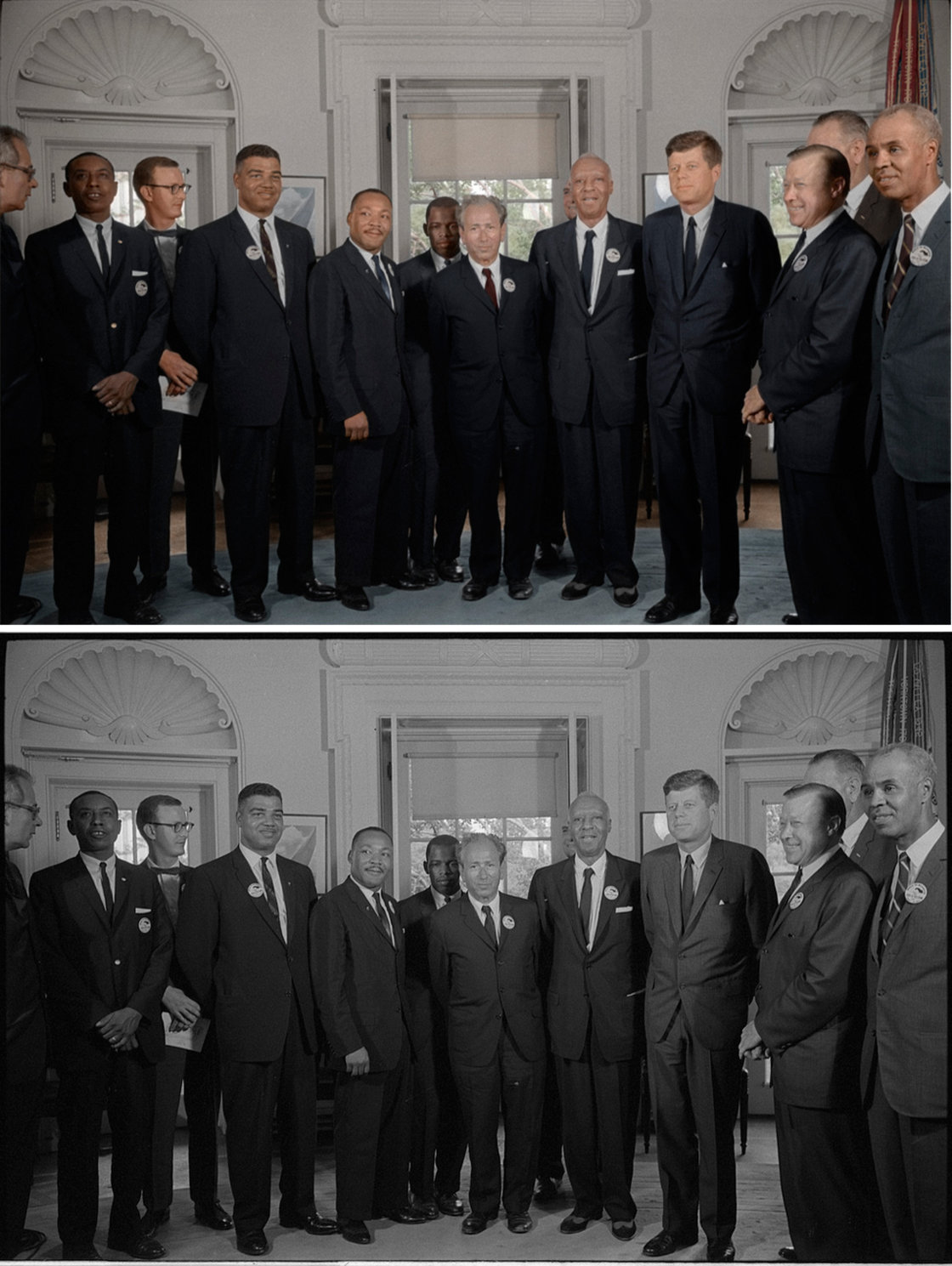 Image colorized by Mads Madsen for NPR.
Maria Bustillos’ “Curses! The birth of the bleep and modern American censorship” has a blacked-out subhed. Mouse over the black virtual ink and you see “Shit, piss, fuck, cunt, cocksucker, motherfucker, and tits,” George Carlin’s original list of Seven Dirty Words that can’t be said on radio or television.
How’d we get here? Supposedly it was because of a nursery rhyme vaguely referencing contraception read live on a Newark radio station by actress Olga Petrova: “There was an old woman who lived in a shoe, She had so many children because she didn’t know what to do.” The rhyme wasn’t censored, but engineers later built a switch to turn on music in case anyone recording went blue.
In the US, the government owns the airwaves and regulates their content, and bases its criteria for obscenity in part on past court cases regulating print.
In order to be considered obscenity, the material in question must pass a three-pronged test: first, it has to “appeal to the prurient interest,” or be be liable to turn the average person on sexually; secondly, it must describe sexual conduct “in a patently offensive way;” and finally, “the material taken as a whole, must lack serious literary, artistic, political or scientific value.” The last is how both Ulysses and Lolita slide out of being considered “obscene.”
But in addition to obscenity, the FCC also has rules governing “indecency” and “profanity”; all three are technically distinct in the same way that a moron is different from an imbecile, which in turn is different from an idiot. And most of the censorship action happens within TV or radio networks’ standards and practices departments anyways.
Once the bleep is introduced, however, it takes on its own meaning. It’s a kind of zero-sign that artists can use deliberately for effect.
The writers of Arrested Development are masters of this comic technique, repeatedly pushing the envelope. They snuck the word “fucking” past prime time television censors by putting half the word at the beginning of the show, and half at the end.
But it was with the aid of censor bleeping that Arrested Development reached the summit of its satiric genius. The show’s creator, Mitch Hurwitz, told Neda Ulaby of NPR, “We realized, you know, it’s more fun to not know exactly what it is that we’re saying … It becomes kind of a puzzle for people. And I think it’s about, you know, letting your imagination do the work.”
The full essay tracks the legal and cultural history of the bleep from its high-analog origins up to its culmination/obsolescence in the digital dump track. Now if a producer really wants to keep you from hearing something that might make someone uncomfortable, they just cut it right out of the audio, and you’d never know it was there.
Disclosure: I worked at The Verge and discussed this feature when it was in development. Also, freelance writer Maria Bustillos is awesome.
There’s a history here.
*Billy Ray Cyrus enters the office* *browser windows close throughout building* *6 people crowded around an iPad suddenly scatter*
— netw3rk (@netw3rk) August 26, 2013
Nobody seems to remember when Shirley Temple celebrated her 19th birthday by twerking on the Jack Benny Goodtime Radio Hour.
— Joel Mathis (@joelmmathis) August 26, 2013
It’s not only uncanny when performers we first knew as girls age into women; it’s awkward when boys become men, too. Molly Shannon used to have the same agent as Gary Coleman (story starts around 2:40).
(Shannon tells a longer/uncensored version of this story on Marc Maron’s WTF podcast.)
Clearly, not everyone gets to have Ron Howard’s or Judy Garland’s career. (And even Judy Garland’s life was the opposite of a success story.)
But what about the alternative? What if child stars never changed their acts, and just aged in place? Wouldn’t that be equally unsettling? On Comedy Bang Bang, Scott Aukerman, Reggie Watts, Seth Rogen, and the great Bob Odenkirk try to answer that question through the life of champion birdcaller Tommy Chalders.
Actually, maybe that would be beautiful. I wish Judy Garland had lived to sing “Over the Rainbow” at an auto show.
But time never stands still for us to paint its portrait. As Marshall McLuhan would, and, what the hell, very well might have said: “we look at the present through a rear-view mirror. We twerk backwards into the future.”
Daft Punk’s Get Lucky “leaked” orig. from Apr 15, 2013
* Q: Wha? A: These previously published entries have been updated with new information in the last 24 hours. You can find past updates here.
Today is a weird day for human-interest stories about bank robbers.
The New York Times highlights Shon R. Hopwood, a former bank robber who studied law in prison, successfully petitioned on behalf of another prisoner in a Supreme Court case his team won 9-0, and will soon be a clerk for the DC circuit federal appeals court, “generally considered the second most important court in the nation, after the Supreme Court”:
The judge Mr. Hopwood worked for last summer said he deserved his 147-month sentence. “He used a weapon in some of those robberies, and that justified a very heavy hit,” said Judge John C. Coughenour of Federal District Court in Seattle. “But everybody we sentence has the potential to turn their life around.”
Meanwhile, one state south in Oregon:
Authorities in Oregon say a homeless man who held up a bank for $1 was just looking for a way to go to jail so he could receive free health care.
According to Clackamas County sheriff’s deputies, 50-year-old Tim Alsip entered a Bank of America in Southeast Portland last Friday morning and handed the teller a note that read, “This is a holdup. Give me a dollar.”
I know he’s a busy man, but it would be remarkable if Mr. Hopwood could drive from Seattle to Portland and find a way to help Mr. Alsip be relegated to an appropriate facility.
Looks like Syfy has ordered a “cast-contingent” hour-long pilot for an adaptation of Terry Gilliam’s Twelve Monkeys, with an eye to make it into a proper TV series. One of the producers of Gilliam’s 1995 film is on board, and Terry Matalas and Travis Fickett, who both worked on Terra Nova and Nikita, wrote it. The model here is Battlestar Galactica: a movie reboot that could be a mini-series that could be multiple seasons.
Syfy’s Mark Stern talked about it with The Hollywood Reporter, back when the pilot was 90 minutes long and still waiting to be approved for production while the network and producers figured out what the whole series would be about:
It’s a return to our roots in terms of science fiction: cool, interesting push-the-genre science fiction. Some we’re looking at doing straight to series, because you really want to give them the flexibility and do a closed-ended, arced run. Some of them are going to be traditional pilots, and then we’ll decide and they may be a bit more episodic.
Given the time-travel theme, the fact that the source material (both Twelve Monkeys and La Jetée) are well-known, and the way TV’s changed over the last ten years with jigsaw-puzzle series like LOST and the revived Arrested Development, I’m curious to see if the showrunners might mess around with the timelines a bit, jumping around, giving the audience previews of things the story doesn’t explain right away, and generally making Doctor Who look like it’s for precocious kids (which, really, it kinda is).
Via Adi Robertson at The Verge.
A couple of weeks ago, a slowed-down version of Dolly Parton’s classic ballad “Jolene” went viral. A lot of people who heard it loved it, a few people didn’t, but everyone seemed to agree that it was like listening to either an entirely new song or the same song again for the first time.
One of the things that’s eerie about this is that if you listen closely, everything is just a little bit out of tune. There’s conflicting information about exactly how much the track has been slowed. Some people have said that it’s simulating a 45 RPM record played at 33 1/3, which is certainly the most common way people who lived with record players heard popular songs at slower speeds. But that would actually be quite a bit slower and lower than this.
The other figure I’ve seen (forgive me for not citing everything, I’m typing as fast as I can) is “Jolene” has been slowed by 17 percent, which sounds about right and would explain why all the notes seem just a little bit sharp. Here’s the formula for slowing or speeding up a recording to shift the pitch but generally stay in tune:
(2 ^ (semitones change/12) - 1) *100 = Percent Change
So — as one does when procrastinating from remunerative work — I made an Excel spreadsheet.
If you want to drop two semitones, you shift the speed down by 12.2462 percent; drop three, you shift by 18.9207 percent, which significantly changes the track. To imitate a 45 RPM record played at 33 1/3, that’s about 25.926, but very few records still sound like something a person actually made at this speed. All of these slowdowns are interesting, even the ones that don’t work.
You can do all of them in the free/open-source audio processing app Audacity; it’s very fast and very easy. (If you want to get freaky, you can also use Audacity to change pitch without changing tempo, or vice versa, or to start out slow and go fast, and all manner of lesser and greater perversity.)
But after messing with Audacity for longer than was strictly necessary, I can tell you that some songs and transformations work out better than others, and they tend to be those that share a lot of the same characteristics as Jolene:
And so, here are some of the results:
I described this Prince track as sounding like the slowest, sultriest, funkiest Sylvester song you’ve ever heard.
Mazzy Star surprised me. I always thought Hope Sandoval’s vocals were gorgeous but a little warbly, which gave them character, but that’s almost entirely a production effect. When you slow it down, you can really hear how clean and sustained her notes are.
My Bloody Valentine is the best example of that fractal quality. You can slow it down almost indefinitely and it still sounds like My Bloody Valentine. At this rate, though, it really just turns Bilinda Butcher’s vocals into Kevin Shields’.
There’s more at my Soundcloud page, including The Breeders’ “Cannonball,” “House of Jealous Lovers,” Hot Chip’s “Over and Over,” Grizzly Bear’s “Two Weeks” (which I actually sped up), and more. (Finally, if slowing a track down and posting it online somehow breaks copyright, let me know and I’ll take them down.)
Update: Andy Baio tips me to a second remix of “Jolene” that slows down the track, but corrects the pitch. Sounds great.
Update 2: Here’s Michael Jackson’s “P.Y.T.” slowed from 127 BPM to 110 BPM, leaving the pitch as-is.
How many people are in space right now? is a single serving site that will give you the answer, along with the astronauts’ names, ranks, nationalities, and how long they’ve been in space.
As of August 26, 2013, these six people have emigrated from Earth’s atmosphere and not yet returned:
When I was a kid, I always thought that by the time I was an adult, we would have town-sized colonies in space stations around Earth, even if nowhere else. But getting and keeping human beings in space is hard, and robots have gotten very smart. Still, when I think about the rise of commercial human spaceflight, part of me is like “I don’t just want to shoot into space like a soda can and do one lousy orbit!” — as if that wouldn’t be the most magical experience of my life. It doesn’t matter. What I really want is to do a semester abroad.
Hats tipped to Zach Seward, Melody Kramer, and Sharon Jacobs.
Speaking of lobster, you could do much worse today than reading David Foster Wallace’s classic piece for Gourmet about attending the Maine Lobster Festival. As you might imagine, Wallace quickly veers from the event at hand into something more interesting and unsettling for Gourmet’s gourmet readers: do lobsters feel pain and do they suffer for your dinner?
Given this article’s venue and my own lack of culinary sophistication, I’m curious about whether the reader can identify with any of these reactions and acknowledgments and discomforts. I am also concerned not to come off as shrill or preachy when what I really am is confused. Given the (possible) moral status and (very possible) physical suffering of the animals involved, what ethical convictions do gourmets evolve that allow them not just to eat but to savor and enjoy flesh-based viands (since of course refined enjoyment, rather than just ingestion, is the whole point of gastronomy)? And for those gourmets who’ll have no truck with convictions or rationales and who regard stuff like the previous paragraph as just so much pointless navel-gazing, what makes it feel okay, inside, to dismiss the whole issue out of hand? That is, is their refusal to think about any of this the product of actual thought, or is it just that they don’t want to think about it? Do they ever think about their reluctance to think about it? After all, isn’t being extra aware and attentive and thoughtful about one’s food and its overall context part of what distinguishes a real gourmet? Or is all the gourmet’s extra attention and sensibility just supposed to be aesthetic, gustatory?

Ian Silva is a Australian commuter train driver who spends his spare time mapping an invented country called the Koana Islands.
People in the Koana Islands love baseball. The first league play started in 1882, barely six years after the MLB. Between the top-tier, Triple- and Double-A leagues, there are over 180 teams spanning the island nation. Fans are so rabid that there’s even talk of expanding to a Single-A league, adding even more teams. If you’re a baseball fan, you might be surprised you’ve never heard of this. You’ll be even more surprised when you try to find the Koana Islands. That’s because the 32-island chain, with its nine major cities, 11 national parks, 93 million residents and a landmass that is equal to Spain and Sweden combined does not really exist.
(thx, toni)
Here’s a video of the 2013 World Yo-Yo Contest winner, Janos Karancz. His motion is so delicate and intricate, it’s almost like he’s doing needlepoint or something:
Contrast that with the winner of the 2000 World Yo-Yo Contest, Yu Kawada. Much simpler tricks, more showmanship, like it’s a dance:
Here’s some footage from a 1989 yo-yo contest. Lots of throwing tricks and fewer spinning tricks. Contestants competed in blazers!
And finally, a Duncan yo-yo commercial from 1976. Super simple tricks and more blazers!
Empire asked a group of visual effects specialists about their favorite special effect movie moments…here’s what they had to say. Tim Webber (The Dark Knight, Gravity, Children of Men) picked the warehouse scene from Raiders of the Lost Ark:
I love Davy Jones in Pirates Of The Caribbean: Dead Man’s Chest and the T-1000 walking out of the flames in Terminator 2, but my pick is the warehouse scene at the end of Raiders Of The Lost Ark. It’s just a simple matte painting, not a very complicated visual effects shot, but it was done brilliantly. A lot of the visual effects from that period look terrible now — there are lines around things or you can see the joins on matte paintings, but that one was immaculate. I was pretty young when I watched it, but I was so impressed by the way it slowly revealed the size of the place. It’s not your big, crash-bang-wallop modern visual effects shot but it has real dramatic effect.
Artist Lisa Hanawalt has been sketching big company logos with alternate slogans, including KFC, BMW, Toyota, McDonald’s, Nike, and Subway. The Subway and Toyota ones are my favorite:
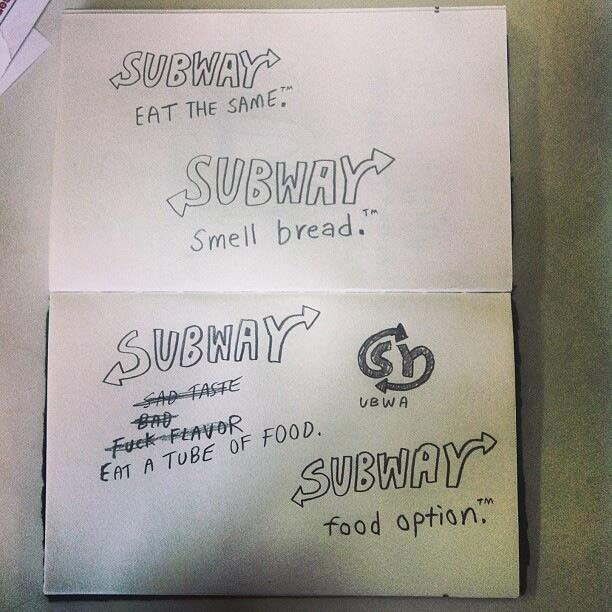

Food option. You need a fucking car unfortunately. Smell bread. Awesome.
Josh Gondelman wants to make love to you like in the movies.
Everything that happens will be sexy. There won’t be any gross sounds or sights. Just like in the movies, our sex will be tasteless and odorless. I will not kiss your neck and get a mouthful of perfume and then you’re like what’s wrong and I’ll be like nothing and you’ll get all distant and I’ll be like sorry it’s the taste of your perfume, and you’ll be sad because you only wore it because I said I liked it one time and then all of a sudden you’re not in the mood and I think about sneaking off to the bathroom to furtively masturbate but I don’t and I just hold you limply until you fall asleep then I check Twitter for like an hour. That doesn’t happen.
From August 1999, a long remembrance of Stanley Kubrick from his friend and colleague, Michael Herr, who co-wrote the screenplay for Full Metal Jacket.
Stanley Kubrick was a friend of mine, insofar as people like Stanley have friends, and as if there are any people like Stanley now. Famously reclusive, as I’m sure you’ve heard, he was in fact a complete failure as a recluse, unless you believe that a recluse is simply someone who seldom leaves his house. Stanley saw a lot of people. Sometimes he even went out to see people, but not often, very rarely, hardly ever. Still, he was one of the most gregarious men I ever knew, and it didn’t change anything that most of this conviviality went on over the phone. He viewed the telephone the way Mao viewed warfare, as the instrument of a protracted offensive where control of the ground was critical and timing crucial, while time itself was meaningless, except as something to be kept on your side. An hour was nothing, mere overture, or opening move, or gambit, a small taste of his virtuosity. The writer Gustav Hasford claimed that he and Stanley were once on the phone for seven hours, and I went over three with him many times. I’ve been hearing about all the people who say they talked to Stanley on the last day of his life, and however many of them there were, I believe them all.
Somebody who knew him 45 years ago, when he was starting out, said, “Stanley always acted like he knew something you didn’t know,” but honestly, he didn’t have to act. Not only that, by the time he was through having what he called, in quite another context, “strenuous intercourse” with you, he knew most of what you knew as well. Hasford called him an earwig; he’d go in one ear and not come out the other until he’d eaten clean through your head.
He had the endearing and certainly seductive habit when he talked to you of slipping your name in every few sentences, particularly in the punch line, and there was always a punch line. He had an especially fraternal temperament anyway, but I know quite a few women who found him extremely charming. A few of them were even actresses.
Some Americans move to London and in three weeks they’re talking like Denholm Elliott. Stanley picked up the odd English locution, but it didn’t take Henry Higgins to place him as pure, almost stainless Bronx. Stanley’s speech was very fluent, melodious even. In spite of the Bronx nasal-caustic, perhaps the shadow of some adenoidal trauma long ago, it was as close to the condition of music as speech can get and still be speech, like a very well-read jazz musician talking, with a pleasing and graceful Groucho-like rushing and ebbing of inflection for emphasis and suggested quotation marks to convey amused disdain, over-enunciating phrases that struck him as fabulously banal, with lots of innuendo, and lots of latent sarcasm, and some not so latent, lively tempi, brilliant timing, eloquent silences, and, always, masterful, seamless segues — “Lemme change the subject for just a minute,” or “What were we into before we got into this?” I never heard him try to do other voices, or dialects, even when he was telling Jewish jokes. Stanley quoted other people all the time, people in the industry whom he’d spoken to that morning (Steven and Mike, Warren and Jack, Tom and Nicole), or people who died a thousand years ago, but it was always Stanley speaking.
Kubrick died a few months before the piece was published and his final film, Eyes Wide Shut, came out right around the publication date. And if you don’t want to read all 12,000 words in your browser, there’s an expanded version of the essay available as a book.
I took a Greek and Roman literature class in college. Among the texts we studied was Lucretius’ On The Nature of Things. Shamefully, about the only thing I remembered from it was that the poem was an early articulation of the concept of atoms (see also Democritus). Impressive, chatting about atoms in 50 BCE. But reading Stephen Greenblatt’s The Swerve has reminded me what an impressive and prescient document it is, quite apart from its beauty as a poem. In chapter eight of his book, Greenblatt summarizes the main points of Lucretius’ poem:
Everything is made of invisible particles.
The elementary particles of matter — “the seeds of things” — are eternal.
The elementary particles are infinite in number but limited in shape and size.
All particles are in motion in an infinite void.
The universe has no creator or designer.
Everything comes into being as a result of a swerve.
[Ok, the swerve deserves a bit of explanation. Here’s Greenblatt:
If all the individual particles, in their infinite numbers, fell through the void in straight lines, pulled down by their own weight like raindrops, nothing would ever exist. But the particles do no move lockstep in a preordained single direction. Instead, “at absolutely unpredictable time and places they deflect slightly from their straight course, to a degree that could be described as no more than a shift of movement.” The position of the elementary particles is thus indeterminate.
I can’t help but think of quantum mechanics here. Anyway, back to the list.]
The swerve is the source of free will.
Nature ceaselessly experiments.
The universe was not created for or about humans.
Humans are not unique.
Human society began not in a Golden Age of tranquility and plenty, but in a primitive battle for survival.
The soul dies.
There is no afterlife.
Death is nothing to us.
All organized religions are superstitious delusions.
Religions are invariably cruel.
There are no angels, demons, or ghosts.
The highest goal of human life is the enhancement of pleasure and the reduction of pain.
The greatest obstacle to pleasure is not pain; it is delusion.
Understanding the nature of things generates deep wonder.
The seeds of atomic theory, quantum mechanics, evolution, agnosticism, atheism…they’re all right there, in a poem written by a man who died more than 2000 years ago.
You’ve probably seen some of these before, but the 1600+ color photos from the 1930s & 1940s uploaded by the Library of Congress to Flickr are a wonderful look at America around the time of WWII. Here are a few quick favorites:



There are a lot of lobsters in the sea. You could even call it a glut. Over the past few years, the massive lobster harvests have resulted in a significant reduction in what buyers are paying for a lobster off the boat. So why aren’t we seeing major price drops at our local restaurants? Here’s part of the reason: A luxury good is considered a luxury good in part because it’s priced like one. Cheap lobster could throw the rest of your menu into chaos.
Studies have shown that people prefer inexpensive wines in blind taste tests, but that they actually get more pleasure from drinking wine they are told is expensive. If lobster were priced like chicken, we might enjoy it less.
In The New Yorker, James Surowiecki cracks open the surprising complexity of lobster prices.
Another one from Quora’s excellent weekly newsletter: What’s something that is common knowledge at your work place, but will be mind blowing to the rest of us? On fast food in commercials:
Everyone thinks the burgers shown on TV commercials must be highly fabricated works of culinary art, but the fact of the matter is that food advertising is subject to many regulations. I am not sure whether these are company policies or laws, and they’re probably a combination of both, but on a typical fast food shoot these rules apply.
The meal must be prepared from actual store stock (from the frozen patty to the bun to the seasonings). On a shoot, stylists would receive tons of product, which they would pore through to find the best-looking raw material.
Other interesting answers reveal the inner workings of political campaign events, the mining industry, investment banking, and orchestras.
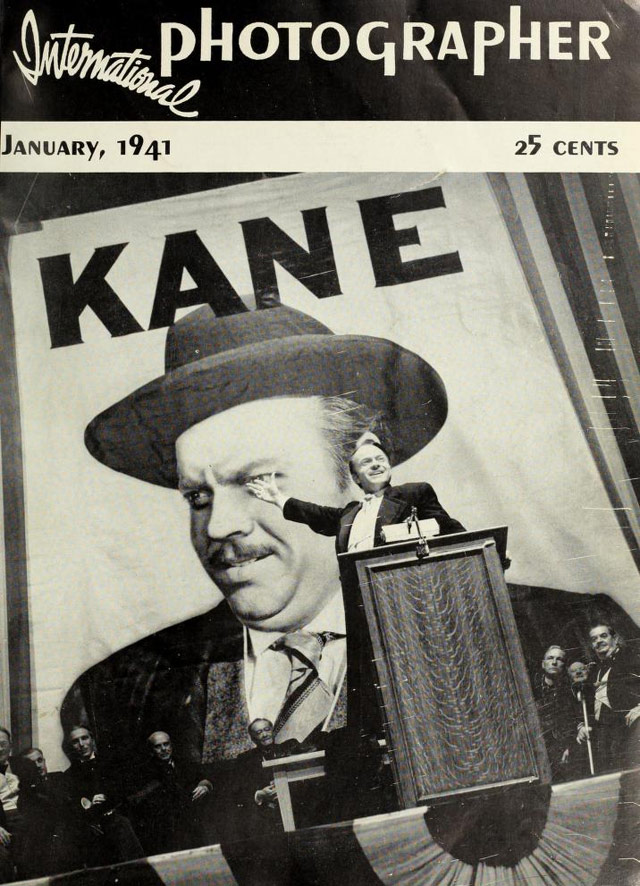
Lantern is a search engine for the books, periodicals, and catalogs contained in the Media History Digital Library. If you are a fan or student of pre-1970s American film and broadcasting, this looks like a goldmine. Here are some of the periodical titles and the years available:
Variety 1905-1926
Photoplay 1914-1943
Movie Classic 1931-1937
Home Movies and Home Talkies 1932-1934
Talking Machine World 1921-1928
(via candler blog)
Meet Jumpy the dog. This dog can jump higher than you, skateboard better than you, dive better than you, walk on its front paws better than you, surf better than you, catch a Frisbee better than you, do a backflip better than you, and ride a scooter better than you. Jumpy is better than you.
Ok, this dog is a better skateboarder, but Jumpy is still better than him. Jumpy is better than everyone. (thx, dad)

Mugi Yamamoto’s inkjet printer, designed for his diploma project, eliminates the paper tray and related components by having the printer sit directly on top of the paper, which it “swallows” as it prints.
A Hong Kong lending company accepts luxury handbags as collateral for loans.
Yes Lady provides a loan within half an hour at 80% of the bag’s value — as long as it is from Gucci, Chanel, Hermès or Louis Vuitton. Occasionally, a Prada purse will do the trick. Secondhand classic purses and special-edition handbags often retain much of their retail prices.
A customer gets her bag back by repaying the loan at 4% monthly interest within four months. Yes Lady says almost all its clients quickly pay off their loans and reclaim their bags.
The company recently lent about US$20,600 in exchange for a Hermès Birkin bag, but Yes Lady’s purse-backed loans start at about US$200.
(via marginal revolution)
When you consider the alternatives — even, and perhaps especially, if you are deeply concerned with sparing civilians — you are led, as Obama was, to the logic of the drone.
The Atlantic’s Mark Bowden provides his take on how to think about drones: The Killing Machines.
A short video about the ingredients that go into every can of Play-Doh:
Sadly, the composition of the amazing fragrance is not revealed, but Wired asked a perfumer about it a couple of years ago:
Hasbro’s patent admits to vanilla, but that’s just to throw us off the scent. The real formula for this iconic odor is guarded like the crown jewels. After talking with New York perfumer Christopher Brosius, who offers a Play-Doh fragrance, we suspect that it draws from the aromatic flowers of the heliotrope, aka the cherry pie plant.
And if you’d like Play-Doh as your signature scent, Demeter makes a Play-Doh cologne. (Off topic, but the word “cologne” always makes me think of this hilarious Twitter search.)
And speaking of new iOS apps, Serious Eats has launched a monthly iOS magazine in conjunction with 29th Street Publishing. Here’s Kenji López-Alt on the app:
So how do we find content for these magazines? It’s a question we wracked our brains on long and hard before deciding that the most valuable service for our readers would be to craft issues around individual subjects — think barbecue, pizza, or pies — by combining the most popular recipes and features in our archives into single, elegant collections.
My friends at Tinybop have released their first app, The Human Body, in which “curious kids ages 4+ can see what we’re made of and how we work, from the beating heart to gurgling guts”. Kelli Anderson did the illustrations for the app and they look amazing. Can’t wait to try this out with Ollie and Minna.
Either you’re a video game nerd or you’re not. That’s generally the perception by most people, nerds and norms alike.
To combat that, merritt kopas created forest ambassador, a blog that showcases short, free, easy to understand games, that you can play either in your browser or download and run without special software.
As single-player browser-based games, simian.interface and The Message might be good places to start.

(via @q0rt)

Nerd boyfriend, meet geek girlfriend.
BforBel creates outfits inspired by cartoon characters ranging from Ariel to Shrek.
I especially like this Rogue outfit for being so reminiscent of the character while looking fashionable, not costume-y.
(via @ironicsans)
With a child and dog at home, Sam Billiter didn’t want to take any chances when he found a large venomous copperhead snake in his woodpile. So he decapitated it. But the body and the head didn’t really want to be parted.

Each of these shirts offered for sale by Litographs contains the entire text of your favorite public domain book.
You may have seen these designs featured back when they were just available as posters. But what good is a poster when you have to bring someone inside your house to show them how literary you are? Now you can wear it right on your sleeve.
For those worried about allover tshirt printing, they use dye sublimation which embeds the ink in the fibers so it’s not heavy paint sitting across the entirety of the shirt waiting to crack and peel. It’s a smooth, long lasting process that leaves it feeling like you’re wearing a regular, blank tshirt.
And with Litographs’ contributions to the International Book Bank for each sale, you can look and feel good while supporting literacy.
The shirt featured above (and below, zoomed in) is the Hamlet shirt.

(via @jenny8lee)
In a great article and video for The New Yorker’s Elements blog, Sky Dylan-Robbins and Matt Buchanan take a look at the technology and history behind puffed breakfast cereal.
In 1901, while attempting to determine the moisture content in a granule of starch, a botanist at the New York Botanical Garden, Alexander P. Anderson, filled hermetically sealed test tubes with cornstarch and wheat flour, and toasted the contents in a five-hundred-degree oven. Hit with a hammer, the still-hot tubes, which became pressurized as the temperature rose, exploded. The cornstarch, he found, had ballooned into a “porous puffed mass, white as snow” and nearly ten times its original volume, according to one account. Essentially, the water in the starch, unable to boil because of the hermetic seal, immediately vaporizes when the seal is released and the pressure drops; the steam expands outward and puffs the starch.

“Whenever you’re granted access into a person’s intimate space, you’re establishing a relationship based on trust,” he said. “In my opinion, trust is trust. That doesn’t suggest I become complacent with my situation to the point of exploitation, nor does it mean I’m selectively disregarding certain moments to depict something that is not. I do admit I try to offer a balanced perspective as to my experiences within marginalized organizations. … [T]o consciously distance myself will in effect (or could) create bias.”
(via ★asimone)
In what might be the oddest article you read today, Ryan Jacobs at The Atlantic makes a compelling case that the practice of penis augmentation by Filipino sailors is part of the culture that keeps them the dominant group in the competitive shipping industry.
(via ★ekstasis)Many Filipino sailors make small incisions in their penises and slide tiny plastic or stone balls — the size of M&M’s — underneath the skin in order to enhance sexual pleasure for prostitutes and other women they encounter in port cities, especially in Rio de Janeiro. “This ‘secret weapon of the Filipinos,’ as a second mate phrased it, has therefore obviously something to do,” Lamvik wrote in his thesis, “‘with the fact that ‘the Filipinos are so small, and the Brazilian women are so big’ as another second mate put it.”
According to University of California, Santa Cruz labor sociologist Steve McKay, who traveled extensively on container ships with Filipino crews in 2005 for his research on the masculine identity in the shipping market, raw materials for the bolitas can range from tiles to plastic chopsticks or toothbrushes. A designated crew member boils them in hot water to sterilize them, and then performs the procedure. There are also different preferred locations for insertion. Some have one on top or bottom, and others have both. One shipmate told McKay that others have four, one on top and bottom and on both sides, “like the sign of the cross.” Another said: “I have a friend at home, you know what his nickname is?” McKay recalled. “Seven.”
Jason posting the trailer for “Her” (which I love and feels like my life except I’m the one in the phone?) reminded me a lot of this episode of Black Mirror titled “Be Right Back”. Black Mirror is a modern, British version of The Twilight Zone. The title refers to the dark, reflective surfaces of our smartphones and TVs and how we’re constantly staring into them. There are 6 hour-long standalone episodes of Black Mirror, many of which are available on Vimeo (for now, at least). They’re all great but “Be Right Back” is my favorite.
Whether you’re into movies, fashion, or history, this site by Matt Spaiser cataloging the outfits worn by James Bond and his contemporaries is a great read.

(via ★murtaugh)This outfit from The Man with the Golden Gun may be the one most to blame for Roger Moore’s undeserved reputation for always wearing a leisure suit as James Bond. This safari jacket, made of cream-coloured silk or a linen and silk blend, is really the only one that’s a 100 percent product of the 1970s. Unlike Moore’s traditional safari shirts, this one is a structured jacket. It has natural—but structured—shoulders, set-in sleeves and a tailored waist. It has most of the traditional details of a classic safari jacket: shoulder straps and four flapped patch pockets with inverted box pleats. The sleeves have buttoned straps around the cuffs as well as a vent. The front has a dart that extends to the bottom hem. The front of the jacket has four buttons, and Moore leaves the top button open. It has a long, single rear vent.
What takes this jacket, more than any of Moore’s other safari jackets, into the 1970s are two things: the collar and the stitching. A safari jacket should have a shirt-type collar, but this jacket has a a long, dog-ear style, leisure-suit collar. The other really fashionable aspect of this jacket is the dark, contrast stitching that’s found all over the jacket. It’s on the collar, lapels, shoulder straps, cuff straps and pockets. And Moore wears the jacket with medium brown, slightly-flared-leg trousers, so it’s not a suit.
Generally a weather report wouldn’t merit a mention on Kottke but this epic 1,500 word New York Times article published in July of 1852 titled “The Streets in Midsummer” uses the heatwave as a way to frame a far reaching denouncement of the city’s terrible conditions at the time. In an artful turn, the article served more as a barometer for public sentiment than temperature.
(thx @ckolderup)You pass by six-storied houses, in which sixty or seventy families harbor, and swelter in the boundless contiguity of life, and ardor, and filth, defying the hygienic law that would seem to demand their immediate surrender to death. Brawling, scolding, half-clad women, breathing out threatenings and spurious Hollands, bar your way with themselves and their infants. You are obliged to tread carefully among the legs of broiling negroes, stretched at full length on cellar-doors and doorsteps, dozing off the effect of the gin, which they paid for with the proceeds of larceny or beggary.
You turn away from the place and the people with a sad heart. You inwardly curse the owners of the soil on which the houses stand for the harbors they erect, and the multitudes they crowd into them, regardless of anything but the heaped-up rent-in-advance. You reflect on the terrible responsibility of those, who so far lose sight of natural benevolence, as to build and pack these dreadful receptacles of living victims. You endeavor to estimate the probable heat, as compared with that you are enjoying at present, of the corner of Hades, to which the owners and lessors of gin-shops will be consigned. You are struck with the fearful amount of guilt resting upon the rich men, the capitalists of the City, the owners of real estate, who, with demoniacal contempt for the life or happiness of their unfortunate fellows, herd them together in their poly-roomed tenements.

Socials & More