Alan Sepinwall is watching season two of The Wire this summer and posting reviews. Here are his episode one reviews: one for newbies and another for veteran viewers. At the risk of sounding like a broken record, season two is underrated and if you didn’t care for it the first time through, I’d give it another shot. (thx, david)
Google | 262,946 | 93.8%
MS Live | 4,307 | 1.5%
Yahoo | 4,036 | 1.4%
MSN | 2,796 | 1.0%
It’s a small sample and doesn’t match up with Comscore’s numbers (Google: 64.2%, Yahoo: 20.4%, MS: 8.2%), but wow. As a comparison, the numbers for a year ago for kottke.org had Google at 91%, Yahoo at 4.9%, and Live at 0.7%.
Altruism in business and behaviorial economics is a topic that comes up quite often on kottke.org, even when it’s not explicit. (For instance, the central issue in the Atul Gawande article I pointed to yesterday pits the individual financial desires of doctors vs. the health of their patients.) This article from Ode Magazine takes a look at the research done in this area so far and how the idea of altruism in economics is currently on the rise.
The theory is based on the premise that humans evolved in small groups with strong social contracts and plenty of contact with strangers. Cooperation within the tribe was advantageous so long as free riders were punished. It was also the best gambit on encountering strangers. Cooperation, particularly in times of famine, was the only means of survival, so altruism became a favored evolutionary trait.
But for some New Yorkers, a vegetable-filled rooftop is far more conceivable and practical than moving to the country. Novak agrees. “When these farmers go in and lecture these inner city kids about dairy farming in upstate New York, it’s in one ear and out the other. But I can tell them, I have two farms in the city,” and they can take the subway and come help on the weekends.
Does this mean that nearly all of Twitter’s content is in the public domain? Or can you copyright a collection of tweets…the entire output of one person, for instance?
Brock sent along a short reply to my question, reprinted here with his kind permission:
This is information and not advice: It’s possible (and likely) that the majority of individual Tweets are in the public domain. But copyright protection may extend to a compilation of otherwise non-protectable Tweets. The question of whether ‘you’ can do that as opposed to the author of those Tweets is tricky and would depend on how it’s done. If the compilation is authored in such a way as to suggest a false designation of origin (i.e., that the person compiling the Tweets actually authored them), you might run into false designation claims. Also, as a practical matter, you may still get sued and forced to spend tens of thousands of dollars to defend a lawsuit you might otherwise win - if you can afford to get to trial. In the end, if you are a Tweet author and want to protect your Tweets, then you should probably compile them and seek protection with the US Copyright Office. If that works out for you, you’re set. If the Copyright Office denies your application for registration, you have your answer.
In one situation, a 22-year-old African American man used a 0.22 caliber revolver in a game with a friend. Each participant pulled the trigger on two occasions; the victim discharged the fatal bullet on his third attempt. […] Four of the victims had pulled the trigger at least 3 times before their fatality.
At least three times! There’s a weird interplay of recklessness and determination going on here.
The Indianapolis Star did a really nice car tracker for the Indianapolis 500. Just push play and watch the race unfold. I was struck by how few changes in position there were…you’d think people would be passing each other all the time but that’s just not the case. (thx, nathan)
1. A detailed examination of the Star Trek franchise which shows that the film by JJ Abrams is merely the latest in a long series of successful reboots.
2. A list of rules to follow to successfully reboot a franchise, whether it’s Star Trek or Bond or Batman.
Don’t abuse the audience goodwill. Remember, you sell the audience on your story based on certain expectations. Break that unspoken contract and you’re in trouble. No one bought a ticket for Spider-Man 3 thinking they were going to get a romance with musical comedy interludes, yet that’s what it felt like we got.
If you’re doing a new version of a beloved old property, that means you need to figure out what it was people liked and make damn sure it’s in there. That doesn’t mean you have to do it the same way every time, you just have to do it. James Bond movies have been retooled a number of times, but we never lose the license to kill, the exquisite stunt work, the Bond theme music, or the cool cars and hot girls. There’s about a million miles of difference between Moonraker and Casino Royale, but they’re both recognizably Bond movies and they were both successful, because they met the baseline audience expectation of what a James Bond movie would give them.
Update: The season three premiere has an official date/time: August 16 at 10pm. Because of the expense of the show, AMC wanted to add two more minutes of advertising but series creator Matthew Weiner balked at cutting that time out of each show. So season three episodes will run slightly past 11pm to accommodate both parties’ desires. (thx, david)
Atul Gawande discovered that McAllen, Texas spends more per person on healthcare than El Paso (which is demographically similar to McAllen) and set out to find out why. Along the way, he encounters a curious relationship between the amount spent on healthcare and the quality of that care: higher spending does not correlate with better care.
When you look across the spectrum from Grand Junction to McAllen — and the almost threefold difference in the costs of care — you come to realize that we are witnessing a battle for the soul of American medicine. Somewhere in the United States at this moment, a patient with chest pain, or a tumor, or a cough is seeing a doctor. And the damning question we have to ask is whether the doctor is set up to meet the needs of the patient, first and foremost, or to maximize revenue.
There is no insurance system that will make the two aims match perfectly. But having a system that does so much to misalign them has proved disastrous. As economists have often pointed out, we pay doctors for quantity, not quality. As they point out less often, we also pay them as individuals, rather than as members of a team working together for their patients. Both practices have made for serious problems.
Obama, you’re reading this guy’s stuff, yes? Get him on the team.
I changed the bit in the first paragraph about El Paso and McAllen being “nearby”. Funny, I thought 800 miles in Texas *was* nearby. (thx, stephen)
I also changed “lower spending correlates with better care” to “higher spending does not correlate with better care”…those two statements are not the same. I misread the results of one of the studies that Gawande mentions. (thx, patrick)
To be sure, the Van Meegeren story raises many, many questions. Among them: what makes a work of art great? Is it the signature of (or attribution to) an acknowledged master? Is it just a name? Or is it a name implying a provenance? With a photograph we may be interested in the photographer but also in what the photograph is of. With a painting this is often turned around, we may be interested in what the painting is of, but we are primarily interested in the question: who made it? Who held a brush to canvas and painted it? Whether it is the work of an acclaimed master like Vermeer or a duplicitous forger like Van Meegeren — we want to know more.
Morris ends the post with a cliffhanger that, if I didn’t know any better, was written specifically for me: “The Uncanny Valley.”
A museum installation consisting of a 100-ton jack connected to a gear box and a turnstile. The 100-ton jack pushes two large timbers against the bearing walls of the museum. Each visitor to the museum must pass through the turnstile in order to see the exhibition. Each input on the turnstile ever so slightly expands the jack, and ultimately if enough people visit the exhibition, Samson could theoretically destroy the building.
Typekit is an upcoming typeface hosting service which will provide vetted fonts that you can include in your site’s stylesheet using the @font-face mechanism.
That’s where Typekit comes in. We’ve been working with foundries to develop a consistent web-only font linking license. We’ve built a technology platform that lets us to host both free and commercial fonts in a way that is incredibly fast, smoothes out differences in how browsers handle type, and offers the level of protection that type designers need without resorting to annoying and ineffective DRM.
What a great idea. And web entrepreneurs pay attention, this is how to make a compelling online property: take an idea that everyone loves in theory but doesn’t use in practice because it’s a pain in the ass (in this case, embedding type on the web) and offer a hosting service to solve that problem. YouTube did this with videos, Blogger/Blogspot, TypePad, & Wordpress did this with blogs, Flickr did it with photos, etc. etc.
I admit, I think a protectable Tweet exists in theory. I have read hundreds if not thousands of Tweets and have yet to read one I believe would be protectable, but the possibility exists. The question is not: Are Tweets Copyrightable. The question is: Is This Tweet Copyrightable. The copyrightability of Tweets is not dependent on the fact that they are Tweets. Rather, it’s dependent on the analysis of the Tweet in question. The all-encompassing response that all Tweets are either protected or not protected is misguided. The real response is that it depends. However, when you analyze most Tweets, they would never individually pass copyright muster.
Does this mean that nearly all of Twitter’s content is in the public domain? Or can you copyright a collection of tweets…the entire output of one person, for instance? Let’s say I want to publish Tweatise: The Wit and Wisdom of Merlin Mann, an unabridged book of Merlin’s Twitter stream…can I do that?
It was extraordinary how some of the palace interiors had been transformed to accommodate the soldiers. Troops scurried beneath vaulted ceilings and glittering faux-crystal chandeliers. Lofty marble columns towered over rat runs between hastily constructed chipboard cubicles. Obama’s face beamed out of televisions overlooking the freezers and microwaves of provisional canteen spaces.
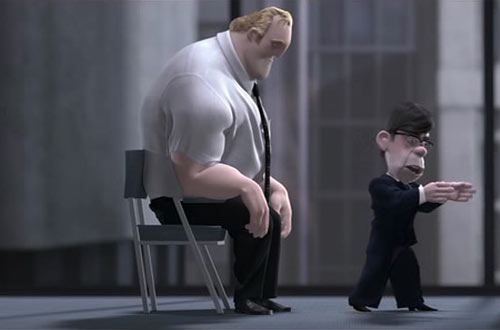
This is my dedication to the creative team behind Pixar’s movie The Incredibles. I loved the depth of the world, the buildings, the gadgets and most of all I loved the chairs.
The Kobe/Shaq clip is worth a closer look because although the NBA picked this clip because it represents a dramatic moment in the NBA playoffs involving two of the best players in history on a storied team, what it actually shows is how dysfunctional Shaq and Kobe’s relationship was even then, in their first championship season.
Bryant creates 95% of the offense here by crossing Pippen over and throwing a perfect lob to O’Neal. O’Neal throws it down and the camera follows him as he heads down the court yelling in celebration, totally blowing right past Kobe, who has his hand out to high-five Shaq. Kobe half-heartedly grabs at O’Neal’s forearm as he passes; Shaq doesn’t even notice. From his celebration, you’d think Shaq had made an amazing play, but Kobe made that whole thing happen. And if you look at the box score for the game, it was clearly Bryant’s game: he had 25 points, 11 rebounds, 7 assists, and 4 blocks to O’Neal’s 18/9/5/1.
The unedited clip of the play1 shows an awkward ending to this awkward moment. After celebrating with the Laker bench, Shaq looks for Kobe and the two finally acknowledge the play together. But it’s a brief moment; they slap hands and go their separate ways, foreshadowing Shaq’s departure four years later.
[1] What’s also striking about the clip is that it shows just how much Kobe has improved the mechanics of his game since then. Even though he makes a great play here, he’s still got those jittery feet that characterized his early career, at times looking like a dog skittering around on freshly polished linoleum. Any stuttering footwork is now long gone, replaced by the silkiest and smoothest of movement. ↩
By the time I was ready for the next shot, the darkening evening sky balanced the light somewhat. A 16mm focal length endowed the image with the depth I wanted and, combined with an f16 aperture, ideal depth of field. Waning light necessitated a one to two second exposure. Although blurred moving birds ruined most of the shots, they blocked direct light from the lanterns. I was making progress.
Perhaps even more interesting that Wolfe’s process is the fishing method employed by his subjects; they use birds, not nets or poles:
For centuries fishermen on the Li River of Southern China have partnered with cormorants to catch fish. Each fisherman has a complement of half a dozen or so trained birds. The light of a lantern attracts the fish, and the cormorants return to the boat, fish in beak. They can’t swallow them because the fisherman fix a band around their necks, but they eventually get their share.
You must, however, stop viewing carelessness, tardiness, helplessness, or any other quality better suited to a child as either charming or somehow beyond your control. A certain grace period for the development of basic consideration and self-sufficiency is assumed, but once you have turned 25, the grace period is over, and starring in a film in your head in which you walk the earth alone is no longer considered a valid lifestyle choice, but rather grounds for exclusion from social occasions.
The best advice: “Be interested so that you can be interesting.”
The New York Transit Museum has developed an extensive online version of their The Future Beneath Us exhibit, featuring eight NYC-area underground projects that are currently under development. The exhibit is on display in two Midtown locations until July 5. (thx, michael)
More than 35,000 people have downloaded Mr. Melvin’s file, North Korea Uncovered. It has grown to include thousands of tags in categories such as “nuclear issues” (alleged reactors, missile storage), dams (more than 1,200 countrywide) and restaurants (47). Its Wikipedia approach to spying shows how Soviet-style secrecy is facing a new challenge from the Internet’s power to unite a disparate community of busybodies.
“Here is one of the most closed countries in the world and yet, through this effort on the Internet by a bunch of strangers, the country’s visible secrets are being published,” says Martyn Williams, a Tokyo-based technology journalist who recently sent Mr. Melvin the locations of about 30 North Korean lighthouses.
American teenagers sent and received an average of 2,272 text messages per month in the fourth quarter of 2008, according to the Nielsen Company — almost 80 messages a day, more than double the average of a year earlier.
I went over on my 200 messages plan for the first time last month. In other news, I am fucking old and get off my lawn, you damn kids!
I don’t seek people out, I am terrible at striking up conversations with strangers and I am happy exploring a strange city alone. I don’t seek out political discourse with opinionated cab drivers or boozy bonding with locals over beers into the wee hours. By the time the hours get wee, I’m usually in bed in my hotel room, appreciating local color TV. (So sue me, but I contend that television is a valid reflection of a society.)
Thank ye to JNSoftware, this week’s kottke.org RSS sponsor. They make software for the Mac and iPhone. Their main app is Dialectic, a scriptable phone tool that helps you wrangle your various phones, accounts, and address books into one place. It works with landlines, mobiles, Skype, Google Voice, Vonage, and many others and integrates with all sorts of apps like Entourage and Address Book.
Keller showcases dishes that can be made every day (and not just for special occasions). Invaluable lessons, secrets, tips and tricks — as well as charming personal anecdotes — accompany recipes for such classics as the best fried chicken, beef Stroganoff, roasted spring leg of lamb, hamburger, the crispiest fried fish, chicken soup with dumplings, potato hash with bacon and melted onions, and superlative grilled cheese sandwiches, apple fritters, buttermilk biscuits, relishes and pickles, cherry pie — 200 recipes in all.
It’s due November 1. Ruhlman, did you have a hand in this one?
Usually when you belong to some kind of ad network, you’re eventually asked to pester your readers with some sort of survey that attempts to gauge what sorts of eyeballs are reading your site. The Deck has never asked me to do this and still hasn’t…but I ran across The Deck Ad Network Readership Survey on SimpleBits this morning and if I were you, I completely wouldn’t mind taking it. The survey questions include:
7. If you were to become romantically involved with a typeface, which one would it be? 15. Where are you, emotionally speaking? 24. What would you say is your greatest weakness?
He said the aggregate power of distributed human activity will trump centralized control. His main point was that Google, and other search engines that analyze the Web and links, are much less useful than a (theoretical) search engine that knows not what people have linked to (as Google does), but rather what pages are open on people’s browsers at the moment that people are searching. “All the problems of search would be solved if search relevance was ranked by what browsers were displaying,” he said.
I like that idea a lot, but it got me thinking: how many instances of Firefox can you run on a cheapo LInux box, how many tabs could you have open in each of those browsers, and would that be more or less cost effective than the search term gaming that currently happens? In other words, good luck with that!
The Hudson’s main current has, for all of recorded history, clung to lower Manhattan’s edge, skimming along the West Side. Battery Park City, built in the seventies, juts out into that flow, and since then, the current has been cutting a new channel, out toward the center of the river. That current is scraping mud off the top of the Lincoln Tunnel where it never did before; the underwater traffic tubes have lost 25 percent of their soil coverage in some spots. If the tubes ever became exposed, they would be at risk for shifting, cracking, and terrorist threats.
Infinite Summer: on online book club which means to read Infinite Jest this summer.
You’ve been meaning to do it for over a decade. Now join endurance bibliophiles from around the web as we tackle and comment upon David Foster Wallace’s masterwork, June 21st to September 22nd. A thousand pages ÷ 93 days = 75 pages a week. No sweat.
medical attache, annular fusion, entertainment cartridge, improbably deformed, howling fantods, feral hamsters, dawn drills, tough nun, professional conversationalist, new bong, ceiling bulged, metro boston, tennis academy, red leather coat, soupe aux pois, red beanie, addicted man, magnetic video, littler kids, little rotter, technical interview, police lock, oral narcotics, sober time, veiled girl
So many of our grandparents were racist, and some of our parents are homophobes. Which of our own closely held beliefs will our own children and grandchildren by appalled by?
That drugs were illegal Eating meat Monogamy (or anti-polygamy) Imprisonment vs. rehabilitation
Attitudes about human treatment of animals is something that will likely change in my lifetime. At some point domestication and consumption will move from something that we do because our ancestors did to something that just doesn’t fit into modern society. In a cultural sense, humans don’t belong to the animal kingdom anymore; we’re not normal predators that need to kill animals to survive. Soon we’ll have the technology to grow enough meat in factories to satisfy even the most hardcore meat-eaters. Once this happens, it will be difficult to justify the continued imprisionment and slaughter of cows, pigs, chickens, and the like simply so that we can eat what we like rather than what we need to survive.
RunPee is quite possibly the GREATEST MOVIE WEB SITE EVER. It tells you the best time to run to the bathroom during a movie and what happened while you were gone. Star Trek has four available times, the first of which starts when Captain Pike leaves the bridge for Nero’s ship.
The protection theory, Dr. Jernigan explained, is that from 1918 to 1957, all circulating seasonal type-A flus were weakened descendants of the 1918 Spanish flu, which was an H1N1, as the current swine is. […] Then in 1957, an H2N2, the Asian flu, emerged and displaced it. It was replaced in 1968 by the H3N2, called Hong Kong flu, which has persisted as a seasonal strain. A different and milder H1N1 emerged in 1977. It was isolated in China but is called the Russian flu because of a suspicion it escaped from a Soviet laboratory. That H1N1, the 1968 H3N2 and a B strain have all circulated in humans ever since, and the seasonal flu shot is aimed at them.
Jonah Lehrer, who is seemingly in a race with Michael Lewis these days to see who can write the most books and articles in a 12-month period, writes about self-control in the New Yorker…what it is, how it works, and how it affects things like achievement, happiness, etc. The article focuses on the efforts of Dr. Walter Mischel and the marshmallow test that he developed to measure self-control in young kids. With the marshmallow test, kids are given a mashmallow and they are told that they can eat it right away or, if they hold out, they can eat two marshmallows.
Once Mischel began analyzing the results, he noticed that low delayers, the children who rang the bell quickly, seemed more likely to have behavioral problems, both in school and at home. They got lower S.A.T. scores. They struggled in stressful situations, often had trouble paying attention, and found it difficult to maintain friendships. The child who could wait fifteen minutes had an S.A.T. score that was, on average, two hundred and ten points higher than that of the kid who could wait only thirty seconds.
I must have really underachieved on the SAT because as a four-year-old, I would have likely waited forever…I don’t like marshmallows.
[Kerouac’s game charted] the exploits of made-up players like Wino Love, Warby Pepper, Heinie Twiett, Phegus Cody and Zagg Parker, who toiled on imaginary teams named either for cars (the Pittsburgh Plymouths and New York Chevvies, for example) or for colors (the Boston Grays and Cincinnati Blacks).
He collected their stats, analyzed their performances and, as a teenager, when he played most ardently, wrote about them in homemade newsletters and broadsides. He even covered financial news and imaginary contract disputes. During those same teenage years, he also ran a fantasy horse-racing circuit, complete with illustrated tout sheets and racing reports. He created imaginary owners, imaginary jockeys, imaginary track conditions.
One advantage of using larger formats is that the process is slower. It takes time to set up the camera. It takes time to visualize what you want.
When doing portraits, it enables the photographer to talk and listen to subjects, to observe their behavior. A camera can trap a photographer sometimes. You can look so intently through a viewfinder that you are unaware of the picture in front of you. When I use an 8-by-10 camera for portraits, I will compose the picture and step back. Using a long cable release, I will look at the subject and wait for the moment. It’s very liberating.
RV shifts are how the vast majority of extrasolar worlds have been discovered, but only because these planets, called “hot Jupiters,” are extremely massive and in hellishly close orbits around their stars. Their stellar wobbles are measurable in meters per second; seeing the much smaller centimeters-per-second wobble of an Earth twin is orders of magnitude more difficult. For the Alpha Centauri system, the feat is akin to detecting a bacterium orbiting a meter from a sand grain-from a distance of 10 kilometers. But by devoting hundreds of nights of telescope time to collecting hundreds of thousands of individual observations of just these two stars, Fischer believes she can eventually distill the faint RV signal of any Earth-like planets. It’s simply a matter of statistics and brute force. The planets wouldn’t reveal themselves as images in a telescope, but as steadily strengthening probabilistic peaks.





Socials & More