Entries for September 2007
A Seymour Hersh piece from tomorrow’s New Yorker about the Bush Administration’s plan for Iran. Amazingly enough, Bush is using the same tactics he did to wage war in Iraq. This time, instead of Iraq = Al-Qaeda, it’s Iran = Iraq.
In a series of public statements in recent months, President Bush and members of his Administration have redefined the war in Iraq, to an increasing degree, as a strategic battle between the United States and Iran. “Shia extremists, backed by Iran, are training Iraqis to carry out attacks on our forces and the Iraqi people,” Bush told the national convention of the American Legion in August. “The attacks on our bases and our troops by Iranian-supplied munitions have increased… The Iranian regime must halt these actions. And, until it does, I will take actions necessary to protect our troops.” He then concluded, to applause, “I have authorized our military commanders in Iraq to confront Tehran’s murderous activities.”
Will we fall for it again?
Radiohead has a new album coming out called In Rainbows. It’s only available from their site for now, either as a download (released Oct 10) or as a “discbox” that includes the CD, a bonus CD, two records, and assorted photos, books, etc. (released Dec 3). (via rex)
Update: Also, Radiohead is letting the buyer choose his/own price for the online album. This has been done before, notably by Magnatune, who offers albums for between $5 and $18 with a recommended price of $8…and people often pay more than the recommended. (thx, greg)
Update: Singer Jane Siberry does variable pricing for her music as well. Siberry also cleverly lists what other people are paying (currently $1.18 per song, a bit more than the recommended $0.99). Freakonomics explains. (thx, phil)
The line of succession to the British Throne, which has on it 1286 members. AKA, the thing you should show someone should they ask you the definition of “thorough”.
For the past few months, I’ve been closely following the activities of FFFFOUND!, a social bookmarking web site and one of my favorite finds of the past year. The technology and presentation are fairly straightforward. Site participants select images to bookmark and the images show up on the site along with the related URL. Users can also bookmark images that other users have already bookmarked, which creates connections between images and users, allowing FFFFOUND!’s software to build recommendation lists (e.g. if you like this image, you may also like…). And then people like me who aren’t participants can just sit back and view people’s image streams. Mike Migurski wrote a nice introduction to the site and its capabilities back in July.
But the thing that makes the site work is that the current participants have really good taste in imagery. The project appears to have been started by Yugo Nakamura, who old school web folks may remember as one of the first true Flash artist wizards (see Mona Lisa matrix, MONO*crafts, and Industrious Clock, for example), and has expanded slowly while in beta; each participant gets only a single invite to pass along. The site’s slow expansion from Nakamura and a small group of his art/design pals & associates has kept the quality high and focused. I hope the quality can remain high as the site gains in popularity and weathers the eventual opening up of participation to the web at large.
PS. I know you’re probably just supposed to pronounce it like “found” but I’ve been favoring “fuh-fuh-fuh-found”, even though that doesn’t exactly roll off the tongue.
Update: I do not have any invitations for FFFFOUND! Sorry.
The story about how drummer and web designer Mark Robohm completely renovated his Chelsea studio for only $11,600 is both inspirational and hilarious.
Ms. Doucette found Mr. Robohm’s office chair on Park Avenue. Before taking it, she called him up to describe it. “I asked her what the name was and she said, ‘Herman Miller,’” Mr. Robohm said. “I was like, ‘Grab that chair and run for your life.’”
The audio slideshow is worth a look as well.
Errol Morris writes several hundred words about two iconic photos taken by Roger Fenton during the Crimean War, during which he explores the interplay between “clear” evidence and the interpretation of that evidence by people with different agendas and ideas.
As I’ve said elsewhere: Nothing is so obvious that it’s obvious. When someone says that something is obvious, it seems almost certain that it is anything but obvious - even to them. The use of the word “obvious” indicates the absence of a logical argument - an attempt to convince the reader by asserting the truth of something by saying it a little louder.
This might be the best blog post I’ve ever read. I can’t wait to see Standard Operating Procedure, Morris’ upcoming documentary on Abu Ghraib and, from what it sounds like, the culmination of his exploration of truth in photography.
Look, I know it’s Friday you’re just looking for some fun stuff to end the work week with, but we’ve got a pressing matter to discuss. Let’s say you’re a new father and a movie fan. When your child is of an appropriate age to start watching movies, in which order will you show him/her the six Star Wars movies? By original release date (Star Wars, Empire, Jedi, Phantom Menace, Clones, Sith) or according to the intra-movie chronology (Phantom Menace, Clones, Sith, Star Wars, Empire, Jedi)?
We’re currently leaning toward by original release date, but I can see the advantages of the other way around too. At dinner the other night, a friend asserted that not only was original release date the way to go, but that viewing the original versions on VHS was essential as well. I believe the relevant tapes and a cheapo VCR have been stashed away for this purpose already.
What do you think? How would you approach this? (thx to rehan for the suggested topic)
Amazon just sent me an email about my preorder of The Wire season 4 DVD. They say the shipping date has slipped a little, but the page still says it’ll be out on Dec 4. Anyway, they made me verify the “change”; if I hadn’t, they would have canceled the order, which seems a less-than-optimal solution to the problem. If you preordered, you might want to watch your inbox.
I’m loving the new 1.1.1 update to the iPhone. Best new features for me: the double-tap of the Home button to go to your address book favorites (first suggested by Steven Johnson shortly after the phone’s introduction) and more alert ringtone choices for when a new text message comes in. I still wish I could set that alert volume independently from the main ringtone volume, but this is a good start…I’ll be able to hear my texts coming in again.
Fritz Kahn’s Man As Industrial Palace.
Kahn’s modernist visualization of the digestive and respiratory system as “industrial palace,” really a chemical plant, was conceived in a period when the German chemical industry was the world’s most advanced.
Be sure to check out the larger version.
I’m thoroughly enjoying Kanye West’s new album, Graduation. Standout tracks so far: Stronger and Homecoming, although it took me much longer than it should have to recognize Chris Martin’s vocals on the latter.
I love the idea of conservation of concentration conveyed in this piece about Roger Federer, that we’ve got only so much intense focus to go around and successful athletes like Federer are really good at saving it up for the big moments.
A couple of times during press conferences, I noticed something kind of interesting about Roger Federer. I’ll get to it in a minute, but let me describe the scene first. Players enter Interview Room One, where all of the Rajah’s pressers take place, at the corner diagonally opposite from where the players enter. The players come in and turn right, to take their seat behind the microphone on the little dais or stage. Most players look to their left as they enter, just gauging the room and who is in it and how full it is. Federer, though, always keeps his head down and eyes averted, until he sits and begins to answer questions, when he makes direct eye contact with each questioner.
Anyway, a couple of times during his press conferences, someone’s cell phone went off, each time with an annoyingly loud ring tone. Both times, everyone turned, first to locate and then to glare at the culprit: have you no shame? And both times, I noticed, Roger kept his eyes locked on his interlocutor, never glancing in the direction of the phone. I’m sure he was conscious, on one level, that there was an interruption occurring, but he had decided to ignore it. Not even a darting of the eyes towards the irritant. Both coming in the room with his head down and refusing to allow himself to be distracted or interrupted seemed to convey the same thing: he chooses to focus selectively, and focuses intensely once he does.
It was difficult to keep the quoting down to those two paragraphs…just go read the whole thing. (And of course, this ties into my continuing fascination with relaxed concentration and the battle with the self as the true struggle in life.)
Not sure why Mas warranted so many negative comments on this Chowhound thread about the worst nice restaurants in NYC. We were there last night for my birthday and everything was great: service, wine, and food. It was our 5th or 6th visit over the past 3 years and nothing’s ever been amiss.
Mesmerizing video of basketball dribbling drills (with two balls at a time). Be sure to keep the volume on…the sound of 12 basketballs intensely bouncing is an odd one. (via truehoop)
Hotel Chevalier, the short film by Wes Anderson that takes place before the action in The Darjeeling Limited, is available at the iTunes Music Store for free.
Is lazy reporting hurting the visual arts? Jonathan Jones argues that almost all reporting about art takes one of six forms: expensive art, graffiti, plagiarism, earth-shattering discoveries, and restoration. Looking back through kottke.org’s art tag page, I am guilty of linking to stories of all those types. Eep.
Without the associated covers, this list of the AIGA’s 50 Books/50 Covers winners for “outstanding book and book cover design produced in 2006” is pretty useless. (Anyone want to track all of these covers down? I’ll host (or link to) the results on kottke.org.)
Update: Photos of the covers and books are all available on the AIGA Design Archives site. No permalink tho. :( (thx, tbit)
The Guardian has been collecting the best interviews from the past century. Interviewees include John Lennon, Marlon Brando, Adolf Hitler, and Marilyn Monroe. An impressive trove.
Dr. Jay Parkinson M.D. emailed in to tell me about his new medical practice in Williamsburg. He’s got no office (housecalls only), takes appointment requests via SMS, email, or IM, handles some follow-ups over video chat, and specializes in the 18-40 age group without traditional health insurance. The goal, states Parkinson, is to “mix the service of an old-time, small town doctor with the latest technology to keep you and your bank account healthy”.
To give you an idea of how the practice operates, here’s a recap of his first day on the job:
Yesterday went quite well and I was very happy with the amount of money I kept out of the hands of companies that attempt to take advantage of how difficult it is to find prices for medications and healthcare services. For example, the first patient I saw needed a medication that Walgreens offered for $60. I called my tried and true Williamsburg mom-and-pop pharmacy only a few blocks from Walgreens and talked to Arthur the Pharmacist who said he sells it for $15. “Thanks Arthur.” “No thank you Jay.” The way it should be done.
My second patient was getting a certain medication for years every month by mail from Walgreens that costs $63 per month. I knew where she could get the same medication for $42 a month. I just saved her $252 per year. After she made her $200 down payment on my services via PayPal, her monthly fee for my services is now only $17 a month. But I just saved her $21 a month on her monthly mail order medication. She’s essentially getting the rest of the year of my services for free. Not bad.
Sounds fantastic. If only every doctor was this much of an advocate for his patients.
P.S. Parkinson also happens to be a heck of a photographer (@ Flickr). Some photos NSFW. I linked to this interview about his photography between him and Joerg Colberg last May.
Update: The WSJ Health blog has a short interview with Parkinson, followed by a lengthy comment thread.
Psychology Today talks with psychologist Robert Epstein about his book, The Case Against Adolescence:
In every mammalian species, immediately upon reaching puberty, animals function as adults, often having offspring. We call our offspring “children” well past puberty. The trend started a hundred years ago and now extends childhood well into the 20s. The age at which Americans reach adulthood is increasing — 30 is the new 20 — and most Americans now believe a person isn’t an adult until age 26.
The whole culture collaborates in artificially extending childhood, primarily through the school system and restrictions on labor. The two systems evolved together in the late 19th-century; the advocates of compulsory-education laws also pushed for child-labor laws, restricting the ways young people could work, in part to protect them from the abuses of the new factories. The juvenile justice system came into being at the same time. All of these systems isolate teens from adults, often in problematic ways.
Epstein says the infantilization of adolescents creates a lot of conflict and isolation on both sides of the divide. Over at Marginal Revolution, economist Tyler Cowen adds:
The problem, of course, is that a contemporary wise and moderate 33 year old is looking to climb the career ladder, find a mate, or raise his babies. He doesn’t have a great desire to educate unruly fifteen year olds and indeed he can insulate himself from them almost completely. He doesn’t need a teenager to carry his net on the elephant hunt. Efficient capitalist production and rising wage rates lead to an increased sorting by age and the moral education of teens takes a hit.
You can read the first chapter of the book at The Radical Academy.
Update: Bryan writes to recommend Neil Postman’s The Disappearance of Childhood, saying that “Postman argues that the idea of childhood is a cultural phenomena that comes and goes through the ages”. (thx, bryan)
Speaking of Weegee, I stumbled across some photos he made based on his well-known portrait of Marilyn Monroe.
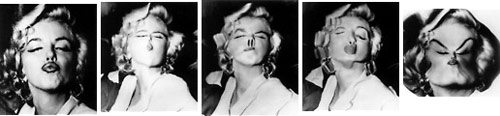
He created the funhouse photos by manipulating negatives and distorting the light falling on the photographic paper from the enlarger. They remind me of images captured by OS X’s Photo Booth with the distortion filters on.

(Photo credits, L to R: Blueberry Pony, Spullara, Winstonavich, Thelastminute, Mysistersabarista)
In the 1970s, Japanese photograhper Kohei Yoshiyuki stumbled upon a couple in a park engaged in sexual activity in the darkness and, somewhat more curiously, two men creeping towards the couple, watching them. Over many months, he followed these voyeurs in the park, befriended them, and outfitted his camera with an infrared flash so as to blend into the crowded darkness. The result is a fantastic series of photos called The Park. As you can see in the photo below, Yoshiyuki even caught some of the peeping toms touching their “visual prey”.
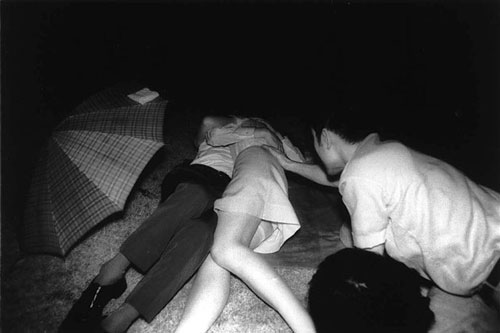
Yoshiyuki’s photographs explore the boundaries of privacy, an increasingly rare commodity. Ironically, we may reluctantly accommodate ourselves to being watched at the A.T.M., the airport, in stores, but our appetite for observing people in extremely personal circumstances doesn’t seem to wane.
The NY Times has an audio slideshow of some images from The Park, which is on display at the Yossi Milo gallery in NYC until October 20 (more photos). A book of Yoshiyuki’s photography is available at Amazon.
The Times article mentions several photographers whose work is similar to Yoshiyuki’s. Merry Alpern took photographs through a window of prostitutes plying their trade with Wall Street businessmen. Weegee used an infrared flash to capture kissing couples at the movie theater (although it seems that particular shot was staged) and on the beach at Coney Island (last photo here). Walker Evans photographed people on the subway without their knowledge.
Amazon has launched their mp3 music store. Files are in mp3 format, no DRM, high bitrate (high quality), and songs are mostly 89-99 cents. A compelling alternative to Apple’s iTMS.
As part of a 2006 Shuttle mission, researchers sent salmonella germs into space to see how they were affected. The result: 167 genes changed in the salmonella during the short trip and “mice fed the space germs were three times more likely to get sick and died quicker than others fed identical germs that had remained behind on Earth.” Holy crap!
Jane Jacobs and the Future of New York is an exhibition at The Municipal Art Society of New York.
Coming at a time of unprecedented growth and redevelopment in the city, this exhibit aims to encourage New Yorkers to observe the city closely and to empower them, with a combination of tools and resources, to take an active role in advocating for a more livable city.
The exhibit runs from Sept 25 through Jan 5, 2008.
Update: A review of the exhibition in the NY Times (slideshow). Among the artifacts at the show is a letter sent by Robert Moses to Jacobs’ publisher: “I am returning the book you sent me. Aside from the fact that it is intemperate and inaccurate, it is also libelous.”
A subjective list — is there any other kind? — of the top 10 issues of McSweeney’s magazine.
New York magazine takes Wes Anderson’s spiritual temperature on the eve of the release of The Darjeeling Limited, his fifth film.
That we happen to be traveling by train to discuss a movie that takes place on a train was not part of the original plan, though I’m starting to think of it as yet another example of Anderson’s knack for retouching reality with an idiosyncratic gloss. (It may be connected to his fear of flying as well; until recently, Anderson traveled to Europe by boat, and he far prefers trains and automobiles to anything airborne.) Also somewhat peculiar is the fact that buried in one of Anderson’s monogrammed suitcases is 10,000 euros in cash — about $14,000 — an amount that may or may not be legal to carry, and that was given to the director by Bill Murray, who asked that the money be “delivered to Luigi.”
The 2007 batch of MacArthur Fellows (AKA the $500,000 genius grantees) includes tinkerer Saul Griffith. Tim O’Reilly has written a long appreciation of Saul and his projects.
Vanilla-tini (vanilla vodka)
Espresso-tini (coffee liqueur + espresso)
Key Lime-tini (key lime)
Valen-tini (tequila rose)
Pome-tini (pomegranate)
Raspberry-tini (raspberry)
Nutty-tini (amaretto + hazelnut liqueur)
Crescendo-tini (at the orchestra)
Moe-tini (at Moe’s Restaurant)
Franklin-tini (for Ben Franklin’s 300th birthday)
Tut-tini (King Tut exhibition)
Mex-tini (orange vodka + tequila)
Ginger-tini (grapefruit + ginger + pomegranate)
Spa-tini (at the spa)
Blue Glow-tini (with glowing ice cubes)
Free-tini (no charge)
Champagne-tini (champagne)
Pineapple-tini (pineapple)
Sex-tini (Asian sex tonic + x-rated vodka)
Flu-tini (vodka + cold medicine)
Apple-tini (apple)
Red Lobster Butter-Tini (butterscotch schnapps + half and half + Bailey’s)
Bikini-tini (low calorie)
Fire-tini (jalapenos)
K-tini (sauerkraut)
Caramel Apple Pie-tini (applesauce + caramel syrup)
Red Hot Santa-tini (chili peppers + whipped cream)
Fall-tini (apple cider)
Insomnia-tini (energy drink)
Jello-tini (lime Jello)
Peep-tini (Peeps candy)
Diamond-tini (1.06 carat diamond)
Influential Italian filmmaker Michelangelo Antonioni listens to the sounds of Manhattan waking up in the morning. “The sheets of metal. A short clatter, like gunfire. A train passes, perhaps the elevated. A peal, prolonged, and then the siren, abrupt. Gone. The sounds change in a moment, they arise and die again immediately. The hum reasserts itself, advancing like a camouflaged army, approaches, closes in, on the alert, ready to take over completely.” The hum reasserts. I hear that one all the time as traffic ebbs and flows outside our apartment.
Remember the Transformers movie from this summer? Those were fun times. Here’s a letter to Optimus Prime from his Geico auto insurance agent. “Mr. Prime, I am going to remind you again: Your policy with GEICO only reimburses you for accidents that occur while you are engaged in the reasonable use of your truck and trailer. As I told you when you originally purchased the policy, GEICO does not offer Megatron coverage, Starscream coverage, Soundwave coverage, Decepticon coverage, or Energon-blast coverage. Those are just not the types of damages we would expect from reasonable use.”
The Lonely Candidate blog is tracking political candidates who attempt to differentiate themselves from their opposition by claiming things like “I am the only candidate with the experience to get things done for our community”.
What is the world’s longest novel? Richard Grossman has been working on a novel for over 35 years and its currently 3 million pages long; he’s planning on printing just 6 copies of the book, each of which will comprise 4000 750-page volumes.
After a complaint that the photos on Flickr are “just all conventional, it’s all cliches, it’s just one visual convention after another”, Alec Soth asks where all the good photos are and gets a bunch of responses.
Lampoon of an hilariously crappy maintenance request web app at University of Pennsylvania.
Yes, I know that it says “Search Criteria Required!” at the top of the screen, in red letters, with an exclamation point. But that’s just to fool you into thinking that search criteria are required. In fact, the only thing that’s required (or even permitted!) for you to do at this point is to click on the large button labelled “Insert” at the top of the page.
Anagram menu items:
Roast taros.
Broccoli rabe with cool crab brie.
A steak and skate duo.
Melon and lemon sorbet.
Legendary mime Marcel Marceau died Saturday at age 84.
Michael Jackson borrowed his famous “moonwalk” from a Marceau sketch, “Walking Against the Wind.”
I tried to find video of that sketch but came up empty.
Update: Here’s some video of Marceau teaching wind walking to a class…and miming with Michael Jackson. (thx, andy & mike)
Update: Here’s a better video of Marceau doing his wind walk, from a Mel Brooks movie no less. (thx, manuel)
Teaser trailer for Alinea’s cookbook, which is due out in Autumn 2008 and will contain 600 recipes. Pre-orders through the site will get signed copies and early access to a companion web site which will contain more recipes, demo videos, and behind the scenes videos. I’m really appreciating the effort these top chefs and restaurants make to open source their recipes and process…it sounds like between the book and web site, one could open a restaurant serving Alinea’s menu. (Whether that restaurant would be successful or not would depend mostly on the 90% of the stuff involved with running a restaurant that doesn’t rely on the ability to read a cookbook.)
Update: Jason Fried says businesses could learn a lot from chefs giving their secrets away.
In a short post yesterday about where writers do their business, I mentioned that Witold Rybczynski had written about the writing room of a famous author that was purposely set away from the rest of his house. I grabbed my copy of The Most Beautiful House in the World off the shelf just now and found that I’d turned down the page containing the relevant passage back when I read the book a few years ago. The author I was thinking of was George Bernard Shaw; here is Rybczynski’s description of his writing room:
But Shaw too was a builder, and the writing room that he erected in his garden was a Shavian combination of simplicity, convenience, and novelty. He called it “the Shelter,” but it was really a shed, only eight feet square. It contained the essentials of the writer’s trade — a plank desk, an electric lamp, a wicker chair, a bookcase, and a wastepaper basket. Beside the desk was a shelf for his Remington portable — like [Samuel] Clemens, Shaw was an early amateur of the typewriter. There was also a telephone (modified to refuse incoming calls), a thermometer, and an alarm clock (to remind him when it was time for lunch).
Shaw’s writing hut had one other curious feature: the entire building was mounted on a pipe so that it could be rotated to take advantage of the sun’s warmth at different times of the day. But the tiny building was so loaded down with books and furniture that the feature was probably never used. Pictures and more on Shaw’s writing hut at BBC News, the National Trust, and Cool Tools.
Rybczynski also mentions that Samuel Clemens wrote most often in a hilltop gazebo he’d constructed for that purpose away from his luxurious house..
Some recent research on the wrist bones of the so-called hobbit skeleton suggests that Flores man is an ancestor of modern humans and not just diseased homo sapiens. The debate continues. (via npr)
Raul Gutierrez tells a great NYC story about his late night adventure with a bunch of strangers.
After a few minutes a very tall girl with long brown hair who I would later learn was a Parsons design student, broke social convention, turned to her fellow benchmates, and said, “My God, wasn’t today beautiful.” At first she just got a few quiet affirmations,”yeah, gorgeous”, “best day yet” etc, but then a young woman in a business suit again broke social convention and revealed personal information: “It was so nice, when I woke up I decided I didn’t want to feel miserable about anything, and broke up with my boyfriend. I ditched him at 7:30 in the morning. He didn’t know what hit him.”
Older posts





Socials & More