kottke.org posts about video
For CBS News in 1985, Charles Kuralt profiled bike messenger David Leopold.
I don’t go slow. I don’t stop for red lights. I go against traffic. I disobey every traffic law there is.
Great street footage of NYC from 40 years ago. You might think that Leopold ended up as a stain on the pavement. In 2010, CBS News did a follow-up on him:
See also Leopold on David Letterman from 1985.
Ambient Earth is a 7.5-hour, real-time, 4K, remastered video of the orbital view from the International Space Station. Seán Doran took almost 49,000 images from 27 time-lapse sequences captured from the ISS by astronaut Butch Wilmore, repaired, remastered, and interpolated them into this incredible video.
Perspective is lost when the world speeds by. The scale and beauty of our home planet is truly appreciated when observed on an epic 7.5 hour journey from The International Space Station. This ambitious 4k compilation, crafted through months of meticulous restoration, invites you to slow down and experience Earth in real time just as astronauts do.
The video is accompanied by ambient audio recorded on the station by Chris Hadfield. This would be great for a screensaver, but after poking around for a bit, it doesn’t seem like there’s a good way to set a YT video as a screensaver on MacOS (without downloading it or having it be a livestream).
Perfect Play ran over 300 million games of Monopoly to determine the best strategy and the most common mistakes players make.
I turned eight classic Monopoly strategies into computer players and made them play 312,898,560 games against each other. At a table of four, the best one won 43% of its games. The worst one won 3%.
The gap doesn’t come from one clever trick. It comes from four common mistakes: being picky about what you buy, saving your cash, stopping at three houses, and refusing to trade. Then I let the computer tune every habit at once, to see how far a carefully tuned player can go and which color set is really worth fighting for.
P.S. I don’t actually play Monopoly anymore — it is the world’s most maddening game (along with Sorry) and I childishly refer to it as “Monotony” — and an aside about 3 minutes into the video is why: “roughly one game in six never ends”. Exactly! And you want me to haggle? For fun? No thank you. I imagine there are folks whose idea of a good time is visiting used car dealerships for funsies when they don’t need a car, but I am not one of them.
See also How to Win at Monopoly and Piss Off Your Friends.
This workshop founded in 1882 still makes dried bonito like they did back in the Edo period.
How katsuobushi — Japanese dried bonito, said to be the world’s hardest food — is made in Nishi-Izu, Japan. Inside Kanesa Katsuobushi Shoten, a workshop founded in 1882, 5th-generation craftsman Yasuhisa Serizawa still uses the 200-year-old “tebiyama” hand-fired smoke-drying method that only a few workshops in Japan preserve. Watch fresh bonito being filleted and boiled for 90 minutes, smoke-dried more than 10 times over a hand-tended wood fire, repaired with bonito paste, fermented with koji mold and sun-dried for months — over half a year until the fish becomes as hard as wood and shines like a jewel. From fresh catch to katsuobushi.
Check out Kanesa Katsuobushi Shoten’s website for more info; here’s what they say about the tebiyama drying/smoking method (Google translation):
This method of making dried bonito flakes has been used in the Tago district of West Izu for a long time, and its history is said to date back about 300 years (to the Edo period). It involves digging a vertical hole about 2 meters deep, burning firewood (raw wood from Izu: oak, sawtooth oak, cherry, etc.) from the bottom of the hole, and smoking and drying the dried bonito flakes with the high temperature of an open flame. This method is called the Tebiyama-shiki smoking method. It is the oldest existing smoking method, and only a few bonito flake manufacturers in the country continue to use this method to make dried bonito flakes, so it is said to be a legendary method. The Tebiyama-shiki smoking method is said to produce dried bonito flakes with a rich flavor because the surface of the bonito is smoked all at once with the high temperature of an open flame, locking in the umami.
(thx, caroline)
This is really impressive: a software engineer got a Game Boy emulator running at 30 fps on a tiny e-ink screen.
If you’re familiar with e-paper, you know that they normally refresh much slower (2-3 times a second), not nearly quick enough to play even a simple video game. This guy wrote his own display driver that got the refresh rate up to 30 times per second. From the transcript of the video explaining how e-paper works and how he hacked the display to make it play games:
Unlike conventional displays like LCD or OLED, ePaper stores its image physically using charged black and white pigment particles. By changing the electric field, the display moves the pigments towards or away from the surface, which in the end gives us black- or white-looking pixel. And usually a sequence of several electrical pulses called a waveform is needed to move the pigment back and forth, before finally driving it towards the new image. This helps produce a clean result without leaving too much of the previous image behind. But this takes a lot of time.
The project is open source — you can get the plans and code on GitHub. This engineer was inspired by Wenting Zhang’s e-paper Game Boy emulator:
Zhang has also made a color e-ink display that runs at 60 fps. Very cool. (via yanko design)
I’d never heard of this before: in 1990, the BBC aired a program created by and starring Douglas Adams called Hyperland. It begins with a frustrated Adams throwing his TV out (too linear, too non-interactive) and Tom Baker (from Doctor Who) popping up as an intelligent interactive agent that promises to “do your every slightest bidding, to fetch and carry for you, to work tirelessly and selflessly on your behalf, always ready, always willing, no job too small or too menial”.
Circumventing the limitations of ‘linear’ broadcast TV, the 50-minute programme imagines a new world in which an AI software ‘agent’ - brought to life here by Doctor Who favourite Tom Baker - helps the user (played by Adams) to find and access material of interest in a global world of hyperlinked information - text, images, audio and video.
Pop-up ‘micons’ (moving icons) conveniently link to interviews with leading technologists of the era (among them Ted Nelson, Robert Winter, Robert Abel, Kristina Hooper, Fabrice Forin and Steve Gano).
Some of this stuff has dated badly - few visions of the future get everything right! - but the programme is nevertheless of considerable historical importance.
Incredibly, at about the time Hyperland was being broadcast, a young CERN computer scientist by the name of Tim Berners-Lee was beavering away on URLs and HTTP, the foundations of what would become the World Wide Web.
Even Adams, who foresaw so much, didn’t anticipate the impact the Web - and the Internet that conveys its data globally - would have on civilisation. Needless to say, the enticing infoworld envisaged in Hyperland was a public-service one of education, art, literature (including nods to Adams’ own works!) and entertainment. There’s no advertising, hacking, cybercrime, information theft, social-media addicts, unaccountable corporate domination or drug-like dependence on the smartphones that Adams himself predicted.
And Tom Baker’s enthusiastic agent isn’t forever popping up to try and sell you something…
The YouTube version above is missing a segment, but you can watch (and download) the whole program on the Internet Archive, a project that fits the vision of the future imagined by techno-utopians like Adams.
I’m imagining what 16-year-old Jason would have made of this (or HyperCard or hypertext had he had any clue that they existed until 4-5 years later) — his brain probably would have exploded.
This woman does some amazing things with a series of white rings — lots of precision optical illusions.
It’s mesmerizing watching people moving like machines — an interesting psychological thing. Like Avantgardey, which if you haven’t heard of them (just because they show up all the time on my Instagram doesn’t mean that happens for everyone), you should check them out:
(via @sevlu)
Diego Poncelet recently set a new world record for the fastest speed on a skateboard. The old record was 146.7 km/h (91.2 mph) and he hit 151.8 km/h (94.3 mph). There are a couple of parts you can skip, but watching most of the video is worth it because you see the process and can compare how truly insanely fast he is moving during the final run — I found myself holding my breath for the last minute or so.
Also, I cannot believe how closely the camera car is following him — looks like only a few feet away. Bonkers.
I just found the first time I posted about speed skateboarding on KDO: this post from 2008. Less aerodynamic, more gonzo, and the cameraman is also on a skateboard going equally fast.
A lovely little mountain biking video with some incredible locations and cinematography. The drone piloting is A+. Also available on Vimeo. (via alastair humphreys)
The great grey owl basically has a sound cone for a face, which helps it hunt down voles burrowing through snow in the winter.
The owl’s large facial ruff, formed of dense feathers, helps amplify sound and funnel it towards his ears. Through half a meter of snow, the sound of scampering feet is inaudible to us. But not to him. With the help of a special acoustic camera equipped with 60 highly sensitive microphones, we can see what the owl is hearing.
The footage in this video is amazing — and so is the owl’s sense of hearing. A YouTube commenter says “Cat software in Bird hardware. Bad news for the Rodents.” You can watch a short video on the science behind owl hunting techniques and watch the whole episode this is from about how animals use sound (but only in Canada, it seems…VPN works fine tho).
The only problem with this video is that now I want two hours of just closeup footage of the owl’s face and it flying directly towards the camera. Those eyes! And its mid-flight loaf-of-white-bread-shaped body! I would also like the owl to be my friend.
BTW, this clip is from a show called The Nature of Things, which is a CBC nature series that’s been going since 1960. A good thing to have on your radar if you’re looking for well-produced science & nature programs.
I 100% love this video of every time someone says a percentage on Star Trek: The Next Generation. And the word “percent” has lost all of its meaning due to semantic satiation. (thx, caroline)
This video from Practical Engineering was very illuminating to me, a naive person who thought there were only three types of electrical outlets used in the US — the two-prong, the three-prong, and the 240V — and not the real number, which is more than 35 types of electrical outlets! Oh and “two-prong”? Not that plug’s actual name! (via unsung)
It might be that this text-only quiz game from 1993 is the most challenging F1 video game of all time. Here are a couple of the 23 questions from Gerhard Berger’s Formula 1 Quiz:
3. Which team was the best in the 80’s?
Statistically, it’s McLaren, but that’s not a correct answer. The correct answer is “Mc Laren.”
4. Who is the youngest champion of ever?
The correct answer in 1993 was Emerson Fittipaldi, but his full name cannot be accepted because it contains too many characters for the computer. The game will not take “Fittipaldi,” “Emerson,” or “E Fittipaldi.” The answer must be “Fit.”
The real quiz, it soon becomes clear, is not a test of one’s F1 knowledge, but figuring out what the game expects to hear.
Berger is a former F1 driver, and the game is so weird and forgotten that it’s not even listed on his Wikipedia page — and it might not have been an official game at all. What is listed on his Wikipedia page is the epic prank war he waged against teammate Ayrton Senna:
In an Australian hotel room, Berger filled Senna’s bed with frogs. An infuriated Senna confronted Berger, who replied, “Did you find the snake?” Senna retaliated by putting strong-smelling French cheese in the air conditioning unit of Berger’s room.
It seems likely it was in this spirit that Gerhard Berger’s Formula 1 Quiz game was created: as a prank Berger himself would have enjoyed. You can play a cracked version of the C64 game for yourself on the Internet Archive (answer “N” and “N” if you want to play it in hard mode as intended) and watch this gameplay video:
Agustín Ferrando Trenchi became a little obsessed with the moon as a kid. As an adult, he’s taken tons of photos and hundreds of hours of footage of the moon. After seeing an airplane fly close to the moon while he filmed, Trenchi began a quest to capture a plane flying across the face of the moon.
Over the course of 10 years, he took photos and videos of birds and statues silhouetted by the moon, but planes eluded him.
I realized if I wanted to film this, I was going to have to try a different approach. It wasn’t just going to happen by accident. So in February of this year, taking advantage of being in London, I decided to go near one of the busiest airports in the world to maximize my odds as much as possible.
But while we were on our way, I had second thoughts. I felt like it took the fun out of it. It didn’t make sense to force it that much either. So we got off.
I’m not going to spoil the video, but the whole thing is just so lovely — a meditation on obsessions, journeys, and finding meaning in your life. (via virginia)
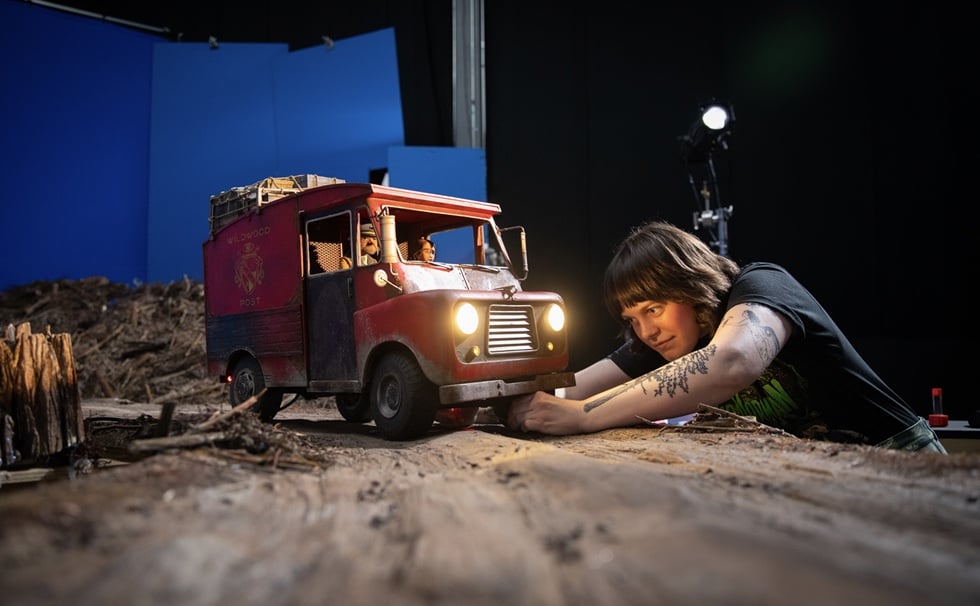
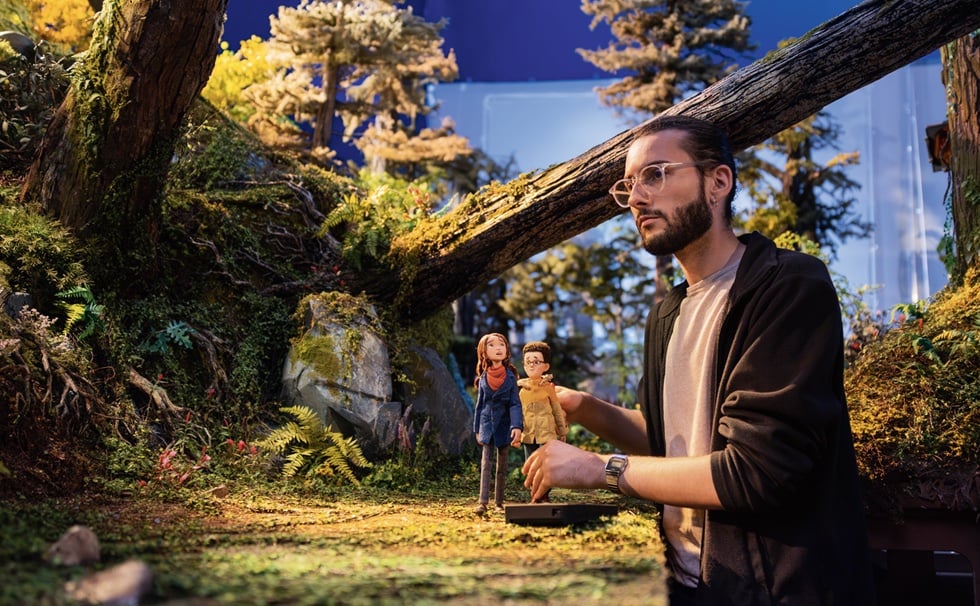
Laika is the stop-motion animation studio that made Coraline & Kubo and the Two Strings. Their newest film, Wildwood, looks pretty incredible; have a look at the trailer.
Creative Boom recently highlighted some of the process behind the film, which is heavily dependent on physical sets and puppets.
The man tasked with putting the show together was art director Matthew Maldonado, having spent five years designing and building Wildwood’s sets. So I asked him the million dollar question: how much of Wildwood is physical and how much is digital?
Matthew’s response is simple. “Every single thing was made by hand, truly,” he stresses. “And every single thing that we built was either shot in camera or referenced by our effects department. We’ve got some really wide, expansive locations and there’s some digital aspect to all of that. But if it wasn’t on camera, on stage, it’s a scanned asset or a reference asset, specifically made by the artisans in the art department.”
“The show” referenced in the quote above is Wildwood: The Exhibition, due to open soon at the Design Museum in London.
(via justin lind)
BBC Earth is returning to the ocean. 25 years after the first installment, the legendary naturalist, presenter, and centenarian David Attenborough narrates Blue Planet III. This first look video, backed by a song Hans Zimmer & Jade Thirwall, is teeming with stunning footage of sea life of all sorts.
Ed Yong called BPIII’s predecessor the best nature series ever:
Blue Planet II is the greatest nature series that the BBC has ever produced.
It is almost transcendentally good—the product of a team that, after six decades of experience, is now at the height of its powers. The Blue Planet II crew traveled to 39 countries to capture over 6,000 hours of footage. They stuck their cameras into coral crevices. They hung off speedboats to film dolphins rocketing behind them. They literally stared into the abyss—and then repeatedly entered it. The resulting episodes, each narrated by David Attenborough in his trademark velvety tones, are hour-long distillations of wonder, featuring sequences that would be breathtaking had earlier shots left you with any breath to take away.
Blue Planet III will air sometime later in the year in the UK; not so sure about timelines in other locations at this point.
Silent Friend is a historical drama written and directed by Hungarian filmmaker Ildikó Enyedi. Here’s the description:
In the botanical garden of a medieval German university, a ginkgo tree hundreds of years old watches its human neighbors through the slip-stream of time. Among them, a young woman in 1908 attempts to break through the botany department’s masculine academic culture; an idealistic couple in 1972 performs experiments on plant communication under its branches; and a neurologist on lockdown in 2020 turns to it as he tries to push the boundaries of perception.
It’s got a 94% rating on Rotten Tomatoes and some good reviews on Letterboxd, including this one from film reviewer David Ehrlich:
me before seeing this movie: that is a big tree.
me after seeing this movie: that is a giant, hormonal, unbearably horned up 900-year-old virgin that understands loneliness on a level that most humans could never even begin to imagine.
The trailer and description put me in mind of Peter Wohlleben’s The Hidden Life of Trees, The Overstory by Richard Powers, and Finding the Mother Tree by Suzanne Simard.
Back in ~2008, right on the cusp of stardom, Lady Gaga did a crate-digging video in a London record shop and named Radiohead’s set at Bonnaroo 2006 as her favorite show she’s ever been to. A post-fame Gaga reaffirmed her choice in this 2018 Vogue interview. Many share her opinion. Here’s the official concert video of that Bonnaroo show so you can judge for yourself.
The setlist for the show:
There There
2+2=5
15 Step
Weird Fishes/Arpeggi
Exit Music (For a Film)
Kid A
Dollars & Cents
Videotape
No Surprises
Paranoid Android
The Gloaming
The National Anthem
Climbing Up The Walls
Nude
Street Spirit (Fade Out)
The Bends
Myxomatosis
How To Disappear Completely
You And Whose Army?
Pyramid Song
Like Spinning Plates
Fake Plastic Trees
Bodysnatchers
Lucky
Idioteque
Karma Police
House of Cards
Everything In Its Right Place
Even the band loved it:
The lore surrounding this show is well-documented: It was among the longest live sets the band has ever played, both by duration (two hours and twenty minutes) and number of songs (29). It featured early, alternate arrangements of six unreleased tracks that would go on to anchor ‘In Rainbows’ the following year. Thom Yorke said it was “his favourite gig for years and years and years.” Jonny Greenwood called it “the best festival experience I’ve ever had in America.”
I’ve mentioned this before but my favorite show was also Radiohead, in Oxford in 2001. It rained and they played Creep for the first time in three years; the crowd exploded.
During the pandemic, the band uploaded a number of full-length videos of their live shows to YouTube. Enjoy.
YouTuber Rob Martinez travelled to Columbus, Ohio to tell the story of what he calls the best sandwich shop in America, Wario’s Beef and Pork. Here’s part of the transcript of owner Stephan Madias talking about the restaurant:
For the longest time, especially the first two years, I was very protective of how the bread was sliced and I would not let anybody cut bread. It’s about the experience. I think about me eating the sandwich. Think about the things that happen when you get a big sandwich. You take that first bite into it. I want you to be able to, like, move this thing around. Take bites from the top, the bottom, the front, the back. And it’s held.
We’re very particular, and it’s part of the reason why we don’t have the bakery cut the bread is cuz we want to sort through our things. Yes, we have volume. Yes, we have speed, but [my employees] all have the integrity that we started when we only sold five sandwiches an hour when the shop first started. That’s part of being committed to the fundamentals and being consistent.
The devil’s in the details, man. You got to take the extra minute to do it. Some people like it. Some people complain about it.
As a fellow sandwich overthinker, I love the ethos and the process. And man, those sandwiches do look amazing — tomato butter, homemade whiz for the cheese steaks, a chicken caesar sandwich, what is not to like?
O Superman by artist Laurie Anderson from 1981. Some of the lyrics:
‘Cause when love is gone
There’s always justice
And when justice is gone
There’s always force
And when force is gone
There’s always Mom
Hi, Mom
So hold me, Mom
In your long arms
So hold me, Mom
In your long arms
In your automatic arms
Your electronic arms
In your arms
So hold me, Mom
In your long arms
Your petrochemical arms
Your military arms
In your electronic arms
Ah, ah, ah, ah
60 Minutes did a profile of Anderson a few years ago and she explained the meaning of the song (to her):
This is a song about how basically technology cannot save you. It’s about a lot of things: justice, safety, power.
As a kid growing up in rural Wisconsin, this kind of music wasn’t available to me, so I only actually heard this for the first time fairly recently. So I thought I’d post it in case you hadn’t really heard it either — that and the message & meaning it carries is relevant these days.
I also liked this rendition of it, slowed down and reverbed. There are also several O Superman remixes on Soundcloud of varying quality.
In this video, Patrick Hicks tells the story of the development of the classic educational video game The Oregon Trail and how Prince (you know, the genius musical artist) was one of the first people in the world to play the very first version of the game.
The basic story is that a college history major (Don Rawitsch) teamed up with two friends (Bill Heinemann and Paul Dillenberger), both of whom were math majors and had some programming experience, to make a computer game to liven up the history class that Rawitsch was student teaching. While developing the game, Heinemann & Dillenberger tested it out with some kids at the high school at which they were student teaching…and one of those kids was Prince Rogers Nelson.
Paul would later say that he heard about Prince before he even met him. One of the other teachers told him, “There’s this kid here who basically is running his own business. He’s this amazing musician who plays all these instruments and writes his own songs.” And then later, Paul realized that that was Prince.
But listen to Hicks tell the whole thing…it’s a good story. And if you want to hear a lot more of the story, here’s Gaming Historian’s feature-length documentary (the Prince anecdote is at ~24:00).
You can play the familar 1980s version of the The Oregon Trail online.
This is a three-hour, high-quality recording of thunderstorms in the distance in the Slovakian countryside. The rest of the channel is loaded of similar (and similarly long) atmospheric videos: thunderstorms, blizzards, rain, wind & fog, winter storms, etc.
The most recent videos are prominently labeled “No AI” because there are so many AI-generated videos like these on YT that are just kinda lifeless and juiced with keywords to show up as related videos.
I love 2005’s Pride and Prejudice, starring Keira Knightly & Matthew Macfadyen and directed by Joe Wright. So I really enjoyed Danny Boyd’s video essay about the great cinematography in the film.
Pride & Prejudice isn’t a movie I’ve exactly seen a 100 times in my life. And believe me, I like a good romcom. But when I finally sat myself down, put on the 4K disc, and paid attention, I could not believe the level of craft on display here. The cinematography of this movie is insane. Some of the closest to my own personal tastes as I’ve ever found. So today, I want to talk about how director Joe Wright created some of the best extended tracking shots, ones, long takes, that I’ve ever seen.
A lovely contemplative short video featuring Toshiyuki Ueno of the Japanese fashion brand Visvim talking about craftsmanship.
We want to make things that people will get attached to and will use for a long time. And that’s at the core of our creating process. It’s simple and not that complicated.
He continues:
I think about how people grow attached to things over time as they use them, and how those things add to its allure over time.
“Those things” is a little ambiguous without the context of the video…he means the wear that develops from use and how people grow attached to those “imperfections”. See also wabi-sabi.
I always learn so much from Evan Puschak’s videos about art. In this one, he takes a look at the work of Mary Cassatt, who, unlike many of her male peers, used the flattened perspective of Impressionism to reveal the thoughts and feelings of her subjects.
Like Manet, she’s dispensing with traditional modeling and perspective. In fact, her choice of a mirror as background is a brilliant way to literally and figuratively foreground the deceptive nature of perspective. Like Degas, she’s exploring the changing effects of artificial light on flesh and fabric. And she’s experimenting with off-kilter viewing angles.
But Cassat isn’t just adopting these techniques for the sake of it. She’s putting them to work in service of her deeper interest in psychology. She realizes that by not allowing the viewer to get drawn into the narrative space opened up by perspective, this new style of painting actually makes it possible to depict the subtle psychology of everyday life, a psychology uncontaminated by allegory or sentimentality. The trick was to combine the immediacy of Manet’s methods with a meticulous observation of posture, gesture, expression, and activity.
I believe I have featured login.jp_ here before — they pair electronic music with different locations around Japan to highlight the Japanese experience. For their latest video, they had English DJ & producer Bonobo play some downtempo ambient electronica in a Shinjuku dyeing workshop.
Standing on a street corner in the middle of Shinjuku, Fujiya Senkobo has preserved one of these techniques, known as hikizome or brush dyeing, for over 70 years. Dyeing is a traditional local industry in Shinjuku dating back to the Taisho period, and about 40 dyeing workshops still exist in Shinjuku Ward today. Composing patterns in his mind and dyeing extended fabrics with a brush, Takatoshi Nakamura, the third generation owner, states that staying sharp and maintaining perfect physical health are essential in hikizome, where mistakes are simply not permitted.
Wes Anderson steps into the mobile Criterion Closet to select some films that he enjoys.
One unsurprising thing about this video: Anderson says he has his own Criterion closet at home with all of the Criterion films. That’s maybe a $40-50K investment? (He probably gets them free from Criterion tho.) I wonder how many films he watches a day? Two? Three? If Soderbergh’s yearly watch/read lists are any indication, it’s probably in that ballpark.
One surprising thing about this video: I was expecting Anderson to go for Kurosawa, Tati, Truffaut, Welles, and some other of his big influences but instead selected family friendly fare suitable for a trip. The man has a wide array of influences. Here’s the full list:
The 39 Steps (Alfred Hitchcock, 1935)
The Red Shoes (Michael Powell and Emeric Pressburger, 1948)
Heaven Can Wait (Ernst Lubitsch, 1943)
Design for Living (Ernst Lubitsch, 1933)
The Lady Eve (Preston Sturges, 1941)
Stagecoach (John Ford, 1939)
Flow (Gints Zilbalodis, 2024)
Tootsie (Sydney Pollack, 1982)
Charulata (Satyajit Ray, 1964)
I love seeing Flow on there. What a great little film.
See also Wes Anderson Talks Up Some of His Favorite Movies in a Parisian Video Store and this delightful video from 20 years ago or so featuring Anderson and Jason Schwartzman picking out music & movies in a Borders:
Uruguayan birder Juan Pablo Culasso, who was born blind, has been recording and collecting bird songs for more than two decades.
I think that because I’m blind, I enjoy birds differently. Bird songs are my way of appreciating and understanding this world.
Culasso is aided in his quest by his incredible sense of of hearing:
Culasso is blind, but his hearing is so acute (he has absolute pitch) he can identify over 3,000 components of birdsong and differentiate among more than 700 species in his native South America (he’s Uruguayan). Ten years ago, he won a $45,000 prize in a National Geographic competition by accurately identifying 15 random bird calls.
You can find dozens and dozens of his recordings on Spotify. Filmmaker Johnny Holder made a 22-minute documentary film that features Culasso called Sonora; you can watch it on Vimeo. (via the kid should see this)
This is fun: Red Bull took over one of the karting tracks at Silverstone (home of the British Grand Prix), put 100 regular folks in karts, positioned four-time F1 champ Max Verstappen at the back of the pack, and gave him 75 minutes (or 30 laps) to pass everyone. Spoiler alert: he only needed 35 minutes. (And yes, his kart was the same speed as everyone else’s…you can see it in the straights later in the race.)
They had F1’s lead commentator Alex Jacques call the race and used a feature called Proximity Chat, where Alex, Max, and whoever Max was fixing to pass did a three-way live voice chat. They should implement this in F1 (only half kidding).1
I guess this is part of an occasional KDO series about normal folks competing against world class athletes; previous installments include The Worst NBA Player Is Way Better Than You, Soccer: 55 vs. 2, All for One and One for All (three expert fencers vs 50 amateurs), and Olympic Gold Medalist Dominates the 100m at Her Kid’s Sports Day Event.
And perhaps this fits here as well, tangentially: “Earlier this year I made a bet with Craig Mod. He felt sure that robots would soon be able to play basketball better than humans.” Hmm!
The gang from Craighill explains the origins and uses of three seemingly small design details that show up everywhere: pips, nubs, and the very useful union of pips and nubs. You’ve seen pips on dice and dominos, nubs are used for Braille text, and the pips/nubs combo is used for locks or stops that can be released under pressure. Craighill even has a pips + nubs category in their online store. (thx, rion)
Older posts


Socials & More