kottke.org posts about video
For Motherboard’s The Most Unknown series, physicist Davide D’Angelo and geomicrobiologist Jennifer Macalady travel to Laboratori Nazionali del Gran Sasso to see one of the latest efforts to detect dark matter, the SABRE detector.
As with the search for neutrinos, looking for dark matter needs to happen under conditions of “cosmic silence” — in this case, beneath a mountain in Italy. D’Angelo, who is a collaborator on the project, likens the search to “hunting ghosts”.
Yeah, I’m not sure what else needs to be explained here, it’s what it says on the tin, etc. Owen Wilson likes saying “wow” in movies, people like pointing out that Owen Wilson likes saying “wow” in movies, and this is a collection of those moments. Purple monkey dishwasher.
These nudibranchs (sea slugs) are lit up like the midway at a county fair because they’re warning predators that they use stinging cells called nematocysts to defend themselves when attacked. But the nematocysts are not native to nudibranch physiology — they hoover them up from hydroids, a jellyfish relative, and distribute them around their bodies.
The nudibranch’s gut has fingerlike branches that extend up into the long cerata on its back. The unfired stingers travel up into the cerata and concentrate in little sacs at the tips, where they continue to develop.
If a fish or crab tries to bite the nudibranch, it squeezes those sacs and shoots out the stingers, which immediately pop in the predator’s mouth. It doesn’t take long for predators to avoid the brightly colored nudibranchs.
What a wild adaptation! (via the kid should see this)
In Mark Slutsky’s short sci-fi film “Final Offer”, a traffic ticket lawyer awakens in a doorless room and discovers he’s there to make a deal with an interstellar attorney that could affect all life on Earth. I liked this…there was a tinge of My Cousin Vinny to it.
See also Slutsky’s “Never Happened” about a Black Mirror-esque business trip fling.
A research company called Morning Consult had 1900 people watch the new Nike commercial featuring Colin Kaepernick and record their reactions in realtime. The video above shows the commercial and the graphed reactions of four age groups: Gen Z (18-21, white line), Millennials (22-37, teal line), Gen X (38-53, yellow line), and Boomers (54-72, red line). The report also has graphs showing results by race and political affiliation (the dashed line is when Kaepernick first appears on screen).
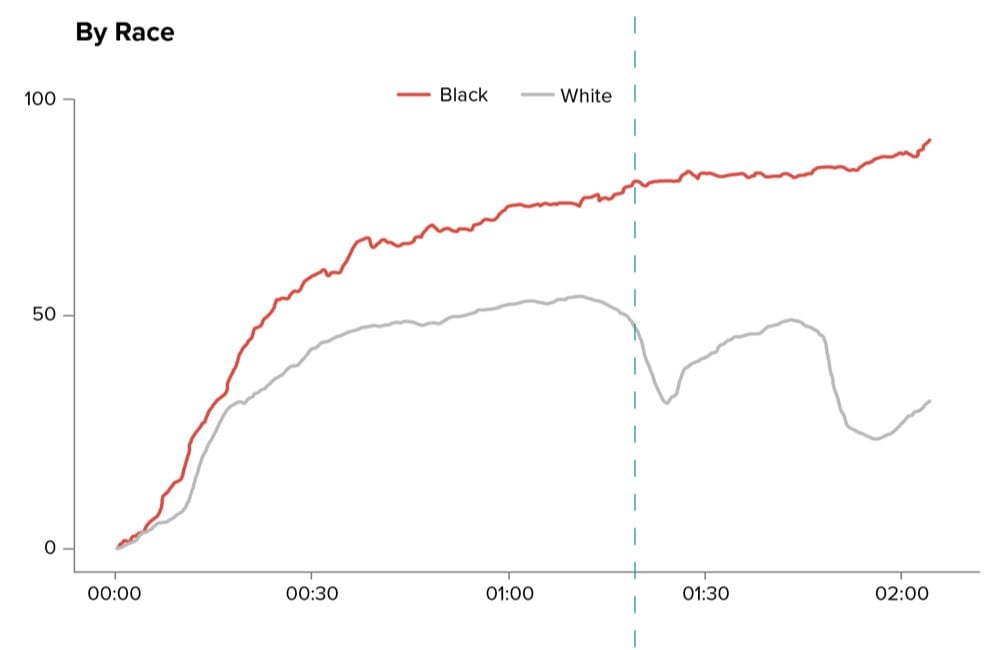
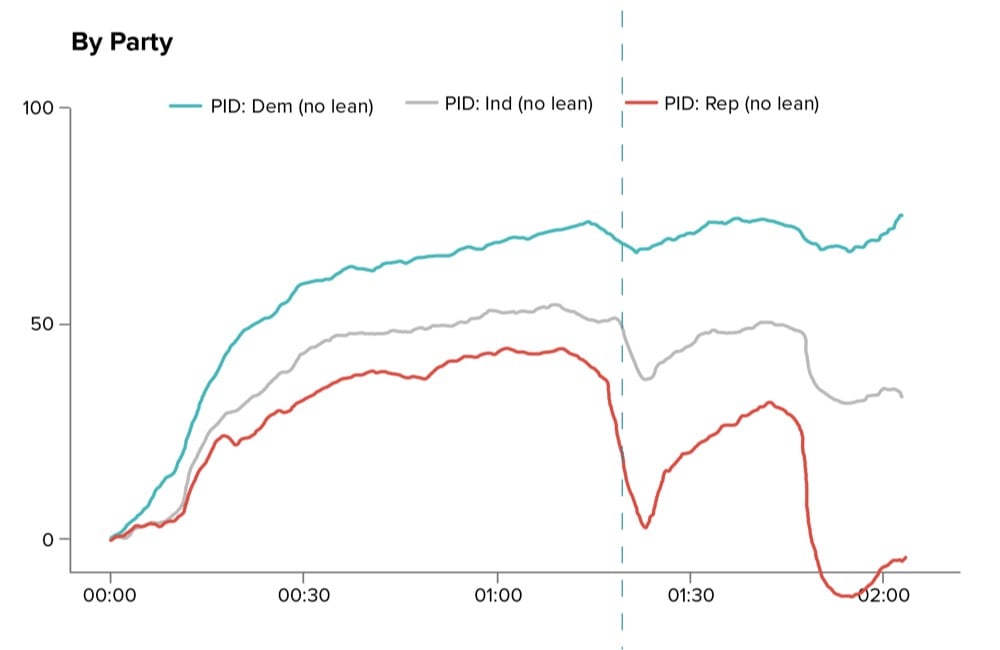
Gen Z & Millennials rated the ad higher than the older viewers throughout and had a less negative reaction to the polarizing parts. Now, the report only mentions the effect of Kaepernick appearing on the screen, but to my eyes, there are four distinct moments when the opinions of some viewers (white, older, Republican) turn negative:
1. Right before Kaepernick is shown for the first time, ratings start to decline when the ad refers to LeBron James as “the best basketball player on the planet” and “bigger than basketball” for recently opening his I Promise School.
2. Kaepernick’s first appearance in front of an American flag with his large Afro triggers a steep decline in favorability among older viewers, particularly Boomers and Republicans.
3. Serena Williams being billed as “the greatest athlete ever” results in the steepest decline during the entire ad…and this was before the controversy at the US Open. Across all groups, only black Americans had no problem with that characterization whatsoever (Gen Z & Millennials showed only slight declines).
4. Immediately after that, Kaepernick is shown again and there’s a continued follow-on decline from Serena.
So that’s interesting! What’s going on here? [insert an entire apologist NY Times Op-Ed piece here about how famous athletes are polarizing no matter what, particularly when accompanied by best-ever proclamations, etc. etc.] But of course, it’s probably racism with a side of sexism — three outspoken black athletes, one of them a woman, are uppity. That’s the simplest explanation.
Since 2011, brothers Morgan and Mason McGrew have been working on a shot-by-shot recreation of Toy Story 3. They’ve built sets, borrowed garbage trucks for scenes, and spent hundreds and hundreds of hours shooting stop motion animation of their army of Toy Story dolls & action figures. They’ve made enough progress on the film to release a trailer and it looks great!
For way too many years now, my brother and I (with the support of our awesome family and friends) have been working on a shot-for-shot recreation of Toy Story 3. This project has been an incredible undertaking, and we’ve made the decision to have this complete by 2019. At this time, I’m not quite sure what a release will look like, but I do know that this has to be done by next year. We’re both pursuing college and full-time careers right now, and it’s time to wrap this side-project up.
It looks like the brothers were around 11 and 14 when they began filming. You can check out the project’s Facebook page for information and updates.
See also Raiders of the Lost Ark: The Adaptation.
I’ve been keeping track of every media thing I “consume”, so here are quick reviews of some things I’ve read, seen, heard, and experienced in the last month or so. This installment has a few things on it from a trip to NYC and is also very movie-heavy. In addition to the stuff below, I also finished Sharp Objects (HBO series, not the book) and Star Trek: Voyager, both of which I reviewed last time. I’m almost done with Origin Story…might do a whole separate post on that one. Up next in the book department: Now My Heart Is Full, The Good Neighbor, or Fantasyland.
Mission: Impossible - Fallout. I’m not a particular fan of the series, but this was so fun that maybe I should be? Love the practical effects. (B+)
Bundyville. This podcast came highly recommended by a reader but as soon as Cliven Bundy opened his mouth to speak I realized I did not want to spend a single second of my life in this asshole’s ville or town or mind or anything. Maybe this makes me intolerant or incurious? Not sure I particularly care…there are worthier things I can choose spend my time on. (-)
Radiohead at TD Garden, 7/29/2018. I somehow won the Ticketmaster lottery and got floor tickets, so we were about 35 feet from the stage. Cool to see my favorite band that close. (A)

French Pastels: Treasures from the Vault, MFA Boston. I don’t have much experience with viewing pastels but these seemed simultaneously alive and dreamy. (A-)
Kitchen Confidential by Anthony Bourdain. One of our culture’s recent great storytellers. It’s dated (and cringeworthy) in places, but that Bourdain voice and perspective is right there on the page, almost fully formed. In the chapter about Tokyo, you also get to witness the prototype for Bourdain’s third and, arguably, greatest career as a culinary and cultural observer of far-flung places. Pro tip: get the audiobook read by the man himself. (A)
My new electric toothbrush. Why didn’t anyone tell me about this sooner? My teeth feel (and probably are) so much cleaner now! (A-)
Holedown. I’ve spent too many hours playing this. It sucks I hate it it’s so good and I can’t stopppppppp. (A-/D+)
David Wojnarowicz exhibition at the Whitney. A strong show about an artist I didn’t know a lot about going in. (B+)

Celebrating Bill Cunningham exhibition at the New-York Historical Society. The exhibition was in a small room and featured very few photographs, so I was a little disappointed. But I did get to see the Norman Rockwell/FDR exhibition, including this arresting painting. (B)
Through a Different Lens: Stanley Kubrick Photographs at the Museum of the City of New York. Even though I have the book, the original photos were worth seeing in person. (B+)
Eighth Grade. The feelings generated by watching this film — dread, crushing anxiety — closely approximated how I felt attending 8th grade. Well played. (B+)
Sorry to Bother You. If you haven’t seen this, don’t watch or read anything about it before you do. Just watch it. (A-)
Arbitrary Stupid Goal by Tamara Shopsin. This had me thinking about all sorts of different things. Recommended. (A)
Succession. This wasn’t quite as good as everyone said it was, but I still enjoyed it. My tolerance for watching rich, powerful, white assholes, however entertaining, is waning though… (B)
The Handmaid’s Tale by Margaret Atwood. Unsurprisingly more spare than the TV series but still powerful and unsparing. (A-)
The Dark Knight. If not the best superhero movie ever, it’s close. (A-)
Crazy Rich Asians. A romantic comedy with a strong dramatic element rooted in family & cultural dynamics, women who are strong & interesting & feminine in different ways, and a wondrous setting. Also, put Awkwafina in every movie from now on. (A-)
Won’t You Be My Neighbor?. Fred Rogers was a relentless person, a fantastic example of a different kind of unyielding masculinity. I sobbed like a baby for the last 20 minutes of this. (A)
BlacKkKlansman. Messy. I didn’t really know what to feel about it when it ended…other than shellshocked. Was that the point? (B+)
Tycho’s 2018 Burning Man Sunrise DJ set. Always an end-of-the-summer treat. (A)
Bill & Ted’s Excellent Adventure. I watched this movie at least 100 times in high school. Despite not having seen it in probably 20 years, I still knew every single line of dialogue — inflections, timing, the whole thing. (A+)
Foggy hikes. (A+)
American Animals. This is like Ocean’s 11 directed by Errol Morris. Stealing things is more difficult than it seems in the movies. (B+)
Past installments of my media diet are available here.
Choreographer & acrobat Yoann Bourgeois and pianist Alexandre Tharaud have collaborated on a performance that combines a trampoline, a staircase, and Claude Debussy’s most famous composition, Clair de Lune. Even though I’ve seen a performance from Bourgeois before and knew what was coming, that first drop onto the trampoline was startling.
Three is a trend: slowly shredding some pow to classical music and Clair de Lune in the moonlight. (via @alexchabotl)
In Michael Jackson’s transition from child singer to the electrifying King of Pop, Evan Puschak argues that Don’t Stop ‘Til You Get Enough from Off the Wall marked an inflection point. The song was a combination of the 70s sounds of funk & disco but mixed with other elements to make a pop hit that culturally belonged more to the 80s.
This is a pitch-perfect mashup by Funny Or Die of Amazon’s new series Tom Clancy’s Jack Ryan (starring John Krasinski) and The Office (also starring John Krasinski).
P.S. I know Funny Or Die called this “Tom Clancy’s Jim Ryan”, but they should have called it “Tom Clancy’s Jim Halpert”. Hardass name + goofy creampuff name = Comedy 101, folks. (via anil dash)
I loved Elena Ferrante’s Neapolitan novels so much that that I almost couldn’t bring myself to watch the trailer for HBO’s upcoming miniseries adaptation of the first book. But I did and I’m…cautiously optimistic? Eight episodes, premieres in November. Oh god, I hope this is good.
P.S. Seriously, this series is probably my favorite read from the last five years. Phenomenal. (via @rkgnystrom)
Netflix is finally releasing The Other Side of the Wind, a film by Orson Welles that has been unfinished since filming was completed in the mid-70s. Here’s how Netflix describes the movie:
Surrounded by fans and skeptics, grizzled director J.J. “Jake” Hannaford (a revelatory John Huston) returns from years abroad in Europe to a changed Hollywood, where he attempts to make his comeback: a career summation that can only be the work of cinema’s most adventurous filmmaker, Orson Welles.
And here’s Wikipedia’s take:
Starring John Huston, Bob Random, Peter Bogdanovich, Susan Strasberg and Oja Kodar, it is a satire of both the passing of Classic Hollywood and the avant-garde filmmakers of the New Hollywood of the 1970s. The film was shot in an unconventional mockumentary style in both color and black-and-white, and it incorporated a film-within-a-film that spoofed the work of Michelangelo Antonioni.
You can also read about the many trials and tribulations of the film’s production on Wikipedia.
Update: As a companion to The Other Side of the Wind, Netflix is releasing a documentary about Welles at the end of his career as he labored to make the film. Here’s the trailer for They’ll Love Me When I’m Dead:
The documentary is directed by Morgan Neville, whose most recent film was Won’t You Be My Neighbor? about Fred Rogers.
In the 50s and 60s during tests of nuclear weapons in the South Pacific, thousands of British soldiers were deliberately exposed to the blasts “to prepare them for nuclear war”. Motherboard recently traveled to a reunion of atomic veterans to talk to them about their experiences. This is a powerful video — the men shared what the blasts felt like and how it affected the rest of their lives: medical problems, not being able to have children, etc.
I gasped when several of the men talked about how the blasts gave them temporary x-ray vision; the radiation from the nuclear reactions allowed them to see the bones of their hands and arms right through the skin. One recalled, “When the flash hit, you could see the x-rays of your hands through your closed eyes.” And another veteran said, “If I was looking at you now, I would see all your bones. You would see all the blood vessels and everything, the bones, the lot.” I’d never heard this before…what a marvelous and horrifying thing.
Over the past few months, a team at Lego has been building a full-scale model of a Bugatti Chiron supercar using only Lego Technics pieces — aside from the wheels, tires, and a few other key components. They got the look of the car down, but the truly impressive thing is that the car actually drives, powered by an electric engine made up of over 2300 Power Function motors. The Lego press release has the details.

The model is the first large scale movable construction developed using over 1,000,000 LEGO Technic elements and powered exclusively using motors from the LEGO Power Function platform. Packed with 2,304 motors and 4,032 LEGO Technic gear wheels, the engine of this 1.5 tonnes car is generating 5.3 horse power and an estimated torque of 92 Nm.
The doors open and close, the spoiler moves up and down, the headlights work, and the all-Lego speedometer works — what a goofy and amazing accomplishment. cc: my Lego- and supercar-loving son
Stephen Colbert is a *huge* J.R.R. Tolkien nerd. When Rolling Stone asked the late night host to break a song down, he chose “Favorite Song” by Chance the Rapper (feat. Childish Gambino) and connected a verse in it to both Gilbert & Sullivan and Lord of the Rings.
Whether or not you know it, Chance and Childish, you wrote a song that includes in it this really kind of rare rhyme and rhythm scheme that Tolkien used in the poem that actually influences all of the rest of Lord of the Rings.
I wonder about the “rare” bit though…rappers packing songs with internal rhymes is not a new thing nor is referencing Gilbert & Sullivan in hip-hop. Still, this is superbly nerdy. (via craig)
The Tables is a short documentary about the ping pong tables in NYC’s Bryant Park and the cast of characters who play there frequently — homeless folks, pro players, bike messengers, and a guy who uses a block of wood for a paddle.
NPR does this thing called Tiny Desk Concerts where they bring musicians and bands into the office to play behind a desk. Recent guests have included T.I., Erykah Badu, Dave Matthews, and the legendary cellist Yo-Yo Ma. Ma played selections from Bach’s suites for cello, which he’s been playing for almost 60 years, and talked about the value of incremental learning.
Why did Laurence Olivier return so often to Shakespeare’s Othello? Why did Ansel Adams keep photographing the Grand Canyon? Obsessed or awestruck, artists revisit great inspirations because they believe there is yet another story to tell — about life, about themselves.
Cellist Yo-Yo Ma brought his great inspiration, and in turn part of his own life story, to an enthusiastic audience packed around the Tiny Desk on a hot summer day. Ma is returning, yet again, to the Six Suites for Unaccompanied Cello by Johann Sebastian Bach, a Mount Everest for any cellist. He has just released his third studio recording of the complete set and is taking the music on a two-year, six-continent tour. Ma’s first recording of the Suites, released in 1983, earned him his first Grammy.
Amazingly, when Ma was only 7 years old, he played in a benefit concert for an audience that included President John F. Kennedy. Composer Leonard Bernstein introduced Ma, saying in part: “Now here’s a cultural image for you to ponder as you listen. A seven-year-old Chinese cellist playing old French music for his new American compatriots.”
Even though he’s only 62 years old, Ma is a great example of The Great Span in action, linking JFK and YouTube and Lil Buck together across seemingly disparate stretches of American history. When he plays a duet with the first virtuoso robotic cellist sometime in the next 20 years, Ma will have more than secured his spot in The Great Span Hall of Fame.
A demo version of Imagine, unheard for decades, was recently uncovered in an archive of Lennon audio tapes. You can listen to the beautifully spare rendition here:
While sifting through boxes upon boxes of the original tapes for Yoko Ono, engineer Rob Stevens discovered something truly remarkable that had gone unnoticed all these years. “Early 2016, during the gestation period of this project, I’m in the Lennon archives with my people going through tape boxes that have labeling that’s unclear, misleading, or missing entirely”, says Stevens. “There’s a one-inch eight-track that says nothing more on the ‘Ascot Sound’ label than John Lennon, the date, and the engineer (Phil McDonald), with DEMO on the spine. No indication of what material was on the tape. One delicate transfer to digital later, the “Imagine” demo, subsequently enhanced superbly by Paul Hicks, appears within this comprehensive set. It was true serendipity.”
Compare it to the remastered studio version and a live version.
Imagine there’s no heaven
It’s easy if you try
No hell below us
Above us, only sky
Imagine all the people living for today
Imagine there’s no countries
It isn’t hard to do
Nothing to kill or die for
And no religion, too
Imagine all the people living life in peace
I could definitely get into that. For those unwilling to imagine no possessions, the demo, along with several others, appears on a collection coming out in the fall: preorder on Amazon or iTunes. (via @tedgioia)
TIL that the hieroglyphic hobo code probably wasn’t used as extensively as the internet suggests. However, hobos and tramps did tag bridges, water towers, and train cars with tramp writing, which usually consisted of their moniker (i.e. their hobo name), the date, and the direction they were heading in.
Hobos, or tramps, were itinerant workers and wanderers who illegally hopped freight cars on the newly expanding railroad in the United States in the late 19th century. They used graffiti, also known as tramp writing, as a messaging system to tell their fellow travelers where they were and where they were going. Hobos would carve or draw their road persona, or moniker, on stationary objects near railroad tracks, like water towers and bridges.
More on hobo graffiti from CityLab.
Traces of hobo graffiti from the early 20th century have become almost totally obliterated, destroyed by natural forces, torn down along with old buildings, or painted over with new graffiti. So when anthropologist Susan Phillips came across a rare one scribbled underneath a bridge near the Los Angeles River, she knew it was a remarkable discovery.
(via open culture)
Beto O’Rourke is running against Ted Cruz for one of Texas’ two Senate seats. At a recent event, he was asked if he thought that NFL players kneeling during the national anthem to protest police violence against black people was disrespectful.
I kind of wanted to know how you personally felt about how disrespectful it is — like, you have the NFL players kneeling during the national anthems. I wanted to know if you found that disrespectful to our country, to our veterans, and anybody related to that.
O’Rourke’s answer, which connects this protest to past non-violent protests undertaken by black Americans, is pitch-perfect — honest, respectful of the questioner & the audience, and inclusive.
I can think of nothing more American than to peacefully stand up, or take a knee, for your rights anytime, anywhere, any place.
That’s how you politic.
P.S. In his campaign against Cruz, O’Rourke is relying solely on individual donors, no PAC money. If you’d like to help him out, you can donate to his campaign here.
For more than 35 years, Dennis Hope has been selling land on the Moon. Hope registered a claim for the Moon in 1980 and, since the US government & the UN didn’t object, he figures he owns it (along with the other planets and moons in the solar system).
“I sent the United Nations a declaration of ownership detailing my intent to subdivide and sell the moon and have never heard back,” he says. “There is a loophole in the treaty — it does not apply to individuals.”
The US government had several years to contest such a claim. which they never did. Neither did the United Nations nor the Russian Government. This allowed Mr. Hope to take the next step and copyright his work with the US Copyright registry office. So, with his claim and Copyright Registration Certificate from the US Government in hand, Mr. Hope became what is probably the largest landowner on the planet today.
An acre-sized plot of the Moon is currently available for $24.99 and Hope says he has sold over a billion acres of his celestial properties to more than 6 million people, including to such moonsteaders as George H.W. Bush, Ronald Reagan, and Star Trek cast members.
Hip hop pioneer Grandmaster Flash grew up in the Bronx and attended a public vocational high school. There he learned how to fix electronics. He was also into music — his father had a huge record collection. In this video, Flash talks about how he combined those two interests and built his first mixer using parts he bought at Radio Shack.
Grandmaster Flash was tinkerer and a hacker. There were commercially available mixers at the time; he built his own. He absorbed the nascent music culture developing around him and twisted it to his own ends, developing new mixing techniques like beat juggling. He perfected scratching and brought it to a wider audience.
Any scientist, engineer, or artist would recognize the process at work here, how tightly coupled the development of new technology and fresh ideas is. Club DJs wanted a way to transition from one record to another without missing a beat, so the mixer was invented. Once that technology existed, people started using mixers to do things other than their initial purpose. New tech begat new ideas begat new tech, the adjacent possible expanding all the while, until a curious kid who dabbled in electronics and was obsessed with music came along and helped invent hip hop, the most culturally significant movement of the past 40 years. (via kelli anderson)
In this video for Vox, Estelle Caswell explores Aretha Franklin’s unique blend of pop, soul, and gospel, particularly in her cover songs and live performances.
Aretha Franklin will always be the Queen of Soul. In the 1960s songs like “Respect” became the symbol for political and social change. It’s likely the reason her music moved so many people wasn’t necessarily the lyrics, but the way she delivered them.
Aretha was raised in the church, and her life and music was rooted in gospel music. You can hear this so clearly in her live performances and covers, where every musical decision she made was in the moment.
Listen to any one of Aretha’s songs and you’ll understand the power of gospel music, but her live performance of “Dr. Feelgood” and her cover of “Son of a preacher man” are a great place to start.
Holy moly, what a voice.
A Swiss company has designed a system for storing energy in concrete blocks. The blocks are lifted by a crane when surplus energy is available (say, when the Sun is shining or the wind blowing) and then, when energy is needed later, allowed to fall, turning turbines to generate electricity.
The innovation in Energy Vault’s plant is not the hardware. Cranes and motors have been around for decades, and companies like ABB and Siemens have optimized them for maximum efficiency. The round-trip efficiency of the system, which is the amount of energy recovered for every unit of energy used to lift the blocks, is about 85% — comparable to lithium-ion batteries which offer up to 90%.
Pedretti’s main work as the chief technology officer has been figuring out how to design software to automate contextually relevant operations, like hooking and unhooking concrete blocks, and to counteract pendulum-like movements during the lifting and lowering of those blocks.
The storage of energy in this way isn’t new…the ARES project uses hills and heavy trains to accomplish the same thing.
It’s a wonderfully simple idea, a 19th century solution for a 21st century problem, with some help from the abundant natural resource that is gravity. When the local utility’s got surplus electricity, it powers up the electric motors that drag 9,600 tons of rock- and concrete-filled railcars up a 2,000-foot hill. When it’s got a deficit, 9,600 tons of railcar rumble down, and those motors generate electricity via regenerative braking — the same way your Prius does. Effectively, all the energy used to move the train up the hill is stored, and recouped when it comes back down.
There’s something really interesting about big kinetic machines operating as though they were computers, autonomous black boxes where data flows in and out that can operate anywhere with a bit of flat ground.
Volumes is a 4K Full CG art film by Maxim Zhestkov exploring the juxtaposition of emotions with the laws of nature. Billions of colourful particles dance, play and communicate with each other in an eternal hypnotic ballet governed by the invisible wind of fate.
This looks fantastic at fullscreen resolution on my iMac. A nice little break in a hectic day. (via colossal)
There’s something so relaxing about watching art conservator Julian Baumgartner restore this damaged painting, a self-portrait by Italian painter Emma Gaggiotti Richards. I love how he paints tiny cracks in the damaged areas to match those in the rest of the painting.
There are many more videos and photos of Baumgartner’s restoration process on Instagram and YouTube. (via the kid should see this)
Irene Taylor Brodsky directed this short film in which about a dozen deaf people talk simply about their hearing loss and the technology (like cochlear implants) that is transforming how they interact with others. This was wonderful…I learned a lot from listening to these stories.
I was also struck by how difficult it actually is to lump “people who X” into a single category, despite the human desire to tidy people and things into groups. Even among the relatively few people featured in this short film, there were many different approaches and attitudes about deafness. Watching it, you think, jeez, what do all these people really have in common? Probably less than you might have assumed initially. (via @JossFong)
In this short video, Evan Puschak talks about how music is made for Super Nintendo games. That system was first released in 1990 and the audio chips could only hold 64 KB of information, only enough room for beeps, boops, and very short samples. But composers like David Wise, whose soundtrack for the Donkey Kong Country series of games is on many lists of the best video game music, were able to make the SNES sing despite its limited capabilities.
NASA recently published this visualization of sunrises and sunsets on the Moon set to the strains of Claude Debussy’s most famous work, Clair de Lune.
The visuals were composed like a nature documentary, with clean cuts and a mostly stationary virtual camera. The viewer follows the Sun throughout a lunar day, seeing sunrises and then sunsets over prominent features on the Moon. The sprawling ray system surrounding Copernicus crater, for example, is revealed beneath receding shadows at sunrise and later slips back into darkness as night encroaches.
A lovely way to spend five minutes. (thx, gina)
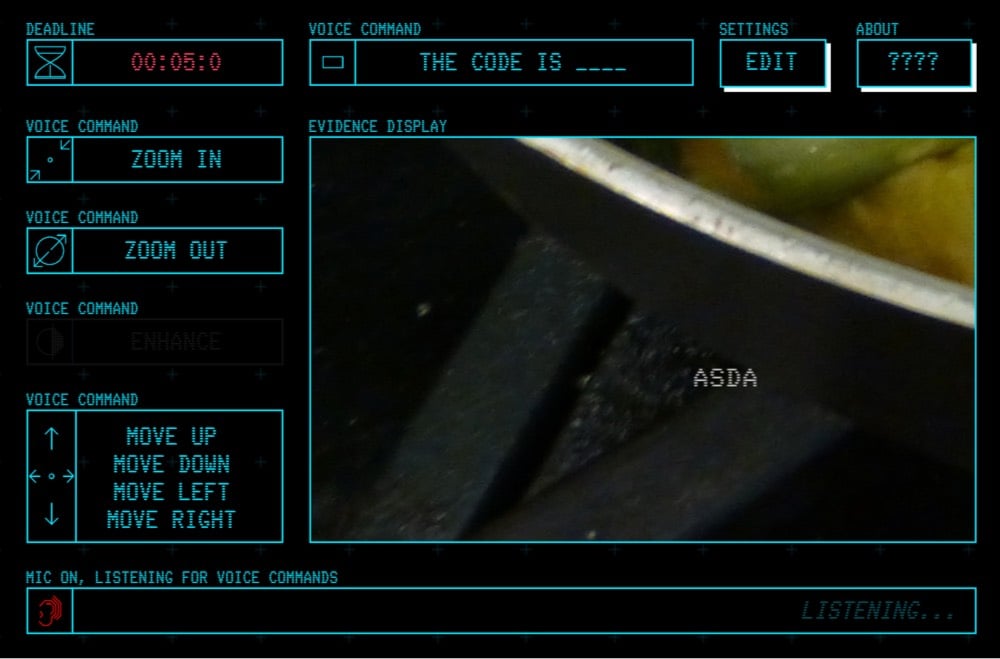
Nicole He has built a voice-controlled game called Enhance in which you speak commands to zoom & enhance images to look for secret codes, just like a detective on a CSI TV show. I bet if you try this in your open plan office, your coworkers will look at you like you’re nuts for a sec but will soon gather around, shouting their own commands at the computer. After all, everyone wants to enhance:
Newer posts
Older posts




Socials & More