kottke.org posts about video
Perhaps intuiting our shared love and fond remembrance of school engineering competitions (egg drop! toothpick bridge!), Spencer Wright alerted me to the latest issue of The Prepared, specifically this bit about a competition to design toothpick towers that can withstand simulated earthquakes. Wright writes:
I’m a big fan of egg drop contests, in which teams make some kind of contraption that lets a raw egg fall — and not break — from a high height. Well, Sojo University’s Department of Architecture holds a seismic loading competition, in which teams of high schoolers build toothpick towers that stay standing when shaken by a simulated earthquake. The towers fail in delightful ways — some lean slowly, some topple all at once, some twist up over a period of minutes before collapsing on themselves. The full 2021 competition (which was live streamed!) can be seen in this video, though highlights of the 2010 competition are perhaps more fun to watch.
I’ve embedded the 2010 competition highlight video above…it’s a fun watch. (via the prepared)
In this clever simulation, bouncing balls obeying the laws of physics somehow arrange themselves, mid-chaos, into neat patterns. This is immensely satisfying.
Spoiler: the trick here is a pair of simulations stitched together, like a physics Texas Switch: “Each sequence is obtained by joining two simulations, both starting from the time in which the balls are arranged regularly. One simulates forward in time, one backwards.”
Three years ago, cinematographer and director Morgan Cooper uploaded a fan-made trailer for a gritty reboot/retelling of the 90s sitcom The Fresh Prince of Bel-Air. It caught the attention of Will Smith, who decided to give Cooper the go-ahead to develop his idea into a series. And now the first trailer of that series, Bel-Air, has dropped. Looks great…I’m going to watch.
I look forward to this every year: David Ehrlich’s video countdown of the 25 best films of 2021. It’s like a trailer for an entire year’s worth of movies, lovingly constructed by a movie fan, critic, and editor, chock full of vivid imagery, memorable moments, and homages to great films of the past. I want to take the rest of the day off and just watch all of these…
Astronaut Scott Kelly arranged to have a gorilla suit sent up to him during his year spent on the International Space Station. One day, near the end of the mission in 2016, he put it on, stowed away in a large storage container, and then escaped and went on a “rampage”.
Charles and Ray Eames’ 1977 short film Powers of Ten is one of the best bits of science communication ever created…and a personal favorite of mine. Here’s a description of the original film:
Powers of Ten takes us on an adventure in magnitudes. Starting at a picnic by the lakeside in Chicago, this famous film transports us to the outer edges of the universe. Every ten seconds we view the starting point from ten times farther out until our own galaxy is visible only a s a speck of light among many others. Returning to Earth with breathtaking speed, we move inward — into the hand of the sleeping picnicker — with ten times more magnification every ten seconds. Our journey ends inside a proton of a carbon atom within a DNA molecule in a white blood cell.
As an homage, the BBC and particle physicist Brian Cox have created an updated version that reflects what we’ve learned about the universe in the 45 years since Powers of Ten was made. The new video zooms out to the limits of our current observational powers, to about 100 billion light years away, 1000X wider than in the original. (I wish they would have done the zoom in part of the video too, but maybe next year!)
And if you’d like to explore the scales of the universe for yourself, check out the Universe in a Nutshell app from Tim Urban and Kurzgesagt — you can zoom in and out as far as you want and interact with and learn about objects along the way.
Vaccines, reunions, coups, climate crisis, shortages, resignations, crypto, strikes, protests, conspiracy thinking, inequality, exploration, breaking down barriers…these are just some of the things that we experienced and turned our focus on in 2021.
See also the AP’s Year in Review, the UN’s 2021 Year in Review, and 100 Things We Learned in 2021 from Mental Floss.
While indigenous communities, farmers, and those living close to the land have known for generations the role that beavers play in maintaining healthy ecosystems, more and more scientists have been experimenting and gathering data on just how essential these animals are. Through their actions, beaver (and humans mimicking their actions) can help restore river-based ecosystems, improve wildfire resilience, bring fish & other animals back to habitats, and fight drought.
Beaver should be our national climate action plan because connected floodplains store water, store carbon, improve water quality, improve the resilience to wildfire, and what beaver do play an enormous role in controlling the dynamics of those systems. So, yeah, it sounds really trite to give a national climate action plan to some rodents. But if we don’t do that directly, we should at least be trying to mimic what they do.
The video above provides a great overview on what we’re learning about how beavers restore ecosystems. Last month, I linked to this Sacramento Bee piece about how beavers were used to revitalize a dry California creek bed:
The creek bed, altered by decades of agricultural use, had looked like a wildfire risk. It came back to life far faster than anticipated after the beavers began building dams that retained water longer.
“It was insane, it was awesome,” said Lynnette Batt, the conservation director of the Placer Land Trust, which owns and maintains the Doty Ravine Preserve.
“It went from dry grassland… to totally revegetated, trees popping up, willows, wetland plants of all types, different meandering stream channels across about 60 acres of floodplain,” she said.
The Doty Ravine project cost about $58,000, money that went toward preparing the site for beavers to do their work.
In comparison, a traditional constructed restoration project using heavy equipment across that much land could cost $1 to $2 million, according to Batt.
See also The Beaver Manifesto and this long piece from Places Journal about beavers as environmental engineers.
Across North America and Europe, public agencies and private actors have reintroduced beavers through “re-wilding” initiatives. In California and Oregon, beavers are enhancing wetlands that are critical breeding habitat for salmonids, amphibians, and waterfowl. In Nevada, Utah, and New Mexico, environmental groups have partnered with ranchers and farmers to encourage beaver activity on small streams. Watershed advocates in California are leading a campaign to have beavers removed from the state’s non-native species list, so that they can be managed as a keystone species rather than a nuisance. And federal policy is shifting, too. The U.S. Fish and Wildlife Service sees beavers as “partners in restoration,” and the Forest Service has supported efforts like the Methow Beaver Project, which mitigates water shortages in North Central Washington. Since 2017, the USDA Natural Resource Conservation Service has funded beaver initiatives through its Aquatic Restoration Program.
(via the kid should see this)
In the mid-1820s, the naturalist Charles Darwin began his research career studying botany in university and he bought a portable brass microscope to aid him in his studies. The microscope was passed down through the generations of his family and was recently sold at auction for ~$790,000.
Charles Darwin’s own research career began in earnest with the more prosaic, but no less philosophical, investigation into the sea creatures being dredged up from the Firth of Forth, which Charles obtained from friendly fishermen while he was trying to avoid his medical studies at the University of Edinburgh. Darwin’s studies of these strange ‘zoophytes’, which made liberal use of the microscope, began in 1826 and reached a successful conclusion in the spring of 1827, when he presented his very first scientific paper to the University’s Plinian Society.
These dates coincide with the first appearance of the present model on the market: the instrument was designed by Charles Gould for the firm Cary around 1825, and was certainly on sale by 1826, when its accompanying booklet was mentioned in the Mechanics’ Register. Of the five other surviving microscopes associated with Charles Darwin, four are known to have been acquired later (two in 1831, one each in 1847 and c.1848), and the other cannot be used for studying marine invertebrates.
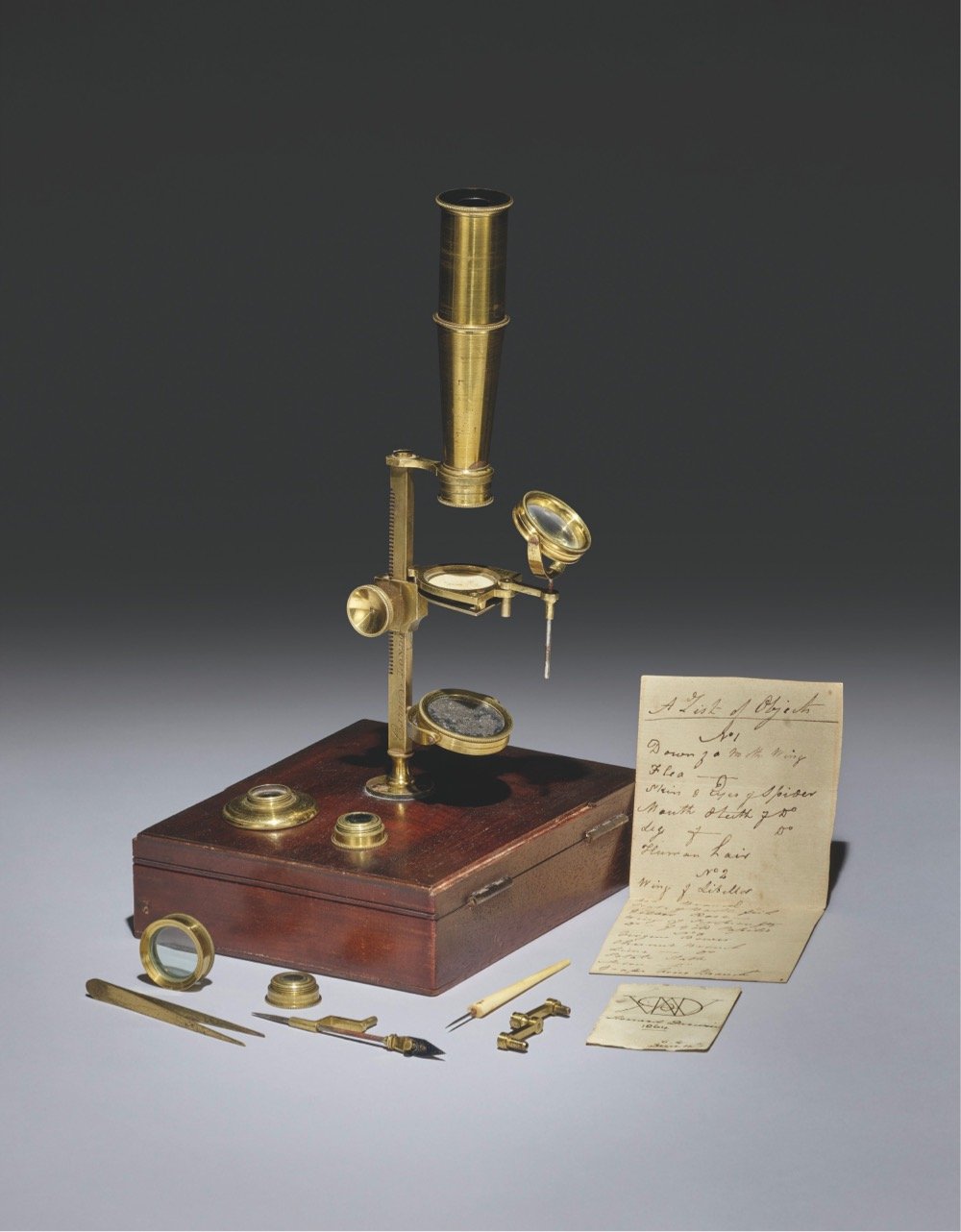
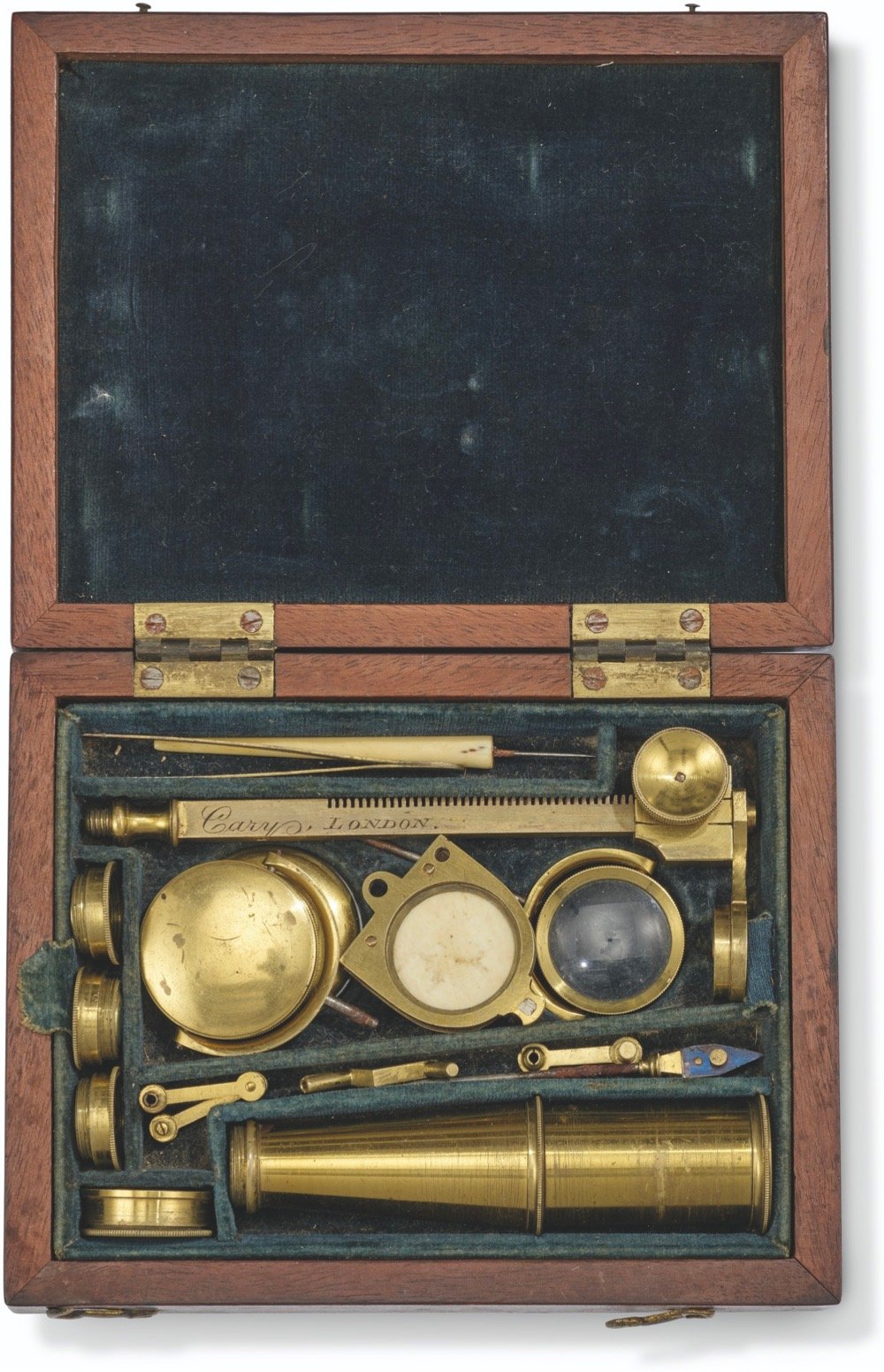
(thx, mick)
From executive producer Adam McKay (who also directed the first episode) comes a glitzy HBO series about the Lakers’ NBA dynasty in the 80s called Winning Time. It’s based on Jeff Pearlman’s book, Showtime: Magic, Kareem, Riley, and the Los Angeles Lakers Dynasty of the 1980s. The casting looks great — Adrien Brody as Pat Riley is particularly fitting.
Winning Time was also the last straw in the disintegration of the creative partnership between McKay and Will Ferrell. From a recent profile of McKay in Vanity Fair:
McKay had been making an HBO limited series about the Los Angeles Lakers basketball team in the 1980s based on the book Showtime and Ferrell, a huge Lakers fan, had his heart set on the role of Jerry Buss, the legendary ’80s-era team owner. After Gary Sanchez dissolved, however, the Lakers show moved under McKay’s new production banner, Hyperobject Industries. And Ferrell, it turns out, was never McKay’s first choice. “The truth is, the way the show was always going to be done, it’s hyperrealistic,” he says. “And Ferrell just doesn’t look like Jerry Buss, and he’s not that vibe of a Jerry Buss. And there were some people involved who were like, ‘We love Ferrell, he’s a genius, but we can’t see him doing it.’ It was a bit of a hard discussion.”
The person McKay wanted for Buss was John C. Reilly, who looks more like the real thing, and who is Ferrell’s best friend. McKay hesitated. “Didn’t want to hurt his feelings,” he says flatly. “Wanted to be respectful.”
In the end he cast Reilly in the role anyway-without telling Ferrell first. Ferrell was infuriated. “I should have called him and I didn’t,” says McKay. “And Reilly did, of course, because Reilly, he’s a stand-up guy.”
Winning Time debuts in March 2022.
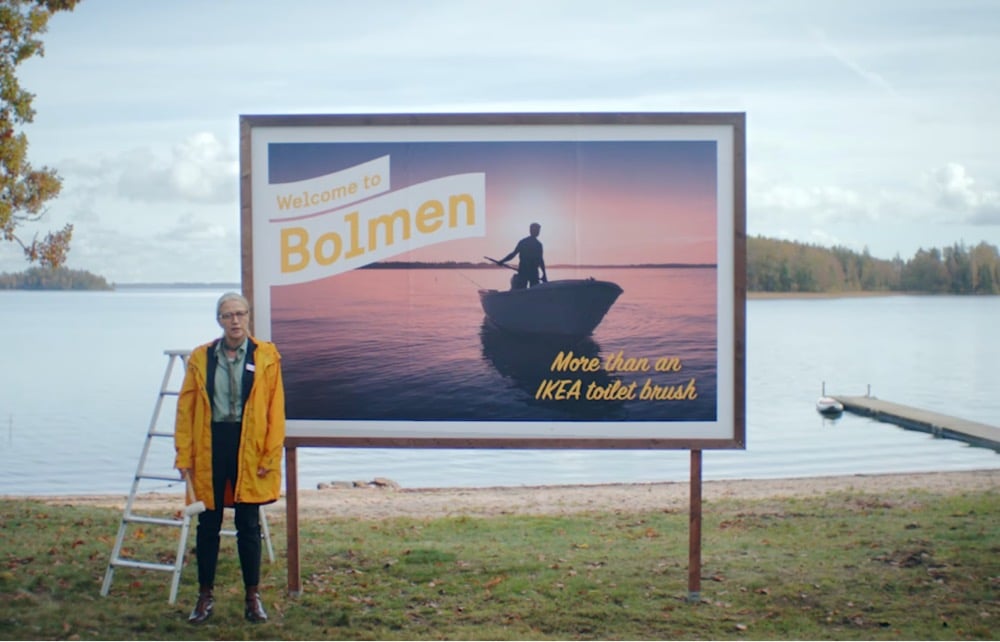
Ikea names their products after locations all over Scandinavia and a bunch of those places in Sweden are fighting back against the practice with a clever “discover the originals” ad campaign.
From Strange Maps:
Bolmen. Now there’s a word you don’t use every day. Where have you encountered it before? In IKEA, where it’s the name of a cheap toilet brush — for a dollar, it’s yours. What you probably don’t know is that the brush was named after a pristine lake in southern Sweden. And now that you do know, that lake doesn’t sound so pristine anymore.
Call it the Curse of IKEA. A curse repeated hundreds of times across the map of Sweden. Beautiful places with exotic names, their appeal diminished by association with mundane items from the world’s most popular furniture catalog. Where does that leave the tourist industry around Lake Toiletbrush? Down in the dumps, is where.
Bodviken is “more than an IKEA countertop sink”; it’s a UNESCO World Heritage site. Voxnan is “more than an IKEA shower shelf”; it’s home to a marvelous river for fishing, paddling, and hiking. Björksta is “more than an IKEA picture with frame”; it’s an historic Viking site. You can check out more of the originals here.
Well this is a nice little holiday boost: a four-minute animated short with Ted Lasso and the gang called The Missing Christmas Mustache.
Inspired by the second book in Liu Cixin’s excellent Three-Body Problem trilogy, Kurzgesagt made a video about the Dark Forest solution to the Fermi paradox.
Confronted with the seemingly empty universe, humanity faces a dilemma. We desperately want to know if we are alone in the Milky Way. We want to call out and reveal ourselves to anyone watching but that could be the last thing we ever do. Because maybe the universe is not empty. Maybe it’s full of civilizations but they are hiding from each other. Maybe the civilizations that attracted attention in the past were wiped away by invisible arrows. This is the Dark Forest solution to the Fermi paradox.
I have The Dark Forest on the Kindle, so I looked up how this is explained in the book (spoilers, obvs):
“The universe is a dark forest. Every civilization is an armed hunter stalking through the trees like a ghost, gently pushing aside branches that block the path and trying to tread without sound. Even breathing is done with care. The hunter has to be careful, because everywhere in the forest are stealthy hunters like him. If he finds other life-another hunter, an angel or a demon, a delicate infant or a tottering old man, a fairy or a demigod-there’s only one thing he can do: open fire and eliminate them. In this forest, hell is other people. An eternal threat that any life that exposes its own existence will be swiftly wiped out. This is the picture of cosmic civilization. It’s the explanation for the Fermi Paradox.”
Shi Qiang lit another cigarette, if only to have a bit of light.
“But in this dark forest, there’s a stupid child called humanity, who has built a bonfire and is standing beside it shouting, ‘Here I am! Here I am!’” Luo Ji said.
“Has anyone heard it?”
“That’s guaranteed. But those shouts alone can’t be used to determine the child’s location. Humanity has not yet transmitted information about the exact position of Earth and the Solar System into the universe. From the information that has been sent out, all that can be learned is the distance between Earth and Trisolaris, and their general heading in the Milky Way. The precise location of the two worlds is still a mystery. Since we’re located in the wilderness of the periphery of the galaxy, we’re a little safer.”
That’s the basic idea, but there’s more to it…you should watch the video or, even better, read the series — I’ve read the entire trilogy twice and this makes me want to read it again! (I loved the Drive Easter egg towards the end of the video. Well played.)
In this movie, Nicolas Cage plays Nicolas Cage (or “Nick Cage”) playing Nicolas Cage roles from actual Nicolas Cage movies at the behest of his biggest fan for $1 million. Ok, I’m sold! It’s like Adaptation crossed with Being John Malkovich. (This is the second movie in as many days that’s reminded me of BJM. Something in the water?)
In this entertaining, informative, and charmingly goofy video, Dr. Kevin Hainline tells us all about the James Webb Space Telescope. The JWST is a bigger and better version of the Hubble Space Telescope and will allow scientists to peer deeper into the universe and farther back in time than ever before.
Listen, science is hard! Engineering is hard! It’s difficult to figure out how to build an incredibly sensitive infrared detector that you have to cram together on the back of a giant, foldable, gold covered mirror, sitting on a delicate, tennis-court-sized parasol, that can survive a rocket launch! It’s hard stuff!
And hundreds and hundreds of people around the world have been working on it together. JWST is the single most complicated science project human beings have ever attempted. But it’s been worth it. Because we want to discover the earliest galaxies in the universe, and clouds on other planets, and baby star-forming regions, and debris disks around stars, and weird dwarf galaxies, and supermassive black holes!
It’s been in development for almost thirty years and everyone is really ready for it! The James Webb Space Telescope is about to change astronomy. Get ready for discovery!
I am ready and excited! The JWST is currently set to launch no earlier than Dec 24, 2021. You can follow the progress of the launch here.
See also Looking back in time with the James Webb Space Telescope (60 Minutes) and 29 Days on the Edge. Oh and scientists have been working on this project for 20 years and are (understandably) really nervous about what happens with the launch.
For the first time in human history, a spacecraft has flown through the Sun’s corona to collect data and capture samples (and, crucially, exited safely).
During the flyby, Parker Solar Probe passed into and out of the corona several times. This is proved what some had predicted — that the Alfvén critical surface isn’t shaped like a smooth ball. Rather, it has spikes and valleys that wrinkle the surface. Discovering where these protrusions line up with solar activity coming from the surface can help scientists learn how events on the Sun affect the atmosphere and solar wind.
Six panels of images taken from inside a coronal streamer. They appear grayish with white streaks showing particles in the solar wind.
At one point, as Parker Solar Probe dipped to just beneath 15 solar radii (around 6.5 million miles) from the Sun’s surface, it transited a feature in the corona called a pseudostreamer. Pseudostreamers are massive structures that rise above the Sun’s surface and can be seen from Earth during solar eclipses.
Passing through the pseudostreamer was like flying into the eye of a storm. Inside the pseudostreamer, the conditions quieted, particles slowed, and number of switchbacks dropped — a dramatic change from the busy barrage of particles the spacecraft usually encounters in the solar wind.
For the first time, the spacecraft found itself in a region where the magnetic fields were strong enough to dominate the movement of particles there. These conditions were the definitive proof the spacecraft had passed the Alfvén critical surface and entered the solar atmosphere where magnetic fields shape the movement of everything in the region.
The first passage through the corona, which lasted only a few hours, is one of many planned for the mission. Parker will continue to spiral closer to the Sun, eventually reaching as close as 8.86 solar radii (3.83 million miles) from the surface. Upcoming flybys, the next of which is happening in January 2022, will likely bring Parker Solar Probe through the corona again.
The video above provides a great overview of the origins, objectives, and motivations for the mission.
I don’t know anything about this movie and its directors (Daniels? Oh, Swiss Army Man!) but it has Michelle Yeoh kicking ass in it and I want to see it at the first possible opportunity. Getting some Jackie Chan meets Marvel multiverse meets Being John Malkovich vibes here.
This pitch-perfect SNL commercial featuring Kate McKinnon & Billie Eilish advertises the bland budget business-ish hotel that can be found all across America.
Our rooms provide every comfort required by law: tiny soap in plastic, phone that blinks, Band-Aid-colored blanket, chair for suitcase, black & white photo of Ferris wheel, blow dryer that goes oooooooh, short glass wearing little hat, and small stain in place you have to touch.
And be sure to enjoy our hot tub; it’s always occupied by an eight-year-old boy in goggles staring at your breasts. He’s been in there for hours and he’s not getting out until you do.
I have stayed at this precise hotel many times in the past and I will again in the future. C+++++.
Street Gang: How We Got to Sesame Street, a documentary about the beloved show’s first two decades, debuts today on HBO Max. The film is based on Michael Davis’s 2009 book Street Gang: The Complete History of Sesame Street.
The documentary focuses on the first two experimental and groundbreaking decades of Sesame Street, highlighting this visionary “gang” that audaciously interpreted radical changes in society and engaged children with innovative new ways to entertain and educate.
Featuring exclusive behind-the-scenes footage and interviews with over twenty original cast members and creators, the documentary explores how the team incorporated groundbreaking puppetry, clever animation, short films, music, humor, and cultural references into each episode to keep kids and parents coming back, while never shying away from difficult conversations with children.
In a review, NY Times TV critic James Poniewozik says the film reminds us that Sesame Street was political right from the beginning:
“Sesame Street,” which premiered in 1969, was the project of Joan Ganz Cooney, a TV executive who was originally more interested in the civil rights movement than in education but came to see the connection between the two. “The people who control the system read,” she once said, “and the people who make it in the system read.” And she believed that the best way to get the kids of the 1960s to read, paradoxically, was through TV.
Her Children’s Television Workshop brought together educators and entertainers, including a puppeteer named Jim Henson and the director Jon Stone, an idealist attracted to Cooney’s idea of closing the literacy gap for inner-city Black children. “I think what drew Dad in really had to do with her political vision,” his daughter Kate Stone Lucas says in the documentary.
The YouTube channel Two Minute Papers enthusiastically shares the findings from scientific papers about technology: computing, graphics, AI, robotics, etc. Recently they reviewed this paper on simulating the growth of large-scale plant ecosystems based on real-world forestry and botany research. From the paper’s abstract:
In this paper we describe a multi-scale method to design large-scale ecosystems with individual plants that are realistically modeled and faithfully capture biological features, such as growth, plant interactions, different types of tropism, and the competition for resources. Our approach is based on leveraging inter- and intra-plant self-similarities for efficiently modeling plant geometry. We focus on the interactive design of plant ecosystems of up to 500K plants, while adhering to biological priors known in forestry and botany research.
What that means, as they show in the video, is that you can watch these incredibly detailed time lapse videos of forests developing over time in a realistic way. So cool. This kind of thing always reminds me of favorite childhood thing, Al Jarnow’s Cosmic Clock. (via waxy)
Since Billie Eilish was 15 years old in 2017, Vanity Fair has been interviewing her every year to see what she is up to, how she is feeling, and what has changed from previous years. A key message from this year’s video, in response to “technological thing that blows your mind”:
The vaccine, dude. Hell fucking yeah. I really, really urge you — if you are not already vaccinated, please get vaccinated. It’s not just for you, you selfish bitch. It’s for everyone around you. Take care of the people around you, man. Protect your friends, protect your children, protect your grandparents, protect anyone you walk by.
If you haven’t seen this before, it’s interesting to go back to watch the interviews from 2017 & 2018, 2019, and 2020 — it’s a fascinating chronicle of a young woman getting really famous really fast and growing up in public. Like I said last year:
I still marvel that Vanity Fair embarked on this project with this particular person. They could have chosen any number of up-and-coming 2017 pop singer/songwriters and they got lucky with the one who went supernova and won multiple Grammys.
See also R.J. Cutler’s 2021 documentary about Eilish, The World’s a Little Blurry and Mel Brooks at 95 (about a long life lived in public).
Built in 1905 and recently restored to working order, the Sumburgh Foghorn is perhaps the last functioning foghorn in Scotland. This two-minute film, which is simply but beautifully shot, documents the surprisingly elaborate process of sounding the horn.
Out of use since 1987, the foghorn was painstakingly restored by Brian Johnson. Shown in the video is the annual Foghorn sounding at Sumburgh Lighthouse, Shetland, Scotland. Brian starts up the 1951 Kelvin K-Series Diesel 44hp Engines. The engines power the Alley and MacLellan compressors, which in turn, power the foghorn.
Just so’s you know, the horn was originally much louder at the end, but YouTube’s audio algorithm turned the volume down. I tried several versions but it wasn’t having it.
I wish we could experience the true loudness of the horn through the video — it was so powerful that it could be heard at a range of 20 miles on foggy days. (thx, mick)
Castles across Europe and the Middle East during the Middle Ages were all pretty different, but by looking at the trends over a period of several centuries, you can determine how to build the perfect castle.
We trace the origins of the castle in the feudal system that emerged in France c.900 CE, and look at the early motte-and-bailey castle, used by the Normans to subjugate England and Wales in the 11th century. We then look at how castle’s became stronger and more sophisticated, with the addition of stone curtain walls, massive keeps, towers (square, round and D-shaped), as well as powerful gatehouses, barbicans, machicolations and moats.
(FYI: The sponsorship in this video for a medieval role-playing game is a little annoying but easily skippable and ultimately doesn’t detract from how interesting & educational the video is.)
This animated documentary about how Israeli Mossad agent Zvi Aharoni tracked down and captured Nazi war criminal Adolf Eichmann in Argentina 15 years after WWII ended is really fantastic.
The rare film to win festival prizes as both a documentary & as an animation, Randall Christopher’s The Driver is Red is a stunning showcase for his minimalist pen and ink art and for his grand aim to increase public awareness of WWII history (which he perceives to be rapidly fading from the consciousness of younger generations). Should he succeed in that noble aim however, the reason will be that he has taken a potentially dry historical record and transformed it into an imaginative and unabashedly cracking spy thriller.
Told through the experience of Israeli Mossad agent Zvi Aharoni, the film documents the discovery and capture of Adolf Eichmann, the senior Nazi official largely responsible for organizing and executing the Holocaust. Hidden for 15 years half a world away, and living under an assumed identity, Eichmann is tracked down by Aharoni and the agent, with a small team in tow, must design and execute a strategy for Eichmann’s capture and extradition.
You can read much more about Eichmann and his crimes, capture, trial, and death in a massive five-part series Hannah Arendt wrote for the New Yorker in 1963 (1, 2, 3, 4, 5), later collected in Eichmann in Jerusalem: A Report on the Banality of Evil. (via open culture)
In the second video by Brick Experiment Channel I’ve posted here in the past week, a Lego car is repeatedly adapted to cross larger and larger gaps, until it can cross a massive gap just a little narrower than the length of the car. As I said before about their climbing car video, watching the iterative process of improving a simple car performing an increasingly difficult task using familiar design objects is such an accessible way to observe how the process of engineering works.
One of the things you get to witness is when a particular design tactic dead ends, i.e. when something that worked across a shorter gap is completely ineffective crossing a wider distance. No amount of tinkering with that same design will make it work…you have to find a whole new way to do it.
Typically, we think of music in movies in terms of what the music adds to the visuals. Music often tells us how to feel about what we’re seeing — it sets the mood and provides an emotional context. But, as Evan Puschak details in this video, you can also learn something about music (Mozart, in this case) from the way in which talented directors and music producers deploy it in movies, particularly when they use it unconventionally.
[These films and TV shows] teach us something about the Lacrimosa. They open up doors in the music that maybe even Mozart didn’t see. This is what’s so cool about movies — they bring art forms together and, in these collisions, it’s possible to see some really beautiful sparks.
Watch as a single seed is plucked from a red bell pepper, planted in soil, and eventually grows into a fruit-bearing plant. I love how plant leaves in time lapse videos always look like they are flapping madly, trying in vain to reach the nourishing light.
This is one of many such time lapse videos on Boxlapse’s YouTube channel — their most popular videos include dragonfruit, tomatoes, and oyster mushrooms.
How do you steer a bike? You turn the handlebars to the left to go left, correct? Actually, you don’t: you turn the handlebars to the right to go left…at least at first. And also? Bikes don’t even need riders to remain upright…they are designed to steer themselves.
If you’d like to play around with your own bicycle geometries, try this web app for analyzing bicycle dynamics.
“Abstract shots of liquid experiments that aim to mimic the visual complexity of human eyes” is what it says on the tin and I cannot improve upon it in an effort to get you to watch the video. Some of these really do look amazingly like eyes.
In this video, a simple Lego car is repeatedly modified to navigate more and more difficult obstacles until it can climb up and down almost anything. This fun exercise also doubles as a crash course in engineering and how to build a capable all-terrain vehicle as it “demonstrates what you need to consider: wheel diameter, gear ratio, 4-wheel drive, tire grip, breakover angle, weight distribution”. (via the prepared)
Newer posts
Older posts




Socials & More