kottke.org posts about remix
Although the announced Disney+ series about Obi-Wan Kenobi may shed some light on the matter, we don’t know too much about what “Ben Kenobi” was up to on Tatooine after the events of Revenge of the Sith, besides keeping an eye on Luke. This short film made by a group of Star Wars fans as a “love letter” to the series shows what may have happened after the Empire makes its presence known when Luke is just a young boy. (via kevin kelly)
The audience for Greta Gerwig’s Little Women is running about 2/3 women and 1/3 men. Bruce Handy has some suggestions for a title change that would entice more men to check the movie out.
“Star Wars, Episode X: The Rise of Amy”
“Four Girls, One Teacup”
“Into the Marchverse”
“The Jo Supremacy”
I saw Little Women on New Year’s Day and loved it — one of my favorite 2019 movies for sure. It’s idiotic that Gerwig didn’t get nominated for a Best Director Oscar.
See also Kaitlyn Greenidge’s opinion piece, The Bearable Whiteness of ‘Little Women’.
Including special shows, Mister Rogers’ Neighborhood ran for 912 episodes and at the beginning of each one, Rogers sang “Won’t You Be My Neighbor?” while putting his sweater on and changing his shoes. In the video above, you can compare his rendition of the song from the first episode (February 19, 1968) and the final episode (August 31, 2001). It would take a significant effort (and might actually be impossible because he sings the song at a different pace each time), but I’d love to see someone cut together a version of this that features all 912 openings strung together chronologically, so you can see Rogers get older as he sings (a la Noah Kalina’s Everyday).
The same YouTube channel also edited together the first and last times Rogers sang “Good Feeling”:
(via open culture)
This video catalogs every borrowed sample from Paul’s Boutique by the Beastie Boys, from the soundtrack to Car Wash to the Sugarhill Gang to the Eagles to the Ramones to the Beatles. They play the original first and then what they did with it on the album.
Somehow this video only has 31,000 views?! You can also listen to this remix of Paul’s Boutique on Soundcloud, which combines the source tracks with Beastie Boys vocals and some audio commentary.
Tim Carmody made a Spotify playlist of all the sampled songs or you can download zip files of the original songs sampled in Paul’s Boutique and five of their other albums.
They just don’t make ‘em like this anymore, mostly because clearing all of the samples would be prohibitively expensive if not impossible.
Hip-hop sampling began as a live technique, with DJs working turntables at parties and clubs. Whether it was strictly legal or not, nobody was going to try to sue anyone about it. As the genre’s popularity grew, people naturally started recording performances and releasing them as albums. Early sampling tended to come fast and furious. In the ’80s, short clips of existing recordings were the order of the day, often — as in the case of the Beastie Boys — lots of them, layered and shuffled in a clearly creative way. As hip-hop pushed further into the mainstream, however, the stakes got bigger and so did the samples.
1990 saw the release of both M.C. Hammer’s “U Can’t Touch This” and Vanilla Ice’s “Ice, Ice, Baby.” Not only did both songs sample, they each relied heavily on one particular sample — the baselines from Rick James’ “Superfreak” and Queen and David Bowie’s “Under Pressure” — for their main hook. Both hits resulted in legal controversy.
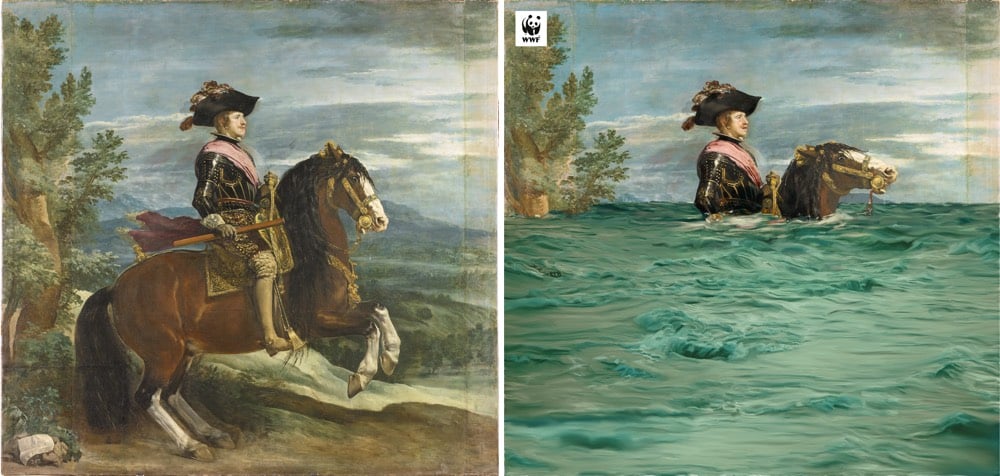
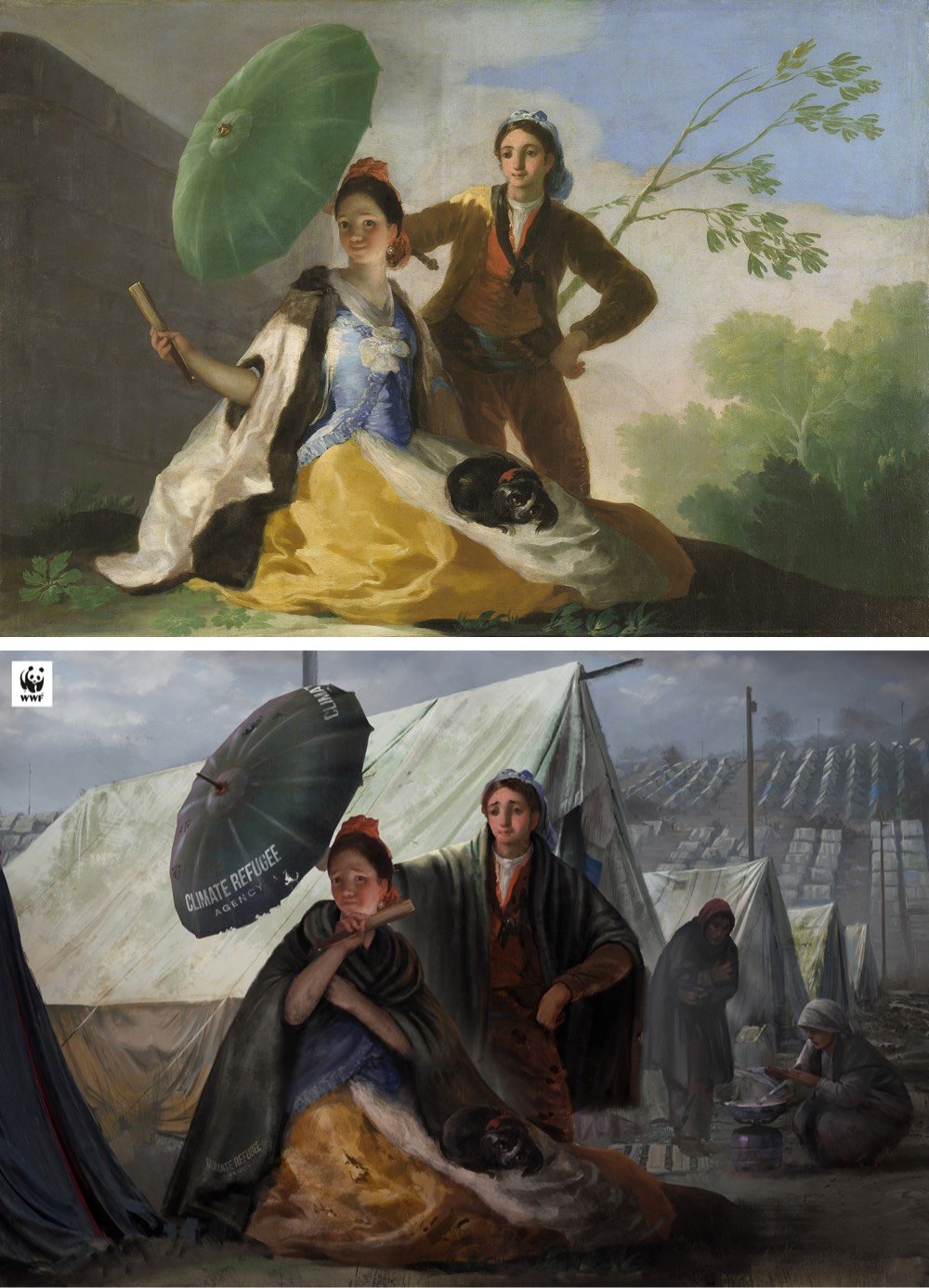
In collaboration with the Prado Museum in Madrid, the World Wildlife Fund altered a few paintings from the museum’s collection to highlight the future effects of climate change: extinction of species, sea level rise, desertification, and climate refugees.
(via open culture)
This is a little slice of genius right here, a mashup of Radiohead’s Creep and Mariah Carey’s All I Want for Christmas is You. It takes a little bit to get going but I LOL’d when the vocals finally came in.
I have to say though that it’s not quite as entertaining as this All I Want for Christmas / This Is America combo, which might actually be the best thing on the internet.
This video of the familiar tune of Pachelbel’s Canon being played by different clips of train horns all edited together is both funny and charming. If you need a little pick-me-up right now, this should do the trick. Watch for the celebrity cameo around the 1:00 mark. (via the kid should see this)
For his Ornitographies project, Xavi Bou takes photographs of birds and stitches them together into single images so that you can see their flight paths through the sky.

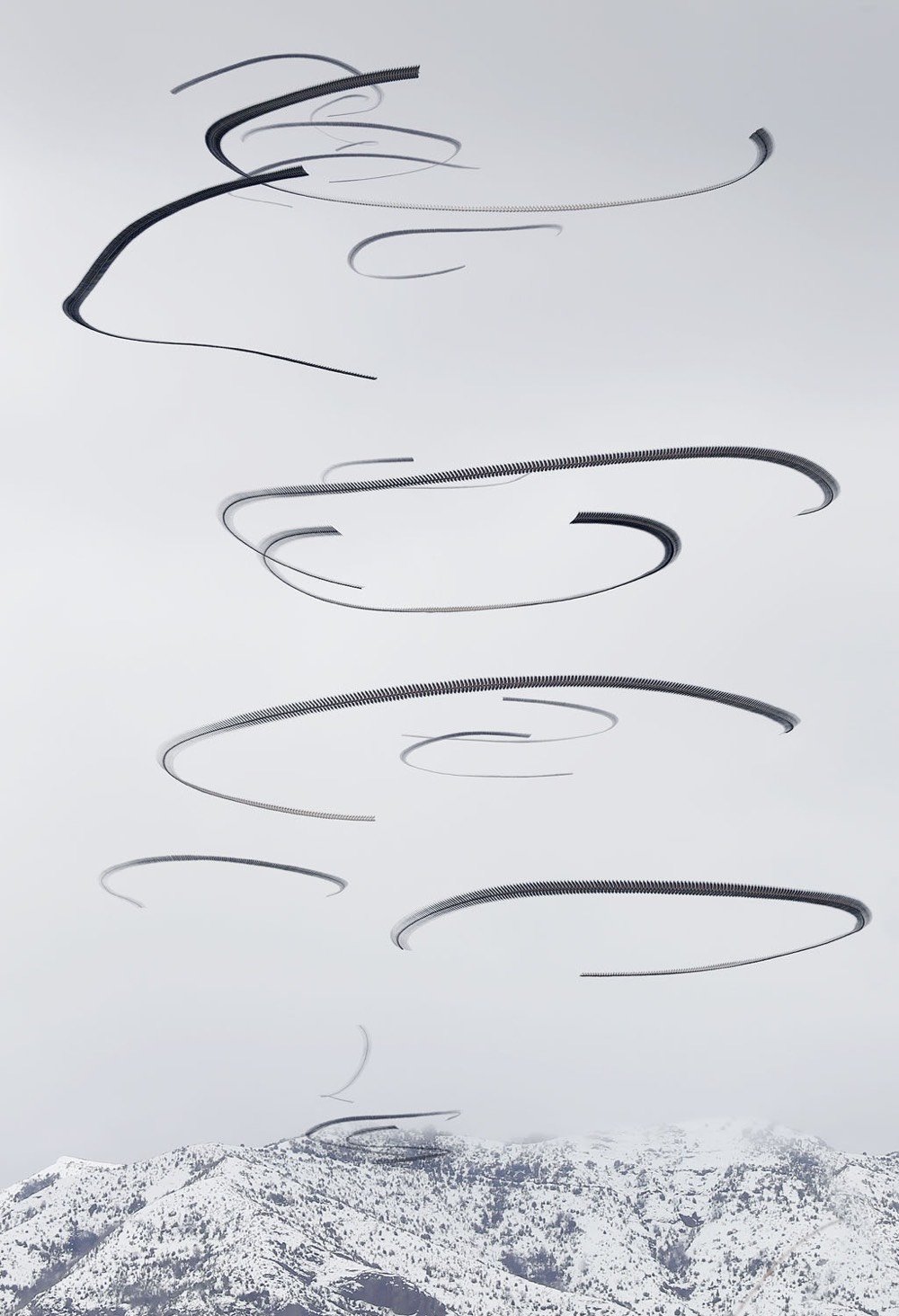

My guest editor Patrick briefly shared one of Bou’s images on his exit post a couple of weeks ago, but I thought they were worth another look.
When Neil Armstrong and Buzz Aldrin landed safely on the Moon in July 1969, President Richard Nixon called them from the White House during their moonwalk to say how proud he was of what they had accomplished. But in the event that Armstrong and Aldrin did not make it safely off the Moon’s surface, Nixon was prepared to give a very different sort of speech. The remarks were written by William Safire and recorded in a memo called In Event of Moon Disaster.
Fifty years ago, not even Stanley Kubrick could have faked the Moon landing. But today, visual effects and techniques driven by machine learning are so good that it might be relatively simple, at least the television broadcast part of it.1 In a short demonstration of that technical supremacy, a group from MIT has created a deepfake version of Nixon delivering that disaster speech. Here are a couple of clips from the deepfake speech:
Fate has ordained that the men who went to the moon to explore in peace will stay on the moon to rest in peace.
The full film is being shown at IDFA DocLab in Amsterdam and will make its way online sometime next year.
The implications of being able to so convincingly fake the televised appearance of a former US President are left as an exercise to the reader. (via boing boing)
Update: The whole film is now online. (thx, andy)
Using almost 1300 photos from Instagram of iconic/stereotypical shots of NYC, Sam Morrison spent 200 hours creating what he calls a crowdsourced hyperlapse video of the city. I love it. Reminds me a little of the old Microsoft application Photosynth, which could stitch together hundreds of online photos of, say, the Eiffel Tower or Golden Gate Bridge into a composite 3D image. (via a newly resurgent waxy.org)
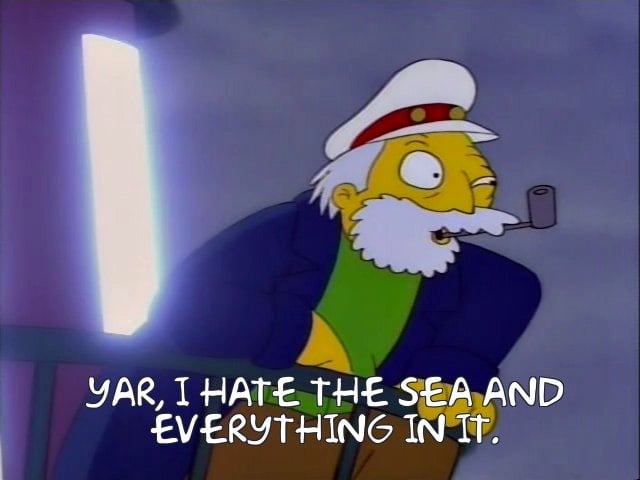
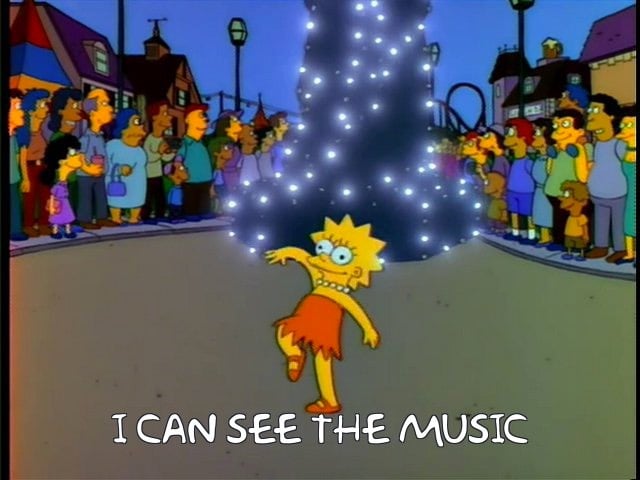
On Twitter, Hannah Woodhead posted a thread of screencaps from The Simpsons that uncannily encapsulate movies released in 2019. My two favorites are Parasite and The Lighthouse:
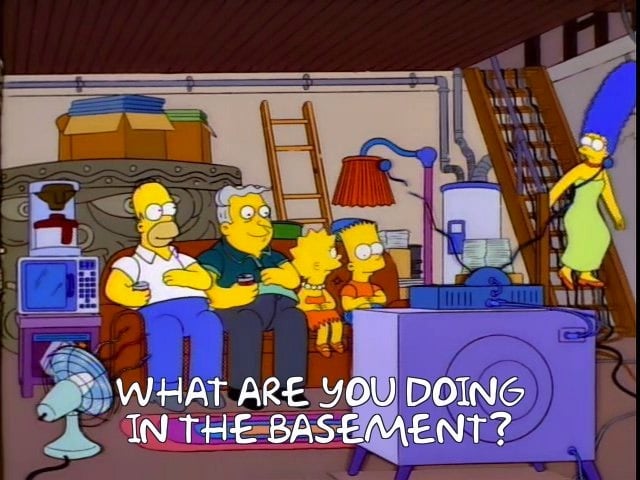
If you’d like, you can make your own using Frinkiac, the Simpsons screencap search engine. I did this one for Booksmart:
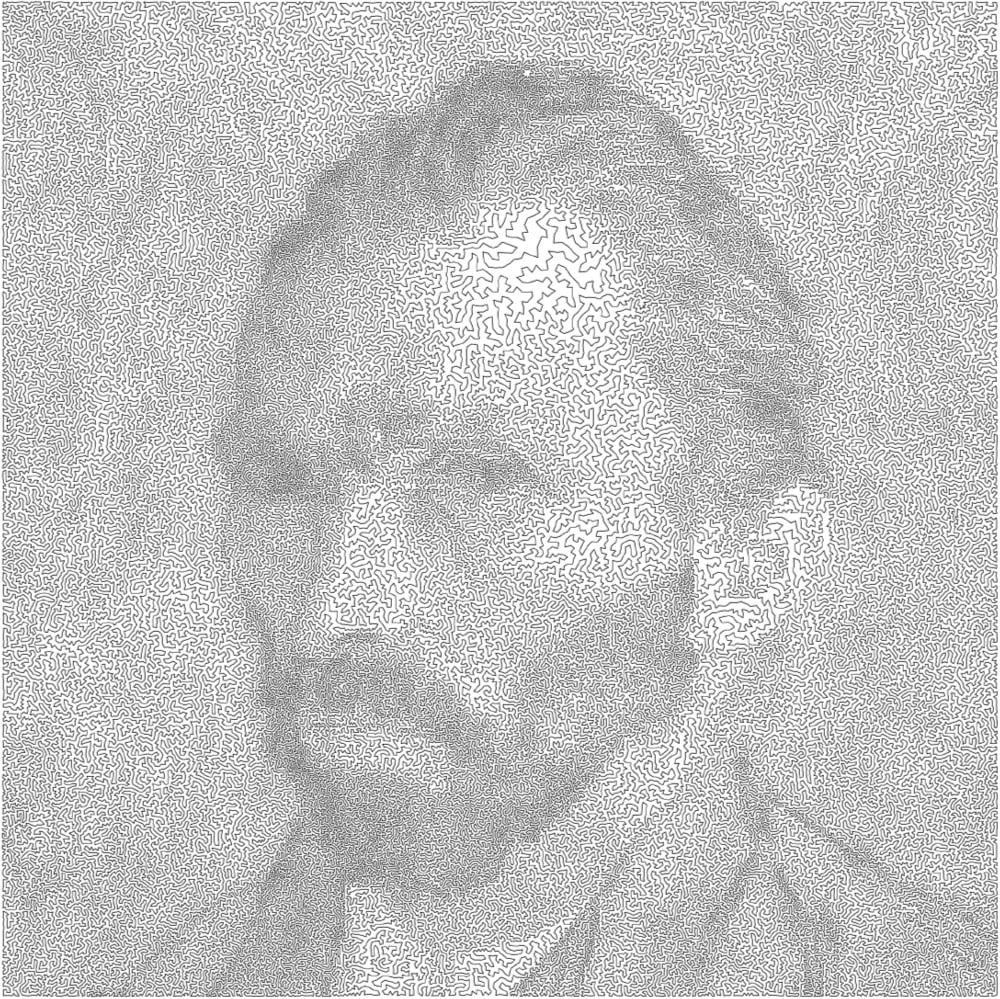

All art is bounded by one constraint or another. Mathematician Robert Bosch makes what he calls “optimization art”, which is best embodied by these images produced as solutions to the travelling salesman problem. Each image is made up of a continuous line that is the shortest possible route through a series of points without revisiting any single point, much like the optimal route of a travelling salesperson visiting cities. The rendition of a van Gogh self-portrait uses a solution for 120,000 “cities” while the single line forming the Girl with the Pearl Earring visits 200,000 cities.
I would love to see an Observable notebook where you could upload any photo to make images like these. (via @Ianmurren)
If you’re having withdrawals from Succession, perhaps this will help a little. A fan created these title sequences of iconic TV shows with the pulsing Succession theme song dubbed over them. The Wire, The Simpsons, and Mad Men are particular favorites of mine:
The Succession theme is to title sequences like what “Christ, what an asshole!” is to New Yorker cartoon captions — it even fits Happy Days (mostly):
If you’d like to try your hand at this, the theme song is available on Spotify. Its composer, Nicholas Britell, also scored Moonlight and If Beale Street Could Talk.
Emily Wilson, whose translation of The Odyssey recently reintroduced the epic to a wider non-classics audience, has now cheekily translated the tale of Odysseus into a series of limericks. She starts off:
There was a young man called Telemachus
who was bullied and in a dilemma ‘cause
he missed his lost dad
and his mom made him mad
and he almost got killed by Eurymachus.
And here’s the bit about Odysseus’ men eating the cattle of Helios, which earns them a thunderbolt from Zeus.
The men were fed up with their boss,
the rich guy, who’d gone for a doss.
They ate up the cattle,
which shortly proved fatal,
and all of their short lives were lost.
So good.
I pretty much stopped using iTunes for music when I switched to Rdio1 (and then to Spotify). So going back in there is like unearthing a time capsule of music I listened to from ~2003-2012. This morning, bored of my Spotify playlists, I dug around a little and rediscovered a cache of songs by The Moog Cookbook. The duo uses old school Moog synthesizers to make playful covers of rock & pop songs like Nirvana’s Smells Like Teen Spirit, Are You Gonna Go My Way? by Lenny Kravitz, and Ziggy Stardust by David Bowie. Their album of classic rock covers is available on Spotify:
Their debut album (which I like more) is a bit tougher to find, but you can listen to the whole thing here on YouTube:
Newer posts
Older posts


Socials & More