kottke.org posts about movies
Once again, Steven Soderbergh kept track of every book, TV show, movie, play, and short story he read or watched in 2014. A sampling: Girls, True Detective, Gone Girl, 2001 (3 times), Dr. Strangelove, Olive Kitteridge, My Struggle: Book One, Boardwalk Empire, and his black & white version of Raiders of the Lost Ark (twice).
Here are his lists for 2013 (House of Cards, Koyaanisqatsi), 2012 (This is Spinal Tap, The Lady in the Lake), 2011 (Cave of Forgotten Dreams, Senna), 2010 (Mad Men, Where Good Ideas Come From), and 2009 (Breaking Bad, Slap Shot). (via @khoi)
From Mike Hale in the NY Times, a short appreciation of Hayao Miyazaki, among the best filmmakers of his generation.
Even at its high end, in the works of the Pixar studio or the director Henry Selick, the American children’s movie (a category that these days is pretty much congruent with the animated feature film) approaches its young viewers in a different and less rewarding way. There is always a sense of the filmmakers looking across a divide at their audience, trying with various degrees of grace or desperation to create an entertainment for them, to figure out what will keep those allegedly hyperdistracted children from losing interest.
Mr. Miyazaki cares deeply about that young audience, but you get the feeling that he doesn’t waste any time trying to guess what it wants. Like other great directors of films for and about children — Carroll Ballard (“The Black Stallion”) Steven Spielberg (“E.T.”), Alfonso Cuaron (“A Little Princess” and “Harry Potter and the Prisoner of Azkaban”) — he inhabits the child’s point of view and directly communicates her joys, her trepidations and, perhaps most important, her endless curiosity.
From the excellent Art of the Title (which had a great year), the top 10 title sequences of 2014. So awesome to see Halt and Catch Fire take the top spot. And Too Many Cooks!
The end credits for The Boxtrolls, a stop motion animation film by Laika, is a clever time lapse sequence showing the work that goes into moving the characters. You can tell how long it takes by how often the animator’s outfit changes.
Christopher Jobson of Colossal writes:
I first saw Boxtrolls in the theater last September with my son, and this single scene caused a more vocal response from the audience than any other moment in the entire movie. People were literally gasping, myself included.
The Boxtrolls is already available for purchase on Amazon…might have to watch this with the kids soon.
Hiro teaching Baymax how to fist bump in Big Hero 6.
Update: Jason Porath smartly speculates that Big Hero 6’s fist bump scene was a social media snack sized moment inserted into the movie for marketing purposes, which is part of a larger industry trend.
I don’t have a good word to describe this phenomenon, so I’m going to term it “hashgags.” This is a joke in an animated movie, usually input at the behest of marketing forces, that is used to sell the movie. It’s usually inserted late into production and test screened to within an inch of its life. Some are used repeatedly, some are one-offs that do well with trailers. And it is crippling the entire industry.
From Every Frame a Painting, an appreciation of Jackie Chan and his particular and excellent brand of action comedy.
I love old Jackie Chan movies. When I lived in Minneapolis, a theater there showed them on Saturday nights, late. Drunken Master II is a particular favorite…the final fight scene is AMAZING. The part about how the camera never moves and shoots wide-angle during his scenes is why action in contemporary Hollywood films leaves me yawning.

When I first saw it during the magical movie year of 1999, Hayao Miyazaki’s Princess Mononoke completely blew me away. Now that it’s (finally!) out on Blu-ray1, I can’t wait to see it again. Bonus: the ability to watch in the original Japanese with English subtitles.
From Mallory Ortberg, some reviews of children’s movies penned by objectivist Ayn Rand.
“Mary Poppins”
A woman takes a job with a wealthy family without asking for money in exchange for her services. An absurd premise. Later, her employer leaves a lucrative career in banking in order to play a children’s game. -No stars.
During the production of 2001: A Space Odyssey, Stanley Kubrick commissioned well-known film score composer Alex North to do the score for the film. North had previously done scores for A Streetcar Named Desire, Spartacus, Cleopatra, and Who’s Afraid of Virginia Woolf? and later received an honorary Oscar for his lifetime of work. As production progressed, Kubrick began to feel that the temporary music he used to edit the film was more appropriate. From an interview with Kubrick by Michel Ciment:
However good our best film composers may be, they are not a Beethoven, a Mozart or a Brahms. Why use music which is less good when there is such a multitude of great orchestral music available from the past and from our own time? When you’re editing a film, it’s very helpful to be able to try out different pieces of music to see how they work with the scene. This is not at all an uncommon practice. Well, with a little more care and thought, these temporary music tracks can become the final score. When I had completed the editing of 2001: A Space Odyssey, I had laid in temporary music tracks for almost all of the music which was eventually used in the film. Then, in the normal way, I engaged the services of a distinguished film composer to write the score. Although he and I went over the picture very carefully, and he listened to these temporary tracks (Strauss, Ligeti, Khatchaturian) and agreed that they worked fine and would serve as a guide to the musical objectives of each sequence he, nevertheless, wrote and recorded a score which could not have been more alien to the music we had listened to, and much more serious than that, a score which, in my opinion, was completely inadequate for the film.
And so the temporary music became the iconic score we know today. For comparison, the embedded video shows how North’s original score would have sounded over the opening credits and initial scene.
Selections from North’s original score were later released publicly. Here’s a 38-minute album on Spotify:
Kubrick was absolutely right to ditch North’s score…it’s perfectly fine music but totally wrong for the movie, not to mention it sounds totally dated today. The classical score gives the film a timeless quality, adding to the film’s appeal and reputation more than 45 years later. (via @UnlikelyWorlds)
Update: Two additional facets to this story. North first learned that Kubrick ditched his score at the NYC premiere of the film; he was reportedly (and understandably) “devastated”. And even when Kubrick was artistically satisfied with the music he chose, negotiations to procure the rights weren’t necessarily smooth.
2) Kubrick’s associates did obtain licenses from Ligeti’s publishers and from record and radio companies, although they were not forthcoming about the pivotal role assigned to the music in the film; 3) Ligeti learned about the use of his music not from his publishers but from members of the Bavarian Radio Chorus; 4) he attended a showing of the film with stopwatch in hand, furiously scribbling down timings — thirty-two minutes in all;
Kubrick was undoubtably of the “shoot first, ask questions later” school of negotiation. (via @timrosenberg)
The Kingdom of Dreams and Madness is a documentary which presents a year in the life of Studio Ghibli and its famed director, Hayao Miyazaki. The year in question was a particularly interesting one during which Miyazaki announced his retirement. The trailer:
Granted near-unfettered access to the notoriously insular Studio Ghibli, director Mami Sunada follows the three men who are the lifeblood of Ghibli — the eminent director Hayao Miyazaki, the producer Toshio Suzuki, and the elusive and influential “other director” Isao Takahata — over the course of a year as the studio rushes to complete two films, Miyazaki’s The Wind Rises and Takahata’s The Tale of The Princess Kaguya. The result is a rare “fly on the wall” glimpse of the inner workings of one of the world’s most celebrated animation studios, and an insight into the dreams, passion and singular dedication of these remarkable creators.
(via @garymross)
Update: The Kingdom of Dreams and Madness is now available for rent/buy on Amazon and iTunes.
Somehow I didn’t know that Zoolander (which Terrence Malick and I both love and Roger Ebert hated) began as a short clip Ben Stiller did for the 1996 VH1 Fashion Awards.
(via the dissolve)
The soundtrack for PT Anderson’s Inherent Vice is now on Spotify, well all except for one song. The album is even more partially on Rdio. For the whole thing, you’ll have to head to Amazon.
The fifth track, Spooks, is a variation of a Radiohead song that’s never been officially released. (via @naserca)
Legal scholar Cass Sunstein presents his annual list of the movies that best showcased behavioral economics for 2014.
Best actor: In 1986, behavioral scientists Daniel Kahneman and Dale Miller developed “norm theory,” which suggests that humans engage in a lot of counterfactual thinking: We evaluate our experiences by asking about what might have happened instead. If you miss a train by two minutes, you’re likely to be more upset than if you miss it by an hour, and if you finish second in some competition, you might well be less happy than if you had come in third.
“Edge of Tomorrow” spends every one of its 113 minutes on norm theory. It’s all about counterfactuals — how small differences in people’s actions produce big changes, at least for those privileged to relive life again (and again, and again). Tom Cruise doesn’t get many awards these days, or a lot of respect, and we’re a bit terrified to say this — but imagine how terrible we’d feel if we didn’t: The Top Gun wins the Becon.
(via @tylercowen)
Finally, courtesy of the Auralnauts, we get the Terminator trailer that we deserve. Time travel is hilarious.
I wish we could send you back with pants, but the technology just isn’t there yet. So as soon as you hit the ground, you’re going to want to find some pants. I know you can do it…because you already did it.
Like the old wives’ tale says, if you want to fix the future, just keep sending Terminators back in time. (via @mouser_nerdbot)
Adrian Curry selects his favorites for the best movie posters of 2014. This one, for Gabe Polsky’s Red Army, caught my eye:
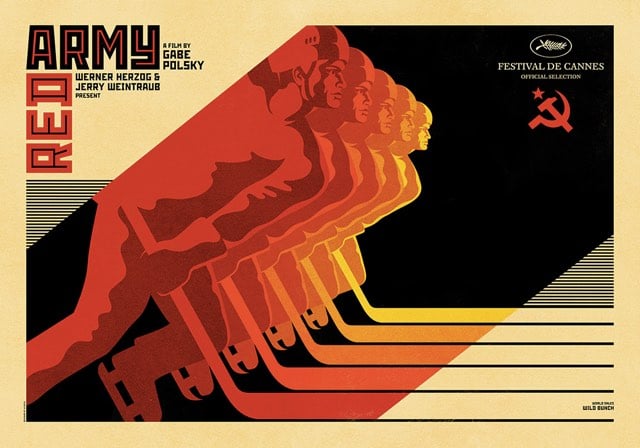
See also the best poster lists from Empire, Entertainment Weekly, and Indiewire. (via subtraction)
Newer posts
Older posts





Socials & More