



Paramount Studio location map of California
Published in 1927 in a publication called The Motion Picture Industry as a Basis for Bond Financing, this map shows what locations in California look like other places from around the world.

(via flickr)

This site is made possible by member support. 💞
Big thanks to Arcustech for hosting the site and offering amazing tech support.
When you buy through links on kottke.org, I may earn an affiliate commission. Thanks for supporting the site!
kottke.org. home of fine hypertext products since 1998.
Beloved by 86.47% of the web.
Published in 1927 in a publication called The Motion Picture Industry as a Basis for Bond Financing, this map shows what locations in California look like other places from around the world.
(via flickr)
Fourth-grader Zachary Maxwell is making a short documentary film about the lunch program at his New York City public school. It’s called Yuck.
In the fall of 2011, fourth grader Zachary Maxwell began asking his parents if he could start packing and bringing his own lunch to school. Unfortunately, they kept insisting that he take advantage of the hot lunch being served at the school. After all, the online menu sounded delicious and the NYC Department of Education (DOE) website assured parents that the meals were nutritious. Zachary wanted to convince his parents that the online menu did not accurately represent what was really being served at his school.
Here’s a short clip in which Zachary compares the special salads concocted by celebrity chefs Rachael Ray and Ellie Krieger for use in NYC public schools to the sad reality.
This is awesome. I mean, the lunches aren’t awesome, but Zachary is.
A recent episode of Planet Money explores what the movie Trading Places can teach us about financial markets.
On today’s show, we talk to commodities traders to answer one of the most important questions in finance: What actually happens at the end of Trading Places?
We know something crazy happens on the trading floor. We know that Eddie Murphy and Dan Aykroyd get rich and the Duke brothers lose everything. But how does it all happen? And could it happen in the real world?
Also on the show: The “Eddie Murphy Rule” that wound up in the the big financial overhaul law Congress passed in 2010.
One of my favorite movie moments is Eddie Murphy’s breaking of the fourth wall in this Trading Places scene:
What if William Shakespeare wrote Star Wars?

Boing Boing has an excerpt.
Lena Dunham shares her fifteen favorite Criterion films, saying she’s embarrassed that “so many of these films are in English, but I just love speaking English”.
Back in November, I posted about the effort of the filmmakers of Capturing the Friedmans to prove the innocence of one of the film’s subjects, Jesse Friedman. On Monday, a 168-page report released by the Nassau County District Attorney’s office found that there was enough evidence to charge and convict Friedman of sexual molestation of minors.
Friedman, his supporters and the makers of the Academy Award-nominated documentary have long maintained he was railroaded into pleading guilty to charges he molested 13 kids in the late 1980s, and were expecting the report to exonerate him.
It did the opposite.
Friedman, they found, was labeled a “psychopathic deviant” by his own shrink, and had actually sexually abused a total of 17 children.
“The District Attorney concludes that Jesse Friedman was not wrongfully convicted,” the blistering 172-page report says.
“In fact, by any impartial analysis, the investigation process prompted by Jesse Friedman … has only increased confidence in the integrity of Jesse Friedman’s guilty plea adjudication as a sex offender.”
The panel said it interviewed three of Friedman’s now-adult victims. “Each confirmed that he was sexually abused by Jesse Friedman. Each told their separate story, marked by pain and recovery,” and “recounted years of shame and humiliation,” the report said.
The Washington Post has more. (via @DavidGrann)
This made me Laugh Out Loud for reals…Simone Rovellini doctors clips from movies to make actresses’ heads explode. The first clip features Dirty Dancing, When Harry Met Sally, Pretty Woman, and Ghost:
And this one features a bunch of Disney princesses:
More videos and animated GIFs on the Exploding Actresses Tumblr. (via @scottlamb)
From filmmakers Leah Wolchok and Davina Pardo comes a documentary about New Yorker cartoons called Very Semi-Serious. They are soliciting funds to finish the film on Kickstarter.

I cold emailed cartoon editor Bob Mankoff, and-to my surprise-he called me right away. So I flew to New York for the New Yorker festival, met all the cartoonists I’d been reading about, and pitched him my idea. An epic film about the past, present and future of cartooning at the New Yorker! The definitive documentary about his beloved craft, his beloved cartoonists, his beloved hair! How could he say no? He said no.
But that was 6 years ago, when I was too young and too nice. Now I’m going gray and getting crabby, and I’ve recruited the talented New York filmmaker Davina Pardo to produce the film with me. Bob has given us amazing access to the cartoon department and we are deep into production on the film.
Prints of that cartoon are also available.
New prints in the Dorothy shop: these really cool Hollywood Star Charts, available in Golden Age and Modern Day editions.

The Modern Day version of our Hollywood Star Chart features constellations named after some of the most culturally significant films to have appeared on the silver screen since 1960 - present day. The stars that make up the clusters are the Hollywood stars that appeared in them.
The chart is based on the night sky over New York on June 16th 1960 — the date of the first showing of Hitchcock’s ‘Psycho’ at the DeMille Theater. With its new approach to storytelling, characterisation and violence it is seen as a key movie in the start of the post-classical era of Hollywood.
The 108 films featured include those chosen for preservation in the US National Film Registry due to their cultural, historical, or aesthetic significance; Academy Award winners; and a few personal favourites. Films include Easy Rider, Bonnie and Clyde, The Exorcist, The Godfather, Chinatown, Star Wars, Pulp Fiction and Avatar.
You may remember Dorothy from their movie name maps.
Here are a few clips from Christian Marclay’s The Clock that have been surreptitiously filmed and uploaded to YouTube and Vimeo.
The clips are crappy bootlegs that cut off part of the screen, but I still totally get sucked in after 30 seconds of each clip.
An extensive examination of the evolution of the Star Wars logo, which went through too many iterations to count.
..Though the poster contained no painted imagery, it did introduce a new logo to the campaign, one that had been designed originally for the cover of a Fox brochure sent to theater owners….Suzy Rice, who had just been hired as an art director, remembers the job well. She recalls that the design directive given by Lucas was that the logo should look “very fascist.”
“I’d been reading a book the night before the meeting with George Lucas,” she says, “a book about German type design and the historical origins of some of the popular typefaces used today — how they developed into what we see and use in the present.” After Lucas described the kind of visual element he was seeking, “I returned to the office and used what I reckoned to be the most ‘fascist’ typeface I could think of: Helvetica Black.”
(via df)
Executive produced by Errol Morris and Werner Herzog, The Act of Killing is a documentary directed by Joshua Oppenheimer about a group of Indonesian mass murderers.
In The Act of Killing, Anwar and his friends agree to tell us the story of the killings. But their idea of being in a movie is not to provide testimony for a documentary: they want to star in the kind of films they most love from their days scalping tickets at the cinemas. We seize this opportunity to expose how a regime that was founded on crimes against humanity, yet has never been held accountable, would project itself into history.
And so we challenge Anwar and his friends to develop fiction scenes about their experience of the killings, adapted to their favorite film genres — gangster, western, musical. They write the scripts. They play themselves. And they play their victims.
Wow. (via @aaroncoleman0)
Update: It expires today, but The Act of Killing is available to watch for free on PBS. After today, try Amazon.
Of course the watches worn by the characters in Fantastic Mr. Fox are going to be classic 70s and 80s timepieces.

From XKCD, a chart of the memes that various star systems are just hearing from the Earth’s light-speed communications.
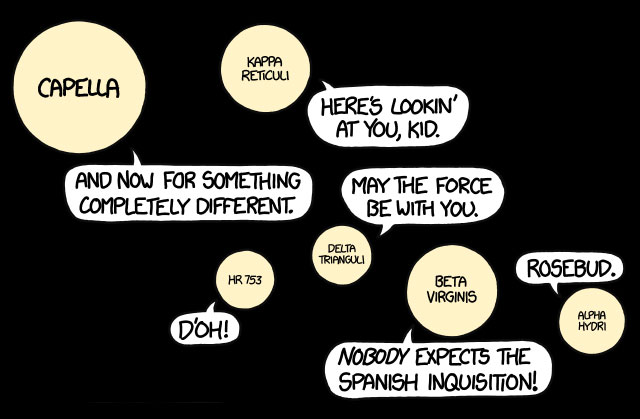
This is the meme version of Contact’s opening credits scene, which is one of my favorites:
There are a lot of outdoor movies showing in NYC this summer: here’s a listing of the whats, wheres, and whens. Movies include The Goonies, Jaws, Duck Soup, Moonrise Kingdom, Grease, and Blade Runner.
A nice short analysis by filmmaker Steven Benedict of the themes expressed and techniques used by Steven Spielberg in his films.
Stanley Kubrick: A Life in Pictures is a documentary released in 2001 about Stanley Kubrick. Narrated by Tom Cruise, the film was directed by his long-time assistant Jan Harlan and features interviews of many actors from Kubrick’s films as well as other noted directors like Spielberg and Scorsese. The entire thing is available on YouTube:
You can also rent/buy on Amazon or rent/buy on iTunes.
At the recent San Francisco Internation Film Festival, Steven Soderbergh gave a keynote about the current state of cinema. It is worth reading if you enjoy movies or are engaged in any sort of creative work.
But before we talk about movies we should talk about art in general, if that’s possible. Given all the incredible suffering in the world I wonder, what is art for, really? If the collected works of Shakespeare can’t prevent genocide then really, what is it for? Shouldn’t we be spending the time and resources alleviating suffering and helping other people instead of going to the movies and plays and art installations? When we did Ocean’s Thirteen the casino set used $60,000 of electricity every week. How do you justify that? Do you justify that by saying, the people who could’ve had that electricity are going to watch the movie for two hours and be entertained - except they probably can’t, because they don’t have any electricity, because we used it. Then I think, what about all the resources spent on all the pieces of entertainment? What about the carbon footprint of getting me here? Then I think, why are you even thinking that way and worrying about how many miles per gallon my car gets, when we have NASCAR, and monster truck pulls on TV? So what I finally decided was, art is simply inevitable. It was on the wall of a cave in France 30,000 years ago, and it’s because we are a species that’s driven by narrative. Art is storytelling, and we need to tell stories to pass along ideas and information, and to try and make sense out of all this chaos. And sometimes when you get a really good artist and a compelling story, you can almost achieve that thing that’s impossible which is entering the consciousness of another human being - literally seeing the world the way they see it. Then, if you have a really good piece of art and a really good artist, you are altered in some way, and so the experience is transformative and in the minute you’re experiencing that piece of art, you’re not alone. You’re connected to the arts. So I feel like that can’t be too bad.
Update: If you prefer to watch the speech, have at it:
(via @MikeShefferNJ)
Upstream Color is now available for viewing, buying, and downloading with a wide array of options. Among them, DRM-free digital download, Blu-ray/DVD from Amazon, rent/buy at Amazon, and buy on iTunes.
Caroline Rothstein on how Kids came about and what happened to the young actors who starred in the film.
Two decades after a low-budget film turned Washington Square skaters into international celebrities, the kids from Kids struggle with lost lives, distant friendships, and the fine art of growing up.
The Hangover Part III is out later in the month and the Hollywood Reporter has an oral history of the making of the first two movies.
HELMS: I was always the nervous Nelly about those jokes. Zach was going to get arrested for the baby thing.
PHILLIPS: Jerking the baby off at Caesars.
GALIFIANAKIS: I did it first with the doll that was just sitting there while we were setting up the shot. I showed Todd, and he goes, “Let’s go ask the parents if we can do that.” (Laughter.) I’m like, “No.”
PHILLIPS: I waited for the [baby’s] mom to go upstairs because the mom was a little bit more not into stuff like that. I go to the dad: “It would be funny if Zach pretends to do this. Would you have a problem with that?” And he literally goes: “[My wife is] going to be gone for a half-hour. Can you do it in the next half-hour?”
COOPER: “Can you jerk my kid off in a half-hour?” (Laughter.)
Steven Spielberg is doing a sequel to Lincoln called Obama and he got Daniel Day-Lewis to play the lead. I knew Day-Lewis was good, but this is bonkers.
Caught The Central Park Five on PBS last night and it’s one of those films that puts you into rage-against-the-machine mode.
The Central Park Five, a new film from award-winning filmmaker Ken Burns, tells the story of the five black and Latino teenagers from Harlem who were wrongly convicted of raping a white woman in New York City’s Central Park in 1989. The film chronicles The Central Park Jogger case, for the first time from the perspective of these five teenagers whose lives were upended by this miscarriage of justice.
The entire film is available to watch on the PBS web site. Tonight, there’s a TimesTalk in NYC featuring Ken Burns, Sarah Burns, Times columnist Jim Dwyer, and all five of the exonerated men; the talk will be broadcast live on the web here.
Deceptive Practice is a documentary about Ricky Jay which features, among other things, a shaggy-haired Jay playing Three-card Monte with Steve Martin on an 80s chat show.
Jay is a fascinating guy, as this 1993 New Yorker profile of him by Mark Singer demonstrates.
Ricky Jay, who is perhaps the most gifted sleight-of-hand artist alive, was performing magic with a deck of cards. Also present was a friend of Mamet and Mosher’s named Christ Nogulich, the director of food and beverage at the hotel. After twenty minutes of disbelief-suspending manipulations, Jay spread the deck face up on the bar counter and asked Nogulich to concentrate on a specific card but not to reveal it. Jay then assembled the deck face down, shuffled, cut it into two piles, and asked Nogulich to point to one of the piles and name his card.
“Three of clubs,” Nogulich said, and he was then instructed to turn over the top card.
He turned over the three of clubs.
Mosher, in what could be interpreted as a passive-aggressive act, quietly announced, “Ricky, you know, I also concentrated on a card.”
After an interval of silence, Jay said, “That’s interesting, Gregory, but I only do this for one person at a time.”
Mosher persisted: “Well, Ricky, I really was thinking of a card.”
Jay paused, frowned, stared at Mosher, and said, “This is a distinct change of procedure.” A longer pause. “All right-what was the card?”
“Two of spades.”
Jay nodded, and gestured toward the other pile, and Mosher turned over its top card.
The deuce of spades.
A small riot ensued.
Anyway, the film is coming out next week in NYC. (via @aaroncoleman0)
Oh hello, what’s this? M83 did the soundtrack to Oblivion, the new sci-fi movie where Tom Cruise plays Wall-E? That will do quite nicely. Here it is on iTunes, Amazon, or Rdio.
In an interview last month with Esquire’s Eric Spitznagel, Michel Gondry talked about his newest movie, The We and the I, and about how time travel is depressing.
ES: In your real life. If you, Michel Gondry, found a time machine and could go anywhere, to any period in history, where would you take it?
MG: I would travel back a few years ago and fix some screw-up I did.
ES: A personal or professional screw-up?
MG: In my personal life.
ES: Can you be more specific?
MG: I would come back and say yes to a girl. That’s all. Actually, I find the whole idea of traveling back in time to be profoundly depressing.
ES: Really? Why so?
MG: Because I know the future. Living in the past, it would feel weird to know what’s going to happen next. You couldn’t escape it. That future’s already in your head. You know it doesn’t get better.
ES: You’d rather not know about the future?
MG: The future is about hope. If you travel from the present to the past, you don’t have that hope anymore. You know how everything turns out.
ES: There are no surprises.
MG: No surprises, exactly! To me, that just sounds so… depressing.
Earlier today, I linked to a post by Roger Ebert announcing his leave of presence. The Chicago Sun-Times has announced that Ebert died today at 70.
Ebert, 70, who reviewed movies for the Chicago Sun-Times for 46 years and on TV for 31 years, and who was without question the nation’s most prominent and influential film critic, died Thursday in Chicago. He had been in poor health over the past decade, battling cancers of the thyroid and salivary gland.
He lost part of his lower jaw in 2006, and with it the ability to speak or eat, a calamity that would have driven other men from the public eye. But Ebert refused to hide, instead forging what became a new chapter in his career, an extraordinary chronicle of his devastating illness that won him a new generation of admirers. “No point in denying it,” he wrote, analyzing his medical struggles with characteristic courage, candor and wit, a view that was never tinged with bitterness or self-pity.
Always technically savvy - he was an early investor in Google - Ebert let the Internet be his voice. His rogerebert.com had millions of fans, and he received a special achievement award as the 2010 “Person of the Year” from the Webby Awards, which noted that “his online journal has raised the bar for the level of poignancy, thoughtfulness and critique one can achieve on the Web.” His Twitter feeds had 827,000 followers.
Ebert was both widely popular and professionally respected. He not only won a Pulitzer Prize - the first film critic to do so - but his name was added to the Hollywood Walk of Fame in 2005, among the movie stars he wrote about so well for so long. His reviews were syndicated in hundreds of newspapers worldwide.
Rest in peace, Roger. And fuck cancer.
Sad news from Chicago: Roger Ebert’s cancer has returned and he’s taking what he calls a “leave of presence” to focus on recovery and a few different projects.
What in the world is a leave of presence? It means I am not going away. My intent is to continue to write selected reviews but to leave the rest to a talented team of writers handpicked and greatly admired by me. What’s more, I’ll be able at last to do what I’ve always fantasized about doing: reviewing only the movies I want to review.
At the same time, I am re-launching the new and improved Rogerebert.com and taking ownership of the site under a separate entity, Ebert Digital, run by me, my beloved wife, Chaz, and our brilliant friend, Josh Golden of Table XI. Stepping away from the day-to-day grind will enable me to continue as a film critic for the Chicago Sun-Times, and roll out other projects under the Ebert brand in the coming year.
Love that first sentence. Get well soon, Roger.
Streaming music service Rdio (which I have been enjoying the hell out of for the past couple months1) is launching a streaming video service called Vdio.
The first thing you’ll notice about Vdio is that it’s designed to solve the “what to watch” problem. It’s not just that we’ve got amazing content, but that the experience is now geared to get you from searching to watching faster. We’re introducing the notion of Sets — playlists for TV shows and movies — so anyone can make and share lists of their favorites, making it easier than ever to discover new stuff. Or, you can just check out what your friends are watching in the moment and jump in. Beyond that, Vdio has the beautiful design and social features that people love about Rdio, with plenty more to come.
I haven’t played with it too much, but it looks like it’s not an all-you-can-eat service like Rdio…you buy/rent movies and TV shows just like iTunes, Amazon, etc.
[1] And that’s actually a huge understatement. I ignored streaming music services like Rdio and Spotify when they came out, opting for the familiarity of iTunes, but Rdio has completely reignited my love of music over the past two months. Should write a whole post about this at some point. ↩
Caught a rerun of an episode of This American Life on reruns the other day. The first segment is about a movie I’d never heard about before, The Beaver Trilogy. I don’t want to spoil it too much (the Wikipedia page contains spoilers as well) but the first part of the film features documentary footage of a kid from Beaver, Utah doing impressions and putting on a talent show. The second and third parts are recreations of that footage featuring, well, just listen to the story or watch the first two parts of the movie for yourself (one, two). (thx, @eventi)
Socials & More