kottke.org posts about food
Kenji Lopez-Alt and the folks at the Harlem Shake restaurant have invented a burger that’s all delicious brown crust.
See, by placing a ball of meat on a hot, un-oiled griddle and smashing it down firmly into a flat, thin disk, you greatly increase the contact points between the meat and the griddle, which in turn increases the Maillard reaction. That’s the series of chemical reactions that creates the rich brown crust that makes our steaks and burgers taste so freaking good. Maximum crust = maximum flavor = maximum craving.
I’ve already discussed the basic ins and outs of smashed burgers in the past, but after writing that article, I found myself wondering, what if I were to take this to the extreme? Is there a way I can pack even more flavor into a burger?
Spoiler alert: the answer is a big fat (or should I say short smashed?) yes.
Legendary designer Milton Glaser (of I❤NY fame) critiques craft beer labels.
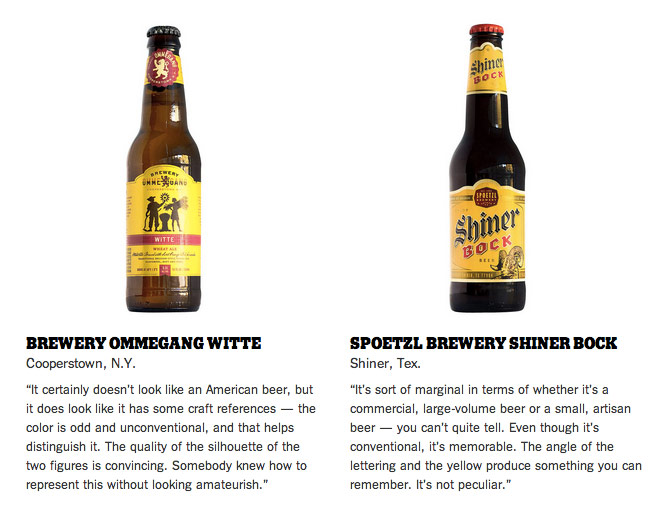
(via @bn2b)
Errol Morris has directed a new series of Taco Bell commercials where a bunch of ordinary men named Ronald McDonald review Taco Bell’s new breakfast menu. Here’s one of the spots:
Khoi Vinh tells us how he really feels about coffee.
In the West, and particularly in urban centers of the United States, we’ve turned coffee into not just a daily habit, but a totem of conspicuous consumption. They are “rituals of self-congratulation” (a choice phrase I believe I read from Sam Sifton, but which I can’t seem to source) wherein we continually obsess over certain coffee purveyors or certain methods of brewing coffee - each new one more complex, more Rube Goldbergian and more comically self-involved than the previous brewing fad.
I don’t drink coffee either (don’t even like the smell), but as someone who regularly indulges in other addictions and “rituals of self-congratulation”, I don’t take issue with other people’s enjoyment of coffee…as long as I’m out of earshot when the “perfect grinder for pulling a great shot” discussion starts.
Coffee, like almost everything else these days, is a sport. Everyone has a favorite team (or coffee making method or political affiliation or design style or TV drama or rapper or comic book), discusses techniques and relives great moments with other likeminded fans, and argues with fans of other teams. The proliferation and diversification of media over the past 35 years created thousands of new sports and billions of new teams. These people turned hard-to-find nail polish into a sport. These people support Apple in their battle against Microsoft and Samsung. This guy scouts fashion phenoms on city streets. Finding the best bowl of ramen in NYC is a sport. Design is a sport. Even hating sports is a sport; people compete for the funniest “what time is the sportsball match today? har har people who like sports are dumb jocks” joke on Twitter. Let people have their sports, I say. Liking coffee can’t be any worse than liking the Yankees, can it?
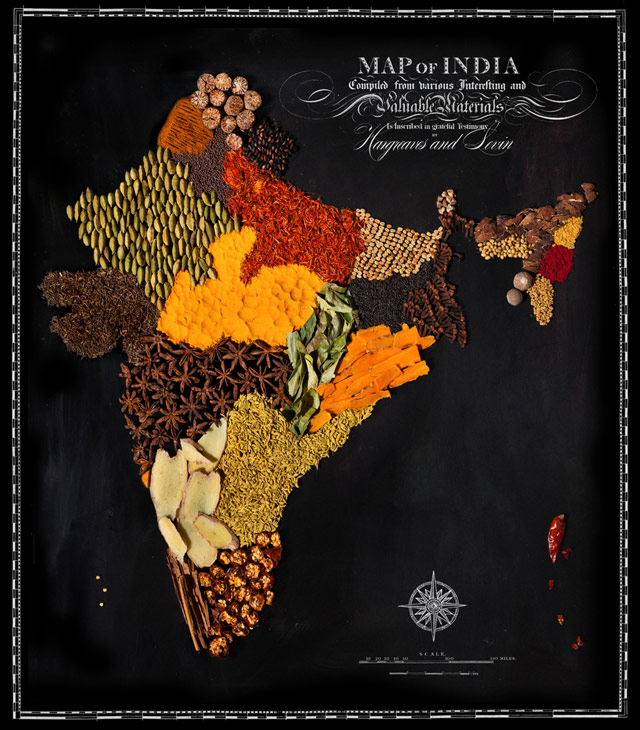
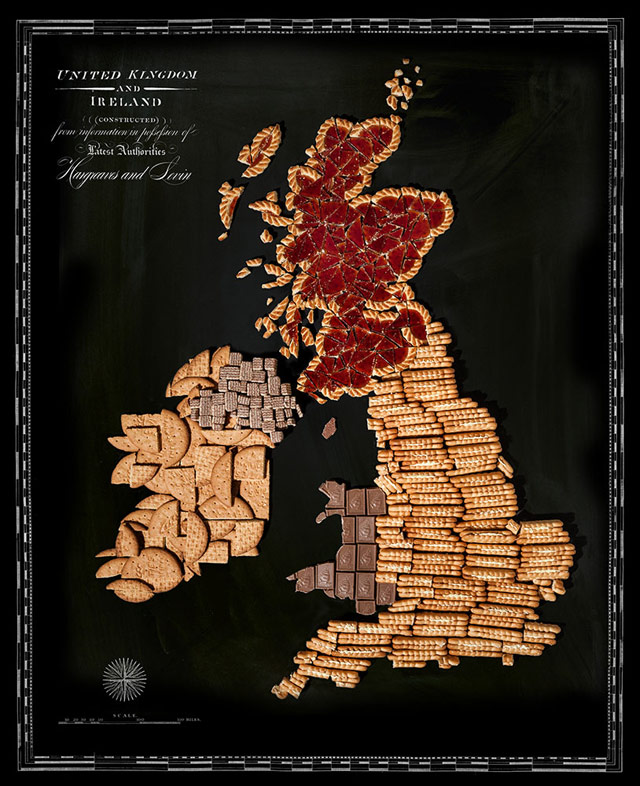
Henry Hargreaves and Caitlin Levin favor food as a medium for creating art. Their country maps made from native foods were cute at first glance, but in many cases the maps also reveal a link between a country’s food and its culture that I’d never really thought about before. For instance, the maps of India and British Isles feel very representative of their respective cultures to me:
A master chef from a Hokkaido sushi restaurant shows how to make dashimaki tamago, a Japanese rolled omelette.
Watching people who are good at what they do never gets old. (via swiss miss)
A group of marine biologists that has been recently studying mesopelagic fish (“fish that live between 100 and 1000m below the surface”) believes that 95% of fish biomass is unknown to humans. Marine dark matter. The problem lies with how fish have traditionally been counted and the enhanced visual and pressure senses of these fish.
He says most mesopelagic species tend to feed near the surface at night, and move to deeper layers in the daytime to avoid birds.
They have large eyes to see in the dim light, and also enhanced pressure-sensitivity.
“They are able to detect nets from at least five metres and avoid them,” he says.
“Because the fish are very skilled at avoiding nets, every previous attempt to quantify them in terms of biomass that fishing nets have delivered are very low estimates.
“So instead of different nets what we used were acoustics… sonar and echo sounders.”
A not-so-difficult prediction to make is that humans will find a way to catch these wary creatures, we’ll eat most of them, and then we’ll be back to where we are now: the world’s oceans running low on fish. (via @daveg)

Have you ever wanted to taste Kanye West’s meat? Then what is wrong with you and what is wrong with these people?!?! They want to take tissue samples from celebrities like James Franco, Kanye, and Jennifer Lawrence and make artisanal salami out of them.
It all starts with your favorite celebrities, and a quick biopsy to obtain tissue samples. Isolating muscle stem cells, we grow celebrity meat in our proprietary bioreactors. In the tradition of Italian cured meats, we dry, age, and spice our product into fine charcuterie.
Note: BiteLabs might be completely fake. But fake is the new real so… nope, this is just fake.
According to an article in The Journal of the American Medical Association, the obesity rate of American 2- to 5-year-old children has dropped from 14% in 2004 to 8% in 2012.
Children now consume fewer calories from sugary beverages than they did in 1999. More women are breast-feeding, which can lead to a healthier range of weight gain for young children. Federal researchers have also chronicled a drop in overall calories for children in the past decade, down by 7 percent for boys and 4 percent for girls, but health experts said those declines were too small to make much difference.
Barry M. Popkin, a researcher at the University of North Carolina at Chapel Hill who has tracked American food purchases in a large data project, said families with children had been buying lower-calorie foods over the past decade, a pattern he said was unrelated to the economic downturn.
He credited those habits, and changes in the federally funded Special Supplemental Nutrition Program for Women, Infants and Children, for the decline in obesity among young children. The program, which subsidizes food for low-income women, reduced funding for fruit juices, cheese and eggs and increased it for whole fruits and vegetables.
Kevin Drum calls the drop “baffling”.
Planet Money: always buy the bigger pizza because geometry.
The math of why bigger pizzas are such a good deal is simple. A pizza is a circle, and the area of a circle increases with the square of the radius.
So, for example, a 16-inch pizza is actually four times as big as an 8-inch pizza.
And when you look at thousands of pizza prices from around the U.S., you see that you almost always get a much, much better deal when you buy a bigger pizza.
And if you want a sense of how weird, and how fraught, the relationship between science, politics, and commerce is in our modern world, then there’s really no better place to go.
In The Daily Beast Michael Schulson provides a alternate view on Whole Foods: America’s Temple of Pseudoscience. (The first time I read this, I nearly spit out my probiotic-infused kombucha, kale, quinoa, coconut water shake.)
I don’t care if all of this vocabulary of NYC’s best bars is made up (it sure sounds made up), I still loved reading it. You can totally tell which places are about the drinks, which are about hospitality, which are bitchy, and which are all about the benjamins.
Sipper: A small pour (typically Mother’s Milk) gifted to a colleague, loved one, regular, etc.
Amuse-booze (experimental term): A tiny sipper to acknowledge a guest an reassure them they will be served soon.
The Cousins: Affectionate term for other cocktail bars (after the British secret service’s name for the CIA in Le Carre’s Smiley novels).
Even if it’s fake, it’s real.
On his site Truth in Olive Oil, Tom Mueller tells us how to buy great olive oil and, more usefully, which brands to buy at the supermarket.
Unlike many wines, which improve with age, extra virgin olive oil is perishable: like all natural fruit juices, its flavor and aroma begin to deteriorate within a few months of milling, a decline that accelerate when the oil is bottled, and really speeds up when the bottle is opened. To get the freshest oil, and cut out middle-men who often muddy olive oil transparency and quality, buy as close to the mill as possible. If you’re lucky enough to live near a mill — common around the Mediterranean, and more and more so in other areas of the world with a Mediterranean-like climate, like Australia, S. Africa, California, Texas, Georgia — visit it during the harvest to see how olives are picked, crushed, stirred, and spun into olive oil.
Mueller is also author of Extra Virginity: The Sublime and Scandalous World of Olive Oil, which was published a few years after his olive oil exposé in the New Yorker.
In 1997 and 1998, olive oil was the most adulterated agricultural product in the European Union, prompting the E.U.’s anti-fraud office to establish an olive-oil task force. (“Profits were comparable to cocaine trafficking, with none of the risks,” one investigator told me.) The E.U. also began phasing out subsidies for olive-oil producers and bottlers, in an effort to reduce crime, and after a few years it disbanded the task force. Yet fraud remains a major international problem: olive oil is far more valuable than most other vegetable oils, but it is costly and time-consuming to produce-and surprisingly easy to doctor. Adulteration is especially common in Italy, the world’s leading importer, consumer, and exporter of olive oil. (For the past ten years, Spain has produced more oil than Italy, but much of it is shipped to Italy for packaging and is sold, legally, as Italian oil.) “The vast majority of frauds uncovered in the food-and-beverage sector involve this product,” Colonel Leopoldo Maria De Filippi, the commander for the northern half of Italy of the N.A.S. Carabinieri, an anti-adulteration group run under the auspices of the Ministry of Health, told me.
McDonald’s Canada continues their series on how their business works with a video on how Chicken McNuggets are made.
Best part of the video: the casual reveal that McNuggets come in four standard shapes: the ball, the bell, the boot, and the bow tie:

I had a McNugget over the weekend, the first one in probably more than 10 years, and it tasted and felt like chicken. Not bad for fast food. See also how McDonald’s fries are made and how McDonald’s photographs their food for advertising.
Fish Tales is billed as the world’s shortest cooking show. Episodes are about 15 seconds long and in each one, you learn how to cook a complete fish/seafood dish. Here’s the latest one, on cooking razor clams:
Newer posts
Older posts






Socials & More