kottke.org posts about food
Everyone has a superpower. This guy’s superpower is that he can flip mini-pancakes faster than I thought humanly possible.
I love watching stuff like this…here’s a guy chopping lemons in half 20 times quicker than Superman himself would.
ps. This is still the world’s best pancake recipe.
A short film about how Neal’s Yard Dairy, a top seller of cheese in London, works with producers to make cheese.
I had a tour of the caves below Murray’s in the West Village where they do the same sort of thing as at Neal’s Yard. Pretty cool to see the process in action and to taste the same cheeses at different ages.
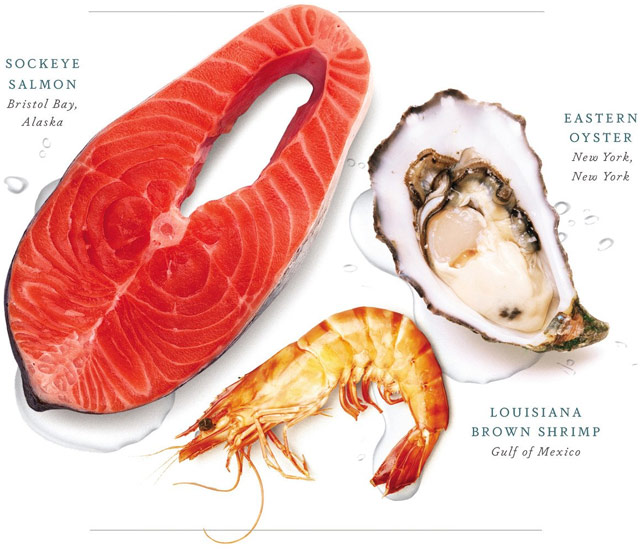
Paul Greenberg has an excerpt in the NY Times of his new book, American Catch: The Fight for Our Local Seafood.
As go scallops, so goes the nation. According to the National Marine Fisheries Service, even though the United States controls more ocean than any other country, 86 percent of the seafood we consume is imported.
But it’s much fishier than that: While a majority of the seafood Americans eat is foreign, a third of what Americans catch is sold to foreigners.
The seafood industry, it turns out, is a great example of the swaps, delete-and-replace maneuvers and other mechanisms that define so much of the outsourced American economy; you can find similar, seemingly inefficient phenomena in everything from textiles to technology. The difference with seafood, though, is that we’re talking about the destruction and outsourcing of the very ecological infrastructure that underpins the health of our coasts.
The article and book focus on three formerly American seafoods that we now mostly import from elsewhere: salmon, oysters, and shrimp.
In 2005, the United States imported five billion pounds of seafood, nearly double what we imported twenty years earlier. Bizarrely, during that same period, our seafood exports quadrupled. American Catch examines New York oysters, Gulf shrimp, and Alaskan salmon to reveal how it came to be that 91 percent of the seafood Americans eat is foreign.
In the 1920s, the average New Yorker ate six hundred local oysters a year. Today, the only edible oysters lie outside city limits. Following the trail of environmental desecration, Greenberg comes to view the New York City oyster as a reminder of what is lost when local waters are not valued as a food source.
Farther south, a different catastrophe threatens another seafood-rich environment. When Greenberg visits the Gulf of Mexico, he arrives expecting to learn of the Deepwater Horizon oil spill’s lingering effects on shrimpers, but instead finds that the more immediate threat to business comes from overseas. Asian-farmed shrimp-cheap, abundant, and a perfect vehicle for the frying and sauces Americans love-have flooded the American market.
Finally, Greenberg visits Bristol Bay, Alaska, home to the biggest wild sockeye salmon run left in the world. A pristine, productive fishery, Bristol Bay is now at great risk: The proposed Pebble Mine project could undermine the very spawning grounds that make this great run possible. In his search to discover why this precious renewable resource isn’t better protected, Greenberg encounters a shocking truth: the great majority of Alaskan salmon is sent out of the country, much of it to Asia. Sockeye salmon is one of the most nutritionally dense animal proteins on the planet, yet Americans are shipping it abroad.

In France, pie charts are called “le camembert” after the cheese. Or sometimes “un diagramme en fromage” (cheese diagram). In Brazil, they are pizza charts. (via numberphile & reddit)
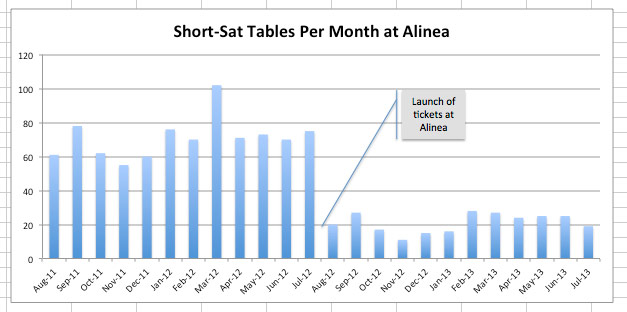
For three years, Nick Kokonas’s trio of eating/drinking establishments in Chicago (Next, Alinea, and Aviary) has been using a ticketed reservation system. In this epic piece, Kokonas details why they started using tickets and what the effect has been (emphasis mine):
Our ticket implementation strategy at Alinea was to create a “higher-touch” system than we had previously used at Next. Every customer buying a ticket at Alinea must include a cell phone number where we can reach them. About a week before they dine with us we call every customer to thank them for buying a ticket to Alinea, ask if they have any dietary restrictions or special needs, and generally get a feel for their expectations and whether it is a special occasion. We can, in fact, spend more time (not less) with every single one of our customers because we are only speaking with the customers we know are coming to dine with us. Previously, we answered thousands of calls from people we had to say ‘no’ to. Now we can take far more time to say ‘yes’.
The results on Alinea’s business are staggering. Bottom line EBITDA profits are up 38% from previous average years. No shows of full tables are almost non-existent and while partial no-shows still occur they are only a handful of people per week at most. That allows us to run at a far greater capacity with less food waste and more revenue.
Will be interesting to see if more restaurants adopt this model…I bet a bunch of restaurateurs’ eyes lit up at the 38% increase in profit. But not every restaurant is Alinea and not every restaurateur is a clever former derivatives trader.
The New Yorker and First We Feast each has an account of a talk given by NYU professor George Solt, who presented some of his research on the history of ramen.
World War II all but destroyed ramen’s first wave of popularity. Thanks to food shortages and famine, the government placed tight regulations on food supplies, and earning a profit via restaurants or pushcarts was strictly prohibited until 1949. Some wheat flour made it onto the black market, though, and many of the country’s unemployed turned to hawking ramen. Which means, Solt points out, that selling future all-nighter fuel could and did land people in jail.
Holt is the author of The Untold History of Ramen: How Political Crisis in Japan Spawned a Global Food Craze.
If distillers can’t keep up with the current and growing worldwide demand for bourbon, we may have to turn to rum instead.
You can buy some old-ass rum, which, after being distilled from molasses or sugar cane, has sat around in barrels for long periods of time, for relatively small sums of money: El Dorado 15 is, as you might expect, made with a blend of rums that have sat in a barrel for at least fifteen years. Is it slightly sweet and rounded with a “full nose packed with dark coffee, candied orange, almonds, dark chocolate, pepper and rich vanilla.” It is only thirty-six dollars. Barbancourt 15 is kind of soft and woody and fruity and other things you might say about a bourbon, but instead of corn it’s like molasses. It’s about forty bucks. Ron Zacapa 23, which is a blend of rums between six and twenty three years old, is probably the first rum that made a lot of people go, “Oh, rum isn’t just that stuff that goes in a daiquiri or a mojito or that made me vomit pieces of my intestines into a urinal while I was wearing a silver crown.” Here are some tasting notes for it: “Nose full or apricots, citrus fruits, vanilla, cocoa and bourbon.”
Beyonce is mad at Solange for not sticking to the plan. What plan? I don’t want to say too much, but it involves Chipotle.
“You just stood there. I was defending you.”
“Do I need defending?”
“That’s not the point. He is a monster.”
“He is my husband.”
Beyoncé looked away, out the window at the people and the buildings, as they sped across 59th St. “I know who I married. That was my decision and I’ll live with it.”
“Of course you take his side.”
“Excuse me?” Beyoncé turned to face her sister. “Beyoncé is on Beyoncé’s side. Always. Trust that.”
(via @ftrain)
“Doodie” is a portmanteau of “dude” and “foodie” and a good word to describe the phenomenon of (mostly) male foodies I’ve observed with increasing regularity in the past few years. Jessica Pressler coined the term in Help! There’s a Doodie in My Kitchen.
You see; these are the things you deal with when you live with a food dude. Or, as I have come to call them, doodies. I know, it’s an unfortunate term, but like its antecedent, the dreaded foodie, it is also extremely useful for summing up the characteristics of a certain breed of food enthusiast, the kind whose culinary preferences are intrinsically, classically male.
You know the type. Has Heat or Fergus Henderson’s Complete Nose to Tail on his bookshelf. Can sustain a remarkably long conversation about knives. Is super into his grill. Likes pour-over coffee. Is, at this moment, really excited about ramps. I could go on, but I won’t, because I am sure you know one. New York City in 2014 is rife with doodies: You can find them stalking around Smorgasburg, attending knife-skills classes at the Meat Hook, writing lengthy, tumescent odes to the Bo Ssam Miracle in the paper of record.
(via @fanelli)
Update: Michael Hoffman of Food52 has another name for doodies: assholes.
The food dude is nothing new. He’s just a jerk who learned to cook. He’s taken what could be a force for good — feeding loved ones well — and made it into yet another thing that he can claim to be better at than his wife or girlfriend. (Apparently, food dudes are all heterosexual, too.)
Here’s what the food dude doesn’t do: He doesn’t spend his Sunday afternoon planning practical dinners for the week; he doesn’t make sure there’s milk in the fridge; he doesn’t make something the baby is going to eat. He might as well be building train sets in the basement. Even for people like us who love doing it, getting dinner on the table is, among many other things, a chore. And guess who’s doing the chores at Food Dude’s place? Women.
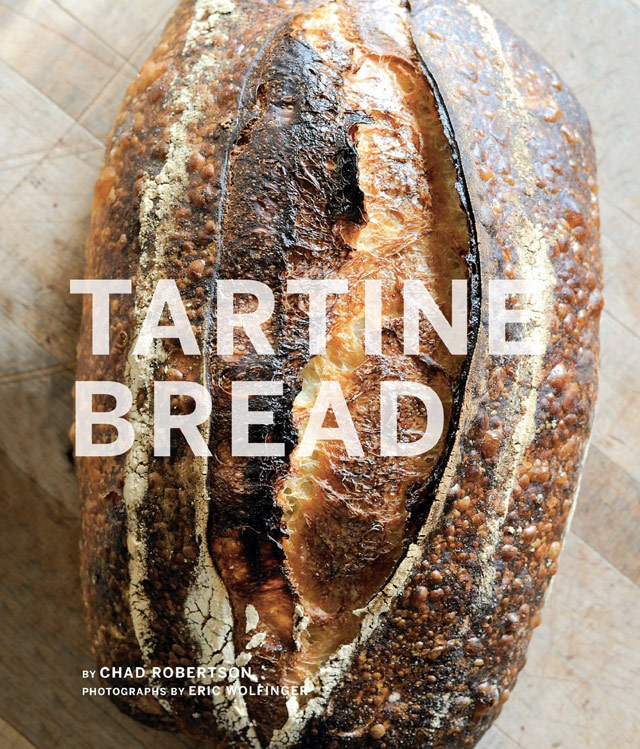
In his cookbook, Tartine Bread, Chad Robertson lays out, over 38 pages, the recipe for what might be the best bread in the world. The first time through, the recipe takes two weeks to make.
To Chad, bread is the foundation of a meal, the center of daily life, and each loaf tells the story of the baker who shaped it. He developed his unique bread over two decades of apprenticeship with the finest artisan bakers in France and the United States, as well as experimentation in his own ovens.
A streamlined version of the recipe is available from the NY Times. (via smithsonian)
Jim Koch is the co-founder and chairman of The Boston Beer Company, brewer of the Sam Adams beers. Part of his job is to drink professionally and he does so without getting completely sloshed. What’s his secret? Eating a packet of dry yeast before tying one on.
You see, what [expert brewer] Owades knew was that active dry yeast has an enzyme in it called alcohol dehydrogenases (ADH). Roughly put, ADH is able to break alcohol molecules down into their constituent parts of carbon, hydrogen, and oxygen. Which is the same thing that happens when your body metabolizes alcohol in its liver. Owades realized if you also have that enzyme in your stomach when the alcohol first hits it, the ADH will begin breaking it down before it gets into your bloodstream and, thus, your brain.
“And it will mitigate - not eliminate - but mitigate the effects of alcohol!” Koch told me.
Could have used this tip last night. Does this mean no hangovers as well?
Update: I got two kinds of feedback about this post:
1) What’s the fun in drinking alcohol if you’re not getting drunk? (Good point.)
2) Yeast doesn’t really work. What does seem to work is Pepcid AC and Zantac. From Shenglong on Hacker News:
Again, I’m not a chemist or a doctor, but from my preliminary internet research and anecdotal testing (though I have quite a few different data points), Famotadine (OTC) [Pepcid], and higher levels of APO-Ranitidine (can be prescription) [Zantac] seems to slow the rate of ethanol -> acetaldehyde, balancing out the drunkness effect more, and giving you more time to process the acetaldehyde -> acetic acid. I typically go from maxing out at 2 drinks / 3 hour period, to about 11 drinks / 3 hour period on Ranitidine, given favorable conditions. I’ve had lower levels of success with Famotadine.
And it goes without saying, I don’t recommend trying any of this at home. At the local bar on the other hand Nope, not there either. (thx, @natebirdman)
American favorites (blue jeans, whiskey, burgers) have been embraced by the Japanese, who have been turning out improved versions of the originals.
In Japan, the ability to perfectly imitate-and even improve upon-the cocktails, cuisine and couture of foreign cultures isn’t limited to American products; there are spectacular French chefs and masterful Neapolitan pizzaioli who are actually Japanese. There’s something about the perspective of the Japanese that allows them to home in on the essential elements of foreign cultures and then perfectly recreate them at home. “What we see in Japan, in a wide range of pursuits, is a focus on mastery,” says Sarah Kovner, who teaches Japanese history at the University of Florida. “It’s true in traditional arts, it’s true of young people who dress up in Harajuku, it’s true of restaurateurs all over Japan.”
It’s easy to dismiss Japanese re-creations of foreign cultures as faddish and derivative-just other versions of the way that, for example, the new American hipster ideal of Brooklyn is clumsily copied everywhere from Paris to Bangkok. But the best examples of Japanese Americana don’t just replicate our culture. They strike out, on their own, into levels of appreciation and refinement rarely found in America. They give us an opportunity to consider our culture as refracted through a foreign and clarifying prism.
Another example, not mentioned in the piece, is coffee. From the WSJ a couple of years ago:
“My boss won’t let me make espressos,” says the barista. “I need a year more, maybe two, before he’s ready to let customers drink my shots undiluted by milk. And I’ll need another whole year of practice after that if I want to be able to froth milk for cappuccinos.”
Only after 18 years as a barista in New York did his boss, the cafe’s owner, feel qualified to return home to show off his coffee-making skills. Now, at Bear Pond’s main branch, he stops making espressos at an early hour each day, claiming that the spike on the power grid after that time precludes drawing the voltage required for optimal pressure.

New from Michael Ruhlman: a cookbook about the mighty egg, “A Culinary Exploration of the World’s Most Versatile Ingredient”.
For culinary visionary Michael Ruhlman, the question is not whether the chicken or the egg came first, it’s how anything could be accomplished in the kitchen without the magic of the common egg. He starts with perfect poached and scrambled eggs and builds up to brioche and Italian meringue. Along the way readers learn to make their own mayonnaise, pasta, custards, quiches, cakes, and other preparations that rely fundamentally on the hidden powers of the egg.
Ruhlman shares a bit about the book with NPR:
But often, Ruhlman argues, we don’t treat our eggs very well. Take scrambled eggs. “It’s one of the most overcooked dishes in America,” he says. “We kill our eggs with heat.”
Instead, we need, in most instances, to give the egg gentle heat. “When you cook them very slowly over very gentle heat, the curds form. And as you sit, the rest of the egg sort of warms but doesn’t fully cook and becomes a sauce for the curds. So it should be a creamy and delicious and delicate preparation.”
Recent studies show that our physical level of hunger, in fact, does not correlate strongly with how much hunger we say that we feel or how much food we go on to consume.
As Maria Konnikova reports, a lot of things can make you hungry — a song, a book, a smell, even a study.
Being genuinely hungry, on the other hand — in the sense of physiologically needing food — matters little.
In other news, Tater Tots.
In recent years, Chipotle has worked to promote their managers from within the company. And the tactic seems to be working.
The common element among the best-performing stores was a manager who had risen up from crew. So Moran started to outline a program that would retain and train the best managers, and reward them to the point where they would be thrilled to stay on.
After Flores expressed his frustration, Moran showed him his early notes for the restaurateur program, which is unique among fast food restaurants in that it ties pay and promotion to how well you mentor people, rather than store sales.
“It was a great meeting but I didn’t know what was going to happen. At most companies you meet the top execs and then you never hear from them again,” Flores says.
A few weeks after the October meeting, while vacationing in Houston, Flores got a call on his cell from Ells and Moran letting him know that he had been promoted to restaurateur and was getting a $3,000 bonus. Rather than waiting until he returned to Milwaukee to get him the check, it was delivered to him in Houston the following day. At the time his salary was around $38,000, and the bonus was meaningful.
“That’s when I knew the company was special,” Flores said.
Interesting bits of business wisdom throughout this piece.
Newer posts
Older posts





Socials & More