kottke.org posts about climate crisis
Scientists at Oak Ridge National Laboratory have stumbled upon a process that uses “nanospikes” to turn carbon dioxide into ethanol, a common fuel.
This process has several advantages when compared to other methods of converting CO2 into fuel. The reaction uses common materials like copper and carbon, and it converts the CO2 into ethanol, which is already widely used as a fuel.
Perhaps most importantly, it works at room temperature, which means that it can be started and stopped easily and with little energy cost. This means that this conversion process could be used as temporary energy storage during a lull in renewable energy generation, smoothing out fluctuations in a renewable energy grid.
This sounds like a big deal…is it now possible to limit the effects of climate change by sinking carbon while also placing less dependence on fossil fuels? Here’s the Oak Ridge press release. That this news is almost a week old already and we haven’t heard more about it makes me a bit skeptical as to the true importance of it. (Of course, CRISPR is potentially a massive deal and we don’t hear about it nearly enough so…)
Update: A relevant series of tweets from Eric Hittinger on “why creating ethanol from CO2 cannot solve our energy or climate problems”. Wasn’t fully awake when I posted this apparently because, yeah, duh. (via @leejlh)
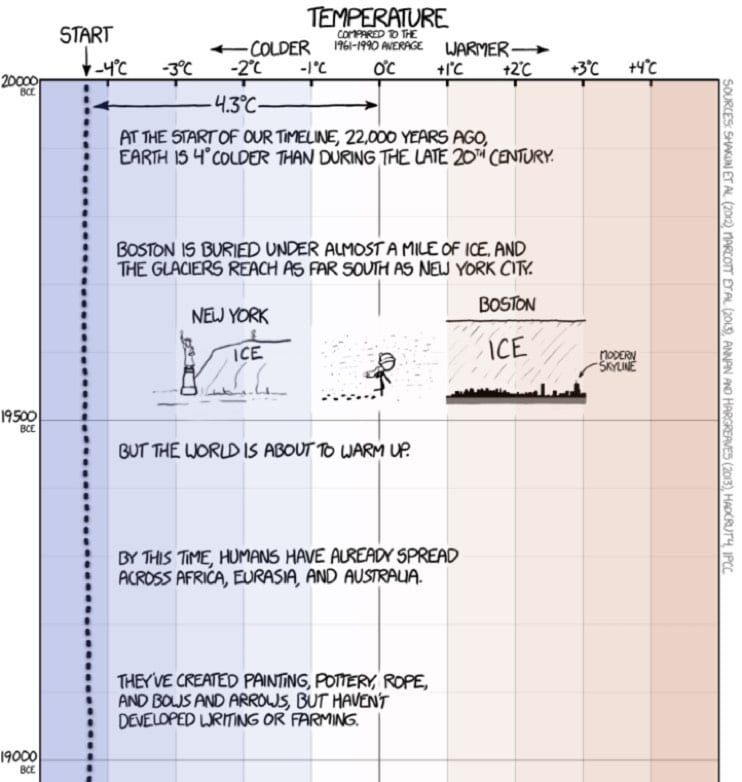
From XKCD, a typically fine illustration of climate change since the last ice age ~20,000 years ago.
When people say “the climate has changed before”, these are the kinds of changes they’re talking about.
And then in the alt text on the image:
[After setting your car on fire] Listen, your car’s temperature has changed before.
The chart is a perfect use of scale to illustrate a point about what the data actually shows. Tufte would be proud.
Update: Tufte is proud. (via @pixelcult)
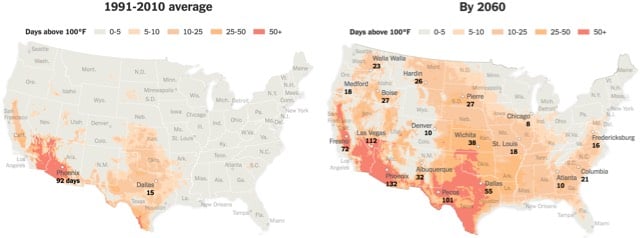
In today’s installment of terrifying graphics about climate change, the NY Times made a series of three maps showing the potential rise of 100 degree temperatures across the United States if current greenhouse gas emission trends continue through the end of this century. Look at the areas in orange and red on the 1991-2010 map: what sort of landscape do you picture? Keeping that landscape picture in your mind, look at the orange and red areas on the 2060 and 2100 maps. Yep! And Phoenix with 163 days above 100 degrees — that’s every day from March 25th to September 4th over 100 degrees.
P.S. A word about climate change and rising temperatures. The temperature that climate scientists typically reference and care about with regard to climate change is “the average global temperature across land and ocean surface areas”. According to the NOAA, the average temperature of the Earth in the 20th century was 13.9°C (57.0°F). In 2015, the average global temperature was 0.90°C (1.62°F) above that.
In order to avoid dangerous effects of climate change, climate scientists advocate keeping the global average temperature increase below 2 degrees (and more recently, below 1.5 degrees). In late 2015, 195 nations came together in Paris and agreed to:
[Hold] the increase in the global average temperature to well below 2°C above pre-industrial levels and to pursue efforts to limit the temperature increase to 1.5°C above pre-industrial levels, recognizing that this would significantly reduce the risks and impacts of climate change
That’s degrees Celsius, not Fahrenheit. I don’t know about you, but as an American, when I hear 2 degrees, I think, oh, that’s not bad. But 2°C is an increase of 3.6°F, which does seem significant.
Note also that it specifies keeping the temperature “below pre-industrial levels” and not below 20th century levels. It is maddeningly difficult to track down an exact figure for the pre-industrial global temperature, partially because of a lack of precise data, partially because of politics, and partially because of the impenetrability of scientific writing. From a piece Eric Holthaus wrote for FiveThirtyEight earlier this year:
It sounds easy enough to measure global warming: see how hot it was, compare it to how hot it used to be. But climate scientists have several ways of measuring how hot it used to be. NASA’s base period, as I mentioned above, is an average of 1951-80 global temperatures, mostly because that was the most recently available 30-year period when the data set was first created. By chance, it’s also pretty representative of the world’s 20th-century climate and can help us understand how much warmer the world has become while many of us have been alive.
Other organizations go further back. The Intergovernmental Panel on Climate Change, the body of climate scientists that was formed to provide assessments to the United Nations, bases its temperature calculations on an 1850-1900 global average. There was about 0.4 degrees of warming between that time period and the NASA base period.
Climate scientists often refer to that 1850-1900 timespan as “pre-industrial” because we don’t have comprehensive temperature data from the 1700s. But meteorologist Michael Mann, director of Penn State University’s Earth System Science Center, has argued that an additional 0.25 degrees of warming occurred between the start of the Industrial Revolution (around 1750) and 1850. Including Mann’s adjustment would bring February 2016 global temperatures at or very near 2 degrees above the “pre-industrial” average.
I now completely understand why some people deny that anthropogenic climate change is happening. Seriously. I looked for more than 30 minutes for a report or scientific paper that stated the average global temperature for 1850-1900 and I couldn’t find one. I looked at UN reports, NASA reports, reports from the UK: nothing. There were tons of references to temperatures relative to the 1850-1900 baseline, but no absolute temperatures were given. Now, I don’t mean to get all Feynman here, but this is bullshit. When the world got together in Paris and talked about a 1.5 degree increase, was everyone even talking about the same thing? You might begin to wonder what the scientists are hiding with their obfuscation.
Anyway, the important point is that according to climate scientists, we are already flirting with 1.5°C of global warming since pre-industrial times. Which means that without action, the spread of those Phoenician temperatures across the circa-2100 United States is a thing that’s going to happen.
A Siberian heatwave has led to permafrost thaws that have released long-dormant anthrax bacteria, resulting in the hospitalization of 13 people and the death of over 1500 reindeer.
Citing earlier work from 2007, they estimated anthrax spores remain viable in the permafrost for 105 years. Buried deeper, the bacteria may be able to hibernate for even longer. At the same time, where meteorological data were available they indicate temperatures in Yakutia are increasing.
“As a consequence of permafrost melting, the vectors of deadly infections of the 18th and 19th centuries may come back,” the scientists warned, “especially near the cemeteries where the victims of these infections were buried.” Cattle grave sites should be monitored, they concluded, and “public health authorities should maintain permanent alertness.”
Another one of those delightful little climate change gotchas, like the near-death of the Great Barrier Reef.
Update: Eric Holthaus talked to some experts and climatologists and yes, pathogens released by warming are something we were warned about and we need to be concerned about it.
Romanovsky says the possibility that additional pathogens may be released from the permafrost, if that is indeed the source, makes it even more important to study this specific outbreak closely. Once in the water supply, in theory, a future pathogen could spread outside the local area, carried by people or by migrating birds or animals.
Though the current outbreak is happening during an unusual period of extreme warmth, Romanovsky says that, “if it gets warmer in the future, and it seems like it will, the thawing permafrost could be massive.” A further degradation of the permafrost would allow more opportunity for the emergence of sequestered microbes.
Eric Holthaus, the internet’s favorite meteorologist, is hosting a new podcast on climate change called Warm Regards (on iTunes). A recent episode is embedded above and here’s a bit more about the show, including some info about his co-hosts:
Joining me with co-hosts Andy Revkin, a veteran environment writer for the New York Times who has covered climate change for 30 years, and Jacquelyn Gill, a paleoecologist at the University of Maine who is an actual, real-life climate scientist and flawlessly navigates climate Twitter.
Also, Holthaus recently started a project on Patreon to support his independent journalism on climate change. I’m in for $3/mo…chip in if you enjoy Eric’s work and Twitter contributions and wish to see more.1

The Industrial Revolution began in the mid-18th century in Great Britain. To provide power for the wondrous new inventions producing marvelous new goods and services, coal (and later oil) was dug out of the ground and burned, releasing billions and billions of tons of carbon dioxide. In time, the speedy introduction of all this new carbon into the atmosphere caused the Earth’s climate to change.
In order to procure new resources for manufacturing and gain access to new markets for finished goods, the British Empire expanded across the globe. At some point, Great Britain invaded nearly 90% of the world’s countries. The expansion fueled climate change and created avenues for immigration to Britain from their colonies. Their activities eventually bring them to the Middle East in search of oil.
Fast forward to 2006. Drought exacerbated by climate change is one of many factors that pushed Syria into a prolonged civil war. The war triggered a humanitarian crisis and millions flee the country, becoming refugees, and some are able to migrate to Europe and other countries around the world, including Britain. The Syrian immigration issue fueled British nationalism, racism, and xenophobia, triggering a vote about whether Britain should leave the European Union. Yesterday, more than 17 million Britons voted to leave, with strong support for Leave in areas with now-empty coalfields and declining industrialization.
Coincidence? Not even close. More than 250 years on, Britain is still dealing with the effects of the Industrial Revolution. (via @EricHolthaus, @johnupton, @MichaelEMann, @chucktodd)
Fake trees to pull carbon dioxide out of the air, sun shields to deflect heat and radiation without damaging the atmosphere, giant ice cubes mined from comets to cool down the oceans. Okay, that last one is from a Futurama episode. But some researchers really do think we can try to slow or reverse climate change with technology built for that purpose — and that we’ve already changed the Earth’s environment so much that we may have no choice. I guess it’s worth a try.
Jimmy Kimmel had some scientists on his show recently to tell the American public that anthropogenic climate change is real, that’s it’s not a prank, and that the scientific community is “not fucking with you” about this. Trigger warning: the first minute of this video features Sarah Palin speaking.
This video from Vox makes an often overlooked point about climate change. Climate change is not about saving the planet. Earth will be fine. Life, in general, will be fine. But many species of plants and animals will die. Addressing climate change is about saving plants and animals that are in some way “useful” to us and preventing human suffering. (via @mims)
Update: George Carlin riffs on this point in an old standup routine:
There is nothing wrong with the planet. The planet is fine. The people are fucked.
(via @austinkleon)
In the past two weeks, the results of three surveys and studies about the Earth’s climate have been released: a paper on a possible dramatic climate shift, a survey of coral bleaching at the Great Barrier Reef, and a study on the West Antarctic ice sheet. All three investigations tell the story of climate change happening quicker than was previously anticipated.
From the paper published last week by former NASA climate scientist James Hansen and a number of colleagues:
Virtually all climate scientists agree with Dr. Hansen and his co-authors that society is not moving fast enough to reduce emissions of greenhouse gases, posing grave risks. The basic claim of the paper is that by burning fossil fuels at a prodigious pace and pouring heat-trapping gases into the atmosphere, humanity is about to provoke an abrupt climate shift.
In Australia, more than 40% of the Great Barrier Reef has been damaged by coral bleaching.
Scientists who have dedicated their careers to studying the reef and its ecosystem say the current bleaching is unprecedented, and perhaps unrecoverable. The emotion in their responses so far have been palpable.
“I witnessed a sight underwater that no marine biologist, and no person with a love and appreciation for the natural world for that matter, wants to see,” said Australian coral scientist Jodie Rummer in a statement, after spending more than a month at a monitoring station in the Great Barrier Reef.
Though corals comprise only about 0.2 percent of the global oceans, they support perhaps a quarter of all marine species.
And just yesterday, a study on the West Antarctic ice sheet was released that says the ice sheet could melt much faster than previously thought, raising global sea levels by 3 feet in less than 90 years. Even the normally staid NY Times invoked the Sword of Damocles in the lede.
The great ice sheet, larger than Mexico, is thought to be potentially vulnerable to disintegration from a relatively small amount of global warming, and capable of raising the sea level by 12 feet or more should it break up. But researchers long assumed the worst effects would take hundreds — if not thousands — of years to occur.
Now, new research suggests the disaster scenario could play out much sooner.
Continued high emissions of heat-trapping gases could launch a disintegration of the ice sheet within decades, according to a study published Wednesday, heaving enough water into the ocean to raise the sea level as much as three feet by the end of this century.
Miami might not make it to the end of the century.
Oh and BTW, the maximum extent of sea ice in the Arctic was a record low in 2016, February was a total Messi-esque outlier in terms of how unusually hot it was, March, while not as warm, will still be the hottest March ever, and just look at the 2016 trend in the first chart here.
You can think of the Earth as a massive machine, with many interconnected, resilient, and redundant systems. For a long time, humans thought it was too big for our actions to affect this machine in a meaningful way. But the Industrial Revolution’s release of hundreds of millions of years of stored greenhouse gases in less than 300 years put a strain on that entire machine. We didn’t notice that strain for a long time, but we’re starting to now in the form of higher temperatures, weird weather, bleaching coral reefs, rapidly melting ice sheets in Greenland & Antarctica, and dozens of other ways. I hope there’s still time to do something meaningful about it before the slower moving parts of the machine fail permanently.
A new paper by climate scientists, including ex-NASA scientist James Hansen, warns that our climate could dramatically change within decades, not centuries.
Virtually all climate scientists agree with Dr. Hansen and his co-authors that society is not moving fast enough to reduce emissions of greenhouse gases, posing grave risks. The basic claim of the paper is that by burning fossil fuels at a prodigious pace and pouring heat-trapping gases into the atmosphere, humanity is about to provoke an abrupt climate shift.
Non-linear systems, man. Gradually, then all at once.
Update: Slate’s Eric Holthaus has more on the paper and its potential implications.
In addition to the risk of “several meters” of sea level rise this century, which Hansen calls the most important finding, the final version of Hansen’s paper gives new emphasis to the possibility that the ocean’s heat circulation system may be in the process of shutting down. The circulation shutdown would precede the rapid increase in global sea levels. If the shutdown happens, simultaneous cooling of the waters near Greenland and Antarctica and warming in the tropics and midlatitudes could spawn frequent strong storms on the order of Hurricane Sandy or worse.
If that sounds a lot like the plot of The Day After Tomorrow to you, you’re not alone.
Hansen also released a 15-minute video about the paper:
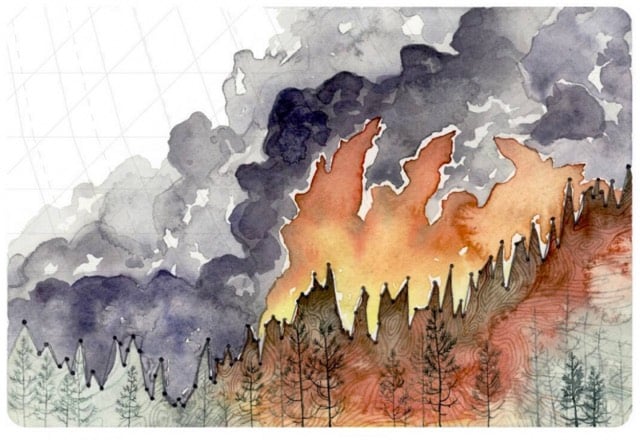
Artist Jill Pelto turns climate change graphs into art. So, for instance, a chart of rising global temperatures turns into a forest fire, which are becoming more common as temps rise:
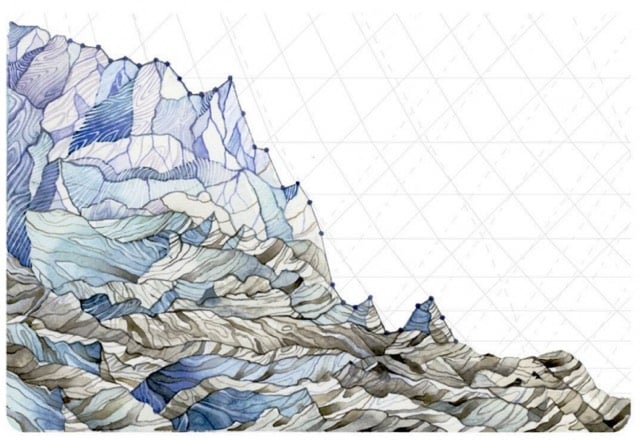
And a graph of the retreat of glaciers over the years becomes a retreating glacier:
(via @EricHolthaus & climate central)
The forecast high temperature for Christmas Eve in New York City is 66°F. What the hell is going on? Climate change? Yes, but mostly the balmy East Coast temps are due to a super-strong El Niño.1 In the video above, Vox explains what El Niño is and how the Pacific weather pattern affects weather around the globe (including the East Coast of the US).
El Niño is a weather phenomenon that occurs irregularly in the eastern tropical Pacific every two to seven years. When the trade winds that usually blow from east to west weaken, sea surface temperatures start rising, setting off a chain of atmospheric impacts.
El Niños can be strong or weak. Strong events can temporarily disrupt weather patterns around the world, typically making certain regions wetter (Peru or California, say) and others drier (Southeast Asia). Some countries suffer major damage as a result.

A new study from scientists and economists at Stanford and Berkeley has taken a stab at determining how climate change will affect the world’s economic activity. As part of their study, they look at which countries might benefit from climate change and which might lose out. As you might expect, countries in the Northern Hemisphere with cooler climates stand to benefit while the rest of the world will not. Here are some of the projected big winners (the Nordic countries) and losers (the Middle East):
Mongolia +1413%
Finland +516%
Iceland +513%
Russia +419%
Estonia +259%
Saudi Arabia -96%
Kuwait -96%
Oman -94%
United Arab Emirates -94%
Iraq -93%
Canada (+247%) is another one of the potential big winners while the US (-36%) stands to lose out…along with all of Africa, South America, India, and China. This quote by one of the study’s lead authors, really grabbed me by the throat:
What climate change is doing is basically devaluing all the real estate south of the United States and making the whole planet less productive. Climate change is essentially a massive transfer of value from the hot parts of the world to the cooler parts of the world. This is like taking from the poor and giving to the rich.
Among other many things, anthropogenic climate change is an issue of discrimination.1 Rich, predominantly white countries caused the problem and can do the most to limit the damage, but climate change will disproportionately affect poor countries, poor people (even in rich countries), women, and people of color. The rich need to do something about it so that the poor will not suffer. The problem is, the world’s wealthy have a long history of not being incentivized to help anyone but themselves. I hope this will turn out differently…or, as sometimes happens, the desires of the wealthy and the needs of the poor dovetail into action of joint benefit.
I made a boiling frogs analogy in my post about coral bleaching this morning.
The oceans are slowly boiling and we’re the frogs who aren’t noticing.
James Fallows has been waging a small war on the use of that analogy for several years now.
You remember our old friend the boiled frog: It’s the staple of any political or business-management speech, used to show that problems that build up slowly can be explained-away or ignored, while ones that happen all of a sudden are more likely to be addressed.
Conservatives use it to talk about the expansion of the socialist state. Liberals use it to talk about climate change. Business managers use it to talk about a slide toward mediocrity. Everyone can use it to talk about something.
And that’s the problem with boiled-frogism. The minor issue is that the metaphor is flat wrong. If you put a frog in a pot of lukewarm water and gradually heat it up, the frog will stay there — until things get uncomfortably warm, at which point it will climb out. But if you drop a frog into a boil of already-boiling water, the poor creature will be so badly hurt and scalded that it will stay there and die.
I’m going to defend my usage just a little. The ocean is literally water that is getting warmer. But other than that, yeah, guilty as charged. (via @jpiz)
Newer posts
Older posts






Socials & More