kottke.org posts about climate crisis
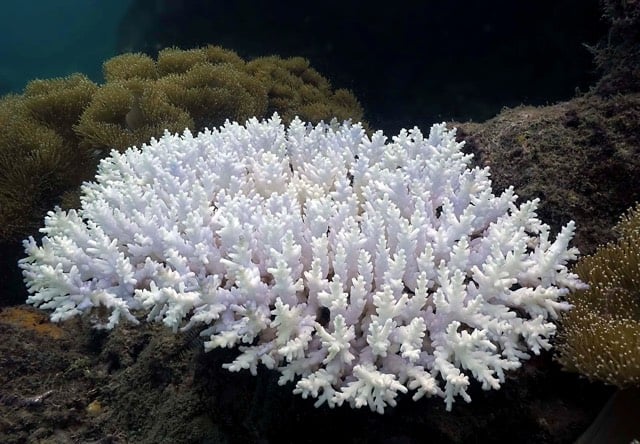
A persistent underwater heatwave is causing corals worldwide to bleach, and scientists believe up to 5% of the world’s coral will die permanently.
Hoegh-Guldberg said he had personally observed the first signs of bleaching on Australia’s Great Barrier Reef in the past fortnight, months before the warm season begins. He said the warming pattern indicated bleaching this summer would likely affect 50% of the reef, leaving 5-10% of corals dead. Eakin said seeing bleaching on the reef at this time of year was “disturbing”.
Also, no matter how many times I read this, it never gets less scary:
Since the early 1980s the world has lost roughly half of its coral reefs.
The oceans are slowly boiling and we’re the frogs who aren’t noticing. (via @EricHolthaus)
It’s the Pope’s first time in America and we sent him straight to Congress. That doesn’t exactly seem like we’re putting our best foot forward. In his historic speech to a joint session of Congress, Pope Francis addressed climate change, capitalism, the death penalty and immigration. MoJo pulled out the ten most important lines from the speech.
“This Pope often operates through symbolism and gestures that convey his intentions in ways that words never could.” The New Yorker on Pope Francis and his little Fiat.
With California in the midst of a particularly intense multi-year drought and 2015 looking to be the warmest year on record by a wide margin,1 Edward Burtynsky’s “Water” series of photographs is especially relevant.


Many of photos in the series are on display in Berkeley through February and are also available in book form.
Update: Burtynsky also collaborated on a documentary about water called Watermark. Here’s a trailer:
The film is available to watch on Amazon Instant and iTunes. (via @steveportigal)
In Rolling Stone, Eric Holthaus writes that as far as climate change is concerned, we are already past the point of no return. The things climate scientists have warned against are already beginning to happen…and faster than predicted.
Hansen’s new study also shows how complicated and unpredictable climate change can be. Even as global ocean temperatures rise to their highest levels in recorded history, some parts of the ocean, near where ice is melting exceptionally fast, are actually cooling, slowing ocean circulation currents and sending weather patterns into a frenzy. Sure enough, a persistently cold patch of ocean is starting to show up just south of Greenland, exactly where previous experimental predictions of a sudden surge of freshwater from melting ice expected it to be. Michael Mann, another prominent climate scientist, recently said of the unexpectedly sudden Atlantic slowdown, “This is yet another example of where observations suggest that climate model predictions may be too conservative when it comes to the pace at which certain aspects of climate change are proceeding.”
Since storm systems and jet streams in the United States and Europe partially draw their energy from the difference in ocean temperatures, the implication of one patch of ocean cooling while the rest of the ocean warms is profound. Storms will get stronger, and sea-level rise will accelerate. Scientists like Hansen only expect extreme weather to get worse in the years to come, though Mann said it was still “unclear” whether recent severe winters on the East Coast are connected to the phenomenon.
You might also like to read Adam Sobel’s reaction to this piece. As I wrote in reaction to James Hansen’s recent paper: “That’s the thing about nonlinear systems like the Earth’s climate: things happen gradually, then suddenly.”
Update: A group of climate scientists at Climate Feedback analyzed Holthaus’ piece at his request for accuracy.
While the information within the article is mostly accurate, the main issue for scientists is the article’s framing of the information. More specifically, the article implicitly attributes many weather events to human-induced climate change, while the influence of human activity on these events is not always supported by science, or is at the frontier of scientific knowledge and still debated.
James Hansen, NASA’s former top climate scientist, is joined by 16 other leading climate scientists in a paper with some alarming conclusions. The gist is that the glaciers in Antartica and Greenland are melting so much faster than previously predicted that the global sea level will rise more than 10 feet in as little as 50 years, rendering many coastal cities uninhabitable. From Eric Holthaus in Slate:
The study — written by James Hansen, NASA’s former lead climate scientist, and 16 co-authors, many of whom are considered among the top in their fields — concludes that glaciers in Greenland and Antarctica will melt 10 times faster than previous consensus estimates, resulting in sea level rise of at least 10 feet in as little as 50 years. The study, which has not yet been peer reviewed, brings new importance to a feedback loop in the ocean near Antarctica that results in cooler freshwater from melting glaciers forcing warmer, saltier water underneath the ice sheets, speeding up the melting rate. Hansen, who is known for being alarmist and also right, acknowledges that his study implies change far beyond previous consensus estimates. In a conference call with reporters, he said he hoped the new findings would be “substantially more persuasive than anything previously published.” I certainly find them to be.
That’s the thing about nonlinear systems like the Earth’s climate: things happen gradually, then suddenly. This is much more terrifying to me than the Pacific Northwest earthquake. BTW, as a reminder, here’s what NYC and the surrounding area looks like with 10 more feet of water. Goodbye JFK Airport.
Update: The paper is now available online.
Update: In the New Yorker, Elizabeth Kolbert provides a bit more explanation and context about Hansen’s paper.
What the new paper does is look back at a previous relatively warm period, known as the Eemian, or, even less melodically, as Marine Isotope Stage 5e, which took place before the last ice age, about a hundred and twenty thousand years ago. During the Eemian, average global temperatures seem to have been only about one degree Celsius above today’s, but sea levels were several metres higher. The explanation for this, the new paper suggests, is that melt from Antarctica is a non-linear process. Its rate accelerates as fresh water spills off the ice sheet, producing a sort of “lid” that keeps heat locked in the ocean and helps to melt more ice from below. From this, the authors conclude that “rapid sea level rise may begin sooner than is generally assumed,” and also that a temperature increase of two degrees Celsius would put the world well beyond “danger.”
“We conclude that the 2°C global warming ‘guardrail,’ affirmed in the Copenhagen Accord, does not provide safety, as such warming would likely yield sea level rise of several metres along with numerous other severely disruptive consequences for human society and ecosystems,” Hansen and his colleagues wrote.
Because of climate change and other activities caused by humans (invasive species, habitat loss), hybridization of species is resulting in things like super-sized coyotes, pizzly bears (grizzly/polar bear hybrids), and other animals that may not be ideally suited to survive.
Some scientists and conservationists see the coywolf as a nightmare of the Anthropocene — a poster child of mongrelization as plants and animals reshuffle in response to habitat loss, climate change and invasive species. Golden-winged warblers increasingly cross with blue-winged warblers in the U.S. Northeast and eastern Canada. Southern flying squirrels hybridize with northern flying squirrels as the southern species presses northward in Ontario. Polar bears mate with grizzlies in the Canadian Arctic along the Beaufort Sea to produce “pizzly bears.”
All of this interbreeding upsets the conventional notion of species as discrete, inviolable entities. Moreover, some scientists and conservationists warn that hybridization will degrade biodiversity as unusual species are lost to genetic homogenization.
Partly scientists fear hybrids will be less fit than organisms that have evolved in place over eons. And often that is true, but the problem solves itself over time as hybrids lose out in the competitive race for survival.
University of Minnesota student Daniel Crawford and geography professor Scott St. George have collaborated on a piece of music called Planetary Bands, Warming World. Composed for a string quartet, the piece uses climate change data to determine the musical notes — the pitch of each note is tuned to the average annual temperature, which means as the piece goes on, the musical notes get higher and higher.
(via @riondotnu)
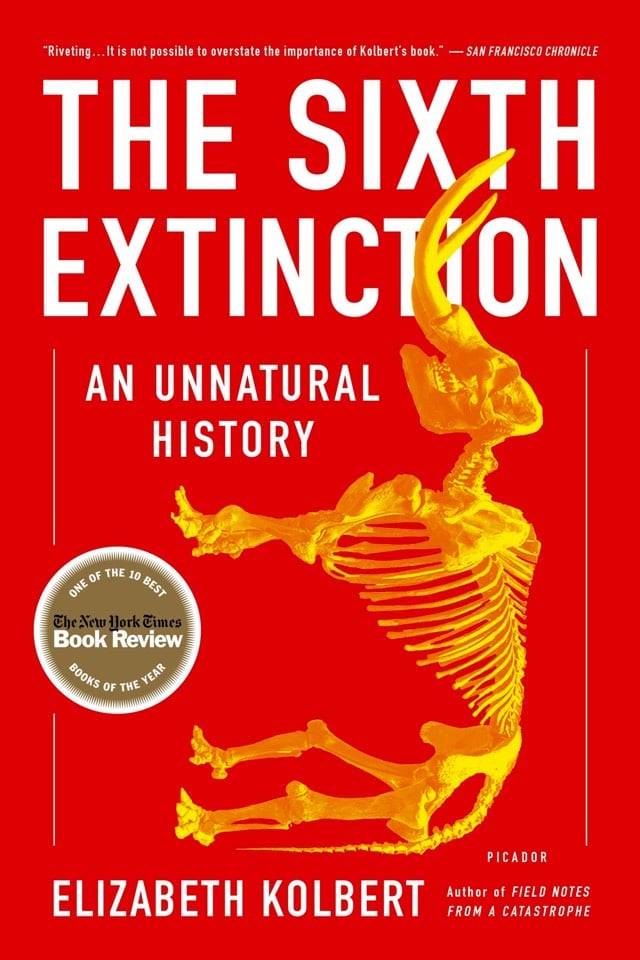
Vox has a list of all the 2015 Pulitzer Prize winners. I am especially pleased to see Elizabeth Kolbert win the general nonfiction category for The Sixth Extinction: An Unnatural History…I’ve been reading her writing on climate change and environmental issues in the New Yorker for years now.
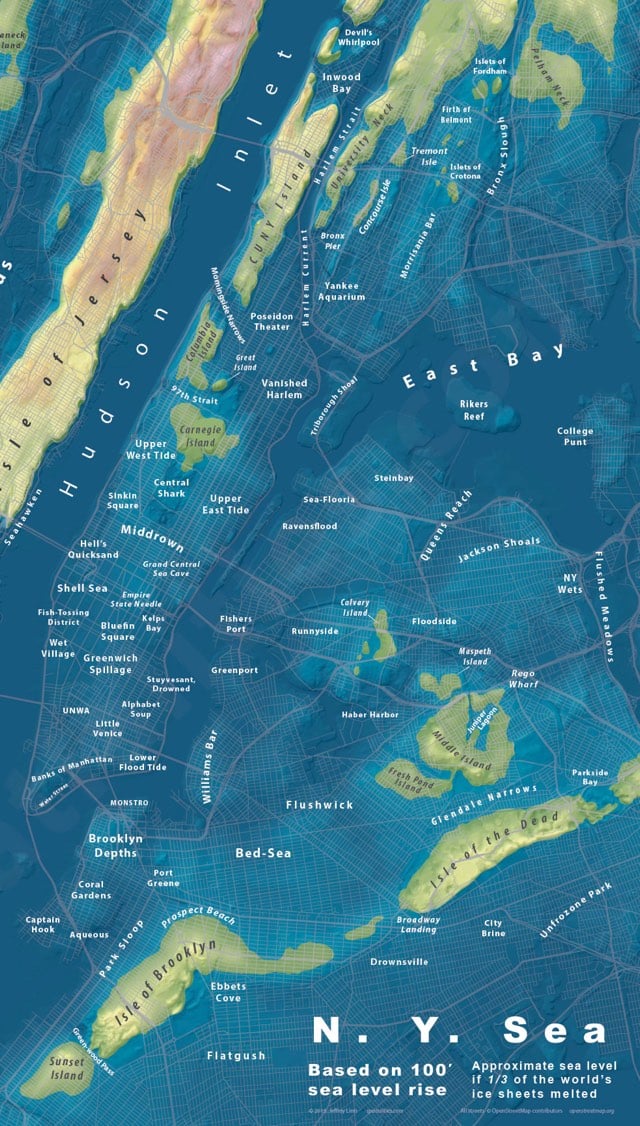
Jeffrey Linn makes maps that show how extreme sea level increase will impact major cities around the globe. Recently he made a map of NYC showing what it would look like if sea levels rose by 100 feet, which is what would happen if a third of the world’s ice sheets melted. So long, most of Manhattan and Brooklyn; hello Coral Gardens, Prospect Beach, and Sunset Island. Prints are available.
See also Linn’s maps of a drowned London, the bay of LA, and islands of Seattle.

A recent paper by three climate scientists concludes there’s a high risk of an unprecedented drought in the Southwest and Midwest United States later this century, even if we manage to get our carbon emissions under control. The scientists say it’ll be drier in the Western US than at any point in the past 1000 years.
In the Southwest and Central Plains of Western North America, climate change is expected to increase drought severity in the coming decades. These regions nevertheless experienced extended Medieval-era droughts that were more persistent than any historical event, providing crucial targets in the paleoclimate record for benchmarking the severity of future drought risks. We use an empirical drought reconstruction and three soil moisture metrics from 17 state-of-the-art general circulation models to show that these models project significantly drier conditions in the later half of the 21st century compared to the 20th century and earlier paleoclimatic intervals. This desiccation is consistent across most of the models and moisture balance variables, indicating a coherent and robust drying response to warming despite the diversity of models and metrics analyzed. Notably, future drought risk will likely exceed even the driest centuries of the Medieval Climate Anomaly (1100-1300 CE) in both moderate (RCP 4.5) and high (RCP 8.5) future emissions scenarios, leading to unprecedented drought conditions during the last millennium.
Eric Holthaus has the layperson’s explanation of the study and its implications.
Smerdon’s study is the first to examine the future risk of “megadrought” in the southwest and central United States in the context of historical episodes of drought in the same regions. Smerdon’s study suggests that the coming years are likely to see droughts worse than the epic dry periods that are thought to have caused profound changes to human settlement in the region over the last millennium.
“They’re ‘mega’ because they are droughts that lasted in these regions for multiple decades,” said Smerdon in an interview with Slate. “We haven’t seen anything like this since at least the 1400s.” In comparison, the current California drought is four years old, though drought has been present in most of the last 15 years somewhere in the West.
Update: This NASA video provides a quick overview of this study and what it means for our climate.
Brad Plumer of Vox plays around with the climate change Global Calculator and discovers, among other things, eating less beef and slowing the world’s population growth would significantly slow global warming.
The IEA scenario I started with assumed that, by mid-century, the average person will be eating 2,330 calories per day, including 220 calories of meat. It also assumes we’ll be eating more beef — that is, about 25 percent of the world’s meat will come from ruminants like cows, up from 22 percent today. Since cows produce a lot of methane, this is significant.
But what if we tweaked those assumptions? I told the calculator to assume that in 2050, the average person was only consuming 152 calories of meat per day — which is the WHO’s target for a healthy diet. I also assumed that the mix of meat stayed similar to what it was today — marginally less beef, more chicken and pork.
The result? Global greenhouse-gas emissions dropped significantly. We’re now on pace for around 2.5°C of global warming, give or take.
On the off chance you get this before it spontaneously combusts, you should probably know that Earth just experienced its hottest year on record (again). You can blame humans, you blame nature, you can blame Mister Heat Miser. But for most scientists, there is a towering body of evidence to explain this inferno, and the debate over what’s causing the warm-up has already been decided (which is good, because the venue where the debate was being held just melted).
WaPo got reactions to the latest numbers from 21 scientists: “The temperature record is yet another brick in the massive wall of evidence that the climate is warming due to human activity.” Hey, (Science) Teacher, leave them kids alone…
If we’re going down in flames, let’s at least take 5 charts that explain 2014’s record-smashing heat. Or perhaps you’d prefer an animation?
Apparently, human activity has pushed Earth beyond four of nine planetary boundaries. (In layman’s terms: Uh oh.)
In other news, ocean life faces mass extinction.
And now some potential good news about climate change. Efforts to restore the world’s rainforests have gained traction and are having small but definite effects on the amount of carbon dioxide in the atmosphere.
Over just a few decades in the mid-20th century, this small country chopped down a majority of its ancient forests. But after a huge conservation push and a wave of forest regrowth, trees now blanket more than half of Costa Rica.
Far to the south, the Amazon forest was once being quickly cleared to make way for farming, but Brazil has slowed the loss so much that it has done more than any other country to limit the emissions leading to global warming.
And on the other side of the world, in Indonesia, bold new promises have been made in the past few months to halt the rampant cutting of that country’s forests, backed by business interests with the clout to make it happen.
In the battle to limit the risks of climate change, it has been clear for decades that focusing on the world’s immense tropical forests — saving the ones that are left, and perhaps letting new ones grow — is the single most promising near-term strategy.
I wish Arbor Day was still a bigger thing. Parts of the US used to be covered by vast forests as well and an effort to encourage the planting of more trees might have an impact not only on our climate but also on the wellbeing of people. It might not seem like much in comparison to the Amazon rain forest, but planting millions of trees each year in the US, if you did it consistently over 20-25 years, would be a wonderful thing. (via @riondotnu)
Update: According to this publication by The Forest History Society, American forests are in better shape today than they’ve been in decades.
Today about one-third of the land area of the U.S. is forested. This is about two-thirds of the forest area that existed in 1600. The area of forestland today is about the same as it was in 1920.
The average volume of wood per acre in U.S. forests today is 50 percent greater than it was in 1953. In the eastern United States, average volume per acre has almost doubled since 1953.
(via @tieguy)
The headline from Eric Holthaus’ latest piece is arresting: The Last Time There Was This Little Arctic Ice, Modern Humans Didn’t Exist.
Ice has been a relatively constant feature of the Arctic for most of the past 36 million years, but there have been some gaps. Scientists aren’t exactly sure what happened during the most recent major ice-free period, but it’s often considered an analog to our future, warmer Earth. The only difference is, this time, the gap in Arctic sea ice is being caused by us.
The US and China, the two largest carbon polluters in the world, have struck an accord on climate change.
As part of the agreement, Mr. Obama announced that the United States would emit 26 percent to 28 percent less carbon in 2025 than it did in 2005. That is double the pace of reduction it targeted for the period from 2005 to 2020.
China’s pledge to reach peak carbon emissions by 2030, if not sooner, is even more remarkable. To reach that goal, Mr. Xi pledged that so-called clean energy sources, like solar power and windmills, would account for 20 percent of China’s total energy production by 2030.
Here’s the official statement from the White House. The NY Times calls the agreement “ambitious” and a “landmark”, but Tyler Cowen says:
People, the China emissions “deal” isn’t much more than a press release…
But James Fallows, who has written extensively on China recently, is more positive.
The United States and China have apparently agreed to do what anyone who has thought seriously about climate has been hoping for, for years. As the No. 1 (now China) and No. 2 carbon emitters in the world, and as the No. 1 (still the U.S.) and No. 2 economies, they’ve agreed to new carbon-reduction targets that are more ambitious than most people would have expected.
Newer posts
Older posts





Socials & More