kottke.org posts about climate crisis
In a rare bit of good news about climate change, it appears that some types of coral have the ability to recover more quickly from trauma caused by rising ocean temperatures (archive).
At Palau in the western Pacific, a survey completed just three years after the 1998 bleaching event showed more coral had recovered on reefs within protected bays and on deep slopes.
Scientists suggest this is because heat and light serve as a double-whammy to coral health and corals that hang out in shady zones will escape the scorching combination, upping the chances that remnants will survive.
Seven years after the bleaching event, some reefs had regained nearly 40 per cent of their corals, with two species of plate-like acroporid coral, A. digitifera and A. hyacinthus, particularly prevalent. “We sampled plating coral colonies there a few years ago and found them to be pool-table size,” says Stephen Palumbi, Director of Stanford University’s Hopkins Marine Station, in Pacific Grove, California, US.
Given what we know now about how anthropogenic climate change is contributing to rising sea levels, Miami will be one of the first major American cities to find itself completely under water in the next century.
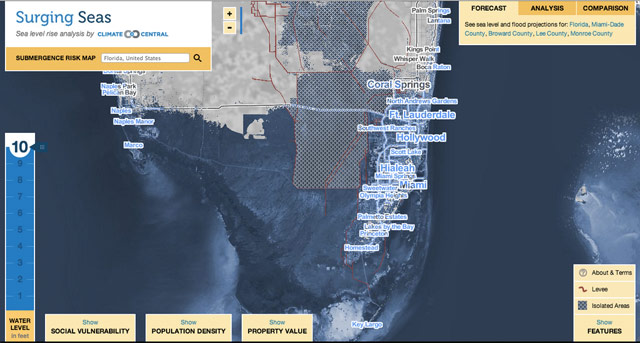
That inevitability is fueling a fledgling secessionist movement. And it’s not some crackpot grassroots effort either…the mayor and city commission of South Miami passed a resolution earlier this month that South Florida should break away and form the nation’s 51st state.
Whereas, South Florida’s situation is very precarious and in need of immediate attention. Many of the issues facing South Florida are not political, but are now very significant safety issues; and
Whereas, presently, in order to address the concerns of South Florida, it is necessary to travel to Tallahassee in North Florida. Often South Florida issues do not receive the support of Tallahassee. This is despite the fact that South Florida generates more than 69 percent of the state’s revenue and contains 67 percent of the state’s population; and
Whereas, the creation of the 51st state, South Florida, is a necessity for the very survival of the entire southern region of the current state of Florida.
Look for more of this type of thing in the years to come. The fight over fossil fuels has already shaped a great deal of the modern global political structure and the coming shifts in climate will almost certainly do the same.
You know how the old saying goes: When life hands you rising sea levels due to anthropogenic climate change, build canals. The city of Boston is considering such a scenario.
By 2100, climate scientists predict, sea levels around Boston will rise as much as 7.5 feet; in just a few decades water levels will be 2.5 feet higher than they are today. That could mean significant flooding not only during big storms but twice daily during high tides, as well as at times of normal rainfall.
The precise amount of sea-level rise is uncertain, but state and municipal leaders say they are taking the threat seriously, even if they are not yet at the stage of redesigning whole neighborhoods.
“We’re not going to start digging the canals tomorrow,” said Brian Swett, Boston’s chief of energy, environment, and open space. “But the report makes the important point that you can’t solve 6 feet of sea level rise simply by building a bigger dam on the Charles River.”
Greenland has been covered in dark ice this summer. Why is that such a problem? Because dark things absorb more heat than lighter colored things, causing the dark ice to melt faster than white ice would. Eric Hotlhaus explains.
There are several potential explanations for what’s going on here. The most likely is that some combination of increasingly infrequent summer snowstorms, wind-blown dust, microbial activity, and forest fire soot led to this year’s exceptionally dark ice. A more ominous possibility is that what we’re seeing is the start of a cascading feedback loop tied to global warming. Box mentions this summer’s mysterious Siberian holes and offshore methane bubbles as evidence that the Arctic can quickly change in unpredictable ways.
This year, Greenland’s ice sheet was the darkest Box (or anyone else) has ever measured. Box gives the stunning stats: “In 2014 the ice sheet is precisely 5.6 percent darker, producing an additional absorption of energy equivalent with roughly twice the US annual electricity consumption.”
Perhaps coincidentally, 2014 will also be the year with the highest number of forest fires ever measured in Arctic.

The Climate Report from the National Audubon Society makes for sobering reading. Due to shifting climates, over 300 species of US birds are in danger of losing their habitats or even extinction within the next century. Here are the primary findings:
Of the 588 North American bird species Audubon studied, more than half are likely to be in trouble. Our models indicate that 314 species will lose more than 50 percent of their current climatic range by 2080.
Of the 314 species at risk from global warming, 126 of them are classified as climate endangered. These birds are projected to lose more than 50 percent of their current range by 2050. The other 188 species are classified as climate threatened and expected to lose more than 50 percent of their current range by 2080 if global warming continues at its current pace.
The NY Times has a piece on the Audubon Society’s findings.
“Common sense will tell you that with these kinds of findings, it’s hard to believe we won’t lose some species to extinction,” said David Yarnold, the president of the National Audubon Society. “How many? We honestly don’t know. We don’t know which ones are going to prove heroically resilient.”
Can the birds just move? “Some can and some will,” Mr. Yarnold said. “But what happens to a yellow-billed magpie in California that depends on scrub oak habitat? What happens as that bird keeps moving higher and higher and farther north and runs out of oak trees? Trees don’t fly. Birds do.”
Getty Images photographer Justin Sullivan recently captured some photos of lakes in California showing the extent of the drought there. For me, this is the craziest one, of Bidwell Marina at Lake Oroville:

And this is what it normally looks like:

From Matter, a list of things to enjoy now before climate change takes them away or makes them more difficult to procure. Like Joshua trees:
The Joshua trees of Joshua Tree National Park need periods of cold temperatures before they can flower. Young trees are now rare in the park.
And chocolate:
Steep projected declines in yields of maize, sorghum, and other staples portend a coming food crisis for parts of sub-Saharan Africa. But here’s what will probably get everyone’s attention in the developed world: Studies suggest cacao production will begin to decline in Ghana and the Ivory Coast, the source of half of the world’s chocolate, by 2030.
And cherries:
Eighty percent of tart cherries come from a single five-county area in Michigan, all of which is threatened.
But as noted previously, we’ve got plenty of time to enjoy jellyfish:
Important cold-water fish species, including cod, pollock, and Atlantic Salmon, face a growing threat of population collapse as the oceans heat up. Studies suggest a radical fix: Eat lots of jellyfish, which will thrive in our new climate.
Also, The Kennedy Space Center, Havana, Coney Island, the Easter Island statues, and The Leaning Tower of Pisa will all be underwater sooner than you think.
From a pair of science historians, Naomi Oreskes and Erik Conway, comes The Collapse of Western Civilization: A View from the Future, a book of science fiction about the consequences of climate change.
The year is 2393, and a senior scholar of the Second People’s Republic of China presents a gripping and deeply disturbing account of how the children of the Enlightenment, the political and economic elites of the so-called advanced industrial societies, entered into a Penumbral period in the early decades of the twenty-first century, a time when sound science and rational discourse about global change were prohibited and clear warnings of climate catastrophe were ignored. What ensues when soaring temperatures, rising sea levels, drought, and mass migrations disrupt the global governmental and economic regimes? The Great Collapse of 2093.
Update: In the same vein is Steven Amsterdam’s Things We Didn’t See Coming.
Richly imagined, dark, and darkly comic, the stories follow the narrator over three decades as he tries to survive in a world that is becoming increasingly savage as cataclysmic events unfold one after another. In the first story, “What We Know Now” — set in the eve of the millennium, when the world as we know it is still recognizable — we meet the then-nine-year-old narrator fleeing the city with his parents, just ahead of a Y2K breakdown. The remaining stories capture the strange — sometimes heartbreaking, sometimes funny — circumstances he encounters in the no-longer-simple act of survival; trying to protect squatters against floods in a place where the rain never stops, being harassed (and possibly infected) by a man sick with a virulent flu, enduring a job interview with an unstable assessor who has access to all his thoughts, taking the gravely ill on adventure tours.
(thx, matty)
Television is in the midst of a protracted golden age. Anthropogenic climate change is beginning to affect the planet’s weather. Sarah Miller puts these two ideas together in a short piece of humor writing.
About half an hour later, a Boston Whaler was cruising down Ninth Avenue, and a man stood on the bow with a megaphone, shouting, “Please leave your buildings. Make your way to the nearest rooftop” in English, then in Spanish, then in Chinese. By this point, the water had risen to the top of the first floor. An emergency siren came on and stayed on. Irritated, Marci turned on the closed captioning. Then she wrote a short post about how watching “House of Cards” with subtitles revealed that, in domestic situations, people with less power spoke more words than those with more power but, in professional situations, it was the reverse. She posted it to her Tumblr. “This is so exactly what I was thinking about right now,” someone commented.
A group led by Dr. Robert Costanza has calculated the value of the world’s ecosystems…the group’s most recent estimate puts the yearly value at $142.7 trillion.
“I think this is a very important piece of science,” said Douglas J. McCauley of the University of California, Santa Barbara. That’s particularly high praise coming from Dr. McCauley, who has been a scathing critic of Dr. Costanza’s attempt to put price tags on ecosystem services.
“This paper reads to me like an annual financial report for Planet Earth,” Dr. McCauley said. “We learn whether the dollar value of Earth’s major assets have gone up or down.”
The group last calculated this value back in 1997 and it rose sharply over the past 17 years, even as those natural habitats are disappearing. This line from the article stunned me:
Dr. Costanza and his colleagues estimate that the world’s reefs shrank from 240,000 square miles in 1997 to 108,000 in 2011.
Coral reefs shrank by more than half over the past 17 years…I had no idea the reef situation was that bad. Jesus.
According to the National Climate Assessment, climate change has already affected the US in significant ways. This map from the NY Times shows the change in temperatures from around the country, specifically the “1991-2012 average temperature compared with 1901-1960 average”.
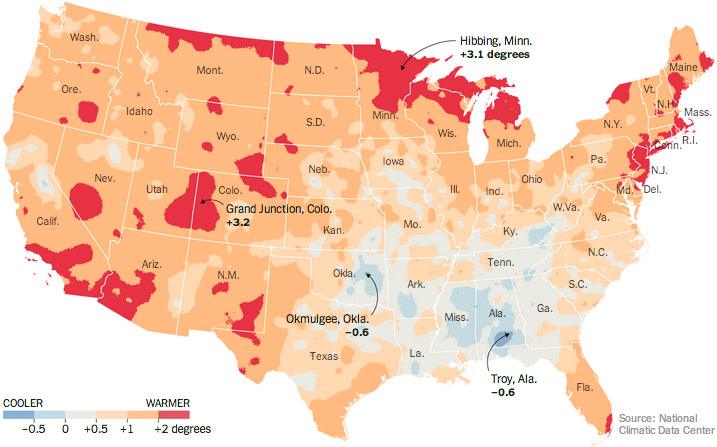
Among the report’s findings? As I’ve noted before, weather is getting weirder and more bursty, not just hotter.
One of the report’s most striking findings concerned the rising frequency of torrential rains. Scientists have expected this effect for decades because more water is evaporating from a warming ocean surface, and the warmer atmosphere is able to hold the excess vapor, which then falls as rain or snow. But even the leading experts have been surprised by the scope of the change.
The report found that the eastern half of the country is receiving more precipitation in general. And over the past half-century, the proportion of precipitation that is falling in very heavy rain events has jumped by 71 percent in the Northeast, by 37 percent in the Midwest and by 27 percent in the South, the report found.
Nonlinear systems, man.
Years of Living Dangerously is a 9-part documentary series on climate change which features celebrity correspondents like Harrison Ford, Oliva Munn, Jessica Alba, and Matt Damon reporting from around the world on different aspects of our changing climate.
The series combines the blockbuster storytelling styles of Hollywood’s top movie makers, including James Cameron and Jerry Weintraub, with the investigative skills of 60 Minutes veterans Joel Bach and David Gelber and a team of leading national news journalists and scientists.
Each YEARS correspondent — including top Hollywood stars recognized for their commitment to spotlighting and acting on the biggest issues of our time — delves into a different impact of climate change. From the damage wrought by Hurricane Sandy in the tri-state area to political upheaval caused by droughts in the Middle East to the dangerous level of carbon emissions resulting from deforestation, the series takes the viewer on a journey to understand the current and intensifying effects of climate change through vivid stories of heartbreak, hope and heroism.
The show starts airing on Showtime on April 13, but the entire first episode is available on YouTube right now:
The show is getting great reviews so far; I hope it helps move the needle. (thx, tobin)
About 250 million years ago, Earth suffered its fifth (and worst) mass extinction event. Nearly seventy percent of land species disappeared. And they got off easy compared to marine species. Are we headed for another mass extinction on Earth? I’m not ready to break that news. But something unusual is definitely going on and extinction rates seem to be speeding up. Here’s an interesting chat with Elizabeth Kolbert, author of The Sixth Extinction.
The worst mass extinction of all time came about 250 million years ago [the Permian-Triassic extinction event]. There’s a pretty good consensus there that this was caused by a huge volcanic event that went on for a long time and released a lot of carbon-dioxide into the atmosphere. That is pretty ominous considering that we are releasing a lot of CO2 into the atmosphere and people increasingly are drawing parallels between the two events.
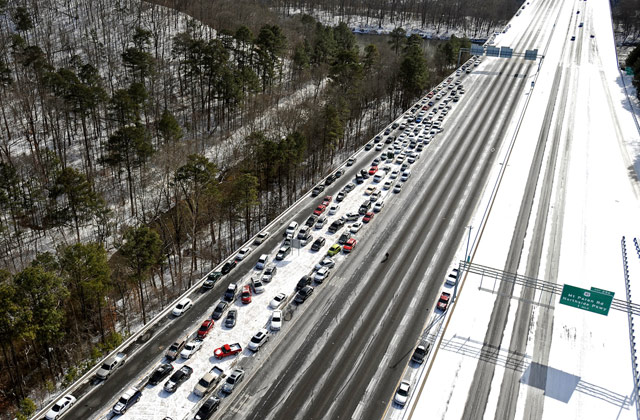
It sounds odd that a city would be digging out from a few inches of snow. But Atlanta residents were faced with a whole lot of chaos (and even more traffic) when they were hit with some unusually white weather.
We’re talking about kids spending the night their schools, commutes a few miles that took more than ten hours, helicopters searching for stranded drivers, and a call to the National Guard for help.
From InFocus, here’s a collection of photos that will give you a good idea of what happens when snowstorm hits a population not accustomed to that kind of weather.
Talking about the weather used to be a euphemism for talking about nothing. Now it can mean talking about everything.
Update: This is the best post I read about the snowfall in the South.
But if you’re making light of the situation, or more realistically using it to reinforce your view of the South and the people in it as full of backwards blubberers, you are an asshole. It’s hard to remember sometimes, but things are different in places you do not personally live.
When it snows where you live, the salt and the snowplows are out on the streets before you even wake up. When you talk about six inches of snow in your city, you are almost definitely talking about six inches of snow on the median strip and shoulder, and highways that are slick, but clear. I’d take that over two inches of snow and ice on every major road any day.
When it snows where you live, it is the latest in a string of snowfalls that date back centuries. You own a car with four-wheel-drive for that very purpose. You may even own snow tires. This is great! You are prepared. But waking up in Birmingham to snow is like waking up in New Hampshire to quicksand.
The internet’s resident meteorologist Eric Holthaus (who incidentally has given up flying because of climate change) warns that a major storm could be on its way to the East Coast in time for Thanksgiving and Hanukkah (which overlap this year and then not again until the year 79811).
Technically, the storm is a nor’easter but is looking more like a tropical storm in the computer models:
At this point, the most likely scenario would be cold, wind-driven rain in the big coastal US cities, with up to a foot of snow stretching from inland New England as far south as the Carolinas. The cold would stick around after the storm exits, with high temperatures in the 20s and wind chills possibly in the single digits as far south as New Jersey on Black Friday.
According to this afternoon’s iteration of the Euro model (a meteorological model that famously predicted superstorm Sandy’s rare left hook into New Jersey six days out), at the storm’s peak, wind gusts on Cape Cod could approach hurricane force.
We’re still a ways out, so things might change, but travel safely next week, folks. (via @marcprecipice)
Newer posts
Older posts





Socials & More