kottke.org posts about climate crisis
Elizabeth Kolbert on yet another report which says that the future effects of anthropogenic climate change will be irreversible and catastrophic.
Promoting “preparedness” is doubtless a good idea. As the executive order notes, climate impacts — which include, but are not limited to, heat waves, heavier downpours, and an increase in the number and intensity of wildfires — are “already affecting communities, natural resources, ecosystems, economies, and public health across the Nation.” However, one of the dangers of this enterprise is that it tends to presuppose, in a Boy Scout-ish sort of way, that “preparedness” is possible.
As we merrily roll along, radically altering the planet, we are, as the leaked I.P.C.C. report makes clear, increasingly in danger of committing ourselves to outcomes that will simply overwhelm societies’ ability to adapt. Certainly they will overwhelm the abilities of frogs and trees and birds to adapt. Thus, any genuine “preparedness” strategy must include averting those eventualities for which preparation is impossible. This is not something that the President can do by executive order, but it’s something he ought to be pursuing with every other tool.
In linking to the piece, Philip Gourevitch notes:
This is simply the most important & urgent issue in our time & will be for as long as there is a foreseeable future
I wonder… what it’s gonna take for the world’s governments to lurch into action on this? Or will they ever? Years of iron-clad scientific consensus isn’t doing it. Sandy didn’t do it. Heat waves, wildfires, and floods seem to have little effect. The melting Arctic, ha! The risk to food and water supplies? Not really. For fun, here’s a Guardian piece from six years ago on 2007’s IPCC report, the same report Kolbert is referring to above.
Sea levels will rise over the century by around half a metre; snow will disappear from all but the highest mountains; deserts will spread; oceans become acidic, leading to the destruction of coral reefs and atolls; and deadly heatwaves will become more prevalent.
The impact will be catastrophic, forcing hundreds of millions of people to flee their devastated homelands, particularly in tropical, low-lying areas, while creating waves of immigrants whose movements will strain the economies of even the most affluent countries.
‘The really chilling thing about the IPCC report is that it is the work of several thousand climate experts who have widely differing views about how greenhouse gases will have their effect. Some think they will have a major impact, others a lesser role. Each paragraph of this report was therefore argued over and scrutinised intensely. Only points that were considered indisputable survived this process. This is a very conservative document — that’s what makes it so scary,’ said one senior UK climate expert.
It’s the same shit! It’s absurd.
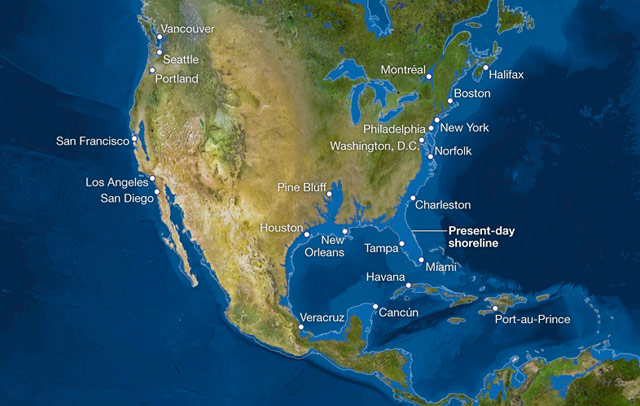
If all the glaciers and snow and ice in the world melted, the sea level would rise 216 feet and, as this National Geographic map of the world shows, things would look a little different.
There are more than five million cubic miles of ice on Earth, and some scientists say it would take more than 5,000 years to melt it all. If we continue adding carbon to the atmosphere, we’ll very likely create an ice-free planet, with an average temperature of perhaps 80 degrees Fahrenheit instead of the current 58.
See also Flood Maps.
For the first time, researchers have put together all the climate data they have (from ice cores, coral, sediment drilling) into one chart that shows the “global temperature reconstruction for the last 11,000 years”:
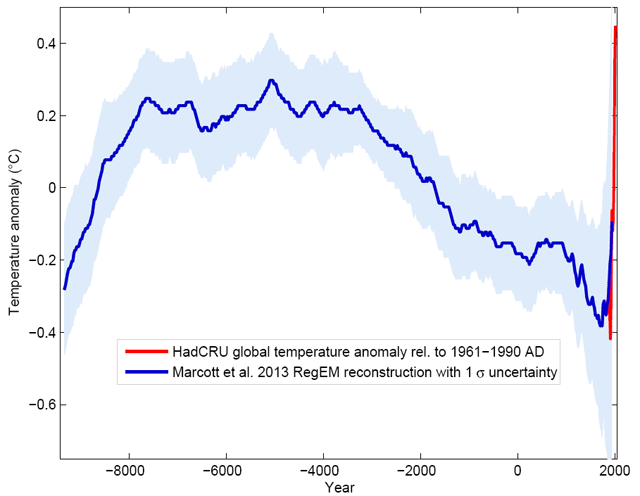
The climate curve looks like a “hump”. At the beginning of the Holocene - after the end of the last Ice Age - global temperature increased, and subsequently it decreased again by 0.7 ° C over the past 5000 years. The well-known transition from the relatively warm Medieval into the “little ice age” turns out to be part of a much longer-term cooling, which ended abruptly with the rapid warming of the 20th Century. Within a hundred years, the cooling of the previous 5000 years was undone. (One result of this is, for example, that the famous iceman ‘Ötzi’, who disappeared under ice 5000 years ago, reappeared in 1991.)
What on Earth could have caused that spike over the past 250 years? A real head-scratcher, that. But also, what would have happened had the Industrial Revolution and the corresponding anthropogenic climate change been delayed a couple hundred years? The Earth might have been in the midst of a new ice age, Europe might have been too cold to support industry, and things may not have gotten going at all. Who’s gonna write the screenplay for this movie? (via @CharlesCMann)
Scientists from an advanced alien society have discovered a potentially remarkable planet that turns out to be “completely hostile to life”.
“Theoretically, this place ought to be perfect,” leading Terxus astrobiologist Dr. Srin Xanarth said of the reportedly blighted planet located at the edge of a spiral arm in the Milky Way galaxy. “When our long-range satellites first picked it up, we honestly thought we’d hit the jackpot. We just assumed it would be a lush, green world filled with abundant natural resources. But unfortunately, its damaged biosphere makes it wholly unsuitable for living creatures of any kind.”
“It’s basically a dead planet,” she added. “We give it another 200 years, tops.”
The alien researchers stated that the dramatically warming atmosphere of RP-26 contains alarming amounts of carbon dioxide and methane, as well as an ozone layer that-for reasons they cannot begin to fathom-has been allowed to develop a gaping hole. They also noted the presence of melting polar icecaps, floods, and enough pollutants to poison “every last drop of the planet’s fresh water, if you can even call it that.”
You finally really did it. You maniacs! You blew it up! God damn you! God damn you all to hell!
Climate scientists have been wrestling with a curious fact lately: the rise in global temperature has been flat over the past decade or more even as we pump ever-increasing rates of carbon dioxide into the atmosphere. The Economist discusses what that might mean for the climate and climate science.
Over the past 15 years air temperatures at the Earth’s surface have been flat while greenhouse-gas emissions have continued to soar. The world added roughly 100 billion tonnes of carbon to the atmosphere between 2000 and 2010. That is about a quarter of all the CO₂ put there by humanity since 1750. And yet, as James Hansen, the head of NASA’s Goddard Institute for Space Studies, observes, “the five-year mean global temperature has been flat for a decade.”
Temperatures fluctuate over short periods, but this lack of new warming is a surprise. Ed Hawkins, of the University of Reading, in Britain, points out that surface temperatures since 2005 are already at the low end of the range of projections derived from 20 climate models. If they remain flat, they will fall outside the models’ range within a few years.
The mismatch between rising greenhouse-gas emissions and not-rising temperatures is among the biggest puzzles in climate science just now. It does not mean global warming is a delusion. Flat though they are, temperatures in the first decade of the 21st century remain almost 1°C above their level in the first decade of the 20th. But the puzzle does need explaining.
Earlier in the week I posted about how climate change is affecting wine. Turns out that coffee is in trouble as well.
But in recent years, keeping the world’s coffee drinkers supplied has become increasingly difficult: The spread of a deadly fungus that has been linked to global warming and rising global temperatures in the tropical countries where coffee grows has researchers scrambling to create new varieties of coffee plants that can keep pace with these new threats without reducing quality.
While coffee researchers can do little to prevent climate change, they’re hard at work to keep up as Earth braces for temperature increases of several degrees over the next several decades.
“Coffee is the canary in the coal mine for climate change,” says Ric Rhinehart, executive director of the Specialty Coffee Association of America. “If you can’t think about the long term risk for planetary impacts, think about the short term risk for your coffee. Know that a day without coffee is potentially around the corner.”
(via nextdraft)
Food and beverages where terroir is a big factor will be the first to be affected by climate change. This is already happening in the world of wine…wine production is happening in Denmark, French wines are changing flavors, and some places may become too hot to grow grapes at all.
As new frontiers for grape growing open up, the viability of some traditional production areas is under threat from scorching temperatures and prolonged droughts.
And in between the two extremes, some long-established styles are being transformed. Some whites once renowned for being light and crisp are getting fatter and more floral while medium-bodied reds are morphing into heavyweight bruisers.
(via @CharlesCMann)
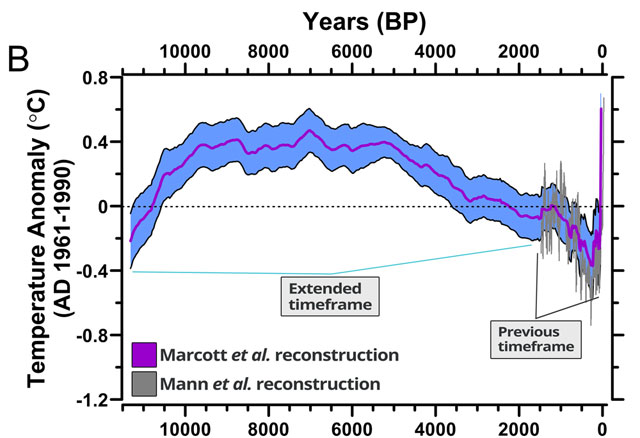
You’ve likely seen the graph of the Earth’s average global temperature over the past 2000 years…it’s mostly a straight line until you get to the industrial revolution and then it shoots up. It looks like a hockey stick. In a study published today in Science, that graph has been extended back 11,300 years and you can really see the scope of the abrupt temperature change.
From a summary of the report at TPM:
The decade of 1900 to 1910 was one of the coolest in the past 11,300 years - cooler than 95 percent of the other years, the marine fossil data suggest. Yet 100 years later, the decade of 2000 to 2010 was one of the warmest, said study lead author Shaun Marcott of Oregon State University. Global thermometer records only go back to 1880, and those show the last decade was the hottest for this more recent time period.
“In 100 years, we’ve gone from the cold end of the spectrum to the warm end of the spectrum,” Marcott said. “We’ve never seen something this rapid. Even in the ice age the global temperature never changed this quickly.”
Using fossils from all over the world, Marcott presents the longest continuous record of Earth’s average temperature. One of his co-authors last year used the same method to look even farther back. This study fills in the crucial post-ice age time during early human civilization.
Marcott’s data indicates that it took 4,000 years for the world to warm about 1.25 degrees from the end of the ice age to about 7,000 years ago. The same fossil-based data suggest a similar level of warming occurring in just one generation: from the 1920s to the 1940s. Actual thermometer records don’t show the rise from the 1920s to the 1940s was quite that big and Marcott said for such recent time periods it is better to use actual thermometer readings than his proxies.
(via digg)
On Friday afternoon, a government advisory committee released a draft of a federal climate assessment report, which pretty much meant that no one saw it, aside from the few journalists who were tasked, at that late hour of the week, with writing something about it. The upshot of the report? Bad news and there’s not much anyone is doing about it. From Mother Jones:
Say what you want about the Obama administration’s relative ignoring of climate issues: Many of his top scientists are paying rapt attention, and they think we’re about to get our butts kicked — although dumping the news at 4 p.m. on a Friday gives some indication of where it sits in federal priorities.
Anyway, what does the report say? From Nature:
Coming just days after news that the United States experienced its hottest year on record in 2012, the draft report says average US temperatures have increased by more than 0.8° Celsius since 1895, with a sharp spike since 1980. It also provides an update on the litany of impacts being analyzed by scientists. There is “strong evidence” that global warming has roughly doubled the likelihood of extreme heat events, contributing to droughts and wildfires, according to the report. Permafrost is melting in Alaska, while much of the country is experiencing more extreme rainfall and winter snowstorms.
And from Bloomberg:
The 60-member panel approved and released a draft report today that says many coastal areas face “potentially irreversible impacts” as warmer temperatures lead to flooding, storm surges and water shortages.
“The chances of record-breaking, high-temperature extremes will continue to increase as the climate continues to change,” the panel said in its report. Temperatures are predicted to increase, on average, by 2 degrees to 4 degrees in the next few decades, according to the report.
The panel of scientists from academia, industry, environmental groups and the government prepared the report, and its findings are the closest to a consensus about global warming in the U.S. Reports in 2000 and 2009 by the U.S. Global Change Research Program concluded carbon-dioxide emissions since the Industrial Revolution have led to a warming of the Earth’s temperature, which threatens to cause extreme weather, drought and floods.
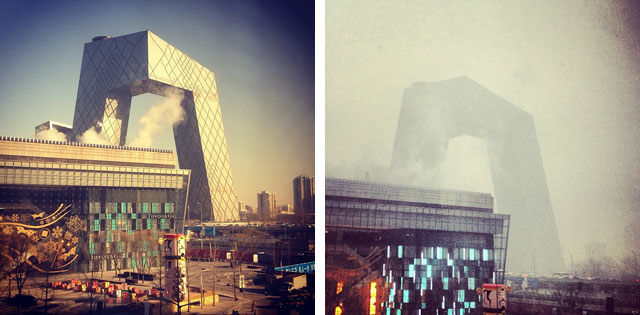
The report also highlighted decreasing air quality as a side effect of the changing climate. This weekend, the air quality in Beijing was off the scale for about 18 hours. The scale goes from 0-500:
Good: 0-50
Moderate: 51-100
Unhealthy for Sensitive Groups: 101-150
Unhealthy: 151-200
Very Unhealthy: 201-300
Hazardous: 301-500
The readings in Beijing topped out at 755. My friend Youngna is there and these two photos she took of the CCTV building two days apart shows how bad the pollution is there:
As previously reported, global warming doesn’t just mean the Earth is getting warmer…the weather is getting weirder.
Britons may remember 2012 as the year the weather spun off its rails in a chaotic concoction of drought, deluge and flooding, but the unpredictability of it all turns out to have been all too predictable: Around the world, extreme has become the new commonplace.
Especially lately. China is enduring its coldest winter in nearly 30 years. Brazil is in the grip of a dreadful heat spell. Eastern Russia is so freezing — minus 50 degrees Fahrenheit, and counting — that the traffic lights recently stopped working in the city of Yakutsk.
Bush fires are raging across Australia, fueled by a record-shattering heat wave. Pakistan was inundated by unexpected flooding in September. A vicious storm bringing rain, snow and floods just struck the Middle East. And in the United States, scientists confirmed this week what people could have figured out simply by going outside: last year was the hottest since records began.
BTW, this story was published the day before the NY Times announced that they are dismantling their environment news desk and dispersing the nine-person staff throughout the newsroom.
It wasn’t a decision we made lightly,” said Dean Baquet, the paper’s managing editor for news operations. “To both me and Jill [Abramson, executive editor], coverage of the environment is what separates the New York Times from other papers. We devote a lot of resources to it, now more than ever. We have not lost any desire for environmental coverage. This is purely a structural matter.”
This seems like a step in the wrong direction. Which prominent national publication will be brave and start pushing climate change coverage alongside that of politics, business, and sports? At the very least, the Times should have a weekly Climate Change section, the New Yorker should have a yearly Climate issue, Buzzfeed should have a Climate & Weather vertical, etc. (via @tcarmody)
The NOAA says that 2012 was the hottest year on record. BY AN ENTIRE DEGREE.
The average temperature was 55.3 degrees, 1 degree above the previous record and 3.2 degrees more than the 20th-century average. Temperatures were above normal in every month between June 2011 and September 2012, a 16-month stretch that hasn’t occurred since the government began keeping such records in 1895.
Weather-wise, 2012 is Usain Bolt crossing the line in the 100-meter final at the Beijing Olympics, already slowing down, arms out, and still so so much faster than everyone else.
The forecasted temperature in the interior of Australia is so high for next Monday that the country’s Bureau of Meteorology has had to add an extra color code at the top end of the temperature scale for REALLY FUCKING HOT.
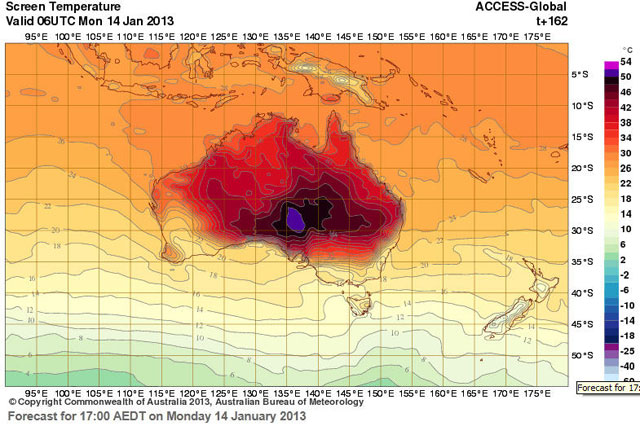
The bureau’s head of climate monitoring and prediction David Jones said the new scale, which also features a pink code for temperatures from 52 to 54 degrees, reflected the potential for old heat records to be smashed.
“The scale has just been increased today and I would anticipate it is because the forecast coming from the bureau’s model is showing temperatures in excess of 50 degrees,” Jones told Fairfax newspapers.
Australia’s all-time record temperature is 50.7 degrees, set in January 1960 at Oodnadatta in the state of South Australia.
The nation as a whole experienced its hottest day on record on Monday with the average maximum temperature across the country hitting 40.33 degrees, surpassing the previous mark of 40.17 degrees set in 1972.
I feel like climate change needs a Steve Jobs to kick everyone’s ass into action on this, iPhone announcement-style. “Unprecedented polar ice cap melt, new colors on Australia’s weather map, massive East Coast hurricanes, are you getting it? These are not three separate incidents. This is one global pattern. And we are calling it anthropogenic climate change. [wild applause]” (via @ftrain)
Climate change, already on the hook for potentially killing spaghetti, will have a big impact on downhill skiing and snowboarding in the United States.
Under certain warming forecasts, more than half of the 103 ski resorts in the Northeast will not be able to maintain a 100-day season by 2039, according to a study to be published next year by Daniel Scott, director of the Interdisciplinary Center on Climate Change at the University of Waterloo in Ontario.
By then, no ski area in Connecticut or Massachusetts is likely to be economically viable, Mr. Scott said. Only 7 of 18 resorts in New Hampshire and 8 of 14 in Maine will be. New York’s 36 ski areas, most of them in the western part of the state, will have shrunk to 9.
The supposed debate among scientists over climate change has melted faster than the polar ice caps. National Science Board member James Lawrence Powell looked at all the related peer-reviewed scientific papers over the last several years. Twenty-four of those articles rejected the notion of climate change. Out of 14,000.
So let this be clear: There is no scientific controversy over this. Climate change denial is purely, 100 percent made-up political and corporate-sponsored crap.
It’s still easy for many of us to ignore the issue of climate change, but every now and then a headline makes us take notice. This one did it for me: The End of Pasta.
But if humans want to keep eating pasta, we will have to take much more aggressive action against global warming. Pasta is made from wheat, and a large, growing body of scientific studies and real-world observations suggest that wheat will be hit especially hard as temperatures rise and storms and drought intensify in the years ahead.
A ProPublica Investigation: Poisoning the Well: How the feds let industry pollute the nation’s underground water supply.
Federal officials have given energy and mining companies permission to pollute aquifers in more than 1,500 places across the country, releasing toxic material into underground reservoirs that help supply more than half of the nation’s drinking water.
In many cases, the Environmental Protection Agency has granted these so-called aquifer exemptions in Western states now stricken by drought and increasingly desperate for water.
In 2006, New York magazine published a piece by Clive Thompson about what climate change is doing to New York’s weather.
Nobody really knows what’ll happen more than a week in advance, of course. But if we assemble these major climatic trends, a rough snapshot of New York’s future begins to emerge.
First off, El Nino will keep our winters reasonably mild and reduce hurricanes in the immediate future, possibly until as late as 2008, because El Ninos usually last for only one or two years.
Meanwhile, the AMO will remain in its warm phase, charging up storms and hurricanes off our shores, for much longer, probably another twenty years. So while El Nino may be driving a temporary reprieve in our nasty weather, once it dissipates, the long-term trend is back to tumultuous hurricane seasons.
The final ingredient in the mix is global warming. In the past century, the average temperature in New York has risen by two degrees, and the trend shows no sign of slowing down. Indeed, the computer models reviewed in the “Metropolitan East Coast Climate Assessment” — a 50-year prediction of New York’s changing climate, developed by nasa and Columbia University — suggest that the city will continue to heat up by as much as one degree by 2010, two degrees by 2020, and accelerate on a gentle curve until we reach as much as nine degrees warmer than now in 2100. It doesn’t particularly matter whether you believe the warming is man-made or a natural cycle (most, but not all, climatologists believe the former). The point is, pumping that much extra energy into the system is bound to have some effect.
The impact on our daily life, though, is the big question. A few degrees of warming won’t turn New York into a Miami-class shirtsleeves town. The effect will be more subtle: Climate scientists suspect that a warmer climate will produce more weather volatility. It’s not that we’ll have more rain overall, more snow overall, or more storms overall. But each event will be more intense than before.
“We’re more likely to get hotter heat waves,” says Mark Cane, a climatologist at Columbia University. “And increased storminess” adds Cullen. Both effects are due to the additional energy that global warming pumps into the “hydrological cycle,” the water and energy that circulates through the atmosphere — and it’s water that creates weather.
As they say, “nailed it”. The term “global warming” continues to be a misleading when it comes to the effect of the Earth’s increasing temperature on our weather; as Thompson notes, it’s not that it’s just gonna get a little hotter in the summer or a little less snowy in the winter, the weather’s gonna get weirder. Which is a problem…it’s difficult for society to measure and talk about “weird”.
Newer posts
Older posts






Socials & More