kottke.org posts about NYC
Eater has the scoop: Danny Meyer’s Union Square Hospitality Group is eliminating tipping at all of their full-service restaurants.
Big news out of Manhattan: Dining out is about to get turned on its head. Union Square Hospitality Group, the force behind some of New York’s most important restaurants, will announce today that starting in November, it will roll out an across-the-board elimination of tips at every one of its thirteen full-service venues, hand in hand with an across-the-board increase in prices.
Why are they doing this? In part because cooks get the shaft at restaurants:
Under the current gratuity system, not everyone at a restaurant is getting a fair shake. Waiters at full-service New York restaurants can expect a full 20 percent tip on most checks, for a yearly income of $40,000 or more on average — some of the city’s top servers easily clear $100,000 annually. But the problem isn’t what waiters make, it’s what cooks make. A mid-level line cook, even in a high-end kitchen, doesn’t have generous patrons padding her paycheck, and as such is, on average, unlikely to make much more than $35,000 a year.
I hope this catches on.

The Silicon City exhibit at the New York Historical Society takes a look at the long history of computing in NYC.
Every 15 minutes, for nearly a year, 500 men, women, and children rose majestically into “the egg,” Eero Saarinen’s idiosyncratic theater at the 1964 World’s Fair. It was very likely their first introduction to computer logic. Computing was not new. But for the general public, IBM’s iconic pavilion was a high profile coming out party, and Silicon City will harness it to introduce New York’s role in helping midwife the digital age.
The exhibit opens on November 13, 2015 and runs through next April. The museum is using Kickstarter to help bring the Telstar satellite back to NYC for the exhibit.
Two weeks ago, 99% Invisible broadcast an audio documentary from 1998 about one of the last remaining flophouses on The Bowery in NYC called The Sunshine Hotel. It is an amazing time capsule from a Manhattan that just doesn’t exist anymore.
The Sunshine Hotel opened in 1922. Rooms — or really, cubicles — were 10 cents a night. The Sunshine, like other flop houses, was always a men-only establishment. In 1998, the hotel had raised it’s rates to 10 dollars a night and it was managed by resident Nathan Smith. He sat behind a metal cage at the front desk, answering the phone and doling out toilet paper to residents for 35 cents. Smith had once worked in a bank until he was injured, and then fired. His wife left him and he ended up in the Bowery, and eventually at the Sunshine Hotel.
The interviewees sound like they’re characters in a play, not real people. It’s so good. There is also a documentary film released in 2001 about The Sunshine Hotel which is available on Amazon Instant; here’s a trailer:
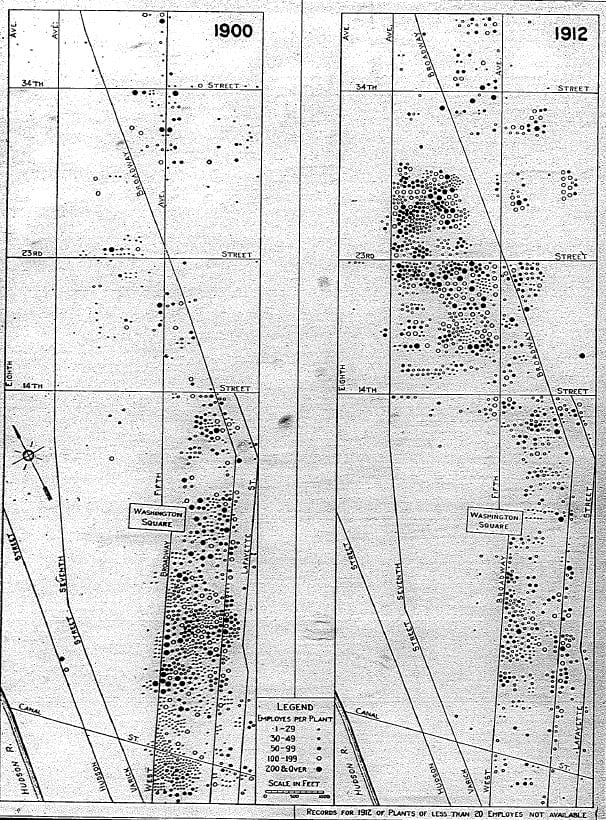
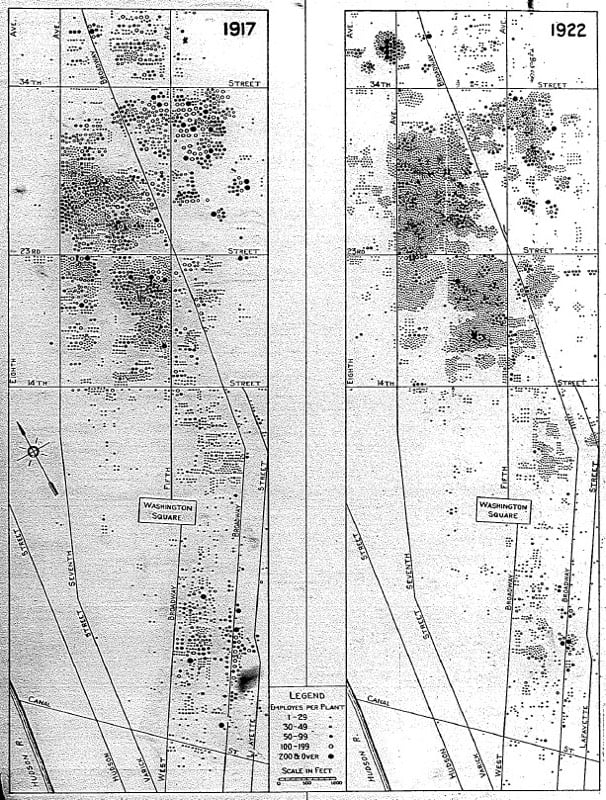
Economist William Easterly and some of his colleagues built a site that focuses on the economic development of a single block in NYC, Greene Street between Houston and Prince. In the past 175 years, use of the block has gone from wealthy residential to sex work to garment manufacturing to artist galleries to luxury retail.
133 Greene Street, for example, has been part of the large Bayard farm, a grand residential home, a brothel, a garment factory, part of a slum, an art gallery, and is today the home of luxury co-op residences and a Dior Homme store.
Many of these shifts took only a decade and could have been very difficult to anticipate.
The site was built to accompany an academic paper on economic development.
By 1870, the Greene Street Block contained 14 brothels, the highest concentration of any block in the City. Just as surprising was the sudden end of prostitution on the block. Brothels still abounded in 1880, but during the next decade entrepreneurs demolished and rebuilt almost the entire block as castiron factories and warehouses, and what was left of the red-light district moved up town.
The site is a little confusing to navigate, but is worth checking out in detail. For instance, check out how quickly the garment manufacturing industry shifted from downtown to the present-day Garment District.
(via wired)
Mark Reay is a former model, actor, and fashion photographer who was homeless in NYC for six years. Homme Less is a documentary on Reay; here’s a trailer:
So began a period of my life sleeping rough. It was pretty tiring, and I didn’t have much luck with the photos, but I stuck it out. I’ve never let the lack of money stop me having a good time, and I still had (dwindling) savings from my modelling. It was a happy time. At night I would always treat myself to a rotisserie chicken, but I always wanted a chilled rosé with it. So, in the afternoon, I would sneak into a minimarket, get the cheapest one from the shelf and hide it under the frozen peas. Then, at night, I would put on a fresh shirt and go to one of the fancy bars with my wine in my bag. Again, maybe because I had a certain look, no one ever checked my bag. I’d just go in, nick a glass off the counter and drink my wine surrounded my millionaires.
You can get away with anything if you’re confident. Oh, and male, white, and good looking.
The walls of the elevator to the observatory at the top of 1 World Trade Center are covered with screens and when you ride it to the top, you see a time lapse of NYC’s development, from 1500 to the present.
The observatory is open daily from 9am to 8pm.
As something of an expert on the topic, I thought this New York Magazine piece about spending time alone in the Big Apple is pretty good. The opening of the piece gets at why busy, crowded NYC is actually a good place for an introvert to be:
Being alone here is a state of mind, a perpetual choice, and an occasional imposition, a burden, and a gift — and sometimes the very best way to meet a fellow stranger. “Every form of human expressiveness is on display,” Vivian Gornick writes of walking the streets by herself, “and I am free to look it right in the face, or avert my eyes if I wish.”
And this tip on the Empire State Building is one for the ol’ bucket list:
A lot of people don’t know this, but the Empire State Building is open until 2 a.m. The last elevator leaves at 1:15. If you go up then, it’s empty, it’s beautiful, and the city sounds like the ocean.
This video from the MTA shows some of the vintage technologies that are still in use to control many of the NYC’s subway lines and how they are upgrading (ve. ry. slow. ly.) to safer and more reliable computerized systems. Some of control systems are more than 80 years old.
Whoa, after watching that, I’m shocked that the trains ever get anywhere at all. (via the kid should see this)
Update: The NY Times has a look at the political and logistical challenges related to upgrading the NYC subway’s antiquated infrastructure.
A computerized signal system like C.B.T.C. is also safer because trains can be stopped automatically. New York’s quest to install the new system began in 1991, after a subway derailment at Union Square in Manhattan killed five people. The train operator was speeding after he had been drinking.
More than 25 years later, the authority has little to show for its effort to install modern signals. The L line began using computerized signals in 2009 after about a decade of work. A second line, the No. 7, should have received new signals last year, but the project was delayed until the end of this year.
The process is complicated. It requires installing transponders every 500 feet on the tracks, along with radios and zone controllers, and buying new trains or upgrading them with onboard computers, radios and speed sensors. The authority also had to develop a design and software that was tailored to New York’s subway.
Over the years, the authority has kept pushing back the timeline for replacing signals. In 1997, officials said that every line would be computerized by this year. By 2005, they had pushed the deadline to 2045, and now even that target seems unrealistic.
40 years to upgrade the entire system? Embarrassing.

Pixar: The Design of Story is an upcoming exhibition at the Cooper Hewitt National Design Museum here in NYC.
Through concept art from films such as Toy Story, Wall-E, Up, Brave, The Incredibles and Cars, among others, the exhibition will focus on Pixar’s process of iteration, collaboration and research, and is organized into three key design principles: story, believability and appeal. The exhibition will be on view in the museum’s immersive Process Lab — an interactive space that was launched with the transformed Cooper Hewitt in December 2014 — whose rotating exhibitions engage visitors with activities that focus on the design process, emphasizing the role of experimentation in design thinking and making.
More details are available in the press release. Definitely going to check this out and take the kids.
This video was shot in NYC on July 18, 1990, mostly in Times Square and Central Park.
The first 30 seconds of the video (stumbling drunk, trash digger, overheating car) is pretty much a perfect representation of how NYC felt to many at the time. A squeegee man can also been seen at work near the end of the video.
The New Yorker did a short feature on Charlie Pellett, the voice of the NYC subway.
This deep, sometimes vexing voice — which also apologizes for “unavoidable delays” — belongs to a man named Charlie Pellett. A radio anchor for Bloomberg News, Pellett was raised in London but cultivated an American accent by listening to the radio. His work for the M.T.A., which is done on a volunteer basis, is the only non-reporting voice-over work that he’s done.

The WNYC Data News Team is looking for the longest possible NYC subway ride. The MTA says the longest direct trip is 38 miles, but WNYC found one that’s 148 miles, requiring 45 transfers. They’re running a little competition to see who can find a longer ride…check the rules for more details (short version: you can repeat stations but not track segments). This is basically a variant of the travelling salesman problem, yes? Anyone care to take a crack at it? (via @ryandawidjan)
An NYPD officer anonymously shares what it’s like to be a cop in NYC.
I’m walking in Boerum Hill on one of the first really good days of summer. It’s been a long week but I’m feeling good in a flowing sundress and sandals, relieved to be freed from what I’ve begun to think of as my blue polyester prison. I look up and realize with amusement that I’m walking by an actual prison, or, to be precise, a jail: Brooklyn Central Booking.
The doors to the courtroom lobby open and a man emerges, pausing to survey the street. He’s a little scruffy but then the newly arraigned usually are — there aren’t many opportunities to freshen up in the holding cells. He has an open, pleasant face, and the recognition on my part is immediate. My heart sinks as I see him cross the street and make a beeline for me.
“Miss? Miss?” He doesn’t sound particularly confrontational and I give him my best blank smile, hoping he has some kind of mundane procedural question.
“I don’t mean to like bother you or anything, but if you’re not busy, and a beautiful lady such as yourself is probably busy, but if you’re not busy I’d love to buy you a cup of coffee.”
Now I have to grin. This is my new favorite person in the world. What chutzpah! I’m so delighted by this guy that I almost chuck him on the shoulder. Then it hits me. He doesn’t recognize me, at all. He has no idea that I’m the person who arrested him two nights before.
(via @choire, who called it “BY FAR the most interesting thing i read all week”)
Eater’s Nick Solares accompanies the proprietor of Peter Luger Steakhouse to one of the few remaining butchers in the Meatpacking District1 to see how she selects meat for the restaurant.

MoMA has announced that they’ve acquired the Rainbow Flag for their permanent collection. The flag has been a symbol of the LGBT community around the world since its creation in 1978. As part of the acquisition, MoMA Curatorial Assistant Michelle Millar Fisher interviewed the man who designed the flag, artist Gilbert Baker.
And I thought, a flag is different than any other form of art. It’s not a painting, it’s not just cloth, it is not a just logo — it functions in so many different ways. I thought that we needed that kind of symbol, that we needed as a people something that everyone instantly understands. [The Rainbow Flag] doesn’t say the word “Gay,” and it doesn’t say “the United States” on the American flag but everyone knows visually what they mean. And that influence really came to me when I decided that we should have a flag, that a flag fit us as a symbol, that we are a people, a tribe if you will. And flags are about proclaiming power, so it’s very appropriate.
So the American flag was my introduction into that great big world of vexilography. But I didn’t really know that much about it. I was a big drag queen in 1970s San Francisco. I knew how to sew. I was in the right place at the right time to make the thing that we needed. It was necessary to have the Rainbow Flag because up until that we had the pink triangle from the Nazis — it was the symbol that they would use [to denote gay people]. It came from such a horrible place of murder and holocaust and Hitler. We needed something beautiful, something from us. The rainbow is so perfect because it really fits our diversity in terms of race, gender, ages, all of those things. Plus, it’s a natural flag — it’s from the sky! And even though the rainbow has been used in other ways in vexilography, this use has now far eclipsed any other use that it had…
Update: Baker died at his home on March 30, 2017. He was 65 years old.
Mr. Baker replicated his flag dozens of times over the years. He crafted a mile-long banner to parade down Fifth Avenue in Manhattan, and he sent flags around the world in support of gay rights protests. He sewed the rainbow flag used in the movie “Milk,” along with a new flag for this year’s television miniseries “When We Rise.”
“I remember the most fabulous queen I’d ever seen in my life shows up in sequins with a sewing machine in his arms, and he insisted on creating that flag exactly the same way he’d created it then,” said Dustin Lance Black, who wrote “Milk” and wrote and directed “When We Rise,” which was based on Jones’ memoir of the same name.
Newer posts
Older posts





Socials & More