The long recession in Japan has led to a curious result: the Japanese are no longer just importing American and European goods and services…they’re perfecting their own take on everything from cocktails and cusine to fashion and hotels.
Imagine going into an espresso bar, as I did in Tokyo, ordering a single shot, and being told that it’s not on offer. The counter at No. 8 Bear Pond may feature the shiniest, spiffiest, newest La Marzocco, as well as a Rube Goldberg-esque water-filtration system, but the menu, which lists lattes and Americanos, makes no mention of espresso or cappuccino.
“My boss won’t let me make espressos,” says the barista. “I need a year more, maybe two, before he’s ready to let customers drink my shots undiluted by milk. And I’ll need another whole year of practice after that if I want to be able to froth milk for cappuccinos.”
Only after 18 years as a barista in New York did his boss, the cafe’s owner, feel qualified to return home to show off his coffee-making skills. Now, at Bear Pond’s main branch, he stops making espressos at an early hour each day, claiming that the spike on the power grid after that time precludes drawing the voltage required for optimal pressure.
This is a nice story for the afternoon. During the cleanup process following the earthquake and tsunami in Japan, citizens have turned in tons of wallets containing $48 million. 5,700 safes washed out to sea in the tsunami have been recovered containing another $30 million. Most of this has been returned to the owners. This is the type of story that makes me say, “Please don’t be fake, please don’t be fake,” as I click submit.
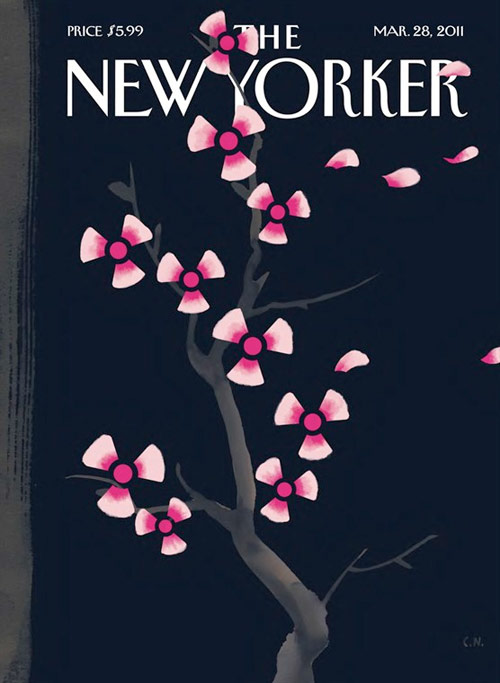
Lovely Japan-themed New Yorker cover this week by Christoph Niemann.
(via stellar)
That’s the title of an article written by Michael Lewis in 1989.
A big quake has hit Tokyo roughly every 70 years for four centuries: 1923, 1853, 1782, 1703, 1633.
(via @daveg)
I haven’t been keeping up with the Japan nuclear power plant situation as much as I want, but I wanted to pass along a few interesting articles. Over at Boing Boing, Maggie Koerth-Baker wrote a widely linked piece about how nuclear power plants work:
For the vast majority of people, nuclear power is a black box technology. Radioactive stuff goes in. Electricity (and nuclear waste) comes out. Somewhere in there, we’re aware that explosions and meltdowns can happen. Ninety-nine percent of the time, that set of information is enough to get by on. But, then, an emergency like this happens and, suddenly, keeping up-to-date on the news feels like you’ve walked in on the middle of a movie. Nobody pauses to catch you up on all the stuff you missed.
As I write this, it’s still not clear how bad, or how big, the problems at the Fukushima Daiichi power plant will be. I don’t know enough to speculate on that. I’m not sure anyone does. But I can give you a clearer picture of what’s inside the black box. That way, whatever happens at Fukushima, you’ll understand why it’s happening, and what it means.
MrReid, a physics teacher, writes about the situation at Fukushima:
Even with the release of steam, the pressure and temperature inside Unit 1 continued to increase. The high temperatures inside the reactor caused the protective zirconium cladding on the uranium fuel rods to react with steam inside the reactor to form zirconium oxide and hydrogen. This hydrogen leaked into the building that surrounded the reactor and ignited, damaging the surrounding building but without damaging the reactor vessel itself. Because the reactor vessel has not been compromised, the release of radiation should be minimal. It appears that a very similar situation has occurred at Unit 3 and that hydrogen is again responsible for the explosion seen there.
And this piece is a more meta take on the situation, What the Media Doesn’t Get About Meltdowns.
Of immediate concern is the prospect of a so-called “meltdown” at one or more of the Japanese reactors. But part of the problem in understanding the potential dangers is continued indiscriminate use, by experts and the media, of this inherently frightening term without explanation or perspective. There are varying degrees of melting or meltdown of the nuclear fuel rods in a given reactor; but there are also multiple safety systems, or containment barriers, in a given plant’s design that are intended to keep radioactive materials from escaping into the general environment in the event of a partial or complete meltdown of the reactor core. Finally, there are the steps taken by a plant’s operators to try to bring the nuclear emergency under control before these containment barriers are breached.
From the NY Times, Japan’s Strict Building Codes Saved Lives:
Had any other populous country suffered the 8.9 magnitude earthquake that shook Japan on Friday, tens of thousands of people might already be counted among the dead. So far, Japan’s death toll is in the hundreds, although it is certain to rise somewhat.
Over the years, Japan has spent billions of dollars developing the most advanced technology against earthquakes and tsunamis. The Japanese, who regularly experience smaller earthquakes and have lived through major ones, know how to react to quakes and tsunamis because of regular drills — unlike Southeast Asians, many of whom died in the 2004 Indian Ocean tsunami because they lingered near the coast despite clear warnings to flee.
Note: the title of the post is a reference to a tweet by Dave Ewing:
The headline you won’t see: “Millions saved in Japan by good engineering and government building codes”. But it’s the truth.
Google has built a quick little app for people trying to locate friends and family in Japan. There are two options: 1) “I’m looking for someone” and 2) “I have information about someone”.
Over at The Atlantic’s In Focus blog, Alan Taylor is compiling a selection of photos of the earthquake and tsunami in Japan. You’ve seen many of these on other sites, but not at these sizes (1280 pixels wide).
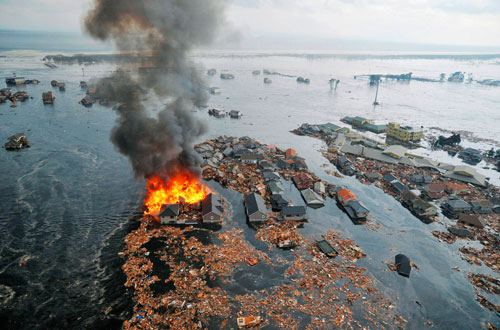
If you haven’t already heard, Al-Jazeera had (and continues to have) some of the best coverage of earthquake and tsunami in Japan. Here’s a clip from earlier showing the tsunami rushing through a populated area.
Contrast with CNN, which was apparently home to giggles and Godzilla jokes as the quake was being reported. In the last three or four big events in the world, Al-Jazeera has had the best coverage…is this a changing of the guard?
Update: Mediaite investigates and finds no evidence that a Godzilla reference or giggling occurred on CNN last night.
We did find an example of an American in Japan that made a reference that it was like a “monster movie” (which is included below) but Church handles herself completely appropriately.
Update: Mediaite found a video of the CNN broadcast in question where the anchor chuckles at something her interviewee says. And her whole tone sounds a bit more chipper than it ought to. The sing-song anchor voice might suffice when reporting non-news filler but fails when watching video of dozens of homes (possibly with people in them!) being swept along by a massive wave of water. (via @somebadideas)
Two videos of the tsunami triggered by the 8.9 magnitude eathquake that struck Japan. Both are from Sendai:
The quake is one of the most powerful ever to hit Japan.
The United States Geological Survey said the earthquake had a magnitude of 8.9, and occurred at about 230 miles northeast of Tokyo and at a revised depth of about 17 miles. The Japanese Meteorological Agency said the quake had a magnitude of 8.8, which would make it among the biggest in a century.
The quake occurred at 2:46 p.m. Tokyo time and hit off Honshu, Japan’s most populous island. The quake was so powerful that buildings in central Tokyo, designed to withstand major earthquakes, swayed.
The Cove has been getting great reviews: four stars from Ebert (who calls it “a certain Oscar nominee”) and a score of 82 on Metacritic. A quick synopsis from Wikipedia followed by the trailer:
The Cove is a 2009 documentary film documenting the annual killing of more than 2,500 dolphins in a cove at Taiji, Wakayama in Japan. The film was directed by former National Geographic photographer Louis Psihoyos, and was filmed secretly during 2007 using underwater microphones and high-definition cameras disguised as rocks.
In remembrance of the mass destruction of life and property due to the dropping of the first atomic bomb on Hiroshima 64 years ago today, The Big Picture presents a typically excellent selection of photos.
Update: From Design Observer about a year ago, Hiroshima, The Lost Photographs.




Socials & More