Entries for May 2017
Vanity Fair’s David Kamp recently tried to get Kathleen Kennedy and Rian Johnson to tell him the meaning behind The Last Jedi, the title of the upcoming Star Wars movie. LOL. Hopeless move, right? Why would he even ask such a question? Oh, because George Lucas told him who the The Phantom Menace referred to before that movie came out.
Vanity Fair: So, do we know what the words The Last Jedi allude to?
Kathleen Kennedy: Why in the world do you think I would tell you that?
VF: I’ll tell you why. Back in 1998, I interviewed George Lucas for V.F. ahead of The Phantom Menace, and I asked, “Who or what is the phantom menace?” And he nonchalantly said, “Oh, it’s Darth Sidious.”
KK: Did he really?
VF: Just like that.
KK: I’m not going to do that.
VF: So, does the word “Jedi” work in the singular or the plural?
KK: That’s actually what’s interesting about the title, and very intentionally ambiguous.
VF: As you’re being right now.
KK: Yes.
Here’s the relevant passage from a piece written by Kamp and published in 1999:
Given that The Phantom Menace is a Vader- and Emperor-free movie, the role of evil string-puller falls to someone we’ve never heard of. “The phantom menace is a character named Darth Sidious,” Lucas says, “who is the last of the Sith” (“An ancient people… conquered by powerful dark-side Jedi magic”-page 268, Star Wars Encyclopedia, by Stephen J. Sansweet). Actually, Lucas goes on to explain, the “menace” honorific should be broadened to include Sidious’s apprentice, Darth Maul, a terrifyingly fierce-looking character played by the martial-arts expert Ray Park. Maul gets to fight a lightsaber battle with Obi-Wan, but Sidious remains a shadowy figure. “Nobody knows Darth Sidious exists,” says Lucas. “Well, he’s seen to the audience, but not to the players.”
Lucas appears to be firmly in the spoilers are fine camp.
I have said it before and I will say it again and you will get tired of me saying it for decades to come (or until Facebook just outright buys the internet and shuts down all independent media), but I will never ever tire of watching high-resolution time lapse videos of thunderstorms. Look at those gorgeous mammatus clouds!
Supercell thunderstorms are a manifestation of nature’s attempt to correct an extreme imbalance. The ever ongoing effort to reach equilibrium, or viscosity, is what drives all of our weather, and the force with which the atmosphere tries to correct this imbalance is proportional to the gradient. In other words, the more extreme the imbalance, the more extreme the storm.
I’ve had this up in a tab since last week but lost track of it…glad to rediscover it via Colossal.
In a talk about Taoism called Swimming Headless, Alan Watts shared with his audience the parable of the Chinese farmer.
Once upon a time, there was a Chinese farmer who lost a horse. Ran away. And all the neighbors came ‘round that evening and said, “that’s too bad.”
And he said, “maybe.”
The next day, the horse came back and brought seven wild horses with it. And all the neighbors came around and said, “that’s great, isn’t it?”
And he said, “maybe.”
The point, according to Watts’ interpretation of Lao Tzu’s teachings, is “to try to live in such a way that nothing is either an advantage or a disadvantage”.
The whole process of nature is an integrated process of immense complexity, and it’s really impossible to tell whether anything that happens in it is good or bad, because you never know what will be the consequence of the misfortune. Or you never know what will be the consequences of good fortune.
I read the Tao Te Ching in an English class in college, and I remember not getting it. It was a small class, only six students, and none of us white midwestern kids had ever read any Eastern philosophy before and didn’t really understand it, to the professor’s frustration. I wish I could take that class again; I’d get so much more out of it now. (via @sausaw)
The internet is chock full of articles and videos on how to be happier. But why chase happiness when making yourself miserable is so much easier? In this video, CGP Grey shares seven tactics to maximize your misery:
1. Stay still.
2. Screw with your sleep.
3. Maximize your screentime.
4. Use your screen to stoke your negative emotions.
5. Set vapid goals.
6. Pursue happiness directly.
7. Follow your instincts.
The video is based on Randy Paterson’s recent book, How to Be Miserable: 40 Strategies You Already Use.
This is the most depressing video I have seen in a long time. The premise is devastating in its simplicity: a collection of clips of news programs and politicians (mostly Republicans) talking about climate change next to a pair of charts showing rising global temperatures and falling Arctic sea ice coverage.
I found it striking that before the 2008 election of Obama and (especially) the 2010 midterm election that resulted in a Republican majority in the House, Republican politicians spoke clearly and publicly that climate change was happening and that something needed to be done about it. And now? Republicans deny climate change is happening and Trump is on the verge of pulling the US out of the Paris Agreement.
Update: See also How G.O.P. Leaders Came to View Climate Change as Fake Science.
Those divisions did not happen by themselves. Republican lawmakers were moved along by a campaign carefully crafted by fossil fuel industry players, most notably Charles D. and David H. Koch, the Kansas-based billionaires who run a chain of refineries (which can process 600,000 barrels of crude oil per day) as well as a subsidiary that owns or operates 4,000 miles of pipelines that move crude oil.
Government rules intended to slow climate change are “making people’s lives worse rather than better,” Charles Koch explained in a rare interview last year with Fortune, arguing that despite the costs, these efforts would make “very little difference in the future on what the temperature or the weather will be.”
History, I hope, will not be kind to the Koch brothers. The ruin they have brought upon America for their own personal gain will be felt for decades.
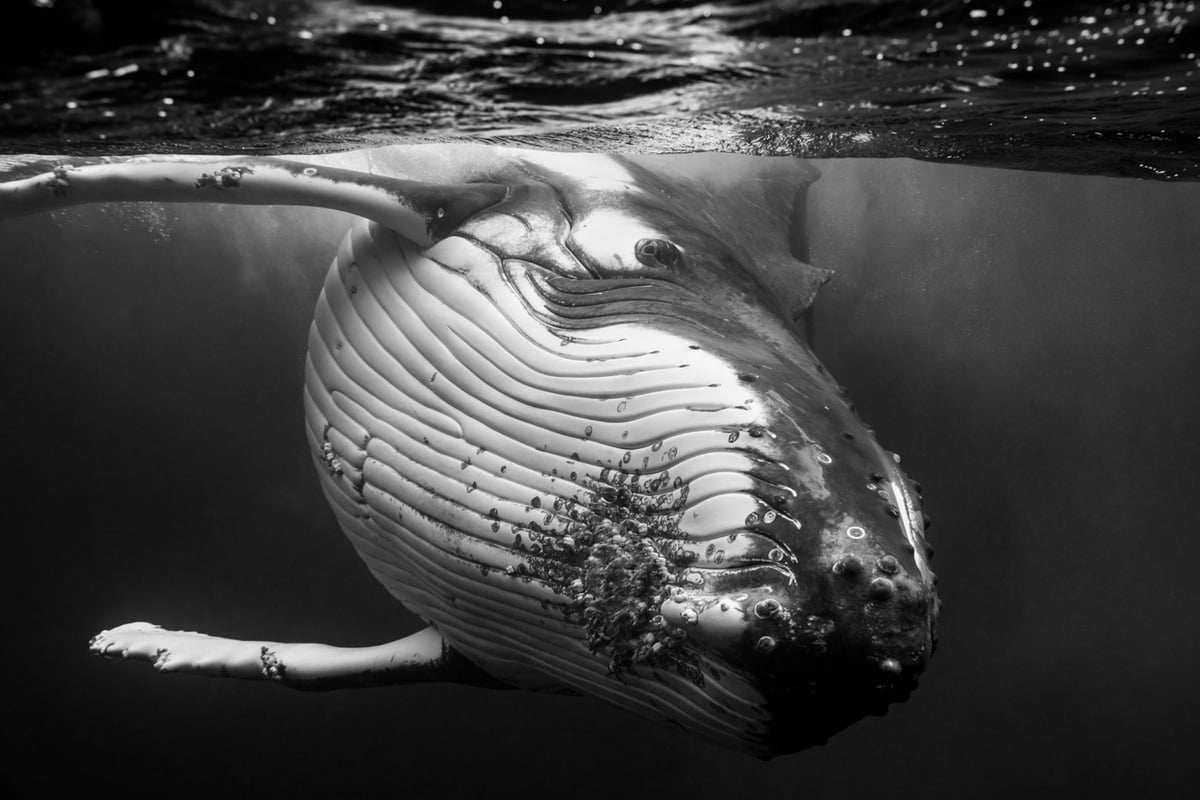
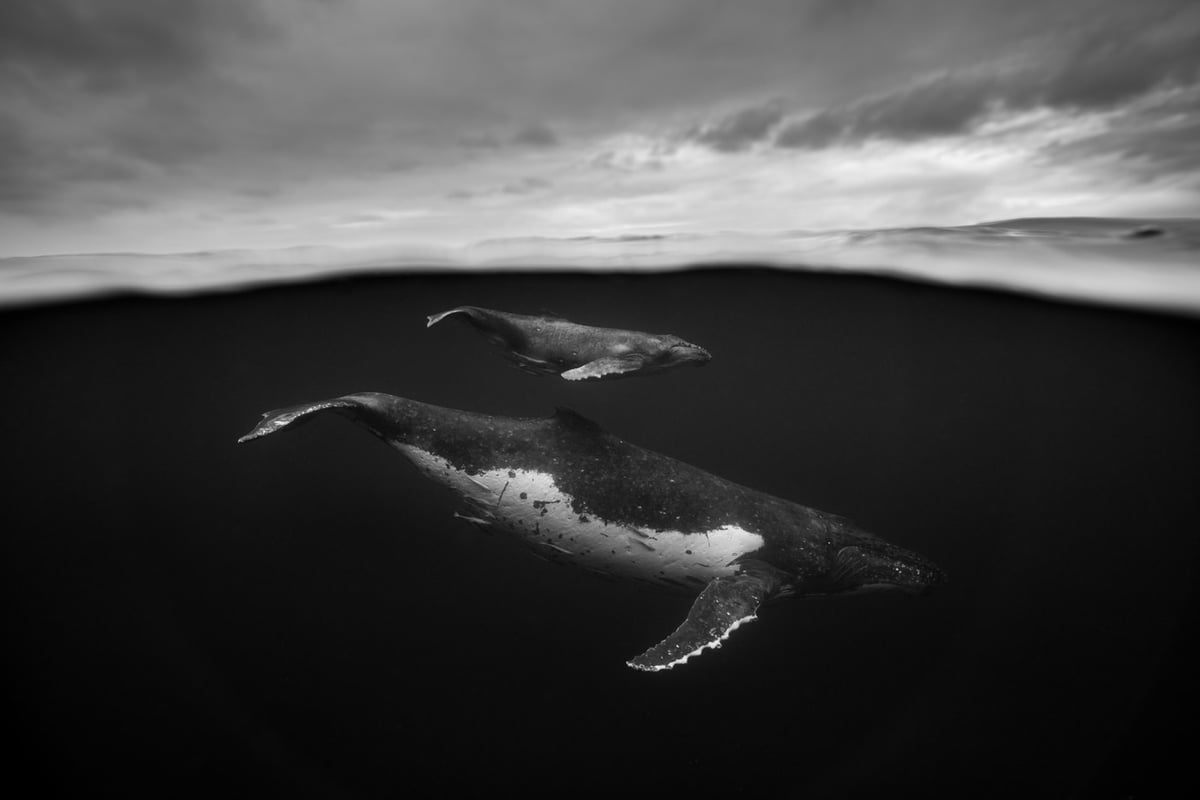
Jem Cresswell swam with humpback whales, took over 10,000 black & white photos, and whittled them down into his series, Giants. From Colossal:
In addition to being intrigued by the animals’ size, the Australian-based artist is also fascinated by their brains. In 2006, spindle cells, which were only thought to be present in humans and great apes, were also found to exist within the brains of humpback whales. These cells, which are tied to social organization, empathy, and intuition, were found to be more than three times as prevalent in humpback whales than they were in humans.
Humpbacks aren’t blue whales,1 but that reminded me of a passage I read recently from Robert Sapolsky’s Behave: The Biology of Humans at Our Best and Worst:
Many neurons are also outlandishly large. A zillion red blood cells fit on the proverbial period at the end of this sentence. In contrast, there are single neurons in the spinal cord that send out projection cables many feet long. There are spinal cord neurons in blue whales that are half the length of a basketball court.
Anyway, here’s a behind-the-scenes of Cresswell doing his work.
Beautiful. I may have to add “swimming with humpbacks” to my bucket list.
Celeste Headlee is an expert in talking to people. As part of her job as a public radio host and interviewer, she talks to hundreds of people each year, teasing from her guests what makes them interesting. At a TEDx conference two years ago, Headlee shared 10 tips for having a better conversations that work for anyone:
1. Don’t multitask.
2. Don’t pontificate.
3. Use open-ended questions.
4. Go with the flow.
5. If you don’t know, say that you don’t know.
6. Don’t equate your experience with theirs.
7. Try not to repeat yourself.
8. Stay out of the weeds.
9. Listen.
10. Be brief.
Watch the video for the explanations of each point. I’m pretty good on 1, 5, & 7 while I struggle with 3, 4, and sometimes 6. 9 is a constant struggle and depends on how much I’ve talked with other people recently. (via swissmiss)
Update: From the WSJ, Save Yourself From Tedious Small Talk.
Much of our day-to-day talk is a missed opportunity. The ability to draw others into meaningful conversations can determine whether people want to get to know you, or remember you at all. Failure to learn it can stall your career.
Vanessa Van Edwards had been attending networking events for several years during and after college when she realized she was having the same conversation again and again. “It went like this: So what do you do? Yeah. Where are you from. Yeah, yeah, been there. Do you live around here? Well, I’d better go get another glass of wine,” says Ms. Van Edwards, a Portland, Ore., corporate trainer and author of “Captivate,” a new book on social skills.
She started trying conversation-openers that jarred people a bit, in a pleasant way: “Have you been working on anything exciting recently?” Or, “Any exciting plans this summer?”
“If I’m feeling very brave, I ask, ‘What personal passion projects are you working on?’” Ms. Van Edwards says. She began making contacts who followed up more often.
This video has much to teach us about how to live. Be sure to watch all the way to the end.
If you require a chaser, check out calligraphy master Seb Lester’s impressive work, including hand-lettered Beyonce and Netflix logos.
He said he was retired from making movies, but Steven Soderbergh is back with a new movie called Lucky Logan. It’s a heist movie that looks like a cross between Ocean’s 11, Talladega Nights, and O Brother, Where Art Thou? Cast? I mean: Adam Driver, Hilary Swank, Daniel Craig, Riley Keough, Katie Holmes, and Channing Tatum. Soderbergh describes the film like so:
On the most obvious level, it’s the complete inversion of an Ocean’s movie. It’s an anti-glam version of an Ocean’s movie. Nobody dresses nice. Nobody has nice stuff. They have no money. They have no technology. It’s all rubber band technology, and that’s what I thought was fun about it. It seemed familiar to me, but different enough. The landscape, the characters, and the canvass were the complete opposite of an Ocean’s film. What was weird is that I was working as a producer on Ocean’s Eight while we were shooting Logan, and it was kind of head-spinning. That’s like a proper Ocean’s film. This is a version of an Ocean’s movie that’s up on cement blocks in your front yard.
Between this and Baby Driver, it looks like we’re all set with crazy car capers for Summer 2017.
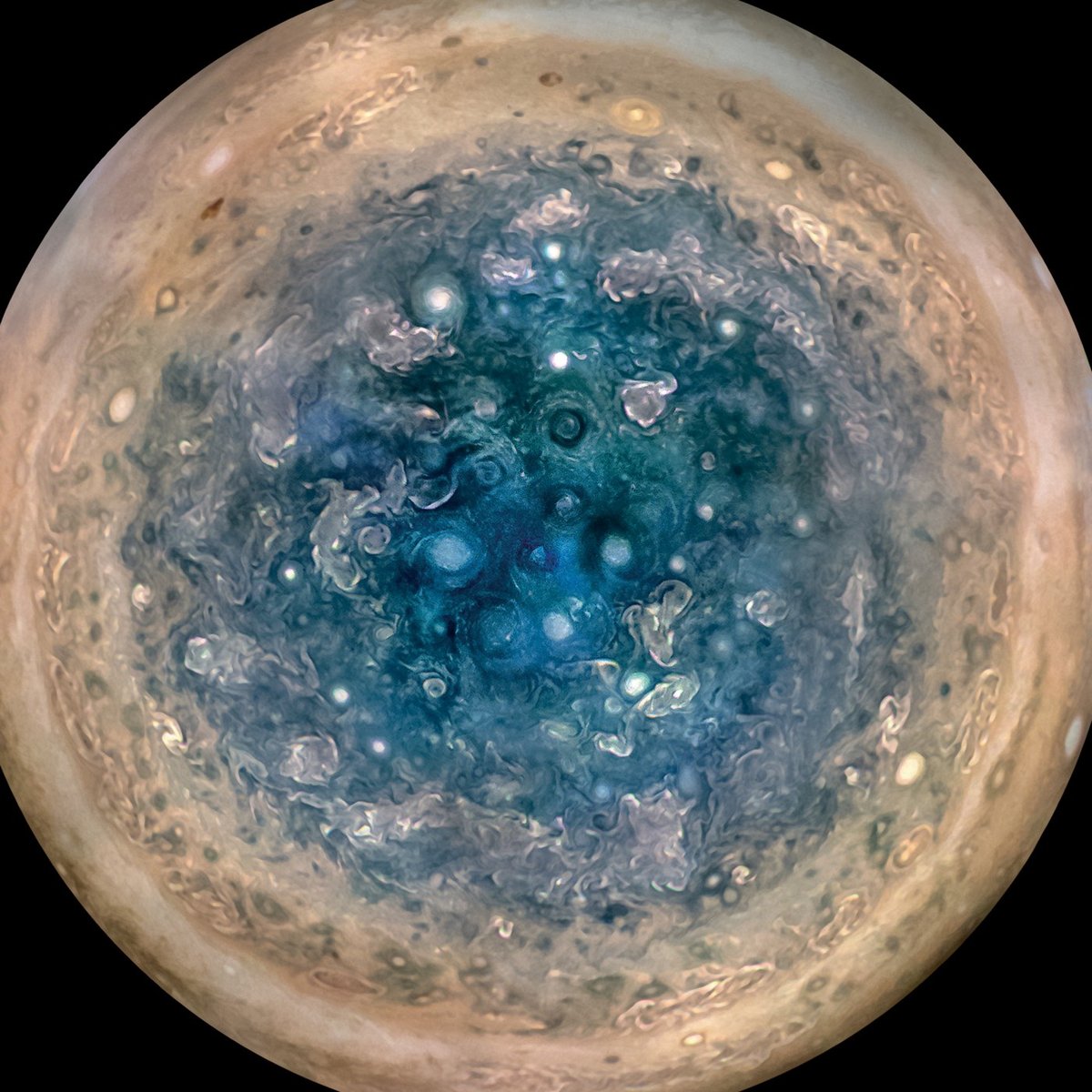
NASA’s Juno spacecraft is currently orbiting around Jupiter and taking some of the best photos and scientific measurements we’ve seen of the solar system’s largest planet. The photo above is of Jupiter’s south pole, gathering point for massive cyclones.
Early science results from NASA’s Juno mission to Jupiter portray the largest planet in our solar system as a complex, gigantic, turbulent world, with Earth-sized polar cyclones, plunging storm systems that travel deep into the heart of the gas giant, and a mammoth, lumpy magnetic field that may indicate it was generated closer to the planet’s surface than previously thought.
“We are excited to share these early discoveries, which help us better understand what makes Jupiter so fascinating,” said Diane Brown, Juno program executive at NASA Headquarters in Washington. “It was a long trip to get to Jupiter, but these first results already demonstrate it was well worth the journey.”
Using data and photos from Juno, Gerald Eichstädt and Seán Doran have created these videos that approximate what it might look like flying by Jupiter in a spacecraft.
Wonderful.
Business or Pleasure? A new comic by Chris Ware for the New Yorker. (I’ve definitely taken trips like this.)
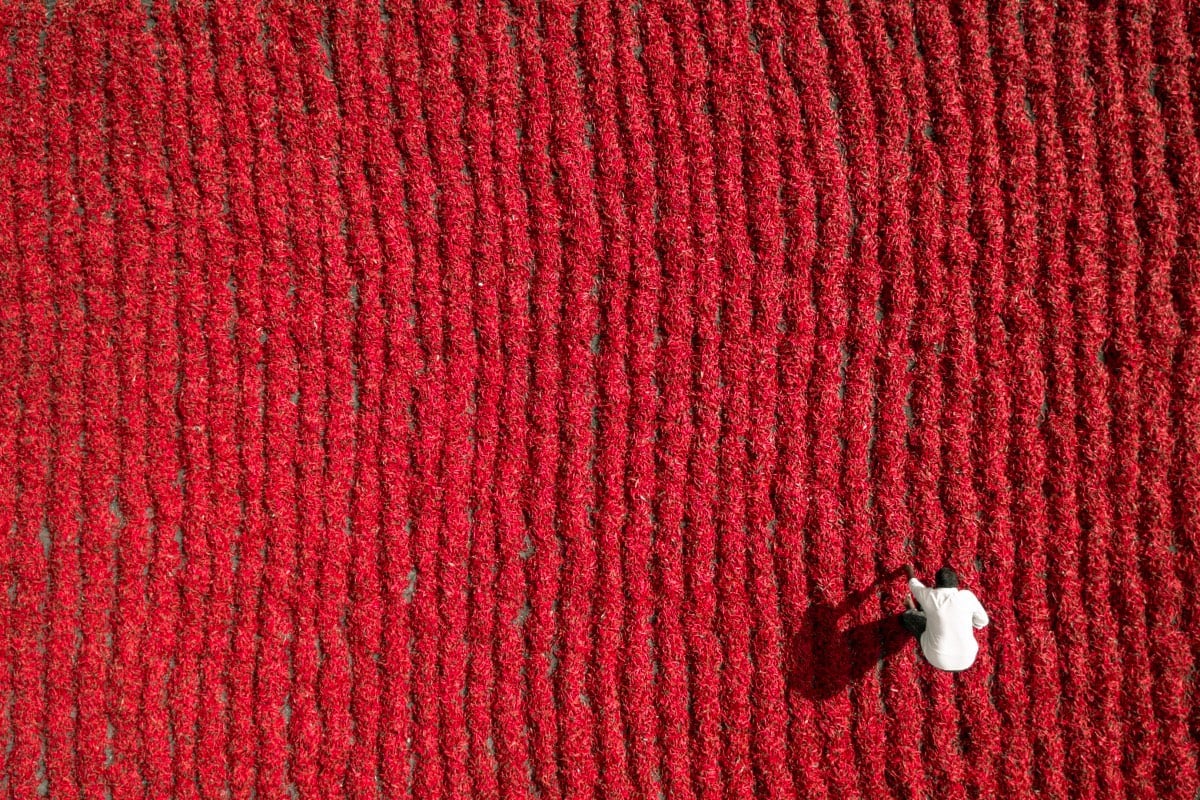
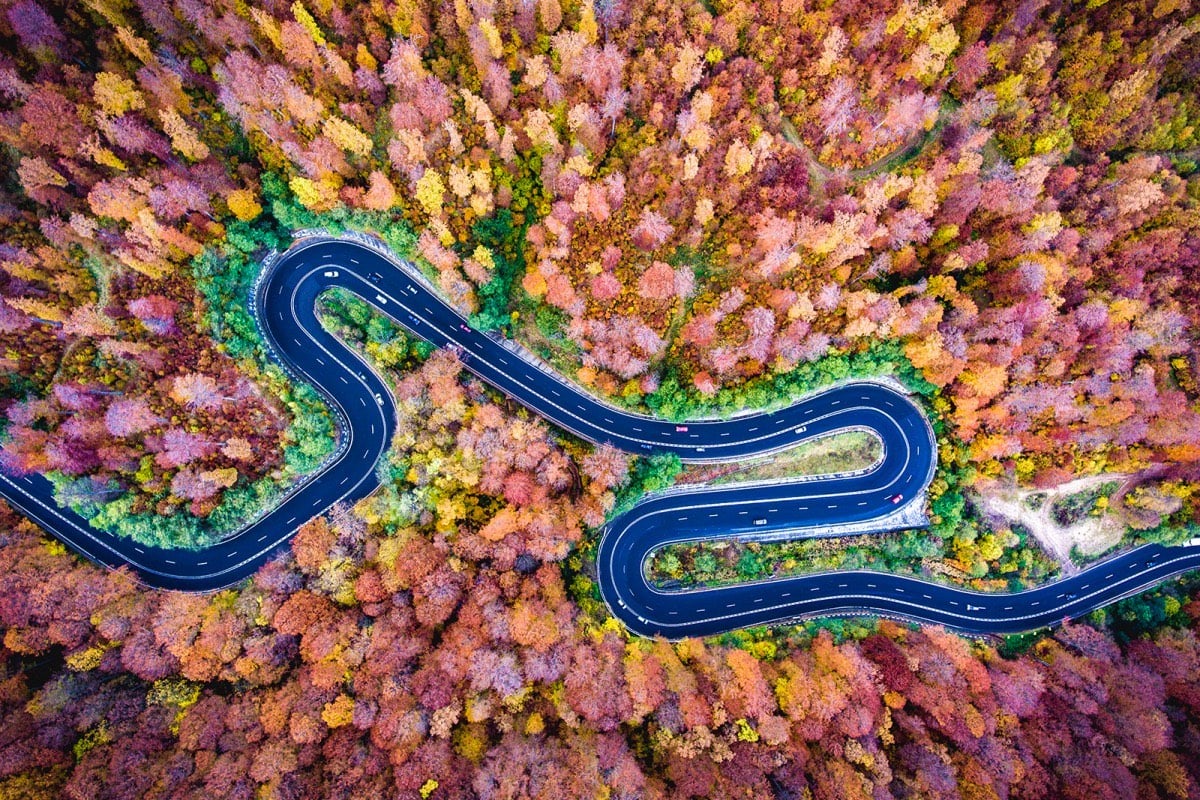

Dronescapes is an art book of some of the most visually arresting drone photography collected from Dronestagram.
Readers will see the planet from entirely new vantage points, whether it’s a bird’s-eye view of Christ the Redeemer in Rio de Janeiro, a photograph taken inches away from an eagle in midflight, or a vertiginous shot taken above Mexico’s Tamul Waterfalls. There are extended commentaries on how individual images were created and a separate, concise guide containing technical advice on how to use a drone and select the right model.
God knows we can all use a shot of the mini-overview effect right now.
Brian Shaw is the World’s Strongest Man, having won that competition in 2011, 2013, 2015, and 2016. In order to fuel his body through what I’m sure is a grueling training program, Shaw eats 12,000 calories spread across 6 meals a day. This video follows him through a typical day before a hard training session. His initial meal is peanut butter, 8 scrambled eggs, and a bowl of Cinnamon Toast Crunch, which is pretty much just an hors d’oeuvre for Shaw.
This meal, even though it’s eight eggs and all that, it doesn’t seem to really fill me up. I get through it pretty quickly and then I’m hungry again.
Just as he did last year, Bill Gates has recommended five books for people to read this summer. Among the picks:
The Heart by Maylis de Kerangal. Gates, who usually reads nonfiction, says:
While you’ll find this book in the fiction section at your local bookstore, what de Kerangal has done here in this exploration of grief is closer to poetry than anything else. At its most basic level, she tells the story of a heart transplant: a young man is killed in an accident, and his parents decide to donate his heart. But the plot is secondary to the strength of its words and characters.
A Full Life by Jimmy Carter. Gates:
Even though the former President has already written more than two dozen books, he somehow managed to save some great anecdotes for this quick, condensed tour of his fascinating life. I loved reading about Carter’s improbable rise to the world’s highest office.
Last year, I took Gates’ advice and read Seveneves by Neal Stephenson, which I thoroughly enjoyed.
For the second part of an ongoing series, Wired asked biologist Neville Sanjana to explain CRISPR to five people with different levels of knowledge: a 7-year-old, a high school student, a college student, a grad student, and an expert on CRISPR. As I began to watch, I thought he’d gone off the rails right away with the little kid, but as soon as they connected on a personal issue (allergies), you can see the bridge of understanding being constructed.
The first installment in the series featured a neuroscientist explaining connectomes to five people.
A moving story of a man who chose when to die. “This was an Irish wake, without grief’s frantic edge.”
You may recognize some of these types of videos in Materialisimo’s funny review of Every Facebook Video EVER. (via @JossFong)
Using John Cawelti’s 1977 article “Chinatown” and Generic Transformation in Recent Films as a guide, Evan Puschak examines the genre of superhero movies (and Logan in particular). In the piece, Cawelti offers four possible responses to the conventions of a genre becoming well-known (or, less kindly, stale):
1. Humorous burlesque
2. The cultivation of nostalgia
3. Demythologization
4. The affirmation of myth
Puschak examines each of these in relation to superhero movies and wonders what sort of response Logan represents.
A short vignette of Bowne & Co. Stationers at Manhattan’s South Street Seaport, an old-school letterpress printing shop. I love the description of printing as “dancing with the machine”. My pals at Swayspace — who have printed a couple of jobs for me over the years, including this watercolor map of Paris — taught me how to use one of their presses many years ago and there’s definitely a rhythm to it that takes awhile to master. I’m just glad I still have all my fingers.


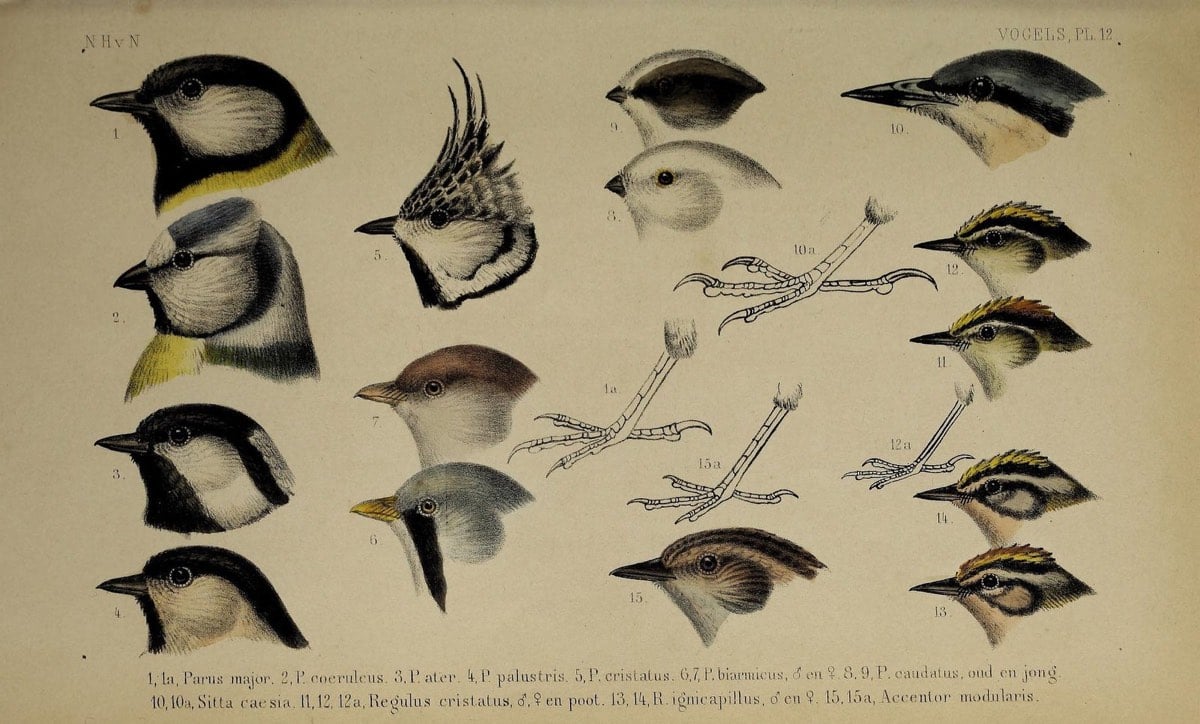

The Biodiversity Heritage Library maintains a huge trove of plant and animal drawings that they’ve put up on Flickr for free.
The Biodiversity Heritage Library (BHL) is a consortium of natural history and botanical libraries that cooperate to digitize the legacy literature of biodiversity held in their collections and to make that literature available for open access and responsible use as a part of a global “biodiversity commons.”
Over 110,000 images are available, organized into hundreds of albums. You could easily lose an entire afternoon in there.
P.S. While the Biodiversity Heritage Library doesn’t appear to be an official participant, Flickr’s The Commons project remains one of the under-appreciated gems of the Web.

Over at Recode, Dan Frommer has a look inside Amazon’s first NYC bookstore, opening Thursday in the mall in the Time Warner Center. I haven’t visited any of Amazon’s stores yet (they’ve got several around the country), but what I find interesting from the photos is how up-front they are about the shopping experience being data driven. There are signs for books rated “4.8 Stars & Above”, a shelf of “Books Kindle Readers Finish in 3 Days or Less”, a section of “If You Like [this book], You’ll Love [these other books]”, and each book’s shelf label lists the star rating and number of reviews on Amazon.com. Another sign near the checkout reads “Over 7950 Goodreads members like this quote from Cassandra Clare’s Clockwork Prince: ‘We live and breathe words.’”
Other bookstores have books arranged according to best-seller lists, store-specific best-sellers, and staff recommendations, but I’ve never seen any store layout so extensively informed by data and where they tell you so much about why you’re seeing each item. Grocery store item placement is very data driven, but they don’t tell you why you’re seeing a display of Coke at the end of the aisle or why the produce is typically right at the entrance. It’ll be interesting to see if Amazon’s approach works or if people will be turned off by shopping inside a product database, a dehumanizing feeling Frommer hints at with “a collection of books that feels blandly standard” when compared to human curated selections at smaller bookstores.
P.S. So weird that there’s no prices on items…you have to scan them with a store scanner or a phone app. Overall, the store feels less oriented towards its book-buying customers and more towards driving Prime memberships, Amazon app downloads, and Kindle & Echo sales (which might be Amazon’s objective).
Update: Jia Tolentino on Amazon’s stores.
The store’s biggest shortcoming, though, is that it is so clearly not intended for people who read regularly. I normally walk into a bookstore and shop the way a person might shop for clothes: I know what I like, what generally works for me, what new styles I might be ready to try. It was a strange feeling, on Thursday, to do laps around a bookstore without feeling a single unexpected thrill. There were no wild cards, no deep cuts, no oddballs — just books that were already best-sellers, pieces of clothing I knew wouldn’t fit me or that I already owned.
Tolentino also notes that the fiction section in the NYC store contains fewer than 200 different titles.
War, huh, good God, what is good for? Ratings and new HBO Now subscriptions, say it again. Finally, after six seasons of mere skirmishes, Jon Snow says “the Great War is here”. Excited for this, particularly because it appears to lack an aspect that plagued seasons in the past: Parliamentary Procedure with Daenerys Targaryen. (“Your dragon stole my goat! What shall we do about it?”) Anyway, excited for this!
Update: Another new trailer:
Over the past couple of years, Foursquare has used their location data to accurately predict iPhone sales and Chipotle’s sales figures following an E. coli outbreak. Their latest report suggests that leisure tourism to the United States was way down year-over-year over the past 6 months (relative to tourism to other countries).
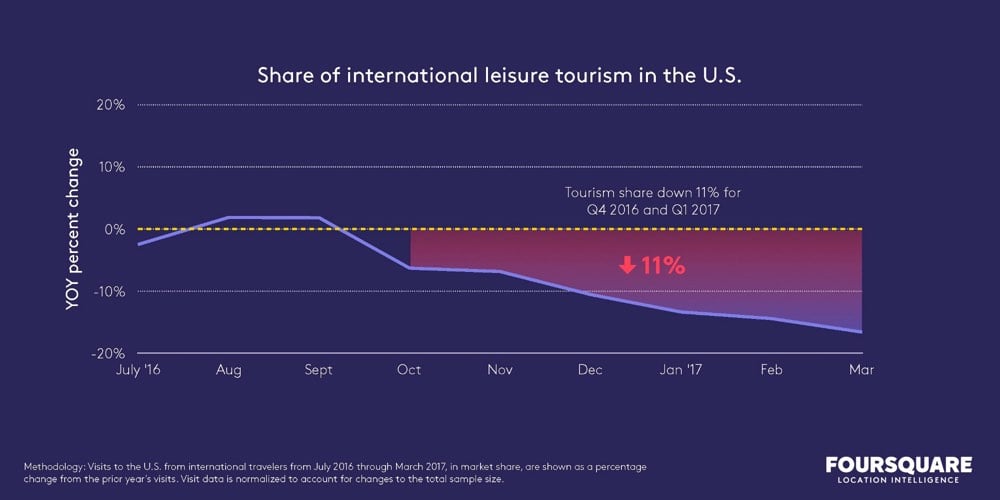
Our findings reveal that America’s ‘market share’ in international tourism started to decline in October 2016, when the U.S. tourism share fell by 6% year-over-year, and continued to decrease through March 2017, when it dropped all the way to -16%. Currently, there is no sign of recovery in the data.
And business travel to the US is suffering as well, relative to other countries:
Business trip activity is up in the U.S. by about 3% (as a share of international traveler global activity), but that trend line is not as high as elsewhere in the world, where YoY trends are closer to 10%. Relative to business travel gains globally, business travel to the U.S. is suffering.
As Foursquare notes, correlation is not causation and there are other factors at play (e.g. a stronger US dollar), but it’s not difficult to imagine that our xenophobic white nationalist administration and its travel & immigration policies have something to do with this decline.

The US Postal Service recently announced a new series of stamps that feature balls from eight different sports.
The U.S. Postal Service will soon release first-of-a-kind stamps with the look — and feel — of actual balls used in eight popular sports. Available nationwide June 14, the Have a Ball! Forever stamps depict balls used in baseball, basketball, football, golf, kickball, soccer, tennis and volleyball.
The stamps are round but what’s really cool is that they will have a special coating that lets you feel the unique texture of each kind of ball — the baseball’s laces, the basketball’s nubby surface, the golf ball’s dimples. The ball stamps are available for preorder and will ship in mid-June.
See also their upcoming solar eclipse stamps, which are printed using thermochromic ink — when you touch them, the heat of your finger reveals the hidden Moon passing in front of the Sun. (via print)
Due to the unprecedented bleaching events over the past few years, the Great Barrier Reef has been eulogized extensively in the media. But it’s not actually dead. Yet. In this video for Vox, Joss Fong explains how corals form, bleach, and die and how our response to climate change might be the only thing that can save the Great Barrier Reef and the world’s other coral reefs from death.
Flat-Earthers aside, people have known that the Earth is round since at least the 3rd century BC. This quick video explores a few of the ways we know the world is spherical, some of them quite simple to recreate as experiments. See also Top 10 Ways to Know the Earth is Not Flat.
(5) Seeing Farther from Higher
Standing in a flat plateau, you look ahead of you towards the horizon. You strain your eyes, then take out your favorite binoculars and stare through them, as far as your eyes (with the help of the binocular lenses) can see.
Then, you climb up the closest tree — the higher the better, just be careful not to drop those binoculars and break their lenses. You then look again, strain your eyes, stare through the binoculars out to the horizon.
The higher up you are the farther you will see. Usually, we tend to relate this to Earthly obstacles, like the fact we have houses or other trees obstructing our vision on the ground, and climbing upwards we have a clear view, but that’s not the true reason. Even if you would have a completely clear plateau with no obstacles between you and the horizon, you would see much farther from greater height than you would on the ground.
This phenomena is caused by the curvature of the Earth as well, and would not happen if the Earth was flat.
Update: Carl Sagan explains how Greek astronomer and mathematician Eratosthenes figured out how the Earth was round in ~200 BC.
(via @preshit)
New Orleans mayor Mitch Landrieu recently gave a speech about why the city chose to remove four Confederate monuments. Here’s a snippet from the transcript…it’s worth reading or watching in full.
The historic record is clear: the Robert E. Lee, Jefferson Davis, and P.G.T. Beauregard statues were not erected just to honor these men, but as part of the movement which became known as The Cult of the Lost Cause. This ‘cult’ had one goal — through monuments and through other means — to rewrite history to hide the truth, which is that the Confederacy was on the wrong side of humanity.
First erected over 166 years after the founding of our city and 19 years after the end of the Civil War, the monuments that we took down were meant to rebrand the history of our city and the ideals of a defeated Confederacy.
It is self-evident that these men did not fight for the United States of America, They fought against it. They may have been warriors, but in this cause they were not patriots.
These statues are not just stone and metal. They are not just innocent remembrances of a benign history. These monuments purposefully celebrate a fictional, sanitized Confederacy; ignoring the death, ignoring the enslavement, and the terror that it actually stood for.
After the Civil War, these statues were a part of that terrorism as much as a burning cross on someone’s lawn; they were erected purposefully to send a strong message to all who walked in their shadows about who was still in charge in this city.
The presence of the monuments became something that was impossible for Landrieu and the city to ignore for any longer:
Another friend asked me to consider these four monuments from the perspective of an African American mother or father trying to explain to their fifth grade daughter who Robert E. Lee is and why he stands atop of our beautiful city. Can you do it?
Can you look into that young girl’s eyes and convince her that Robert E. Lee is there to encourage her? Do you think she will feel inspired and hopeful by that story? Do these monuments help her see a future with limitless potential? Have you ever thought that if her potential is limited, yours and mine are too?
The FX show The Americans follows a married couple, Philip and Elizabeth Jennings, who are Soviet spies living in America during the 1980s. In the course of their spying activities, the KBG couple often don disguises to protect their identities. Costume designer Katie Irish is responsible for dressing the couple on the show, and she’s been sharing some of the fashion inspiration boards for those disguises (as well as other costumes) on her Twitter and Instagram accounts.
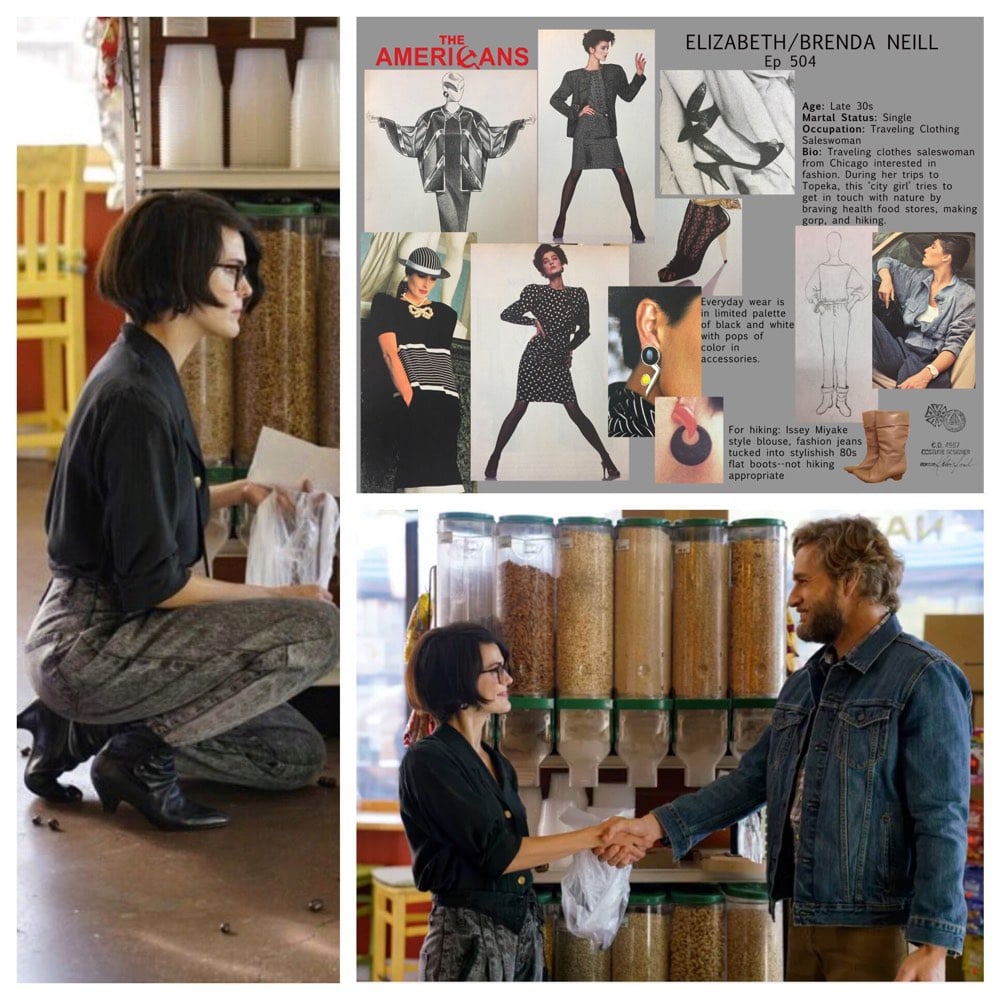
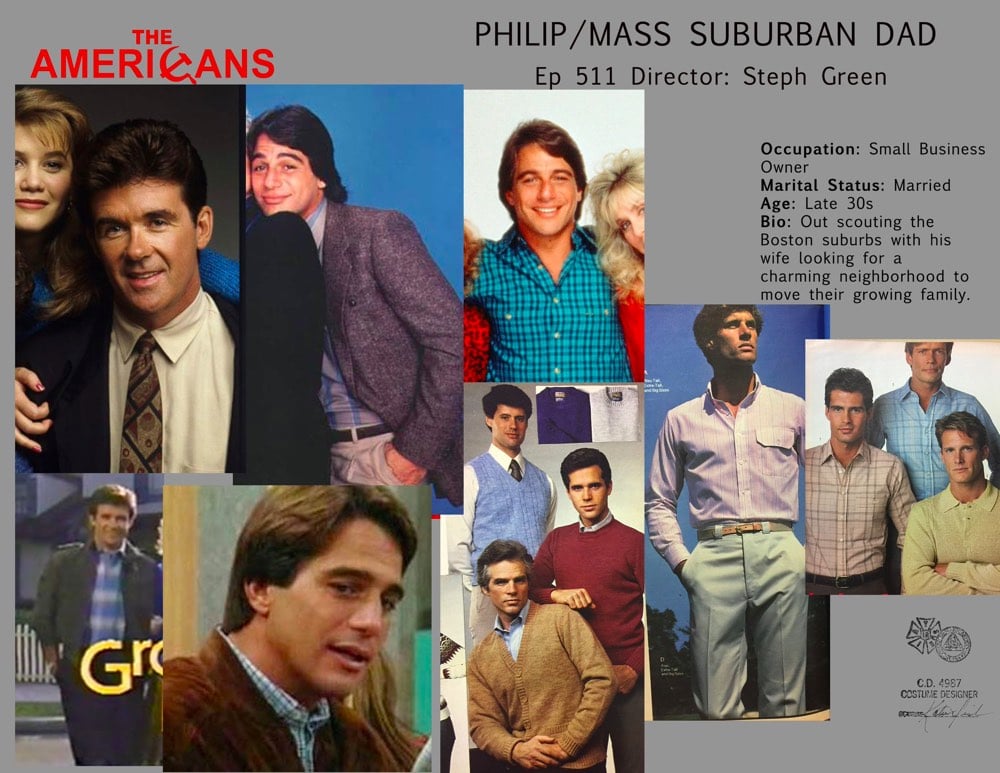

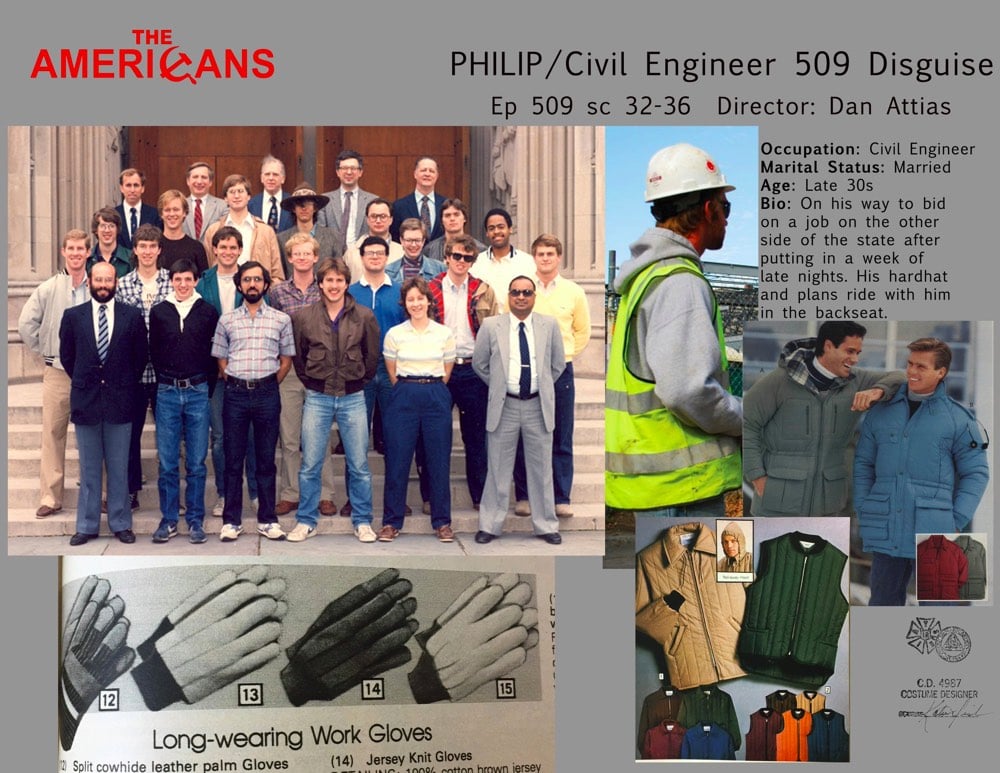

As you can see, Irish and her team pull images from anywhere: TV, movies, catalogs, photojournalism, yearbooks, advertising, etc. The goal is authenticity:
The point is to use clothes to embody the characters and bring them to life in a way that lets audiences believe in and feel invested in them. The show’s leads, Elizabeth and Philip Jennings, played by Keri Russell and Matthew Rhys, are characters who live their lives in costume, in a sense. They dress like the upper-middle-class travel agents that they have embodied for years, but there are subtle hints at their internal selves, as ideologically driven Russian spies. “They’re Russian at the core,” Irish explains, “and they don’t want anything that is overtly capitalist.” You won’t see much logo branding on their clothes.
P.S. I’ve been waiting for someone to make a supercut video of all of the Jennings’ disguises, but it hasn’t happened yet. Am I going to have to do it myself?
Watch stone carver Anna Rubincam as she goes from measuring a live person (essentially creating a geometric model of their face) to a clay model to a finished stone portrait in three weeks.
On a human face, even though there’s a change in pigment, there’s no end. Like, you come to the end of the lips and it just carries on going. And if you try and make it a stark difference, then the face will look strange. The skin is sort of a continuous surface that undulates and has tension in certain places and slack in other places.
I got so anxious watching her carving the stone piece from the clay model. One false move and… *bites nails* More about how the film was made. (via digg)
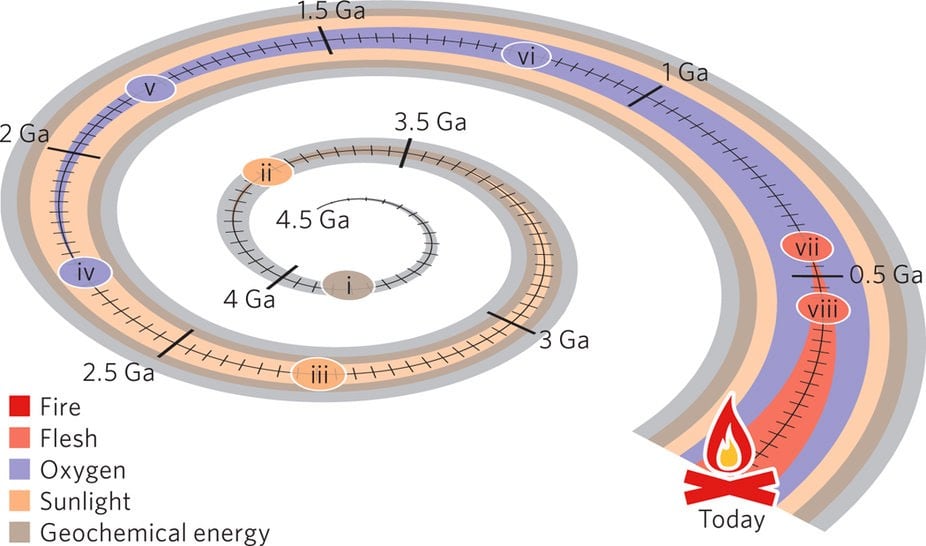
Since life first formed on Earth billions of years ago, the ability of organisms to use more powerful and efficient energy sources has been key in driving the diversity and complexity of life. According to this provocative piece in Nature by Olivia Judson, the history of life on Earth can be divided into five energetic epochs characterized by the following energy sources: geochemical energy, sunlight, oxygen, flesh and fire.
The first two were present at the start, but oxygen, flesh and fire are all consequences of evolutionary events. Since no category of energy source has disappeared, this has, over time, resulted in an expanding realm of the sources of energy available to living organisms and a concomitant increase in the diversity and complexity of ecosystems. These energy expansions have also mediated the transformation of key aspects of the planetary environment, which have in turn mediated the future course of evolutionary change. Using energy as a lens thus illuminates patterns in the entwined histories of life and Earth, and may also provide a framework for considering the potential trajectories of life-planet systems elsewhere.
Organisms formed on Earth and changed the planet, which led to the formation of new organisms more suited to the new environment. For instance, when a type of bacteria evolved to turn sunshine into oxygen, it completely changed the planet.
In the absence of a biotic source of oxygen, trace quantities of the gas can be generated abiotically: water molecules can be split by sunlight or radioactive decay. However, these abiotic processes are much less efficient than their biotic equivalent. Had cyanobacteria, or something like them, never evolved, oxygen would never have built up in the atmosphere of the Earth.
But build up it did. Between 2.45 and 2.32 Ga, significant quantities of oxygen began to accumulate in the air, an episode known as the Great Oxidation Event. Before the Great Oxidation, atmospheric oxygen levels were less than 10^-5 of the present atmospheric level of ~21%. By ~2 Ga, they had risen to perhaps 0.1-1% of the present atmospheric level. Although the subsequent history of oxygen is complex and many details are uncertain, Earth’s atmosphere has contained an appreciable level of the gas ever since. (Full oxygenation of the oceans, however, would not happen until around 1.8 billion years after the Great Oxidation.)
The original piece in Nature is fairly readable for a science journal, but this summary in The Atlantic is worth a look if you’re short on time or attention. (via @CharlesCMann)
How much Coca-Cola do you have to drink to go through severe withdrawal symptoms for weeks when you go cold turkey? Find out in Coke Habit, a short animation about a delicious childhood treat that got out of hand.
The Summer after 10th grade Mike spent two solid weeks with horrible horrible migraines, dizziness, blind spots and tunnel vision — he didn’t know what it was… This is the story of his Coke Habit.
It’s not a suit. The outfit that matadors wear when they fight bulls is called a bullfighter’s dress.
It’s called a dress of lights. A bullfighter’s dress is heavy when you hold it in your hand. You can only really understand the dress when you have a 1,300-pound animal coming at you.
And the Fermin Tailor Shop in Madrid has been making dresses by hand for matadors for 55 years. One dress takes seven people a month to make. Check out that embroidery!
Older posts



Socials & More