Entries for October 2014
From the emergence of markets in the 13th century to the scientific revolution of the 17th century to castles in the 11th century, this is a list of historian Ian Mortimer’s 10 biggest changes of the past 1000 years.
Most people think of castles as representative of conflict. However, they should be seen as bastions of peace as much as war. In 1000 there were very few castles in Europe — and none in England. This absence of local defences meant that lands were relatively easy to conquer — William the Conqueror’s invasion of England was greatly assisted by the lack of castles here. Over the 11th century, all across Europe, lords built defensive structures to defend them and their land. It thus became much harder for kings to simply conquer their neighbours. In this way, lords tightened their grip on their estates, and their masters started to think of themselves as kings of territories, not of tribes. Political leaders were thus bound to defend their borders — and govern everyone within those borders, not just their own people. That’s a pretty enormous change by anyone’s standards.
The list is adapted from Mortimer’s recent book, Centuries of Change.
From the Guardian’s photo editor, an annotated list of the 25 best photographs of Muhammad Ali. My favorite is by Neil Leifer:
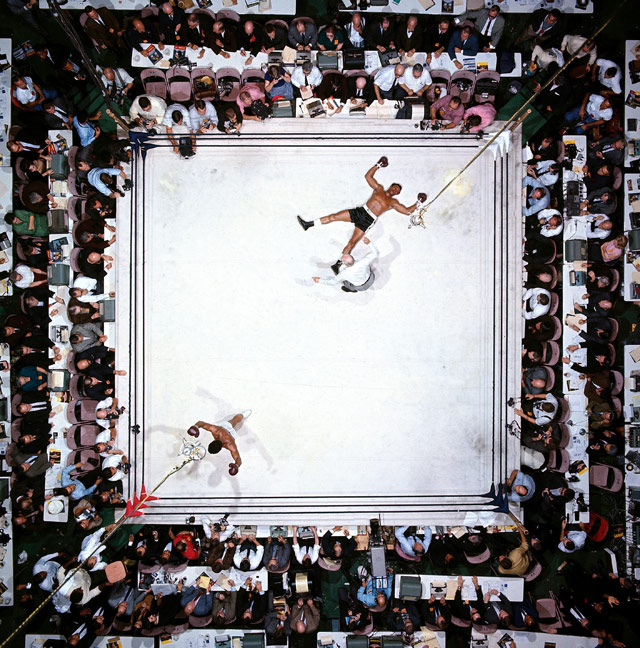
(via @DavidGrann)
Been obsessed with Run the Jewels 2 from Killer Mike and El-P this week.
Anil Dash clued me in to Run the Jewels earlier this week on Twitter:
Okay, RTJ2 is incredible. @KillerMikeGTO & @therealelp make it three classic albums in a row. Is anybody else at their level right now?
I’m not qualified to answer that, but this album is very good. Plus! Run the Jewels 2 is available as a free download.
You know what’s pretty? Big waves and surfing in slow motion. Take a break and relax at 1000 fps with this mesmerizing video.
The Hans Zimmer soundtrack only adds to the effect. (via ★interesting)
A new short episode of Every Frame a Painting, in which Tony Zhou talks about how to show character choice in movies without using dialogue. His main example is Snowpiercer. Spoilers ahoy.
Three dancers from The Australian Ballet share their prep routines for their pointe shoes.
Take-aways: Ballerinas’ feet are really not attractive, they soup up their shoes in all sorts of unusual ways, but the end result is beautiful. (thx, fiona)
It can be difficult to understand how large (or small) astronomical objects are, so here are some handy comparisons to things on Earth. Here’s the size of Mars compared to the United States & Canada:

And here’s a neutron star nestled next to Liverpool on the northwest coast of England:

A neutron star also crams in over 1.5 times the mass of the Sun into a tiny ball maybe not much bigger than your daily commute to work, and the Sun is huge (see the size of the Sun later). So this thing is incredibly dense, so dense in fact that just a tea spoon of it would weigh over a billion tonnes, and if you could stand on its surface you’d feel the gravitational pull of 200 billion times that of our planet…not that you’d ever survive it of course.
(via @theclintmcleod)
At this point it’s almost a Pavlovian response; a natural disaster hits and we hit the Red Cross donate button. We feel better, but do the victims benefit? NPR and ProPublica looked at internal emails and confidential reports and uncovered The Red Cross’ Secret Disaster.
During Isaac, Red Cross supervisors ordered dozens of trucks usually deployed to deliver aid to be driven around nearly empty instead, ‘just to be seen’ … During Sandy, emergency vehicles were taken away from relief work and assigned to serve as backdrops for press conferences, angering disaster responders on the ground.
The directorial debut of Alex Garland, screenwriter of Sunshine and 28 Days Later, looks interesting.
Ex Machina is an intense psychological thriller, played out in a love triangle between two men and a beautiful robot girl. It explores big ideas about the nature of consciousness, emotion, sexuality, truth and lies.
(via http://devour.com/)
In an article for Businessweek, Apple CEO Tim Cook publicly reveals he is gay.
At the same time, I believe deeply in the words of Dr. Martin Luther King, who said: “Life’s most persistent and urgent question is, ‘What are you doing for others?’ ” I often challenge myself with that question, and I’ve come to realize that my desire for personal privacy has been holding me back from doing something more important. That’s what has led me to today.
For years, I’ve been open with many people about my sexual orientation. Plenty of colleagues at Apple know I’m gay, and it doesn’t seem to make a difference in the way they treat me. Of course, I’ve had the good fortune to work at a company that loves creativity and innovation and knows it can only flourish when you embrace people’s differences. Not everyone is so lucky.
While I have never denied my sexuality, I haven’t publicly acknowledged it either, until now. So let me be clear: I’m proud to be gay, and I consider being gay among the greatest gifts God has given me.
We the Economy is a series of 20 short videos that attempt to explain important economic concepts. For instance, acclaimed director Ramin Bahrani did a video about regulatory capture starring Werner Herzog, Patton Oswalt, and the Sherman Antitrust Act of 1890.
Anchorman director Adam McKay directed an animated My Little Pony-esque video about wealth distribution and income inequality featuring the voice talents of Amy Poehler, Maya Rudolph, and Sarah Silverman.
Paul Allen and Morgan Spurlock are behind the effort, with Bob Balaban, Steve James, Catherine Hardwicke, and Mary Harron directing some of the other videos. (via mr)

Canadian astronaut Chris Hadfield became a celebrity while aboard the International Space Station. Now he’s publishing a book of photographs he took during his time in orbit: You Are Here: Around the World in 92 Minutes.
During 2,597 orbits of our planet, I took about 45,000 photographs. At first, my approach was scattershot: just take as many pictures as possible. As time went on, though, I began to think of myself as a hunter, silently stalking certain shots. Some eluded me: Brasilia, the capital of Brazil, and Uluru, or Ayers Rock, in Australia. I captured others only after methodical planning: “Today, the skies are supposed to be clear in Jeddah and we’ll be passing nearby in the late afternoon, so the angle of the sun will be good. I need to get a long lens and be waiting at the window, looking in the right direction, at 4:02 because I’ll have less than a minute to get the shot.” Traveling at 17,500 miles per hour, the margin for error is very slim. Miss your opportunity and it may not arise again for another six weeks, depending on the ISS’s orbital path and conditions on the ground.
In an interview with Quartz, Hadfield says the proceeds from the book are being donated to the Red Cross.
A woman recently took to the streets of NYC and walked around for 10 hours. She walked behind someone wearing a hidden camera that captured all of the catcalls and harassment directed toward her during that time…108 incidents in all. This is what it’s like being a woman in public:
At The Awl, John Herrman notes the parallels between a woman on the streets of NYC and a woman spending time on the internet.
But the video works in two ways: It’s also a neat portrayal of what it is like to be a woman talking about gender on the mainstream internet. This became apparent within minutes of publication, at which point the video’s comment section was flooded with furious responses.
A typical post in the YouTube comments thread:
are you fucking kidding me “verbal harassment”? most of all the guys called that woman “beautiful” or said to “have a good day”….it would be harassment if the guys called that woman a “hoe” or “bitch”…you are a fucktard.
On Tumblr, Alex Alvarez neatly dispenses with that sort of “logic”:
To anchor this more concretely, consider the behavior of the men in the video. Take a look at how they seek the woman out to wish her a good morning, despite her not having made eye contact or shown any interest in talking to them. Take a look at how they’re not wishing a good morning to any other person, particularly male people, also walking around. The woman is walking directly behind the man filming her (the camera is hidden in his backpack), and not one of the men shown in the video are seen to be greeting him and wishing him a good day. Just her.
Why is this?
It’s because they don’t care, really whether she has a good day or not. What they care about is letting her know that they have noticed her — her hair, her face, her body, her outfit. They want her to notice that they’ve noticed, and they want her to notice them, however fleetingly.
In this music video for Roy Kafri, a bunch of iconic album covers come alive and start singing.
Among them, The Smiths, Madonna, David Bowie, and Michael Jackson. (via colossal)
In a rare bit of good news about climate change, it appears that some types of coral have the ability to recover more quickly from trauma caused by rising ocean temperatures (archive).
At Palau in the western Pacific, a survey completed just three years after the 1998 bleaching event showed more coral had recovered on reefs within protected bays and on deep slopes.
Scientists suggest this is because heat and light serve as a double-whammy to coral health and corals that hang out in shady zones will escape the scorching combination, upping the chances that remnants will survive.
Seven years after the bleaching event, some reefs had regained nearly 40 per cent of their corals, with two species of plate-like acroporid coral, A. digitifera and A. hyacinthus, particularly prevalent. “We sampled plating coral colonies there a few years ago and found them to be pool-table size,” says Stephen Palumbi, Director of Stanford University’s Hopkins Marine Station, in Pacific Grove, California, US.
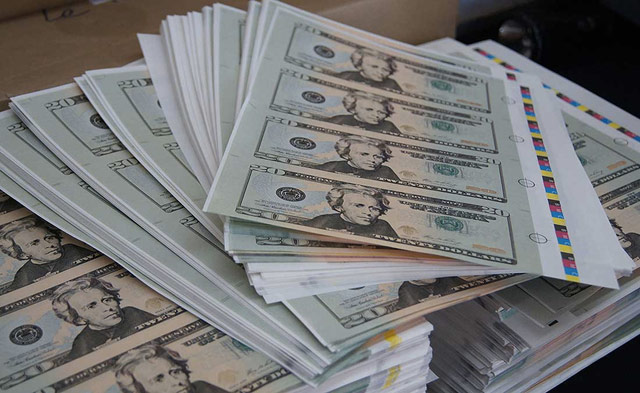
Wells Tower recently profiled master counterfeiter Frank Bourassa for GQ. Bourassa made $200 million in nearly flawless fake US twenties in a barn in Canada, got caught, and, you get the feeling pretty early on in the piece, didn’t really do any time for the crime.
Drawing on cautionary news reports of failed counterfeiters, Frank sketched out a set of best-practice guidelines for his new concern. First, “don’t ever try to pass the money yourself. You want to be as far away as possible from where the money’s being spent.” Second, “don’t sell your stuff to anyone who’s going to be passing it locally. I knew from the beginning, I needed to sell my bills to Europe or Asia.” Third, resist the temptation to print big bills. “Do twenties. It’s stupid to try to pass hundred-dollar bills anymore. People look at them all day long, hold it up to the light and everything. Nobody looks twice at a twenty.” Fourth, don’t cheap out. Most of the people who try their luck at counterfeiting do so by breathtakingly broke-dick means, with stuff you can buy at Office Depot.
“Can you make bills on a $50 ink-jet? Sure, if you want to get busted right away,” said Frank. “All the security features in a bill are basically there to stop broke fucking-moron assholes who are trying to do their thing on an ink-jet. I knew if I wanted to succeed, my bills had to be as perfect as possible, as close as possible to the way the bills are actually made.”
Don’t miss the video of Bourassa examining one of the new $US100 bills. He doesn’t really come off as someone organized enough to pull something like this off, which was probably advantageous to him in actually (almost) doing so. There’s much more information about Bourassa on his web site.

Today’s Google Doodle honors Jonas Salk on what would have been his 100th birthday. Salk developed the first successful polio vaccine in 1955 and was hailed as a hero for it.
On April 12, 1955, Dr. Thomas Francis, Jr., of the University of Michigan, the monitor of the test results, “declared the vaccine to be safe and effective.” The announcement was made at the University of Michigan, exactly 10 years to the day after the death of President Roosevelt. Five hundred people, including 150 press, radio, and television reporters, filled the room; 16 television and newsreel cameras stood on a long platform at the back; and 54,000 physicians, sitting in movie theaters across the country, watched the broadcast on closed-circuit television. Eli Lilly and Company paid $250,000 to broadcast the event. Americans turned on their radios to hear the details, department stores set up loudspeakers, and judges suspended trials so that everyone in the courtroom could hear. Europeans listened on the Voice of America. Paul Offit writes about the event:
“The presentation was numbing, but the results were clear: the vaccine worked. Inside the auditorium Americans tearfully and joyfully embraced the results. By the time Thomas Francis stepped down from the podium, church bells were ringing across the country, factories were observing moments of silence, synagogues and churches were holding prayer meetings, and parents and teachers were weeping. One shopkeeper painted a sign on his window: Thank you, Dr. Salk. ‘It was as if a war had ended’, one observer recalled.”
Because of Salk’s vaccine and subsequent vaccines, the US has been polio-free since 1979.
An Antares rocket on its way to the International Space Station is taking off from a launch pad in Virginia tonight at 6:45 ET and the launch should be visible from South Carolina to central Massachusetts. Here’s where you should be able to see the launch, if your skies are clear:

Cool!
Update: The launch has been scrubbed for today…some idiot boat was in the “hazard area”. Same time tomorrow? (Smaller update: Not quite…launch is scheduled for 6:19 ET tomorrow.)
The NY Times interviewed several people in their 80s who are still killing it in their careers and creative pursuits. Says Ruth Bader Ginsberg about surprises about turning 80:
Nothing surprised me. But I’ve learned two things. One is to seek ever more the joys of being alive, because who knows how much longer I will be living? At my age, one must take things day by day. I have been asked again and again, “How long are you going to stay there?” I make that decision year by year. The minute I sense I am beginning to slip, I will go. There’s a sense that time is precious and you should enjoy and thrive in what you’re doing to the hilt. I appreciate that I have had as long as I have… It’s a sense reminiscent of the poem “Gather ye rosebuds while ye may.” I had some trying times when my husband died. We’d been married for 56 years and knew each other for 60. Now, four years later, I’m doing what I think he would have wanted me to do.
The interviews are accompanied by an essay by Lewis Lapham, himself on the cusp of 80.
John D. Rockefeller in his 80s was known to his business associates as a crazy old man possessed by the stubborn and ferocious will to know why the world wags and what wags it, less interested in money than in the solving of a problem in geography or corporate combination. By sources reliably informed I’m told that Warren Buffett, 84, and Rupert Murdoch, 83, never quit asking questions.
I read a book several years ago which is relevant here called Old Masters and Young Geniuses, in which economist David Galenson divided creative people into two main camps: conceptual and experimental innovators:
1) The conceptual innovators who peak creatively early in life. They have firm ideas about what they want to accomplish and then do so, with certainty. Pablo Picasso is the archetype here; others include T.S. Eliot, F. Scott Fitzgerald, and Orson Wells. Picasso said, “I don’t seek, I find.”
2) The experimental innovators who peak later in life. They create through the painstaking process of doing, making incremental improvements to their art until they’re capable of real masterpiece. Cezanne is Galenson’s main example of an experimental innovator; others include Frank Lloyd Wright, Mark Twain, and Jackson Pollock. Cezanne remarked, “I seek in painting.”
When the new Airbnb logo was introduced, the company caught a lot of flack from the internet because the logo resembled an odd combination of almost every sexual body part. I actually liked the logo right away and after a few months with it, the juvenile connotations have faded.
But you know what makes Airbnb’s logo really really really look like a cartoonish vagina butt? Putting arms and legs and hats on the logo and animating it.

Airbnb is sponsoring the NYC Marathon this year, and the logo characters were created for the event. Maaaaybe they’d like to rethink this?

What if Windows 95 had come out in 1993? I guess? I have no idea what this is1, but it’s fun to play around with. If this doesn’t make you nostalgic, congratulations, you’re young as fuck!
NASA has a new Soundcloud account with playlists like Rocket Engine Sounds, Solar System & Beyond Sounds, and Space Shuttle Mission Sounds. Here is the infamous Sputnik beep:
“Ok Houston, we’ve had a problem here”:
And “one small step”:
(via @brillhart)
Earlier today, with zero fanfare from an energy drink company, 57-year-old Alan Eustace broke Felix Baumgartner’s 2-year-old record for the highest free-fall parachute jump.
Mr. Eustace’s maximum altitude was initially reported as 135,908 feet. Based on information from two data loggers, the final number being submitted to the World Air Sports Federation is 135,890 feet.
The previous altitude record was set by Austrian daredevil Felix Baumgartner, who jumped from 128,100 feet on Oct. 14, 2012.
Mr. Eustace was carried aloft without the aid of the sophisticated capsule used by Mr. Baumgartner or millions of dollars in sponsorship money. Instead, Mr. Eustace planned his jump in secrecy, working for almost three years with a small group of technologists skilled in spacesuit design, life-support systems, and parachute and balloon technology.
He carried modest GoPro cameras aloft, connected to his ground-control center by an off-the-shelf radio.
Flash? Meet substance.
Given what we know now about how anthropogenic climate change is contributing to rising sea levels, Miami will be one of the first major American cities to find itself completely under water in the next century.
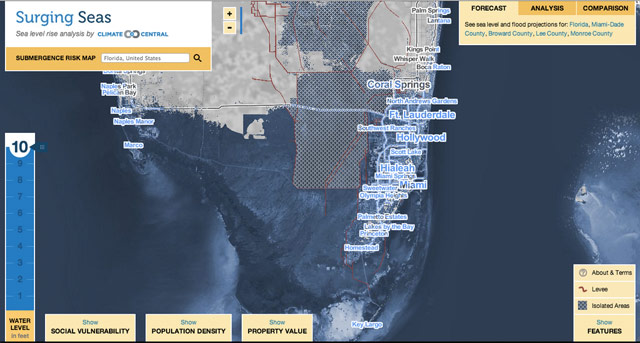
That inevitability is fueling a fledgling secessionist movement. And it’s not some crackpot grassroots effort either…the mayor and city commission of South Miami passed a resolution earlier this month that South Florida should break away and form the nation’s 51st state.
Whereas, South Florida’s situation is very precarious and in need of immediate attention. Many of the issues facing South Florida are not political, but are now very significant safety issues; and
Whereas, presently, in order to address the concerns of South Florida, it is necessary to travel to Tallahassee in North Florida. Often South Florida issues do not receive the support of Tallahassee. This is despite the fact that South Florida generates more than 69 percent of the state’s revenue and contains 67 percent of the state’s population; and
Whereas, the creation of the 51st state, South Florida, is a necessity for the very survival of the entire southern region of the current state of Florida.
Look for more of this type of thing in the years to come. The fight over fossil fuels has already shaped a great deal of the modern global political structure and the coming shifts in climate will almost certainly do the same.
From her recent memoir, Sheila E. recounts the first time she met Prince.
I never did make it down to the studio to meet “the kid,” but a few months later, in April 1978, I was at Leopold’s record store in Berkeley browsing through records when I looked up to see a new poster. It featured a beautiful young man with brown skin, a perfect Afro, and stunning green eyes. The word Prince was written in bold letters at the top. That was the guy Tom was talking about!
I found his album For You in the rack and immediately looked at the credits: “Produced, arranged, composed, and performed by Prince.”
The staff at the store, whom I’d known for years, let me take the poster home. Before I’d even listened to his record, I’d taped the poster above my waterbed. Then I lowered the needle onto the album on my record player, sat on the floor, and listened to it in its entirety. Tom was right. I immediately heard that funky rhythm guitar part he’d been talking about. It wasn’t only on one song, but the whole album. I stared up at the poster and told him, “I’m gonna meet you one day.”
(via @anildash, probably)

This happened a few days ago, but I just got a chance to check it out: FXX launched Simpsons World, a site where you can stream every Simpsons episode ever aired. You just need a cable login, as with HBO GO. There are apps too: iOS and Android. To get you started, here are the top 10 episodes of all time, from a 2003 Entertainment Weekly list.
1. Last Exit to Springfield
2. Rosebud
3. Cape Feare
4. Marge vs. the Monorail
5. Homer’s Phobia
6. Mr. Plow
7. Itchy & Scratchy Land
8. A Fish Called Selma
9. Treehouse of Horror V
10. The Last Temptation of Homer
Update: Got a bunch of complaints that the “free” in the title is misleading because a cable subscription is required, even though I explicitly called that out in the second sentence. Fair enough. But then again, if you’re going to nitpick, nothing is free. Even if you didn’t need a cable login, Simpsons World would hardly be free. You need access to an expensive computer or mobile device, high-speed internet access, and enough free (there’s that word again!) time to watch. And even if you’re viewing using a computer at the public library, you’re paying with your attention by watching advertising.
But all that is red herring nonsense. I was using “free” in the sense that for cable subscribers, they’re getting something they did not have for the same price they were previously paying. You know, free.
An endling is an individual that’s the last of its species. This is Martha, the world’s last passenger pigeon, who died in the Cincinnati Zoo in 1914.

Mat Kirkby’s short film, The Phone Call, won the Best Narrative Short prize at the Tribeca Film Festival and is rumored to be in the running for an Oscar nomination. It features a young woman who works in helpline call office (Oscar nominee Sally Hawkins) taking a call from a distraught man (Oscar winner Jim Broadbent). (via slate)
Update: The video has been taken down from Vimeo, so I’ve removed the embed. I think it was something about film festival eligibility?
Update: The Phone Call did end up being nominated for an Oscar; here’s Kirkby and friends reacting to the nomination.
You don’t know what you would do unless you’re in that situation.
That’s Philip Zimbardo’s1 introduction to this fascinating and deeply disturbing video, depicting a real-world instance of Stanley Milgram’s experiment on obedience to authority figures2. In the video, you see a McDonald’s manager take a phone call from a man pretending to be a police officer. The caller orders the manager to strip search an employee. And then much much worse.
The video is NSFW and if you’re sensitive to descriptions and depictions of sexual abuse, you may want to skip it. And lest you think this was an isolated incident featuring exceptionally weak-minded people, the same caller was alleged to have made several other calls resulting in similar behavior. (via mr)
Actress Tippi Hedren and her family (including her then-teenage daughter Melanie Griffith) lived with a pet lion named Neil for a while back in the 1970s. Here’s Neil and Melanie catching a few winks together:


From Grantland’s 30 for 30 Shorts series, a short film on former major league catcher Mackey Sasser and how he lost the ability to throw the ball back to the pitcher.
[I took the video out because someone at ESPN/Grantland is idiot enough to think that, by default, videos embedded on 3rd-party sites should autoplay. Really? REALLY!? Go here to watch instead.]
I remember Sasser (I had his rookie card) but had kinda stopped paying attention to baseball by the time his throwing problem started; I had no idea it was so bad. The video of him trying to throw is painful to watch. According to the therapists we see working with Sasser in the video, unresolved mental trauma (say, from childhood) builds up and leaves the person unable to resolve something as seemingly trivial as a small problem throwing a ball back to the pitcher. I’ve read and written a lot about this sort of thing over the years.
Christine Muhlke talks to several different chefs and writers about how they approach writing recipes.
The goal should be that the reader can make the recipe his or her own — that the instructions are clear and good enough that after a few tries, he or she can improvise to please themselves. The chef gives ideas so that the cook can profit. It’s not dictation; it’s inspiration.
When’s the last time I let you down? Ok, maybe don’t answer that. But, when I tell you that a short film about the hand gestures used by a quarry boss guiding massive excavators harvesting marble is well worth watching, you’re gonna go ahead and watch it, right? Because this is a beautiful little film.
I was so taken by the chief, watching him work. How he can move gigantic marble blocks using enormous excavators, but his own movements are light, precise and determined.
Notice the tips of two fingers are missing. That’s how you get to be the boss. More hand gestures: hand signals used by traders on the floor of the NY Mercantile Exchange, nightclub hand signals, hand signals at Eleven Madison Park, and church usher hand signals. (via digg)

As Ebola enters a deepening relationship with the human species, the question of how it is mutating has significance for every person on earth.
From the front lines in West Africa to the genomics researchers who hope to control the outbreak, The New Yorker’s Richard Preston provides a detailed and interesting look at The Ebola Wars. Preston is the author of 1995’s The Hot Zone, the bestselling account of the first emergence of Ebola, which is back in the top 50 on Amazon.
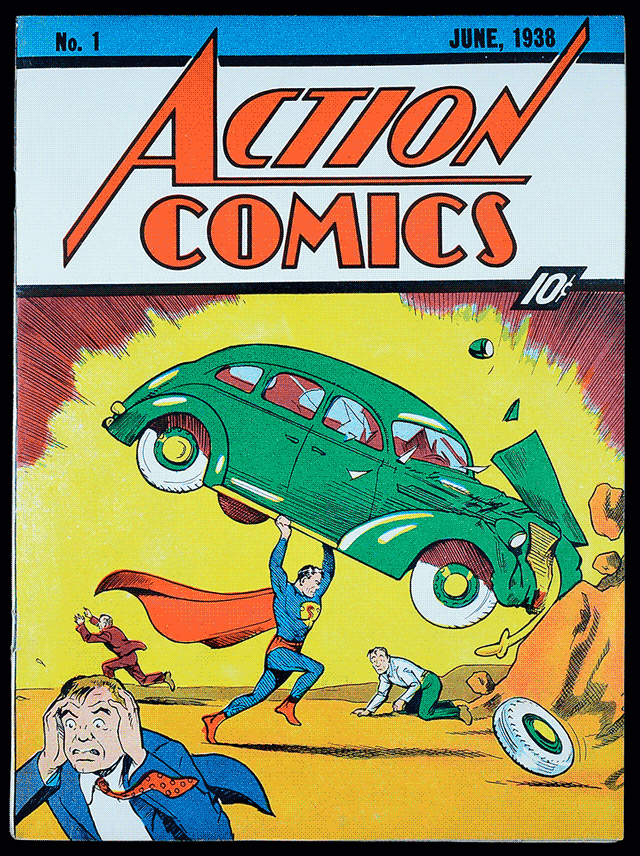
A single nearly flawless copy of Action Comics #1 recently sold on eBay for just over $3.2 million. Produced in 1938, the comic marked the first appearance of Superman and is considered the genesis of the superhero genre of comics (although there is some debate about that). This video shows what great condition this comic is in:
I’ve bought new comics that didn’t look that good. Here’s why:
The reason it was in such impeccable condition was that the while the first owner bought it for 10 cents from the newsstand in 1938 like 200,000 other people did, unlike most everyone else he lived at fairly high altitude in the Blue Ridge Mountains of West Virginia and when he finished reading it, he put the comic in a cedar chest where it remained virtually untouched for four decades. The cool, dark, dry environment of the cedar chest froze time for this comic.
You can flip through the entire comic yourself right here.
With A Little Help From My Fwends is The Flaming Lips full-length cover of The Beatles’ Sgt. Pepper’s Lonely Hearts Club Band. NPR has a first listen to it. ft. Foxygen, Miley Cyrus, Moby, Tegan And Sara, and others.
Last year’s pulverizing and strangely pretty The Terror was often punishingly uncompromising, but With A Little Help From My Fwends tackles its impossible task with a comparatively light touch. That lightness is clear from the title alone, and yet The Flaming Lips’ audaciously playful streak (required in order to cover Sgt. Pepper’s in the first place) still gets undercut with moments of abrasiveness, aggression and detours down strange side roads.
This is the most delightful restaurant review I’ve read in quite awhile. In it, Jay Rayner disembowels the “hilariously silly” London restaurant Beast and its presumed clientele, “men with teeny-weeny penises”. I have no idea how to pick just one of the great passages from this review so I’ll do two:
“I’m sorry sir, we don’t serve bread.” Eh? What’s all that about? I could see this as some stand for a bang-on-trend, carb-free Palaeolithic diet, were it not for the fact they serve chips. Mind you, they’re crap chips, huge fat things that could exclude drafts. Who actually likes their chips this way? They’re advertised as coming with truffle and foie-gras salt, which is like getting a gold-plated, diamond-encrusted case for your smartphone because you’ve run out of things to spend money on. It’s a spoilt person’s version of luxury; the pillowy “chips” do not taste either of goose liver or truffle.
And:
The corn-fed, dry-aged Nebraskan rib-eye, with a carbon footprint big enough to make a climate-change denier horny, is bloody marvellous: rich, deep, earthy, with that dense tang that comes with proper hanging. And at £100 a kilo it bloody well should be. At that price they should lead the damn animal into the restaurant and install it under the table so it can pleasure me while I eat.
Reminiscent of Pete Wells’ review of Guy Fieri’s place in Times Square. Some restaurants become immortal and immune to criticism but I don’t think Beast and Guy Fieri’s are quite there yet.
Watch as Stig Severinsen, aka The Man Who Doesn’t Breathe, swims underwater amongst icebergs. Beautiful.
Severinsen is currently the world’s record holder for the longest time holding a breath at 22 minutes. 22! I barely breathed myself while watching this video of his record breaking attempt. (via devour)
With the BBC’s new online feature, Your Life on Earth, you plug in when you were born and it spits out all sorts of facts about how the world has changed since you were born. Here are some of mine:
Population has increased by 3,324,602,171 since you were born (currently 7.24 billion)
A coast redwood’s growth in your lifetime: 52’10”
Travelled 24.1 billion miles around the Sun
Global life expectancy has increased by 10.1 years since you were born
I am 170 years old on Mercury
Very quickly, here’s how a computer works at the simplest level.

Want to see how computers store data? This next device is called a ‘D-Latch’. It holds a binary bit. The top switch is the value to be stored, the bottom switch enables storage. Eight of these devices can be used to store a byte in memory.
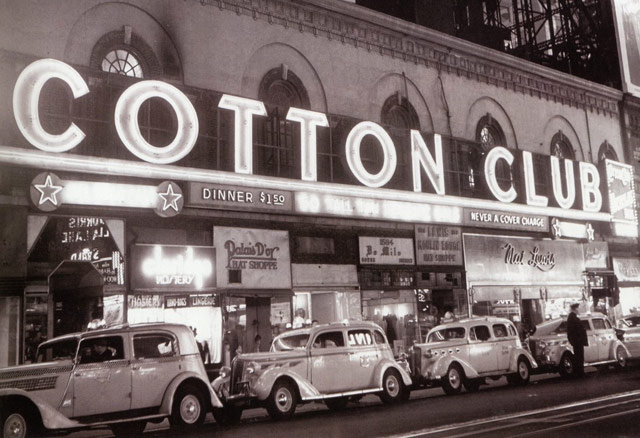
From A Continuous Lean, a review of some of NYC’s most beloved bygone music venues, including The Cotton Club (closed 1940), The Gaslight Cafe (closed 1971), and CBGB (closed 2006).
Despite being located in Harlem, and showcasing many black performers, The Cotton Club actually had a strict “whites only” policy.
If you want to watch a bunch of realistic-looking fake people run into a slowly spinning metal bar (and you really should want to watch it), this is the video for you:
It’s better bigger or with sound. (via waxy)
From Silence of the Lambs (#1) to To Kill A Mocking Bird (#9) to Blade Runner (#28), these are the 50 best book-to-movie adaptations ever, compiled by Total Film.
Somehow absent is Spike Jonze’s Adaptation and I guess 2001 was not technically based on a book, but whatevs. The commenters additionally lament the lack of Requiem for a Dream, Gone with the Wind, The French Connection, Rosemary’s Baby, Last of the Mohicans, and The Wizard of Oz.
For the first episode of podcast called Working, David Plotz talks to Stephen Colbert about how he and his staff construct The Colbert Report. This is fascinating.
My show is a shadow of the news, so I have to know what shadow it’s casting right now, so I can distort it in my own way.
At the 13 minute mark, he talks about how the team communicates with each other about how the show is shaping up, changes, concerns, etc. They do it all by what sounds like text messaging. Paging Stewart Butterfield, you should get those folks on Slack. (via digg)
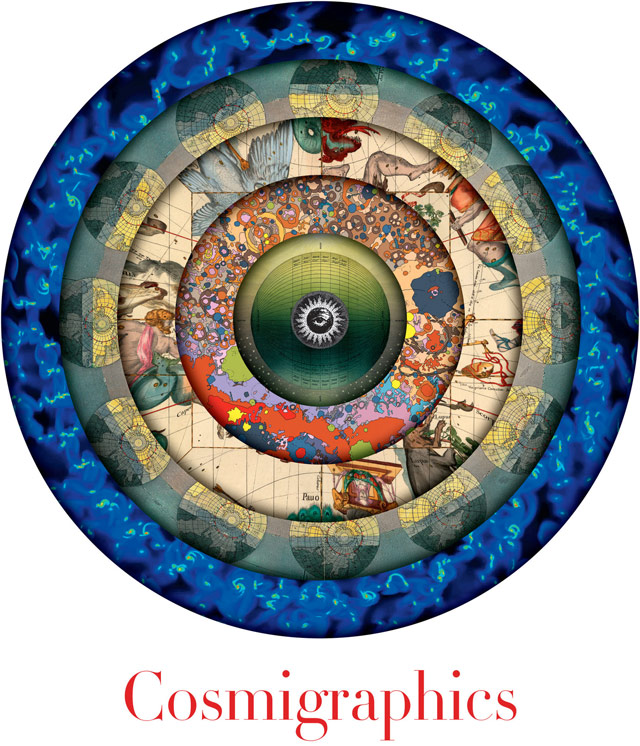
From Michael Benson comes Cosmigraphics, a survey of many ways in which humans have represented the Universe, from antiquity on up to the present day.
Selecting artful and profound illustrations and maps, many hidden away in the world’s great science libraries and virtually unknown today, he chronicles more than 1,000 years of humanity’s ever-expanding understanding of the size and shape of space itself. He shows how the invention of the telescope inspired visions of unimaginably distant places and explains why today we turn to supercomputer simulations to reveal deeper truths about space-time.
The NY Times has an adaptation of the introduction to the book.
Among the narrative threads woven into the book are the 18th-century visual meditations on the possible design of the Milky Way - including the astonishing work of the undeservedly obscure English astronomer Thomas Wright, who in 1750 reasoned his way to (and illustrated) the flattened-disk form of our galaxy. In a book stuffed with exquisite mezzotint plates, Wright also conceived of another revolutionary concept: a multigalaxy cosmos. All of this a quarter-century before the American Revolution, at a time when the Milky Way was thought to constitute the entirety of the universe.
Last week, Emily Dreyfuss wrote a piece at about Why I’m Giving Wikipedia 6 Bucks a Month.
“Give me money, Emily,” Wales begged, “then go back to researching Beyonce lyrics.”
“Excuse me, Jimmy,” I wanted to say, “I don’t appreciate being watched as I read about how her song “Baby Boy” includes a lyrical interpolation of “No Fear” by O.G.C.”
Later, Wikipedia replaced Wales with other employees of the Wikimedia Foundation, which maintains Wikipedia with grants and donations. They moved me about as much as Wales did, which is to say not at all.
Today, while scanning my third Wikipedia article in as many hours, I saw the beggi…. er, note was back. It’s at the bottom now, without the pleading visage of a Wikipedian, and now includes an option to pay monthly.
I was annoyed, again. That’s the first instinct of anyone who spends time on the Internet and is constantly bombarded by pleas for money. But then I realized something: My annoyance was a symptom of my dependence on Wikipedia. I rely on it utterly. I take it completely for granted.
I found her argument persuasive, so much so that I just signed up to give Wikipedia a monthly amount as well. I consider it a subscription fee to an indispensable and irreplaceable resource I use dozens of times weekly while producing kottke.org. It’s a business expense, just like paying for server hosting, internet access, etc. — the decision to pay became a no-brainer for me when I thought of it that way.
Do other media companies subscribe to Wikipedia in the same fashion? How about it Gawker, NY Times, Vox, Wired, ESPN, WSJ, New York Magazine, Vice, Washington Post, The Atlantic, Buzzfeed, Huffington Post? Even $500/month is a drop in the bucket compared to your monthly animated GIF hosting bill and I know your writers use Wikipedia as much as I do. Come on, grab that company credit card and subscribe.
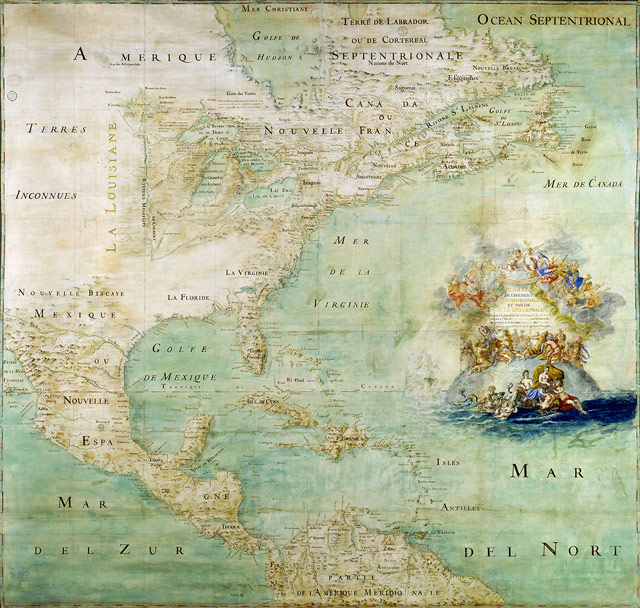
Like it says on the tin: a collection of Beautiful Maps. I wish there was some attribution attached to each map though. The map above is by Claude Bernou circa 1681. (via @khoi)
Rex Sorgatz wonders what sort of robots we’ll build, R2-D2s or C-3POs.
R2-D2 excels in areas where humans are deficient: deep computation, endurance in extreme conditions, and selfless consciousness. R2-D2 is a computer that compensates for human deficiencies — it shines where humans fail.
C3-PO is the personification of the selfish human — cloying, rules-bound, and despotic. (Don’t forget, C3-PO let Ewoks worship him!) C3-PO is a factotum for human vanity — it engenders the worst human characteristics.
I love the chart he did for the piece, characterizing 3PO’s D&D alignment as lawful evil and his politics as Randian.
Tony Zhou’s excellent series on filmmaking, Every Frame a Painting, has become a much-watch for me. Here’s the latest one, a short look at a single scene from Silence of the Lambs in which Zhou asks: Who Wins the Scene?
Older posts






Socials & More