


Kilian Martin: Altered Route
Oh, boy. A new Kilian Martin skate video. Martin’s style is really distinctive. The spinning, the two skateboards, the handstands. Lovely stuff.
(via ★interesting)

This site is made possible by member support. 💞
Big thanks to Arcustech for hosting the site and offering amazing tech support.
When you buy through links on kottke.org, I may earn an affiliate commission. Thanks for supporting the site!
kottke.org. home of fine hypertext products since 1998.
Beloved by 86.47% of the web.
Oh, boy. A new Kilian Martin skate video. Martin’s style is really distinctive. The spinning, the two skateboards, the handstands. Lovely stuff.
(via ★interesting)
The Tacoma Narrows Bridge was open for about four months in 1940 before a steady wind set it twisting and ultimately tore the bridge apart.
Damn Interesting has a detailed account of the bridge’s short history and demise.
After opening, the new bridge shortly came to be known as “Galloping Gertie,” so named by white-knuckled motorists who braved the writhing bridge on windy days. Even in a light breeze, Gertie’s undulations were known to produce waves up to ten feet tall. Sometimes these occurrences were brief, and other times they lasted for hours at a time. Numerous travelers shunned the route altogether to avoid becoming seasick, whereas many thrill-seeking souls paid the 75-cent toll to traverse Gertie during her more spirited episodes.
The 99% Invisible podcast devoted a show to the collapse of the bridge.
(via sarah pavis)
Rick Paulas has a deep look in the Awl at baseball players who, regardless of how long their professional careers were, only played in one Major League Baseball game. They’re in an interesting spot, possessing great enough talent to get them to the pinnacle of their profession but not enough to keep them there (though military service, luck, and injuries also play a role in some cases).
Some players performed poorly in their one game, others did…better.
On the final day of the 1963 regular season, John Paciorek had a hell of a career. The 18-year-old started in right field for the Houston Colt .45s — two years away from trading in the handgun for the Space Race-influenced “Astros” moniker — and had a perfect day at the plate: three-for-three, two walks, three RBIs and four runs. Nagging back injuries meant he’d never have a chance to blemish that perfection.
By the math in the article, 5.5% of all major leaguers ever have only played in one game. I can’t decide if that’s more or less than I would expect.
This looks promising — Howler, a quarterly magazine for North American soccer fans started by some experienced big mag editors, designers, and writers. They’re looking for $50,000 to get it started on Kickstarter.
Howler is a new magazine about soccer. It’s a big, glossy publication that will come out four times a year with distinctive, original writing about American and international soccer, as well as some of the most striking art and design you’ll find in any publication being made today. (We know that’s a bold claim, but we really believe it’s true.) We’ve been working on Howler for months, and issue one is nearly ready to be printed, shipped, and in your hands by late summer.
I ordered a year’s subscription. (via @thessaly)
The internet is going through a bit of a thing with standing desks right now, fueled by yesterday’s The Wirecutter article about them. One of the most famous standing desk enthusiasts was Ernest Hemingway.
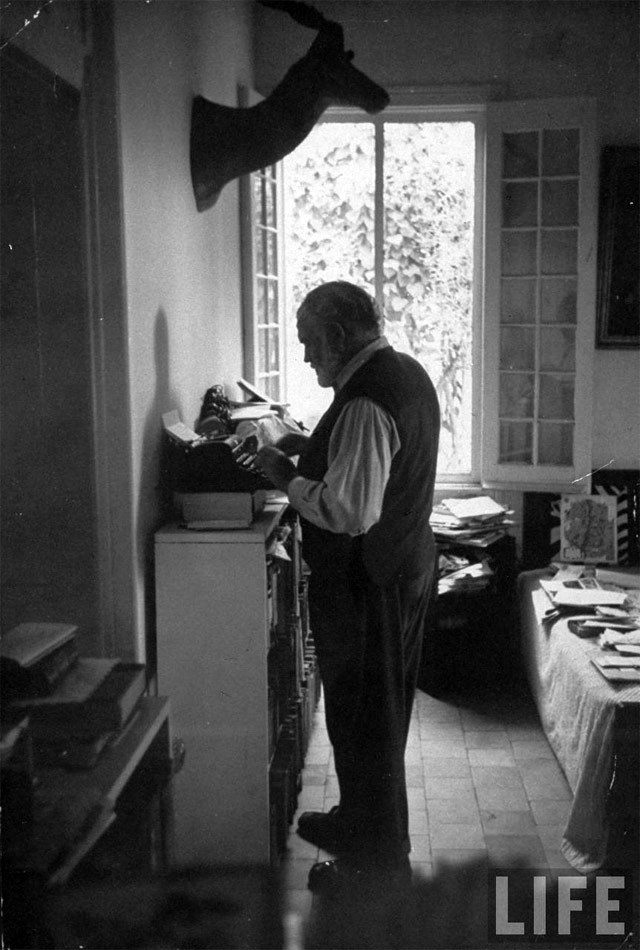
The introduction of this 1958 Paris Review interview with Hemingway briefly describes Papa’s upright working setup:
A working habit he has had from the beginning, Hemingway stands when he writes. He stands in a pair of his oversized loafers on the worn skin of a lesser kudu — the typewriter and the reading board chest-high opposite him.
Most articles I’ve seen on standing desks recommend anti-fatigue mats to help with foot pain, but of course Hemingway would go with the hide of an African antelope that he likely killed himself.
Other famous users of standing desks included Winston Churchill, Lewis Carroll, Donald Rumsfeld, Charles Dickens, Otto von Bismarck, Henry Clay, Thomas Jefferson, John Dos Passos, and Virginia Woolf. (thx, megnut)
In the past day, I’ve run across two related theories of how all of Quentin Tarantino’s films are part of the same universe: this video and this post on Reddit. They differ slightly but the Reddit one is more interesting…specifically that Pulp Fiction, Reservoir Dogs, etc. take place in the aftermath of Inglourious Basterds and its unorthodox ending to World War II.
Because World War 2 ended in a movie theater, everybody lends greater significance to pop culture, hence why seemingly everybody has Abed-level knowledge of movies and TV. Likewise, because America won World War 2 in one concentrated act of hyperviolent slaughter, Americans as a whole are more desensitized to that sort of thing. Hence why Butch is unfazed by killing two people, Mr. White and Mr. Pink take a pragmatic approach to killing in their line of work, Esmerelda the cab driver is obsessed with death, etc.
You can extrapolate this further when you realize that Tarantino’s movies are technically two universes - he’s gone on record as saying that Kill Bill and From Dusk ‘Til Dawn take place in a ‘movie movie universe’; that is, they’re movies that characters from the Pulp Fiction, Reservoir Dogs, True Romance, and Death Proof universe would go to see in theaters. (Kill Bill, after all, is basically Fox Force Five, right on down to Mia Wallace playing the title role.)
(via ★pieratt & @natebirdman)
Not content to ban cigarettes, educate the public on calorie counts, and grade the city’s restaurants, the Bloomberg administration wants to ban the sale of large sugary drinks.
The proposed ban would affect virtually the entire menu of popular sugary drinks found in delis, fast-food franchises and even sports arenas, from energy drinks to pre-sweetened iced teas. The sale of any cup or bottle of sweetened drink larger than 16 fluid ounces — about the size of a medium coffee, and smaller than a common soda bottle — would be prohibited under the first-in-the-nation plan, which could take effect as soon as next March.
The measure would not apply to diet sodas, fruit juices, dairy-based drinks like milkshakes, or alcoholic beverages; it would not extend to beverages sold in grocery or convenience stores.
Over my dead fat diabetic body!
More than nine years ago, Phil Gyford started publishing The Diary of Samuel Pepys online as a time-shifted blog…perhaps the first of its kind. During that time, each entry in Pepys’ diary was published 343 years after Pepys originally wrote them. In time, a popular Twitter account was added. The final entry will be published tomorrow (May 31), which is when Pepys suspended his diary in 1669 due to poor eyesight. Congrats on the run, Phil!
According to a recent study, the cause of Pine Mouth (where eating pine nuts can make food taste horrible for days afterwards) is still unknown. The full text of the study is behind a paywall but The Awl has a short summary of the findings.
Now, a new publication by the Journal of Agricultural & Food Chemistry finds esteemed scientists literally throwing up their hands. They learned a lot about pine nuts and their composition! But nothing useful.
cc: Megnut.
The fantastically obsessive Mark Lukach just spent an outlandish amount of time researching stand-up desks and shared his findings at The Wirecutter. Even if you have no interest in standing on the job, The Wirecutter is worth a visit for their concise and excellent guides on what to buy from headphones to juicers. (via nextdraft)
Note: This post is from Dave Pell’s NextDraft email newsletter, hopefully the first of many. Dave and I are going to be trading content back and forth on a more-or-less weekly basis, so keep a lookout for that. If you like what you see, subscribe to NextDraft whydontcha?
The Jenny McCarthy Body Count site tracks the number of vaccine-preventable illnesses and deaths in the US since June 2007.
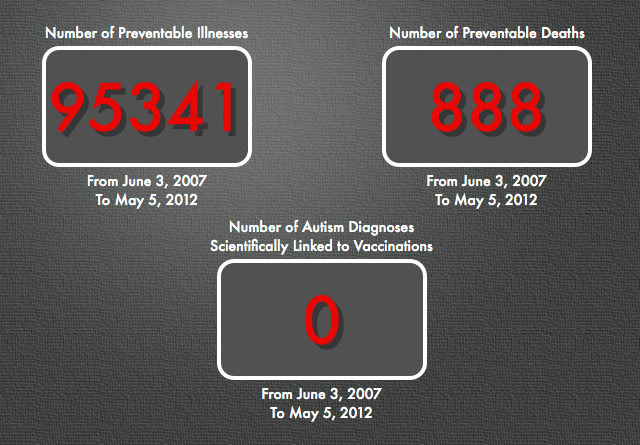
In June 2007 Jenny McCarthy began promoting anti-vaccination rhetoric. Because of her celebrity status she has appeared on several television shows and has published multiple books advising parents not to vaccinate their children. This has led to an increase in the number of vaccine preventable illnesses as well as an increase in the number of vaccine preventable deaths.
I hadn’t realized just how much of a nutter McCarthy is…her embrace of pseudoscience runs deep.
Indigo children is a term used to describe children who are believed to possess special, unusual and sometimes supernatural traits or abilities. The term is pseudoscientific. The idea is based on New Age concepts developed in the 1970s by Nancy Ann Tappe and further developed by Jan Tober and Lee Carroll. The concept of indigo children gained popular interest with the publication of a series of books in the late 1990s and the release of several films in the following decade. A variety of books, conferences and related materials have been created surrounding belief in the idea of indigo children and their nature and abilities. The interpretations of these beliefs range from their being the next stage in human evolution, in some cases possessing paranormal abilities such as telepathy, to the belief that they are more empathic and creative than their peers.
This thread at Ask MetaFilter contains several examples of English words and phrases that sound current but actually aren’t.
“Fly” mentioned above is one of my favorites (though it’s considered dated by youngsters today — they’ll basically only use it ironically), but one not mentioned so is “crib” (also a bit dated) which has meant something like “house” or “home” since 1600. OED: “A small habitation, cabin, hovel; a narrow room; fig. a confined space. In N.Z. now esp. a small house at the seaside or at a holiday resort.”
I particularly liked this early example of the maternal insult from Shakespeare’s Titus Andronicus:
Demetrius: “Villain, what hast thou done?”
Aaron: “That which thou canst not undo.”
Chiron: “Thou hast undone our mother.”
Aaron: “Villain, I have done thy mother.”
From McSweeney’s Interviews With People Who Have Interesting or Unusual Jobs series, a brief interview with a professional safecracker.
Q: Do you ever look inside?
A: I NEVER look. It’s none of my business. Involving yourself in people’s private affairs can lead to being subpoenaed in a lawsuit or criminal trial. Besides, I’d prefer not knowing about a client’s drug stash, personal porn, or belly button lint collection.When I’m done I gather my tools and walk to the truck to write my invoice. Sometimes I’m out of the room before they open it. I don’t want to be nearby if there is a booby trap.
The view from an old time burger joint orig. from Feb 02, 2012
* Q: Wha? A: These previously published entries have been updated with new information in the last 24 hours. You can find past updates here.
I missed this last July when the news came out, but since I’ve been following the Pioneer Anomaly for the past eight years, I wanted to mention it here for closure purposes. First, what the hell is the Pioneer Anomaly?
The Pioneer anomaly or Pioneer effect is the observed deviation from predicted accelerations of the Pioneer 10 and Pioneer 11 spacecraft after they passed about 20 astronomical units (3×10^9 km; 2×10^9 mi) on their trajectories out of the Solar System. Both Pioneer spacecraft are escaping the Solar System, but are slowing under the influence of the Sun’s gravity. Upon very close examination of navigational data, the spacecraft were found to be slowing slightly more than expected. The effect is an extremely small but unexplained acceleration towards the Sun, of 8.74±1.33x10^-10 m/s^2.
A team at JPL has tracked the problem to uneven heat emissions from the probes’ fuel source.
For their new analysis, Turyshev et. al. compiled a lot more data than had ever been analyzed before, spanning a much longer period of the Pioneers’ flight times. They studied 23 years of data from Pioneer 10 instead of just 11, and 11 years of data from Pioneer 11 instead of 3. As explained in their new paper, the more complete data sets reveal that the spacecraft’s anomalous acceleration did indeed seem to decrease with time. In short, the undying force had been dying after all, just like the decaying plutonium.
A more recent paper by the same researchers offers even more support for their theory. Case closed, I say.
Aisha Mustafa, a 19-year-old Egyptian physics student, has invented a promising new quantum propulsion system for spacecraft.
Mustafa invented a way of tapping this quantum effect via what’s known as the dynamic Casimir effect. This uses a “moving mirror” cavity, where two very reflective very flat plates are held close together, and then moved slightly to interact with the quantum particle sea. It’s horribly technical, but the end result is that Mustafa’s use of shaped silicon plates similar to those used in solar power cells results in a net force being delivered. A force, of course, means a push or a pull and in space this equates to a drive or engine.
Earlier in the year I shared a lovely short film about Prime Burger, a midtown Manhattan institution.
For many of the guys that work here, the restaurant is like a second home — some of them have been slinging burgers, making shakes, and waiting on customers at this location for decades. Opened in 1938, the place hasn’t been altered since the early ’60s, and it looks all the better for it.
Sadly, as of Saturday, Prime Burger is no more, booted out by the new ownership of their building.
Prime Burger, the 74-year-old coffee shop and restaurant, run for 36 years by the DiMiceli family, is closing. And though Michael DiMiceli spoke hopefully on Friday of finding a new space in which to reinstall Prime Burger’s futuristic “Jetsons”-era d’ecor, the family has scarcely had time yet to look or to strike a deal. The small building in which Prime Burger is a tenant was sold recently, and the new owners sent the restaurant packing.
File this one under what fast looks like: motorcycle racers reach speeds in excess of 200 mph as they navigate the tiny curved roads of the Isle of Man during the Isle of Man TT race. The crash at 1:30, which is insane by the way, involves a stone wall, sheep, and was filmed cinematically from a helicopter.
(thx, @garymross)
In a pair of articles at GigaOM, David Galbraith shares some lessons from building Wists, a visual bookmarking site that was a precursor to Pinterest. In part one, he describes how the site came about:
I get too much credit for RSS and for Yelp, but the one thing that I can unashamedly claim to have invented is visual bookmarking, and more specifically the “choose images to thumbnail via a bookmarklet” method that Pinterest is based on. It’s not much of an “invention” per se. It’s a moronically simple thing, but it’s the right moronically simple thing. And given that more than one billion dollars rests on the idea, maybe it’s worth looking back at its history.
In part two, he talks about the rise of grid sites:
Although a seemingly trivial distinction, grid sites have their distinct advantages and disadvantages over linear ones. They look pretty, but require scanning in two directions. This is not good for news, where you need to understand the timeline at a glance. However, for scanning thumbnails, a grid is particularly efficient. But even then, the success of such image-rich sites as Tumblr made people think that the river worked for everything. I suspect the key UX component of Tumblr’s success is the ease of sharing or reblogging. Also, in such a heterogeneous text/image environment, you can’t just have a grid.
I disagree strenuously with David about the importance and utility of grids for visual sites…using Pinterest for more than a few seconds makes me want to smash things.
Kanye and Jay-Z are doing a second album together!
Kanye West’s producer Mike Dean, who co-produced part of Jay and ‘Ye’s Watch the Throne, has confirmed that there will be a Watch the Throne 2! While Dean revealed that a follow up album is definitely in the works, he was unable to give a specific time for its release.
Maybe they’ll call it Watch the Throner?
No, it’s not a typewriter that plays music. The Keaton Music Typewriter was invented in 1936 for the purpose of printing musical notes on sheet music paper.

The Keaton Music Typewriter was first patented in 1936 (14 keys) by Robert H. Keaton from San Francisco, California. Another patent was taken out in 1953 (33 keys) which included improvements to the machine. The machine types on a sheet of paper lying flat under the typing mechanism. There are several Keaton music typewriters thought to be in existence in museums and private collections. It was marketed in the 1950s and sold for around $225. The typewriter made it easier for publishers, educators, and other musicians to produce music copies in quantity. Composers, however, preferred to write the music out by hand.
Soon after the US dropped two nuclear bomb on Japan in 1945, a group of physicists at the University of Pennsylvania decided to investigate for themselves how nuclear fission and the bomb might work using non-classified materials. In doing so, they ventured into classified territory and raised questions about the nature of science and secrecy.
To what degree would nuclear research become shackled by the requirements of national security? Would the open circulation of new scientific knowledge cease if that knowledge was relevant to nuclear fission? Those questions were hardly idle speculation: From the fall of 1945 through the summer of 1946, the US Congress was crafting new, unprecedented legislation that would legally define the bounds of open scientific research and even free speech. The idea of restricting open scientific communication “may seem drastic and far-reaching,” President Harry S. Truman argued in an October 1945 statement exhorting Congress to rapid action. But, he said, the atomic bomb “involves forces of nature too dangerous to fit into any of our usual concepts.”
The former Manhattan Project scientists who founded what would eventually become the Federation of American Scientists were adamantly opposed to keeping nuclear technology a closed field. From early on they argued that there was, as they put it, “no secret to be kept.” Attempting to control the spread of nuclear weapons by controlling scientific information would be fruitless: Soviet scientists were just as capable as US scientists when it came to discovering the truths of the physical world. The best that secrecy could hope to do would be to slightly impede the work of another nuclear power. Whatever time was bought by such impediment, they argued, would come at a steep price in US scientific productivity, because science required open lines of communication to flourish.
At the University of Pennsylvania were nine scientists sympathetic to that message. All had been involved with wartime work, but in the area of radar, not the bomb. Because they had not been part of the Manhattan Project in any way, they were under no legal obligation to maintain secrecy; they were simply informed private citizens. In the fall of 1945, they tried to figure out the technical details behind the bomb.
Eric Simons is a 19-year-old entrepreneur who lived for two months in the AOL HQ in Palo Alto. Simons was given a badge while participating in Imagine K12, an education incubator housed at AOL. When the program ended, Simons’s badge continued to work. So he stayed, sleeping on one of three couches, showering in the gym, and eating for free in the cafeteria. There’s a walled garden joke in here, maybe even a domain squatting joke, too.
For someone with neither money nor an aversion to sleeping on others’ couches, the AOL building had plenty of allure. “They had a gym there with showers,” Simons said. “I’d take a shower after work. I was like, ‘I could totally work here…They have food upstairs, they have every drink on tap. This would be a sweet place to live.’”
It’s too bad Simons didn’t keep a Tumblr of his two months living at AOL, he’d have a book deal already. (via ★asimone)
Many of you liked the slinky on the treadmill video. This slow-motion video of Alan Rickman drinking tea isn’t quite as compelling, but it’s not bad either. Wait for the drop around 1:22 before judging.
The original video without the dramatic sound is here. (More info.)
My pal Andy Baio is throwing a conference in Portland in September and funding the whole thing on Kickstarter.
XOXO is a celebration of disruptive creativity. We want to take all the independent artists using the Internet to make a living doing what they love — the makers, craftspeople, musicians, filmmakers, comic book artists, game designers, hardware hackers — and bring them together with the technologists building the platforms that make it possible. If you have an audience and a good idea, nothing’s standing in your way.
It reminds me a bit of what SXSW used to be. I bought a ticket and am hoping to be there. Only 68 tickets remaining so if you want to go, you’d better pull the trigger on the ticket gun.
There’s a driving technique called heel-and-toe where the driver uses all three pedals (brake, clutch, throttle) at once to make deceleration smoother, especially in the turns.
Heel-toe or heel-and-toe double-declutching is used before entry into a turn while a vehicle is under braking, preparing the transmission to be in the optimal range of rpm to accelerate out of the turn. One benefit of downshifting before entering a turn is to eliminate the jolt to the drivetrain, or any other unwanted dynamics. The jolt will not upset the vehicle as badly when going in a straight line, but the same jolt while turning may upset the vehicle enough to cause loss of control if it occurs after the turn has begun. Another benefit is that “heel-and-toeing” allows the driver to downshift at the last moment before entering the turn, after starting braking and the car has slowed, so the engine speed will not be high enough when the lower gear is engaged.
Here is a video of Formula One great Ayrton Senna demonstrating the techique in a Honda NSX. You’ll note he’s wearing a button-down shirt, dress pants, Italian loafers, and no helmet while burying the speedometer on his way around the track.
It’s a bit difficult to understand from the video what Senna is actually doing…this step-by-step video shows the heel-and-toe technique more clearly. (thx, micah)
Quarterly is a hybrid of a magazine and an online store…you subscribe to people and receive items in the mail. It’s a fun idea and I’m pleased to announce that you can now subscribe to me on Quarterly. Here’s what I’m planning on sending out, very generally:
Each day on kottke.org, I attempt to find the interesting in everything. Part of that is casting a wide net and looking for connections between seemingly unrelated things. I hope that — for instance — a sports freak can appreciate something about how the human brain works, a book editor is enticed to read about the history of the American automobile industry, or a startup CEO can find business lessons in fashion. In that vein, I’ll be sending you things that you didn’t know you wanted to see until you saw them.
Price is $25 per quarter with the first mailing shipping in about two months. Sign up!
Gary Connery is apparently the first person to skydive out of an aircraft and land on the ground without injury without the use of a parachute.
Over at the NY Times Olympics blog, Victor Mather takes a look at a few sports that would be fun to see in the Olympic Games again.
3. Dueling pistol, 1906
No actual duels were fought, alas. Rather, contestants shot at a dummy dressed in a frock coat. Shooting events tend to be rather dull to watch, but they would have a chance with creative thinking like this.
And tandem bike racing!
And don’t forget the art competitions.
With the LA Kings, LA Lakers, and LA Clippers all in the playoffs this year, the Staples Center has been pretty busy. Between May 17th and May 20th, there were 6 games. The crew at the Staples Center has to break the arena down between every game, what with all the different teams and sports. Watching the set up is pretty neat, and since no one would watch a four-day-long video, they’ve been kind enough to share a time lapse. Watch the arena go from Kings to Lakers to Clippers to Lakers to Kings to Clippers. My favorite parts are the pre-game introductions and that they lower the jumbotron every night.
(via Quickish)
Movie Simpsons is a Tumblr of scenes from the Simpsons paired with the referenced movie scenes.

It’s only just getting going, but 1995 Jason would have killed for this. The first time I watched Citizen Kane and The Godfather, I smacked my forehead with my hand so many times in recognition that it turned red.
Dr. Sergio Cittolin has worked at CERN for the past 30 years as a research physicist. He has also made several drawings of the Large Hadron Collider in the style of Leonardo da Vinci.
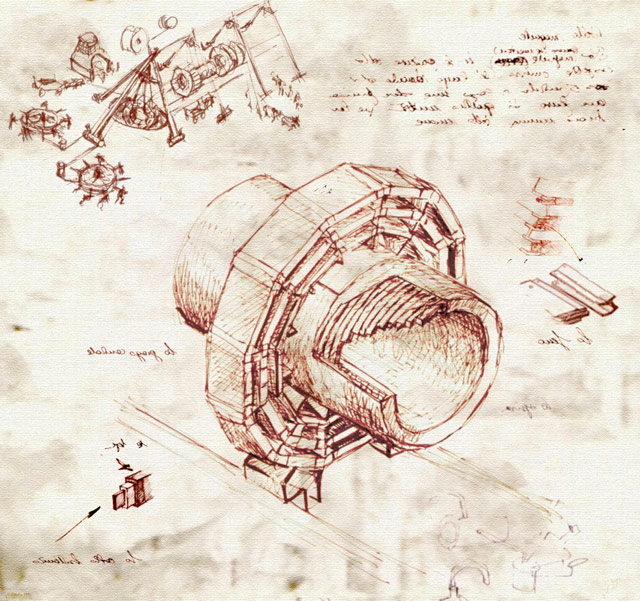
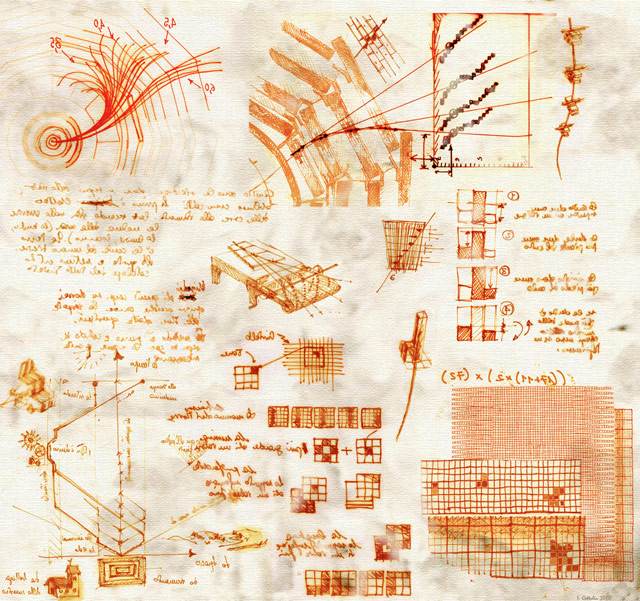
Symmetry magazine profiled Cittolin a few years ago.
As a naturalist, da Vinci probed, prodded, and tested his way to a deeper understanding of how organisms work and why, often dissecting his object of study with this aim. “I thought, why not present the idea of data analysis to the world within the naturalist world of Leonardo?” Cittolin says. In the drawing below, the CMS detector is the organism to be opened; the particles passing through it and the tracks they leave behind are organs exposed for further investigation.
Cittolin brings a sense of humor to his work. For example, after betting CMS colleague Ariella Cattai that he could produce a quality drawing for the cover of the CMS tracker technical proposal by a given deadline, he included in the drawing a secret message in mirror-image writing-which was also a favorite of da Vinci’s. The message jokingly demanded a particular reward for his hard work. The completed picture was delivered on time and within a few hours Cattai cleverly spotted and deciphered the message. She promptly presented him with the requested bottle of wine.
(via ★johnpavlus)
I had no idea a Slinky’s adventures on a treadmill could be so dramatic or affecting. The stumble at ~1:43 is the most harrowing scene in film so far in 2012.
(via stellar)
Sipping Stones are small stones that you put into your drink instead of ice. Gives new meaning to “on the rocks”!!! LOL LMAO ROFLCOPTER, etc.
When enjoying a premium spirit, why tarnish the taste with water? Providing a slight chill protects the taste without drowning the quality.
Sipping Stones are made of all natural soapstone, which is non-porous and won’t impart any taste or flavor. Generally Regarded As Safe (GRAS) by the FDA soapstone is comprised of talc, which will not react to water, alcohol, or other drinks. When used with care, Sipping Stones will not scratch your glassware.
You can get nine of them for $15 from Amazon. Has anyone used these? Are they any good?
The Atlas of the United States Printed for the Use of the Blind, published in 1837 before Braille was widely used, used embossed printing of lines, words, and symbols to be finger-readable.
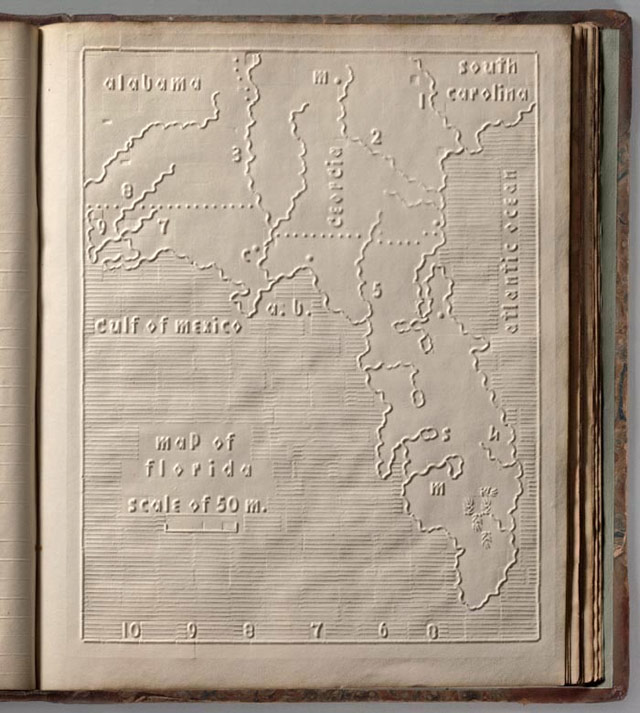
Without a drop of ink in the book, the text and maps in this extraordinary atlas were embossed heavy paper with letters, lines, and symbols. To the best of our knowledge, this is the first atlas produced for the blind to read without the assistance of a sighted person. Braille was invented by 1825, but was not widely used until later. It represented letters well, but could not represent shapes and cartographic features.
(via @ftrain)
Ethan Zuckerman proposes measuring attention with a unit of measure called a Kardashian. One Kardashian is equal to the amount of worldwide media attention that Kim Kardashian gets in a day.
I choose the Kardashian as a unit both because I like the mitteleuropean feel of the term — like the Ohm or the Roentgen — and because Kardashian is an exemplar of attention disconnected from merit, talent or reason. The Kardashian mentions how much attention is paid, not how much attention is deserved, so naming the unit after someone who is famous for being famous seems appropriate. Should the unit be adopted, I would hope that future scholars will calculate Kardashians using whatever public figure is appropriate at the time for being inappropriately famous.
Example usage: The crisis in Greece received 12 microKardashians of attention today.
This long four-part interview of 30 Rock show runner Robert Carlock at the AV Club is, as mentioned, long but worth reading if you’re into TV or 30 Rock. Part one covers season one & and part of two, and part two walks us through part of season two & season three.
[Jerry Seinfeld’s] people and NBC were talking at a very high level about promoting Bee Movie, and they were encouraging us to use him. We were really eager to do anything we could to continue our life writing the show, in part, at that point, because we’d really fallen in love with writing it. I will never have another opportunity to write for those people again. Writing a half-hour for Alec Baldwin is insane. And to work with Tina. A lot of the things this show has done, like product integration and guest stars, is partly to give NBC the fewest number of excuses possible to get rid of us. If they’re saying, “We’ll promote you. Have Seinfeld on,” and we all love Seinfeld, we’ll sit down and try to find a way to do it on our terms-much like product integration, where every time we’ve done it, we’ve had the luxury of being able to call it out or mock it or integrate it. This past live show had a couple of P.I. things in it, because that was so much about television that you’re able to do it. We were happy to have Jerry come on the show, and he shot 10 pages in a very long day. We usually shoot six or seven pages, so it was a real burden.
Parts three & four to come. (via @khoi)
Fantastic time lapse map of Europe, 1000 - 2005 A.D. orig. from May 15, 2012
* Q: Wha? A: These previously published entries have been updated with new information in the last 24 hours. You can find past updates here.
I can’t tell if the app featured in this video is imaginary or not, but it’s a great theoretical solution to the problem of douche parking. Douche parking is basically parking like a douche, and is way more prevalent in Russia than in the US. The Village feels publicly shaming is the best way to deal with douches. Unfortunately, one trait of douches is an inability to be shamed.
(via ★interesting)
The teaser trailer for P.T. Anderson’s next film, The Master. Anderson himself cut the trailer — why don’t more director/editors do this?
Written and directed by Academy Award nominee Paul Thomas Anderson (the acclaimed director of, There Will Be Blood, Magnolia and Boogie Nights), this story stars Academy Award winner Philip Seymour Hoffman (Capote) and Academy Award-nominee Joaquin Phoenix (Walk the Line). Set in America in the years following World War II, a charismatic intellectual (Hoffman) launches a faith-based organization and taps a young drifter (Phoenix) as his right-hand man. But as the faith begins to gain a fervent following, the onetime vagabond finds himself questioning the belief system he has embraced, and his mentor. A truly one-of-a-kind drama, which promises magnetic virtuoso performances, the film marks the fifth collaboration between Anderson and Hoffman, following Hard Eight, Boogie Nights, Magnolia, and Punch Drunk Love.
As good as this looks, I’m a wee bit disappointed that this isn’t a PT Anderson-directed documentary style film about Doctor Who’s nemesis. Wouldn’t that be something? (via cigarettes & red vines)
Dirk van der Kooij is a designer who uses a low-resoution 3D printer of sorts to print out plastic furniture with plastic recovered from recycled refrigerators.
Images of the finished product are available on his web site as are the chairs themselves, for €840. (via @curiousoctopus)
Since the companies mining the oil from the sands of Alberta wouldn’t provide access to their operations to a reporter, he rented a plane and took a bunch of photos.

As Stewart said, “Better than I thought”.
Cory Poole made this video of the annular solar ecplise yesterday using 700 photographs from a telescope with “a very narrow bandpass allowing you to see the chromosphere and not the much brighter photosphere below it.”
Cory says: “The filter only allows light that is created when hydrogen atoms go from the 2nd excited state to the 1st excited state.” Very cool.
In this interview with The Daily Beast, Ridley Scott reveals that he’s currently working on a sequel to Blade Runner.
Funny enough, I started my first meetings on the Blade Runner sequel last week. We have a very good take on it. And we’ll definitely be featuring a female protagonist.
Eighteen months on, the alien who discovered Voyager’s Golden Record still hasn’t gotten around to listening to the whole thing.
“The wind, rain, and surf sounds are pretty cool, but I usually sort of zone out when it gets to the crickets chirping, and then I just end up turning it off,” said Ellinger, adding that he will sometimes put the record on as background noise when he’s cleaning his electro-biological habitat.
Current status of The Onion: still really pretty good.
If you’re attempting to enjoy beer and are without your bottle opener but you have your chainsaw, this will come in handy:
Didn’t spill a drop! See also opening a beer bottle with a piece of paper, opening a beer bottle with a cigarette lighter, and opening a beer bottle with an iPad power brick.
Craig Claiborne was the NY Times’ first dedicated restaurant critic, providing an example that was soon followed by newspapers everywhere in the US.
Some American writers had nibbled at the idea of professional restaurant criticism before this, including Claiborne, who had written one-off reviews of major new restaurants for The Times. But his first “Directory to Dining,” 50 years ago this month, marks the day when the country pulled up a chair and began to chow down. Within a few years, nearly every major newspaper had to have a Craig Claiborne of its own. Reading the critics, eating what they had recommended, and then bragging or complaining about it would become a national pastime.
As the current caretaker of the house that Claiborne built, I lack objectivity on this subject. Still, I believe that without professional critics like him and others to point out what was new and delicious, chefs would not be smiling at us from magazine covers, subway ads and billboards. They would not be invited to the White House, except perhaps for job interviews. Claiborne and his successors told Americans that restaurants mattered. That was an eccentric opinion a half-century ago. It’s not anymore.
A few years ago, I wrote about the first restaurant review to appear in the Times in 1859…it’s still one of my favorite posts.
In this Smithsonian interview, University of Minnesota history professor Jeffrey Pilcher drops serious knowledge on the history of tacos. Among other bits of taco trivia, Pilcher, author of the forthcoming book Planet Taco: A Global History of Mexican Food, roughly disabuses us of the lie spread by Glen Bell (of Taco Bell) that Bell invented the hard shell.
What made the fast-food taco possible?
The fast-food taco is a product of something called the “taco shell,” a tortilla that has been pre-fried into that characteristic U-shape. If you read Glen Bell’s authorized biography, he says he invented the taco shell in the 1950s, and that it was his technological breakthrough. Mexicans were cooking tacos to order — fresh — and Glen Bell, by making then ahead, was able to serve them faster. But when I went into the U.S. patent office records, I found the original patents for making taco shells were awarded in the 1940s to Mexican restaurateurs, not to Glen Bell.
Pilcher’s other books include editing The Oxford Handbook of Food History, and writing The Sausage Rebellion: Public Health, Private Enterprise, and Meat in Mexico City, 1890-1917 and Que vivan los tamales! Food and the Making of Mexican Identity. The Sausage Rebellion indeed.
Jesse Thorn had me on Bullseye again to talk links. We discussed Benton’s ham (see if you can make it past the “we’re about to go ham” crack at the beginning) and Senna, one of my favorite films from the past six months.
Socials & More