



Gaga cured her meat dress!
Of course she did. No word on if my local butcher will be offering cured Gaga flank steak as well.

This site is made possible by member support. 💞
Big thanks to Arcustech for hosting the site and offering amazing tech support.
When you buy through links on kottke.org, I may earn an affiliate commission. Thanks for supporting the site!
kottke.org. home of fine hypertext products since 1998.
Beloved by 86.47% of the web.
Of course she did. No word on if my local butcher will be offering cured Gaga flank steak as well.
This is a Japanese dish called odori-don.
A live squid with its head removed is served on top of a bowl of sushi rice, accompanied by sashimi prepared from the head (usually sliced ika (squid) and ika-kimo (squid liver)) as well as other seafood. Seasoned soy sauce is first poured on top of the squid to make it “dance”.
AGHHHH!! Gak! That is just about the freakiest thing I’ve ever seen. Delicious torture! (via mlkshk)
Rorschmap is a trippy Google Maps mashup by James Bridle that provides kaleidoscopic views of locations from around the world. Here’s Paris, complete with MegaSeine.
Harrison Ford has made credited appearances in 40 movies…to celebrate, the National Post had illustrator Chip Zdarsky draw portraits of Ford from each of his films.

(via @moleitau)
Audiosurf is a racing game where the courses are determined by the music you play from your own library. There are all sorts of YouTube clips of the gameplay (which is reminiscent of Guitar Hero)…here’s a representative one:
Music critic Anthony Tommasini goes to a baseball game at Yankee Stadium and treats the game as a musical piece.
For all the hubbub of constant sound it is amazing how clearly the crack of a bat, the whoosh of a pitch (at least from the powerhouse Sabathia), and the leathery thud of the ball smothered in the catcher’s mitt cut through the textures. And if the hum of chattering provides the unbroken timeline and undulant ripple of this baseball symphony, the voices that break through from all around are like striking, if fleeting, solo instruments.
The most assertive soloists are the vendors. My favorite was a wiry man with nasal snarl of a voice who practically sang the words “Cracker Jack” as a three-note riff: two eighth notes on “Cracker,” followed by a quarter note on “Jack,” always on a falling minor third. (Using solf`ege syllables, think “sol, sol, mi.”) After a while I heard his voice drifting over from another section, and he had transposed his riff down exactly one step.
The most beautiful suicide orig. from Jul 16, 2008
* Q: Wha? A: These previously published entries have been updated with new information in the last 24 hours. You can find past updates here.
Here’s a four-minute teaser trailer for In Time, a sci-fi action thriller directed by Andrew Niccol (Gattaca) and starring Justin Timberlake and Amanda Seyfried.
In the late 21st century, time has replaced money as the unit of currency. At 25 years old, aging stops and each person is given one more year to live. Unless you replenish your clock, you die.
Nice to see someone taking the attention economy literally. (thx, david)
A short and charming documentary about fashionable seniors who are very much young-at-heart.
I’m not ready for a convent or anything, so I can wear leopard glasses.
If you like that, check out the portraits on Advanced Style, which is like a Sartorialist for the AARP set.
Allison Arieff argues that companies and their workers should worry less about office design and focus more on how people want to work.
Two other factors often undervalued (and often ignored) in the workplace? Family and time. Architect Iris Regn and artist Rebecca Niederlander have been working to bring these into the conversation by exploring the intersection between creativity and family life in an ongoing collaborative effort they call Broodwork.
Don’t be put off by the awkward name. Broodwork suggests that, far from being the hindrance it’s often presented as, incorporating family into work can have overwhelmingly positive effects. Regn is trained as an architect but is open enough in her thinking to understand that in the scheme of things, the adjustability of her desk isn’t going to have an impact on her creative process nearly as much as what her daughter might say tonight at the dinner table.
“The first impetus [of Broodwork] was to get people to acknowledge interweaving of creative practice and family life,” she told me. “Not to have to hide [your family] when you have to go pick up your kid while at a meeting, for example. That raised eyebrow is going away. Yes, you’re juggling. That’s just part of the deal. When you talk to other parents, everyone knows the deal so why is it that in a professional setting that can’t be brought to the table?
The Telegraph has a great photo gallery of divers’ faces as they compete in diving world championships in Shanghai.

(via ★antimega)
Photographer Joao Silva lost his legs last October when a land mine exploded under him in Afghanistan. Today, he’s back at work with a photo on the front page of the NY Times.
Although Mr. Silva can walk, he still needs a cane, which he holds in his right hand. When he wants to shoot, he must transfer the cane to his left arm so he can pick up the camera. He also conceded that he was frustrated about not yet being able to move as nimbly as he once could. But all in all, he said he was happy with his first day’s work.
“It was a matter of making the best of what I had,” he said. “There will come a time when I can run, but now I can walk.”
Adrian Hon cites Kickstarter & iPhone clones as evidence that cargo cult thinking is alive and well in the modern age.
Kickstarter isn’t the only success to attract cargo cults. Mere months after the iPhone was announced in 2007, a parade of competitors built their own cargo cults around it, hoping that by mimicking the iPhone’s design and its characteristic ‘apps’ they’d attract customers who don’t know any better, even if their phones didn’t have the same range of apps as Apple, or weren’t as fast.
(via waxy)

Jae Rhim Lee is growing mushrooms that will eat her body after she dies. She has also designed a special suit that will house the mushrooms as they do their work.
I am interested in cultural death denial, and why we are so distanced from our bodies, and especially how death denial leads to funeral practices that harm the environment — using formaldehyde and pink make-up and all that to make your loved one look vibrant and alive, so that you can imagine they’re just sleeping rather than actually dead. The US government recently upgraded formaldehyde from a probable carcinogen to a known carcinogen, so by trying to preserve the body we poison the living.
So I was thinking, what is the antidote to that? For me the answer was this mushroom - the Infinity Mushroom. It is a symbol of a new way of thinking about death.
A documentary about El Bulli offers “a rare inside look at some of the world’s most innovative and exciting cooking”.
(thx, aaron)
Airbnb is becoming a popular option for travellers looking for cheaper/homier places to stay and owners/renters to make a little dough on the side. But when you’re dealing with people that you don’t know staying in your house, things can sometimes go awry. Or very crazy:
They smashed a hole through a locked closet door, and found the passport, cash, credit card and grandmother’s jewelry I had hidden inside. They took my camera, my iPod, an old laptop, and my external backup drive filled with photos, journals… my entire life. They found my birth certificate and social security card, which I believe they photocopied - using the printer/copier I kindly left out for my guests’ use. They rifled through all my drawers, wore my shoes and clothes, and left my clothing crumpled up in a pile of wet, mildewing towels on the closet floor. They found my coupons for Bed Bath & Beyond and used the discount, along with my Mastercard, to shop online. Despite the heat wave, they used my fireplace and multiple Duraflame logs to reduce mounds of stuff (my stuff??) to ash - including, I believe, the missing set of guest sheets I left carefully folded for their comfort. Yet they were stupid and careless enough to leave the flue closed; dirty gray ash now covered every surface inside.
According to the CEO of Airbnb, they have been working with the police and supposedly a suspect is in custody.
New York City’s tap water used to taste of fish and cucumbers but now is some of the best tasting water in the country.
A handful of New York Times articles from the same month describe attempts to wipe out the “flavor bug,” which tastes “fishy to some palates and like cucumbers to others,” and “may even have tonic properties” despite its unpalatability. City officials began their efforts by building a bypass to cut out the Kensico reservoir at Valhalla from the New York water supply system. However, as the Times laments later in the month, “that Synura taste again taints water,” with a newly discovered colony in the Ashokan reservoir producing the “most pungent fish-and-cucumber flavor” yet recorded.
Evolutionary biologists are increasingly studying organisms (like mice, fish, and bacteria) in urban areas like New York City to find out how they evolve to urban conditions.
Dr. Munshi-South and his colleagues have been analyzing the DNA of the mice. He’s been surprised to find that the populations of mice in each park are genetically distinct from the mice in others. “The amount of differences you see among populations of mice in the same borough is similar to what you’d see across the whole southeastern United States,” he said.
Here’s a photo of three gentlemen running in the first Olympic marathon in 1896 attired in what looks like street clothes.
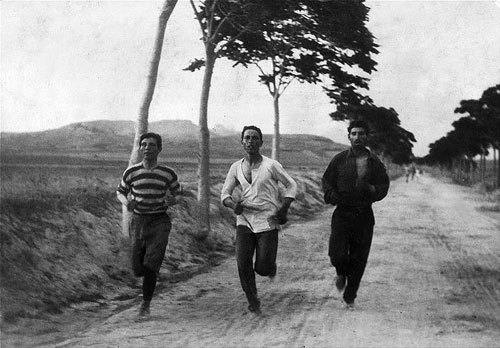
This was the second modern running of the marathon; the first was a pre-Olympic qualifying race held a month before. In the Olympic race, seventeen competitors started the race and only about half finished. The winning time was just under three hours and the third place finisher was disqualified for covering “part of the course by carriage”. I would also not be surprised if the three fellows in the photo above stopped off for a coffee and some painting along the way.
Based on Super Mario 3, this HTML5 Super Mario game goes on forever. Someone bet Billy Mitchell he can’t finish this game and we’ll never have to hear from him again! (via waxy)
If you’ve ever played Monopoly, you probably haven’t followed the rules. The Campaign for Real Monopoly (via marco) would like to remind you of the real rules and the reasons for sticking to them.
BUYING PROPERTY…Whenever you land on an unowned property you may buy that property from the Bank at its printed price. You receive the Title Deed card showing ownership; place it face up in front of you.
If you do not wish to buy the property, the Banker sells it at auction to the highest bidder. The buyer pays the Bank the amount of the bid in cash and receives the Title Deed card for that property. Any player, including the one who declined the option to buy it at the printed price, may bid. Bidding may start at any price.
Although, as Andy Baio notes, the rules of Monopoly weren’t always the rules of Monopoly.
Contrary to popular belief, Charles Darrow didn’t invent Monopoly in 1933 from scratch. It was heavily based on The Landlord’s Game, an innovative board game patented in 1904 by Lizzie Magie, to be a “practical demonstration of the present system of land-grabbing with all its usual outcomes and consequences.”
Using a modified iPhone and a fluorescing nanoparticle tattoo, researchers at Northeastern University have found a way to monitor chemicals in the blood without drawing blood.
The team begins by injecting a solution containing carefully chosen nanoparticles into the skin. This leaves no visible mark, but the nanoparticles will fluoresce when exposed to a target molecule, such as sodium or glucose. A modified iPhone then tracks changes in the level of fluorescence, which indicates the amount of sodium or glucose present. Clark presented this work at the BioMethods Boston conference at Harvard Medical School last week.
The tattoos were originally designed as a way around the finger-prick bloodletting that is the standard technique for measuring glucose levels in those with diabetes. But Clark says they could be used to track many things besides glucose and sodium, offering a simpler, less painful, and more accurate way for many people to track many important biomarkers.
These color photos taken of London during WWII’s Battle of Britain are great.

Alan Taylor recently covered the Battle of Britain over at In Focus as well…I love this “business as usual” photo.
Bushwacker is the top-rated bull in the US as determined by the Professional Bull Riders; he bucks riders off after an average of just under three seconds (eight seconds are needed for the rider to score points). The NY Times interviewed his trainer and some of his riders to find out why Bushwacker is so tough to ride.
Bushwacker short-hopped into the arena. Drool flew out of his mouth and whirled over Elliott’s head. Bushwacker bounded more than two feet into the air, kicked his hind legs up, and drove his front legs into the ground. Instead of waiting for his back legs to touch dirt, as most bulls do, he sprung off his front feet immediately.
This is Bushwacker’s signature move, and it is as effective in its offbeat athleticism as a point guard executing a crossover dribble to ditch a defender. Elliott came forward and lost the weight of his feet underneath him.
Possibly sensing the rider’s weight shift, Bushwacker staccato-hopped to the right. He accelerated into five successive spinning jumps. His tail whipped his own rump with emphatic snaps. Elliott flew to the right and hit the dirt. The clock showed 6.57 seconds.
Don’t miss watching the video inlined at the top of the page…Bushwacker is a total Ferdinand. And here’s video of the ride described in the passage above:
Russell Brand’s post about Amy Winehouse is a lovely tribute and a sobering reminder.
When you love someone who suffers from the disease of addiction you await the phone call. There will be a phone call. The sincere hope is that the call will be from the addict themselves, telling you they’ve had enough, that they’re ready to stop, ready to try something new. Of course though, you fear the other call, the sad nocturnal chime from a friend or relative telling you it’s too late, she’s gone.
Frustratingly it’s not a call you can ever make it must be received. It is impossible to intervene.
Could help but think of Wallace while reading this, particularly this bit:
All addicts, regardless of the substance or their social status share a consistent and obvious symptom; they’re not quite present when you talk to them. They communicate to you through a barely discernible but un-ignorable veil. Whether a homeless smack head troubling you for 50p for a cup of tea or a coked-up, pinstriped exec foaming off about his “speedboat” there is a toxic aura that prevents connection. They have about them the air of elsewhere, that they’re looking through you to somewhere else they’d rather be.
Recent analysis of some Viking bones suggests that women were a significant part of the Viking settlement of England around 900 A.D.
So, the study looked at 14 Viking burials from the era, definable by the Norse grave goods found with them and isotopes found in their bones that reveal their birthplace. The bones were sorted for telltale osteological signs of which gender they belonged to, rather than assuming that burial with a sword or knife denoted a male burial.
Overall, McLeod reports that six of the 14 burials were of women, seven were men, and one was indeterminable. Warlike grave goods may have misled earlier researchers about the gender of Viking invaders, the study suggests. At a mass burial site called Repton Woods, “(d)espite the remains of three swords being recovered from the site, all three burials that could be sexed osteologically were thought to be female, including one with a sword and shield,” says the study.
The most beautiful suicide orig. from Jul 16, 2008
* Q: Wha? A: These previously published entries have been updated with new information in the last 24 hours. You can find past updates here.
Corey Starliper believes he’s cracked the code of the 340-character cipher sent to the San Francisco Chronicle by the Zodiac Killer *and* that it identifies the killer.
Starliper split his work into two sessions of 6 hours and 3 hours. When he was done, he had decoded the following text:
KILL/SLF/DR/HELP/ME/KILL/MYSELF/GAS/CHAMBER/
AEIOUR/DAYS/QUESTIONSABLE/EVERYY/WAKING/
MOMENT/IM/ALIVE/MY/PRIDE/LOST/I/CANT/GO/ON/
LIVING/IN/THIS/WAY/KILLING/PEOPLE/I/HAV/KILLD/
SO/MANY/PEOPLE/CANT/HELP/MYSELF/IM/SO/
ANGRY/I/COULD/DO/MY/THING/IM/ALONE/IN/THIS/
WORLD/MY/WHOLE/LIFE/FUL/O/LIES/IM/UNABLE/
TO/STOP/BY/THE/TIME/YOU/SOLVE/THIS/I/WILL/
HAV/KILLD/ELEVEN/PEOPLE/PLEASE/HELP/ME/
STOP/KILLING/PEOPLE/PLEASE/MY/NAME/IS/
LEIGH/ALLEN/
Why are there 60 seconds in a minute and 60 minutes in an hour but 24 hours in a day?
Thanks to the ancient civilizations that defined and preserved the divisions of time, modern society still conceives of a day of 24 hours, an hour of 60 minutes and a minute of 60 seconds. Advances in the science of timekeeping, however, have changed how these units are defined. Seconds were once derived by dividing astronomical events into smaller parts, with the International System of Units (SI) at one time defining the second as a fraction of the mean solar day and later relating it to the tropical year. This changed in 1967, when the second was redefined as the duration of 9,192,631,770 energy transitions of the cesium atom. This recharacterization ushered in the era of atomic timekeeping and Coordinated Universal Time (UTC).
On the day before the 1996 US presidential election, the NY Times ran a crossword puzzle that correctly predicted the winner.

Click through to see how they did it.
From a NY Times article on how to disappear, a quick tip on how to effectively fake a fingerprint:
Are officials troubling you for fingerprints? “There’s a nongreasy glue, like a mucilage,” he said, that is more or less invisible once applied. “You put it on your thumb. You roll your thumb over your heel. Now, you’ve got a heel print on your thumb for no one who exists.”
Frank Ahearn, one of the people quoted in the article, actually runs a business that helps people disappear…or at least he used to, until he disappeared.
I’m sure a bunch of these iPhone autocorrected conversations are made-up, but I was still almost crying with laughter by the time I got to the end of the list.

Can rap be charming? Maybe so…Chris Sullivan set up in Union Square and beatboxed so that anyone who wanted to could come up and rap:
(via @dens)
This is a macro photo of…what do you think this is?

Click through to find out and see more macro photos from Caren Alpert.
Sesame Street characters, including Grover on the flute, perform the Beastie Boys’ Sure Shot.
(via devour)
A paper authored by Tatu Westling of Helsinki University explores the relationship between the GDP growth of countries and the penile length of their residents.
The size of male organ is found to have an inverse U-shaped relationship with the level of GDP in 1985. It can alone explain over 15% of the variation in GDP. The GDP maximizing size is around 13.5 centimetres, and a collapse in economic development is identified as the size of male organ exceeds 16 centimetres.
That “U-shaped” curve…it looks like something flaccid-ish, innit? (via @atenni)
Playgrounds built in the last 20 years may be safer and result in fewer lawsuits, but the kids who use them may be missing out on some critical emotional development.
“Children need to encounter risks and overcome fears on the playground,” said Ellen Sandseter, a professor of psychology at Queen Maud University in Norway. “I think monkey bars and tall slides are great. As playgrounds become more and more boring, these are some of the few features that still can give children thrilling experiences with heights and high speed.”
After observing children on playgrounds in Norway, England and Australia, Dr. Sandseter identified six categories of risky play: exploring heights, experiencing high speed, handling dangerous tools, being near dangerous elements (like water or fire), rough-and-tumble play (like wrestling), and wandering alone away from adult supervision. The most common is climbing heights.
“Climbing equipment needs to be high enough, or else it will be too boring in the long run,” Dr. Sandseter said. “Children approach thrills and risks in a progressive manner, and very few children would try to climb to the highest point for the first time they climb. The best thing is to let children encounter these challenges from an early age, and they will then progressively learn to master them through their play over the years.”
(via @tcarmody)
Seven-minute video of 12,000 screenshots of the front page of the NY Times website taken over a period of several months by “an errant cron task”.
From Sady Doyle, an alternate history of the Harry Potter series if Rowling would have written the books from the perspective of Hermione Granger.
So, before she goes away for good, let us sing the praises of Hermione. A generation could not have asked for a better role model. Looking back over the series — from Hermione Granger and the Philosopher’s Stone through to Hermione Granger and the Deathly Hallows — the startling thing about it is how original it is. It’s what inspires your respect for Rowling: She could only have written the Hermione Granger by refusing to take the easy way out.
For starters, she gave us a female lead. As difficult as it is to imagine, Rowling was pressured to revise her initial drafts to make the lead wizard male. “More universal,” they said. “Nobody’s going to follow a female character for 4,000 pages,” they said. “Girls don’t buy books,” they said, “and boys won’t buy books about them.” But Rowling proved them wrong. She was even asked to hide her own gender, and to publish her books under a pen name, so that children wouldn’t run screaming at the thought of reading something by a lady. But Joanne Rowling never bowed to the forces of crass commercialism. She will forever be “Joanne Rowling,” and the Hermione Granger series will always be Hermione’s show.
In this interview with Francis Lam, Grant Achatz drops some clues as to what the menu at Next might look like in the near future:
Chef Dave is really inspired by a children’s book right now, and our next menu can be entirely built on that. Or we can be an exact replica of another time and place. One menu might be from my memory: My first day at The French Laundry. It comes down to trying to be expressive. You can be expressive with a plate of food, or with the whole concept of a restaurant.
Another menu we’re planning is El Bulli. One course from each year from 1983 to 2003. I’d work with Ferran [Adria] to choose the dishes that he feels are his most significant; I’d need to get him on board with that.
That El Bulli menu? Fucking crazytown. And this is the third or fourth time I’ve heard about the “first day at The French Laundry” menu and every single time my mouth starts watering and my hand reaches for my wallet. (via @kathrynyu)
Not content to knock-off simple iPhones and iPads, some enterprising Chinese have built an entire fake Apple Store in Kunming, China. It’s an actual store selling actual products but is obviously not affiliated with Apple in any way.

Being the curious types that we are, we struck up some conversation with these salespeople who, hand to God, all genuinely think they work for Apple.
Even if it’s fake, it’s real. (via stellar)
And as usual, the definitive review of any new version of OS X is John Siracusa’s for Ars Technica. This time around, it runs 19 pages. If that’s not to your liking, you can just download Lion right now from the Mac App Store for $30.
Two other misc Apple thoughts: 1) They appear to have discontinued the MacBook. There are Airs and Pros but no plain-old MacBooks. 2) Apple Inc, already among the largest companies in the world in terms of market cap, announced yesterday that the company’s “revenue [is] up 82 percent and profits [are] up 125 percent” over the same quarter last year. That level of growth in such a big company…that’s just astounding. And much of the revenue and profit are from products that didn’t exist even five years ago…the iPad alone was a ~$5 billion business in Q3 (for comparison, Google had $9 billion in total revenues in Q2). If that’s not unprecedented, it’s damn close.
There are only a few images, but even this brief look at a mid-70s NASA graphic standards manual is tantalizing.

(via stellar)
Aaron Swartz indicted on charges of “wire fraud, computer fraud” etc. orig. from Jul 19, 2011
* Q: Wha? A: These previously published entries have been updated with new information in the last 24 hours. You can find past updates here.
Swartz is known around these parts for being a programmer, long-time blogger, early employee of Reddit, and legal enthusiast. Nick Bilton, writing for the NY Times Bits blog:
Aaron Swartz, a 24-year-old programmer and online political activist, was indicted Tuesday in Boston on charges that he stole over four million documents from the Massachusetts Institute of Technology and JSTOR, an archive of scientific journals and academic papers. (Read the full indictment.)
The charges were filed by the United States Attorney for the District of Massachusetts, Carmen M. Ortiz, and could result in up to 35 years in prison and a $1 million fine.
In a press release, Ms. Ortiz’s office said that Mr. Swartz broke into a restricted area of M.I.T. and entered a computer wiring closet. Mr. Swartz apparently then accessed the M.I.T. computer network and stole millions of documents from JSTOR.
The full indictment is here (PDF, via @delfuego). Non-PDF version is here. The whole thing is worth a read for the technical detail of how the “hack” was allegedly perpetrated:
26. This time around, Swartz circumvented MIT’s guest registration process altogether when he connected to MIT’s computer network. By this point, Swartz was familiar with the IP addresses available to be assigned at the switch in the restricted network interface closet in the basement of MIT’s Building 16. Swartz simply hard-wired into the network and assigned himself two IP addresses. He hid the Acer laptop and a succession of external storage drives under a box in the closet, so that they would not be obvious to anyone who might enter the closet. January 4 through 6, 2011
27. On January 4, 2011, Aaron Swartz was observed entering the restricted basement network wiring closet to replace an external hard drive attached to his computer.
28 On January 6, 2011, Swartz returned to the wiring closet to remove his computer equipment. This time he attempted to evade identification at the entrance to the restricted area. As Swartz entered the wiring closet, he held his bicycle helmet like a mask to shield his face, looking through ventilation holes in the helmet. Swartz then removed his computer equipment from the closet, put it in his backpack, and left, again masking his face with the bicycle helmet before peering through a crack in the double doors and cautiously stepping out.
Here’s a statement from Demand Progress, an organization founded by Swartz, about the case (via @aaronsw). This is a very different take from the indictment.
Moments ago, Aaron Swartz, former executive director and founder of Demand Progress, was indicted by the US government. As best as we can tell, he is being charged with allegedly downloading too many scholarly journal articles from the Web. The government contends that downloading said articles is actually felony computer hacking and should be punished with time in prison.
“This makes no sense,” said Demand Progress Executive Director David Segal; “it’s like trying to put someone in jail for allegedly checking too many books out of the library.”
“It’s even more strange because the alleged victim has settled any claims against Aaron, explained they’ve suffered no loss or damage, and asked the government not to prosecute,” Segal added.
James Jacobs, the Government Documents Librarian at Stanford University, also denounced the arrest: “Aaron’s prosecution undermines academic inquiry and democratic principles,” Jacobs said. “It’s incredible that the government would try to lock someone up for allegedly looking up articles at a library.”
JSTOR, the document storage service allegedly accessed by Swartz, released a statement on the case (via @delfuego):
Last fall and winter, JSTOR experienced a significant misuse of our database. A substantial portion of our publisher partners’ content was downloaded in an unauthorized fashion using the network at the Massachusetts Institute of Technology, one of our participating institutions. The content taken was systematically downloaded using an approach designed to avoid detection by our monitoring systems.
The downloaded content included over 4 million articles, book reviews, and other content from our publisher partner’s academic journals and other publications; it did not include any personally identifying information about JSTOR users.
We stopped this downloading activity, and the individual responsible, Mr. Swartz, was identified. We secured from Mr. Swartz the content that was taken, and received confirmation that the content was not and would not be used, copied, transferred, or distributed.
The criminal investigation and today’s indictment of Mr. Swartz has been directed by the United States Attorney’s Office.
As for what Swartz was planning to do with all these documents, it’s not difficult to guess…he’s done something like this before (this isn’t actually a very good guess…see the update below):
Those courts, with the help of the Government Printing Office, had opened a free trial of Pacer at 17 libraries around the country. Mr. Malamud urged fellow activists to go to those libraries, download as many court documents as they could, and send them to him for republication on the Web, where Google could get to them.
Aaron Swartz, a 22-year-old Stanford dropout and entrepreneur who read Mr. Malamud’s appeal, managed to download an estimated 20 percent of the entire database: 19,856,160 pages of text.
Then on Sept. 29, all of the free servers stopped serving. The government, it turns out, was not pleased.
A notice went out from the Government Printing Office that the free Pacer pilot program was suspended, “pending an evaluation.” A couple of weeks later, a Government Printing Office official, Richard G. Davis, told librarians that “the security of the Pacer service was compromised. The F.B.I. is conducting an investigation.”
Lawyers for Mr. Malamud and Mr. Swartz told them that they appeared to have broken no laws, noting nonetheless that it was impossible to say what angry government officials might do.
Twice bitten, indictment? Is that how the saying goes?
Update: This is a more accurate guess as to what Swartz wanted with the JSTOR documents: analyse the documents as part of his on-going work with “the corrupting influence of big money on institutions”…and *not* to free non-copyrighted information from an inefficient gatekeeper as with the PACER data. From the front page of his web site.
He is the author of numerous articles on a variety of topics, especially the corrupting influence of big money on institutions including nonprofits, the media, politics, and public opinion. In conjunction with Shireen Barday, he downloaded and analyzed 441,170 law review articles to determine the source of their funding; the results were published in the Stanford Law Review. From 2010-11, he researched these topics as a Fellow at the Harvard Ethics Center Lab on Institutional Corruption.
The Stanford Law Review article is available here.
Paul Ford compares the neverending stories told to us by ourselves on Facebook, blogs, Twitter, etc. with the machinery of old media, which Ford calls The Epiphanator, a vast media contraption which excels at drawing conclusions.
And how do the Whole Earth heirs of Silicon Valley stand today compared to their financially bereft Epiphonatorian counterparts? Apple couldn’t get much bigger without selling oil, while the media industry has been reduced to dime-size buttons that show up on iPhone screens. Google regularly announces initiatives to “save” the newspaper and book industries — like a modern-day hunter who proclaims himself a conservationist. And Facebook, having already swallowed up enormous chunks of discretionary media consumption time, has its old-school media counterparts chasing after “Likes” as if they were cocaine being dispensed in a lab rat’s cage.
Also, Franzendentalist!
This scene from iCarly, a Nickelodeon show for tweens and pre-tweens, references the scene in season five of The Wire where (highlight text to show spoilers!) Michael kills Snoop.
(via @aliotsy)
The Onion’s A.V. Club takes a field trip to see the Harlem house where the exteriors (and many of the interiors) were shot for The Royal Tenenbaums.
(via devour)
I feel like I’ve heard this before, but in the early days of Google, Sergey Brin ended his job interviews in an unusual manner.
Finally, he leaned forward and fired his best shot, what he came to call “the hard question.”
“I’m going to give you five minutes,” he told me. “When I come back, I want you to explain to me something complicated that I don’t already know.” He then rolled out of the room toward the snack area. I looked at Cindy. “He’s very curious about everything,” she told me. “You can talk about a hobby, something technical, whatever you want. Just make sure it’s something you really understand well.”
I wonder if Mark Zuckerberg asks similar sorts of questions on his walks in the woods.
I’ve seen other more formal on-stage performances by these amazing French twin dancers, but I like this one the best…even fooling around, their precision is impressive.

Socials & More