Big thanks to this week’s RSS sponsor, Clutterpad, an feature-rich online project management and collaboration tool. They offer plans for individual users working on one project (which are free, BTW), small organizations with dozens of projects, or corporations with thousands of projects. Clutterpad’s feature set includes calendars, to-do lists, chat rooms, in-app messaging, time tracking, and file upload/download. Get started with a one-month free trial today.
6. Visualization. Where will I wear this dress? Who will be there? Will I wear it once, or over and over again? Will I blog it?
7. Shoes. Which ones? Do I already own them? Would this dress require shoes that do not, in fact, actually exist? (E.g., every pair of boots I’ve ever wanted.) Do I have a pair of shoes in a weird color that I need to make a dress to match? Am I looking for an excuse to buy a new pair of shoes in a weird color? (Lather, rinse, repeat for “Coat” and “Bag”.)
McKean is perhaps better known as a lexicographer…I like her McKean’s Law:
Any correction of the speech or writing of others will contain at least one grammatical, spelling, or typographical error.
In an attempt to eliminate Manhattan’s travel inefficiencies and encourage more use of public transportation, Charles Komanoff spent three years creating an Excel spreadsheet (you can download it here) that details “the economic and environmental impact of every single car, bus, truck, taxi, train, subway, bicycle, and pedestrian moving around New York City”. Based on that research, he’s come up with a plan for changing how transportation is paid for in Manhattan below 60th St. (the CBD or central business district).
It would charge $3 to cars entering the CBD on weekday nights, $6 for most of the day, and $9 during rush hour. The subway fare also varies, but is always less than the $2.25 it is today: $1 at night, rising to $1.50 as day breaks, and peaking at $2 during weekday rush hours. Buses are always free, because the time saved when passengers aren’t fumbling for change more than makes up for the lost fare revenue. Komanoff’s plan also imposes a 33 percent surcharge on every taxi ride, 10 percent of which would go to the cab driver and the rest to the city.
Komanoff’s plan is vastly more sophisticated than a simple bridge toll. Instead of merely punishing drivers, he has built a delicate system of incentives and revenue streams. Just as a musical fugue weaves several melodic lines into a complex yet harmonious whole, Komanoff’s policy assembles all the various modes of transportation into a coherent, integrated traffic system.
To go along with James Fallows’ 1982 report on personal computing, a 1981 TV report about reading newspapers online.
It takes over two hours to recieve the entire text of the newspaper over the phone and with an hourly use charge of five dollars, the new telepaper won’t be much competition for the 20-cent street edition.
The report was done back in the days when “Owns Home Computer” was a useful differentiating label.
The new subway map makes Manhattan even bigger, reduces Staten Island and continues to buck the trend of the angular maps once used here and still preferred in many other major cities. Detailed information on bus connections that was added in 1998 has been considerably shortened.
Manhattan will be shown on the map as nearly twice as wide as in real life. Cut back on the chili-cheese fries, my friend!
FreshDirect is an online grocery store that delivers in the NYC area. I needed to do an order this morning, so I downloaded their iPhone app on my iPad and discovered that grocery shopping is one of those things that the iPad is *perfect* for (an it would be more perfect with a native iPad app). You just take the thing into the kitchen with you, rummage through the cabinets & fridge, and add what you need to your FD shopping cart. Then you take the it with you around the rest of the house (the bathroom, the garage, the pantry in the basement) adding needed supplies as you go. It inverts the usual “wander around the grocery store searching for items” shopping practice; instead you wander about the house looking for what you need.
Obviously the iPhone would work for this as well, but a tablet-sized device is generally better at these sorts of tasks: activities where your attention is shifted back and forth between the screen and something else (or shared between two people). The iPhone is a greedy little thing; it’s better for tasks that require your full attention on the screen.
I’ve got to do something about my desk. This is where most of my crimes against focus occur. There are so many temptations. So many needs to fulfil. Snacks, cups of water, caffeine, curiosity about what Julie’s doing. I pop up from my desk once every five minutes.
I decide to engage in some light bondage. I once read about how Odysseus demanded his sailors tie him to the mast so he wouldn’t take a swan dive off the starboard side when he heard the alluring singing of the Sirens. So, in an homage, I’ve tied myself to the chair in front of my computer with a long extension cord. It feels safe, like a seat belt.
This James Fallows article from the July 1982 issue of The Atlantic Monthly is a wonderful technological time capsule. Fallows purchased a PC early in the 80s for use as a word processor.
For a while, I was a little worried about what they would come up with, especially after my father-in-law called to ask how important it was that I be able to use both upper- and lower-case letters. But finally, for a total of about $4,000, Optek gave me the machinery I have used happily to this day.
In the early days of personal computing, there were many competing machines, processors, operating systems manufactured by a number of companies. The PC Fallows bought was a crazy-quilt of a machine — the monitor was made by Ball Corporation (the canning supplies company) and the printer was a converted IBM Selectric typewriter — and was soon obsolete.
If I had guessed right, my brand, the Processor Technology SOL, would have caught on, and today I’d have the equivalent of a Mercedes-Benz instead of a Hupmobile. I’d be able to buy new programs at the computer store, and I’d be able to plug in to all the over-the-phone services. But I guessed wrong, and I’m left with a specimen of an extinct breed. When I need new programs, I try to write them myself, and when I have a breakdown, I call the neighborhood craftsman, Leland Mull, who lovingly tends the dwindling local population of SOL-20s.
Keep a food diary not of what you eat but what you experience. She says, “There’s a pretty big difference between eating and tasting.”
What she means is considering and taking note of the entire experience of tasting: The way the food feels in your mouth, what your beer smells like cold and if it’s different when it’s lukewarm, what you notice with the first piping-hot bite of sauce compared with the last chilled streaks you scrape up before the server takes the plate. Do you feel one sensation more than others as you chew, a citrusy tingle at first, followed by rush of sweet?
Affix Velcro to the back of your iPad and you’ve got yourself a dashboard GPS map, a TV on the ceiling, an on-stove cooking guide, or a digital picture in your front hallway.
The US Air Force, Pratt & Whitney, and Boeing are jointly developing a hypersonic aircraft that can travel faster than existing cruise missiles. It’s powered by a crazy-sounding “air-breathing hypersonic engine that has virtually no moving parts” and reached a speed of 3500 mph in a recent test.
“This is truly transformational technology,” Brink said. “This engine can be considered the next step in aviation. It’s as big of leap as it was when we went from propellers to jet engines.”
Composition with JavaScript is a Piet Mondrian painting with moveable lines and changeable colors so that you can make your own version.
Composition with Javascript is an interactive work made using HTML, CSS, Javascript and jQuery, based on Piet Mondrian’s “Composition with Yellow, Red, Black, Blue and Grey” (1920). It allows everybody deconstruct the original painting and form it again in whatever he or she wants. Lines are shiftable (just drag it with your mouse) and colours changeable (click on it). Texture of the painting was preserved for authentic look. One can play with composition, forms and colours, alter the harmony of the piece or even destroy it and compose something pictorial.
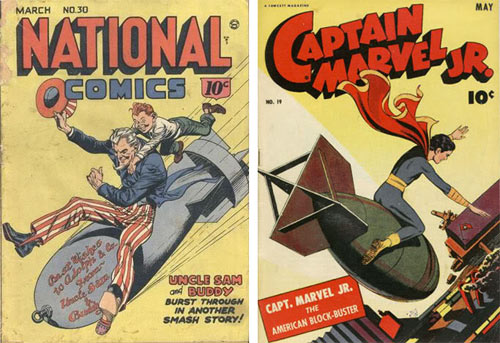
Slim Pickens riding a nuclear bomb out of the bay doors of his B-52 Bomber in Dr. Strangelove is an iconic cinematic scene. But the imagery of people riding on bombs has been used on comic book covers since the early 1940s:
That’s some mighty Pickensian hat wavin’ by Uncle Sam. (via oobject)
The Truman Show delusion is how some psychiatrists are describing the condition of psychotic patients who believe they are filmed stars of reality TV programs.
Another patient traveled to New York City and showed up at a federal building in downtown Manhattan seeking asylum so he could get off his reality show, Dr. Gold said. The patient reported that he also came to New York to see if the Twin Towers were still standing, because he believed that seeing their destruction on Sept. 11 on television was part of his reality show. If they were still standing, he said, then he would know that the terrorist attack was all part of the script.
As for the movie itself, for all its popularity and critical success when released, it’s little-remembered today. And unfairly so; the “realness” about our increasingly mediated lives remains a hot topic of debate.
BankSimple sounds promising…I hope they are able to deliver.
BankSimple is an easy, intuitive, and social bank for people who appreciate simple online services. Unlike other banks, we don’t trap you with confusing products nor do we charge any hidden fees. No overdraft fees. We use sophisticated analytics to help you better manage your finances by providing you an individualized service, catered to your needs and goals.
It’s a return to how banks used to make money before they started charging fees for everything: charge more for borrowing than you pay out in savings interest. From the BankSimple FAQ:
We make money from two sources: interchange and interest margin. Interest margin is the revenue earned from lending, less what they pay on deposits. For example a bank may charge a customer 12% to borrow money, but pay 5% interest on a savings account. The difference, less any defaults on the loan, is revenue to the bank. Interchange is a small revenue source that card issuing banks earn whenever that card is used at a store. Typically banks earn less than 1% for each time the card is used to make a purchase. These are both great revenue streams, but banks got greedy and started charging additional fees to bolster their revenue. Our operation is low cost, so we don’t need to rely on extraneous fee revenue.
Early Twitter employee Alex Payne recently left to co-found BankSimple. See also Square (which was also co-founded by a Twitter alum).
There’s lots of good stuff in this long James Fallows article about Google’s now-intense interest in the health of journalism. In short, Google feels obligated from a business perspective to help serious news organizations put good information online so that people can find it through Google.
There really is no single cause,” I was told by Josh Cohen, a former Web-news manager for Reuters who now directs Google’s dealings with publishers and broadcasters, at his office in New York. “Rather, you could pick any single cause, and that on its own would be enough to explain the problems-except it’s not on its own.” The most obvious cause is that classified advertising, traditionally 30 to 40 percent of a newspaper’s total revenue, is disappearing in a rush to online sites. “There are a lot of people in the business who think that in the not-too-distant future, the classified share of a paper’s revenue will go to zero,” Cohen said. “Stop right there. In any business, if you lose a third of your revenue, you’re going to be in serious trouble.”
The Style Rookie gets ahold of a bunch of old issues of Sassy and scans in a couple dozen pages, including a fashion layout featuring Sassy intern Chloë Sevigny.
Sassy seems to be one of those rare magazines that is dearly missed but doesn’t really have a modern day analogue. (See also Might and Spy.)
I’ve recently noticed Twitter’s search is finding keyword matches in shortened URLs. So if http://kottke.org/tag/Pixar is hidden behind something like http://bit.ly/r3H8Aq in a tweet, a search for “pixar” will pick it up. Which means that Twitter is unpacking shortened URLs. Which means that they could be displaying original URLs in their interface and pushing them out via the API for use in third-party Twitter apps. URL shorteners still suck, so how about it guys? Or are you not really interested in the long-term health and value of your service? (This will probably never happen, BTW. Twitter and bit.ly are partners and share investors. Plus, people are using shorteners for click tracking and whatnot so we’re likely stuck with them. But I still believe that outsourcing the long-term viability of your URLs in exchange for a little bit of information is a devilish deal.)
Here’s the entire text of a talk given at math, magic, and puzzle gathering (attendees included Stephen Wolfram and John Horton “Game of Life” Conway) by Gary Foshee:
I have two children. One is a boy born on a Tuesday. What is the probability I have two boys?
The first thing you think is “What has Tuesday got to do with it?” Well, it has everything to do with it.
The key word in the puzzle is “probability”, which is not a very well understood term outside of the mathematics community. The full answer is at the end of the article.
I am glad that someone compiled a list of all of the unanswered questions that the Lost producers/writers left when the show ended.
I don’t really care about the answers to most of these but watching it irritates me that they jerked us around with the Dharma/Others/Walt/4-toed statue crap when it didn’t matter at all. Oh, and the fucking numbers and the whole ARG thing. “All of this matters”, Jack? Uh, no.
Mr. Marzovilla welcomes young children at his restaurant, even discounts their meals on Sunday evenings, and is not above serving a simple appetizer portion of pasta to please little ones. But he has strong opinions about food, and about the messages parents convey to their offspring through what they eat. Children’s menus aim too low, he argues — they’re a parenting crutch.
That maps post snuck out this morning before I could properly thank Aaron Cohen for for his exemplary handling of kottke.org for the past week++. From what I hear, many of you enjoyed his time here and I’m hoping he’ll join us again soon. I’m looking forward to catching up on what he posted.
While I’m thinking about it, I’d like to acknowledge my pals at Buzzfeed for their continued behind-the-scenes support of kottke.org. I’ve been working out of their Chinatown office for several years; having a desk outside the house makes all the difference for this sole proprietor. They just moved into new offices in Soho (within walking distance of my house!); I haven’t been there yet and am looking forward to checking them out today.
5. Google Earth. Google Earth presents a world in which the area of most concern to you (in this instance, Avebury in Wiltshire) can be at the centre, and which - with mapped content overlaid - can contain whatever you think is important. Almost for the first time, the ability to create an accurate map has been placed in the hands of everyone, and it has transformed the way we view the world.
Mark Twain’s will stipulated that his autobiography remain unpublished for 100 years after his death, the 100th anniversary of which was April 21st. In November, the University of California Press will release the first volume of what’s anticipated to be a rip roaring good time.
Although parts of the autobiography have appeared in previous biographies of the author, Hirst said that over half of it had never been published before. Running to half a million words, the trilogy of books will cover Twain’s relationship with his secretary Isabel van Kleek Lyon, his religious doubts and his criticisms of Theodore Roosevelt.
One of the vehicles involved in a deadly car crash in Minnesota today was a truck carrying bees. First responders to the scene faced what was described as a “big black cloud” of bees. Firefighters were spraying the trucks with hoses to subdue the bees because they don’t fly in the rain (the bees, not the trucks). I can only imagine a few things worse than this, one of which is an accident involving a truck full of sharks.
The truck that crashed carried upwards of 17 million bees; each of the trucks carried 700 hives, with about 25,000 bees per hive, said Dale Bauer of Bauer Honey Inc. of Fertile, Minn. The bees were being shipped to North Dakota after spending the winter in Mississippi. There was no immediate estimate of how many of the bees escaped.
Last week, Mike Davidson put up a post about Apple discussing the idea that having a ruthless company making great products is a good problem to have (compared to a ruthless company making so-so products). It got picked up by DF, but I flagged it in my RSS because of a section close to the bottom. I haven’t seen this theory about Apple discussed before.
What’s the best way to avoid becoming a monopoly? Make sure you never get close to 100% market share. What’s the best way to temper your market share? Keep prices a bit higher than you could. Keep supply a bit lower than you could. Keep investing in high margin differentiation and not low margin ubiquity…They are fighting hard right now to make sure they are one of the two or three that will continue to be relevant in 5-10 years, but their goal is clearly not to be at 100% or even 90%…It’s scary to people because they remember the harm other companies have done when they reached monopoly status, but with Google, Microsoft, Nokia, RIMM, and now HP all keeping the market healthy with different alternatives, there is no excuse for not voting with your feet if you’re unhappy. Apple’s not going to take over the world because — if for no other reason — the laws of the United States won’t let them.
Via its blog, Twitter has just announced that it is banning third-party ad networks from using the Twitter API to insert ads into a user’s stream.
“Why are we prohibiting these kinds of ads? First, third party ad networks are not necessarily looking to preserve the unique user experience Twitter has created. They may optimize for either market share or short-term revenue at the expense of the long-term health of the Twitter platform. For example, a third party ad network may seek to maximize ad impressions and click through rates even if it leads to a net decrease in Twitter use due to user dissatisfaction.
The Metheny vs Kenny G post from the other day reminded me of my OTHER favorite piece of music history on the internet: yelling at his band. I think rant #3 is my favorite, followed closely by rant #2. Click through for audio AND transcripts, but be warned the audio is entirely NSFW unless you work in a place where angry drummers cussing out trombonists and bass players is appropriate. Then it’s completely SFW.
If you’ve ever wanted to live in a rolling house that doesn’t take up much space and even has space on the outside for advertising, get thee to the U of Karlsruhe (non-German link here).
This cyclindrical design is a modular protype that provides flexible space within a minimum housing unit. Three different sections are dedicated to different functional needs: there’s a bed and table in section, an exercise cylinder, and a kitchen with a sink.
Think about the following platforms and when the first traditional media activity/participation occurred in that platform’s history: Friendster, MySpace, Facebook, Twitter, Tumblr, Foursquare, Chatroulette. It was a shorter and shorter period for each platform.*
Let’s call this the adoption half-life. It’s a bastardization of Moore’s Law, but the level of adoption required for a social platform to be covered as The Next Big Thing in social platforms will continue to decrease until NBT status is bestowed upon a platform used only by those in the media.
I’d been writing a post about this that wasn’t coming out the way I wanted, so I shelved it until I saw The Onion’s take on last fall’s New York Times’ take on Foursquare. Then I decided to jam 2 posts together.
The Onion sums this all up way more succinctly:
Aging, scared newspapermen throw themselves at the latest mobile technology trend in a humiliatingly futile attempt to remain relevant.
For his part, Foursquare founder, Dennis Crowley, had this to say:
Um, The Onion poking fun of @foursquare (and me). This is the greatest moment of my entire life.
*If someone has a LexisNexis account and can find the first mention of these platforms, I’d be grateful, but since this is the internet, I don’t need sources, mirite?
I get giddy around big television events. The Lost finale this weekend certainly qualifies and a big question is, “Will fans of the show be satisfied with how it ends?” From Seinfeld to the Sopranos (for different reasons), series finales have a history of being disappointing. In this way, it’s almost easier when a show is canceled because then we get to blame the network as opposed to the writers. That said, I want to be satisfied Sunday. LOTS of other people are talking about Lost this week. Here’s what some of them are saying:
I’m ready for the final chapter, ready to see how it sums up the season and brings the series to a close. I’m ready to watch meaning (which, to be clear, is different than answers)… But will the meaning leave us in despair, or take us into happily ever after?
What makes Lost so special is that it never spelled things out for us the way a normal TV show does. It defies formula in a medium that regularly rewards it. Lost asked us to get lost within the show and to be satisfied with being lost for most of its run. TV almost never operates that way.
The show had one good season, its first. It was very, very good …but none of the seasons since have approached that level, and the current sixth season, rushed, muddled and dull, has been the weakest.
To me, some of the trick of Lost has been that some things are important and some things aren’t…And that doesn’t bother me at all, because that’s part of constructing a convincing universe.
I’m not saying there aren’t major mysteries of Lost that I don’t want solved…But I’ve accepted at this point that the running tally of questions I’ve had about the show will likely never be answered…I don’t want them to be. Why? Because the answers would probably suck.
Or perhaps the message will be that we should all find meaning in one another, instead of in some mystical riddle. (A swipe at religion? An affirmation of personal agency? A meta-critique of fans who take the show waaaay too seriously?)
It’s all going to come down to this: is this a story about fate or choice? All along, many clues left us thinking it was a matter of fate: the numbers, the crazy mainland connections, Jacob’s touch…
The show really had a lot of ground to cover this season in order to satisfy its loyal fans, but I think we all knew deep down that we’d never really know everything. Still, we were thrown several bones of juicy Island lure…
If you think of Lost as being one big novel…then the stuff that happened in Chapter Five ought to be meaningful in the final chapter. There ought to be a sense that everything was leading towards this ending…
Nothing that was key in the early seasons…is even in play. Even the ambiguities of “Across the Sea” now seem like attempts to shade the battle between mustache-twirling, murderous Smokey and his limp, Jesus-y antagonist.
And now we see that the writers have saved the explanation of the sideways universe for the finale. Even with all that extra time to play with, that seems like an awful lot to squeeze into the finale…I still find myself oddly trusting that they know what they’re doing with this finale.
Did their deaths have meaning or were they just more victims of the seemingly endless battle between the Man in Black/Smockey and Jacob? This episode started the process of claiming that their deaths did indeed have meaning…
For a drama that traffics in philosophy, religious allegory, physics, and literary references from Jane Austen to Kurt Vonnegut, “Lost” has a decidedly B-movie feel. After the remarkably cinematic 2004 pilot episode, set immediately after the Oceanic 815 plane crash, the adventure has been pretty schlocky.
With only two and a half hours to go, there’s simply no way for the show to answer every lingering mystery still up for discussion. I’m not entirely sure that’s a bug as a much as a feature.
If we give the writers a little grace and extend some patience, the suspense leading up to the finale of this television show could teach us something about faith in general.
We propped up the show with our eyeballs, our blog posts, our participation in those agonizing summertime internet Easter egg hunts. They created the whole thing, out of nothing…Let them end it their way.
For years series were canceled and disappeared without ceremony, but nowadays…it is more usual to aim for some sort of closure. (Just as it’s become more common, in life, to think we need it.)
If we were to do a poll on which of the three retiring shows will have the longest and strongest afterlife, I’d bet the winner would be “Lost.” Of course, the poll would be conducted on the Internet, which is sagging under the load of commentary…
Fates will be decided, questions will be answered, and one of TV’s greatest series…will come to its conclusion. Not since The Fugitive, one suspects, has a series finale been greeted with such anticipation, and such dread.
This MetaFilter thread from Wednesday/Thursday is a gripping/crazy/thrilling real-time look at an internet community coming together to prevent two Russian women from getting trafficked into a likely life of unpaid prostitution. It’s impossible to describe appropriately and I suggest you read through all the way. THIS is why they made the internet.
On Wednesday afternoon, a friend of one of the women (himself in the process of driving from Wyoming to LA) posted a message to MetaFilter asking for help. The women started in DC and took a bus to New York where they were supposed to get hostessing jobs at a bar on Coney Island. By the time the two women got on the bus, they were refusing to communicate with their friend anymore, but luckily took a call from another community member who convinced them to party with her instead. Just wow.
Update:: Some more details about the woman that convinced the girls not to go to the club. MeFi members have sent $3,500 to her to help the women. (via @ryansholin)
I just read J.D. Salinger’s Franny and Zooey, and in discussing it, I got to wondering about the pronunciation of Zooey. I couldn’t find any record of Salinger discussing the pronunciation, so no one really knows how it’s supposed to sound. This Live Journal post has a few comments from people certain it rhymes with showy. It also has a few comments from people certain it rhymes with dewy. MetaFilter was also non-conclusive. Is it possible the internet doesn’t know?
Actress Zooey Deschanel is named after the book title, but pronounces her name Zoe. However, when asked about Salinger’s pronunciation, Deschanel said “I don’t really care what Salinger says about my name. It’s my name.” So let’s take her with a grain of salt.
For my money, I’m going with Zooey as in Zoo-y. If you want an analytical reason why, I’ll go with doubting the meticulous Salinger would have used the word “Phooey” in the book if the pronunciation was Zoe. If you find certain evidence otherwise, let me know.
Comments for this thread are open for a bit. I swear you guys, I’m going to be moderating, and if there’s any trouble, I’ll turn this comment section right around.
Update:
Via Jeremy Stahl in the comments, a disappointing end to the argument.
Changes in regulations governing school vending machines by states like New York and California are making healthy options more prominent. This is a good thing.
This spring the Alliance for a Healthier Generation reported an 88 percent decrease in beverage calories shipped to schools from the first half of 2004-05 to 2009-10, mostly due to calorie reformulations and reduced container sizes.
Please go to Google.com. The Pac Man homage logo is a playable version of Pac Man. PLAYABLE! Hitting “Insert Coin” lets you play…another game. Holy crap. I think this is why they made the internet.
I couldn’t tell exactly what I loved about that skateboarding video the other night, but I figured out it reminded me of the Danny MacAskill video from last year that you really should have seen by now. I went fruitlessly looking for a bike video that might have the same feeling and then this showed up in my feed this morning and I figured it could be what takes you through the night (play your favorite song while watching).
I’ve watched it 3 times and I still can’t figure out how those left turns into our face work.
A new Hubble discovery was announced today and it’s not for the faint of heart. At least, that is, if you care deeply about mysterious exoplanets 600 light years away.
WASP-12b is orbiting a sun-like yellow dwarf star 600 light-years away and it has such a tight orbit (of only 1.1 days) that it is being roasted to nearly 2,800 degrees Fahrenheit. This superheated state has caused the doomed exoplanet to puff up to nearly twice the size of Jupiter.
WASP-12b is in trouble and there’s no Willis/Affleck/Bay mission planned to save it. That said, it’s going to take about another 10 million years for WASP-12b to be totally eaten, so it has time to cross a few things off its bucket list.
Today’s entry in the A.V. Club’s Gateways to Geekery series is Spaghetti Westerns. Want to get into Spaghetti Westerns, but feeling a little sheepish (If God didn’t want them sheared, he wouldn’t have made them sheep) about not knowing where to start? Gateways to Geekery suggests A Fistful of Dollars.
It’s an adaptation of Akira Kurosawa’s cynical samurai masterpiece Yojimbo, which was itself inspired by Dashiell Hammett’s noir classic Red Harvest. And thus, an American TV actor became a movie star playing a cowboy for an Italian director working in Spain looking to a Japanese interpretation of an American crime novel for inspiration. It really is a small world after all, or at least a world pop culture helped make smaller.
You might also be interested in the Gateways to Geekery take on David Foster Wallace.
Earlier this week at the Garrett Coliseum in Montgomery, Alabama, there was a successful test to inflate the world’s largest inflatable airship. It worked! Click the link to watch a video of the giant blimp being inflated. For my money, I’d like the biggest airship in the world to be able to carry more than 2,000 pounds, but I know practically nothing about current airship technology.
PS, if you’re in the area, the Garrett Coliseum is having a Quarter Horse Show this weekend.
Update:Sean sent in an email to help explain the 2K payload of the Bullet 580. To start, the Bullet 580 is a blimp, as opposed to rigid airships like the Graf Zeppelin and the Hindenburg (which could carry about 550K pounds). Further, “The 2,000 lb lifting capacity mentioned is the E-Green 580’s lifting capacity at 20,000 feet. The lifting capacity of the E-Green 580 at 2,500 feet, the normal operating altitude for most blimp activities, is 15,000 lbs.”
Pat Metheny really hates Kenny G. Maybe you’re thinking to yourself, “I don’t like either of those fellows, why would I care about this?” And then you’ll click through and you’ll see why I think you should care. It’s a 15 paragraph character destruction that, since it’s now on the web, must be considered one of the top flames of all time. If you didn’t think it was possible to gut someone with words, click through. If I were to pull out a quote for you, it’d be from the 9th paragraph, but it uses some words I’m not sure I’m allowed to use. Actually, I probably am allowed, but they’re very mean and I don’t want to damage Jason’s chances of selling ads to Kenny G one day.
*UW readers might recognize this from a couple years ago, but it’s one of my favorite parts of the internet, so I figured I’d share it here.
Kevin Costner’s ocean cleaning invention, “Ocean Therapy”, has been OK’d by British Petroleum for testing in clean up of oil gushing into the Gulf of Mexico. BP will be testing 6 of the $24 million dollar vacuum barges in hopes of mitigating the impact of the spill. Costner is donating the technology.
Esquire has an excerpt of the new Bret Easton Ellis book, Imperial Bedrooms, which is a sequel to Less Than Zero. It reads almost exactly as you would expect it to read, by which I mean the prose feels very familiar.
If I was a fan of England, this wouldn’t make me feel too confident. J.P. Morgan’s quant team used FIFA Ranking, historical results, and something called “J.P. Morgan Team Strength Indicator” to predict the winner of the 2010 World Cup. Their results:
Ultimately our Model indicates Brazil as being the strongest team taking part in the tournament. However, due to the fixture schedule our Model predicts the following final outcome: 3rd: Netherlands, 2nd: Spain, World Cup Winners: England. Alternatively, we point out that the 3 favourite teams (from market prices recorded on 30 April of 3.9-to-1 for Spain, 5-to-1 for Brazil and 5.4-to-1 for England) represent a 52.5% probability of winning the World Cup.









Socials & More