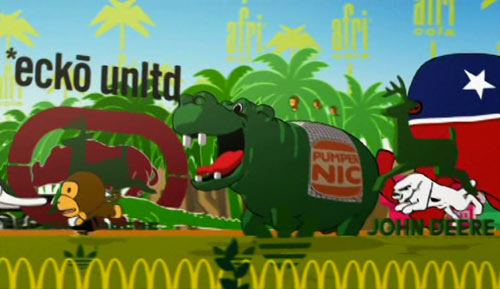
One of the films up for the Best Animated Short Oscar is called Logorama. It’s a Pulp Fiction-inspired ditty composed almost entirely of inventively used corporate logos. A screenshot is instructive in illustrating what I’m talking about:
Take, for instance, the way Google’s engine learns which words are synonyms. “We discovered a nifty thing very early on,” Singhal says. “People change words in their queries. So someone would say, ‘pictures of dogs,’ and then they’d say, ‘pictures of puppies.’ So that told us that maybe ‘dogs’ and ‘puppies’ were interchangeable. We also learned that when you boil water, it’s hot water. We were relearning semantics from humans, and that was a great advance.”
But there were obstacles. Google’s synonym system understood that a dog was similar to a puppy and that boiling water was hot. But it also concluded that a hot dog was the same as a boiling puppy. The problem was fixed in late 2002 by a breakthrough based on philosopher Ludwig Wittgenstein’s theories about how words are defined by context. As Google crawled and archived billions of documents and Web pages, it analyzed what words were close to each other. “Hot dog” would be found in searches that also contained “bread” and “mustard” and “baseball games” — not poached pooches. That helped the algorithm understand what “hot dog” — and millions of other terms — meant. “Today, if you type ‘Gandhi bio,’ we know that bio means biography,” Singhal says. “And if you type ‘bio warfare,’ it means biological.”
Or in simpler terms, here’s a snippet of a conversation that Google might have with itself:
A rock is a rock. It’s also a stone, and it could be a boulder. Spell it “rokc” and it’s still a rock. But put “little” in front of it and it’s the capital of Arkansas. Which is not an ark. Unless Noah is around.
The New Yorker has a nice profile of Paul Krugman in this week’s magazine. His political awakening has a somewhat born-again Christian vibe to it.
In his columns, Krugman is belligerently, obsessively political, but this aspect of his personality is actually a recent development. His parents were New Deal liberals, but they weren’t especially interested in politics. In his academic work, Krugman focussed mostly on subjects with little political salience. During the eighties, he thought that supply-side economics was stupid, but he didn’t think that much about it. Unlike Wells, who was so upset when Reagan was elected that she moved to England, Krugman found Reagan comical rather than evil. “I had very little sense of what was at stake in the tax issues,” he says. “I was into career-building at that point and not that concerned.” He worked for Reagan on the staff of the Council of Economic Advisers for a year, but even that didn’t get him thinking about politics. “I feel now like I was sleepwalking through the twenty years before 2000,” he says. “I knew that there was a right-left division, I had a pretty good sense that people like Dick Armey were not good to have rational discussion with, but I didn’t really have a sense of how deep the divide went.”
I don’t know what took me so long, but I finally tracked down the soundtracks for both Moon and Sunshine…hiding in plain sight on iTunes. They are both great in their entirety. If you just want a taste, at least get Welcome to Lunar Industries from Moon and Sunshine (Adagio in D Minor) from Sunshine.
Update: Forgot to add that the Sunshine soundtrack is only available through iTunes and the Moon soundtrack is available in the US as an expensive import (and not on Amazon’s mp3 site or anything like that) so your best bet is iTunes there as well.
Atlas Obscura is organizing a worldwide event on March 20th called Obscura Day, “a day of expeditions, back-room tours, and hidden treasures in your own hometown”. Events include tours of a pneumatic tube system in Palo Alto, an underground salt museum in Kansas, a Icelandic museum of phalluses, a Cuban perfume museum, and a hikaru dorodango demonstration in Albuquerque.
I work in the film business, where schmoozing is an art form, lunch hour lasts from 12:30 until 3, and every meeting takes an hour whether there’s an hour’s worth of business or not. Not so at Vogue, where meetings are long if they go more than seven minutes and everyone knows to show up on time, prepared and ready to dive in. In Anna’s world, meetings often start a few minutes before they’re scheduled. If you arrive five minutes late, chances are you’ll have missed it entirely. Imagine the hours of time that are saved every day by not wasting so much of it in meetings.
There’s something dystopic about the place generally, and CityCenter is starting to feel like the world of Blade Runner come to life. I head back to my room, shut the black-out curtains and lie in bed. More people commit suicide in Las Vegas than in any other city in the United States.
But then, upon his return to NYC:
Drinks at Prime Meats, in Brooklyn, with my wife. Realistically, this place is as much an artifice as anything on the Strip, a re-imagining of a 19th-century saloon, complete with polished bar, antique typography, Edison bulbs. Why, then, does it feel so much more honest? Because its aesthetic is filtered through a contemporary sensibility? Because it seems a natural part of a vibrant neighborhood? Is this all bullshit I invent to make myself feel more comfortable?
They include mood, group size, authority, and social approval.
People use conformity to ingratiate themselves with others. Conforming also makes people feel better about themselves by bolstering self-confidence. Some people have a greater need for liking from others so are more likely to conform.
Have you noticed that nonconformers are less likely to care what other people think of them? Nonconformity and self-confidence go hand-in-hand.
Showing at MoMA next month, a documentary based on the NY Times’ relentless and intrepid street photographer Bill Cunningham. From the press release:
The opening night feature of this year’s New Directors/New Films is the world premiere of Bill Cunningham New York (USA, 2010) on Wednesday, March 24, at 7:00 p.m. at MoMA. Director Richard Press’ documentary is a heartfelt and honest film about the inimitable New York Times photographer, who has for decades lovingly captured the unexpected trends, events, and people of Manhattan for the Styles section of the newspaper. The film shows Cunningham, an octogenarian, riding his Schwinn bicycle to cover benefits, galas, and fashion shows around Manhattan, and illustrates how his camera has captured the looks that have defined generations.
I couldn’t really find any other information online about this film. They should at least get a trailer up on YouTube or something.
In this 28-minute presentation, Jesse Schell talks about the psychological and economic aspects of Facebook games and what that means for the future of gaming and living. If you make products or software that other people use, this is pretty much a must-see kinda thing…the last 5 or 6 minutes are dizzying, magical, and terrifying.
We found by experience that if we were truthful about not being regular church attenders, the play dates suddenly ended. Thus started the faking of the religious funk.
Thankfully this doesn’t seem to be an issue in Manhattan. (via clusterflock)
This includes new drawings made with glitter, old drawings pepped up with a little sparkle, as well as anything else that you can imagine so long as it satisfies two criteria:
The Guardian asked a bunch of writers to share their tips for writing fiction. The responses appear in twoparts. Elmore Leonard:
Never use an adverb to modify the verb “said”… he admonished gravely. To use an adverb this way (or almost any way) is a mortal sin. The writer is now exposing himself in earnest, using a word that distracts and can interrupt the rhythm of the exchange. I have a character in one of my books tell how she used to write historical romances “full of rape and adverbs”.
Here’s Philip Pullman’s response in full:
My main rule is to say no to things like this, which tempt me away from my proper work.
Yitta Schwartz died last month aged 93. It’s estimated she may have had over 2000 living descendants, including more than 200 grandchildren.
In 1953, the Schwartzes migrated to the United States, settling into the Satmar community in Williamsburg. She arrived with 11 children — Shaindel, Chana, Dinah, Yitschok, Shamshon, Nechuma, Nachum, Nechemia, Hadassah, Mindel and Bella — and proceeded to have five more: Israel, Joel, Aron, Sarah and Chaim Shloime, who died in summer camp at age 8. Sarah came along after Mrs. Schwartz had already married off two other daughters.
To start with, only simple tissues, such as skin, muscle and short stretches of blood vessels, will be made, says Keith Murphy, Organovo’s chief executive, and these will be for research purposes. Mr Murphy says, however, that the company expects that within five years, once clinical trials are complete, the printers will produce blood vessels for use as grafts in bypass surgery. With more research it should be possible to produce bigger, more complex body parts. Because the machines have the ability to make branched tubes, the technology could, for example, be used to create the networks of blood vessels needed to sustain larger printed organs, like kidneys, livers and hearts.
The Bloom box is a new kind of fuel cell that produces electricity by combining oxygen in the air with any fuel source, such as natural gas, bio-gas, and solar energy. Sridhar said the chemical reaction is efficient and clean, creating energy without burning or combustion. He said that two Bloom boxes - each the size of a grapefruit - could wirelessly power a US home, fully replacing the power grid; one box could power a European home, and two or three Asian homes could share a single box.
But the article says that several commercial Bloom boxes are already in use at Google, eBay, FedEx, and Wal-Mart and VC John Doerr and Colin Powell are on board, so who knows? (via @daveg)
“When I planned to ski Everest, the first thing I faced was ‘How can I return alive?’” he recalls. “All the preparation and training was based on this question. But the more I prepared, I knew the chance of survival was very slim. Nobody in the world had done this before, so I told myself that I must face death. Otherwise, I am not eligible.”
Do you ever get time to visit museums? I used to go a lot with my kids. Donald Trump is a great friend, and he has four or five Picassos on his plane. And that’s where I would look at them. One time, I was at a museum and tried touching a Picasso. You break it, you buy it, they said. I was told it would cost $2 million.
Over at Worldchanging, Alex Steffen calls Bill Gates’ talk about climate change the most important speech ever given at TED. Gates said that the number one priority for him and the Gates Foundation (the world’s largest philanthropic organization) is to combat human-driven climate change.
He reckons that because population is going to continue to grow for at least four decades, because billions of poor people want more equitable prosperity, and because (as he sees it) improvements in energy efficiency are limited, we have to focus on the last element of the equation, the carbon intensity of energy. Simply, we need climate-neutral energy. We need to use nothing but climate-neutral energy.
Using the Relativistic Heavy Ion Collider at the Brookhaven National Laboratory on Long Island, particle physicists have succeeded in creating quark-gluon plasma, the temperature of which is 4 trillion degrees Celsius (about 250,000 times hotter than the center of the Sun). The plasma is believed to be the state the universe was in a microsecond after its creation.
The departure from normal physics manifested itself in the apparent ability of the briefly freed quarks to tell right from left. That breaks one of the fundamental laws of nature, known as parity, which requires that the laws of physics remain unchanged if we view nature in a mirror.
This happened in bubbles smaller than the nucleus of an atom, which lasted only a billionth of a billionth of a billionth of a second. But in these bubbles were “hints of profound physics,” in the words of Steven Vigdor, associate director for nuclear and particle physics at Brookhaven. Very similar symmetry-breaking bubbles, at an earlier period in the universe, are believed to have been responsible for breaking the balance between matter and its opposite antimatter and leaving the universe with a preponderance of matter.
The Lord of the Rings movie trilogy is finally coming out on Blu-ray on April 6th, but more than 1800 angry Amazon commenters would like to remind you that these are the theatrical versions and not the extended versions that true LOTR fans have canonized.
Some confusion among other reviewers that somehow we’re obligated to post a five star recommendation for the movie. This is an incorrect understanding of the review process. If I were reviewing the movie itself it would get a five. This review is for the product, as listed — in other words, I DO NOT RECOMMEND BUYING THIS PRODUCT/DVD. This product is being created FOR NO OTHER REASON than to dupe people into buying this movie twice…again. Those of us who were huge fans bought the original DVDs of the theatrical releases. THEN the studio FINALLY released the extended editions, even though they could have released both at the same time. Now that Blu Ray has won the High Def battle, the studios are salivating at screwing us all again the same way! Please do not let them get away with holding the extended edition hostage until everyone buys the theatrical versions.
Or, to put it in a way that Gandalf would understand:
New Line/WB need to learn a lesson from the movies themselves and realize that evil never prevails. Greed has a grip on them stronger than the Ring itself.
An archeological find in Turkey, believed to be a temple built 11,500 years ago that predates “villages, pottery, domesticated animals, and even agriculture”, suggests religion created civilization and not the other way around.
Most startling is the elaborate carving found on about half of the 50 pillars Schmidt has unearthed. There are a few abstract symbols, but the site is almost covered in graceful, naturalistic sculptures and bas-reliefs of the animals that were central to the imagination of hunter-gatherers. Wild boar and cattle are depicted, along with totems of power and intelligence, like lions, foxes, and leopards. Many of the biggest pillars are carved with arms, including shoulders, elbows, and jointed fingers. The T shapes appear to be towering humanoids but have no faces, hinting at the worship of ancestors or humanlike deities.
A representation of how deep the Mariana Trench is. Turns out it’s really, really, really, really, really, really, really, really, really, really, really, really, really deep. (via df)
Flattery sells, so to further those positive emotions, he insists that sales associates compliment the customer’s own watch, even if it’s from a competitor.
When an insect brushes against a hair on the leaf of a Venus flytrap, the bending triggers a tiny electric charge. The charge builds up inside the tissue of the leaf but is not enough to stimulate the snap, which keeps the Venus flytrap from reacting to false alarms like raindrops. A moving insect, however, is likely to brush a second hair, adding enough charge to trigger the leaf to close.
Volkov’s experiments reveal that the charge travels down fluid-filled tunnels in a leaf, which opens up pores in cell membranes. Water surges from the cells on the inside of the leaf to those on the outside, causing the leaf to rapidly flip in shape from convex to concave, like a soft contact lens. As the leaves flip, they snap together, trapping an insect inside.
Since then I’ve downloaded a lot of games and educational apps for my daughter (who is now four and a half) and I’ve been meaning to write up the ones I think are worth a few bucks and have stood the test of time, and here they are.
A recent study indicates that the wing shapes of North American birds are changing in response to deforestation.
He found that over half of the species he examined demonstrated changes over time with boreal birds developing more pointed wings and temperate birds developing rounder wings. These results support the hypothesis that habitat isolation is spurring evolutionary changes in birds.
Boreal forests have suffered severe deforestation over the past century, and so Desrochers had predicted that increased distances between habitat patches would select for more pointed wings in birds. Pointed wings are associated with more energy-efficient sustained flight.
Another fantastic feature from Pictory: The One Who Got Away features lost loves, hard choices, and former friends.
My friend and I grew up together: went through big losses early, endured school, survived through everything. This is her writing her final essay for law school, in late summer. I used to love this photo because it meant that we made it, at last. Then, after she became a lawyer, she helped my neighbor sue my family. We just got the letter from her, no warning. If I try hard, I understand her point of view. Business is business. As another good friend said: Welcome to adult issues.
Unlike previous racist dictatorships, the North Korean one has actually succeeded in producing a sort of new species. Starving and stunted dwarves, living in the dark, kept in perpetual ignorance and fear, brainwashed into the hatred of others, regimented and coerced and inculcated with a death cult.






Socials & More