It’s enough to give a tugboat captain angina. So when Bob Henry, captain of the Rachel Marie, who is in charge of towing Smithson’s island, looked out across the East River Thursday afternoon and saw another piece of conceptual art gaining on him, he did not view the development kindly.
Addictive Flash game of the week: Hedgehog Launch. There’s something really clever about the game play here but can’t quite put my finger on what it is. The objective of the game — to launch the ‘hog into space — is so beside the point the first time around that you forget all about it until it actually happens. My best time was 7 days. (via cyn-c)
Update: Woo, 5 days! My technique: upgrade to a parachute as quick as you can, use it to float for valuable multiplier, then get rockets and band/launcher.
Update: Got it down to 4 days. 3 days is possible but I’m retiring.
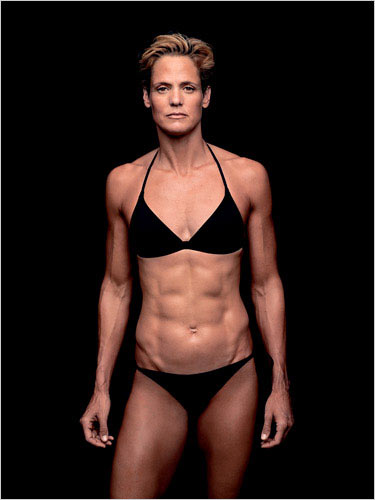
She’s 41 years old, has a two-year-old daughter, and won her first Olympic medal, a relay gold, in 1984. Torres is training to make the 2008 US Olympic team, but it’s not some casual attempt to relive the good old days: Torres set the American record in the 50-meter freestyle just a few months ago. As the photo above attests, part of Torres’ continuing success is due to her training regimen.
Torres calls resistance stretching her “secret weapon.” Bob Cooley, who invented the discipline, describes it in less-modest terms. According to Cooley, over a two-week period in 1999, his flexibility system turned Torres “from being an alternate on the relay team to the fastest swimmer in America.” The secret to Torres’s speed, Cooley says, is that his technique not only makes her muscles more flexible but also increases their ability to shorten more completely, and when muscles shorten more completely, they produce greater power and speed. “What do race-car drivers do when they want to go faster?” Cooley asks. “They don’t spend more hours driving around the track. They increase the biomechanics of the car. And that’s what resistance flexibility is doing for Dara - increasing her biomechanics.”
The Olympic Trials are going on right now in Omaha, NE. The women’s 50-meter freestyle preliminaries take place on July 5 with the final on July 6, broadcast live on NBC.
The Image Fulgurator is an ingenious device that detects the flash from nearby cameras and quickly inserts a message onto whatever is being photographed so that it shows up in any photos being taken.
It operates via a kind of reactive flash projection that enables an image to be projected on an object exactly at the moment when someone else is photographing it. The intervention is unobtrusive because it takes only a few milliseconds. Every photo another photographer takes of an object at which the Fulgurator is also aimed is affected by the manipulation. Hence visual information can be smuggled unnoticed into the images of others.
I’m fascinated by early color photography…it takes a time we think of being in black & white and makes it accessible and modern. In the hands of Auguste and Louis Lumière, the “lowly, lumpy potato” made color photography possible in the early 1900s. The photos were called autochromes.
The Lumière brothers gathered up their potatoes and ground them into thousands of microscopic particles; they separated this powder into three batches, dying one batch red-orange, one violet and one green; the colored particles were thoroughly mixed and sifted onto a freshly varnished, clear glass plate while the lacquer remained tacky; excess potato bits were swept from the plate, which was pressed through steel rollers to flatten the colored grains, transforming each into a minuscule color filter measuring from .0006 to .0025 millimeters across. Gaps between the colored particles were filled in with carbon black, the plate was varnished again and a thin, light-sensitive emulsion of silver bromide was brushed over that. Now the plate was ready for the camera. When the shutter was opened, light filtered through the translucent potato grains, and a multicolored image was imprinted on the emulsion. After the negative plate was developed in the lab, it was washed and dried, covered with another piece of glass to protect the emulsion and bound with gummed tape. Et voilà! A color photograph unlike any seen before.
I’ve not been paying enough attention to Bill Cunningham’s street fashion photography slideshows. Each week, Cunningham goes out on the streets of NYC to find out what people are wearing. Even better than the photos are his enthusiastic descriptions of what he’s found.
The “Pillars of Creation” may be the most iconic Hubble photograph ever taken. “Located in the Eagle Nebula, the pillars are clouds of molecular hydrogen, light years in length, where new stars are being born,” says Aguilar. “However, recent discoveries indicate these pillars were destroyed by a massive nearby super nova some 6,000 years ago. This is a ghost image of a past cosmic disaster that we won’t see here on Earth for another thousand years or so-and a perfect example of the fact that everything we see in the universe is history.”
After the video of a Chinese farmer’s homemade airplane started circulating around the web late last week, commenters on several sites cried hoax, and I received several emails and tweets questioning my mental health for believing such a thing exists.
But the video wasn’t obviously fake; home-built airplanes aren’t rare, I have no reason to doubt the ingenuity of the Chinese farmer, and I’d rather believe in the wonderfully improbably than be cynical about everything I see. A second video of the plane has been uploaded to YouTube which, in my mind, corroborates the existence of the flying contraption (it’s actually an autogyro) beyond a reasonable doubt.
Over the years, in every comedy act or movie I ever worked in, I’ve “thrown a Gookie” at least once. It wasn’t always planned, especially in our early vaudeville days. If we felt the audience slipping away, fidgeting and scraping their feet through our jokes, Groucho or Chico would whisper in panic, “Ssssssssssst! Throw me a Gookie!” The fact that it seldom failed to get a laugh is quite a tribute to the original possessor of the face.
It’s sour because in the US, particularly in San Francisco, it’s hard to buy good bread. About 75% of the decent bread in my grocery store, both fresh baked and industrial, is sourdough. Consumers think sourdough is shorthand for quality. It’s not. In fact, sourdough is seldom the appropriate bread for a meal. It makes lousy sandwiches, lousy breakfast, it clashes with cheese. It’s good with creamy soups, and it’s good plain with butter. But the premium bakeries all push sourdough, and so sourdough becomes synonymous with “good”, when it’s not.
This is probably more than 50% of the reason why I left San Francisco.
Although he said further tests would have to be conducted, Mr Kounaves said the soil seemed “very friendly… there is nothing about it that is toxic,” he said. “It is the type of soil you would probably have in your back yard — you know, alkaline. You might be able to grow asparagus in it really well.”
Vulture’s wrong, wrong, wrong list of the best Pixar films. Finding Nemo belongs in #1 with The Incredibles and Ratatouille close behind. Then Toy Story 2 followed by the rest. Putting The Incredibles in the #7 spot, that’s just plain irresponsible.
Dalmatians “Hey, look, the truck’s stopping.” “Did they take us to the park this time?” “No — it’s a fire. Another horrible fire.” “What the hell is wrong with these people?”
This site lets you track the International Space Station, the Space Shuttle (when in orbit), and all sorts of other satellites in relation to their position over the earth with a familiar Google Maps interface. Very cool.
Is the universe fractal-like, even on large scales? A group of Italian and Russian scientists argue that it displays a fractal pattern on a scale of 100 million light years. Other scientists aren’t so sure.
Many cosmologists find fault with their analysis, largely because a fractal matter distribution out to such huge scales undermines the standard model of cosmology. According to the accepted story of cosmic evolution, there simply hasn’t been enough time since the big bang nearly 14 billion years ago for gravity to build up such large structures.
Perhaps most exaggerated of all though has to be the images that are typically given to show the accumulation of “space junk” — remnants of space flights and defunct satellites, etc. In this image each pixel represents approximately 114 miles; so a piece of debris the size of a car is marked with a point the size of Long Island — easily a 6 order of magnitude exaggeration.
Of all the things that Flickr has done, The Commons project might be the most significant. If, in two years, there are tens or even hundreds of thousands of old photographs previously unavailable to the general public from collections all over the world — all tagged, geocoded, annotated, contextualized, and available to anyone with a web browser — that would be an amazing resource for exploring our recent history.
God ruined I Am Legend with the most literal deus ex machina I’ve ever seen in a movie. The alternate ending makes a whole lot more sense. Then again, I would have been satisfied with three straight hours of how Neville spends his time in Manhattan wilderness, alone, procuring supplies, checking buildings off of his scavenging list, visiting the MoMA to get new art for his walls, collecting iPods for “new” music, etc. Is it every New Yorker’s fantasy to have all of Manhattan to himself for a day?
Date back to 2007, due to an open (maybe leak?) source of MTK platfrom (a wireless communication development platform), there are millions of cell phone factories burst out in south China. These factories made lots of famous-brand cell-phone-copies in a short period of time. They just copied the outline and software design from Nokia, Apple iPhone etc. The manufacturing cost is very low so many people are involved. However, these cell phones are not all completely copied. They are even totally redesigned and added a lot of features. A brand called “NCIKA” even went very popular in China. People’re even joking that the farmers in big mountains can develop and design a cell phone too. So many people call it “Shanzhai Ji” (Ji means machine in Chinese, here means cell phone) and then the name is widespread in China.
Since then, many funny/weird stuff from ordinary people are called “shanzhai” something, and that’s why this plane is named “Shanzhai Huaxiangji” in Chinese :)
Runners in lane eight got off the mark on average about 150 milliseconds after runners in lane one, Dapena found. A time delay of that magnitude translates to about a metre’s difference at the finish line.
Two bits of news about the High Line and its impending park.
1. Curbed has new renderings of what the park is going to look like. Here’s phase 1 (Gansevoort St. to 20th) and phase 2 (21st to 30th). They’re calling it a park but from the drawings it seems more like a glorified sidewalk.
A new type of artist arises: someone whose task is to gather together existing but overlooked pieces of amateur art, and, by directing attention onto them, to make them important. (This is part of a much larger theory of mine about the new role of curatorship, the big job of the next century.)
Yahoo is grown up. They know what they’re great at. They are great at news. When it comes to news, they absolutely crush Google. So here’s a whacky idea my Yahoo friends. Why not define yourself by your news services and the other stuff where you destroy the competition?
NY Times wine guy Eric Asimov and his panel taste a bunch of root beers and conclude, among other things, that “too much root beer can make a man mean”.
Our No. 1 root beer, from Sprecher in Wisconsin, a wonderfully balanced and complex brew, uses a combination of corn syrup and honey, while our No. 2, the restrained and flavorful IBC, uses only corn syrup. So even with the importance of the sweetener, something more is at play with root beers.
No benign deity plucks television news-show hosts from their desks in the prime of life and then hastily compensates their friends and family by displays of irradiated droplets in the sky
I did my best to capture as many of the best comments as possible but 3:26 isn’t a huge canvas. I’m particularly sad that I never figured out a way to mention how bad the people must have smelled, or my plan to get rich selling soap.
But at a press conference today, Gloucester Mayor Carolyn Kirk emerged from a closed-door meeting with city, school and health officials to say that there had been no independent confirmation of any teen pregnancy pact. She also said that the principal, who was not present at the meeting, is now “foggy in his memory” of how he heard about the pact.
In celebration of Euro 2008, public prankster and more-than-fair soccer striker Rémi Gaillard made the following video of himself using the urban landscape as a soccer pitch. Gaillard scores goals into police vans, trash cans, open windows, etc. to the annoyance of his oblivious goalies.
Something about the video seemed familiar and after a bit of searching, I discovered that the same fellow was also responsible for one of my favorite links from a few years ago, Rocky Recreated. There are tons of his videos on YouTube, most of them centered on Gaillard’s brand of graffiti-esque performance art. I can’t condone some of his actions but he’s certainly amusing to watch. (via memeticians)
We try to start from a position of great abundance and information, to show the vastness or the liveness. I think live, vast, and deep is some of the terminology that we’ve been using lately in a lot of our talks.
I try not to miss any of Atul Gawande’s New Yorker articles, but his piece on itching from this week’s issue is possibly the most interesting thing I’ve read in the magazine in a long time. He begins by focusing on a specific patient for whom compulsive itching has become a very serious problem. (Warning, this quote is pretty disturbing…but don’t let it deter you from reading the article.)
…the itching was so torturous, and the area so numb, that her scratching began to go through the skin. At a later office visit, her doctor found a silver-dollar-size patch of scalp where skin had been replaced by scab. M. tried bandaging her head, wearing caps to bed. But her fingernails would always find a way to her flesh, especially while she slept.
One morning, after she was awakened by her bedside alarm, she sat up and, she recalled, “this fluid came down my face, this greenish liquid.” She pressed a square of gauze to her head and went to see her doctor again. M. showed the doctor the fluid on the dressing. The doctor looked closely at the wound. She shined a light on it and in M.’s eyes. Then she walked out of the room and called an ambulance. Only in the Emergency Department at Massachusetts General Hospital, after the doctors started swarming, and one told her she needed surgery now, did M. learn what had happened. She had scratched through her skull during the night — and all the way into her brain.
From there, Gawande pulls out to tell us about itching/scratching (the two are inseparable), then about a recent theory of how our brains perceive the world (“visual perception is more than ninety per cent memory and less than ten per cent sensory nerve signals”), and finally about a fascinating therapy initially developed for those who experience phantom limb pain called mirror treatment.
Among them is an experiment that Ramachandran performed with volunteers who had phantom pain in an amputated arm. They put their surviving arm through a hole in the side of a box with a mirror inside, so that, peering through the open top, they would see their arm and its mirror image, as if they had two arms. Ramachandran then asked them to move both their intact arm and, in their mind, their phantom arm-to pretend that they were conducting an orchestra, say. The patients had the sense that they had two arms again. Even though they knew it was an illusion, it provided immediate relief. People who for years had been unable to unclench their phantom fist suddenly felt their hand open; phantom arms in painfully contorted positions could relax. With daily use of the mirror box over weeks, patients sensed their phantom limbs actually shrink into their stumps and, in several instances, completely vanish. Researchers at Walter Reed Army Medical Center recently published the results of a randomized trial of mirror therapy for soldiers with phantom-limb pain, showing dramatic success.
Crazy! Gawande documents and speculates about other applications of this treatment, including using virtual reality representations instead of mirrors and utilizing multiple mirrors for treatment of M.’s itchy scalp. Anyway, read the whole thing…highly recommended.
Since Ms. Harrison started the Gramercy Park Block Association in 1994, after her son was attacked and beaten up in front of their apartment building at 34 Gramercy Park, she has effectively remade the area in her own image.
She has added to a list of regulations (no dogs, no feeding of birds, no groups larger than six people, no Frisbees or soccer balls or “hard balls” of any kind) that, in turn, have served to dictate how the park is - and is not - used. Most recently, she helped pave the way for Zeckendorf Realty to redevelop a 17-story Salvation Army boarding house on the south side of the park, and for the company’s plan to convert the 300 rooms into 14 floor-through apartments plus a penthouse duplex. The company would not confirm the transaction.
What a bunch of elitist horseshit. Ms. Harrison sounds like a Grade A wanker. (via anil)
“It is pretty scary,” said Charles Truxal, 64, a retired corporate manager in Rochester, Minn. “People are thinking things are going to get better, and they haven’t been. And then you go hide in your basement because tornadoes are coming through. If you think about things, you have very little power to make it change.”
My guess is that the writers’ editor was out of town and they decided to see if they could slip this Onion-esque article on to the wire. (thx, scott)
Present for the reunion was office manager Miriam Lubow (center of new picture), who missed the original sitting due to a snowstorm. (When Lubow, now retired, first met Gates, she couldn’t believe that disheveled kid was the president.) Absent for the reshoot was Bob Wallace (top center), who died in 2002; after leaving Microsoft in 1983, he pioneered the idea of shareware.







Socials & More