And how much oil is there? Estimates bounced around for years until 1999, when Alberta got serious about determining its potential. Based on data from 56,000 wells and 6,000 core samples, the Energy and Utilities Board (EUB) came up with an astonishing figure: The amount of oil that could be recovered with existing technology totalled 175 billion barrels, enough to cover U.S. consumption for more than 50 years. With the new math, Canada slipped quietly into second place behind Saudi Arabia’s 265 billion barrels in oil reserves, followed by Iran and Iraq.
6. Nothing is a mistake. There is no win and no fail. There is only make.
7. The only rule is work. If you work it will lead to something. It’s the people who do all of the work all the time who eventually catch on to things.
The show has no redeeming/moral value what so ever. The show actually had the gall to show GOD in bed with a young woman ready to have sexual intercourse and the dialogue to go with that event, including the use of condoms. They also had Jesus and his earthly father Joseph having an argument. Along with portraying the total disrespect of family values Stewie hitting his mother, the father and son ganging up on the wife/mother, there was also a male sexual predator in this episode as well.; The whole show was quite revolting. It should be taken off the air.
Greenwood is better understood as a composer who has crossed over into rock. Trained as a violist, he worked seriously at writing music in his youth, and had just embarked on studies at Oxford Brookes University when, in 1991, Radiohead was signed by the EMI record label. He dropped out of college to join the band on tour.
They were very big around 1970 or so. Bookman set the example, even though it’s from much earlier. By the mid-seventies, they were adding Bookman-style swashes to everything. They were usually called Whateverthefontwascalled Flair.
Scroll down the page for samples of Univers Flair, Franklin Gothic Flair, etc.
Starting in about 40 minutes, I’ll be liveblogging the Mythbusters episode where they take on the infamous airplane on a conveyor belt problem. Updates will be reverse chronological (newest at the top) so don’t scroll down if you’re DVRing the episode for later viewing or otherwise don’t want anything spoiled.
Fair warning? Ok here we go.
10:32p I’ve turned comments on. Why not!!
10:04p
The plane took off so easily. The laws of physics are proven correct once again. But I’m not sure this is going to settle anything. I’m getting email as we speak that the test was unfair. Plane was too light. Tarp was pulled too slowly. Etc. But the thing is, it doesn’t matter how large the plane is…given enough runway and a strong enough conveyor belt, it will still take off. Ditto for the speed of the treadmill…it doesn’t matter how fast the treadmill is moving. It could be going 300 mph in the opposite direction and as long as the bearings in the plane’s wheels don’t melt, it’s gonna take off. (For an explanation, try this one by my friend Mouser, who has a MIT Ph.D in Physics Sc.D. in Nuclear Science and Engineering.)
9:58p
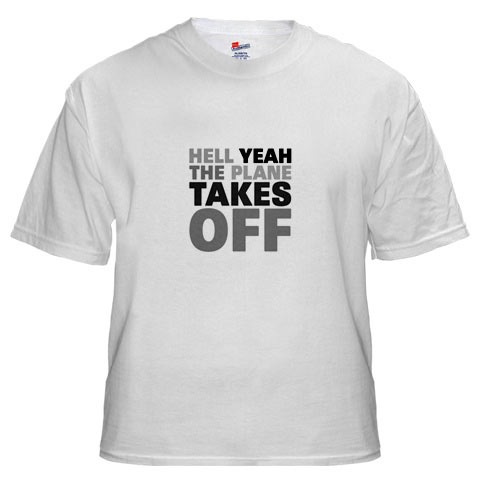
Update: Due to popular demand, the above graphic is available on a t-shirt at CafePress. Prices start at $18 and they’re available in men’s and women’s sizes.
9:58p
Heeeeeeeere we go.
9:56p
The pilot flying the ultralight is predicting that he won’t be able to take off.
9:50p
Cockroach mini-myth: cockroaches would survive a nuclear blast longer than humans but there were other kinds of bugs that fared better. Another commercial.
9:47p
Back to the shaving cream in the car prank. Now they’re going to use A-B foam…they’re trying to fill all the space in the car and perhaps explode it. Totally worked.
9:44p
Expedia commercial. Nice synergistic placement. Good work, Discovery Channel’s ad sales team.
9:43p
Ok, to do the large-scale plane test, they’re using a 2000 foot tarp and a 400 pound ultralight. Tarp is pulled in one direction and the plane tries to take off in the other direction. The wind is picking up and blowing the tarp runway all over the place. They’re also having problems with punching holes in the tarp. They’re going to try again after we hear some more about radioactive cockroaches. Aaaand, another commercial.
9:36p
Second mini-myth: if you freeze a can of shaving cream, cut it open, and then put the foam in a car, it will heat and expand to fill the car. One can did almost nothing. 50 cans didn’t do too much either.
9:32p
Off to commercial again. Macbook Air ad. I don’t understand all the whining about how expensive and underpowered it is. You can’t get by with an 80 GB hard drive? Come on.
9:30p
Now a bit of explanation from the boys. (Things are moving faster now, which is welcome.) The thrust from the airplane acts upon the air so it doesn’t matter too much what the runway is doing to the plane’s wheels. And then back to the roach thing. They irradiated them (and some other bugs) and most of the roaches died. Still pending…
9:25p
Ok, they’re dragging paper behind a Segway and trying to take off with the model airplane in the opposite direction. IT JUST TOOK OFF.
9:19p
Back to the roach thing. More recapping and a little bit more setup. I don’t see how people can watch this show…it’s sooooo slooooow. And now another commercial break. Hello picture-in-picture.
9:18p
As expected, the model airplane “flew” off the end of the exercise treadmill. It didn’t have enough room to take off, but if it stayed straight, it probably would have.
9:14p
First recap…they took a solid minute to explain what they’ve already done. Ugh.
9:13p
Going into the first commercial, we’ve caught a glimpse of how they’re going to test the main myth. They’re going to drag a huge plastic sheet long the ground and have the plane sit on the plastic and being going the other way attempting to take off. A reasonable substitute for the treadmill.
9:08p
They’re starting off small with a model airplane on an exercise treadmill. They’re showing the two hosts learning how to fly the tiny airplane. One of them is riding around on a Segway. Oh, and they’re also doing two other mini-myths during the episode. They just switched gears to the first mini-myth: can a cockroach survive a nuclear blast?
9:04p
And we’re off. They’re calling it “the moment we’ve all been waiting for”. My guess: the plane will take off.
8:58p
I’ve only watched one other episode of Mythbusters before today. I found the show to be a little slow and very repetitive; 8 minutes of material stretched into 45 minutes of show. Unfortunately, this practice seems to be common among science programs on television.
8:40p
Watching Family Guy as a warmup. The one with the nudist family. Good stuff.
8:22p
Preemptive answer for the inevitable “Do you realize how boring/stupid/goofy it is to liveblog this?” Most definitely.
Grant Barrett researches the origins of the word “w00t” and determines that it probably originated from the “whoot/whoomp there it is” dance craze of the early 90s and not from the hacker/gaming community. Which conclusion provoked a little nerdfury in the comments. (via waxy)
“If society is ready to embrace a trend, almost anyone can start one—and if it isn’t, then almost no one can,” Watts concludes. To succeed with a new product, it’s less a matter of finding the perfect hipster to infect and more a matter of gauging the public’s mood. Sure, there’ll always be a first mover in a trend. But since she generally stumbles into that role by chance, she is, in Watts’s terminology, an “accidental Influential.”
Perhaps the problem with viral marketing is that the disease metaphor is misleading. Watts thinks trends are more like forest fires: There are thousands a year, but only a few become roaring monsters. That’s because in those rare situations, the landscape was ripe: sparse rain, dry woods, badly equipped fire departments. If these conditions exist, any old match will do. “And nobody,” Watts says wryly, “will go around talking about the exceptional properties of the spark that started the fire.”
The Heatbar - a hand-held electronic smoking device that emits 90% less smoke than a regular cigarette, hence less second hand smoke. Only $118 for 1 year of service (2 cartons of cigarettes included)
The Incompatible Food Triad. Are there three foods that don’t taste good together but every pair of them does?
There are many ways to interpret this “going together” but an example solution would be three pizza toppings — A, B, and C — such that a pizza with A and B is good, and a pizza with A and C is good, and a pizza with B and C is good, but a pizza with A, B, and C is bad. Or you might find three different spices or other ingredients which do not go together in some recipe yet any pair of them is fine.
Prof. Paul L. Dawson, a food microbiologist, proposed it after he saw a rerun of a 1993 “Seinfeld” show in which George Costanza is confronted at a funeral reception by Timmy, his girlfriend’s brother, after dipping the same chip twice.
Let’s look at individuals. Human beings evolved in small groups and hunter-gatherer societies, in which virtually all competition was face to face. That is the environment most of us are biologically and emotionally geared to succeed in, and it explains why our adrenalin surges when a rival wins the boss’s favor or flirts with our special someone. But in the new arena, with its faceless and anonymous competitors, those who are driven to action mostly by adrenalin will not fare well. If that’s what they need to get things done, they will become too passive and others will overtake them.
To me, the most interesting challenge is maintaining motivation in the absence of visible competition. How do you win a race you might not even know you’re running?
New York Works is an audio portrait of a vanishing city. From a knife sharpener who still makes house calls to one of Brooklyn’s last commercial fisherman, New York Works tells the stories of those who keep the city’s past alive.
With his review of trees, Steven Frank cleverly skewers what passes for culture/tech trend writing these days.
Trees. It seems like you see them everywhere these days. But are trees viable in the long-term, or just another flash-in-the-pan fad for the under-30 crowd?
The generation that came of age in the ’80s, as the VCR was becoming a staple, is especially prone to VHS nostalgia, a manifestation of the broader retro culture that has accounted for untold hours of programming on VH1.
But for a generation of filmmakers who cut their filmmaker teeth by shooting with the family camcorder and editing with two VCRs, there is a logical fixation with the object of the plastic and magnetic 1/2” VHS videocassette and the visual artifacts of its recorded image.
The Remedi Project, launched in 1997, is an online interactive art gallery. Over the course of its five year lifespan, 12 exhibitions have presented experimental work from over 60 digital artists from around the world. The Remedi Project, now ended, continues online through this site.
I was never a big believer in multitasking. One of the many realizations of having a kid is that true multitasking is a pipe dream. Watching Ollie and doing anything requiring more concentration than breathing or maintaining a heartbeat is just plain impossible. Conversation with others has become clipped and disjointed as the part of my brain responsible for speech is rerouted to help keep pointy objects out of his reach and remembering when he last ate.
Capa established a mode and the method of depicting war in these photographs, of the photographer not being an observer but being in the battle, and that became the standard that audiences and editors from then on demanded. Anything else, and it looked like you were just sitting on the sidelines. And that visual revolution he embodied took place right here, in these early pictures.
The 5 Whys: just keep asking “Why?” until you get to the true cause of a particular situation or problem.
The technique was originally developed by Sakichi Toyoda and was later used within Toyota Motor Corporation during the evolution of their manufacturing methodologies. It is a critical component of problem solving training delivered as part of the induction into the Toyota Production System. The architect of the Toyota Production System, Taiichi Ohno, described the 5 whys method as “… the basis of Toyota’s scientific approach … by repeating why five times, the nature of the problem as well as its solution becomes clear.”
What would happen to planet earth if the human race were to suddenly disappear forever? Would ecosystems thrive? What remnants of our industrialized world would survive? What would crumble fastest? From the ruins of ancient civilizations to present day cities devastated by natural disasters, history gives us clues to these questions and many more.
The upshot of Life After People is that, with the exception of some domesticated animals, our planet would be better off without us. Waaaay better off. Like if Mother Nature sat us down for a talk and said, “listen, you’re really shitting on the rest of the planet, its residents, its ecosystems, etc. and, by the way, you’re killing me slowly and painfully” and the only honorable thing to do would be to jump in a rocketship to colonize Mars or commit mass suicide so everything else could live in peace.
The other interesting thing about the show is how little is left of humans after a few thousand years of absence. Roads, buildings, cars, bridges; they all break down. Ashes to ashes, dust to dust. The Great Pyramid at Giza might still be around in another ten thousand years, but it may be covered in sand. The Great Wall of China and Hoover Dam could survive for awhile longer. Mount Rushmore, caved out of solid granite, may last for 200,000 years or more. They didn’t mention anything about cut & diamonds or objects made from platimun or titanium, but I imagine that they would last millions of years, if not practically forever.
Which leads you to wonder: if the Earth supported an advanced civilization that died out over 500,000 years ago, would we have any way of knowing they even existed? Small cut gemstones and platinum artifacts left behind by such a civilization would be difficult to discover unless they were of sufficient size. Fossils would certainly survive in some form and we could perhaps make some guesses as to their intelligence based on morphology. Would that be enough to detect them?
Update: Two other possible advanced civilization detectors: chemical and geological changes caused might show up in mineral layers and long-lasting nuclear waste. (thx, jordan & leonard)
The other sex diary is more puzzling and, in a way, more informative. An economist to the core, Keynes organized the second sex diary also year-by-year, but this time in quarterly increments.
Unfortunately for us, however, this second sex diary is in code. And as far as I know, no one yet has been prurient enough to crack it.
Here’s what Keynes’ tabulation looks like. For every quarter-year from 1906 to 1915, he tallies up his sexual activities and totals them under three categories: C, A, and W.
For each of these headings, he records the number of times each activity occurred, and also when. For example, between May and August, 1911, he performed (if that’s the right word) C sixteen times, A four times, and W five times.
But if they lose — especially if they lose late — the New England Patriots will be the most memorable collection of individuals in the history of pro football. They will prove that nothing in this world is guaranteed, that past returns do not guarantee future results, that failure is what ultimately defines us and that Gisele will probably date a bunch of other dudes in her life, because man is eternally fallible.
Jill Lepore would likely agree with Klosterman. In her recent New Yorker article on Benjamin Franklin (the patron saint of bloggers, BTW), she argues that he failed to follow many of his aphoristic writings and in doing so became more interesting.
He carried with him a little book in which he kept track, day by day, of whether he had lived according to thirteen virtues, including Silence, which he hoped to cultivate “to break a Habit I was getting into of Prattling, Punning and Joking.” What made Franklin great was how nobly he strived for perfection; what makes him almost impossibly interesting is how far short he fell of it.
It’s also worth noting that, per Aristotle and Shakespeare, the hero in a tragedy always has a fatal flaw; it’s what makes him a hero and the story worth listening to.
Pixar’s Toy Story 3 will be produced in 3-D. I like Pixar a lot but 3-D has never been anything but a gimmick, so I don’t know. TS3 will be out in June 2010. (2010! We’ll go together in my hovercar!)
Web Trend Map 2008 Beta, which is basically 300 influential web sites mapped onto a Tokyo train map. It’s very pretty, but once again, kottke.org gets no love.
Using “favorite books” data from Facebook and the average SAT/ACT scores from the colleges the people in the data set attend, Virgil Griffith plotted a graph of “books that make you dumb”. Lolita, 100 Years of Solitude, and Crime and Punishment were the “smartest” books while the Zane erotica books are the “dumbest”. (via o’reilly radar)
In another case, a truck painted with DirecTV and other markings was pulled over in a routine traffic stop in Mississippi and discovered to be carrying 786 pounds of cocaine. Police said they became suspicious because the truck carried the markings or DirecTV and several of its rivals. An 800 number on the truck’s rear to report bad driving referred callers to an adult sex chat line.
Passage, a tiny game that takes 5 minutes or an entire lifetime to play. It’s much better if you play it once and then read the creator’s statement. I didn’t know a game (and such a tiny one at that) could be so poignant. (via clusterflock)
Once the Italian immigrants brought their Naples-style pies to the States, it evolved a bit in the Italian neighborhoods of New York to something I’ve seen referred to as “New York-Neapolitan.” This is basically what all the coal-oven pizzerias of New York serve. It follows the tenets of Neapolitan style in that it’s thin-crusted, cooked in an ultra-hot oven, and uses a judicious amount of cheese and sauce (sauce which is typically fresh San Marzano tomatoes, as in Naples). It deviates from Naples-style in that it’s typically larger, a tad thinner, and more crisp.
The New Yorker’s Eustace Tilley Contest just ended. Contestants were asked to design their own version of the New Yorker’s monocled mascot; here are all the entries. The winner will be announced on Feb 4. (via waxy)
Build your own Apple Store. Oobject tracked down the materials, furniture, fixtures, and finishes used in the Apple Stores, giving anyone enough information to turn their living room into one.






Socials & More