kottke.org posts about video
Warren Buffett’s net worth is right around $84 billion. Each morning before he drives himself to work, he tells his wife how much his McDonald’s breakfast is going to cost — $2.61, $2.95, or $3.17 — and she puts the exact change in the cup holder for him to pay with. No, really:
That’s a clip from the HBO documentary, Becoming Warren Buffett. The full documentary is here.
On Medium, Daniel Bourke shared some things he learned from watching Becoming Warren Buffett.
Bill Gates and Warren Buffett are two of the richest men in the world.
One time Warren was at Bill’s house for dinner and Bills dad asked them to write down on a piece of paper what was one word to describe their success.
Focus.
They both wrote down the exact same word.
(via gruber)
On New Year’s Eve, Bogdan Teodorescu uploaded a video of drone footage he shot of different locations around Romania over the course of 2017. Here is last year’s video:
What a beautiful country…I want to go to there.
A Japanese group trained a deep learning algorithm to compose soundscapes for locations on Google Street View. Try it out for yourself.
For a stadium, it correctly concocted crowd noise from a ball game but also Gregorian chanting (because presumably it mistook the stadium’s dome for a church’s vaulted ceiling). A view outside the Notre Dame in Paris had seagulls and waves crashing…but if you turned around to look into the church, you could hear a faint choir in the background.
David Letterman is returning to TV with a Netflix series called My Next Guest Needs No Introduction. There will be six 60-minute shows in the series and he’ll interview only one guest per show. The guests will be George Clooney, Malala Yousafzai, Jay-Z, Tina Fey, Howard Stern and President Barack Obama. The Obama show is first up on January 12, with an additional show following each month after that.
This is a big departure from how Netflix normally releases shows. Usually they put all the episodes of a series out there at once. Is this the first instance of them releasing episodes one at a time?
My other big question: do any of his guests play the drums?
Update: This isn’t the first time Netflix has episodes of a show one-at-a-time: Chelsea Handler’s show and Riverdale have also been released that way.
Oh, and here’s the story behind “Are those your drums?” (thx @t_w_t, @ShaneMBailey, @inayali)
Update: Here’s a short clip from Letterman’s interview of Obama; they’re discussing Obama dancing onstage with Prince.
This bent my brain a little: if you re-tune Nirvana’s Smells Like Teen Spirit in a major key, it sounds like an upbeat pop-punk song. Like, Kurt Cobain actually sounds happy when he says “oh yeah, I guess it makes me smile” and the pre-chorus — “Hello, hello, hello, how low” — is downright joyous. Although I guess it shouldn’t be super surprising…in a 1994 interview with Rolling Stone, Cobain admits that the song was meant to be poppy.
I was trying to write the ultimate pop song. I was basically trying to rip off the Pixies. I have to admit it [smiles]. When I heard the Pixies for the first time, I connected with that band so heavily I should have been in that band — or at least in a Pixies cover band. We used their sense of dynamics, being soft and quiet and then loud and hard.
“Teen Spirit” was such a clichéd riff. It was so close to a Boston riff or “Louie, Louie.” When I came up with the guitar part, Krist looked at me and said, “That is so ridiculous.” I made the band play it for an hour and a half.
Like me, if you don’t know a whole lot about music, here’s the difference between major and minor chords & scales.
The difference between major and minor chords and scales boils down to a difference of one essential note — the third. The third is what gives major-sounding scales and chords their brighter, cheerier sound, and what gives minor scales and chords their darker, sadder sound.
You can also listen to the song on Soundcloud.
See also this falling shovel sounds exactly like Smells Like Teen Spirit.
Update: I heard from a few people that the changes made to the song aren’t as straightforward as shifting from minor to major. See this series of tweets by Jesse Appelman.
This is fun and well-executed, but it’s not just Smells Like Teen Spirit transposed as-is from minor to major. They changed the chord progression (from 1-IV-bIII-bVI to I-V-vi-IV) and altered the melody to better fit the chords…
If they had just switched all the minor stuff to major it would sound, well, pretty hilarious but less like a radio-ready pop song. This is not to take away from the joy of this clever reimagining…
…but it’s not quite as simple and miraculous as “change from minor to major and voila!” It’s more like “write new changes and melody while preserving the rhythmic phrasing and general contours/directionality of the original.” Still great stuff and sorry if I un-blew your mind.
And to appreciate the difference between major and minor keys, this six-minute video of Chilly Gonzalez is highly entertaining and worth your time. (via @karolzyk)
Update: On his YouTube channel, Oleg Berg has reworked dozens of songs from major-to-minor or from minor-to-major, including Don’t Worry, Be Happy in a minor key, Louis Armstrong’s What A Wonderful World in a minor key, and the Game of Thrones theme in a major key. Surprisingly, the comments of the GoT theme are pretty good:
Meet Brienne, the beautiful maid of Tarth. Meet Jon, the legitimate son of Ned Stark. Meet Cersei, the queen of hearts. All these characters meet at the Blue Wedding and vow eternal friendship.
Spring is coming
If the plot ran backwards, this would be the theme.
You know everything, Jon Snow.
(via @volapuk)
The latest video from Jay-Z’s 4:44 is for Family Feud, directed by Ava DuVernay (Selma, 13th, A Wrinkle in Time).
The Ava DuVernay-directed short film spans more than 400 years, beginning in the year 2444 with a Shakespearean tale of infidelity, politics and murder before working its way backwards through different generations. The video, scored by Flying Lotus, finishes in a church in 2018, with Blue Ivy Carter watching parents Jay Z and Beyonce perform in confessional booths and pulpits.
Besides Jay-Z and his daughter Blue Ivy, the video features Beyonce, Jessica Chastain, Michael B. Jordan, Thandie Newton, Brie Larson, Rosario Dawson, Rashida Jones, and Mindy Kaling.
Many of us feel alone from time to time or spend a day or two holed away working or worrying without seeing another person. But true solitude is difficult to come by these days. For the past 19 years, Alexandra de Steiguer has been the off-season caretaker for the Oceanic Hotel, located 10 miles off the coast of New Hampshire. During the winter months, she’s the only person on the island. Brian Bolster’s meditative short film looks at de Steiguer’s life on the island and her embrace of solitude.
Winter’s Watch explores de Steiguer’s relationship to extreme isolation. Its meditative imagery contemplates the beauty of absence, while de Steiguer reflects on the unique challenges and rewards of solitude. “There are no other distractions,” she says. “You have to decide how to fill your days….and yet it is peaceful, and I can use my imagination.”
The hulking-and possibly haunted-hotel bears a striking resemblance to The Shining, but de Steiguer maintains that “if there are ghosts out here, they are being extremely kind to me.” Rather, she has embraced what she calls “the great waiting of winter.”
See also how to be alone. (via @ifyoucantwell)
In 1999, two friends went into a Nebraska antique shop and found a massive collection of letterpress blocks and plates that were used to make advertisements for movies in newspapers. They bought the whole shebang for $2000 and have spent the last 17 years cataloging and cleaning the 60,000 plates & blocks (here is just a partial inventory). The collection, which spans nearly the entire history of the film industry from the silent era to 1984, was recently appraised at ~$10 million and is available for acquisition.
The short film embedded above is a must-see for design/movie nerds…my jaw hit the floor when these pristine posters for movies that were 50, 60, 70 years old started rolling off of the letterpress. I mean, look at this stuff!
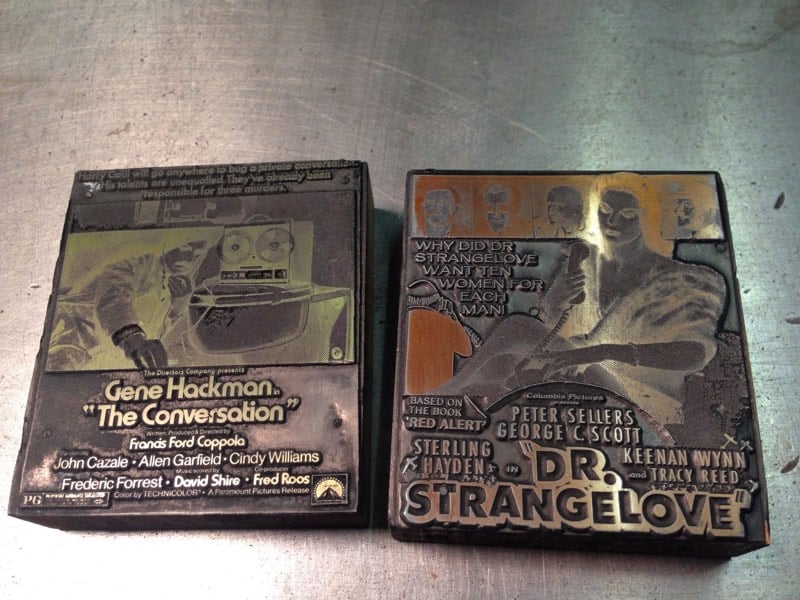
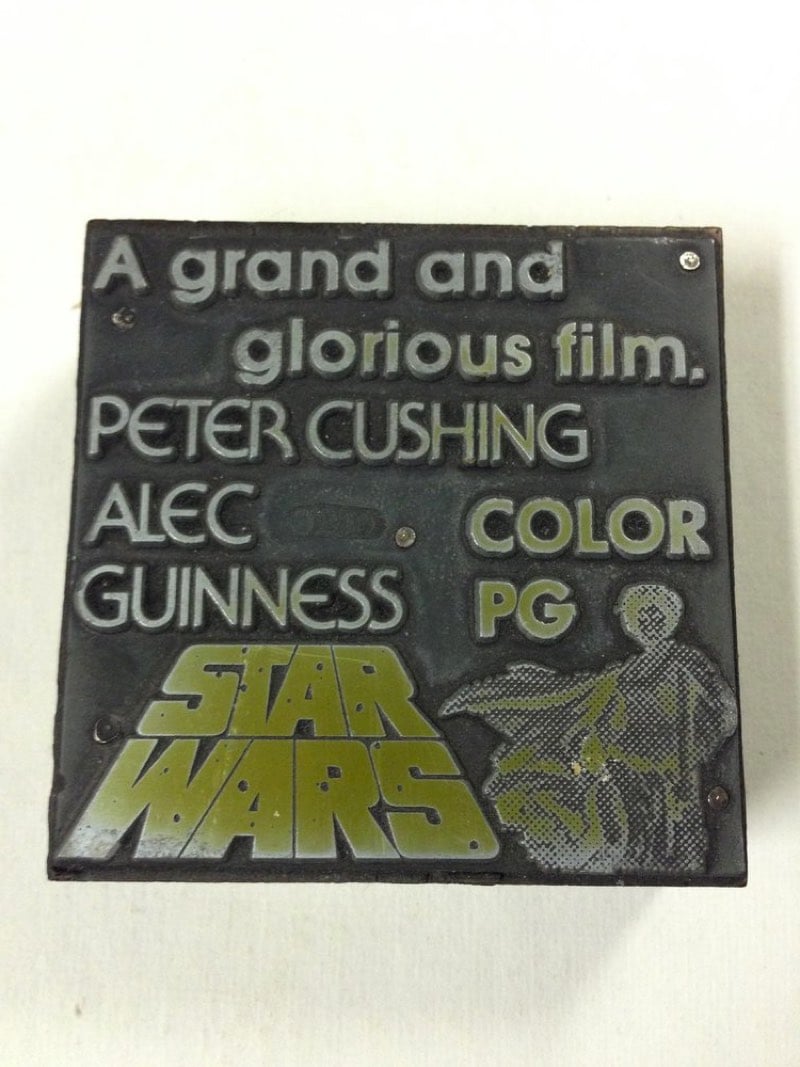
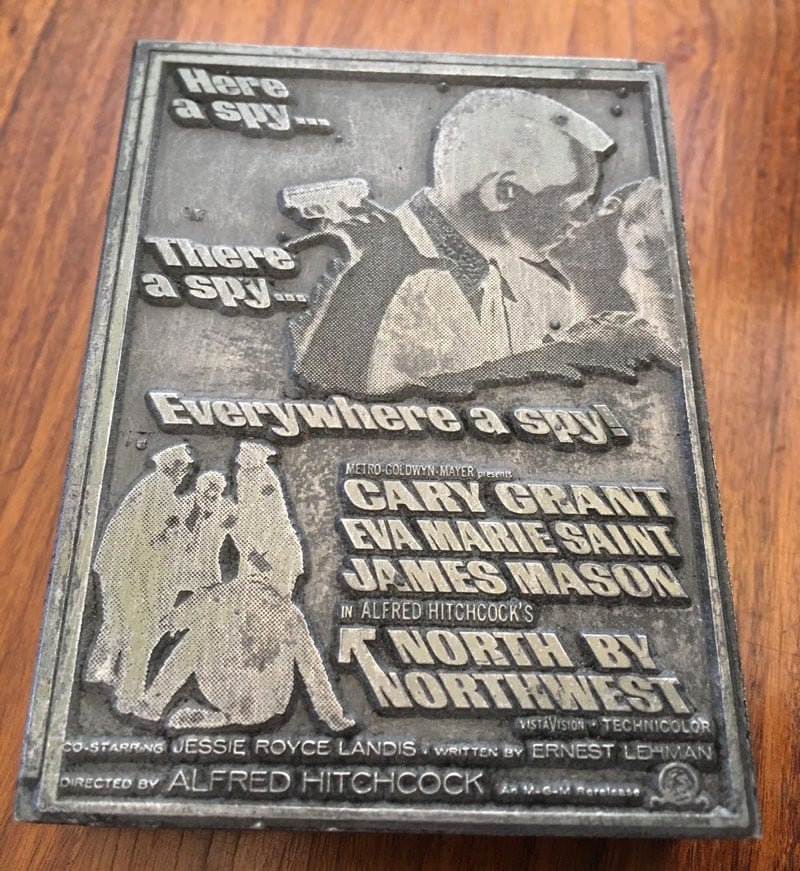
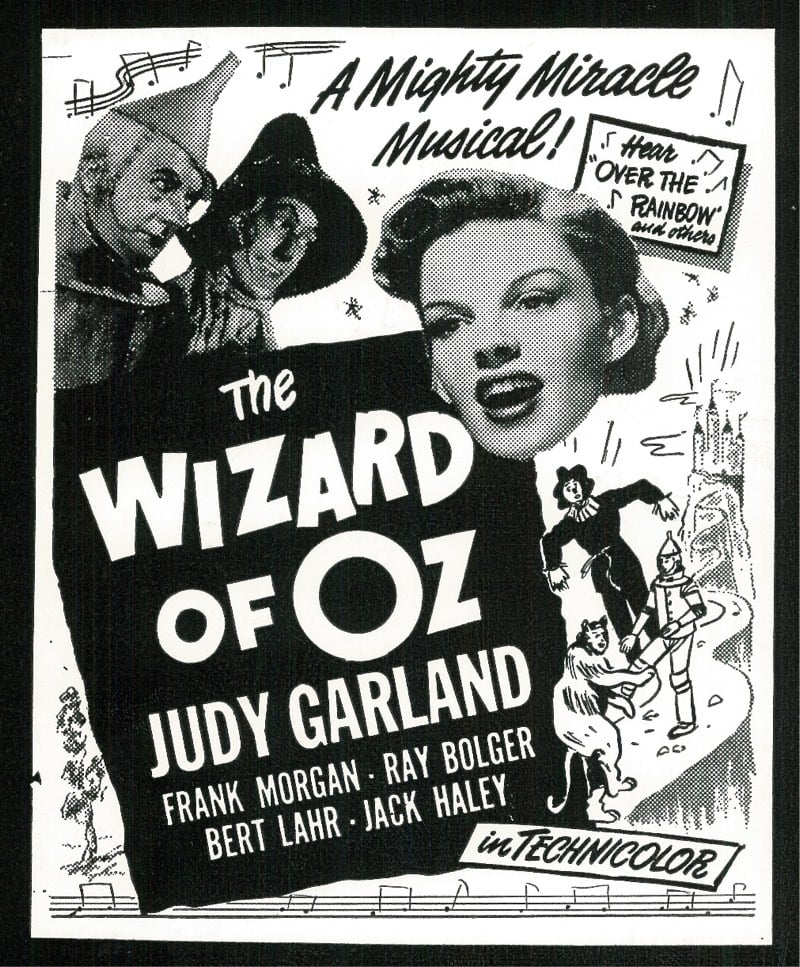
Note: I flipped the images of the plates so they would be readable. The actual plates are mirror images of the printed advertisements. Here’s what a print made from a plate looks like:
Have you ever wondered why, when you’re driving along on a straight road in the Western US, there’s a weird curve or short zigzag turn thrown into the mix? Grids have been used to lay out American roads and houses since before there was a United States. One of the most prominent uses of the grid was in the Western US: the so-called Jefferson Grid.
The Land Ordinance of 1785, drafted by Thomas Jefferson, extended government authority over the Mississippi River and the Great Lakes regions. As a response to what he believed to be a confusing survey system already in use, Jefferson suggested a new grid system based on the rectangle. The grid divided land into plots one mile square, each consisting of 640 acres. The grid also placed a visible design upon a relatively untouched landscape.
As most people know, the Earth is roughly spherical. When you try to cover the surface of a sphere with squares, they are not going to line up perfectly. That means, every so often, sections of the grid shift away from each other. Gerco de Ruijter’s short film, Grid Corrections, shows dozens of examples of places where this shift occurs and the corrections employed to correct them.
By superimposing a rectangular grid on the earth surface, a grid built from exact square miles, the spherical deviations have to be fixed. After all, the grid has only two dimensions. The north-south boundaries in the grid are on the lines of longitude, which converge to the north. The roads that follow these boundaries must dogleg every twenty-four miles to counter the diminishing distances.
If you want to look at some of the corrections yourself, try this location in Kansas (or this one). See that bend? Now scroll the map left and right and you’ll see a bunch of the north/south roads bending at that same latitude.

You can read more about de Ruijter’s project and grid corrections in this Travel & Leisure article by Geoff Manaugh.
Update: An email from my dad:
Hi son, just reading your blog on the section lines….don’t forget, you used to live on a correction line…that is why 3 of my 40’s were only 26.3 acres….
“40’s” refers to 40 acre plots…a common size for a parcel of land back when that area was divvied up. Wisconsin has so many lakes, rivers, and glacial features that interrupt the grid that it’s difficult to tell where the corrections are, but looking at the map, I can see a few roads curving at that latitude. Cool!
One of the first things you notice when watching Dunkirk is the sparse use of dialogue. There are long stretches of the film, particularly on the beach, when no one says anything. In interviews, Christopher Nolan has stated that he wanted to use visuals to drive the story in the film…”looking to the visual masters of the silent era”. Tom van der Linden took Nolan at his word and recut Dunkirk into 7-minute-long silent film; it works remarkably well.
Someone did a full-length silent version for Mad Max: Fury Road as well after director George Miller stated that the purest version of the film would be silent, but it got taken down. In my quick review of Dunkirk, I said “I feel like Christopher Nolan watched Mad Max: Fury Road and said, ‘I can do that…but my way.’”
Happy New Year everyone! Let’s get the year started off on a good note with some lowbrow laaaaaaaaffffs. Video funnyfolk Corridor took scenes from TV shows & movies (Stranger Things, Arrested Development, The Office, Full Metal Jacket) and replaced the actor’s heads with iPhone X animoji. The Gob scene is *kisses fingers*.
Mark Rober and some friends staked out the carnival games at a local fair for the day in order to find the scams and the ones you can win…if you know how. Armed with info from their observations, Rober hit the fair with a Mets player who could dominate all the throwing games and cleaned them out.
I spent some time at a county fair this past summer and, if you’re with little kids, the carnies will sometimes show you how to win the games that are winnable (like the basket toss). But even after he was shown, my son still couldn’t get that damned wiffle ball in the basket on the two-out-of-three times needed to win a prize.
For the holidays, the dusky-voiced gentleman behind Binging with Babish prepares some of the Baltimore specialties featured on The Wire…like pit beef and lake trout, which as Bunk says, features “no lake, no trout”. He even prepares the beer with an egg cracked in it enjoyed by the dock workers, although I didn’t appreciate his “kind of inferior season two” remark.
Speaking of inferior seasons of The Wire, I wonder if it’s time to go back to see how season five holds up in this current atmosphere of fake news. Maybe it wasn’t so outlandishly over-the-top after all?
Because of light pollution from urban areas, many people around the world don’t know what the night sky actually looks like. Sriram Murali made a video to illustrate light pollution levels by shooting the familiar constellation of Orion in locations around the US with different amounts of light pollution, from bright San Francisco to a state park in Utah with barely any light at all. In SF, about all you can see are the handful of stars that make up Orion’s belt, arms, and legs. But as the locations get darker, the sky explodes in detail and Orion is lost among the thousands of visible stars (and satellites if you look closely).
This video is a followup to one Murali made of the Milky Way in increasingly dark locations, which is even more dramatic:
But he did the second video with Orion as a reference because many people had no concept of what the Milky Way actually looks like because they’ve never seen it before. Murali explains why he thinks light pollution is a problem:
The night skies remind us of our place in the Universe. Imagine if we lived under skies full of stars. That reminder we are a tiny part of this cosmos, the awe and a special connection with this remarkable world would make us much better beings — more thoughtful, inquisitive, empathetic, kind and caring. Imagine kids growing up passionate about astronomy looking for answers and how advanced humankind would be, how connected and caring we’d feel with one another, how noble and adventurous we’d be.
The measurement scale for sky darkness is called the Bortle scale, as explained by David Owen in his wonderful piece in the New Yorker:
In Galileo’s time, nighttime skies all over the world would have merited the darkest Bortle ranking, Class 1. Today, the sky above New York City is Class 9, at the other extreme of the scale, and American suburban skies are typically Class 5, 6, or 7. The very darkest places in the continental United States today are almost never darker than Class 2, and are increasingly threatened. For someone standing on the North Rim of the Grand Canyon on a moonless night, the brightest feature of the sky is not the Milky Way but the glow of Las Vegas, a hundred and seventy-five miles away. To see skies truly comparable to those which Galileo knew, you would have to travel to such places as the Australian outback and the mountains of Peru.
Nicola Twilley and Geoff Manaugh interviewed Paul Bogard, author of a book on darkness about light pollution and the Bortle scale:
Twilley: It’s astonishing to read the description of a Bortle Class 1, where the Milky Way is actually capable of casting shadows!
Bogard: It is. There’s a statistic that I quote, which is that eight of every ten kids born in the United States today will never experience a sky dark enough to see the Milky Way. The Milky Way becomes visible at 3 or 4 on the Bortle scale. That’s not even down to a 1. One is pretty stringent. I’ve been in some really dark places that might not have qualified as a 1, just because there was a glow of a city way off in the distance, on the horizon. You can’t have any signs of artificial light to qualify as a Bortle Class 1.
A Bortle Class 1 is so dark that it’s bright. That’s the great thing — the darker it gets, if it’s clear, the brighter the night is. That’s something we never see either, because it’s so artificially bright in all the places we live. We never see the natural light of the night sky.
If you’d like to find a place near you with less light pollution, check out The Light Pollution Map. I’m lucky enough to live in a place with a Bortle class of 3 and I’ve visited class 2 locations before…visiting one of the class 1 parks out west is definitely on my bucket list.
We’ve seen autonomous swarming killer robots before (in Black Mirror and other places), but this video presents a particularly plausible scenario for their development: a venture-backed company led by a Travis Kalanick-style CEO combining tiny drones invented by a playful technologist, AI-powered facial recognition, and miniature explosives to make tiny killbots that will no doubt disrupt the world while creating a ton of shareholder value.
The video is produced by a group that wants to ban autonomous weapons, and I think these things will probably be banned in some form, possibly by banning drones and some kinds of consumer electronics altogether. What struck me most while watching this is that if guns were a new invention, they would most likely be banned in the US, just like lawn darts or explosive devices. A hand-held machine that can kill a person 1000 feet away and hides easily in a pocket? That sounds like a dangerous, litigious nightmare, just the sort of thing the US routinely regulates against for the safety of its people.
Mortal Engines is a forthcoming post-apocalyptic movie about giant mobile cities roaming the Earth in search of smaller cities to scavenge.
Thousands of years after civilization was destroyed by a cataclysmic event, humankind has adapted and a new way of living has evolved. Gigantic moving cities now roam the Earth, ruthlessly preying upon smaller traction towns.
The Lord of the Rings team of Fran Walsh, Philippa Boyens and Peter Jackson wrote the screenplay, adapted from the first book in Philip Reeve’s series of the same name. Here’s concept of the book from Wikipedia:
The book is set in a post-apocalyptic world, ravaged by a “Sixty Minute War”, which caused massive geological upheaval. To escape the earthquakes, volcanoes, and other instabilities, a Nomad leader called Nikola Quercus installed huge engines and wheels on London, and enabled it to dismantle (or eat) other cities for resources. The technology rapidly spread, and evolved into what is known as “Municipal Darwinism”. Although the planet has since become stable, Municipal Darwinism has spread to most of the world except for Asia and parts of Africa. Much technological and scientific knowledge was lost during the war. Because scientific progress has almost completely halted, “Old Tech” is highly prized and recovered by scavengers and archaeologists. Europe, some of Asia, North Africa, Antarctica, and the Arctic are dominated by Traction Cities, whereas North America was so ravaged by the war that it is often identified as “the dead continent”, and the rest of the world is the stronghold of the Anti-Traction League, which seeks to keep cities from moving and thus stop the intense consumption of the planet’s remaining resources.
This sounds like it could be great…if they don’t muck it up.
The first version of Star Wars that George Lucas showed publicly (to Steven Spielberg and Brian De Palma) was, as Spielberg later related, a mess. This video from RocketJump shows how Lucas and the film’s team of editors, particularly George’s then-wife Marcia Lucas, recut the film into the classic it is today. The beginning of the film was extensively reworked — some scenes were cut and others moved around to give the story more clarity. In other spots, small cutaway scenes were added to improve the flow, to explain plot details without expositional dialogue, and to smooth over rough transitions. And the drama of the end of the film was totally constructed in the editing phase by using off-screen dialogue and spliced-in scenes from earlier in the film.
There are greater examples of editing in other films, but Star Wars is such a known entity that this is a particularly persuasive take on just how important editing is in filmmaking. (via fairly interesting)
If you grew up watching Sesame Street but are now old enough to realize that Bert, Ernie, Big Bird, and Oscar aren’t actually real, this behind-the-scenes video about how the puppets are controlled is a must-see. What struck me most was that the puppeteers do both the movement and the voice for these characters…the guy inside the Snuffleupagus suit is actually speaking the lines. It would be so easy to separate the two activities with voiceovers added later, but I bet the final result wouldn’t be as good as using the on-set full-body performance.
See also Four things about Mr. Snuffleupagus, including the unusual reason his existence was finally revealed to the grownups on the show. (via @simplebits)
Rick Brown owns an adventure tour company called Adventure Sixty North in Seward, Alaska, a small town on an inlet of the Kenai Peninsula. They offer guided hikes and kayaking tours of the surrounding country, including ice hikes on the Exit Glacier.
In this video, Brown talks very simply and powerfully about the changes that he’s witnessed in the glacier and in Alaska in his long career as a guide…like that the Exit Glacier is currently retreating 10 to 15 feet per day.
Normally I think the park will tell you that it retreats about 150 feet per year. Right now they’re looking at 10 to 15 feet per day. You’re seeing the big crevasses that used to be blue up on top of the compression zones now down in the toe of the glacier just falling over. Something that normally would take hundreds of years we’re seeing probably in a matter of a year or two.
You can see a map of how much the glacier has retreated since 1950. But it’s not just the glacier…other changes are occurring in Alaska.
We’re seeing a change in the wildlife. We have villages that are being relocated. We get storms up here that if they were happening down in the lower 48, we’d name them something. Our ten-year floods are happening every other year now. You can drive to our town and look at what’s going on, and if you can’t see what’s happening, then I think that you must be blind. Normally I would need a plow here in my office and we need a lawnmower.
While Seward is not quite so far north, I couldn’t help but think of Eric Holthaus’s recent piece on how the fundamental character of the Arctic has changed, possibly for good. Namely, that it won’t be frozen anymore:
Last week, at a New Orleans conference center that once doubled as a storm shelter for thousands during Hurricane Katrina, a group of polar scientists made a startling declaration: The Arctic as we once knew it is no more.
The region is now definitively trending toward an ice-free state, the scientists said, with wide-ranging ramifications for ecosystems, national security, and the stability of the global climate system. It was a fitting venue for an eye-opening reminder that, on its current path, civilization is engaged in an existential gamble with the planet’s life-support system.
In an accompanying annual report on the Arctic’s health — titled “Arctic shows no sign of returning to reliably frozen region of recent past decades” — the National Oceanic and Atmospheric Administration, which oversees all official U.S. research in the region, coined a term: “New Arctic.”
What an astonishing thing. Perhaps in 20 years, when someone over the age of 35 uses a phrase like “Arctic cold” as a stand-in for extremely cold weather, their kids won’t know what the hell they’re referring to. (via @JossFong)
A good idea, persistence, the value of limits, the power of collaboration, turning weaknesses into strengths, procuring funding for creative projects…there’s a little bit of everything in this video on the creative process in action.
For years, Max Joseph had an idea: what if you could turn highway divider markers into an animation via the zoetrope effect? You know, Burma Shave by way of Eadweard Muybridge. He kept telling people about this idea until one day, someone agreed to fund it. He found some enthusiastic collaborators and started work. They soon reached a potential failure point — the project as originally conceived was logistically impossible — but quickly found a solution that made the project thematically stronger without straying too far from the initial concept. (via swissmiss)
Published just the poster last night and lo-and-behold, the first trailer is out this morning. Can’t wait for this.
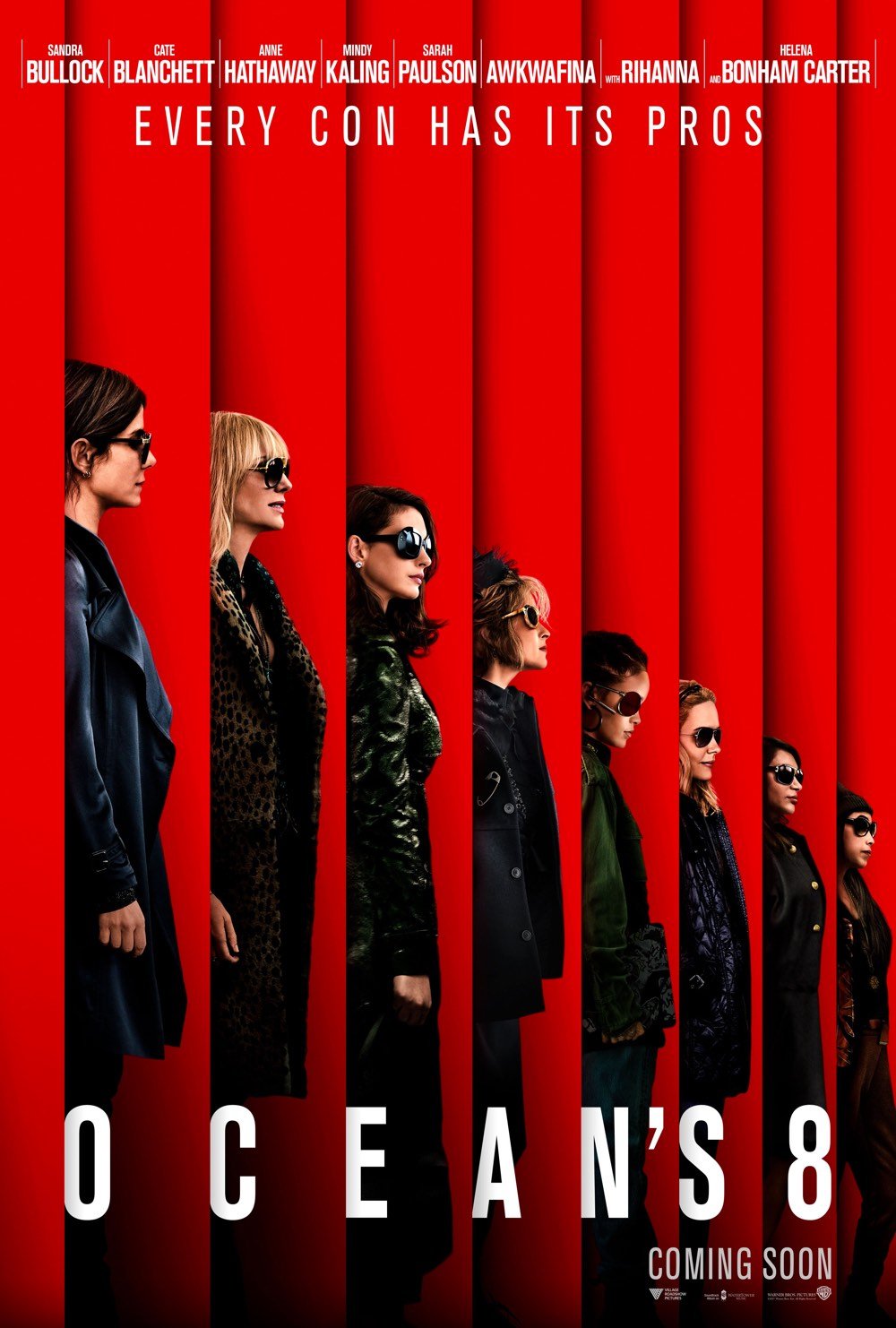
Oh don’t mind me, I’m just hyperventilating over this poster for Ocean’s 8. Helena Bonham Carter, Mindy Kaling, Rihanna, Sandra Bullock, Anne Hathaway, and Cate Blanchett.
Update: A new trailer and a release date: June 8.
This is an animation of traffic flows simulated on 30 different kinds of four-way junctions, from two roads intersecting with no traffic lights or signs to complex stacked interchanges that feature very few interactions between individual cars. It was recorded in a game called Cities: Skylines, a more realistic take on SimCity.
The developer’s goal was to create a game engine capable of simulating the daily routines of nearly a million unique citizens, while presenting this to the player in a simple way, allowing the player to easily understand various problems in their city’s design. This includes realistic traffic congestion, and the effects of congestion on city services and districts.
I don’t know how accurate the observed rates of flow are — where my transportation engineers at? — but it’s super interesting to watch the various patterns get increasingly complex and efficient, and how the addition of dedicated turn lanes, roundabouts, overpasses, and slip lanes affect the flow. Be on the lookout for the turbo roundabout, the diverging windmill (which, coincidentally, is the name of my signature dance move), and the incredibly complex pinavia,1 which can handle almost five times the traffic flow compared to a simple intersection with no lights.
DeepDream is, well, I can’t improve upon Wikipedia’s definition:
DeepDream is a computer vision program created by Google engineer Alexander Mordvintsev which uses a convolutional neural network to find and enhance patterns in images via algorithmic pareidolia, thus creating a dream-like hallucinogenic appearance in the deliberately over-processed images.
The freaky images took the web by storm a couple of years ago after Google open-sourced the code, allowing people to create their own DeepDreamed imagery.
In the video above, Mordvintsev showcases a DeepDream-ish new use for image generation via neural network: endlessly zooming into artworks to find different artworks hidden amongst the brushstrokes, creating a fractal of art history.
Bonus activity: after staring at the video for four minutes straight, look at something else and watch it spin and twist weirdly for a moment before your vision readjusts. (via prosthetic knowledge)
For the latest installment of the Dance In The Real World series, the NY Times visited a Chicago roller rink where people skate in a JB Style, named after the performer James Brown. I wanted to watch about 10 more minutes of that…and then go roller skating. See also Dancing on Skates.
Other videos in the Dance In The Real World series include stilt-dancing in Trinadad and the new vogueing scene in NYC. And they’re the perfect snackable size…I watched all five of them just now.
From British Pathé, a short video from 1963 on how candles are made.
Oh yes, candles make the whole of humanity into one big understanding family.
Candles! I can’t believe the answer has been staring us in the face this whole time. (via the morning news)
Vanity Fair does this thing where they get people to put their hands into a box to touch an unknown object. They call it The Fear Box. The latest installment features John Boyega & Gwendoline Christie from Star Wars: The Last Jedi confronting their fear of snakes, lizards, BB-8s, and plush Chewie toys. If you need a pick-me-up today, this should do the trick.
In an episode of Pop Culture Detective, Jonathan McIntosh discusses The Fantastic Masculinity of Newt Scamander. Scamander is the hero of the Fantastic Beasts and Where to Find Them movie that takes place in the Wizarding World of Harry Potter.
Many reviews of the film found Scamander to be a weak hero, but McIntosh argues that the character offers a view of masculinity that we don’t often see in movies, “a gentle empathetic version of heroic masculinity”. Scamander is not The Chosen One (like Harry or Luke Skywalker)…he’s a male hero who is emotional and nurturing and whose strengths are vulnerability, sincerity, and sensitivity.
It’s funny, when I was reading Harry Potter with my kids, we talked a lot about the flaws in Harry’s heroism, e.g. how his hotheadedness frequently put him and his friends into danger. But I didn’t notice how much of strong and vulnerable hero Scamander was. I’m gonna have to go back and watch this again.
A wheel comes off of a car during a race and behaves in an amazingly tidy way until…well, I won’t spoil it for you but watch until the wheel stops. The polar opposite of this video of the most unsatisfying things in the world.
For his work Nowhere and Everywhere at the Same Time, William Forsythe sets in motion hundreds of pendulums in a room and invites people to walk among them, attempting to avoid collisions.
Suspended from automated grids, more than 400 pendulums are activated to initiate a sweeping 15 part counterpoint of tempi, spacial juxtaposition and gradients of centrifugal force which offers the spectator a constantly morphing labyrinth of significant complexity. The spectators are free to attempt a navigation this statistically unpredictable environment, but are requested to avoid coming in contact with any of the swinging pendulums. This task, which automatically initiates and alerts the spectators innate predictive faculties, produces a lively choreography of manifold and intricate avoidance strategies.
When I read the preview for the video at The Kid Should See This, I was expecting heavy brass pendulums cutting large swaths through the room, not unlike the first challenge in Indiana Jones and the Last Crusade where “only the penitent man will pass”. That would have been fun but perhaps too dangerous and not art.
A Bite of China is documentary TV series on food and cooking in China. Writing for The Guardian, Oliver Thring called it “the best TV show I’ve ever seen about food” and one commenter called it “the Planet Earth of food”. While A Bite of China predates it by 3 years, Chef’s Table might be a better comparison. Here’s a trailer:
China has a large population and the richest and most varied natural landscapes in the world. Plateaus, forests, lakes and coastlines. These various geographical features and climate conditions have helped to form and preserve widely different species. No other country has so many potential food sources as China. By collecting, fetching, digging, hunting and fishing, people have acquired abundant gifts from nature. Traveling through the four seasons, we’ll discover a story about nature and the people behind delicious Chinese foods.
The first season is available on Amazon Prime (with English subtitles) but you can also find it on YouTube at varying levels of quality with and without subtitles and dubbed in English. (thx, seamus)
Newer posts
Older posts




Socials & More