kottke.org posts about video
Every once in a while during my internet travels, I run across something like this video: something impossibly mundane and niche (a ~26-minute video of someone solving a sudoku puzzle) that turns out to be ludicrously entertaining. I cannot improve upon Ben Orlin’s description:
You’re about to spend the next 25 minutes watching a guy solve a Sudoku. Not only that, but it’s going to be the highlight of your day.
The solver himself calls it “a work of sublime genius” and “one of the most extraordinary puzzles we’ve ever seen”. It’s fascinating listening to him slowly uncover different aspects of the puzzle — watching him methodically figure out the 3s was genuinely thrilling. And the symmetry thing at the end…
If you fancy yourself a sudoku master, you can try solving the puzzle yourself here (keeping in mind the special chess-related rules laid out in the video). (via @robinsloan)
In this charming little film (that feels very Wes Andersonian), we get to visit the Union Glacier Camp in West Antarctica, see what life is like there, and meet the people who run it. The camp is situated next to a blue-ice runway (which makes the area accessible to large aircraft) and serves as the jumping-off point for many kinds of activities, projects, and expeditions.
Union Glacier Camp is the only facility of its kind in Antarctica. Our full-service private camp operates during the Antarctic summer (November through January) and is dismantled at the end of each season. Our camp not only provides accommodations to guests on guided experiences but also serves as a logistics hub, supporting private expeditions and National Antarctic Programs.
I love the grid of tents for guests.
We can house up to 70 guests in our dual occupancy Clam Tents. These double-walled sleeping tents are designed to withstand Antarctic conditions with a high-tech nylon covering and durable aluminum frame that opens up like a clam shell. They are also incredibly comfortable to live in with large doors and a tall interior that allows you to stand upright and move around easily (16 ft x 8 ft or 5 m x 2.4 m). Tents are naturally heated by the 24-hour sunlight up to 60^0-70^0F (15^0-21^0C) but also have a wooden floor underneath to provide insulation from the snow and solid footing. Each guest is provided with a cot, mattress, pillow, linens, towels, and wash basin.
Tourist trips to Union Glacier start at $26,000 for six days.
Spike Lee’s newest film, Da 5 Bloods, is coming to Netflix on June 12 and the trailer, driven by the Chambers Brothers’ psychedelic rock anthem Time Has Come Today, is really compelling.
From Academy Award(R) Winner Spike Lee comes a New Joint: the story of four African-American Vets — Paul (Delroy Lindo), Otis (Clarke Peters), Eddie (Norm Lewis), and Melvin (Isiah Whitlock, Jr.) — who return to Vietnam. Searching for the remains of their fallen Squad Leader (Chadwick Boseman) and the promise of buried treasure, our heroes, joined by Paul’s concerned son (Jonathan Majors), battle forces of Man and Nature — while confronted by the lasting ravages of The Immorality of The Vietnam War.
Having recently been to Vietnam and done a bit of reading about US veterans retiring there, I’m interested to see how Lee handles that dynamic and portrays the country.
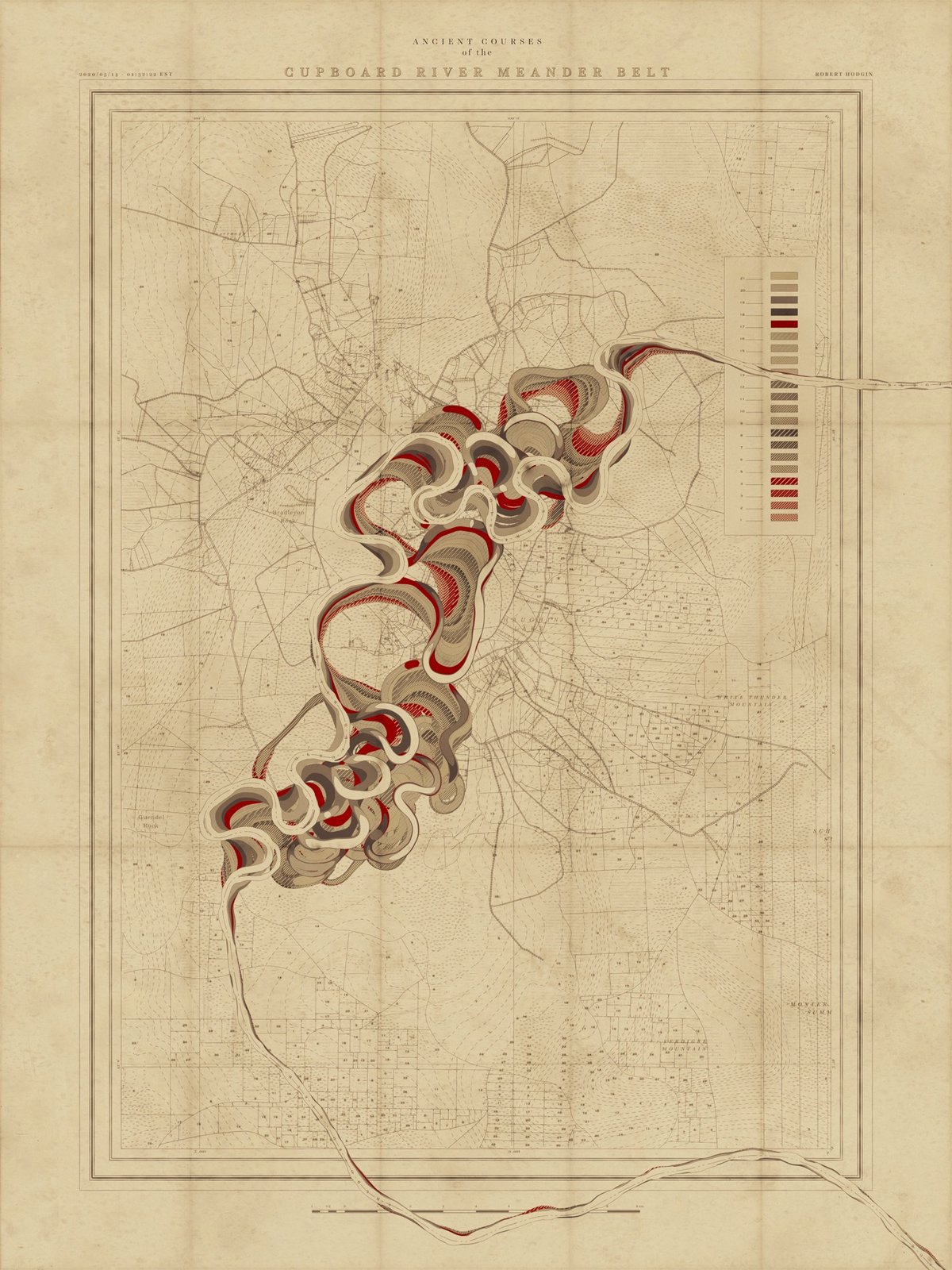
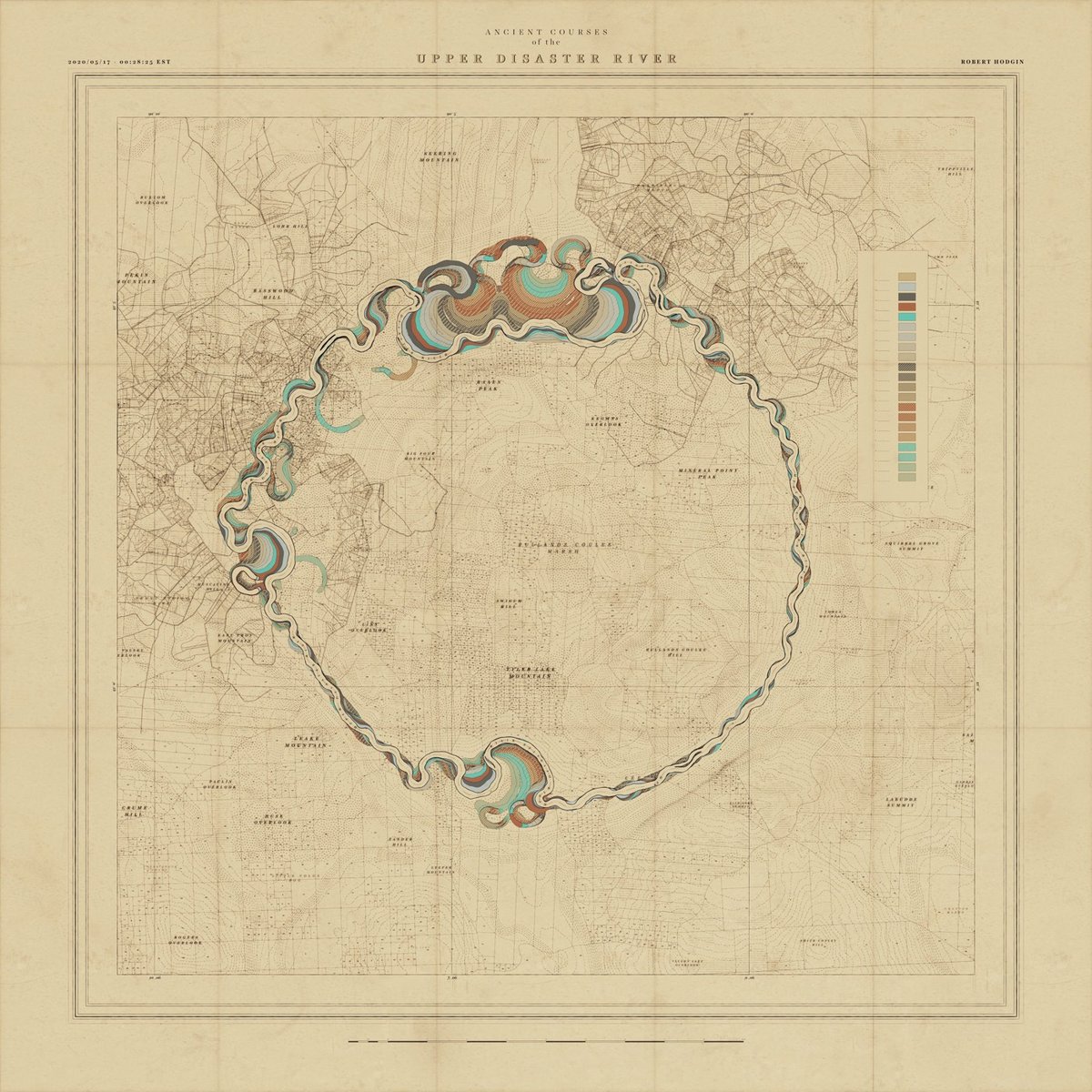
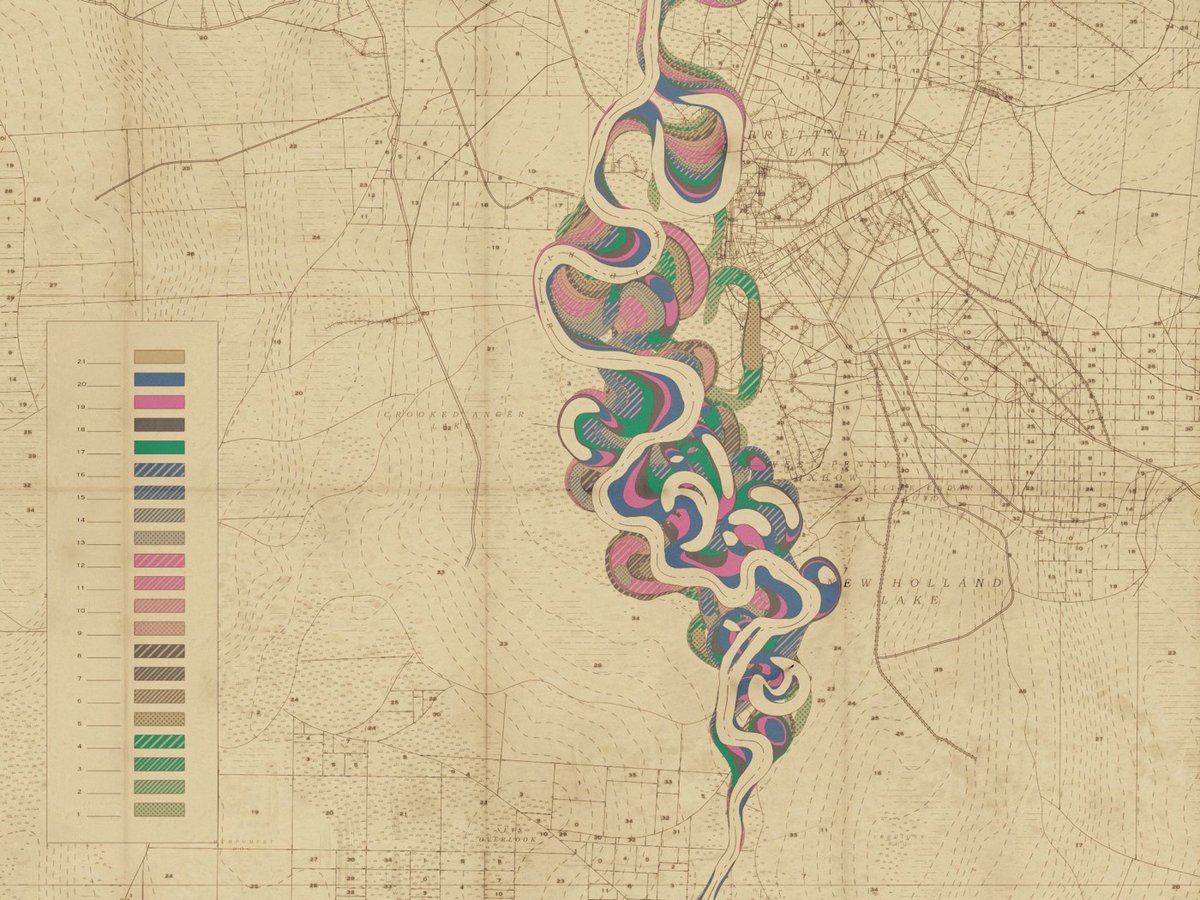
I have written previously about cartographer Harold Fisk’s wonderful meander maps of the Mississippi River produced for the Army Corps of Engineers. Borrowing the aesthetic of these maps, interactive artist & engineer Robert Hodgin wrote some software called Meander to generate meander maps for fictional rivers.
From an input curve, the terrain, land plots, side roads, highways, marsh land and mountain peaks are generated and prominent features are named. The map is then weathered and rendered in the style of old US Army Corp of Engineers maps from the 1930s and 40s.
You can check some of the generated maps out on Twitter or on Instagram, including some prototypes and animations (this one is my favorite). Hodgin has promised a full write-up of the project; I’ll link to it when he publishes it.
Coincidentally, while I was writing this post I got an email from a reader about an audiovisual installation called Meandering River that displayed “real-time visuals generated by an algorithm and music composed by an A.I.”
Synchronicity!
Update: Hodgin wrote about the Meander project on his website and included several more gorgeous examples of his output.
One of many cancellations due to the pandemic is the Public Theater’s annual Shakespeare in the Park performances. But for the next three weeks, PBS is streaming their Great Performances recording of last year’s Shakespeare in the Park production of Much Ado About Nothing for free on their site (embedded above, reviews here).
This bold interpretation of Shakespeare’s comedic masterpiece features Danielle Brooks (“Orange is the New Black,” Broadway’s “The Color Purple”) and Grantham Coleman (“Buzzer,” “The Americans”) as the sparring lovers Beatrice and Benedick. Tony Award winner Kenny Leon (“American Son,” “A Raisin in the Sun”) directs with choreography by Tony Award nominee Camille A. Brown (“Choir Boy”).
To whet your appetite, you can check out some of the highlights of the performance in this short video.
P.S. You can also watch this 2009 production of Macbeth starring Patrick Stewart in the lead role. (via laura olin)
Most nights since mid-March, The Roots’ Questlove has been doing lengthy DJ sets for fans, kind of like a series of distributed house parties. The shows range in length from 2.5 hours to more than 6 hours — most are in the 3-4 hour range. The past shows have been collected in this playlist. The most recent show, from Tuesday, celebrated the 70th birthday of Stevie Wonder:
He did a 3-hour set made up of audience requests:
And of course there were sets focused on particular artists and bands — the Beastie Boys, James Brown, and Prince:
From a Fast Company piece about how The Roots have adapted their approach to entertainment during the pandemic:
“My whole narrative is that I’m this musical griot or this musical expert with 170,000 pieces of vinyl that you can Google, but now that I’m thrown in the pool, I realized, yeah, I have 170,000 records, but at the end of the day, I know maybe 400.”
Questlove has digital access to about 30% of that massive collection and decided to get to know more of his songs in front of a live audience. It’s different when that audience is the internet, but Questlove gets it now. He can reach more people. He’s having fun with his selections, and his diverse and meticulous approach to music shows up in his nightly playlists.
“I challenged myself to do a dancehall set that didn’t require me to play ‘Murder She Wrote.’ I’m gonna try and do the salsa set that doesn’t require me to play like ‘Suavemente,’ all the Captain Obvious stuff,” he explains. “So, I mean just as a music lover and a musician, it’s challenging me to find exciting ways to present music.”

For a limited time, you can view the feature length documentary Chair Times: A History of Seating online for free courtesy of Vitra, a Swiss design company. Here’s a trailer:
In the focus are 125 objects from the Collection of the Vitra Design Museum. Arranged according to their year of production, they illustrate development from 1807 to the very latest designs straight off the 3D printer, forming a timeline to modern seating design.
Accompanying the film is a book of the same name. (via moss & fog)
As part of a benefit for Covid-19 relief, The Prince Estate will be broadcasting a classic concert by Prince & the Revolution from 1985’s Purple Rain tour on YouTube. The stream (embedded above) will begin on Thursday, May 14 at 8pm ET and will only be available through Sunday, May 17.
The concert was recorded in Syracuse, NY on March 30, 1985 and is considered a classic, a show that found Prince at the crest of his pop culture stardom. Laurie Gwen Shapiro recounted going to the show in college — a friend of hers camped out in the ticket line to get front row seats.
In the past decade it has been very difficult to find this legendary concert film in the United States that was later released in the 1991 as “Prince and the Revolution Live!” on VHS only. If you watch the film — and I swear this is true — I am the person the cameras flashes on first in a venue that holds 40,000 plus, and I am making a rather ridiculous orgiastic face for the ages. To understand how I was the beneficiary of such dumb luck, and the greatness of Prince’s performance, let’s go back to 1985 when the internet was yet to come.
The setlist includes many of his most popular songs — Let’s Go Crazy, When Doves Cry, 1999, Little Red Corvette — and the show ended with a 20-minute rendition of Purple Rain (10 minutes of which is a Prince guitar solo).
By the time they finished a towering 20 minute rendition of “Purple Rain,” featuring what is probably the best single guitar solo I’ve ever witnessed in the flesh, most of the crowd would have let Prince do anything with them that he wished. What Prince did to us, and for us, was the best gift of all.
The show is also available on DVD as part of this remastered edition of Purple Rain. The remastered audio from the concert will also be released to streaming services on Friday.
Update: The live album is now available on streaming music platforms: Spotify, Apple Music, Amazon, Pandora.
The Purple Rain closer clocks in at 19 minutes 26 seconds.
Update: Prince superfan Anil Dash wrote up some notes about this show.
Finally, we come to Prince’s scorching final guitar coda to “Let’s Go Crazy” where he brings out his entire palette of Guitar Face expressions, from playful smirk to full Mustachioed Telecaster Orgasm.
This made me laugh really hard today:
Gotta be frustrating. ♪ Around the world, around the world, around the world, around the world, around the world, around the world… ♪ (thx, naomi)
In the “couch gag” preceding The Simpsons episode that aired on May 3, 2020, they did a pitch-perfect parody of the opening title sequence of Succession, complete with the iconic theme song. (via @omcfarlane)
11-year-old skateboarder Gui Khury has become the first person ever to land a 1080 on a vert ramp. That’s 3 full spins.
More than two decades after Tony Hawk completed the first 900-degree turn, Khury shattered a long-standing record by flying off the top of a ramp and completing three full spins in the air before landing cleanly and skating off. The manoeuvre has long been one of the holy grails of skateboarding.
“The isolation for the coronavirus helped because he had a life that was about school and he didn’t have a lot of time to train, when he got home from school he was tired,” the skater’s father Ricardo Khury Filho told Reuters.
“So now he is at home more, he eats better and he has more time to train and can focus more on the training so that has helped. He has an opportunity to train here, if he didn’t have [the skate facilities] … he would be stuck at home like everyone else and unable to do sport. So the isolation helped him focus.”
Wow.
Update: Now 12, Khury landed a 1080 at the X Games yesterday and collected a gold medal for best trick. Better yet, he did it in front of Tony Hawk.
Perhaps my fondness for Michel Gondry’s video for The Chemical Brothers’ Star Guitar has primed me to enjoy these POV Swiss train videos paired with techno music. The driving beat of the music, the forward motion of the train, and the soaring scenery complement each other perfectly. (via why is this interesting?)
Andy Serkis, who played Gollum in the Lord of the Rings movies, is reading The Hobbit (the entire book!) aloud for 12 straight hours today to raise money for Covid-19 relief.
So many of us are struggling in isolation during the lockdown. While times are tough, I want to take you on one of the greatest fantasy adventures ever written, a 12 hour armchair marathon across Middle Earth whilst raising money for two amazing charities which are doing extraordinary work right now to help those most in need in the UK: Best Beginnings and NHS Charities Together.
He’s been going since 5am EST, so you can join in progress or rewind your way back to the beginning. The campaign has already reached its initial goal of £100,000 — you can contribute here. A “special surprise” was promised if the goal was met…I wonder if Ian McKellen or Martin Freeman will be stopping by for a chapter or two?
Listening to recorded music as if it’s being played in empty malls1 is a thing that I find incredibly soothing and nostalgic and also a little creepy?
An entire playlist is available here. Some of these sound more convincing than others, but almost any of them with 80s music instantly transports me back to wandering past Kay Bee Toys, Chess King, and Spencer’s while wearing my Hypercolor t-shirt, KangaROOS, and Guess jeans.1 (via @Remember_Sarah)
As someone who suspects I may have had a mild case of Covid-19 a couple of months ago, I’ve been thinking about getting tested for antibodies. But as this video from ProPublica shows, even really accurate tests may not actually tell you all that much.
And the thing is, the “do I have Covid-19 right now” tests are plagued by the same issue.
For patients getting tested, the main concern is how to interpret the outcome: If I test negative with an RT-PCR genetic test, what are the chances I actually have the virus? Or if I test positive with an antibody test, does it actually mean I have the antibodies?
It turns out that the answers to these questions don’t just hinge on the accuracy of the test. “Mathematically, the way that works out, that actually depends on how many people in your area have Covid,” Eleanor Murray, an assistant professor of epidemiology at the Boston University School of Public Health, said.
The rarer the disease in the population, the less you’ll learn by testing.
Let’s say we have a hypothetical Covid-19 test for antibodies that is both 99 percent sensitive — meaning almost all people with antibodies will test positive — and 99 percent specific, meaning almost all people who were never infected will yield a negative result.
If you test a group of 100 uninfected people, odds are one of them will still test positive even though they don’t have the virus. Conversely, if you test 100 people who were infected, it’s likely one of them will still test negative.
Now let’s presume the virus has a prevalence rate of 1 percent, so one person in 100 carries antibodies to it. If you test 100 random people and get a positive result, what is the chance that this person was truly infected?
Deborah Birx, the White House Covid-19 response coordinator, explained the answer at a press conference on April 20: “So if you have 1 percent of your population infected and you have a test that’s only 99 percent specific, that means that when you find a positive, 50 percent of the time will be a real positive and 50 percent of the time it won’t be.”
So even if I test positive for antibodies and I assume that confers immunity, given that the number of confirmed infections in Vermont is so low (~900 statewide), it doesn’t seem like I would be justified in changing my behavior at all. I would still have to act as though I’ve never had the virus, both for my own health and the health of those around me. Maybe if I had two or three corroborating tests could I be more certain…
Designer Cyril Diagne has developed a prototype of an augmented reality app that can copy objects from the real world and paste them into a Photoshop document. Here’s how it works: you point your phone at a book sitting on your desk, the software produces an image of just the book on your phone screen, you point the phone at your computer, and the book image gets pasted into the Photoshop document. It looks like straight-up magic (or at least like a scene from Minority Report or something):
Diagne wrote a thread on Twitter with more technical details. The code is available on Github if you’d like to give it a try. (via colossal)
My kids have been making their way through the Daniel Craig Bond movies so when I mentioned that our local theater was planning on showing drive-in movies on a screen in the parking lot, my son said, “ooh, maybe they’ll show the new Bond movie”.1 Then they began to speculate who would be singing the theme song in the new movie, and I piped in: it’s Billie Eilish and they’ve already released the song.
So we listened to it and, since they had just watched Spectre, I also played Radiohead’s rejected theme song, which I obviously prefer to Sam Smith’s bland Oscar-winning song. This morning, while trying to figure out who sang the official one, I ran across the video of Radiohead’s version played over the opening credits (embedded above). Gah, so much better. What a missed opportunity.
P.S. Funny story from my research: not only was Smith unaware that Radiohead had been asked to do the theme song before them, they were also apparently unaware of who Radiohead frontman Thom Yorke even was.
The Pacific Crest Trail runs 2650 miles from the border of Mexico to the border of Canada through California, Oregon, and Washington. Hiking the whole thing usually takes months, but this video by Mac of Halfway Anywhere compresses the entire experience down to just three minutes presented in 1-second snippets.
I was skeptical about this going in — I thought it was going to be like watching one of those impossible-to-follow “my life in one-second increments” videos — but the consistent presence of the path tied all the disparate moments into a cohesive journey. You can check out a much longer cut of the same journey and a similar edit of the Continental Divide Trail in four minutes.
The scenery in both of these videos are spectacular and remind me of my roadtrips from the past two years. (via @stewartbrand)
Based on her memoir of the same name and produced by the production company she created with her husband, Becoming is a film about Michelle Obama that premiered on Netflix today.
Becoming is an intimate look into the life of former First Lady Michelle Obama during a moment of profound change, not only for her personally but for the country she and her husband served over eight impactful years in the White House. The film offers a rare and up-close look at her life, taking viewers behind the scenes as she embarks on a 34-city tour that highlights the power of community to bridge our divides and the spirit of connection that comes when we openly and honestly share our stories.
The trailer and a clip from the film are embedded above. The clip features Obama talking with a group of young black women on her book tour and one of them asks about getting her life “back on track” after her husband’s presidency. Obama’s answer is remarkably timely:
What I’ve learned is that…get back on what track? It’s a whole new track. It’s not going back — it’s just all different and it’s different forever. So it’s not getting back on track, it’s creating my next track.
I think many Americans and people across the world are struggling with accepting that idea in the midst of the pandemic.
The NYPL has released an album of sound-based experiences that you might be missing right now as we all shelter at home: Missing Sounds of New York.
It’s a short album (16 min) and includes soundscapes like Serenity Is a Rowdy City Park, I’d Call a Cab to Anywhere, and The Not-Quite-Quiet Library.
See also this 3+ hour album of ambient city sounds. There are also many videos of ambient city sounds on YouTube, like this 10-hour video of ambient NYC sounds:
This is a mix of ambience sounds recorded around Christmas Eve as well as St Patrick’s Day. Enjoy the sounds of people talking, traffic noises, police sirens, subway sounds, footsteps around NYC. City sounds at night and day.
Or perhaps you’d like to go for a stroll in the city instead? (via the morning news)
Have a Good Trip is an upcoming Netflix documentary about tripping on psychedelics, like a celebrity/comedy version of Erowid’s drug trip report database.
Mixing comedy with a thorough investigation of psychedelics, HAVE A GOOD TRIP explores the pros, cons, science, history, future, pop cultural impact, and cosmic possibilities of hallucinogens. The film tackles the big questions: Can psychedelics have a powerful role in treating depression, addiction, and helping us confront our own mortality? Are we all made of the same stuff? Is love really all we need? Can trees talk?
The celebs telling their trip stories include Sting, Sarah Silverman, Ad-Rock, and Rosie Perez. I Laughed Out Loud at A$AP Rocky’s short anecdote in the trailer. I hope we’ll hear more about his musical rainbow when Have a Good Trip premieres on May 11.
Like other schools, performing arts conservatory The Juilliard School is closed due to the pandemic. But constraints drive creativity, and a group of dance, drama, and music students at the school (along with some alumni like Yo-Yo Ma, Laura Linney, Patti LuPone, and Itzhak Perlman) have created this wonderful performance of Ravel’s Bolero, each performing from their own home.
This is one of the best and most creative grid music videos I’ve seen. The meeting through the glass at 3:40 was genuinely moving. You can read about how the performance came together.
Created with the support of a roster of internal producers, staff, and faculty members as well as a team of external artistic and technical personnel, Bolero Juilliard is a complex online puzzle with many components being conceived, rehearsed, and produced simultaneously. Keigwin and his co-choreographer, Nicole Wolcott, created a storyboard based on states of being and emotional concepts like “Interior Lives” or “Soothing.” Juilliard dancers learn Keigwin’s choreography in Zoom sessions, creating a simulacrum of unity and cohesion very much in spite of the reality of social isolation. Juilliard actors, singers, and alumni contribute videos of emotionally specific gestures and actions. Rather than gathering in-person as they normally would, members of the Juilliard Orchestra and Juilliard Jazz — from wherever they happen to be — video-record themselves playing individual lines, which are edited together to create a complete piece from disparate parts.
Well, it has been awhile. I have not done one of these since late December. First I was away for a few weeks and then, well, you know. I’m not even sure if anyone wants to read this sort of thing right now — I barely wanted to write it — but I know a lot of people are stuck at home, looking for stuff to watch, read, and listen to. Plus, keeping the media diet going feels normal, at least a little.
If you’re strapped for time/attention, my top recs are Portrait of a Lady on Fire, Devs, Exhalation, Little Women, Unbelievable, Future Nostalgia, The Overstory, and You’re Wrong About.
Devs. Fantastic. I loved every minute of this gem. (A)
Unbelievable. Based on a true story. Excellent performances by Toni Collette and (especially) Merritt Wever. (A)
The Report. Also based on a true story. The Bush presidency still does not get the credit in terms of the harm it did, and continues to do, to America. (B+)
Exhalation by Ted Chiang. Killer collection of tech/science stories. (A)
Slow Burn (season 3). Not just about Biggie/Tupac, but about 90s hip-hop & the cultural reaction to it. (B+)
AirPods Pro. Wearing these feels a little like the future. (A)
Aeronauts. Perfectly fine. (B)
Portrait of a Lady on Fire. Straight-up masterpiece. (A)
Don’t F**k with Cats. How on Earth did I not hear anything about this case when it originally happened and why is it not more widely known? A media-obsessed wanna-be serial killer caught by online sleuths? It seems like fiction. (B+)
How to Change Your Mind by Michael Pollan. This maybe would have been better at half the length. (B+)
1917. Technically stunning but I never truly got involved in the story because I was trying to see where the cuts were. (B+)
Icarus. Almost unbelievable where the story goes in this. (A-)
Little Women. My choice for the best 2019 movie. (A)
My Brilliant Friend (season 2). The second part of the first season set a high bar to clear, but I’m loving this season so far. (A)
Jojo Rabbit. Like Inglourious Basterds directed by Wes Anderson. (A-)
On Earth We’re Briefly Gorgeous by Ocean Vuong. Fittingly finished this on the plane to Vietnam. (B+)
Anthropocene. Typically excellent look at the impact of humans on the Earth by Edward Burtynsky. (A-)
Frances Ha. Baby Adam Driver! (B+)
Catch Me If You Can. Spielberg (and DiCaprio) at their most entertaining. (A-)
Edge of Tomorrow. Love this movie. An underrated gem. (A)
The Overstory by Richard Powers. A wonderful novel about trees and the natural world. (A)
Titanic. A masterclass of blockbuster filmmaking and storytelling. (A)
Good Place (season 4). Loved the ending to this. (A-)
Outbreak. Contagion. Deep Impact. 2012. The Core. I Am Legend. I have been watching all of the disaster movies. They are terrible and I love them. (A/C-)
The Aftermath. The ending of this felt random, a gotcha to the audience rather than the natural end to the story. (B)
Breakfast, Lunch & Dinner. I had medium hopes for this, but the Seth Rogan episode made me laugh harder than I have in months. (B+)
Watchmen. The first three episodes gave me this-is-gonna-end-like-Lost vibes and then they announced there wasn’t going to be second season, so I stopped watching. (B-)
The Farewell. Wonderful. (A-)
A Shaun the Sheep Movie: Farmageddon. Started slow but finished strong. Keep your eyes peeled for all of the sci-fi references. (B+)
Birds of Prey. This was mindless. And not in a good way. (D)
McMillion$. My main takeaway was being aghast at how much time, energy, and money the FBI put into this case, which one of the lead investigators only pursued because it was fun. (B)
Star Trek: Picard. I would have voted against bringing this beloved character back (for fear they’d ruin it) but I enjoyed almost every second of this. (B+)
The Splendid and the Vile by Erik Larson. Another great book from Larson. The Battle of Britain is surprisingly relevant to these pandemic times. (A-)
Onward. Not my favorite Pixar, but solid as always. (B)
Future Nostalgia. Love this album, not a single weak song. (A)
The Mandalorian. It took me too long to realize that this was a western. I don’t care that much for westerns. (B)
Star Wars Episodes I II III. I needed some true garbage to watch about two weeks into my self-quarantine. These movies are mostly terrible. (C-)
You’re Wrong About. I’ve mentioned this podcast before, but You’re Wrong About has become essential listening for me. The OJ and DC Sniper series are both great, and their episode Why Didn’t Anyone Go to Prison for the Financial Crisis was excellent and surprisingly didn’t really mention the actual crisis at all. (A)
Iron Man. Iron Man 2. Thor. Captain America: The First Avenger. The Avengers. The kids and I are rewatching all the MCU movies in release order. Some are better than others. (B)
Tiger King. I watched the first episode and…is this anything more than just gawping at yokels? Does this documentary have anything important to say about society or is it just reality TV? (C)
LBJ and the Great Society. A fascinating look at a brief moment in time when our government worked and how that happened. (A-)
The Case of the Missing Hit. You’ve likely heard this instant-classic episode of Reply All by now, but if you haven’t, it’s worth the hype. (A-)
Tempest in a Teacup. Outside/In talks to Charles Mann about a passage in 1491 about passenger pigeons, which suggested that their famous abundance was a relatively recent occurence caused by the decimation of indigenous populations in the Americas by Europeans and their diseases. (B+)
The Living Room. The episode of Love + Radio that inspired the Oscar-winning The Neighbor’s Window. (A-)
Simulcast. Tycho’s instrumental companion album to Weather. (B+)
Minority Report. This was cheesier than I remembered it. Hasn’t aged well in some ways. (B)
Pelican Brief. So 90s. But I’d forgotten the star power of Denzel and Julia Roberts, even in a mediocre movie. (B)
Murder on the Orient Express. Rewatch. Branagh sure does chew the scenery, but it is fun to watch. (B+)
Gemini Man. Action. Sci fi. Mostly forgettable. (B-)
Yesterday. Cute flick. (B)
Monsters University. This was the only Pixar movie I had never seen. And now I have. (B)
Dark Phoenix. Slightly more entertaining than I was expecting. (B)
Past installments of my media diet are available here.
In this charming video from 1969, right before Sesame Street premiered on PBS, Jim Henson spends about 15 minutes showing how to make simple puppets out of materials you might have handy at home: cardboard, plastic cups, fabric, wooden spoons, potatoes, etc. Joining him was the designer of the Muppets, Don Sahlin.
He is “the inventor” of the Muppet look, from a design point of view. As discussed in the book Jim Henson’s Designs and Doodles, many of the Muppets began as Henson’s rough sketches, which Sahlin then built and modified as needed… Sahlin was known to refer to himself as the “guardian of the essence” of the Muppets.
Henson’s Kermit-y voice is super soothing. What a great find by the indispensable Kid Should See This.
You might remember last year1 when the Hood Internet released a series of videos mashing up the top songs of 1979-1983. Over the next few weeks, they’re going to finish up the 80s. The video from 1984 is up first:
As previously noted, 1984 was perhaps mass pop culture’s high tide, a great year for music, and the most 80s year of the 1980s.
Update: Here are the videos for 1985, 1986, 1987, 1988, & 1989.
Update: Steve Reidell and Aaron Brink of The Hood Internet talk about how they do these year-by-year mixes.
Oftentimes we’ll have an idea of where we want to start and where we want to end, and the work is figuring out how to get from one place to another. We’re changing song speeds and tempos to match and pulling in individual instrumental or vocal tracks if we can find them. Sometimes the thing that matches is a musical similarity and sometimes it’s lyrical. In the 1981 video, there’s a section where we string together Rick Springfield singing “Jessie’s Girl” and Rick James singing “Superfreak” and made it sound kind of like a duet about the same girl. Dropping that on top of Vangelis’ theme to Chariots Of Fire just ups the intensity and the absurdity of it all.
Update: They’ve released the entire 1979-1989 mix as a continuous mix on Soundcloud.
Using thousands of original photographs taken by astronauts during the Apollo missions, motion designer Christian Stangl and composer Wolfgang Stangl worked for 18 months to create this animated short film depicting a flight to the Moon, culminating in a landing and the exploration of the surface. (via moss & fog)
Have you ever wanted to hear Jay Z rap the “To Be, Or Not To Be” soliloquy from Hamlet? You are in luck:
What about Bob Dylan singing Britney Spears’ “…Baby One More Time”? Here you go:
Bill Clinton reciting “Baby Got Back” by Sir Mix-A-Lot? Yep:
And I know you’re always wanted to hear six US Presidents rap NWA’s “Fuck Tha Police”. Voila:
This version with the backing track is even better. These audio deepfakes were created using AI:
The voices in this video were entirely computer-generated using a text-to-speech model trained on the speech patterns of Barack Obama, Ronald Reagan, John F. Kennedy, Franklin Roosevelt, Bill Clinton, and Donald Trump.
The program listens to a bunch of speech spoken by someone and then, in theory, you can provide any text you want and the virtual Obama or Jay Z can speak it. Some of these are more convincing than others — with a bit of manual tinkering, I bet you could clean these up enough to make them convincing.
Two of the videos featuring Jay Z’s synthesized voice were forced offline by a copyright claim from his record company but were reinstated. As Andy Baio notes, these deepfakes are legally interesting:
With these takedowns, Roc Nation is making two claims:
1. These videos are an infringing use of Jay-Z’s copyright.
2. The videos “unlawfully uses an AI to impersonate our client’s voice.”
But are either of these true? With a technology this new, we’re in untested legal waters.
The Vocal Synthesis audio clips were created by training a model with a large corpus of audio samples and text transcriptions. In this case, he fed Jay-Z songs and lyrics into Tacotron 2, a neural network architecture developed by Google.
It seems reasonable to assume that a model and audio generated from copyrighted audio recordings would be considered derivative works.
But is it copyright infringement? Like virtually everything in the world of copyright, it depends-on how it was used, and for what purpose.
Celebrity impressions by people are allowed, why not ones by machines? It’ll be interesting to see where this goes as the tech gets better.
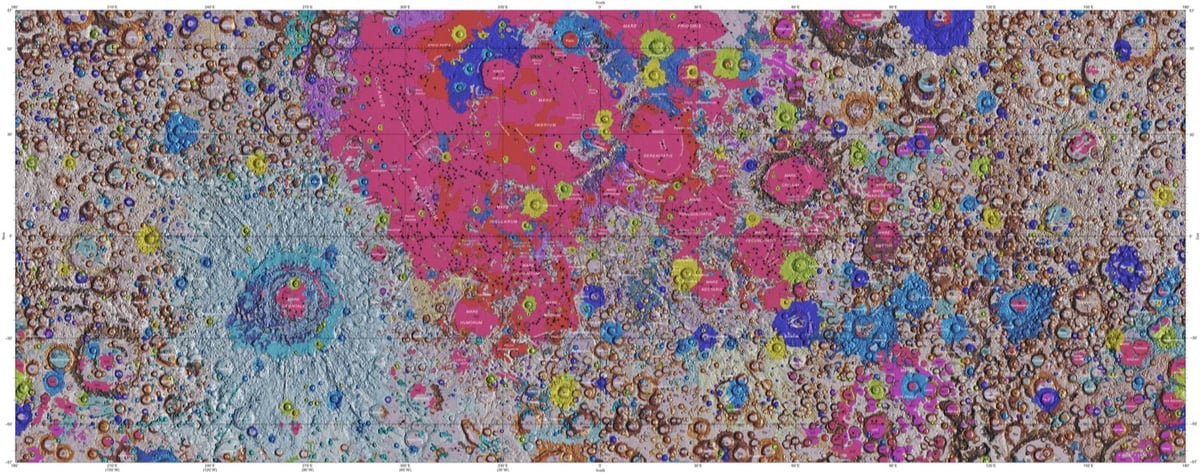
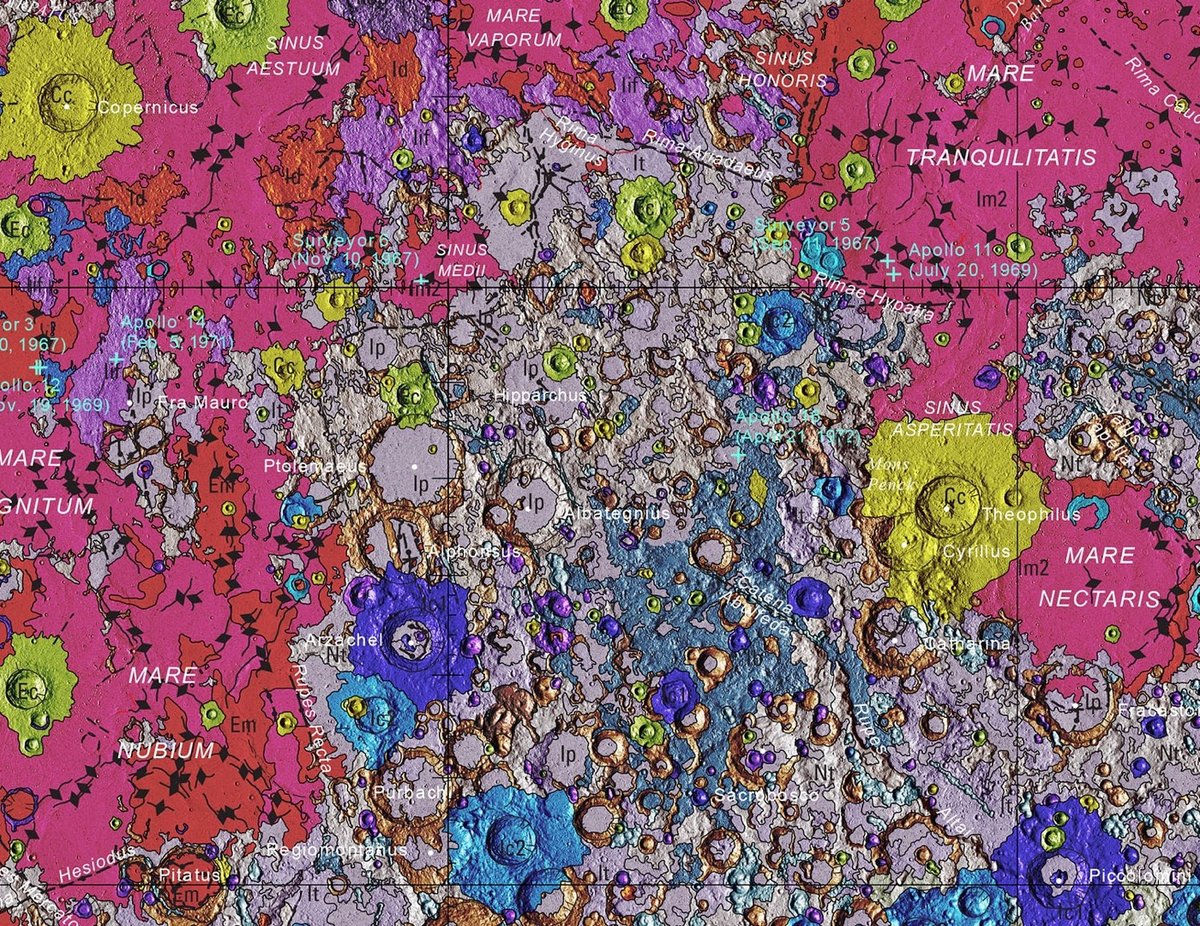
In collaboration with NASA and the Lunar and Planetary Institute, the USGS has released the first complete geological map of the Moon’s surface.
This new work represents a seamless, globally consistent, 1:5,000,000-scale geologic map derived from the six digitally renovated geologic maps (see Source Online Linkage below). The goal of this project was to create a digital resource for science research and analysis, future geologic mapping efforts, be it local-, regional-, or global-scale products, and as a resource for the educators and the public interested in lunar geology.
Strange Maps has more information on how the map came to be and what it shows.
The map was created by the U.S. Geological Service’s Astrogeology Science Center in Flagstaff, Arizona. In collaboration with NASA and the Lunar and Planetary Institute, it combined six ‘regional’ maps of the Moon made during the Apollo era (1961-1975) with input from more recent unmanned lunar missions.
This included data on the polar regions from NASA’s Lunar Orbiter Laser Altimeter (LOLA) and close-ups of the equatorial zone from the Japanese Space Agency’s recent SELENE mission.
The two images above show the entire map and a detailed view of a single area (which includes the landing sites of 3 Apollo missions) while the video shows a rotating globe version of the map.
Characters in Wes Anderson’s films are often misfits, outcasts, or are estranged from one another for various reasons. That apartness is often depicted cinematically using physical distance between individuals onscreen, with the aesthetic side effect of using all of that gorgeous 1.85:1 or even 2.35:1 aspect ratio. Luis Azevedo made a short supercut of moments in Anderson’s movies where the characters are practicing good social distancing techniques.
Over the course of 24 hours, Beau Miles ran around his mile-long block once every hour (plus a few more at the beginning) to complete a marathon in a day. But he also did a bunch of other stuff along the way: cooked dinner, made a table, fixed things, picked up trash, played Scrabble, got a bit of sleep, and made the short film above.
A different kind of marathon; running one lap an hour, for 24hrs, around my perfectly mile long block. The rest of the time I do as much as possible; making things, odd jobs, fixing stuff. It’s about running, doing, and thinking.
Newer posts
Older posts





Socials & More