kottke.org posts about timeless posts
vintage post from Oct 2016
Stutterer by Benjamin Cleary won the 2016 Oscar for Best Live Action Short Film and is now available to view online for free courtesy of the New Yorker.
It’s a thirteen-minute movie about a young London typographer named Greenwood (Matthew Needham). Greenwood stutters, to the extent that verbal conversation is difficult. When he tries to resolve an issue with a service representative over the phone, he can’t get the words out; the operator, gruff and impatient, hangs up. (For surliness, she rivals the operator in the old Yaz song.) When a woman approaches Greenwood on the street, he uses sign language to avoid talking. But in his thoughts, which we hear, he does not stutter.
Great little film…my heart broke three separate times watching it. Here’s an alternate video if you can’t view the embed at the top of the page.
vintage post from Nov 2017
A few years ago, in a forest just outside of Oslo, 1000 trees were planted. In 2114, after a century of growth, the trees will be cut down and made into paper for an anthology of books. Meet the Future Library, an artwork by Katie Paterson.
Between now and then, one writer every year will contribute a text, with the writings held in trust, unpublished, until the year 2114. Tending the forest and ensuring its preservation for the one hundred year duration of the artwork finds a conceptual counterpoint in the invitation extended to each writer: to conceive and produce a work in the hopes of finding a receptive reader in an unknown future.
The first three writers to contribute texts are Margaret Atwood, David Mitchell, and Icelandic novelist Sjón. Atwood said of her participation:
How strange it is to think of my own voice — silent by then for a long time — suddenly being awakened, after a hundred years. What is the first thing that voice will say, as a not-yet-embodied hand draws it out of its container and opens it to the first page?
See also the John Malkovich movie that no one will see for 100 years. The Future Library also has something in common with the (possibly apocryphal) story of the grove of oak trees specifically planted to replace the massive ceiling beams in the dining hall at Oxford hundreds of years in the future. Stewart Brand told the story in the TV adaptation of How Buildings Learn.
One of the Junior Fellows stuck his neck out and suggested that there might be some worthy oaks on the College lands. These colleges are endowed with pieces of land scattered across the country which are run by a college Forester. They called in the College Forester, who of course had not been near the college itself for some years, and asked him if there were any oaks for possible use.
He pulled his forelock and said, “Well sirs, we was wonderin’ when you’d be askin’.”
Upon further inquiry it was discovered that when the College was founded, a grove of oaks had been planted to replace the beams in the dining hall when they became beetly, because oak beams always become beetly in the end. This plan had been passed down from one Forester to the next for over five hundred years saying “You don’t cut them oaks. Them’s for the College Hall.”
Update: Karl Ove Knausgaard has become the 6th contributor to the library. (via @tedgioia)
vintage post from Jan 2016
I love watching Gordon Ramsay make scrambled eggs. I first saw this video years ago and, possibly because I am an idiot, have yet to attempt these eggs at home. You and me, eggs, next weekend.
P.S. Jean-Georges Vongerichten makes scrambled eggs in a very similar way. Not quite soft-scrambled…Serious Eats calls them fancy French spoonable eggs.
P.P.S. Anyone have a square Japanese omelette pan I can borrow?
P.P.P.S. In Jiro Dreams of Sushi (now on Netflix!), an apprentice talks about making tamagoyaki (Japanese omelette) over 200 times before Jiro declared it good enough to serve in his restaurant.
That apprentice, Daisuke Nakazawa, is now the head chef at Sushi Nakazawa, one of the five NYC restaurants that currently has a four-star rating from the NY Times (along with the aforementioned Jean-Georges and not along with Per Se, which recently got dunce capped down to 2 stars by populist hero Pete Wells).
vintage post from Oct 2019
This maddening little web toy on vole.wtf challenges visitors to draw a perfect circle and judges them on how well they do. After dozens of tries with a mouse, I could only manage 92.9% perfection (which looks more like 80% tbh).

Then I tried it on a touchscreen and got much closer: 95.2%. Several more tries with an Apple Pencil bumped it up to 97.7%, after which I retired so as not to waste the entire rest of my afternoon on this.
And of course, here’s the classic video of Alexander Overwijk drawing a perfect freehand circle on the blackboard in about a second.
I love everything about this video — the way he swings his arm to warm up, his drying-the-blackboard flapping motion, and the ease of his perfection. 100.0%. (via sam potts)
vintage post from Aug 2016
This is a video of Nirvana playing Smells Like Teen Spirit in a small club just two days after Nevermind came out in 1991. There’s a freight train bearing down on those boys and they don’t even know it. (via digg)
See also The Notorious B.I.G. freestyling on a Brooklyn corner at 17 and LL Cool J plays to a mostly empty gymnasium in Maine…he was also just 17.
Update: And here’s 40+ minutes from the same show at which they played Drain You, Polly, and Breed. (via @fimoculous)
vintage post from Jul 2012
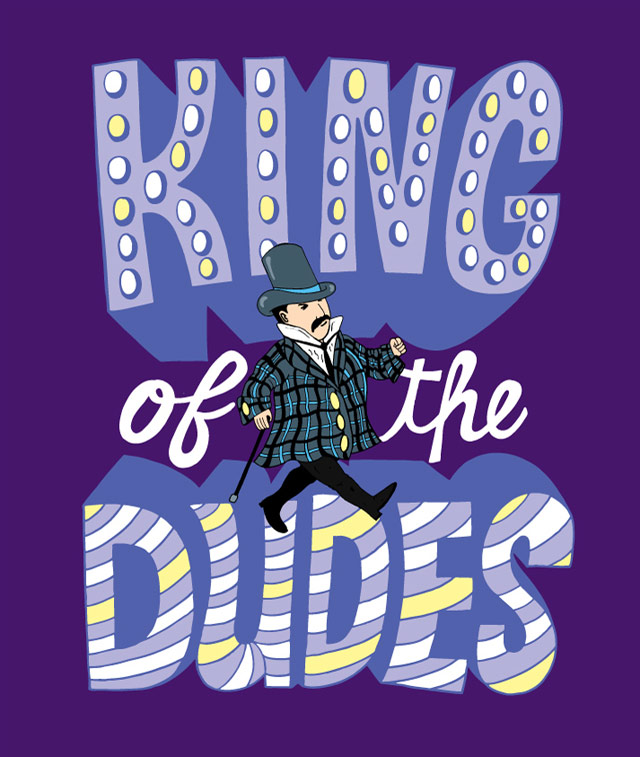
E. Berry Wall was a dude. But not just any dude. In 1888, he was declared “King of the Dudes” in a competition against another gentleman, one Robert Hilliard.
Wall became famous after meeting Blakely Hall, a reporter hungry for good copy. Thereafter, every week or so, Hall’s articles publicizing Wall’s adventures in clothing appeared in newspapers across the country. Then one of Hall’s competitors set up a rival, actor Robert “Bob” Hilliard, another flashy dresser. Thus began the Battle of the Dudes, in which each sought to eclipse the other in sartorial extremes. According to the Times, Wall finally won when, during the Great Blizzard of 1888, he strode into the Hoffman House bar clad in gleaming boots of black patent leather that went to his hips. (Nonetheless, some social historians claim Hilliard won with the high boots, supposedly part of his Western gambler’s costume from a play in which he was then appearing).
But it was Wall who won a later sartorial marathon:
Wall won another contest in Saratoga when daredevil financier John “Bet-A-Million” Gates wagered that he could not wear 40 changes of clothes between breakfast and dinner. On the appointed day, Wall repeatedly appeared at the racetrack in one flashy ensemble after another until, exhausted but victorious, he at last entered the ballroom of the United States Hotel in faultless evening attire to wild applause.
I wonder how Wall would have done against the likes of Kanye and his entourage? (via @mrgan)
Note: Illustration by Chris Piascik.
vintage post from Jun 2014
Tom Chiarella shares his rules for giving a eulogy.
It may hurt to write it. And reading it? For some, that’s the worst part. The world might spin a little, and everything familiar to you might fade for a few minutes. But remember, remind yourself as you stand there, you are the lucky one.
And that’s not because you aren’t dead. You were selected. You get to stand, face the group, the family, the world, and add it up. You’re being asked to do something at the very moment when nothing can be done. You get the last word in the attempt to define the outlines of a life. I don’t care what you say, bub: That is a gift.
This rule surprised me:
You must make them laugh. Laughs are a pivot point in a funeral. They are your responsibility. The best laughs come by forcing people not to idealize the dead. In order to do this, you have to be willing to tell a story, at the closing of which you draw conclusions that no one expects.
vintage post from Aug 2015
This image was tweeted out by the NASA Europa Mission account the other day:

One of these images is of Europa, Jupiter’s icy moon, and the other eight are frying pans. Can you pick Europa out? Hint: frying pans tend not to have impact craters.
Update: The photos of the frying pans were taken by Christopher Jonassen, whose work I featured back in 2011 (which I had totally forgotten about). At the time, I even joked about the pans looking like a Jovian moon. kottke.org is a flat circle. (thx, tony)
vintage post from Dec 2019
This video catalogs every borrowed sample from Paul’s Boutique by the Beastie Boys, from the soundtrack to Car Wash to the Sugarhill Gang to the Eagles to the Ramones to the Beatles. They play the original first and then what they did with it on the album.
Somehow this video only has 31,000 views?! You can also listen to this remix of Paul’s Boutique on Soundcloud, which combines the source tracks with Beastie Boys vocals and some audio commentary.
Tim Carmody made a Spotify playlist of all the sampled songs or you can download zip files of the original songs sampled in Paul’s Boutique and five of their other albums.
They just don’t make ‘em like this anymore, mostly because clearing all of the samples would be prohibitively expensive if not impossible.
Hip-hop sampling began as a live technique, with DJs working turntables at parties and clubs. Whether it was strictly legal or not, nobody was going to try to sue anyone about it. As the genre’s popularity grew, people naturally started recording performances and releasing them as albums. Early sampling tended to come fast and furious. In the ’80s, short clips of existing recordings were the order of the day, often — as in the case of the Beastie Boys — lots of them, layered and shuffled in a clearly creative way. As hip-hop pushed further into the mainstream, however, the stakes got bigger and so did the samples.
1990 saw the release of both M.C. Hammer’s “U Can’t Touch This” and Vanilla Ice’s “Ice, Ice, Baby.” Not only did both songs sample, they each relied heavily on one particular sample — the baselines from Rick James’ “Superfreak” and Queen and David Bowie’s “Under Pressure” — for their main hook. Both hits resulted in legal controversy.
vintage post from Oct 2015


From photographer Richard Silver, vertical panoramic photos of churches that emphasize their often incredible ceilings. (via ignant)
vintage post from Aug 2011
In 1956, 96-year-old Samuel Seymour appeared on a game show called I’ve Got A Secret…his secret was that he saw Lincoln’s assassination when he was five years old.
Mind-blowing…the Civil War & Lincoln’s assassination directly linked to something as modern as a TV game show. Two years earlier, Seymour gave an interview about witnessing the assassination. His father, an overseer on a Maryland estate, and his boss Mr. Goldsboro needed to travel to Washington to check on “the legal status of their 150 slaves”. Seymour got to go along.
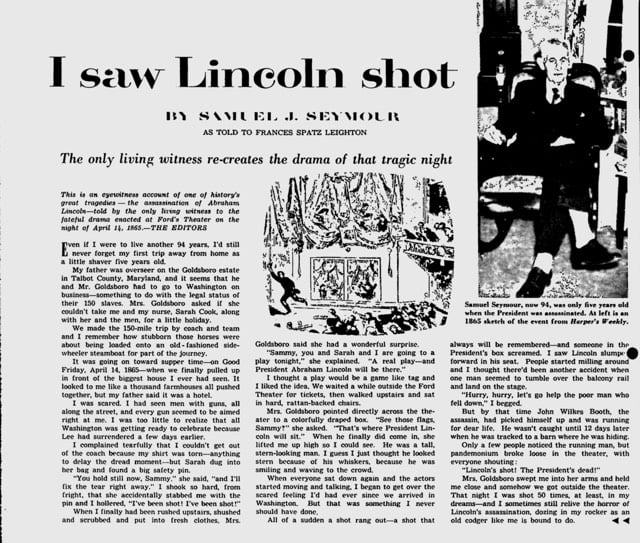
It was going on toward supper time — on Good Friday, April 14, 1865 — when we finally pulled up in front of the biggest house I ever had seen. It looked to me like a thousand farmhouses all pushed together, but my father said it was a hotel.
[…] When I finally had been rushed upstairs, shushed and scrubbed and put into fresh clothes, Mrs. Goldsboro said she had a wonderful surprise.
“Sammy, you and Sarah and I are going to a play tonight,” she explained. “A real play — and President Abraham Lincoln will be there.”
After Lincoln was shot, Seymour saw Booth fall from the balcony and run off.
vintage post from Sep 2014
Marvin Gaye’s isolated vocals on I Heard It Through The Grapevine. The man has pipes.
vintage post from Apr 2013
I’ve posted this before, but it’s so good, here it is again: a super-simple explanation of why differential gears are necessary in cars and how they work.
(via @stevenstrogatz)
vintage post from Aug 2018
TIL that the hieroglyphic hobo code probably wasn’t used as extensively as the internet suggests. However, hobos and tramps did tag bridges, water towers, and train cars with tramp writing, which usually consisted of their moniker (i.e. their hobo name), the date, and the direction they were heading in.
Hobos, or tramps, were itinerant workers and wanderers who illegally hopped freight cars on the newly expanding railroad in the United States in the late 19th century. They used graffiti, also known as tramp writing, as a messaging system to tell their fellow travelers where they were and where they were going. Hobos would carve or draw their road persona, or moniker, on stationary objects near railroad tracks, like water towers and bridges.
More on hobo graffiti from CityLab.
Traces of hobo graffiti from the early 20th century have become almost totally obliterated, destroyed by natural forces, torn down along with old buildings, or painted over with new graffiti. So when anthropologist Susan Phillips came across a rare one scribbled underneath a bridge near the Los Angeles River, she knew it was a remarkable discovery.
(via open culture)
vintage post from Aug 2018
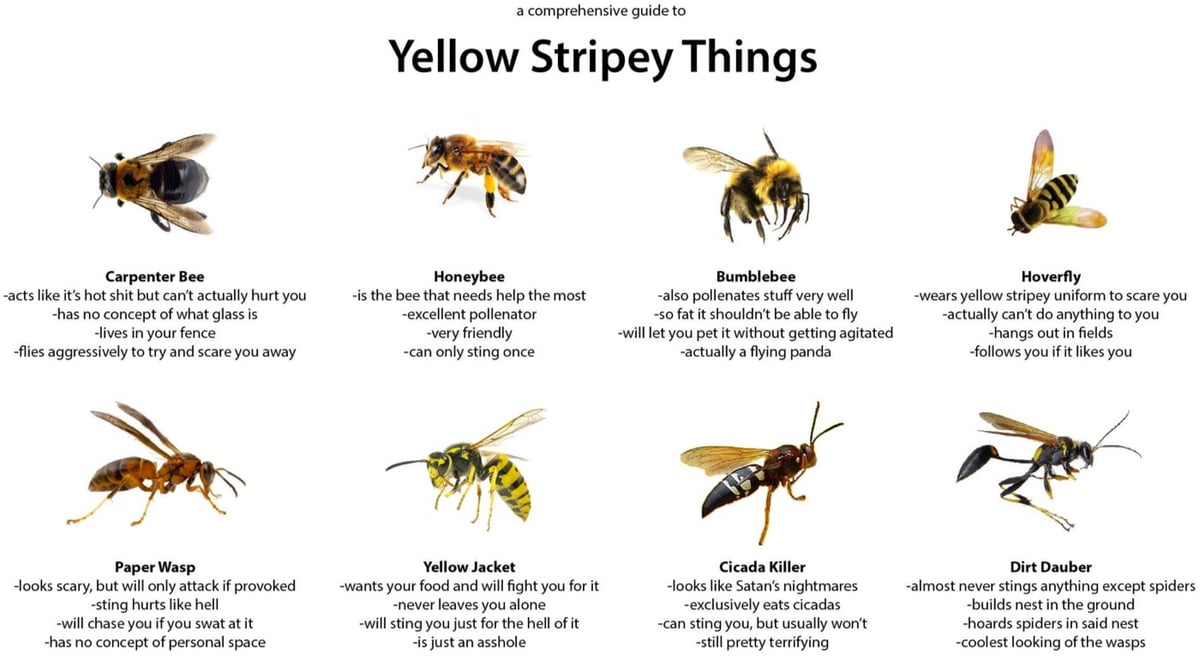
Bumblebee, honey bee, yellow jacket, paper wasp…what’s the difference? I don’t know if this comprehensive guide to Yellow Stripey Things is entirely truthful or not — a bumblebee is “actually a flying panda” and a yellow jacket “is just an asshole” — but it is pretty entertaining. Has anyone fact-checked this thing?
Ok fine, I’ll do it!1
Carpenter bees are mostly harmless:
Male carpenter bees are quite aggressive, often hovering in front of people who are around the nests. The males are quite harmless, however, since they lack stingers. Female carpenter bees can inflict a painful sting but seldom will unless they are handled or molested.
Honey bees don’t always sting just once:
A honey bee that is away from the hive foraging for nectar or pollen will rarely sting, except when stepped on or roughly handled. Honey bees will actively seek out and sting when they perceive the hive to be threatened, often being alerted to this by the release of attack pheromones (below).
Although it is widely believed that a worker honey bee can sting only once, this is a partial misconception: although the stinger is in fact barbed so that it lodges in the victim’s skin, tearing loose from the bee’s abdomen and leading to its death in minutes, this only happens if the skin of the victim is sufficiently thick, such as a mammal’s.
Bumblebees:
Queen and worker bumblebees can sting. Unlike in honeybees, a bumblebee’s sting lacks barbs, so the bee can sting repeatedly without injuring itself; by the same token, the sting is not left in the wound. Bumblebee species are not normally aggressive, but may sting in defence of their nest, or if harmed.
And yes, you can actually pet a bumblebee:
Hoverflies don’t sting. But paper wasps do and their sting can be deadly:
Unlike yellowjackets and hornets, which can be very aggressive, polistine paper wasps will generally only attack if they themselves or their nest are threatened. Since their territoriality can lead to attacks on people, and because their stings are quite painful and can produce a potentially fatal anaphylactic reaction in some individuals, nests in human-inhabited areas may present an unacceptable hazard
I couldn’t find a good all-in-one source about yellow jackets, but by all accounts, they are aggressive and easily agitated.
The cicada killer wasp look fierce but are generally only dangerous to cicadas:
Solitary wasps (such as the eastern cicada killer) are very different in their behavior from the social wasps such as hornets, yellowjackets, and paper wasps. Cicada killer females use their sting to paralyze their prey (cicadas) rather than to defend their nests; unlike most social wasps and bees, they do not attempt to sting unless handled roughly.
Mud daubers don’t sting people that often and prey on spiders:
Black and yellow mud daubers primarily prey on relatively small, colorful spiders, such as crab spiders (and related groups), orb weavers and some jumping spiders. They usually find them in and around vegetation. Blue mud daubers are the main predator of the black and brown widow spiders.
All in all, this checks out.
Bonus stinging insect fact: There’s a sting pain index that entomologist Justin Schmidt first came up with in the 80s. Schmidt has been stung by almost everything with a stinger and rated the stings on a scale of 1 to 4 (least to most painful). He has also described the stings of individual insects more colorfully:
Western honey bee (level 2) — “Burning, corrosive, but you can handle it. A flaming match head lands on your arm and is quenched first with lye then with sulfuric acid.”
Giant paper wasp (level 3) — “There are gods, and they do throw thunderbolts. Poseidon has rammed his trident into your breast.”
vintage post from Sep 2016
From Mark Forsyth’s The Elements of Eloquence, a reminder of the rules of adjective order that fluent English speakers follow without quite knowing why.
…adjectives in English absolutely have to be in this order: opinion-size-age-shape-colour-origin-material-purpose Noun. So you can have a lovely little old rectangular green French silver whittling knife. But if you mess with that word order in the slightest you’ll sound like a maniac. It’s an odd thing that every English speaker uses that list, but almost none of us could write it out.
The Cambridge Dictionary lists a slightly different order: opinion, size, physical quality, shape, age, colour, origin, material, type, purpose. A poem by Alexandra Teague explores the topic in a creative way:
That summer, she had a student who was obsessed
with the order of adjectives. A soldier in the South
Vietnamese army, he had been taken prisoner when
Saigon fell. He wanted to know why the order
could not be altered. The sweltering city streets shook
with rockets and helicopters. The city sweltering
streets.
Did anyone learn this in school? I sure didn’t. How do we all know then? My daughter’s kindergarten teacher had a great phrase she used when things got a bit tricky as her students learned to read: “the English language is a rascal”. (via @MattAndersonBBC)
Update: Language Log’s post on adjective order is worth reading. (thx, stephen & margaret)
vintage post from Aug 2016
Speaking of DJ Shadow, his 2-hour Essential Mix that aired in early July is really hitting the spot right now.
vintage post from Jul 2012
This is a five-minute video of Andy Warhol eating a Burger King hamburger accompanied by Heinz ketchup.
The scene is part of a film done by Jorgen Leth called 66 Scenes from America.
Leth had his assistant buy some burgers and directly advised him to buy some in halfway neutral packaging as Leth was afraid that Warhol might reject some brands (Warhol always had an obsession with some of his favorite brands).
So Andy Warhol finally did arrive at the studio, of course along with his bodyguards, and when he saw the selection of burgers the assistant had brought he asked “Where is the McDonald’s?” and Leth — slightly in panic — was immediately like “I thought you would maybe not like to identify…” and Warhol answered “no that is the most beautiful”. Leth offered to let his assistant quickly run to McDonald’s but Warhol refused like “No, never mind, I will take the Burger King.”
(via bon appetit)
vintage post from Nov 2013
I posted a video earlier today of a Super Cub airplane landing on the side of a mountain. Super Cubs are ideal for that undertaking because of their low stall speed and short take-off and landing distances. But I had no idea you could land and take off in one in the space of 20 feet.
Never seen a plane do that before…well, aside from tiny model planes. What an incredible power-to-weight ratio that plane must have. You can seriously land these things anywhere, almost like a helicopter. Wanna go fly fishing? Just set it down on the banks of a stream:
Or on a gravel bar in a river:
These planes are referred to as STOL (short takeoff and landing) aircraft; here’s some detail on how they work. (via @alper)
Update: Is this the shortest takeoff in history?
Six feet. Six. (via @mikebee)
vintage post from Dec 2016
Art director Antonio Alcalá, one of four art directors employed by the USPS, talks a little bit about the history behind US postage stamps and how they are designed and produced.
vintage post from Aug 2012
Team Spirit is a wonderful short film for ESPN by Errol Morris about the funerals of die-hard sports fans.
I love the Steelers fan laid out in a recliner under a Steelers blanket in front of a television with a Steelers game on as if “he just fell asleep watching the game”.
vintage post from Aug 2018
There’s something so relaxing about watching art conservator Julian Baumgartner restore this damaged painting, a self-portrait by Italian painter Emma Gaggiotti Richards. I love how he paints tiny cracks in the damaged areas to match those in the rest of the painting.
There are many more videos and photos of Baumgartner’s restoration process on Instagram and YouTube. (via the kid should see this)
vintage post from Oct 2012
Two sequences from Dr. Strangelove done in Lego: Muffley’s call to Kissoff on the hotline in the war room and Dr. Strangelove’s increasingly erratic presentation of his plan to preserve humanity in a mine shaft.
This is really well done. (via bb)
vintage post from Mar 2013
This story by Kevin Guilfoile about his aging father (who worked for the Pirates and the Baseball Hall of Fame) and the mystery of what happened to the bat that Roberto Clemente got his 3,000th hit with is one of my favorite things that I’ve read over the past few months.
[My father’s] personality is present, if his memories are a jumble. He is still funny, and surprisingly quick with one-liners to crack up the staff at the facility where he lives. He is exceedingly polite, same as he ever was. He is good at faking a casual conversation, especially on the phone. But if you sit and talk with him for a long time, he gets very anxious. He starts tapping his forehead with his fingers. “Shouldn’t we be going?” he’ll say. You tell him there’s no place we need to be, but 30 seconds later he’ll ask again, “Shouldn’t we be going?”
What happens to memories when they’re collapsed inside time like this? They don’t exactly disappear, they just become impossible to unpack. And so my father, who loved stories so much — who loved to tell them, who loved to hear them — can no longer comprehend them. The structure of any story, after all, is that this happened and then that happened, and he can’t make sense of any sequence.
That is the real hell of this disease. His own identity has become a puzzle he can’t solve.
Objects have stories, too. Puzzles that need to be solved. Like a pair of baseball bats, for instance, that each passed through Roberto Clemente’s hands before they passed through my father’s. One hung on my bedroom wall throughout my childhood. The other is in the Baseball Hall of Fame.
These objects never forget, but they never tell their stories, either.
Without a little bit of luck, we’d never hear them.
Or more than a little luck:
My father has lots of old baseball bats given to him by players he worked with over the years. He has Mickey Mantle bats from his years with the Yankees, and Willie Stargell and Dave Parker bats from his days with the Pirates. The one I always loved best was an Adirondack model with R CLEMENTE embossed in modest block letters, instead of the usual signature burned into the barrel. On the bottom of the knob, Roberto had written a tiny “37” in ballpoint pen, presumably to indicate its weight: 37 ounces. It also had a series of scrapes around the middle where someone had scratched off the trademark stripe that encircled all Adirondack bats. Former Pirates GM Joe Brown gave my dad this bat several years after Roberto died. For much of my childhood it hung on the wall of my bedroom, on a long rack with about a dozen other game-used bats.
My dad had been working at the Hall of Fame for more than a decade when, in 1993, his old friend Tony Bartirome, a one-time Pirates infielder who had become their longtime trainer, came to Cooperstown for a visit. Tony and his wife went to dinner with my folks and then came back to our house to chat. The only way to go to the first-floor washroom in that house was through my old bedroom, and on a trip there, Tony noticed that Adirondack of Clemente’s hanging on the wall.
Tony carried it into the living room. He said to Dad, “Where did you get this bat?” My dad told him that Joe Brown had given him the bat as a gift, sometime in the late ’70s. “Bill,” Tony said. “This is the bat Roberto used to get his 3,000th hit.”
My father was confused by this. “That’s impossible,” he told Tony. “The day he hit 3,000 I went down to the clubhouse, and Roberto himself handed me the bat he used. I sent it to the Hall of Fame. I walk by it every day.”
“Well,” Tony said. “I have a story to tell you.”
It’s a wonderful story, read the whole thing. Or get the book: the story is excerpted from Guilfoile’s A Drive into the Gap, available here or for the Kindle.
vintage post from Feb 2015
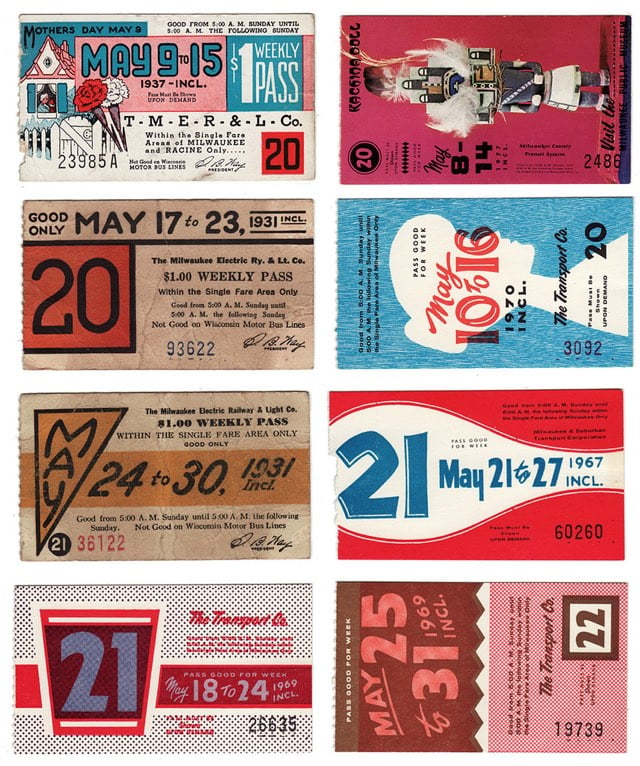
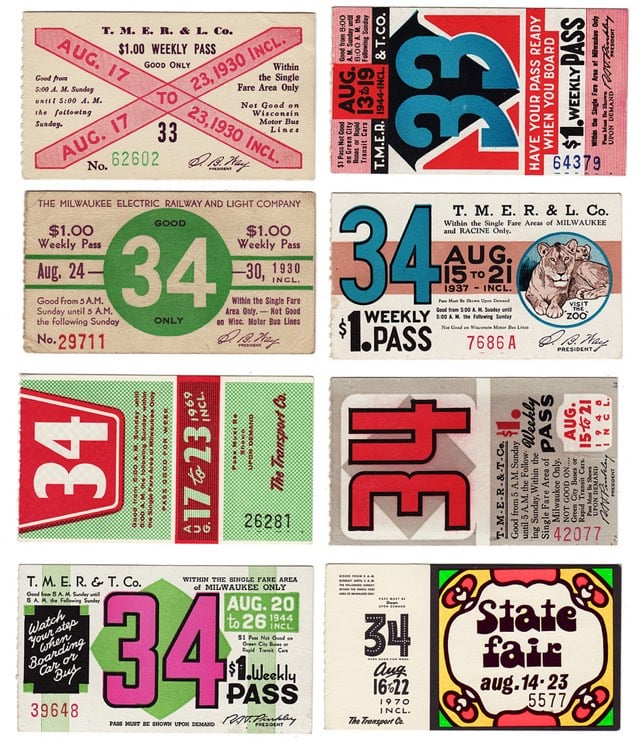
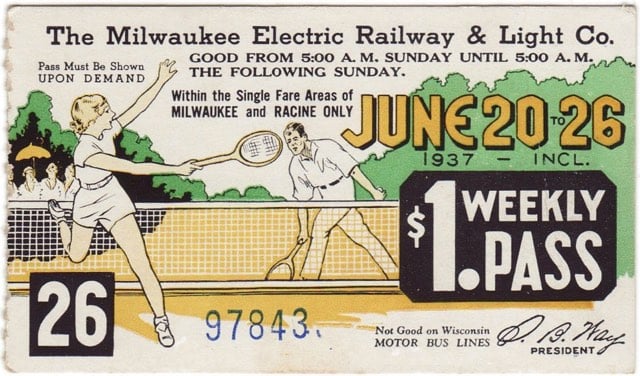
A collection of weekly bus passes from Milwaukee, WI. Years covered are 1930-1979. Was there a new design every single week? (via @slowernet)
vintage post from Nov 2012

Of the current 200 nations in the world, the British have invaded all but 22 of them. The lucky 22 include Sweden, Luxembourg, Mongolia, Bolivia, and Belarus. The full analysis is available in Stuart Laycock’s book, All the Countries We’ve Ever Invaded.
Stuart Laycock, the author, has worked his way around the globe, through each country alphabetically, researching its history to establish whether, at any point, they have experienced an incursion by Britain.
Only a comparatively small proportion of the total in Mr Laycock’s list of invaded states actually formed an official part of the empire.
The remainder have been included because the British were found to have achieved some sort of military presence in the territory — however transitory — either through force, the threat of force, negotiation or payment.
Incursions by British pirates, privateers or armed explorers have also been included, provided they were operating with the approval of their government.
The US currently has military personnel stationed in all but 43 countries.
For instance, as of Sept. 30, 2011, there were 53,766 military personnel in Germany, 39,222 in Japan, 10,801 in Italy and 9,382 in the United Kingdom. That makes sense. But wait, scanning the list, you also see nine troops in Mali, eight in Barbados, seven in Laos, six in Lithuania, five in Lebanon, four in Moldova, three in Mongolia, two in Suriname and one in Gabon.
But the presence in most of those countries is due to diplomatic usage of military personnel. (thx, aaron)
vintage post from Aug 2016

Here’s a gem from the archive of the NY Times. One day in September 1976, NY Times food critic Mimi Sheraton and Colonel Harland Sanders stopped into a Manhattan Kentucky Fried Chicken. The Colonel, then estranged from the company he founded, strolled into the kitchen after glad-handing some patrons and proceeded to tear into the quality of the food:
Once in the kitchen, the colonel walked over to a vat full of frying chicken pieces and announced, ‘That’s much too black. It should be golden brown. You’re frying for 12 minutes — that’s six minutes too long. What’s more, your frying fat should have been changed a week ago. That’s the worst fried chicken I’ve ever seen. Let me see your mashed potatoes with gravy, and how do you make them?”
When Mr. Singleton explained that he first mixed boiling water into the instant powdered potatoes, the colonel interrupted. “And then you have wallpaper paste,” he said. “Next suppose you add some of this brown gravy stuff and then you have sludge.” “There’s no way anyone can get me to swallow those potatoes,” he said after tasting some. “And this cole slaw. This cole slaw! They just won’t listen to me. It should he chopped, not shredded, and it should be made with Miracle Whip. Anything else turns gray. And there should be nothing in it but cabbage. No carrots!”
Sanders sold his company to an investment group in 1964, which took the company public two years later and eventually sold to a company called Heublein. After selling, Sanders officially still worked for the company as an advisor but grew more and more dissatisfied with it, as evidenced by the story above. When the company HQ moved to Tennessee, the Colonel was quoted as saying:
This ain’t no goddam Tennessee Fried Chicken, no matter what some slick, silk-suited son-of-a-bitch says.
And he got sued by a KFC franchisee after he commented:
My God, that gravy is horrible. They buy tap water for 15 to 20 cents a thousand gallons and then mix it with flour and starch and end up with pure wallpaper paste. And I know wallpaper paste, by God, because I’ve seen my mother make it.
To the “wallpaper paste” they add some sludge and sell it for 65 or 75 cents a pint. There’s no nutrition in it and the ought not to be allowed to sell it.
And another thing. That new crispy chicken is nothing in the world but a damn fried doughball stuck on some chicken.
Colonel Sanders: serving up chicken and sick burns with equal spiciness. (via @mccanner)
vintage post from Jul 2017

Per Betteridge’s law of headlines and also the map above, my answer is clearly no. You can try it yourself here…you draw them one at a time and it adds them to the map automagically. I’m going to blame my trackpad use a little, but I’m not sure I would have done much better had I drawn with a pencil and looked a map beforehand.
Update: Your periodic reminder that Senator Al Franken can draw all 50 US states from memory with astonishing accuracy.
(thx, eric)
vintage post from Apr 2015
The aluminum soda can is a humble testament to the power and scope of human ingenuity. If that sounds like hyperbole, you should watch this video, which features eleven solid minutes of engineering explanation and is not boring for even a second.
More science/engineering programming like this please…I feel like if this would have been on PBS or Discovery, it would have lasted twice as long and communicated half the information. For a chaser, you can watch a detailed making-of from an aluminum can manufacturing company:
vintage post from Sep 2013
I was poking around on YouTube for “how to” videos (one of my favorite video genres) the other day when I hit a small jackpot: a bunch of How Do They…? videos from the National Film Board of Canada. A favorite shows how chain link fences are made:
You can view all the videos at the NFB site as well. NFB produced one of my favorite “how to” videos ever: how to build an igloo.
Older posts





Socials & More