kottke.org posts about movies
Mike Upchurch was a writer for Mr. Show and MADtv but now he’s making these clever little videos with additional actors spliced into the narratives of Cocktail (the Tom Cruise movie) and the Dragnet TV series.
Both feature actor/comedian Chris Fairbanks in the lead role and are noted as “proof-of-concepts” for a series called Electric Television that Upchurch is presumably developing. Someone should greenlight it. (via @dunstan)
From Accio to Wingardium Leviosa, this is a supercut of every spell uttered in the 8 Harry Potter movies. Lots of Expecto Patronum, Expelliarmis, and Stupefy. As supplementary reading, here’s a list of spells in Harry Potter from Wikipedia.

Frodo (and Sam) made their way from Hobbiton to Mordor in six months and now you can see the route they took on Google Maps. “This route has trolls.” LOL. Full size image here. (via bb)
Update: From 2002, Mapquest directions for walking from Hobbiton to Mt Doom. (thx, seth)
Alfred Hitchcock liked to insert himself, briefly, into his films. As the video above shows, he appears in 39 of his films, mostly near the beginning so he doesn’t distract his audiences by looking for him the entire time.
Using Gillian Flynn’s screenplay for Gone Girl as an example, Michael Tucker walks us through some important aspects of screenwriting techniques. This makes me want to read a book on screenwriting and watch Gone Girl again. (via one perfect shot)
Update: As expected, I got recommendations from readers for screenwriting books: Lew Hunter’s Screenwriting 434 and Invisible Ink. There is also Story by Robert McKee, who you may remember as the screenwriting guru consulted by Donald Kaufman in Adaptation. (via @byBrettJohnson & @poritsky)
They’re rebooting Ocean’s Eleven with an all-female ensemble including Helena Bonham Carter, Mindy Kaling, Rihanna, Sandra Bullock, and Cate Blanchett. As a lover of Soderbergh’s Ocean’s Eleven, I am totally on board with this.
Ocean’s Eleven director Steven Soderbergh, who is based in New York and is expected to be deeply involved with the spinoff — perhaps taking on a below-the-line job like he has done on other studio films like Magic Mike XXL — is producing solo (Oceans Eleven producer Jerry Weintraub passed away last year). Olivia Milch and Ross wrote the screenplay.
And while we’re at it, let’s reboot everything with female leads. We’ve already got Ghostbusters and Ocean’s Ocho. Someone I was talking with at a party last week suggested an all-women A-Team reboot, which would be fantastic.1 What else? Reservoir Dogs? Indiana Jones? Back to the Future? Any movie Tom Hanks/Cruise/Hardy has ever made?
Graphic Means is a documentary film by Briar Levit about the history of graphic design production from the 1950s to the 1990s.
It’s been roughly 30 years since the desktop computer revolutionized the way the graphic design industry works. For decades before that, it was the hands of industrious workers, and various ingenious machines and tools that brought type and image together on meticulously prepared paste-up boards, before they were sent to the printer.
Features interviews with Steven Heller, Ellen Lupton, Tobias Frere-Jones, and more. (via @cleverevans)
A study undertaken by a group of German scientists suggests that the chemical makeup of the collective breath of movie audiences change in reaction to what’s happening on the screen.
Human beings continuously emit chemicals into the air by breath and through the skin. In order to determine whether these emissions vary predictably in response to audiovisual stimuli, we have continuously monitored carbon dioxide and over one hundred volatile organic compounds in a cinema. It was found that many airborne chemicals in cinema air varied distinctively and reproducibly with time for a particular film, even in different screenings to different audiences. Application of scene labels and advanced data mining methods revealed that specific film events, namely “suspense” or “comedy” caused audiences to change their emission of specific chemicals.
Christopher Nolan’s next film is a WWII action/thriller about the evacuation of Allied troops from Dunkirk, France in 1940. The film comes out in July 2017 and if that last scene in the teaser trailer is any indication of the overall film, I will be there.
Update: The first full trailer has dropped. Yeah, this looks good.
A visual comparison of Wes Anderson’s movies with some of the films that influenced him, including The 400 Blows, The Graduate, The French Connection, Star Wars, and Last of the Mohicans. (thx, luis)
Update: Here’s another short video from Candice Drouet that shows more of Anderson’s references, with almost none repeated from the video above by Luís Azevedo.
Drouet used “references claimed by Anderson himself” while Azevedo’s pulled its references from Matt Zoller Seitz’s work, most notably from The Wes Anderson Collection. Azevedo explains some of the connections made in his video.
Wes Anderson saw Truffaut’s “The 400 Blows” on Beta tape at when he was 17 or 18. When discussing his love for Truffaut with Matt Zoller Seitz, Anderson said that movie “made a huge, rock band-type impression on me when I saw it. It’s one of those films where you say, ‘not only did I just enjoy this experience, now I think I would like to model my future on this somehow.’”
He also felt a unique voice from “The 400 Blows”: “There’s one name you can put to on the whole thing.”
Lo and Behold, a documentary about technology and the internet directed by Werner Herzog is coming out soon and so Herzog is doing some interviews and such about the film and dozens of other topics. With Paul Holdengraber, Herzog talks about North Korea and volcanoes:
The North Koreans apparently had seen quite a few of my films. I established a trust with them. It’s very strange because you’re accompanied by people who would look after what you were doing, who would politely tell you you cannot film this, or cannot film that, and at one point I filmed something which I was not allowed to do, so I wanted to have it edited or deleted. But since they are filming in 4K or 5K or so, very complicated data management, we were unable to delete it, and they wanted to take the entire memory hard drive. And I said, “But it contains two days worth of shooting, that would be terrible.” So I said, “You know what, I can guarantee to you that I’m not going to use this material.” And they said, “Guarantee, what do you mean by that?” I said, “Just look me in the eye, what I offer is my honor, my face, and my handshake.” And they said “ok” and they trusted me. And of course I’m not going to use this moment of filming that I was not supposed to film.
Herzog talked about Pokemon Go and film school with Emily Yoshida:
Q: You might be able to catch some. It’s all completely virtual. It’s very simple, but it’s also an overlay of physically based information that now exists on top of the real world.
A: When two persons in search of a pokemon clash at the corner of Sunset and San Vicente is there violence? Is there murder?
Q: They do fight, virtually.
A: Physically, do they fight?
Q: No-
A: Do they bite each other’s hands? Do they punch each other?
Jason Tanz spoke with Herzog for his profile on the director and his new film:
Herzog grins as he takes a seat in a conference room at UCLA, which has been set up for an event later this evening. His eyes droop, but his skin is remarkably smooth, like the surface of a slightly underinflated balloon. And then there’s that voice-silky, portentous-you can imagine it coming out of a GPS system giving driving directions to Valhalla. “I like to look back at the evolution of modern human beings,” he says of his interest in the Internet. “Using fire or electricity was an enormous step for civilization, and this is one of those. And I think the poet must not avert his eyes.”
What is interesting about Lo and Behold is that it’s technically branded content. No, really:
It’s a bonafide film that premiered at Sundance in January and has been generating lots of buzz heading toward its wider release. It also happens to be one giant ad, half in disguise, for POD New York client Netscout. The whole thing started out as an agency idea to produce short videos about the internet as part of a online Netscout campaign. But after they roped in Herzog, the vision for the project soon changed-for the better.
“I come from a digital background, and I’ve talked about the internet for my entire career. My first job was as the internet guy at DDB in Brazil,” Pereira said. “When we hired Werner to do content about the internet, I felt like, OK, I know it’s going to be awesome, but I’m pretty sure I know what I’m going to see. But actually, it’s mind-blowing. We gave him the beginning of the idea and told him, ‘This is where it starts.’ He took it from there and owned it. It’s a mind-blowing documentary.”
I saw the film last week,1 and from what I remember, there’s nothing about Netscout in the film. They financed the film but according to Tanz, Herzog had final cut:
Herzog retained final cut while granting McNiel veto power, a privilege McNiel used only once, to excise some of the more horrifying troll comments, a decision Herzog now says he agrees with.
See also 24 pieces of life advice from Werner Herzog.
In his latest video, Evan Puschak takes Batman v Superman director Zack Snyder to task for filling his movies with flashy moments instead of scenes that would give the movie more emotional punch.
It’s a convincing argument. But before watching this — and full disclosure: I have not seen Batman v Superman — I thought he was going to discuss the real flaw in BvS which is very simply: Superman is an invincible man and Batman is a normal guy in a fancy suit. If this were not a movie designed to entertain 14-year-old boys but a real thing happening in an actual world, Superman would just deal with Batman as trivially as you or I might swat a mosquito. And don’t get me started on kryptonite and Superman’s greater Achilles Heel, his goodness and love of humanity. As a storyteller, how many more interesting ways can you exploit those weaknesses? Superman is the most boring superhero — a nearly invincible man with very obvious flaws — and that’s why no one can make a contemporary film about him that’s any good.
P.S. Actually, Superman’s biggest flaw is that he wants to be a writer when he could quite literally do anything else with his time, like fly around or make time go backwards. What an idiot.
I have to admit I didn’t watch all 17 minutes of it, but this is a nicely edited compilation of direct narration, looks into the camera, and other self-conscious moments from movies.
The Playlist lists their picks for the 50 best sci-fi films of this century. Unlike the list of 50 best animated films I posted the other day, there are many movies on this list I haven’t seen or even heard of, so I’m eager to dig in. Here are picks 6-2:
6. Her
5. Mad Max: Fury Road
4. Eternal Sunshine of the Spotless Mind
3. Upstream Color
2. Under the Skin
Good choice for #1 too. I really didn’t care for Under the Skin. Nice to see some love for Edge of Tomorrow, Sunshine, Donnie Darko, Primer, and Snowpiercer as well. I would also have included Cloud Atlas, which I know not a lot of other people liked but I loved, and the first Hunger Games movie.
Watch the intricate dance of trailing camera car, camera, and stunt car as they each bob and weave through traffic during the filming of the latest Jason Bourne movie in Las Vegas. The relevant scene is at 2:23 in the behind-the-scenes video above. (via @MachinePix)
A short but info-packed explanation about how film works…you know, the actual stuff that snakes its way through movie cameras. (via one perfect shot)
I am not alone in saying that The Darjeeling Limited is perhaps my least favorite Wes Anderson movie (even though Ebert liked it). But it’s Evan Puschak’s favorite and he does an admirable job in raising my appreciation for the film.
The Stanley Kubrick Exhibition is currently showing at the Contemporary Jewish Museum in San Francisco and Adam Savage went to take a look and show us around. Super bummed I haven’t seen this in person yet. After SF, it heads off to Mexico City.
The Playlist has decided on their list of the 50 best animated films of the 21st century (so far). Here is 50-46:
50. Brave
49. The Pirates! Band of Misfits
48. Cloudy with a Chance of Meatballs
47. Tokyo Godfathers
46. Frankenweenie
And 5-2:
5. The Triplets of Belleville
4. It’s Such a Beautiful Day
3. Up
2. The Incredibles
I’ll give you a hint about #1: it is somehow not Wall-E, which didn’t even crack the top 10. And come on, Up? The opening of that movie is damn near perfect, but the rest of it is good but not great.
The Auralnauts are back with their expertly made revisions of Star Wars movies (see also Star Wars Episode II: The Friend Zone) and this time their subject is Kylo Ren from The Force Awakens.
What? What, dude?! Jim, what is up with your friend?
The Po Dameron interrogation scene: I haven’t laughed that hard in a loooong time.
This is a scene from Miloš Forman’s 1971 film, Taking Off, in which a support group of “square” parents meet to try and understand their children who have run away from home. What a great scene. Unfortunately, the entire movie seems quite difficult to find these days. It’s not streaming anywhere and this Blu-ray is $45. (via @dunstan)
Saving Private Ryan has been praised for its graphic and intense depiction of World War II, particularly the Normandy landing scene. History Buffs recently analyzed the film for its historical accuracy. How well does the film reflect the events of the actual D-Day landing and aftermath?
The video takes a bit to get going but is really good when it does. For instance, did you know that the Allies used inflatable tanks and Jeeps to make Germany believe Allied forces had strongholds in places they did not? Look at them inflating the tanks and bouncing Jeeps around:
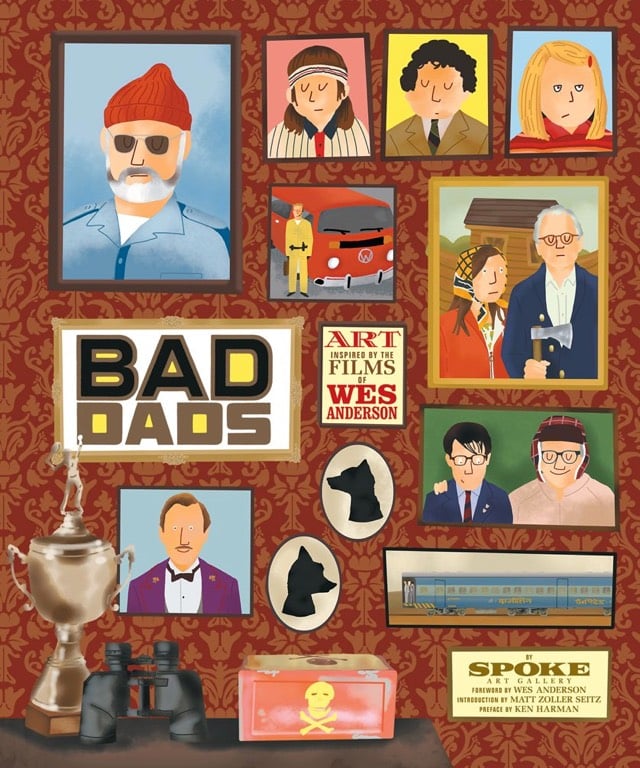
Wes Anderson’s films are chock full of bad fathers and father figures. Bad Dads, the third book in the Wes Anderson Collection, showcases some of the art from the annual Bad Dads art show (prints!) at the Spoke Art Gallery in San Francisco.
Alex Gibney, the documentary filmmaker who directed the awesome Going Clear (on Scientology) as well as films about Enron and Wikileaks, has a new film out called Zero Days. The film is generally about cyberwarfare and specifically about the Stuxnet virus, which has a particularly cyberpunk sci-fi first paragraph on Wikipedia:
Stuxnet is a malicious computer worm believed to be a jointly built American-Israeli cyber weapon. Although neither state has confirmed this openly, anonymous US officials speaking to The Washington Post claimed the worm was developed during the Obama administration to sabotage Iran’s nuclear program with what would seem like a long series of unfortunate accidents.
The movie was funded on Kickstarter and is out in select theaters…but is also available to rent on Amazon right now. Gonna watch this tonight.
Update: Ok, weird. Zero Days was not funded on Kickstarter. The KS film was originally called Zero Day and changed its name to Every Move You Make when the focus of the film changed. Gibney came on as a “Consulting Producer” to Every Move last year so that’s where my confusion came in. (thx, ken)
From the films he made as a teenager on up to the recently released BFG, this is a look at the evolution of the films of Steven Spielberg.
I was 20 when Jurassic Park came out and while I really liked it, I didn’t think much about who directed it at the time. It certainly didn’t remind me much of Raiders of the Lost Ark or ET. I watched it again last night (it’s on Netflix) and it is soooooo obviously Spielberg.
Using a 5000-word dictionary of words rated on their happiness, the Hedonometer measures the average happiness on Twitter.
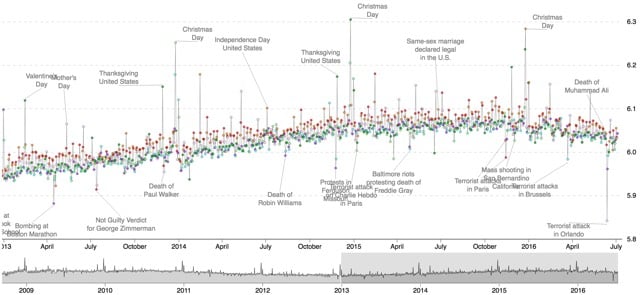
Christmas is always the happiest day of the year (“merry”, “happy”, and “joy” are all pretty positive) while shootings and terrorist attacks are Twitter’s saddest events. The recent mass shooting in Orlando seems to be the least happy Twitter has been over the past 7+ years.
The Hedonometer also analyzes the overall happiness of movies based on their scripts. The happiest movie is Sex in the City while the saddest is Omega Man (followed by The Bourne Ultimatum). Somehow, the fourth happiest movie is Lost in Translation, which might be reason for some overall skepticism about the project’s sensitivity to context.
The happiness over time of individual movie scripts has been analyzed by the Hedonometer too. Pulp Fiction’s happiest moment is when Vincent and Mia go to Jackrabbit Slim’s and the low point is “Bring out the Gimp”.
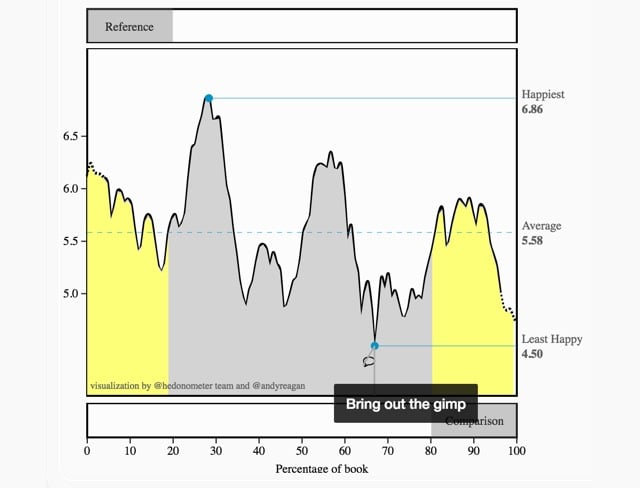
The system has analyzed books as well…the low point of the entire Harry Potter series seems to be the event at the end of The Half-Blood Prince.
Update: Grain of salt and all that, but the shootings of Alton Sterling, Philando Castile, and the Dallas police officers have pushed the happiness quotient on Twitter lower again so that the two least happy days have both occurred in the past month. There’s been a general feeling that 2016 has been a bad year, like George RR Martin is writing it. I wish the data were available for a closer analysis, but if you look at the chart, you can see that Twitter’s overall happiness starts to rise around the end of 2012 but starts to fall again right around the beginning of 2016…the effect is quite clear, even just from eyeballing it.
In a relatively new video essay about movies, Lessons from the Screenplay, Michael Tucker looks at Dan Aykroyd and Harold Ramis’s original script for Ghostbusters and how the framework it provided, enhanced by the improv skills of the actors, produced a movie better than the script might have indicated at first glance. And oh man, I love the turn-of-the-century Ghostbusters idea. (via one perfect shot)
If you’re looking to avoid the family or ocean or grilled meats or fireworks, there are some seriously good movies that have been added to Netflix in the US just in time for the long holiday weekend:
Mean Girls
Beverly Hills Cop
Gladiator
Back to the Future (I II & III)
Deliverance
Lethal Weapon
The Sting
And The Big Short arrives on July 6.
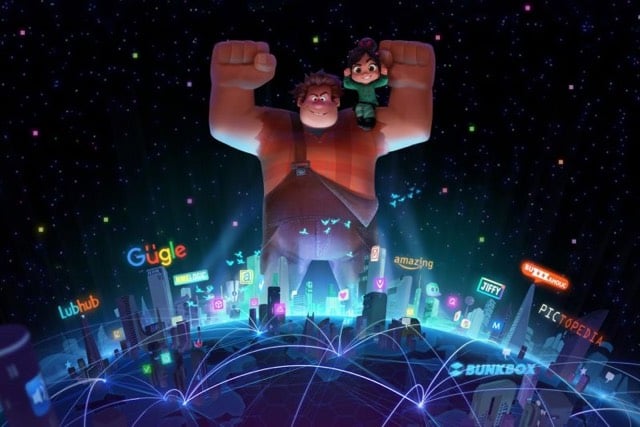
Disney has announced a sequel to Wreck-It Ralph due to come out in 2018. Given that the plot summary is “Ralph’s wrecking wreaks havoc on the Web”, I guess it’s appropriate the announcement took place on Facebook, which has already done its part in wrecking the open web.
Newer posts
Older posts







Socials & More