kottke.org posts about lists
The person I listen to the most regarding books I should be reading is Tyler Cowen…he has never once steered me wrong. So when he wrote about the best fiction of 2015, I perked up. I’ve been hearing many good things about Elena Ferrante’s series (Cowen himself flagged her The Lost Daughter as a favorite back in 2008) but his assertion that her recent series of novels ranks as “one of the prime literary achievements of the last twenty years” puts it solidly on my holiday beach reads list. The New World by Chris Adrian & Eli Horowitz and Vendela Vida’s The Diver’s Clothes Lie Empty also sound particularly interesting.
Update: Cowen recently shared his list of best non-fiction books of the year as well. Biographies rule the list: on Elon Musk, Henry Kissinger, Margaret Thatcher, and Genghis Khan. What a list…but I have to say that reading biographies of Thatcher or Kissinger doesn’t appeal at all.
Update: The NY Times weighs in with their list of 100 Notable Books of 2015. Between the World and Me by Ta-Nehisi Coates makes an appearance, as do the latest installments by Ferrante and Karl Ove Knausgaard.
Update: From Buzzfeed, The 24 Best Fiction Books of 2015 and from Slate, The Overlooked Books of 2015.
Update: The NY Times Sunday Book Review names their 10 Best Books of 2015. Coates and Ferrante feature. By my count, 7 of the 10 books are written by women.
Update: From Slate, a list of the best audiobooks of 2015. The Economist’s best books of the year, including SPQR: A History of Ancient Rome and Steve Silberman’s NeuroTribes. For part one of their best books list, The Guardian asked writers for their favorite books of the year; Max Porter’s Grief is the Thing with Feathers got multiple mentions (but is not yet out in the US).
Update: Amazon’s editors picked their 100 best books of the year and Lauren Groff’s Fates and Furies topped the list. The top non-fiction book is Becoming Nicole: The Transformation of an American Family.
Update: A design-oriented list from Michael Bierut, including The Making of Stanley Kubrick’s ‘2001: A Space Odyssey’.
Update: Bill Gates shared his favorite books of 2015, including Randall Munroe’s Thing Explainer: Complicated Stuff in Simple Words.
For The Millions Year in Reading 2015, they asked a bunch of writers for their reading recommendations. Joyce Carol Oates recommends the Didion biography The Last Love Song while Celeste Ng read The Suicide Index.
The Atlantic asked their editors and writers to share The Best Book I Read This Year. This is one of several lists to include The Invention of Nature: Alexander von Humboldt’s New World by Andrea Wulf.
Update: The NY Times book critics weigh in with their favorite books of the year. Moar Ferrante! Moar Coates!
From the New Yorker Food Issue,1 Lauren Collins examines how the World’s 50 Best Restaurants list comes together. I haven’t eaten at any of these sorts of restaurants in years (for a lot of reasons), and this bit gets to part of the reason why:
The restaurants in the upper reaches of the list tend to fall into a certain mode. They are all the same place, Giles Coren once conjectured in the London Times, “only the face changes, like Doctor Who.” Just as there is Oscar bait, there is 50 Best bait. “It’s opening up in Beijing,” David Chang said, imagining the archetypal 50 Best restaurant. “It’s a Chinese restaurant by a guy who worked for Adrià, Redzepi, and Keller. He cooks over fire. Everything is a story of his terroir. He has his own farm and hand-dives for his own sea urchins.” Hearing about 50 Best winners, and having eaten at a few of them, I started to think of them as icebreaker restaurants — places that create moments, that give you prompts. This can be exhilarating, or it can be infantilizing. It is the dining experience as Cards Against Humanity.
Kevin Kelly and Mark Frauenfelder polled 1600 people to find a list of the 50 best non-fiction podcasts. The list skews nerdy, science, and tech. The top 5 is unsurprising:
1. This American Life
2. Radiolab
3. Serial
4. 99% Invisible
5. WTF with Marc Maron
I wasn’t expecting much, but this list of status items from The Cut is pretty interesting reading. Status is often equated with money, but this list goes beyond that with picks like Japanese chalk for lecturing professors, the proper throat balm for theater people, watches for bankers1, weed for High Times editors, and the best canned tomatoes.
From the always excellent BLDGBLOG, a list of recommended books for your end-of-summer reading. Included on the list are a novel about drug cartels, a book about crime in the future, a history of Nazi concentration camps, and a book on rust, about which I have personally heard good things.
From Back to the Future’s DeLorean to Dr. Who’s Tardis, here’s a listing of sci-fi vehicles ranked from slowest to fastest.
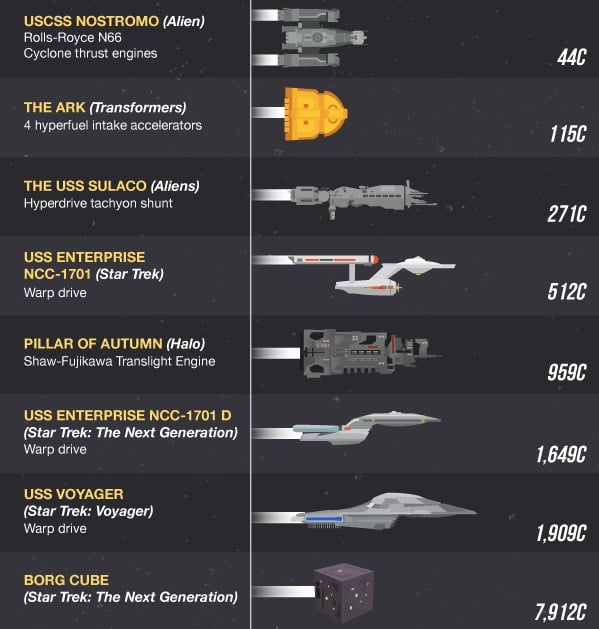
In the ongoing struggle of Star Wars vs. Star Trek, Wars is the clear winner in the speed category: the Millennium Falcon is thousands of times faster than the Enterprise. Also, I didn’t know the Death Star was so fast!
Ok, so narrowing down all of the beautifully shot movies in the world to a list of just 10 is absurd, but to their credit, the gang at Cinefix manage to mention more than 50 or 60 movies in their top 10 review. If you’ve only seen even a few of these, you’re doing well.
Manhattan, Citizen Kane, The Fall, 2001, Hero, The Tree of Life. Damn.
Still, where did the lighter fluid come from?
Sister is my new mother, Mother.
I’m afraid I just blue myself.
I’m about halfway through season two of Arrested Development again on Netflix and it might be the best show ever on television. I’m not even kidding.
Update: NPR has been obsessively cataloging the show’s running gags here. Holy shit, the extensive foreshadowing of Buster losing his hand! This show is amazing. (via @Nick__Vance)
This list ranking Don DeLillo’s novels into categories ranging from “Classic” to “Avoid” from 2007 excludes his two most recent novels, but if you have little exposure to the author, it’s a good place to start.
White Noise. DeLillo’s breakthrough success, arguably still his quintessential masterpiece, and the funniest and most sustained example of his talent. Jack Gladney, professor of Hitler Studies, struggles with information overload, simulated disasters, an “airborne toxic event,” the most photographed barn in America, and a drug that neutralizes the fear of death. If you’re going to like DeLillo, this is the book that will make it happen.
Confession: aside from attempting to tackle Underworld1 more than 10 years ago, I have not read any DeLillo. I should probably fix that? (via @davidgrann)
Near the end of a piece by Morgan Housel called Innovation Isn’t Dead, appears “the typical path of how people respond to life-changing inventions”:
1. I’ve never heard of it.
2. I’ve heard of it but don’t understand it.
3. I understand it, but I don’t see how it’s useful.
4. I see how it could be fun for rich people, but not me.
5. I use it, but it’s just a toy.
6. It’s becoming more useful for me.
7. I use it all the time.
8. I could not imagine life without it.
9. Seriously, people lived without it?
That’s about right. I can only recall a couple of instances where I’ve skipped from step 1 to step 8 or 9: when I first used the Web1 and when Jobs introduced the iPhone at MacWorld. Everything else — Google, HD TV, Twitter, personal computers, streaming music services, wifi, laptops, Instagram, mobile phones — went through most of the 9 phases. (via @cdixon)
From John Horgan, a list of 25 Terrific Science(y) Books. There are some unorthodox picks here (next to some no-brainers):
Ulysses, by James Joyce, 1922. Yeah, it’s a work of fiction, but as I argued a few years ago, Joyce was a more astute observer of the mind than anyone before or since. He exemplifies Noam Chomsky’s dictum that we will always learn more about ourselves from literature than from science.
The Structure of Scientific Revolutions, Thomas Kuhn, 1962. This sneaky, subversive assault on conventional notions of scientific truth and progress triggered a revolution itself within the philosophy of science. Be sure to note where Kuhn compares scientists with drug addicts.
From Steven Weinberg, a list of the 13 best science books for the general reader. Solid list. But The Origin of Species is more than a little tough for the lay reader; I tried reading it a few years ago and it was a slog. I recommend The Elegant Universe and The Making of the Atomic Bomb w/o reservation.
From designer Karl Sluis, a list of nine great book about information visualization not written by Edward Tufte. Gonna keep my eye out for Stephen Few’s Now You See It and David McCandless’ The Visual Miscellaneum, but Herbert Bayer’s World Geographic Atlas is a little too rich for my blood.
From Petapixel, a list of photographic firsts, including the first photograph (1826), the first digital photograph (1957), the first photo of the Sun (1845), and the first photograph of a US President (1843).
John Quincy Adams, the sixth President of the United States, was the first president to have his photograph taken. The daguerreotype was shot in 1843, a good number of years after Adams left office in 1829. The first to have his picture taken in office was James Polk, the 11th President, who was photographed in 1849.
Adams was born in 1767, which got me thinking about a long-standing interest of mine: who was the earliest born person ever photographed? The Maine Historical Society believes Revolutionary War vet Conrad Heyer was the earliest born. Born in 1749, he crossed the Delaware with Washington before sitting for this portrait in 1852.
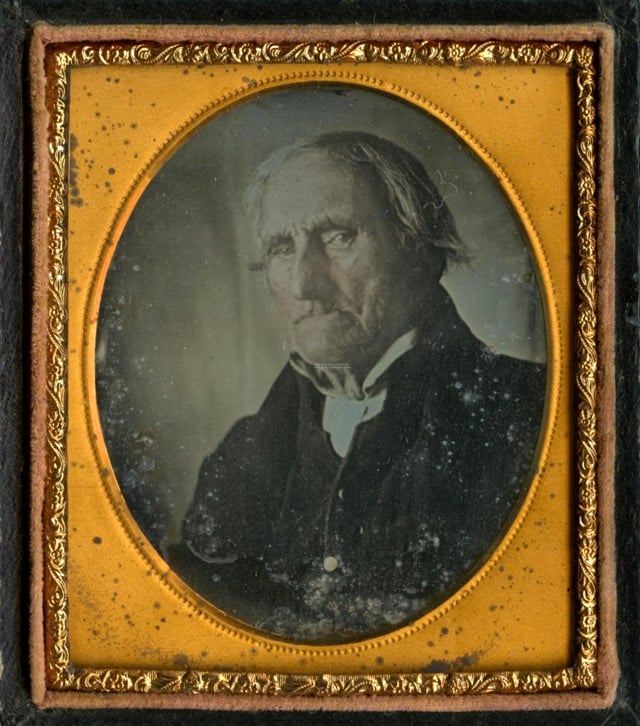
But according to the Susquehanna County Historical Society, John Adams (no apparent relation to the above Adams) was born in 1745 and was photographed at some point before he died in 1849. Other contenders with unverified ages include Revolutionary War vet Baltus Stone (born somewhere between 1744 and 1754 according to various sources) and a former slave named Caesar, photographed in 1851 at the alleged age of 114, which would mean he was born around 1737.
Still, that’s photographs of at least two people who were born in the 1740s, at least five years before the start of the French and Indian War. As children, it’s possible they could have interacted with people who lived through England’s Glorious Revolution in 1688 or even the English Civil War (1642-1651). The Great Span lives on.
Brown Bunny, Cannibal Holocaust, The 120 Days of Sodom, and The Last Temptation of Christ… they are among the most controversial movies of all time.
Perhaps a little NSFW. (via devour)
Tim Grierson and Will Leitch did a pretty good job in this list of All 15 Pixar Movies, Ranked From Worst to Best.
We went back-and-forth on the top two here, but we ultimately had to go with [Wall-E], the most original and ambitious of all the Pixar movies. The first half-hour, which basically tells the story of the destruction of the planet and the devolution of the human race without a single line of dialogue, is total perfection: It’s almost Kubrickian in its attention to detail and perspective, though it never feels cold or ungenerous.
Piece-of-shit Cars 2 is rightly parked at the bottom of the heap, Wall-E is obviously #1, and they correctly acknowledged Up as overrated. I would have rated the original Toy Story lower and Ratatouille higher, but overall: well done.
From Parents Against Gun Violence, a few of the reasons people shot people in May 2015.
My fiancee and I had an argument, so I open-carried my gun to a park and shot four random people.
The bartender put Clamato in my beer when I wanted tomato juice, so I shot him and his dog.
I found suspicious calls on my boyfriend’s phone, so I shot him. He was armed at the time too.
Rather than let my ex-wife win custody, I shot my own daughter to death.
Click through for the whole depressing list and links to news articles about each incident.
Jan Chipchase writes about Twelve Concepts in Autonomous Mobility, aka behavioral and design considerations of self-driving vehicles. You may not have thought of some of these.
Nanny mode: vehicles that are assigned to pick up young children from school, but end up trailing them at a discreet distance because the kids prefer to walk home alone.
Car surprise: when you come across your car somewhere where you didn’t expect it to be and witness your vehicle engaging in unexpected activities e.g. pickup up flowers at the mall: the equivalent of catching your parent or kid smoking or shoplifting.
And why is Google, an advertising company, interested in self-driving cars? Perhaps this:
Trailer trashing: where dodgy looking vehicles are assigned to trail an otherwise apparent owner either as a joke or to send a message e.g. a hearse sent by a debt collection agency to scare-up payment. You’ll also see this happen with more aggressive companies who send a vehicle around to their competitors to send a message, recruit their staff or to gather intelligence. Task Rabbit or San Da ha + autonomous mobility + intent. The most obvious market for this will be straight-up advertising.
In 2015, you can follow brands on Facebook, Twitter, and Instagram. In 2023, the brands follow you! Around town!
While researching this post on some weekend reading from David Foster Wallace, I stumbled across Way More than Luck, an anthology of notable commencement speeches.
Here, in an anthology of some of the finest of the genre, brilliant creative minds in every sector offer their wisdom: David Foster Wallace on living a compassionate life, Debbie Millman on the importance of taking risks, Michael Lewis on the responsibility that good fortune merits — and so many other greats. Some of this advice is grand (believe in the impossible), and some of it is granular enough to check off a life list (donate five percent of your money or your time).
See also The Top 7 Commencement Speeches of All Time.
I’ve never had the desire to go to business school or get an MBA, but I found this post by Ellen Chisa about what she learned during her first year at Harvard Business School fascinating. It almost nearly sort of makes me want to think about maybe applying to business school.
People often know what they’re good at (it got them where they are!) Unfortunately, things won’t always go well in your career. How you react and recover impacts everyone around you.
One of the best things I did this year was answering these two questions honestly, for myself:
What is my worst self?
When does my worst self come out?
My worst self: critical, impatient, stubborn, cynical, and sarcastic. It comes out when I feel like I’m not in a position to make an impact, and when I feel undervalued in a situation. It also happens if I think I’m fundamentally “right” and someone disagrees. If it goes on for too long I become incredibly apathetic and don’t do anything.
I have a hard time avoiding this, but I am better at catching it now. When I do catch it, I attempt to apologize to the group, move on, and catch it faster the next time.
Knowing yourself wasn’t really something I was taught in school, nor was it emphasized at home, so I was slow to learn my strengths and weaknesses and how to properly apply them to situations in my life. That struggle continues even today.
For the 30th anniversary of Spin, the editors compiled a list of the 300 best albums released in the past 30 years. The top 20 includes albums by Nirvana, Pixies, Bjork, Radiohead, Beastie Boys, and DJ Shadow. The #1 album is…….. nevermind, you should go find out for yourself. (via @jblanton)
From Reddit, dozens of people share their favorite lines from literature, from Nabokov to Milne to Dante. Here are a few of my favorites:
Piglet sidled up to Pooh from behind. “Pooh?” he whispered. “Yes, Piglet?” “Nothing,” said Piglet, taking Pooh’s hand. “I just wanted to be sure of you.” — A.A. Milne
Look again at that dot. That’s here. That’s home. That’s us. On it everyone you love, everyone you know, everyone you ever heard of, every human being who ever was, lived out their lives. The aggregate of our joy and suffering, thousands of confident religions, ideologies, and economic doctrines, every hunter and forager, every hero and coward, every creator and destroyer of civilization, every king and peasant, every young couple in love, every mother and father, hopeful child, inventor and explorer, every teacher of morals, every corrupt politician, every “superstar,” every “supreme leader,” every saint and sinner in the history of our species lived there — on a mote of dust suspended in a sunbeam. — Carl Sagan
Some men are born mediocre, some men achieve mediocrity, and some men have mediocrity thrust upon them. With Major Major it had been all three. Even among men lacking all distinction he inevitably stood out as a man lacking more distinction than all the rest, and people who met him were always impressed by how unimpressive he was. — Joseph Heller
‘Happy,’ I muttered, trying to pin the word down. But it is one of those words, like Love, that I have never quite understood. Most people who deal in words don’t have much faith in them and I am no exception - especially the big ones like Happy and Love and Honest and Strong. They are too elusive and far too relative when you compare them to sharp, mean little words like Punk and Cheap and Phony. I feel at home with these, because they’re scrawny and easy to pin, but the big ones are tough and it takes either a priest or a fool to use them with any confidence. — Hunter S. Thompson
If you need more, try your luck with these. (via @eqx1979)
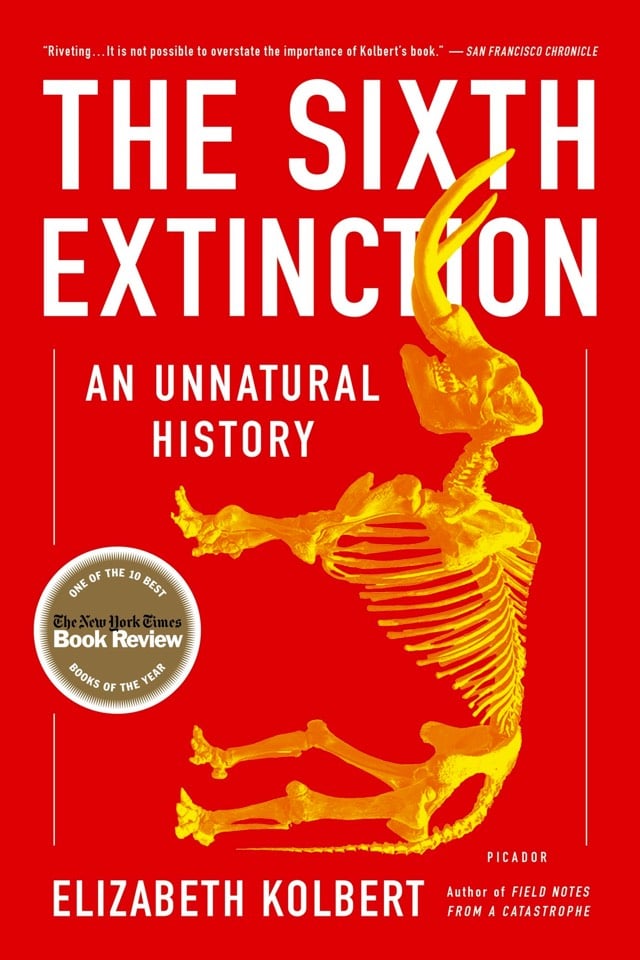
Vox has a list of all the 2015 Pulitzer Prize winners. I am especially pleased to see Elizabeth Kolbert win the general nonfiction category for The Sixth Extinction: An Unnatural History…I’ve been reading her writing on climate change and environmental issues in the New Yorker for years now.
From pediatrics professor Aaron Carroll, a list of guidelines for sensible & healthy eating.
1. Get as much of your nutrition as possible from a variety of completely unprocessed foods. These include fruits and vegetables. But they also include meat, fish, poultry and eggs that haven’t been processed. In other words, try to buy food that hasn’t been cooked, prepared or altered in any way. Brown rice over white rice. Whole grains over refined grains. You’re far better off eating two apples than drinking the same 27 grams of sugar in an eight-ounce glass of apple juice.
What’s more interesting than the guidelines is the admission up front that they’re not supported by rigorous science…and neither is nutrition in general. In the absence of science, “everything in moderation” seems to be the recommended course. (via @jimray)
Update: Julia Belluz recently interviewed Surgeon General1 Vivek Murthy for Vox and within, Murthy shares his four basic rules for health:
One is to eat healthy. I tend to avoid salt, added sugar, and processed foods whenever possible, and try to eat fresh fruits and vegetables as part of all my meals whenever possible.
Second is to stay physically active. That means not just going to gym but incorporating activity into whatever I do, whether that’s taking the stairs or converting sitting meetings to walking meetings whenever possible.
Third is making sure I’m focusing on my emotional and mental well-being. For me, an important part of that is the meditation practice that I do every morning. It’s a chance for me to center myself, a chance for me to remember who I want to be every day.
The fourth thing is I remind myself to stay away from toxic substances like tobacco and drugs.
From the AV Club, a publication by The Onion, a list of the 100 best films of the decade (so far). Good to see Her, The Grand Budapest Hotel, The Tree of Life, and Upstream Color on there, among others.
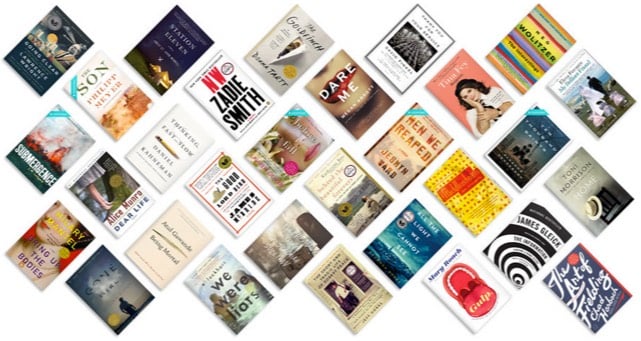
From the Oyster Review, a publication by online bookseller Oyster, a list of the 100 Best Books of the Decade So Far. Good to see The Emperor of All Maladies, Cleopatra: A Life, Bring Up the Bodies, and Mr. Penumbra’s 24-Hour Bookstore on there, among others.
Oh my, I had forgotten about the Name of the Year site and how amazing it is. Each year, they collect the most unusual names in the world and pit them against each other in a March Madness-style bracket. Here are some of the names in the running for the 2015 Name of the Year:
Swindly Lint
Dr. Electron Kebebew
Flavious Coffee
Lancelot Supersad Jr.
Jazznique St. Junious
(A reminder…these are actual names of actual people. Somehow.)
Littice Bacon-Blood
Dr. Wallop Promthong
Infinite Grover
Genghis Muskox
Malvina Complainville
Beethoven Bong
Amanda Miranda Panda
Some Hall of Name inductees include Tokyo Sexwale, Nimrod Weiselfish, Doby Chrotchtangle, Tanqueray Beavers, and Vanilla Dong.
From the Motion Picture Editors Guild, a list of the 75 best-edited movies of all time.
As for directors, Alfred Hitchcock is the most often cited, making the list 5 times (although not placing in the top 10), and spanning 3 decades. Right behind him are Steven Spielberg and Francis Ford Coppola, both of whom made the list 4 times. Like Hitchcock, Spielberg’s pictures were released over 3 decades. Coppola’s pictures, however, were all released in the 1970s - with 2 in 1974 (the only director with 2 films in a single year). All of his pictures placed in the top 22 films, with 3 of them in the top 11. At the other end of the continuum, there were 33 years between Terrence Malick’s 2 films on the list.
Directors Stanley Kubrick and Martin Scorsese follow, with 3 films each making the cut. Tied with Malick for 2 pictures are Bob Fosse, William Friedkin, Akira Kurosawa, Christopher Nolan, Ridley Scott, Steven Soderbergh, Orson Welles and Bob Wise; all others received 1 mention.
The top ten:
1. “Raging Bull” (Thelma Schoonmaker, 1980)
2. “Citizen Kane” (Robert Wise, 1941)
3. “Apocalypse Now” (Lisa Fruchtman, Gerald B. Greenberg, Walter Murch, 1979)
4. “All That Jazz” (Alan Heim, 1979)
5. “Bonnie And Clyde” (Dede Allen, 1967)
6. “The Godfather” (William H. Reynolds, Peter Zinner, 1972)
7. “Lawrence of Arabia” (Anne V. Coates, 1962)
8. “Jaws” (Verna Fields, 1975)
9. “JFK” (Pietro Scalia, Joe Hutshing, 1991)
10. “The French Connection” (Gerald B. Greenberg, 1971)
You think of filmmaking as male dominated, but one thing I noticed about that top 10 right away: five women in the list, including three in the top five. (via hitfix)
Update: Women have been well-represented in film editing in part because the job began as menial labor.
For much of Hollywood history, there were virtually no filmmaking opportunities available to women other than screenwriting and acting — with one major exception. Women have always been welcomed — and in many quarters preferred by male directors — as film editors, or “cutters,” as they were originally known. In the early days, the job was regarded as menial labor, and it largely was. Cutters worked by hand, running film on reels with hand cranks and manually cutting and gluing together strips of it. (Moreover, they almost never received screen credit.) After the advent of the Moviola editing machine in 1924, the process became faster and easier, but was still tedious and low paying, which is why most cutters remained young, working-class women.
It was around this time that the job of cutting films became less about just maintaining proper continuity and more about being creative. The Russian films of Sergei Eisenstein introduced the concept of montage — how “colliding” separate pieces of film together could advance a storyline and manipulate viewers’ emotions — and this approach became widely discussed and imitated the world over, not least of all by some of the more enterprising female cutters in America, some of whom, like Margaret Booth, began to experiment with leftover footage on the cutting room floor and proved to be quite inventive.
More on the early history here. (via @ironicsans)
The Dissolve picks the 50 best films of the current decade. Picks 50-26, and picks 25-1. Boyhood, The Social Network, Under the Skin, and Inside Llewyn Davis all rank high. (via @khoi)
Amazon has compiled a list of 100 Books to Read in a Lifetime “to create a well-read life”. Lots of the usual suspects here, including Lolita, The Catcher in the Rye, and To Kill a Mockingbird. But there are also some quirkier and more recent picks like A Very Hungry Caterpillar, The Fault in Our Stars, and Unbroken. Went through and counted…I’ve read 29 of these.
David Ehrlich returns with a video montage of his 25 favorite movies of 2014. (Here’s his 2013 video.)
His top 5:
5. Gone Girl
4. Nymphomaniac
3. Under The Skin
2. Inherent Vice
1. The Grand Budapest Hotel
These year-end videos by Ehrlich are incredibly effective trailers for movies. Not just the individual films, but the whole idea of cinema itself. Having just watched this, I want to leave my office, head to the nearest theater and just watch movies all day.
Newer posts
Older posts




Socials & More