When I go back and read journalism from the ’70s and ’80s, I can see that there has been little, if any, innovation in the form since. But! While they may not be drastically “new,” there are at least two bits of excitement in internet journalism today that seem somewhat radical. First, Brian Lam at Gizmodo talks overtly about the twisted relationship between tech companies and journalists. (“As one reporter put it while chiding me, ‘Journalists are guests in the houses of these companies.’ Not first and foremost! We are the auditors of companies and their gadgets on behalf of the readers.”) And over on another Gawker Media blog (my former employer, and one that I have deeply conflicted feelings about), Jezebel’s Tracie Egan writes an astounding and reallly not for the faint-of-heart (or crotch) account of schtupping this guy she met in Vegas. It’s BANANAS. And probably NSFW. And a great read.
For a long time, I wanted to write a profile of the designer Tom Ford—and I realized the only way to do so properly would be to have sex with him and write about it. I sent an emissary to him; he declined the opportunity. I was relieved.
Fantastic and disturbing Esquire article about Dateline NBC’s “To Catch a Predator” series in which people are lured to a house with the prospect of sex with minors, ambushed by a camera crew, and then arrested when they attempt to leave. I can’t say much about the article without spoiling it, but a friend who has watched the show says there’s nothing redeeming about any of the people on the show, from the show’s host on down to the would-be molesters…and how the whole thing is orchestrated off-camera makes it seem even worse. More from Esquire about the article and NBC’s rebuttal.
Regret the Error’s annual list of media errors and corrections is one of my favorites…the 2007 installment doesn’t disappoint. The corrections in the UK newspapers are awesome:
An article about Lord Lambton (“Lord Louche, sex king of Chiantishire”, News Review, January 7) falsely stated that his son Ned (now Lord Durham) and daughter Catherine held a party at Lord Lambton’s villa, Cetinale, in 1997, which degenerated into such an orgy that Lord Lambton banned them from Cetinale for years. In fact, Lord Durham does not have a sister called Catherine (that is the name of his former wife), there has not been any orgiastic party of any kind and Lord Lambton did not ban him (or Catherine) from Cetinale at all.
Henry Abbott at TrueHoop picked up on a policy that Colin Powell had when he was the chairman of the Joint Chiefs of Staff. Here’s Mike McConnell repeating what Powell told him:
Look, I have got a rule. As an intelligence officer, your responsibility is to tell me what you know. Tell me what you don’t know. Then you’re allowed to tell me what you think. But you always keep those three separated.
Abbott rightly comments that that’s good advice for journalists and bloggers.
A depressing story about the media’s coverage of Al Gore during the 2000 election.
Eight years ago, in the bastions of the “liberal media” that were supposed to love Gore — The New York Times, The Washington Post, The Boston Globe, CNN — he was variously described as “repellent,” “delusional,” a vote-rigger, a man who “lies like a rug,” “Pinocchio.” Eric Pooley, who covered him for Time magazine, says, “He brought out the creative-writing student in so many reporters… Everybody kind of let loose on the guy.”
I want to believe that news outlets are in the business of news, not entertainment, but it’s just not true in most cases. Even more depressing is that blogs, especially political blogs, are even worse in this regard.
On his NYTimes blog, Dick Cavett remembers having Norman Mailer on his show along with Gore Vidal and Janet Flanner. It was a notorious episode; a perhaps more than slightly drunk Mailer lashed out first at Vidal and then everyone else in the room but couldn’t keep up with the jeers and witticisms flying at him from all angles.
Mailer: I said that the need of the magazine reader for a remark he could repeat at dinner was best satisfied by writers with names like Gore Vidal.
Flanner: All those writers called Gore Vidal.
Vidal: I know. There are thousands of them, yeah.
Mailer: There are two or three.
Cavett: Who are some of the others?
Mailer [with a dark look]: I don’t know.
Cavett: Who wants to host the rest of this show?
Mailer, years later, told me that it was at this point that “in the face of the Cavett wit and Flanner’s deft interruption” — adored by the audience — and in consideration of his alcohol content, he realized that he was not being skillful at mounting a sustained argument.
In an interview a number of years ago with Cavett, Charlie Rose showed a clip of the incident:
[Dead Flash embed of http://video.google.com/googleplayer.swf?docId=-8150850263045831787]
The video should cue up at the clip in question, but if not, skip to 29:00 in. Highly entertaining reading and viewing.
“The full Ginsburg” is the term for appearing on all five of the big Sunday morning political shows: This Week, Meet the Press, Face the Nation, Fox News Sunday, and Late Edition. The term is named after William Ginsburg, Monica Lewinsky’s attorney and the first person to complete this political Pokemon collection. According to Wikipedia, four individuals have completed the full circuit: Ginsburg, Dick Cheney, John Edwards, and Hillary Clinton. Source: Brouhahaha, The New Yorker.
RU Sirius asks: Is the net good for writers? Ten professional writers weigh in.
I like to develop topics, approach them from different, often contradictory angles, and most of all, I like to polish the shit out of them so that the flow and the prose shine and bedazzle. On and offline, I find the internet-driven pressure to make pieces short, data-dense, and crisply opinionated — as opposed to thoughtful, multi-perspectival, and lyrical — rather oppressive, leading to a certain kind of superficial smugness as well as general submission to the forces of reference over reflection. I do enjoy writing 125-word record reviews though!
My favorite aspect of the piece is the interspersed American Apparel ads…they add a little texture to the discussion.
Mental Floss has an ongoing feature called The First Time News Was Fit To Print, which chronicles the first mentions of famous people, places, and events in the NY Times. Among the topics covered so far: The Simpsons, Kobe Bryant, and Starbucks.
Louisiana pastor Eddie Thompson feels that the media and activists have gotten the story wrong about the Jena Six. In this article, he attempts to correct some of the misconceptions and erroneous statements made about the case.
The actions of the three white students who hung the nooses demonstrate prejudice and bigotry. However, they were not just given “two days suspension” as reported by national news agencies. After first being expelled, then upon appeal, being allowed to re-enter the school system, they were sent to an alternative school, off-campus, for an extended period of time. They underwent investigations by Federal and Sate authorities. They were given psychological evaluations. Even when they were eventually allowed back on campus they were not allowed to be a part of the general population for weeks.
(thx, james)
Is lazy reporting hurting the visual arts? Jonathan Jones argues that almost all reporting about art takes one of six forms: expensive art, graffiti, plagiarism, earth-shattering discoveries, and restoration. Looking back through kottke.org’s art tag page, I am guilty of linking to stories of all those types. Eep.
While poking around in the newly opened archives of the New York Times yesterday, I stumbled upon an article called How We Dine (full text in PDF) from January 1, 1859. I’m not well versed in the history of food criticism, but I believe this is perhaps the first restaurant review to appear in the Times and that the unnamed gentleman who wrote it (the byline is “by the Strong-Minded Reporter of the Times”) is the progenitor of the paper’s later reviewers like Ruth Reichl, Mimi Sheraton, and Frank Bruni.
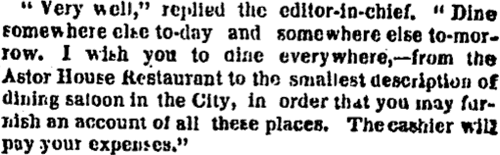
The article starts off with a directive from the editor-in-chief to “go and dine”:
“Very well,” replied the editor-in-chief. “Dine somewhere else to-day and somewhere else to-morrow. I wish you to dine everywhere, — from the Astor House Restaurant to the smallest description of dining saloon in the City, in order that you may furnish an account of all these places. The cashier will pay your expenses.”
Before starting on his quest, the reporter differentiates eating from dining — noting that many believe “whereas all people know how to eat, it is only the French who know how to dine” — and defines what he means by an American dinner (as opposed to a French one). Here’s his list of the types of American dinner to be found in New York, from most comfortable to least:
1. The Family dinner at home.
2. The Stetsonian dinner.
3. The Delmonican, or French dinner.
4. The Minor dinner of the Stetsonian principle.
5. The Eating-house dinner, so called.
6. The Second-class Eating-house dinner.
7. The Third-class Eating-house feed.
The remainder of the article is devoted to descriptions of what a diner might find at each of these types of establishments. Among the places he dined was Delmonico’s, where dining in America is said to have originated:
Once let Delmonico have your order, and you are safe. You may repose in peace up to the very moment when you sit down with your guests. No nobleman of England — no Marquis of the ancienne nobless — was ever better served or waited on in greater style that you will be in a private room at Delmonico’s. The lights will be brilliant, the waiters will be curled and perfumed and gloved, the dishes will be strictly en règle and the wines will come with precision of clock-work that has been duly wound up. If you “pay your money like a gentleman,” you will be fed like a gentleman, and no mistake… The cookery, however, will be superb, and the attendance will be good. If you make the ordinary mistakes of a untraveled man, and call for dishes in unusual progression, the waiter will perhaps sneer almost imperceptibly, but he will go no further, if you don’t try his feelings too harshly, or put your knife into your mouth.
According to a series of articles by Joe O’Connell, Delmonico’s was the first restaurant in the US when it opened in 1830 and invented Eggs Benedict, Oysters Rockefeller, Baked Alaska, Lobster Newberg, and the term “86’d”, used when the popular Delmonico Steak (#86 on menu) was sold out, or so the story goes. O’Connell’s history of Delmonico’s provides us with some context for the How We Dine piece:
The restaurant was a novelty in New York. There were new foods, a courteous staff, and cooking that was unknown at the homes of even the wealthiest New Yorkers. The restaurant was open for lunch and dinner.
The restaurant featured a bill of fare, which was itself new. Those who dined at inns were fed on a set meal for a set price. As a result, everyone was fed the same meal and were charged the same price, whether they ate little or much. In Paris, however, restaurants offered their patrons a “bill of fare”, a carte, which listed separate dishes with individual prices. Each patron could choose a combination of dishes which was different from the other patrons. Each dish was priced separately. Thus, the restaurant was able to accommodate the tastes and hunger of each individual. The various dishes and their prices were listed on a carte or (the English translation) “bill of fare”. Today, we call it a menu.
And from Delmonico’s developed many different types of dining establishments, which the Strong-Minded Reporter set out to document thirty years later. Contrast his visit to Delmonico’s with the experience in the “sandwich-room” at Browne’s Auction Hotel, an eating-house:
The habitués of the place are rarely questioned at all. The man who has eaten a sandwich every day for the past ten years at the Auction Hotel no sooner takes his seat than a sandwich is set before him. The man who has for the same period indulged daily in pie or hard boiled eggs (there are some men with amazing digestion) is similarly treated. The occasional visitor, however, is briefly questioned by the attendant before whom he takes his place. “Sandwich?” or “Pie?” If he say “Sandwich,” in reply, the little man laconically inquires, “Mustard?” The customer nods, and is served. If his mission be pie, instead, a little square morsel of cheese is invariably presented to him. Why such a custom should prevail at these places, no amount of research has yet enabled me to ascertain. Nothing can be more incongruous to pie than cheese, which, according to rule and common sense, is only admissible after pie, as a digester. But the guests at the Auction Hotel invariably take them together, and with strict fairness — a bite at the pie, and a bite at the cheese, again the pie, and again the cheese, and so on until both are finished.
The experience of being a regular has barely changed in 150 years. And finally, our intrepid reporter visits an unnamed third class eating-house:
The noise in the dining hall is terrific. A guest has no sooner seated himself than a plate is literally flung at him by an irritated and perspiring waiter, loosely habited in an unbuttoned shirt whereof the varying color is, I am given to understand, white on Sunday, and daily darkening until Saturday, when it is mixed white and black — black predominating. The jerking of the plate is closely followed up by a similar performance with a knife and a steel fork, and immediately succeeding these harmless missiles come a fearful shout from the waiter demanding in hasty tones, “What do you want now?” Having mildly stated what you desire to be served with, the waiter echoes your words in a voice of thunder, goes through the same ceremony with the next man and the next, through an infinite series, and rushes frantically from your presence. Presently returning, he appears with a column of dishes whereof the base is in one hand and the extreme edge of the capital is artfully secured under his chin. He passes down the aisle of guests, and, as he goes, deals out the dishes as he would cards, until the last is served, when he commences again Da Capo. The disgusting manner in which the individuals who dine at this place, thrust their food into their mouths with the blades of their knives, makes you tremble with apprehensions of suicide…
The entire article is well worth the read…one of the most interesting things I’ve found online in awhile.
Update: According to their web site, a restaurant in New Orleans named Antoine’s claims that they invented Oysters Rockefeller. Another tidbit: from what I can gather, the Delmonico’s that now exists in lower Manhattan has little to do with the original Delmonico’s (even though they claim otherwise), sort of like the various Ray’s Pizza places sprinkled about Manhattan. (thx, everyone who sent this in)





Socials & More