Andy Baio interviews Alan Taylor, the fellow behind The Big Picture, the journalistic photo blog that’s taken the web by storm.
Internally, externally, everywhere, people are being really thankful to me. I need to make sure (with some link-love in my upcoming blogroll) that the response gets directed to the photographers as well. I’m just a web developer with access to their photos and a blog - they’re the ones out there working hard to get these amazing images. “Photographers” here is a loose term, encompassing photojournalists, stringers, amateurs, scientific imaging teams and more.
New Yorker profile of Keith Olbermann, with lots about the changing face of journalism from the desire for objective neutrality to the more sensational opinion that saturates cable, newspapers, and the blogosphere.
But Olbermann contends that the labored pretense of neutrality in the news business is a fruitless exercise. “There are people who, with absolute conviction, believe that Brian Williams is a Communist,” he said. “There are people who, with absolute conviction, believe that Katie Couric is in the pay of the Pentagon. There are people who are absolutely certain that Charlie Gibson sleeps with Hillary Clinton, based on the last debate. This is an old schoolyard thing I learned from being repeatedly beat up in the fourth grade. It finally dawned on me one day — they are going to keep beating me up whether I respond to them or not.” Olbermann continued, “Brian sometimes looks like his collar button is going to burst from the restraint that he has. I know the pain that he goes through; he measures each word like an apothecary — and they beat him up, too. The point is, why not? Why not add something to the discourse?”
As much as I agree with some of what Olbermann says, I put him in the same bucket as Lou Dobbs and Bill O’Reilly…entertaining but intellectually untrustworthy.
Is Deborah Solomon, the NY Times Magazine’s notoriously irritating Q&A interviewer, turning over a new leaf? After complaints about her columns surfaced last fall, the NY Times public editor agreed that Solomon had not complied with the Times’ policy of fairly representing the answers of her interviewees. Ben Wheeler noted that her most recent piece is an excellent straightforward interview with zero snarky asides or abusive questions.
If you point out when they suck, you gotta point out when they do well. On Sunday, Deborah Solomon’s weekly NY Times Magazine interview was an excellent talk with Enrique Penalosa, former mayor of Bogota known for his Susan Jacobs/Scandinavian vision of urban planning. Solomon’s old method, of inserting snide remarks and different questions after the fact, is gone; we can thank Ira Glass and Amy Dickinson (Ann Landers’s successor) for that, since they complained when she did it to them. But beyond that change, Solomon here just asks good, sensible questions of an interesting subject.
Russian writer Maxim Gorky wrote one of the first movie reviews in 1896 after seeing a collection of Lumiere films. Film/sound editor Walter Murch introduces the piece:
It is written on a completely clear slate, by someone who had not already been taught how to regard the cinema by a thousand other writers, and the newness of it all leaps from the page. What is remarkable is Gorky’s prescience in the last two paragraphs, as he leaps ahead from his description of the first films to speculation on what directions the cinema might eventually take, toward sex and violence. How did he know?
The bulk of Gorky’s short review concerns the absence of color and sound from the films, as if he’s viewing shadows of reality.
Their smiles are lifeless, even though their movements are full of living energy and are so swift as to be almost imperceptible. Their laughter is soundless although you see the muscles contracting in their grey faces. Before you a life is surging, a life deprived of words and shorn of the living spectrum of colours — the grey, the soundless, the bleak and dismal life.
In a collection of accounts of new technology, the NY Times has a pair of film reviews, the first from the Paris debut of the Lumiere films in 1895:
Photography has ceased to record immobility. It perpetuates the image of movement. When these gadgets are in the hands of the public, when anyone can photograph the ones who are dear to them, not just in their immobile form, but with movement, action, familiar gestures and the words out of their mouths, then death will no longer be absolute, final.
And this one from the projectionist of the first Lumiere in NYC:
You had to have lived these moments of collective exaltation, have attended these thrilling screenings in order to understand just how far the excitement of the crowd could go. With the flick of a switch, I plunge several thousand spectators into darkness. Each scene passes, accompanied by tempestuous applause; after the sixth scene, I return the hall to light. The audience is shaking. Cries ring out.
The Times also has a short article previewing the debut of Thomas Edison’s vitascope1, which demonstrates the difficulty in describing this new technology to the public.
The vitascope projects upon a large area of canvas groups that appear to stand forth from the canvas, and move with great facility and agility, as though actuated by separate impulses. In this way the bare canvas before the audience becomes instantly a stage upon which living beings move about.
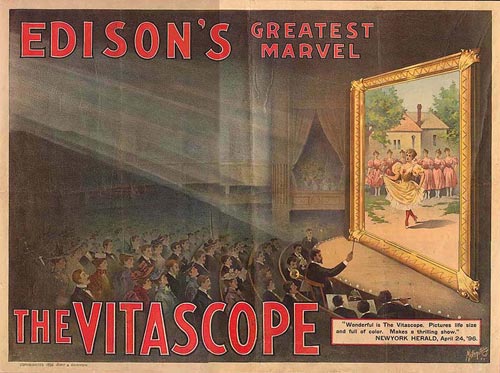
That sounds a bit boring but audiences loved it.
So enthusiastic was the appreciation of the crowd long before this exhibition was finished that vociferous cheering was heard. There were loud calls for Mr. Edison, but he made no response.
By 1898, the language of cinema was beginning to sort itself out, more or less, as this Times editorial notes.
All the resources of the word-builders see to have been exhausted in finding names for the simple but ingenious machine that throws moving pictures on a screen. The essential features in every device of this sort are the same — a brilliant light before which a long band of minute photographs is rapidly drawn, and a lens to focus and distribute the rays properly. The arrangements for the manipulation of the light, the band, and the lens are numerous, but they vary only in the inconsequential details, and for all practical purposes the machines are identical. Some mysterious impulse, however, has impelled almost every purchaser of the apparatus to buy with it, or to invent for it, a distinctive name. Vitascope and biograph are most familiar here, with cinematograph coming next at a considerable distance. These hardly begin the list that might be formed from a careful study of the amusement advertisements in the papers of this and other countries. From such sources might be taken phantoscope, criterioscope, kinematograph, wondorscope, animatoscope, vitagraph, panoramograph, cosmoscope, anarithmoscope, katoptikum, magniscope, zoeoptrotrope, phantasmagoria projectoscope, variscope, cinograph, cinnomonograph, hypnoscope, centograph, and xograph. This is far from exhausting the supply. Electroscope exists, and so do cinagraphoscope, animaloscope, theatrograph, chronophotographoscope, motograph, rayoscope, motorscope, kinotiphone, thromotrope, phenakistoscope, venetrope, vitrescope, zinematograph, vitropticon, stinnetiscope, vivrescope, diaramiscope, corminograph, kineoptoscope, craboscope, vitaletiscope, cinematoscope, mutoscope, cinoscope, kinetograph, lobsterscope, and nobody knows how many more. Here, surely, is a curious development of the managerial mind.
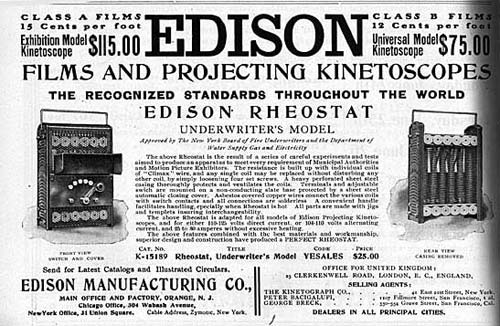
It’s difficult to read these accounts and not think about how we’ll all sound in 100 years as we now attempt to explain the internet, mobile phones, the web, blogs, and the like.
[1] Edison didn’t actually invent the vitascope. Thomas Armat sold the rights to his invention to The Edison Company on the condition that Edison could claim to have invented it. ↩
Big Picture is a fantastic and dead-simple new site from boston.com. Each entry tells a story through high-quality newswire images displayed at large sizes; recent entries include a look at Saturn from the Cassini space probe and the daily lives of soldiers in Afghanistan. If you’re frustrated by the tiny news imagery we get spoon-fed to us on the web, this site will be a welcome addition to your daily browse. Alan Taylor, the project’s instigator, has a post on his blog about Big Picture.
The sizes of the photographs are deliberately large - taking advantage of the majority of web users who have screens capable of displaying 1024x768 or larger. The long-held tradition of keeping images online tiny and lightweight is commendable still - when designing a general purpose site. But one dedicated to quality imagery should take full advantage of the medium, and I hope I’ve struck a good balance with The Big Picture.
When I see quality photography consigned to the archives, or when I see bandwidth readily given up to video streams of dubious quality, or when I see photo galleries that act as ad farms, punishing viewers into a click-click-click experience just to drive page views - those times are the times I’m glad I was able to get this project off the ground (many thanks to my friends within boston.com)
After a stutter step back in late February, NY Times releases their slick archive browser, TimesMachine. Here’s the announcement from the team that put it together.
TimesMachine is a collection of full-page image scans of the newspaper from 1851-1922 (i.e., the public domain archives). Organized chronologically and navigated by a simple calendar interface, TimesMachine provides a unique way to traverse the historical archives of The New York Times. Topics ranging from the Civil War to the sinking of the Titanic to the first cross-country auto race to women’s fashions in the 20s are just a few electronic flips away. And of course, there’s the advertisements.
Unfortunately, full access to the archives through TimesMachine is only available to subscribers. (via fimoculous)
A list of the top one articles by Neal Pollack about how sportswriters should stop writing about the NBA MVP race and, oh yeah, lists of stuff are dumb:
1. This article right here.
Sportswriters and pundits, on the other hand, are treating the MVP race with the gravitas of a presidential election. That’s because they make up the Electoral College. When they’re debating who’s going to win the award, they’re not really talking about who they think the best player is; they’re talking about whom they should pick as the best player. It’s the ultimate circle-jerk of sports-guy self-regard.
Google Earth now displays location-specific news from the NY Times.
I read a lot of news by surfing the Internet, as do many of my colleagues and friends, and I’ve always dreamed of a way to browse news based on geography. What’s happening in Paris today? What are the top headlines in Japan?
In past few years, several prominent US magazines and newspapers have begun to offer their extensive archives online and on DVD. In some cases, this includes material dating back to the 1850s. Collectively it is an incredible record of recent human history, the ideas, people, and events that have shaped our country and world as recorded by writers, photographers, editors, illustrators, advertisers, and designers who lived through those times. Here are some of most notable of those archives:
Harper’s Magazine offers their entire archive online, from 1850 to 2008. Most of it is only available to the magazine’s subscribers. Associate editor Paul Ford talks about how Harper’s archive came to be.
The NY Times provides their entire archive online, most of it for free. Most of the stories from 1923 to 1986 are available for a small fee. The Times briefly launched an interface for browsing their archive called TimesMachine but withdrew it soon after launch.
Time Magazine has their entire archive online for free, from 1923 to the present.
Sports Illustrated has all their issues online for free, dating back to 1954.
The Atlantic Monthly offers all their articles since Nov 1995 and a growing number from their archive dating back to 1857 for free. For a small fee, most of the rest of their articles are available as well, although those from Jan 1964 - Sept 1992 are not.
The Washington Post has archives going back to 1877. Looks like most of it is for pay.
The New Yorker has free archives on their site going back to 2001, although only some of the articles are included. All of their articles, dating back to 1925, are available on The Complete New Yorker DVD set for $40.
Rolling Stone offers some of their archive online but the entire archive (from 1967 to 2007) is available as a 4-DVD set for $79.
Mad Magazine released a 2-DVD set of every issue of the magazine from 1952-2006.
And more to come…old media is slowly figuring out that more content equals more traffic, sometimes much more traffic.
Update: Nature has their entire archive online, dating back to 1869. (thx, gavin)
Buzzfeed gets a little love in this week’s New Yorker article about the “death and life of the American newspaper”.
The Huffington Post’s editorial processes are based on what Peretti has named the “mullet strategy.” (“Business up front, party in the back” is how his trend-spotting site BuzzFeed glosses it.) “User-generated content is all the rage, but most of it totally sucks,” Peretti says. The mullet strategy invites users to “argue and vent on the secondary pages, but professional editors keep the front page looking sharp. The mullet strategy is here to stay, because the best way for Web companies to increase traffic is to let users have control, but the best way to sell advertising is a slick, pretty front page where corporate sponsors can admire their brands.”
Here’s the mullet strategy page on Buzzfeed. (Disclosure: I’m an advisor to Buzzfeed.)
The NY Times launches TimesMachine, an alternate look into their vast online archive. It’s basically an interface into every single page of the newspaper from Sep 18, 1851 to Dec 30, 1922. The advertising on these old pages is fascinating.
Update: For whatever reason, the Times has taken TimesMachine offline.
An official decision has been reached in the Long Bet between Dave Winer and Martin Nisenholtz of the NY Times. The bet was made in 2002 when Winer asserted that:
In a Google search of five keywords or phrases representing the top five news stories of 02007, weblogs will rank higher than the “New York Times” Web site
Winer won the bet but it’s worth noting that the Times has a growing stable of good blogs itself. (via workbench)
91-year-old NPR man Daniel Schorr has had it up to here with you kids and your internets. [Warning, print link to avoid stupid registration window.]
Q: In some commentaries, you touch on the latest journalistic trends, sometimes in not so complimentary a way. Such as blogs and citizen journalism. Is this a form of news gathering that you embrace?
A: I can’t embrace it. Not after what I’ve been through at the hands of the copy editors’ desks. I have suffered many, many arguments about what I’ve wanted to say — whether it was grammatically correct, factually correct and all of that — and I want everybody to have to experience what I experienced. But today, your blogger is totally free. He is his own reporter, his own editor, his own publisher, and he can do whatever he wants.
A person like me who believes in the tradition of a discipline in journalism can only rue the day we’ve arrived at where we don’t need discipline or anything. All you need is a keyboard.
He suffered, so you should too, you undisciplined mouthers-off! Update: A reader writes: “You are not giving the man the respect he deserves. He did not suffer—he honed his craft in an environment that expected professionalism, balance and honesty. What is unfortunate today is that today’s professional media are not held to the same standards. Most, if not all bloggers, do not rise to the quality of a Daniel Schorr. Unfortunately, neither do most of his younger colleagues.”





Socials & More