kottke.org posts about food
From pediatrics professor Aaron Carroll, a list of guidelines for sensible & healthy eating.
1. Get as much of your nutrition as possible from a variety of completely unprocessed foods. These include fruits and vegetables. But they also include meat, fish, poultry and eggs that haven’t been processed. In other words, try to buy food that hasn’t been cooked, prepared or altered in any way. Brown rice over white rice. Whole grains over refined grains. You’re far better off eating two apples than drinking the same 27 grams of sugar in an eight-ounce glass of apple juice.
What’s more interesting than the guidelines is the admission up front that they’re not supported by rigorous science…and neither is nutrition in general. In the absence of science, “everything in moderation” seems to be the recommended course. (via @jimray)
Update: Julia Belluz recently interviewed Surgeon General1 Vivek Murthy for Vox and within, Murthy shares his four basic rules for health:
One is to eat healthy. I tend to avoid salt, added sugar, and processed foods whenever possible, and try to eat fresh fruits and vegetables as part of all my meals whenever possible.
Second is to stay physically active. That means not just going to gym but incorporating activity into whatever I do, whether that’s taking the stairs or converting sitting meetings to walking meetings whenever possible.
Third is making sure I’m focusing on my emotional and mental well-being. For me, an important part of that is the meditation practice that I do every morning. It’s a chance for me to center myself, a chance for me to remember who I want to be every day.
The fourth thing is I remind myself to stay away from toxic substances like tobacco and drugs.
Jiro Ono (who Dreams of Sushi) and René Redzepi (who is probably the current Best Chef in the World™) sit down for a cup of tea and a chat.
At one point, Redzepi asks Jiro at what age he thought he had become a master. The reply:
Let’s say it’s 50. There is a lot of failure before that. You go through failures and successes, and more failures for years until it feels like you have achieved what you had in mind the whole time.
There’s also a bit at the end, offered almost as an aside, of what it takes to be a master: a blend of stubbornness and sensitivity. What a combination…I wish they’d had another cup and talked about that.
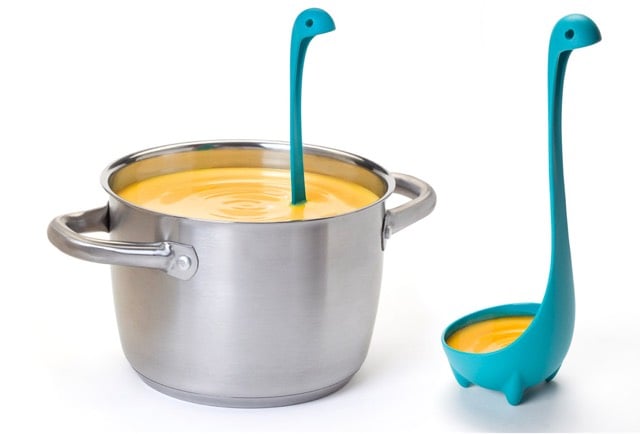
Behold, the world’s greatest kitchen utensil, the Nessie Ladle.
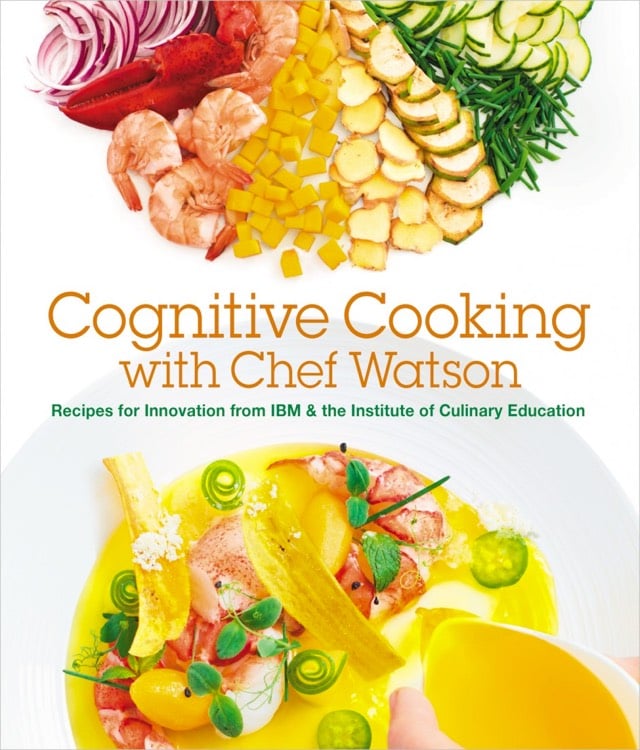
Watson, IBM’s evolving attempt at building a computer capable of AI, was originally constructed to excel at Jeopardy. Which it did, handily beating Jeopardy mega-champ Ken Jennings. Watson has since moved on to cooking and has just come out with a new cookbook, Cognitive Cooking with Chef Watson.
You don’t have to be a culinary genius to be a great cook. But when it comes to thinking outside the box, even the best chefs can be limited by their personal experiences, the tastes and flavor combinations they already know. That’s why IBM and the Institute of Culinary Education teamed up to develop a groundbreaking cognitive cooking technology that helps cooks everywhere discover and create delicious recipes, utilizing unusual ingredient combinations that man alone might never imagine.
In Cognitive Cooking with Chef Watson, IBM’s unprecedented technology and ICE’s culinary experts present more than 65 original recipes exploding with irresistible new flavors. Together, they have carefully crafted, evaluated and perfected each of these dishes for “pleasantness” (superb taste), “surprise” (innovativeness) and a “synergy” of mouthwatering ingredients that will delight any food lover.
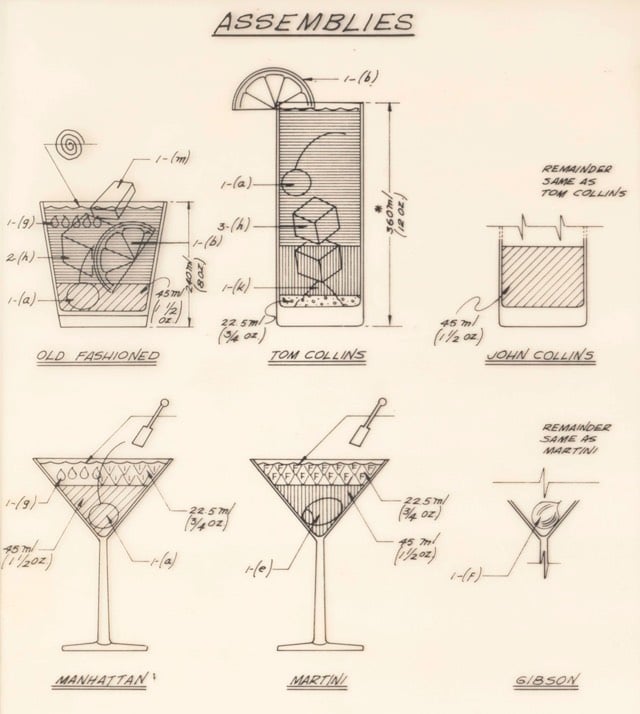
This is…weird. The National Archives contains a Cocktail Construction Chart made in an architectural style, for some reason, by the US Forest Service in 1974.
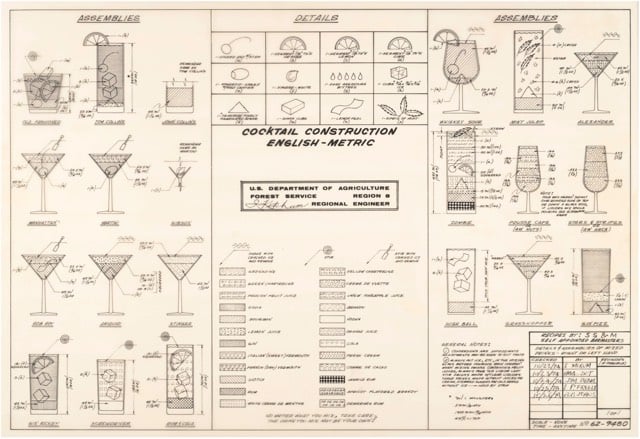
Update: Kenny Herzog at Esquire did some digging and found out some of the chart’s backstory.
If it does, royalties might be due to the family of late Forest Service Region 8 Engineer Cleve “Red” Ketcham, who passed away in 2005 but has since been commemorated in the National Museum of Forest Service History. It’s Ketcham’s signature scribbled in the center of the chart, and according to Sharon Phillips, a longtime Program Management Analyst for Region 8 (which covers Virginia, Georgia, Florida, Oklahoma and Puerto Rico, though Ketcham worked out of its Atlanta office), who conferred with her engineering department, there’s little doubt Ketcham concocted the chart in question. “They’re assuming he’s the one, because the drawing has a date of 1974, and he was working our office from 1974-1980,” she said. And in case there’d be any curiosity as to whether someone else composed the chart and Ketcham merely signed off on it for disbursement, Phillips clarified that, “He’s the author of the chart. I wouldn’t say he passed it along to the staff, because at that time, he probably did that as maybe a joke, something he did for fun. It probably got mixed up with some legitimate stuff and ended up in the Archives.”
I contacted the librarian at the Forest History Society and found similar information. An archivist pulled a staff directory from the Atlanta office (aka “Region 8”) from 1975 and found three names that correlate with those on the document: David E. Ketcham & Cleve C. Ketcham (but not Ketchum, as on the document) and Robert B. Johns (presumably aka the Bob Johns in the lower right hand corner). Not sure if the two Ketchams were related or why the spellings of Cleve’s actual last name and the last name of the signature on the chart are different.
However, in the past few days, I’ve run across several similar charts, most notably The Engineer’s Guide to Drinks.1 Information on this chart is difficult to come by, but various commenters at Flowing Data and elsewhere remember the chart being used in the 1970s by a company called Calcomp to demonstrate their pen plotter.
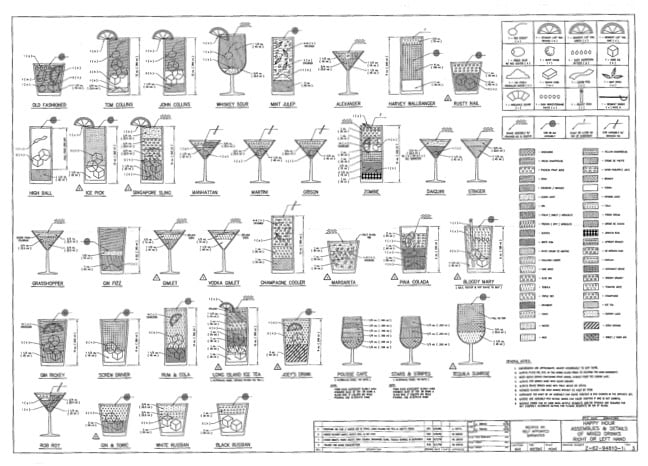
As you can see, the Forest Service document and this one share a very similar visual language — for instance, the five drops for Angostura bitters, the three-leaf mint sprig, and the lemon peel. And I haven’t checked every single one, but the shading employed for the liquids appear to match exactly.
So which chart came first? The Forest Service chart has a date of 1974 and The Engineer’s Guide to Drinks is dated 1978. But in this post, Autodesk Technologist Shaan Hurley says the Engineer’s Guide dates to 1972. I emailed Hurley to ask about the date, but he couldn’t point to a definite source, which is not uncommon when you’re dealing with this sort of thing. It’s like finding some initials next to “85” scratched into the cement on a sidewalk: you’re pretty sure that someone did that in 1985 but you’d have a tough time proving it.
FWIW, if I had to guess where this chart originated, I’d say that the Calcomp plotter demo got out there somehow (maybe at a trade show or published in an industry magazine) and every engineer took a crack at their own version, like an early internet meme. Cleve Ketcham drew his by hand while others probably used the CAD software running on their workplace mainframes or minicomputers.
Anyway, if anyone has any further information about where these CAD-style cocktail instructions originated, let me know. (thx, @john_overholt & tre)
From Amanda McCall, a selection of Ben & Jerry’s flavors featuring women.
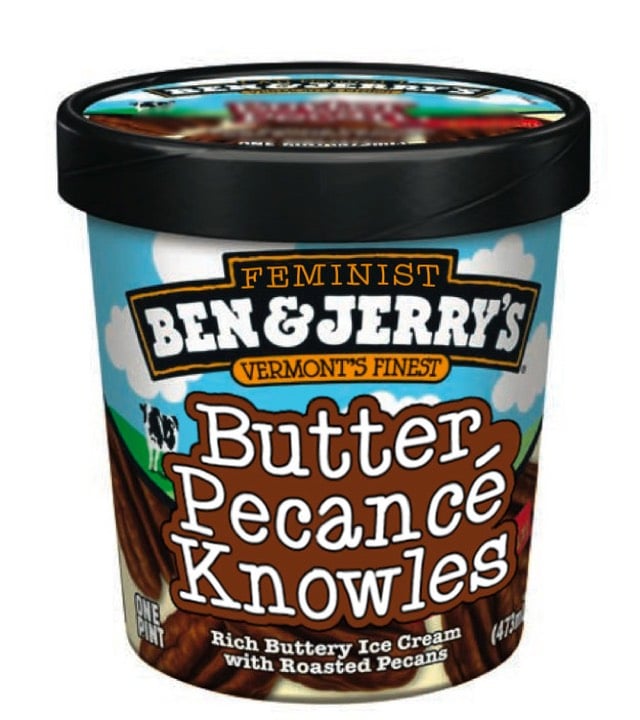

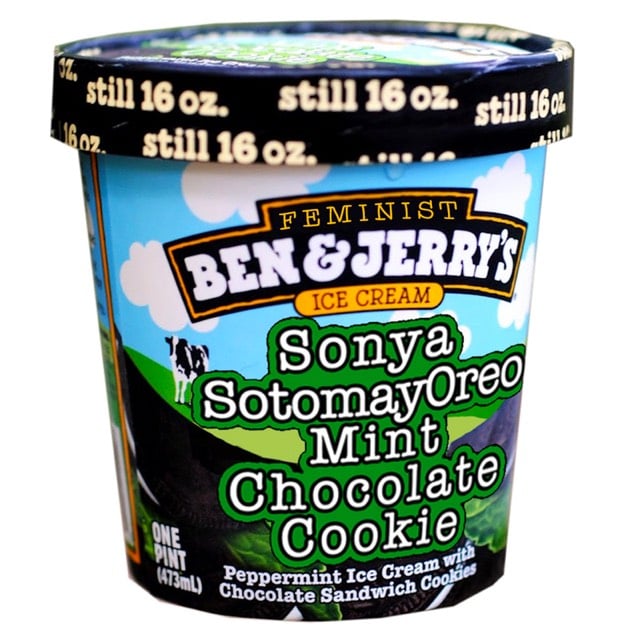

McCall made these because Ben & Jerry’s hasn’t done such a good job highlighting women with their products:
Over the past three decades, Ben & Jerry’s has created over twenty flavors honoring various famous people, and only two of those people have been female: Tiny Fey’s character on 30 Rock (“Liz Lemon’s Greek Frozen Yogurt”, released in 2013 ) and Olympic snowboarder Hannah Teter (“Hannah Teter’s Maple Blondie”, released briefly in 2009).
There are currently no female flavors of Ben & Jerry’s ice cream (even Tina Fey would agree that, while “Greek frozen yogurt” is certainly a healthy ice cream alternative, it is not the same as ice cream), despite the fact that women consume significantly more ice cream than men do.
The best thing about the Butter Pecancé Knowles flavor is that butter pecan ice cream is actually the singer’s favorite flavor.
“I love my butter pecan ice cream,” she says, “but I also love to work out. We all have our issues. Mine is arms and legs, keeping them tight and toned. It takes work, believe me.”
Ben & Jerry’s! Let’s make this happen! (via @amateurgourmet)
If you and a friend are walking around Manhattan trying to find dinner, this is how the conversation will go:
It’s funny because it’s true. That’s a clip from We’ll Find Something, a short film by Casey Gooden starring Upstream Color’s Shane Carruth and Amy Seimetz.
Update: The full film has been released online and it is excruciating to watch if you’ve ever had bad relationship moments while traveling.
I love watching people who are particularly adept at food prep and this guy preparing teh tarik certainly fits the bill. His pour seems to violate at least two of Newton’s three laws of motion.
This guy has some serious skills as well.
These gentlemen making parathas is still my all-time favorite food prep video, but these are good as well. (via cyn-c)
About a minute into The Katering Show, I already knew it was going to be my favorite cooking show of all time. In this episode, the toothsome twosome with the Beatlesesque names of McCartney and McLennan make risotto hot wet rice using a Thermomix.
So “what is a Thermomix?” I hear anyone under the age of 33 ask. It’s a blender, a microwave, an ice bucket, and a set of kitchen scales. It’s a gangbang of kitchen appliances that’s created a futuristic robot saucepan. It’s the kind of appliance that your rich mother-in-law gives you as a wedding gift because she doesn’t think you can cook. Or something that you buy yourself because you’ve always wanted to join a cult, but you don’t have the energy for the group sex.
(via digg)
David Chang is exactly right: when dining at a restaurant, often the best option is to sit at the bar.
When everyone’s so close, it changes the dining experience. Out on the floor, you’re a dickhead if you overhear a conversation and chime in. Not at the bar. You connect, trade stories, then trade bites. I’ve never shared as much food with strangers as I have at the bar. You meet great people that way — you’re part of this band of outsiders within the restaurant. And for me, that’s the best possible dining experience of all.
I almost always eat at the bar at my regular place.
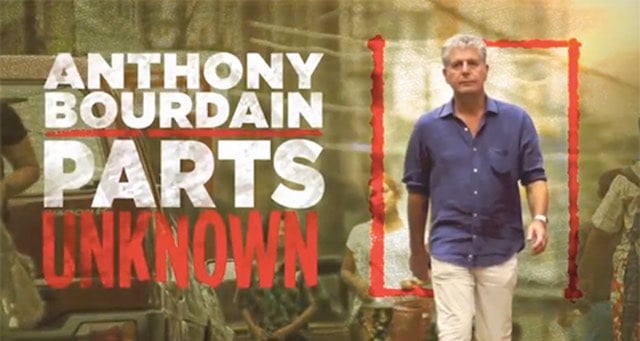
I’ve caught a couple of episodes of CNN’s Anthony Bourdain: Parts Unknown and I’ve been impressed with the show so far. In it, chef/author Anthony Bourdain travels to places off the beaten path and explores the local culture. But it’s not just about food and culture as with his previous shows. In Parts Unknown, Bourdain also delves into local politics and social issues. In Iran, he spoke with journalists about their tenuous relationship with the government (and two of the journalists he spoke with were subsequently arrested). Episodes in the Congo, Myanmar, and Libya are produced with a focus on their oppressive governments, past and present. Even in the Massachusetts episode, he talks about his former heroin addiction and the current addiction of poor whites in the US. Many of the places he visits, we only hear about the leadership and bad things that happen on the news, but Bourdain meets with the locals and finds more similarities amongst cultures than differences. I’d never considered going to visit someplace like Iran, but Parts Unknown has me considering it…what a great people.
Season four recently wrapped up and they’re shooting season five now. The first three seasons are currently available on Netflix and all four seasons are on Amazon. (FYI to the web team at CNN: “Unknown” is misspelled in the title of that page.)
Matchbook Diaries is an Instagram account collecting photos of NYC restaurant matchbooks. Some notables:


The food is fresh. Natural. Locally sourced. Sometimes even organic. That might sound like your local farmer’s market, but it’s actually part of a new and growing movement in the fast-food industry. Think Shake Shack, Chipotle, Panera. While we’re not exactly seeing tractors in the drive-thrus, the rise of these chains (and the pressure on their predecessors that placed a lot more emphasis on the fast than the food) tell us a lot about economic inequality, the modern workday, and fries. From The New Yorker’s James Surowiecki: The Shake Shack Economy.
Lucky Peach, the publishing arm of the Momofuku restaurant group, recently launched their new web site with a bunch of online content. Among their offerings is a series of videos featuring David Chang making various foods, including this omelette flavored with an instant ramen seasoning packet:
See also Chang making tonkotsu broth and gnocchi from instant ramen noodles.
At Serious Eats, Ed Levine writes about Why Diners Are More Important Than Ever. From his ten-point list of what defines a diner:
8. All-occasion places: Diners must rise to many occasions, from first dates to pre- or post-game celebrations by fans or teammates, to wallowing in solitary self-pity. Diners are the best restaurants for planning murders, stick-ups, or other nefarious enterprises.
Being an all-occasion place is not the only egalitarian thing about diners:
People talk about Starbucks reintroducing the notion of what sociologist Ray Oldenburg coined the “third place” in American life: spaces where we gather besides home and work to form real, not virtual, communities. Starbucks and more high-minded cafes that followed in its wake have surely succeeded on this point, but long before 1971, when the first Starbucks opened in Pike Place Market in Seattle, diners were already serving that invaluable function for us, along with the corner tavern.
And that’s why we need to cherish our local diners, whether it’s a mom and pop or a Waffle House or a Greek coffee shop. They’re some of the few cheap, all-inclusive places to eat and hang out and laugh and cry and stay viscerally connected with other folks.
And it warmed my heart to see Ed include Cup & Saucer and Eisenberg’s on his list of notable NYC diners. An unusual thing I’ve noticed about Eisenberg’s: instead of getting your check at the table, you just tell the cashier what you ordered on the way out and pay for it. Like on the honor system! Is there anywhere else in NYC that does this? I wonder what their loss rate is compared to the norm?
Newer posts
Older posts





Socials & More