kottke.org posts about food

Frank Ocean dropped his long-awaited album the other day and to go along with it, he gave away a magazine called Boys Don’t Cry for free at four pop-up locations in LA, NYC, Chicago, and London. Kanye West contributed to the album and magazine, penning a poem about McDonald’s for the latter. Here’s the poem:
McDonald’s man
McDonald’s man
The French fries had a plan
The French fries had a plan
The salad bar and the ketchup made a band
Cus the French Fries had a plan
The French fries had a plan
McDonald’s man
McDonald’s
I know them French fries have a plan
I know them French fries have a plan
The cheeseburger and the shakes formed a band
To overthrow the French fries plan
I always knew them French fries was evil man
Smelling all good and shit
I don’t trust no food that smells that good man
I don’t trust it
I just can’t
McDonald’s man
McDonald’s man
McDonald’s, man
Them French fries look good tho
I knew the Diet Coke was jealous of the fries
I knew the McNuggets was jealous of the fries
Even the McRib was jealous of the fries
I could see it through his artificial meat eyes
And he only be there some of the time
Everybody was jealous of them French fries
Except for that one special guy
That smooth apple pie
Man, I can’t help but like Kanye. Just when you think he takes himself way too seriously, he does something like this and you can’t tell if he’s taking himself way WAY too seriously or not seriously at all. McDonald’s, man. Kanye drawing courtesy of Chris Piascik. (via @gavinpurcell)
On a recent episode of the Serious Eats podcast Special Sauce, Ed Levine talks to Danny Meyer about the origins of the Shake Shack.
Did Meyer have any idea that that hot dog cart would eventually become the massive sensation it is today? Not at all. It was a happy accident, born of his love of burgers, Chicago hot dogs, and the custard that’s still served at Ted Drewes in his native St. Louis.
In Situ is Corey Lee’s new restaurant in the recently refurbished SFMOMA. Like the museum does with art, In Situ brings culinary masterpieces from chefs around the world and presents them to guests. The current menu, which provides the name of the chef and the date the dish was first made in the style of the info cards next to artworks, includes Shrimp Grits from the now-closed WD-50 (Wylie Dufresne, 2013), Spicy Pork Sausage Rice Cakes from Ssam Bar (David Chang, 2007), Meyer Lemon Ice Cream and Sherbet from Chez Panisse (Alice Waters, 1980), and Wood Sorrel & Sheep Milk’s Yogurt from Noma (René Redzepi, 2005).
This sort of thing is not exactly without precedent. From the very beginning of Grant Achatz and Nick Kokonas’ Next, one of the ideas was to present the menu from the French Laundry from Achatz’s first day on the job there in October 1996 (which is happening this fall) and the Chicago restaurant has already featured menus with dishes from El Bulli and Trio (Achatz’s first restaurant as head chef). Ssam Bar used to have cocktails from other places (Milk and Honey, Death & Co., etc.) on their beverage menu, properly credited. But as Pete Wells explains in his positive NY Times review, In Situ takes the concept further:
Would any chef have dreamed of building a restaurant like this 25 years ago? Would anyone have gone there? In Situ probably requires a steady supply of customers who care about restaurants in Lima and Copenhagen enough to have seen some of these dishes in cookbooks or at least in the Instagram accounts of the chefs in question. Mr. Lee depends on, and caters to, a class of eaters who pay attention to the global restaurant scene the way certain art hounds follow the goings on in Basel, Miami Beach and Venice.
One thing In Situ proves, just by existing, is that certain chefs are now cultural figures in a sense that once applied only to practitioners of what used to be called high culture: literature, concert music, avant-garde painting. A Redzepi dish can be visited in an art museum in 2016, and nobody finds this very strange.
What In Situ is doing also underscores how context and the renown of an artist can affect our perception of what is creative appropriation versus theft or plagiarism. That In Situ is helmed by one of the best chefs in the US and affiliated with a world-class museum matters. The similar work of an unknown chef might not get the same treatment, as Robin Wickens found out in 2006, when he presented dishes from WD-50 and Alinea on the menu at his Australian restaurant:
That’s what happened three months ago on the eGullet.com Web site. Sam Mason, a pastry chef at WD-50 in New York, set off an international dust-up when he posted a link to the Web site of Interlude, a restaurant in Melbourne, Australia, and asked: “Is it me or are some of these dishes strikingly similar to a few American restaurants?” Interlude’s site showed photos of such unusual fare as noodles made of shrimp and a glass tube full of eucalyptus jelly and yogurt, dishes pioneered at WD-50 and Chicago’s Alinea, respectively. Interlude’s chef, Robin Wickens, had worked for a week at Alinea as a stagiere, or unpaid intern, and had dined at WD-50 while visiting the U.S.
EGullet’s administrators then juxtaposed Interlude’s images to nearly identical ones from WD-50 and Alinea. Within a few days, restaurateurs and chefs from around the country and dozens of eGullet members added to the thread, many branding Mr. Wickens a plagiarist.
Mortified, Mr. Wickens says he removed the dishes from his menu and his site, and sent letters to the chefs whose work he’d copied explaining that he only wanted to utilize what he’d learned on his travels. “I never tried to claim them as my own,” says Mr. Wickens, who says he told many patrons that the dishes had originated at the American restaurants.
I wish I had San Francisco travel plans…In Situ is the first new restaurant I’ve been excited about visiting in ages (for obvious reasons). Soon, hopefully.
Chef and Momofuku founder David Chang spends a lot of time thinking about food and he’s arrived at what he calls the Unified Theory of Deliciousness.
My first breakthrough on this idea was with salt. It’s the most basic ingredient, but it can also be hellishly complex. A chef can go crazy figuring out how much salt to add to a dish. But I believe there is an objectively correct amount of salt, and it is rooted in a counterintuitive idea. Normally we think of a balanced dish as being neither too salty nor undersalted. I think that’s wrong. When a dish is perfectly seasoned, it will taste simultaneously like it has too much salt and too little salt. It is fully committed to being both at the same time.
I’m not sure his observations are exactly unified, but they are interesting and also why I enjoy eating at his restaurants so much. A meal I had at Ssam Bar shortly after they switched away from the initial Korean burritos menu is in my top 5 meals of all time and a pair of dishes at Ko (both somehow simultaneously familiar and new) are among the most delicious things I’ve ever eaten.
For an episode of food podcast Gastropod, hosts Cynthia Graber and Nicola Twilley consider how sound influences our perception of food and drink.
In this episode, we discover how manipulating sound can transform our experience of food and drink, making stale potato chips taste fresh, adding the sensation of cream to black coffee, or boosting the savory, peaty notes in whiskey.
One takeaway: don’t listen to the sound of breaking glass if you want to continue eating potato chips:
He recruited 200 volunteers willing to eat Pringles for science, and played them modified crunching sounds through headphones, some louder and some more muffled, as they ate. And he found that he could make a 15 percent difference in people’s perception of a stale chip’s freshness by playing them a louder crunch when they bit into it.
“The party version” of this trick, according to Spence, was developed by colleagues in the Netherlands and Japan. Volunteers were asked to crunch on chips in time with a metronome, while researchers played crunching sounds back, in perfect synchrony, through their headphones. All was well until the researchers replaced the crunching with the sound of breaking glass-and “people’s jaws just freeze up.”
The human brain is fascinating.
In today’s post on “What is barbecue?” I skipped past “is a hot dog a sandwich?” so quickly that I forgot to answer the question. So in the same spirit in which someone can boldly declare that only smoked, slow-cooked pork is barbecue, here is my minimal definition of a sandwich:
A sandwich is any solid or semi-solid filling between two or more slices of bread. Not a roll, not a wrap, not a leaf of lettuce: sliced bread. What is inside far less than the container.
Consequently:
- A hot dog is not a sandwich.
- A burrito is not a sandwich.
- A wrap is not a sandwich.
- A cheeseburger on a roll is not a sandwich. Sliced bread only.
- A lobster roll is not a sandwich.
- A hoagie is not a sandwich.
- An ice cream sandwich is not a sandwich.
- A hot turkey sandwich is not a sandwich.
- An open-faced sandwich is not a sandwich.
- If you make a sandwich using one end of the bread and one proper slice, it’s kind of a sandwich still, but not really. See also folding over a single slice of bread for a half-sandwich.
- If you make a sandwich using both ends of the bread, it is no longer a sandwich at all.
- A peanut butter or grilled cheese sandwich is a sandwich.
- A mayonnaise, butter, or ketchup sandwich is probably a sandwich — I’m not sure whether those fillings are solid enough — just not a very good one.
- A sandwich made with crackers instead of bread is not a sandwich, but an imitation of a sandwich.
- A sandwich made with crackers between two slices of bread is a sandwich, but not a very good one.
Alternatively, “sandwich” is a family-resemblance concept and we can’t appeal to definitional consistency to get away from the fact that language is a complex organism and its rules don’t always make perfect sense.
(PS: I do not speak for Jason or Kottke.org on this matter, please do not argue with him about sandwiches)
Update (from Jason): Boy, you leave Tim to his own devices for a few hours and he establishes the official kottke.org stance on sandwiches. [That new emoji of the yellow smiley face grabbing its chin and looking skeptical that you might not have on Android IDK I’m Apple Man] I was just talking to my kids the other day about this important issue and Ollie, who is almost 9, told me that both hamburgers and hot dogs are sandwiches because “the meat is sandwiched in between the bread; it’s right there in the word”. When Ollie and Minna take over the family business in 2027, they can revisit this, but for now, Tim’s definition stands.
Update: Tim’s definition has been weakened further. In talking with Stephen Colbert, Justice Ruth Bader Ginsberg asserted that a hot dog is a sandwich.
At Eater, Chris Fuhrmeister hits on another topic near to my amateur linguist heart: policing the word “barbecue”:
When it comes to American barbecue — I certainly won’t attempt to set ground rules for other barbecue cultures across the globe — there are absolute rights and wrongs. Sure, there’s some room for interpretation, but good-intentioned “barbecue” lovers across this country are blaspheming day in and day out. Before declaring what barbecue isn’t, it’s best to define what it is: pork that’s slow-cooked with smoke.
This is controversial, because “barbecue” is also used to mean:
- n. other slow-cooked smoked meats, e.g., beef
- v. the act of cooking or eating such meats,
- v. grilling anything outdoors,
- n. an outdoor grill
- a. a type or flavor of sauce, potato chips, and other foods
- and so forth.
It’s also odd because, as Fuhrmeister notes, it’s an American controversy, and Americans tend to play faster and looser with food words than people elsewhere. Cognac has to be from Cognac, champagne from Champagne, and so on. Americans have lots of different regional words and practices when it comes to food (soda vs pop, sub vs hoagie, etc.), and we’re definitely competitive when it comes to where and how food is made best, but we’re generally pretty pluralist about definitions. Which is probably why “barbecue” has metastasized to mean so many different but related things.
I tried to come up with a shortlist of honest-to-goodness American food word debates.
- What is barbecue?
- Is a hot dog a sandwich?
- Is Chicago-style pizza really pizza?
- Is it donut or doughnut?
- Is a wrap a burrito?
- Why do we say “chai tea” when “chai” means “tea”?
From here you start to get into all the ways Americans abuse imported food words, which is a much longer list. British English also has a debated distinction between cake and biscuit that I don’t fully understand. Some of us like “is a patty melt a hamburger?,” because the ontology of hamburger is pretty complex stuff. But this is enough to get started.
Donut/doughnut is a straight-up style dispute, and doesn’t have anything to do with definitions. “Are hot dogs sandwiches?” is almost too much about definitions — there’s no history, no implied values, or real stakes. Chicago vs NYC pizza is a regional value rivalry posing as a definitional one: press people, and they’ll say, “yeah, what they make is pizza, it’s just not as good as ours.”
Barbecue is the debate that has everything. It’s a regional rivalry with value attached to it, that’s making definitional claims. And there are so many possible distinctions! Texas and Carolina partisans might unite to reject “barbecue” to mean “cookout,” but fall apart again over the merits of beef vs pork. You can even vote on it; the voting will decide nothing. It is an infinite jewel.

From the International Center for Tropical Agriculture, a map showing where the world’s most used crops originated. Potatoes and tomatoes are from the Andes, watermelon from southern Africa, bananas from south & southeast Asia, and blueberries from North America. (via @CharlesCMann)
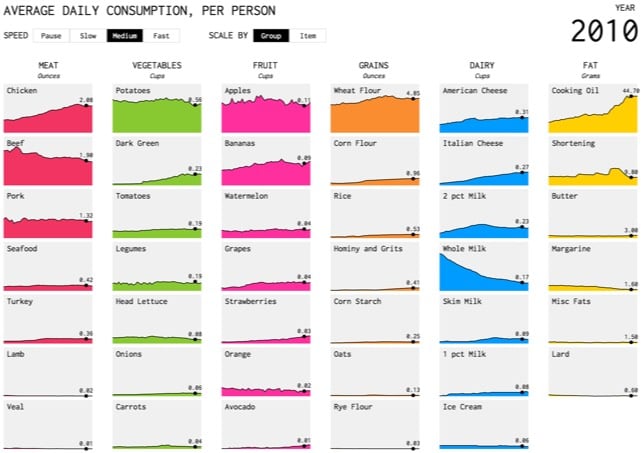
From Flowing Data, an animated infographic that shows how the American diet has changed since 1970. We eat less beef, potatoes, margarine, and whole milk than we used to, but more chicken, cooking oil, bananas, and Italian cheese.
From CBC Radio show This Is That, which previously did a bit on Artisanal Firewood, comes a spoof on fancy shows about chefs like Chef’s Table called Cooks.
What do I want people to think of my food? Well, that it’s fast, it’s cheap, it’s a little salty, and most importantly, that it was cooked all the way through.
Nailed it.
Serena Solomon grew up in Australia and when she moved to the US, she was shocked at the number of products sold at American grocery stores. Solomon recently asked other immigrants to share their biggest surprises about American culture. From a French welder:
It is so frustrating here. Nothing is easy. Nothing is efficient. To pay rent, you have to use a check? I have never written a check. The last time I got a check was maybe 20 years ago, from my granddad. Getting an apartment takes so long as opposed to other countries I have lived in where it’s just a handshake. That’s it. I went to the post office yesterday, and I was waiting in line for maybe an hour — and there were only five people in front of me. I felt like I went from a Western country to a third-world country. People here with money have access to things. The rest of the people are just trying to survive.
Food is a big difference for some:
Food-wise, I noticed us all getting these round faces from the bad food we ate. We did not realize it, because it was the standard and you think because it’s advertised and readily available it can’t be bad for you. We were so ignorant coming from South Africa, eating home cooked food every night over there. Then, once we got here, we ate those corn dogs almost every day for lunch, little pizzas for snacks, and sugary cereals for breakfast.
Reminds me of Cup of Jo’s excellent series about how parenthood differs around the world.
One of the oldest businesses in the world, Sudo Honke is a sake brewery founded in 1141 and managed by the Sudo family for the past 55 generations.
We’ve been making sake for at least 870 years.
I love the “at least” bit. You can buy some of their sake online. (BTW, feel free to supply your own “Sudo, pour me a sake” joke.)
This is a perfect Friday video. Enjoy your weekend, everyone. (Or not, the machines are gonna take all of our jobs.) (via @dunstan)
Jeff Seal digs through garbage bags outside of NYC grocery stores, delis, bakeries, and supermarkets to find perfectly good food that’s been thrown out.
Stewart Brand wrote a summary of a seminar given by Jane Langdale about how the efficiency of photosynthesis might be improved for some of the world’s plants, particularly rice.
Most plants use what’s called C3 photosynthesis to produce sugars and starch, but the process is not very efficient. Some plants, like corn and sugarcane, have evolved the capability to produce sugars and starch using the much more efficient C4 photosynthesis process. So if you could modify rice to use C4 instead of C3, yields would increase dramatically.
Rice is a C3 plant — which happens to be the staple food for half the world. If it can be converted to C4 photosynthesis, its yield would increase by 50% while using half the water. It would also be drought-resistant and need far less fertilizer.
You can read more about the efforts in developing C4 photosynthesis in Technology Review.
Newer posts
Older posts






Socials & More