kottke.org posts about food
This folding measuring spoon on Kickstarter is clever as hell. Polygons lays flat in a drawer and, depending on how you pick it up, folds into four different volumes.
Premarked areas on both spoon sizes (tablespoon and teaspoon) let you know where to pick up from to measure the volume required for your recipe. Practicality and simplicity at its finest.
The spoons come in two sizes (the smaller measures teaspoons and the larger one tablespoons), they’re marked with US and metric measurements, you can flatten it to easily scrape every last bit of stuff into the bowl, and it doubles as a knife when flat as well. (via colossal)
Update: Hmm, it looks like Polygons needs a little more work to be a fully functional product. (thx, mac)
A quick short film about how different people in LA approach breakfast, from the woman who nibbles to the professional bodybuilder who eats 30 egg whites and a cup of grits on his off day.
Me? I almost never eat breakfast and have been unwittingly following an intermittent fasting regimen for many years.
In the village of Nanshan in China, traditional Suomian noodles are still very much made by hand. The noodles are made and dried outside, which puts the whole process at the mercy of the weather.
The noodle maker has to add different amounts of salt and flour according to the seasons and has to be very observant about the weather when it comes to choosing the days to dry the noodles.
The video doesn’t say, but I’d be very interested to hear what the unique stretching and drying process does to the taste and texture of the noodles.

More than 40 years ago, food enthusiast and artist Salvador Dali published a cookbook called Les Diners de Gala. The book mixes Dali’s surrealist imagery and with dozens of recipes, including some that originated from the top restaurants in Paris at that time. The original book is quite rare and valuable now, but Taschen is reprinting it; it’s available for pre-order here.
This reprint features all 136 recipes over 12 chapters, specially illustrated by Dal’i, and organized by meal courses, including aphrodisiacs. The illustrations and recipes are accompanied by Dal’i’s extravagant musings on subjects such as dinner conversation: “The jaw is our best tool to grasp philosophical knowledge.”
See also The Artists’ and Writers’ Cookbook. (via colossal)
This is entertaining: Megan McArdle considers four possible economic approaches to how couples should order food in restaurants.
3. Individual property rights, with option trading. Now we’re moving toward a more centrally planned economy. The menu is individually consulted, and then the two parties state their preferences. If these preferences are strong, then matters proceed much as in the above strategy. However, if indecision is expressed, the trading is opened: “If you get the clam chowder, I’ll get the mushroom crostini, and we can split.” Option trading is usually, but not always, confined to the appetizer course. Any offer can be refused, and a substitute offered — “What if I got the clam chowder, and you got the ham timbales?” — or both parties may reluctantly conclude that no trade is possible, and revert to their original choices.
Well done, Team Restaurant! You are now beginning to realize the magnificent benefits of trade. Coordination and cooperation have permitted you to agree on choices that jointly improve utility.
However, I must tell you that you are still probably not at the highest valued use of your food dollar. You are almost certainly investing most of your effort in appetizers or shared desserts, which are the minority of your spending, time and consumption. If you want not merely to improve your utility, but to maximize it, then you are going to have to invest more effort in coordination.
Her conclusion is spot on; it’s the best way to dine out.


Episcopal Community Services runs a program called CHEFS that provides food industry training for homeless and low-income people in San Francisco. Photographer Wesley Verhoeve visited the program to take portraits of the students and staff. The photos accompany a San Francisco Magazine article that has more information on the program.
The seven-month program culminates in a 240-hour internship at participating eateries like Nopa and Kokkari; Hanks completed her internship at Lotta’s Bakery in Nob Hill, where she was struck by the universal power of food. “We cook when somebody dies, we cook when a child is born,” she says. “I’ve realized cooking is related to everything: to family, to religion, to happiness, to sadness.”
While I don’t quite agree, I did enjoy reading Andy Kryza’s take on In-N-Out: In-N-Out Is Crushingly Disappointing.
This is your basic, salty, flat-grilled burger that you can get absolutely anywhere. If somebody gave me a blind taste-test between this and most other fast-food burgers, I might be able to distinguish In-N-Out, but it’s not guaranteed. It’s highly generic, as if culled together from a series of stock photos: bun, burger, watery lettuce, and a slice of tomato. Sure, you can get it Animal Style, but be honest: Animal Style sauce tastes like Whole Foods’ version of Big Mac sauce, except not as good.
And as Anil Dash said on Twitter:
it’s the best burger for people who eat a burger for the vegetables
They are in different leagues — an In-N-Out cheeseburger is $2.35 while a Shackburger goes for $5.29 — so a comparison is unfair, but in my mind, that extra $3 at the Shack buys you a lot of flavor. Still, as Kryza says, next time I’m in CA, I’m gonna get myself a burger at In-N-Out.

From photographer Brea Souders, an assortment of food photographed using a thermal camera.
As an object’s temperature increases, so does the amount of radiation it emits. This special camera uses state-of-the-art technology to detect infrared radiation, thereby displaying differing levels of heat in various colors and creating images reminiscent of pop art.
(thx, ray)
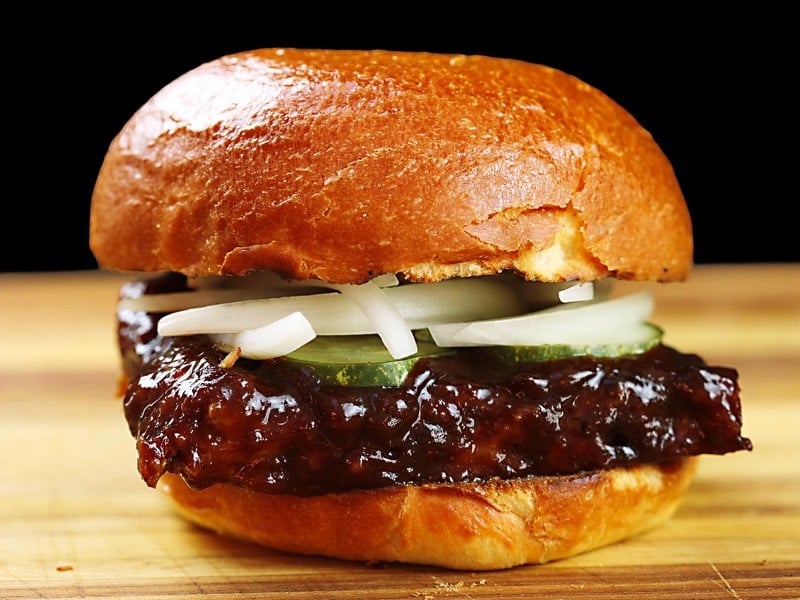
That, my friends, is a photo of Kenji López-Alt’s homemade McRib sandwich. The McDonald’s version is beloved but has been on and off the menu with maddening irregularity, so Kenji spent weeks/months creating a McRib recipe for the home cook.
The problem is that, while the McRib might be inspired by real barbecue, it’s ultimately a lie. Despite its corrugated appearance, it has little to do with actual ribs. (McDonald’s doesn’t even indicate that the product contains actual rib meat.) It’s not smoked, as one would expect of barbecue ribs. Indeed, it’s not even grilled — it’s cooked on a griddle. We can do better.
My goal? Take everything we love about the McRib sandwich and turn it up to 11, by starting from scratch with a few high-quality ingredients and a lot of good technique (including honest-to-goodness smoking). I wanted to maximize flavor and texture, unlocking the sandwich’s full potential and allowing it to evolve, Pokémon-style, into something so much better.
One of my favorite pieces of food writing from the past few years is Willy Staley’s piece on the economics of the McRib.
And for recipes for more of your favorite fast food at home, see the homemade Shack Burger, homemade McDonald’s fries, homemade Egg McMuffin, homemade Big Mac, and homemade Chick-Fil-A.


Gluten Free Museum takes works of art (high and low) and removes all of the gluten from them. A one-trick pony, but a particularly entertaining one. (via tmn)
Ian Parker wrote about the NY Times’ restaurant critic Pete Wells for the New Yorker this week.
Wells is generally a well-mannered critic, if not an overly respectful one. In his first years on the job, he was sometimes faulted in the food press for being too generous in his appraisals; he had made a point of publishing fewer one-star reviews than his immediate predecessors. “No one likes one-star reviews,” Wells told me, in a conversation at his apartment, which is in a Clinton Hill brownstone. “The restaurants don’t like them, and the readers don’t like them. It’s very tricky to explain why this place is good enough to deserve a review but not quite good enough to get up to the next level.” He added, “I’m looking for places that I can be enthusiastic about. Like a golden retriever, I would like to drop a ball at the feet of the reader every week and say, ‘Here!’”
Parker covers Wells’ most notable reviews — Per Se, Fieri, Senor Frog’s, Momofuku Nishi — as well as the reactions of the restaurants to the reviews.
“I can’t ever read that review again — I’ll get so fucking angry I’ll die,” Chang said. “I made a lot of that food! I tasted it! It was delicious. And… fuck! I believe in the fucking food we make in that restaurant, I believe it to be really delicious, I believe it to be innovative, in a non-masturbatory way.”
I love David Chang. Never change. But back to Wells, I had a conversation last night with a friend who worked in a restaurant that Wells reviewed and he said that Wells is perhaps not physically suited for undercover restaurant dining — “he’s an odd looking dude” was the quote. And I have another friend in the restaurant industry who, after living in Clinton Hill for a few months, told me, “I think Pete Wells is my backyard neighbor.” Several months later: “Yeah, Pete Wells definitely lives behind me.” We joked about Wells talking over the fence in the style of Wilson, the neighbor in Home Improvement whose face is always partially hidden.
While attempting to do a commercial for the chicken pot pie at Dysart’s Restaurant in Maine, this gentleman has a little problem with saying his lines. This just gets funnier and funnier as it goes on, and it is imperative that you watch until the very end. This is the hardest I’ve laughed all week.
P.S. If you live in New England, you can get a Dysart’s pie shipped right to your house. Fruit pies only, but they presumably still have that buttery crispy crun- … dammit! (via @heyadamroberts)

Here’s a gem from the archive of the NY Times. One day in September 1976, NY Times food critic Mimi Sheraton and Colonel Harland Sanders stopped into a Manhattan Kentucky Fried Chicken. The Colonel, then estranged from the company he founded, strolled into the kitchen after glad-handing some patrons and proceeded to tear into the quality of the food:
Once in the kitchen, the colonel walked over to a vat full of frying chicken pieces and announced, ‘That’s much too black. It should be golden brown. You’re frying for 12 minutes — that’s six minutes too long. What’s more, your frying fat should have been changed a week ago. That’s the worst fried chicken I’ve ever seen. Let me see your mashed potatoes with gravy, and how do you make them?”
When Mr. Singleton explained that he first mixed boiling water into the instant powdered potatoes, the colonel interrupted. “And then you have wallpaper paste,” he said. “Next suppose you add some of this brown gravy stuff and then you have sludge.” “There’s no way anyone can get me to swallow those potatoes,” he said after tasting some. “And this cole slaw. This cole slaw! They just won’t listen to me. It should he chopped, not shredded, and it should be made with Miracle Whip. Anything else turns gray. And there should be nothing in it but cabbage. No carrots!”
Sanders sold his company to an investment group in 1964, which took the company public two years later and eventually sold to a company called Heublein. After selling, Sanders officially still worked for the company as an advisor but grew more and more dissatisfied with it, as evidenced by the story above. When the company HQ moved to Tennessee, the Colonel was quoted as saying:
This ain’t no goddam Tennessee Fried Chicken, no matter what some slick, silk-suited son-of-a-bitch says.
And he got sued by a KFC franchisee after he commented:
My God, that gravy is horrible. They buy tap water for 15 to 20 cents a thousand gallons and then mix it with flour and starch and end up with pure wallpaper paste. And I know wallpaper paste, by God, because I’ve seen my mother make it.
To the “wallpaper paste” they add some sludge and sell it for 65 or 75 cents a pint. There’s no nutrition in it and the ought not to be allowed to sell it.
And another thing. That new crispy chicken is nothing in the world but a damn fried doughball stuck on some chicken.
Colonel Sanders: serving up chicken and sick burns with equal spiciness. (via @mccanner)
When he was asked to design a new outpost of iconic NYC hot dog joint Papaya King in the East Village, Andrew Bernheimer went around to several other establishments in the city built to serve food quickly — Chipotle, Russ & Daughters, Katz’s, Shake Shack, Gray’s Papaya — and looked at their floor plans and flow of customers through their spaces. Mark Lamster talked to Bernheimer about the survey.
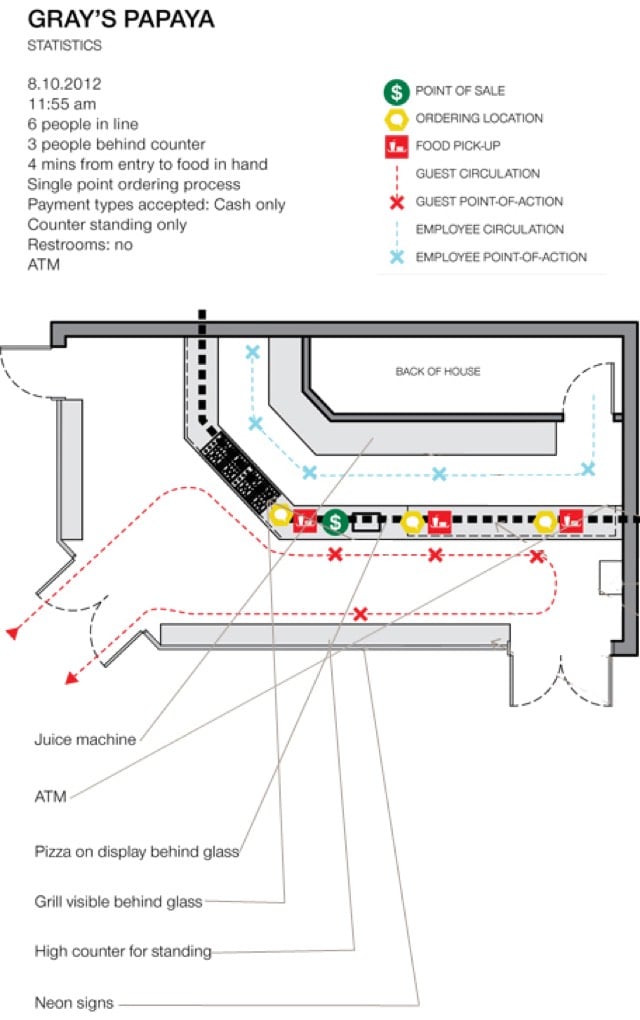
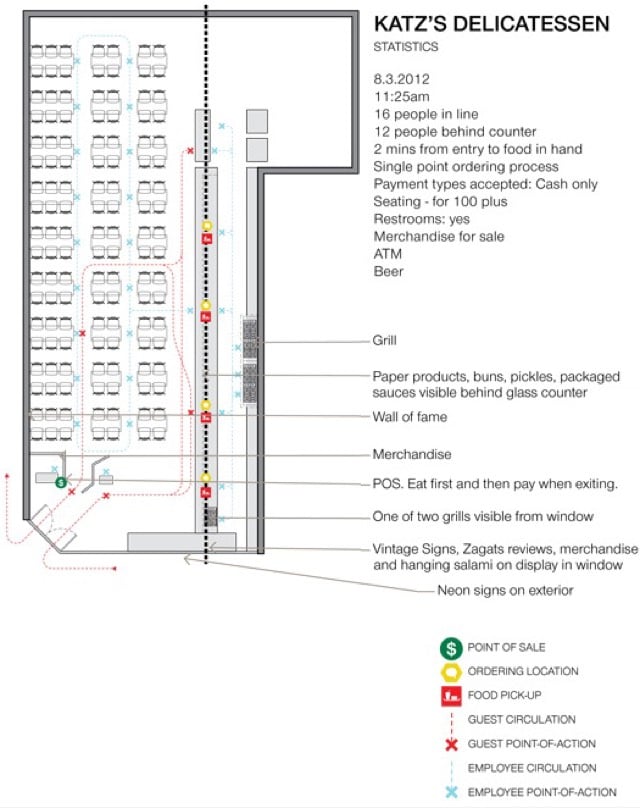
ML: I think at fast food joints we’re conscious that we’re in a very controlled environment, but perhaps don’t realize (because we are in a rush), just how manipulative that space can be. How did you see this playing out in the places you looked at?
AB: It ranged. Artisanal places (like Russ & Daughters) don’t feel manipulative in an insidious way at all (other than showing off some great food and triggering all sorts of synaptic response), while others do (Five Guys and their peanuts, a pretty nasty and obvious trigger to go order soda or spend money on WATER). We didn’t just look at fast food joints, but also icons of New York (R&D, Katz’s) that do try to serve people quickly but I don’t think qualify as “fast food joints.” In these cases the manipulation is either entirely subliminal and beyond recognition, or it has been rendered unnecessary because a place has become iconic, the domain of the “regular.”
Speaking as a customer, places like Katz’s and Russ & Daughters always felt like a total mess to me. Katz’s in particular is the worst: the whole thing with the tickets, paying on the way out, the complete lack of a single line, separate ordering locations for different types of food, etc.
That Gray’s Papaya that used to be on the corner of 8th St and 6th Ave, however, was fantastic. It had the huge benefit of being situated on the corner, but when you walked in, there was the food being cooked right in front of you. It was obvious where the line was and what direction it was moving. And after getting your food, you could exit immediately out the “back” door or circle back against the line to find a counter spot to quickly eat your meal.
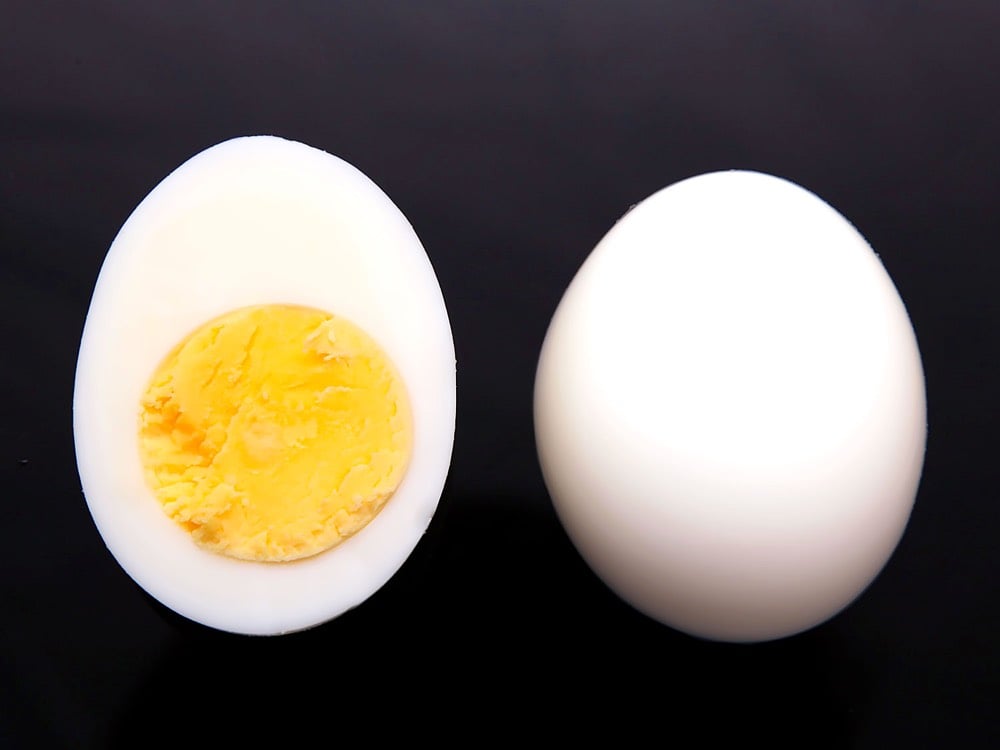
There are lots of ways to boil an egg. You can drop them in already boiling water. You can start them in cold water and bring to a boil. You can bake them in an oven at a low temperature. You can sous vide them for awhile. I’m sure you have your technique.
The easiest, fastest, and tastiest way I’ve found to make perfect hard boiled eggs is Kenji López-Alt’s Perfect Steamed Boiled Eggs Recipe. That’s right, you steam the eggs.
Fill a large pot with 1 inch of water. Place steamer insert inside, cover, and bring to a boil over high heat. Add eggs to steamer basket, cover, and continue cooking 6 minutes for soft boiled or 12 minute for hard.
Since that little bit of water boils much quicker than a full pot, you’re done much quicker. And peeling is easy too; I don’t even wait the 15 minutes or do it under running water, those shells come off super easy.
P.S. I’ve been cooking more recently, and I’m almost exclusively using recipes and techniques from Serious Eats and The Food Lab. (For instance, I made this Spanish tortilla a couple of weeks ago and it was amazing.) I’m sure I’ll branch out soon, but for now, *kisses fingers*.
Newer posts
Older posts





Socials & More