kottke.org posts about WWW
Someone located a VHS copy of an hour-long program from 1996 called Discovering the Internet and ripped it to YouTube. Total nostalgia bomb for me…even at 28.8K modem speeds, I probably spent 12 hours a day online back then, wrestling with HTML, Photoshop, frames, and JavaScript.
In this tutorial, we’ll take a look at the differences between The Internet and The World Wide Web, the differences between commercial OnLine Services such as the Microsoft Network, Prodigy, or America Online and the Internet, how to get connected to the Web, how to use something called a Web browser to navigate the Web, what a Web Page is, and how to search, locate, and download all types of files, from information files to video and audio files.
It’s worth skipping ahead to 17:30 to hear how the host pronounces “URL”.
See also a brief clip of Blogger/Twitter/Medium co-founder Evan Williams explaining the Internet in the mid-90s.
Look at that kid! He just knew the Internet was going to be a big deal, and boy was he right. (via laughing squid)
If you are a regular reader and appreciate what I do here, please support kottke.org by purchasing an annual membership. It only takes a minute (or about 20 seconds on iOS w/ Apple Pay) and your collective support will mean a lot to the future of kottke.org. This has been in the works for a while now and I have a lot to say about it, but go check it out first, subscribe, and then come back. I’ll wait.
All set? Ok. A couple of recent catalysts have set this into motion, but I’ve been thinking about it for the last few years. So here’s why I feel this is necessary now, in four interconnected main points.
Focus on dedicated readers. Anyone who relies on an audience of some kind — artists, writers, businesses, etc. — has to focus on serving regulars while keeping an eye on attracting new readers/customers/users. As much as I feel that everyone in the world would enjoy reading the world’s best blog — I mean, who wouldn’t? — it’s difficult for me to take time out from writing the site to reach out to potential new readers.1 I love being a regular myself and at this point in the site’s evolution, it makes sense to focus mostly on the people who read and love the site. Part of that focus is building up the financial link between us. In an ideal world: I write for you, you pay me, I write some more. No middlemen. I’m not sure that’s an entirely feasible arrangement at this point, but we can get part of the way there and work on the rest.
Revisiting an old idea. Some of you may remember that I’ve asked for support directly from readers before.2 A few months ago, I went out to lunch with Tim Urban from Wait But Why. We’d hardly said hello when he said something like “my goal for this lunch is by the end of the meal, you’ll agree to ask your readers to financially support kottke.org”. Tim was very clear that asking his readers for support on Patreon had been game-changing for his site. Project creators and potential backers have become comfortable with directly funding creative efforts online, particularly through Kickstarter & Patreon and I’m curious to see how it works for kottke.org in 2016.3
A changed media landscape. It’s been 11+ years since I quit my job to do kottke.org full-time. Online media has changed a lot since then. Hell, it’s changed a lot in the past few years. Blogs are dead — long live blogs! — and the open web is struggling. If you ask around to the creators of other established independent sites on the web (and I have talked to many of them), you’ll hear that traffic and display ad revenue have been falling for the last few years. Many factors have contributed — Facebook, readers switching to mobile, the rise of apps, social overtaking search for discovery, ad blockers, Google Reader’s shutdown, VC money flooding into online media — and smaller sites without dedicated content marketing and mobile/social development teams can’t keep up. Other strategies are necessary.
Diversification. The site currently has two main sources of revenue: advertising via The Deck & the We Work Remotely job board and affiliate income from Amazon & iTunes. In an effort to diversify revenue, I’ve tried several things — RSS sponsorships, sponsored posts for Kickstarter projects, consulting for startups, and speaking — and none of them have stuck. I’ve thought about writing a book, putting on a conference, or doing a podcast. But that all feels like it’s beside the point and not what I really want to do, which is just to write here, for you. A recent (hopefully temporary) hiccup in one of these revenue sources4 has driven home the need for not putting all my eggs in one basket. I would love for reader support to become a healthy third leg on the ol’ revenue stool.
I could go on — and in several previous drafts, boy, did I! — but here’s what it boils down to for me: I’m proud of what I’ve built here at kottke.org over the past 18 years and I’m committed to publishing here regularly and operating independently as long as I am able. Even though the site is primarily a one-person operation, I’ve never done it alone. You have always been an essential part of this site — providing me with feedback, counsel, encouragement, pushback, and many great links and ideas for posts — and I’d love your help in taking this next step. As always, thanks for reading and thanks for the support!
Andy Baio has redesigned his long-running blog Waxy.
After 14 years of blogging, I switched from MovableType to WordPress. The design is finally responsive, though pretty minimalist for now with lots of rough edges. It took some effort, but I preserved the links to everything I’ve ever written — 472 posts and 15,891 links.
In his post about the redesign, he notes why he still continues to publish on his own site:
Ultimately, it comes down to two things: ownership and control.
Last week, Twitter announced they’re shutting down Vine. Twitter, itself, may be acquired and changed in some terrible way. It’s not hard to imagine a post-Verizon Yahoo selling off Tumblr. Medium keeps pivoting, trying to find a successful revenue model. There’s no guarantee any of these platforms will be around in their current state in a year, let alone ten years from now.
Here, I control my words. Nobody can shut this site down, run annoying ads on it, or sell it to a phone company. Nobody can tell me what I can or can’t say, and I have complete control over the way it’s displayed. Nobody except me can change the URL structure, breaking 14 years of links to content on the web.
I might have said “freedom” instead of “control” but there’s some hard nodding from me right here. I’d also add something about the freedom to pursue revenue in whatever way you want. Publishing on YouTube or Facebook or Medium or Instagram or Twitter limits how you can do that.
But given the state of the open web these days, Andy rightly notes that going it alone is much more difficult now than it used to be:
But the ecosystem for independent publications is fundamentally broken. Getting discovered, building a readership, and profiting from your work as an independent writer are all much, much harder than they used to be.
I also have lots of thoughts about this, and I’m glad Andy has decided to join me in sticking it out and remaining independent. Waxy is one of my favorite sites in the world and I’m happy to see it looking so smart this morning.
Note: There are some *major* unavoidable spoilers about the finale of season three of Halt and Catch Fire in this post. If you’ve been watching (and you definitely should be), you might want to catch the finale first and then come back.
The final two episodes of Halt and Catch Fire aired last night. The previous eight episodes of the season took place in the mid-1980s with Joe running something like Norton or McAfee in San Francisco, and Cameron, Donna, and Gordon running a dial-up service like Compuserve for playing online video games, chatting, and selling stuff on a nascent Etsy. In the 8th episode, a lot of that changed and the characters headed their separate ways.
For the final two episodes, the show jumps forward to 1990, and in the last episode, Donna brings the four main characters (plus Cameron’s husband Tom, who works for Sega in Japan) back together to talk about a new and potentially revolutionary idea that’s crossed her desk at the VC firm where she’s now a senior partner: the World Wide Web. The five of them meet over two days, trying to figure out if there’s a business to be built on the Web — Joe argues metaphorically that they should build a stadium while Cameron says that no one’s gonna come to the stadium unless you have a kickass band playing (lack of compelling content) and then Gordon retorts that rock n’ roll hasn’t even been invented yet (aka there’s no network for this to run on). The discussion, some anachronisms and having the benefit of hindsight aside, is remarkably high level for a television audience…I doubt I could explain the Web so well.
At the second meeting, Joe, who is a Steve Jobs / Larry Ellison sort of character, has had some time to think about the appeal of the Web and lays out his vision (italics mine):
Joe: Berners-Lee wrote HTML to view and edit the Web and HTTP so that it could talk to itself. The chatter could be cacophonous, it could be deafeningly silent. Big picture: What will the World Wide Web become? Short answer: Who knows?
Donna: Ok, so what’s your point?
Joe: It’s a waste of time to try to figure out what the Web will become, we just don’t know. Because right now, at the end of the day, it’s just an online research catalog running on NeXT computers on a small network in Europe.
Cam: So, you’re saying everything we’ve talked about since we got here has been a waste of time?
Joe: I’m saying let’s take a step back. Literally step back.
Gordon: What is this on the board?
Joe: It’s the code for the Web browser.
Tom: And you wrote it all on the whiteboard.
Donna: The online catalog of research?
Cameron: Full of Norwegian dudes’ physics papers and particle diagrams and stuff?
Gordon: And we care about this because why?
Joe: How did we all get here today? The choices we made? The sheer force of our wills, something like that? Here’s another answer: the winds of fate, random coincidence, some unseen hand pushing us along. Destiny. How did we all get here today? We walked through this door. We don’t have to build a big white box or stadium or invent rock n’ roll. The moment we decide what the Web is, we’ve lost. The moment we try to tell people what to do with it, we’ve lost. All we have to do is build a door and let them inside.
When I was five, my mother took me to the city. And we went through the Holland Tunnel and it was basic, concrete and steel, but it was also my excitement sitting in the backseat, wondering when it was going to be our turn to emerge, it was the explosion of sunlight. And when we exited the tunnel, all of Manhattan was laid out before us. And that was the best part of the trip: the amazing possibility to be able to go anywhere within something that is magnificent and never-ending.
This is the first Web browser, the one CERN built to view and edit research. I wrote it up here for you to see how simple it is. It takes up one whiteboard — that’s basic concrete and steel — but we can take this and we can build a door and we can be the first ones to do it because right now, everyone else sees this…
Donna: …as an online research catalog…
Gordon: …running on NeXT…
Cameron: …on a network in Europe.
Joe: And with this handful of code, we can build the Holland Tunnel.
It’s Don Draper’s carousel speech from Mad Men…but for the Web. And it hit me right in the feels. Hard. When I tell people about the first time I saw the Web, I sheepishly describe it as love at first sight. Logging on that first time, using an early version of NCSA Mosaic with a network login borrowed from my physics advisor, was the only time in my life I have ever seen something so clearly, been sure of anything so completely. It was a like a thunderclap — “the amazing possibility to be able to go anywhere within something that is magnificent and never-ending” — and I just knew this was for me and that it was going to be huge and important. I know how ridiculous this sounds, but the Web is the true love of my life and ever since I’ve been trying to live inside the feeling I had when I first saw it.
Which is why this scene wrecked me so hard. The Web that they are talking about on the show, the open Web, is ailing, dying. It was like listening to a eulogy at a funeral, this thing that I love, poured the best of my self into, gone forever. Of course that’s not strictly true, the Web is still a fabulous place where anyone can set up a site to do, say, or sell whatever they want, but instead of the promise of small pieces loosely joined, what we mostly got was large pieces tightly coupled. Today’s Web browsers and apps are Holland Tunnels that open up right into shopping malls instead of open city streets. Facebook makes it absurdly easy to start your own blog that all your friends and family can conveniently read, but you give up the freedom to say anything you want, it’s impossible to move those words elsewhere if you’d like (I’m talking with URLs and social graph intact), and they sell advertising against your words & images and you don’t get a cut.
Now, I’m not advocating a Make The Web Great Again policy because the open Web of the 90s had many problems, the greatest of which was a lack of access for anyone without the free time and skills necessary to set up a web server, install software, etc. etc., not to mention the expense involved. Today’s Web is much more accessible to people of all ages, backgrounds, and skill levels and as a result you see much more participation across the socioeconomic spectrum, especially in developing countries.
But the open Web enthusiasts and advocates missed an opportunity to take what the Web was in the 90s and make that available to everyone. Instead of walled gardens like Facebook, Pinterest, and Medium (which echo the closed online services like AOL, Prodigy, and Compuserve that predated the Web), imagine a bunch of smaller services bound together with open protocols where individuals have both freedom and convenience. At this stage, building an open Twitter or open Facebook is nearly impossible, but it wouldn’t have been 10-12 years ago. I hope I’m wrong, but with all of the entrenched incumbents and money pumping into online services, I’m afraid that time has truly passed. And it’s breaking my heart.

For the first time in more than four years, kottke.org is sporting a new design this morning. Since you should never launch anything completely finished,1 there are probably still some things that need to be ironed out, but I hope most of it works. (Drop me a note if you notice something amiss?) Let’s hop right into what’s new and why. (For reference, here’s what the site looked like until late yesterday, here’s what I said about that design, and here’s what some of the previous designs looked like.)
Design. Gone is the now-beloved blue gradient (which ppl didn’t like when I introduced it), replaced with a colorful rainbow banner thingie. The site title and the old school tagline — “home of fine hypertext products” — are both making a comeback. The march toward simplicity continues…every remaining design element serves a purpose. The type is a bit bigger to offset ever increasing display resolutions (which somewhat paradoxically makes everything smaller). Post titles are quite a bit larger. Media embeds and images are much larger, especially if it’s right at the top of the post. Check out this post and this one for examples of what I’m talking about. Tweaked the footnote style.2 More tweaks to come. (Including moving to some even faster new servers at Arcustech, the fantastic hosts of kottke.org for years now. Big thanks to them for all their support!)
The layout of the site is responsive — not fully so, but if you resize your browser window, it’ll change and flow and do all of the neat things that responsive design does. The type is still my favorite Whitney ScreenSmart by Hoefler & Co (designed by Tobias Frere-Jones), but I finally (FINALLY!!!) turned on smart quotes and such — you know, like “opening and closing quotes around this text” and apostrophes’ apostrophes and the proper m-dash right heeeeeere — so now the designers who read the site can finally stop tutting about it. (And Hoefler and Frere-Jones can stop tearing their hair out about seeing text rendered with their point-perfect typeface littered with dumb quotes. Enjoy your tresses, fellows!)
Mobile. This was the main impetus behind the redesign. Over 40% of you read kottke.org on a mobile device of some kind. The old site worked fine on phones and tablets, but not great. Now, the site looks and works great on mobile. (At least I think it does.)
Tags. Some of my favorite things about kottke.org are the tags and tag pages. Looking at the site through the lens of tags, it becomes apparent that kottke.org is actually a collection of hundreds of small blogs about introversion, Stanley Kubrick, time travel, early color photography, economics, crying at work, and all sorts of other things. For the redesign, I made them more visible on the site and I’m hoping to find more ways to improve their involvement in the site soon. You’ll now find tags at the end of posts no matter where you find them on the site; previously they were only on the individual post pages. Tag pages are now paginated so you can go back through hundreds and even thousands of posts on each topic. I’ve also included a list of related tags at the top of each tag page…which is incredibly addictive for surfing around aimlessly.
Biography. With the help of some friends (aka the kottke.org board of advisors), I rewrote the about page. I liked the brevity of the old version, but in the words of one friend, “the previous version undersold the site so much it was almost inaccurate”. This is the first bio I’ve ever written that takes seriously what the site is and what I’ve done in my career…and as such it makes me really uncomfortable. Taking credit, particularly in public, has never been my thing. But I wanted to have a chance at explaining kottke.org to people who might not know the whole story. Everyone here has an opinion about kottke.org, this is mine.
When I started the site in 1998, people expressing their ideas & beliefs through links and attempting to stitch technology & the liberal arts together were not commonplace pursuits. In many ways, media on the web has come to resemble, in form and function, what kottke.org and other early blogs were doing back then. The largest social media companies in the world are now centered around people collecting and showing each other cool/interesting/funny links in order to say something about what they believe. I’m proud that kottke.org and I have played a role in that (r)evolution.
Future. The past 2.5 years have been the most challenging out of the 18+ years I’ve been doing the site. (Translation: they sucked.) I’ve been working, with many loooong periods of inactivity, on this redesign for more than 2 years. It’s not a cure for cancer or the world’s best design work, but to have it finally be out in the world feels amazing. Like a bad chapter in my life is ending. Like I’m still alive. Vital. A start of something. Like I’m finally investing in myself and my future for the first time in a long while. It feels like hope. And I hope you like it. It’s a genuine pleasure being able to share myself with you like this, and I don’t know what I’d do without it.
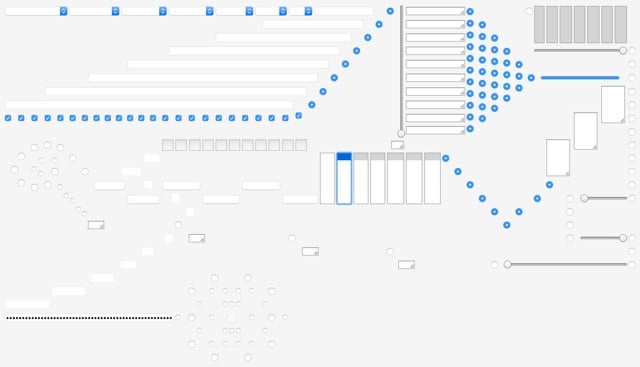
Ahhh, this makes me nostalgic for the 90s World Wide Web. Designer Sebastian Serena has built a Rube Goldberg machine out of HTML form elements. Once you start, you’ll watch the whole thing. (via @Colossal)
From 1996, a Wired article by Josh Quittner about Suck, Carl Steadman and Joey Anuff’s now-legendary website.
Who at HotWired noticed the look of dread and tension on the faces of Carl and Joey when Suck secretly launched like a torpedo on August 28, 1995? Carl tied his desktop machine at HotWired into his server, which was hidden in plain sight among the array of hardware, so he could watch as people logged in to Suck that first day. This is the coldly accurate terror of the new medium: Carl could tell at any second not only how many people were logged in to his server, but in some cases, who they were.
On that first day, a hundred people found Suck — not a bad turnout considering the Boys told only their friends. Naturally, their friends told their friends, and good news travels like a sweet breeze across the Web.
This was critical since Carl had set some ambitious goals: he wanted 1,000 hits by the end of the week, he wanted to be more successful than any HotWired channel by the end of two months, and he wanted to be the Cool Site of the Day within three months.
Suck made each benchmark.
Some notes: 1) Suck was one of the handful of sites that inspired me to start publishing online. Thank you, Carl & Joey. 2) I loved the site so much that I build a parody of it called Sock. They linked to it soon after it went up and I DIED. Can’t link to it because 0sil8, my site from that era, isn’t online right now. 3) I applied for an internship at Hotwired in early 1996. Never heard back. What an alternate timeline that would have been. 4) Reading this made me sad. I love the Web so much, like more than is probably sane and healthy for a non-human entity, but nearly every other good thing in my life has happened because of it. And that Web is going quickly, if not already gone. All good things… and all that, but it still fucking wrecks me.
Justin Hall has been sharing his life online for over 20 years at links.net. Justin’s Links from the Underground was one of the first sites I found and read regularly, back in the mid 90s. Now Hall has made a documentary about his time online, overshare: the links.net story.
Starting in 1994, my personal web site Justin’s Links from the Underground has documented family secrets, romantic relationships, and my experiments with sex and drugs.
overshare: the links.net story is a documentary about fumbling to foster intimacy between strangers online. Through interviews, analysis and graphic animations, I share my motivations, my joys and my sorrows from pioneering personal sharing for the 21st century. In 2004 the New York Times referred to me as “perhaps the founding father of personal weblogging.” I hope this documentary reveals that I was a privileged white male with access to technology who worked to invite as many people as possible to join him in co-creating an internet where we have a chance to honestly share of our humanity.
The movie is available in various formats, including as a digital download with extra footage from VHX for $11.99.
In 2008, Hossein Derakhshan was sentenced to 20 years in jail in Iran for blogging and championing the open web. Released and pardoned late last year, Derakhshan is now wondering why the web he went to jail for is dying and why no one is stopping it. Just as things changed in the real world while he was imprisoned:
Around me, I noticed a very different Tehran from the one I’d been used to. An influx of new, shamelessly luxurious condos had replaced the charming little houses I was familiar with. New roads, new highways, hordes of invasive SUVs. Large billboards with advertisements for Swiss-made watches and Korean flat screen TVs. Women in colorful scarves and manteaus, men with dyed hair and beards, and hundreds of charming cafes with hip western music and female staff. They were the kinds of changes that creep up on people; the kind you only really notice once normal life gets taken away from you.
…so too did the web:
The hyperlink was my currency six years ago. Stemming from the idea of the hypertext, the hyperlink provided a diversity and decentralisation that the real world lacked. The hyperlink represented the open, interconnected spirit of the world wide web — a vision that started with its inventor, Tim Berners-Lee. The hyperlink was a way to abandon centralization — all the links, lines and hierarchies - and replace them with something more distributed, a system of nodes and networks.
Blogs gave form to that spirit of decentralization: They were windows into lives you’d rarely know much about; bridges that connected different lives to each other and thereby changed them. Blogs were cafes where people exchanged diverse ideas on any and every topic you could possibly be interested in. They were Tehran’s taxicabs writ large.
Since I got out of jail, though, I’ve realized how much the hyperlink has been devalued, almost made obsolete.
(via @anildash)
Near the end of a piece by Morgan Housel called Innovation Isn’t Dead, appears “the typical path of how people respond to life-changing inventions”:
1. I’ve never heard of it.
2. I’ve heard of it but don’t understand it.
3. I understand it, but I don’t see how it’s useful.
4. I see how it could be fun for rich people, but not me.
5. I use it, but it’s just a toy.
6. It’s becoming more useful for me.
7. I use it all the time.
8. I could not imagine life without it.
9. Seriously, people lived without it?
That’s about right. I can only recall a couple of instances where I’ve skipped from step 1 to step 8 or 9: when I first used the Web1 and when Jobs introduced the iPhone at MacWorld. Everything else — Google, HD TV, Twitter, personal computers, streaming music services, wifi, laptops, Instagram, mobile phones — went through most of the 9 phases. (via @cdixon)
Kevin Fox recently unearthed a screenshot he took of Apple’s homepage in the early 90s:
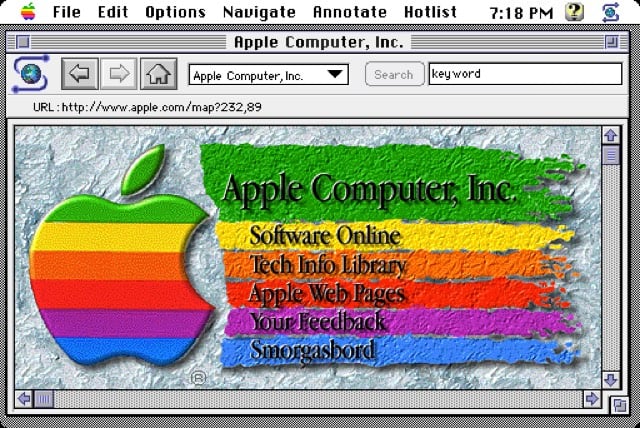
I don’t remember this version, but it looks like it was contemporary with this Microsoft homepage (which I do remember). I bet there’s footage of this page in Triumph of the Nerds or Nerds 2.0.1 or on an episode of Computer Chronicles. Anyone?
Paul Ford writes about how Greg Knauss scaled Paper’s web site after they broke the internet with nude photos of Kim Kardashian.
Via email, Jacobs told Knauss that PAPER believed “they’ve got something that they think will generate at least 100 million page views, and will their current infrastructure support that?”
“This sort of cold thrill goes down my spine,” Knauss said, “and the only thought that makes it out of my brain is, ‘Eep.’”
He continued: “I reflexively begin designing the architecture in my head. It’s a nerd impulse. Dogs chase after thrown balls, system administrators design to arbitrary traffic.”
I love this article for a whole bunch of reasons (including that it’s written by a friend about two other friends, one of whom is responsible for keeping kottke.org’s servers going), but I was just talking about the burstable web scaling issue with a friend the other day. She was trying to make a reservation for a ferry. The reservations open for the entire season on a particular day at a particular hour and in a matter of hours, most (if not all) of the reservations are taken. And of course, their tiny web site and backend systems melts into a huge puddle that day, people can’t get in, and everyone wastes 4 hours of their day trying to make a simple reservation. Basically, the ferry company needs to be Ticketmaster, but only for 3 or 4 hours every year. That’s a weird problem and it’s been an issue on the web since forever, and no one has solved it in an entirely off-the-shelf way. Someone get on this, riches await.
This article attempts to explain, in great detail, what happens when you type ‘google.com’ into your browser and press enter.
To pick a zero point, let’s choose the enter key on the keyboard hitting the bottom of its range. At this point, an electrical circuit specific to the enter key is closed (either directly or capacitively). This allows a small amount of current to flow into the logic circuitry of the keyboard, which scans the state of each key switch, debounces the electrical noise of the rapid intermittent closure of the switch, and converts it to a keycode integer, in this case 13. The keyboard controller then encodes the keycode for transport to the computer. This is now almost universally over a Universal Serial Bus (USB) or Bluetooth connection, but historically has been over PS/2 or ADB connections.
An I, Pencil for the internet age.
To celebrate the 20th anniversary of the first Microsoft home page, the company has recreated that old page here. More here, including screenshots of subsequent designs.
In terms of “Web design,” the notion, much less the phrase, didn’t really exist.
“There wasn’t much for authoring tools,” Ingalls says. “There was this thing called HTML that almost nobody knew.” Information that was submitted for the new Microsoft.com website often came to Ingalls via 3-1/2-inch floppy disks.
“Steve Heaney and I put together PERL scripts that handled a lot of these daily publishing duties for us,” he says. “For a while, we ran the site like a newspaper, where we published content twice a day. And if you missed the cutoff for the publishing deadline, you didn’t get it published until the next running of the presses, or however you want to term it.”
Interestingly, Microsoft doesn’t seem to know exactly when the page first went live:
Based on the findings, it appears the website was launched during the time between HTML/1.0 (June 1993) and HTML/2.0 (Dec 1994).
I made a brief search of the NCSA What’s New Archive, where a web site for Microsoft should have been noted, and found nothing between June 1993 and September 1994. This piece written in 1999 about the beginnings of Microsoft’s site says the page launched in April 1994. I searched some early Usenet groups to no avail. Anyone have a more accurate date? (via waxy)
Newer posts
Older posts






Socials & More