kottke.org posts about 2016 election
Because of the Electoral College and the way the primary system works in the US, presidential candidates end up spending a disproportionate amount of time is so-called “battleground states” like Pennsylvania, Ohio, and our dysfunctional friend Florida and primary states like Iowa and New Hampshire and less time where most of the US population actually lives (NY, CA, TX, IL, and in cities). The campaign for the National Popular Vote has produced a map that shows where the candidates did campaign events in 2016:
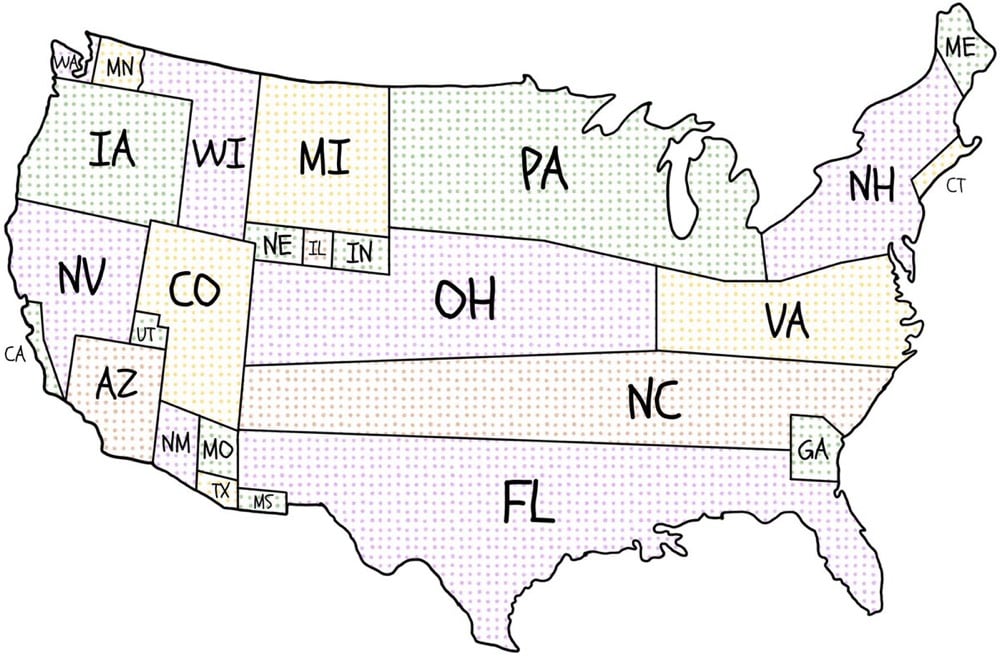
Because of these state winner-take-all statutes, presidential candidates have no reason to pay attention to the issues of concern to voters in states where the statewide outcome is a foregone conclusion. In 2012, as shown on the map, all of the 253 general-election campaign events were in just 12 states, and two-thirds were in just 4 states (Ohio, Florida, Virginia, and Iowa). Thirty-eight states were completely ignored.
And here’s the map for the 2012 election, which is even more extreme:
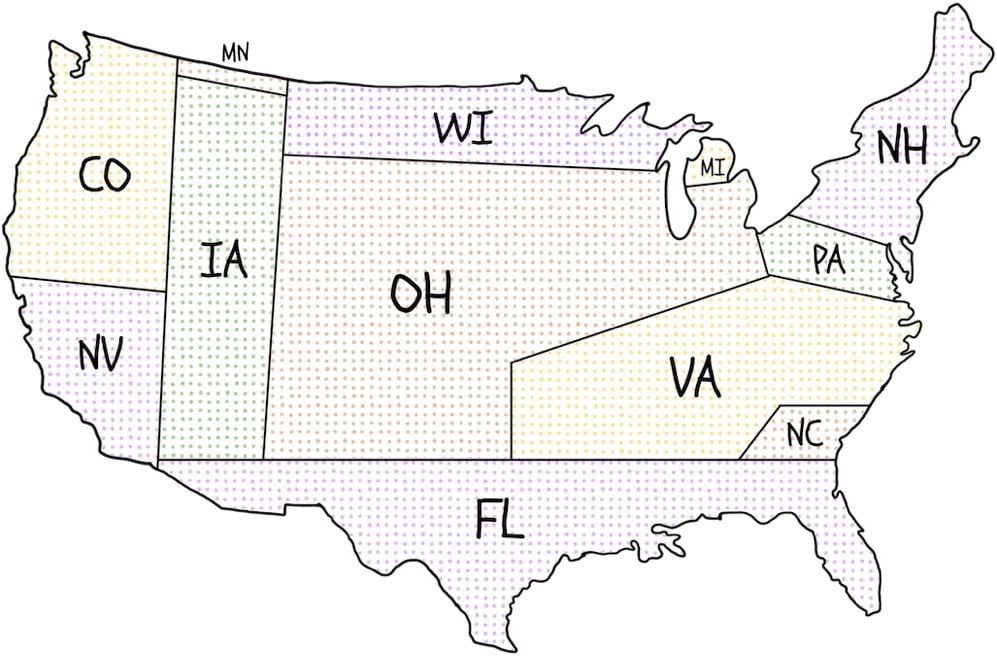
State winner-take-all statutes adversely affect governance. “Battleground” states receive 7% more federal grants than “spectator” states, twice as many presidential disaster declarations, more Superfund enforcement exemptions, and more No Child Left Behind law exemptions.
Also, because of state winner-take-all statutes, five of our 45 Presidents have come into office without having won the most popular votes nationwide. The 2000 and 2016 elections are the most recent examples of elections in which a second-place candidate won the White House. Near-misses are also common under the current state-by-state winner-take-all method of awarding electoral votes. A shift of 59,393 votes in Ohio in 2004 would have elected John Kerry despite President Bush’s nationwide lead of over 3,000,000 votes.
At this point, reading about how incompetent the Trump campaign and White House have been and continue to be — perhaps knowingly, given the viewpoint of some of his advisors and backers about wanting to weaken the federal government — is getting tiring, but Michael Lewis is always worth paying attention to. His newest book, The Fifth Risk, is about how unprepared the incoming Trump administration was to govern the country, to “take control of the portfolio of existential risks managed by the US government” as he puts it. The Guardian has an excerpt:
Chris Christie was sitting on a sofa beside Trump when Pennsylvania was finally called. It was 1.35am, but that wasn’t the only reason the feeling in the room was odd. Mike Pence went to kiss his wife, Karen, and she turned away from him. “You got what you wanted, Mike,” she said. “Now leave me alone.” She wouldn’t so much as say hello to Trump. Trump himself just stared at the TV without saying anything, like a man with a pair of twos whose bluff has been called. His campaign hadn’t even bothered to prepare an acceptance speech. It was not hard to see why Trump hadn’t seen the point in preparing to take over the federal government: why study for a test you will never need to take? Why take the risk of discovering you might, at your very best, be a C student? This was the real part of becoming president of the US. And, Christie thought, it scared the crap out of the president-elect.
Not long after the people on TV announced that Trump had won Pennsylvania, Jared Kushner grabbed Christie anxiously and said: “We have to have a transition meeting tomorrow morning!” Even before that meeting, Christie had made sure that Trump knew the protocol for his discussions with foreign leaders. The transition team had prepared a document to let him know how these were meant to go. The first few calls were easy — the very first was always with the prime minister of Great Britain — but two dozen calls in you were talking to some kleptocrat and tiptoeing around sensitive security issues. Before any of the calls could be made, however, the president of Egypt called in to the switchboard at Trump Tower and somehow got the operator to put him straight through to Trump. “Trump was like … I love the Bangles! You know that song Walk Like an Egyptian?” recalled one of his advisers on the scene.
Ho. Ly. Shit. Incredibly, Lewis’ very next line is: “That had been the first hint Christie had of trouble.” — which makes Chris Christie the most tone-deaf individual in the world? (Probably…Christie was fired the next day, a complete surprise to him.)
The book comes out tomorrow…you can pre-order from Amazon here.
I’ve been thinking about Trump’s presidency in terms of a coup to come, but Rebecca Solnit makes a compelling case for that event already being in our rear view mirror.
A lot of people are waiting for something dramatic to happen, some line to be crossed, an epic event like the firing of special counsel Robert Mueller III that will allow them to say that now we have had a coup and now we are ready to do something about it.
We already had the coup.
It happened on November 8, 2016, when an unqualified candidate won a minority victory in a corrupted election thanks in part to foreign intervention. Any time is the right time to pour into the streets and demand that it all grinds to a halt and the country change direction. The evidence that the candidate and his goons were aided by and enthusiastically collaborating with a foreign power was pretty clear before that election, and at this point, they are so entangled there isn’t really a reason to regard the born-again alt-right Republican Party and the Putin Regime as separate entities.
Update: A site called No Package Deals argues that the coup took place earlier than the 2016 election and began with the obstruction by Senate Republicans in not seating any judges, including Scalia’s replacement to the Supreme Court.
In February of 2016, after the death of Associate Justice Antonin Scalia, Mitch McConnell announced that the President no longer had the power to appoint justices to the Supreme Court, period. For some years now the President has not had the power to appoint judges, but nobody much noticed because it wasn’t the Supreme Court. The Republicans just said, Nope. Not seating your judges. End of discussion.
When McConnell said, Nope, not seating your Supreme Court justice either, we’ve already told you we’re not seating your judges, most people noticed. President Obama nominated someone anyway. McConnell stood firm: Mr. President, we have stripped that power from you. You are not going to seat any judges. Nobody did anything. The coup stood.
There’s also this little tidbit concerning Iran:
On March 9th of that same year 47 Republican members of the Senate wrote a letter denying in plain terms the President’s power to negotiate with a specific foreign power. They sent their letter to the government of Iran. Paraphrased they said, Don’t make any deals with our President, because we’ll weasel out of them as soon as he’s not looking. Iran took a chance and made the deal with the President. We will see how it comes out.
Well, it turned out pretty much like No Package Deals expected. (via @heatherhollick)
Back in March, John Pavlovitz wrote an open letter to friends he has lost contact with because of the 2016 election. This paragraph in particular articulates something I’ve been having trouble putting my finger on w/r/t some lost personal relationships due to “politics”:
I know you may believe this disconnection is about politics, but I want you to know that this simply isn’t true. It’s nothing that small or inconsequential, or this space between us wouldn’t be necessary. This is about fundamental differences in the ways in which we view the world and believe other people should be treated. It’s not political stuff, it’s human being stuff — which is why finding compromise and seeing a way forward is so difficult.
Fair or not, that is precisely how I feel. See also I Don’t Know How To Explain To You That You Should Care About Other People:
I cannot have political debates with these people. Our disagreement is not merely political, but a fundamental divide on what it means to live in a society, how to be a good person, and why any of that matters.
Update: Jennifer Wright: If You Are Married to a Trump Supporter, Divorce Them.
Supporting Trump at this point does not indicate a difference of opinions. It indicates a difference of values.
Values aren’t like hobbies or interests. They don’t change over time, and they more or less define who you are. Trump’s administration may have been, for some of us, a time when what we value has become much clearer to us.
So, while you may be able to convince your partner that there is a more efficient way to load the dishwasher, you will never be able to convince them that they need to care about people they are fundamentally uninterested in caring about.
The members of the two large writing guilds representing more than 12,000 Hollywood writers recently voted to strike.
Leaders of the Writers Guild of America, East, and the Writers Guild of America, West, announced the results of an online strike authorization vote in an email to members. The unions said that 6,310 eligible members voted; 96 percent of the vote was in favor of a strike.
A three-year contract between the guilds and the Alliance of Motion Picture and Television Producers, which represents the makers of films and TV series, expires at midnight on May 1. Negotiators were set to resume talks on Tuesday, with funding of a failing union health care plan a sticking point.
Last time there was a writers strike in 2007, networks moved to replace their scripted shows with reality programs, including the resurrection of a fading reality show called The Apprentice.
During the last work stoppage, CBS ordered additional seasons of its flagship reality competition shows to fill airtime. And then there’s NBC.
Trump’s “The Apprentice” had been removed from the network’s lineup amid low ratings. But a new programming chief came aboard in 2007, and the network decided to revive the competition show, but with a twist. And when the writers’ strike meant no more new episodes of “The Office” and “Scrubs,” NBC replaced the Thursday night shows in 2008 with “The Celebrity Apprentice.”
That’s a curious butterfly effect. The writers strike made room for The Celebrity Apprentice on TV. The Celebrity Apprentice gave Trump seven more seasons of primetime TV visibility. Trump parlayed that visibility into the highest political office in the land.
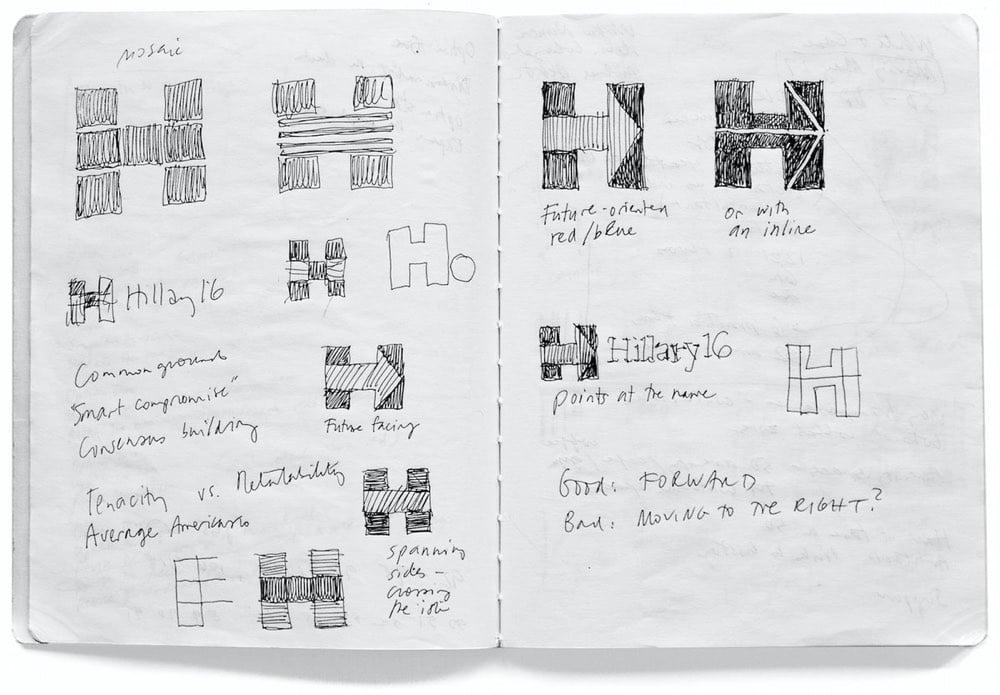
Pentagram’s Michael Bierut and his team designed the identity for Hillary Clinton’s 2016 Presidential campaign (of which I was not initially a fan but came around later). Here’s how it happened.
I put together a three-person team: me, designer Jesse Reed, and project manager Julia Lemle. We would work in secret for the next two months. Our first meeting with the Clinton team began with a simple statement: “Our candidate has 100 percent name recognition.” There is a well-known marketing principle that is often credited to midcentury design legend Raymond Loewy. He felt that people were governed by two competing impulses: an attraction to the excitement of new things and a yearning for the comfort provided by what we already know. In response, Loewy had developed a reliable formula. If something was familiar, make it surprising. If something was surprising, make it familiar.
That same principle applies to political campaigns. In 2008 Sol Sender, Amanda Gentry and Andy Keene were faced with the challenge of branding a candidate who had anything but name recognition. Barack Obama’s design team responded with a quintessentially professional identity program, introducing — for the first time — the language of corporate branding to political marketing. Obama’s persona — unfamiliar, untested, and potentially alarming to much of the voting public — was given a polished logo and a perfectly executed, utterly consistent typographic system. In short, they made a surprising candidate seem familiar.
We faced the opposite problem. Our candidate was universally known. How could we make her image seem fresh and compelling?
This is a great look at how a designer at the top of his game approaches a problem…and reckons with failure. Even this little bit:
It wasn’t clever or artful. I didn’t care about that. I wanted something that you didn’t need a software tutorial to create, something as simple as a peace sign or a smiley face. I wanted a logo that a five-year-old could make with construction paper and kindergarten scissors.
Leading up to the election, how many photos did you see of Hillary logos hand-drawn by kids on signs and t-shirts? Lots and lots…my kids even got into the act.
Anyway, a huge contrast to the process and impact of the Trump campaign’s identity.
Maria Guadalupe, an economics and political science professor, and Joe Salvatore, a professor of educational theater, recently put on a pair of performances that restaged the three Presidential debates between Donald Trump and Hillary Clinton. But this time, they had a woman play the Trump role (as “Brenda King”) and a man play the Clinton role (as “Jonathan Gordon”), with each attempting to portray the precise mannerisms, styles, and speech of the respective candidates. How would audiences react to the gender-switched candidates?
Salvatore says he and Guadalupe began the project assuming that the gender inversion would confirm what they’d each suspected watching the real-life debates: that Trump’s aggression — his tendency to interrupt and attack — would never be tolerated in a woman, and that Clinton’s competence and preparedness would seem even more convincing coming from a man.
But the lessons about gender that emerged in rehearsal turned out to be much less tidy. What was Jonathan Gordon smiling about all the time? And didn’t he seem a little stiff, tethered to rehearsed statements at the podium, while Brenda King, plainspoken and confident, freely roamed the stage? Which one would audiences find more likeable?
The audience’s reaction to the performances was surprising.
We heard a lot of “now I understand how this happened” — meaning how Trump won the election. People got upset. There was a guy two rows in front of me who was literally holding his head in his hands, and the person with him was rubbing his back. The simplicity of Trump’s message became easier for people to hear when it was coming from a woman — that was a theme. One person said, “I’m just so struck by how precise Trump’s technique is.” Another — a musical theater composer, actually — said that Trump created “hummable lyrics,” while Clinton talked a lot, and everything she was was true and factual, but there was no “hook” to it. Another theme was about not liking either candidate — you know, “I wouldn’t vote for either one.”
Here’s a clip from one of the rehearsals:
I think it’s important not to take away too much from this experiment (and perhaps the same should be said of televised political debates in general) but after watching that short clip and hearing about the audience’s reaction, I couldn’t help but think of Al Gore. In the lead-up to the election, I’d never thought of Clinton that way — meaning very smart, compassionate, and supremely qualified but ultimately a bit dull and uninspiring a la Gore — but maybe she did lack a critical charisma compared to Trump.
Since the Kennedy/Nixon debates, we’ve known that how candidates handle themselves on television — in debates, interviews, televised speeches, etc. — is critical to the voters’ perceptions of them. Gore, Jimmy Carter, Michael Dukakis, Mitt Romney, Bob Dole, Walter Mondale, John Kerry…they all were bested by more charismatic candidates (Reagan, Obama, Bill Clinton) that were in some cases not as qualified on paper. Even the Bushes (especially Dubya) had an aw shucks-y folksiness that could charm people sympathetic to their message. Perhaps Hillary Clinton belongs on that list as well. (via mr)
I posted earlier about Atul Gawande’s piece in the New Yorker on the importance of incremental care in medicine. One of the things that the Affordable Care Act1 did was to make it illegal for insurance companies to deny coverage to people with “preexisting conditions”, which makes it difficult for those people to receive the type of incremental care Gawande touts. And who has these preexisting conditions? An estimated 27% of US adults under 65, including Gawande’s own son:
In the next few months, the worry is whether Walker and others like him will be able to have health-care coverage of any kind. His heart condition makes him, essentially, uninsurable. Until he’s twenty-six, he can stay on our family policy. But after that? In the work he’s done in his field, he’s had the status of a freelancer. Without the Affordable Care Act’s protections requiring all insurers to provide coverage to people regardless of their health history and at the same price as others their age, he’d be unable to find health insurance. Republican replacement plans threaten to weaken or drop these requirements, and leave no meaningful solution for people like him. And data indicate that twenty-seven per cent of adults under sixty-five are like him, with past health conditions that make them uninsurable without the protections.
That’s 52 million people, potentially ineligible for health insurance. And that’s not counting children. Spurred on by Gawande, people have been sharing their preexisting conditions stories on Twitter with the hashtag #the27Percent.
The 27% figure comes from a recent analysis by the Kaiser Family Foundation:
A new Kaiser Family Foundation analysis finds that 52 million adults under 65 — or 27 percent of that population — have pre-existing health conditions that would likely make them uninsurable if they applied for health coverage under medical underwriting practices that existed in most states before insurance regulation changes made by the Affordable Care Act.
In eleven states, at least three in ten non-elderly adults would have a declinable condition, according to the analysis: West Virginia (36%), Mississippi (34%), Kentucky (33%), Alabama (33%), Arkansas (32%), Tennessee (32%), Oklahoma (31%), Louisiana (30%), Missouri (30%), Indiana (30%) and Kansas (30%).
36% uninsurable in West Virginia! You’ll note that all 11 of those states voted for Trump in the recent election and in West Virginia, Trump carried the day with 68.7% of the vote, the highest percentage of any state. The states whose people need the ACA’s protection the most voted most heavily against their own interest.
Update: An earlier version of this post unfairly pinned the entire blame for the lack of coverage of those with preexisting conditions on the insurance companies.2 I removed the last paragraph because it was more or less completely wrong. Except for the part where I said we should be pissed at the Republican dickheads in Congress who want to repeal the ACA without replacing it with something better.3 And the part where we should be outraged. And the part where we regulated cars and cigarettes and food to make them safer, forced companies to build products in ways they didn’t want, and saved millions of lives. We can’t make everyone healthier and raise taxes to do it? Pathetic for what is supposedly the world’s most powerful and wealthy nation. (thx @JPVMan + many others)
In November, shortly after the election, Vann Newkirk wrote an article for The Atlantic called This Is Who We Are, a reflection on racism in America.
At a gas station just outside of Rockingham, serendipity found us. As we pulled up to the pump, just there in front of our car was Mr. Confederate Plate, leaning like all villains do against the side of his car. I’m not sure who recognized whom first, but I remember the shouting match, and Mr. Confederate Flag calling my father the one name he would never answer to, looking at me and saying the same, and then pantomiming that he had a gun in the car. I remember looking around at similar flags on another truck and inside the gas station, and knowing instinctively that we were not in friendly territory. I also remember my father shaking with rage and that same hot shame as my own when he climbed back in the truck.
After another cussing fit, Vann Newkirk Sr. looked at me and said the thing that’s always stuck with me since. “This is who we are,” he told me. “Don’t forget.” And we went back down the road.
The piece was adapted into the short video above. Both are worth your time.
Dave Pell from Nextdraft on the connection between OJ Simpson and Donald Trump and how celebrity warps American minds.
By the time OJ Simpson was arrested after the infamous ride in the White Ford Bronco, it was totally impossible to imagine he’d be found not guilty.
By the time Trump reached election day, he had broken every rule of politics. He committed more campaign-ending gaffes in a week than most losing presidential campaigns during an entire run.
Both men had a fame that completely cut across all American demographics.
I thought I’d mentioned this somewhere at the time — Twitter? kottke.org? Can’t find it… — but when I watched the excellent OJ: Made in America documentary this summer, the parallels between the OJ story and Trump made me feel very uneasy. Two men, both broadly famous, both wealthy, both charming, both outcasts from their respective social groups, both misogynist abusers, both committed crimes, both gamed the American political and legal systems to get away with something that they shouldn’t have. OJ eventually got his but will Trump? Are Americans doomed to keep repeating these mistakes when it comes to celebrity?
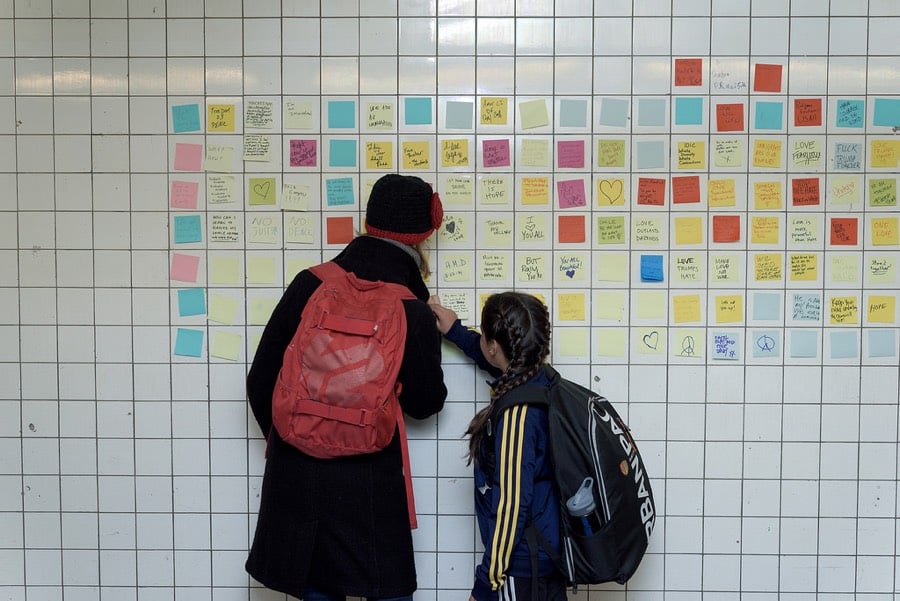
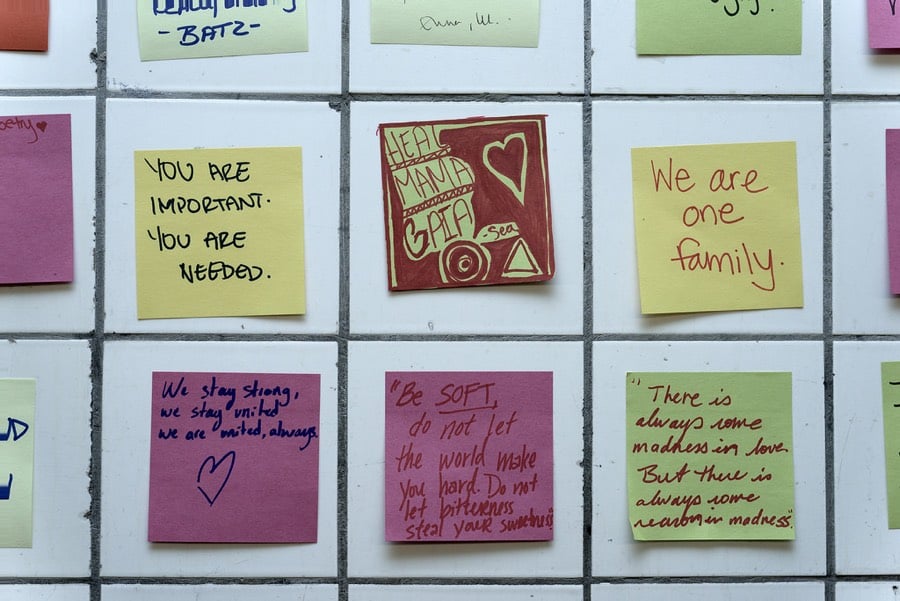
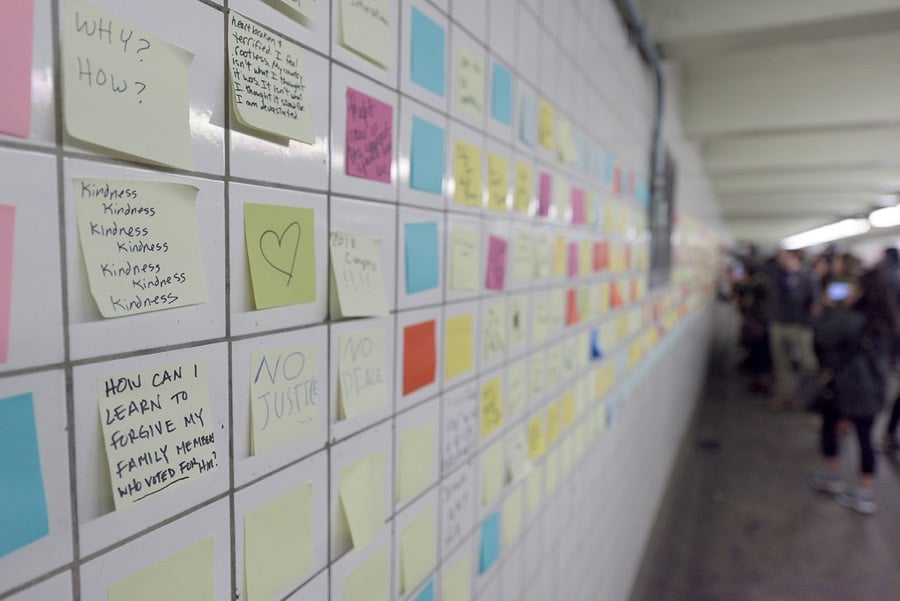
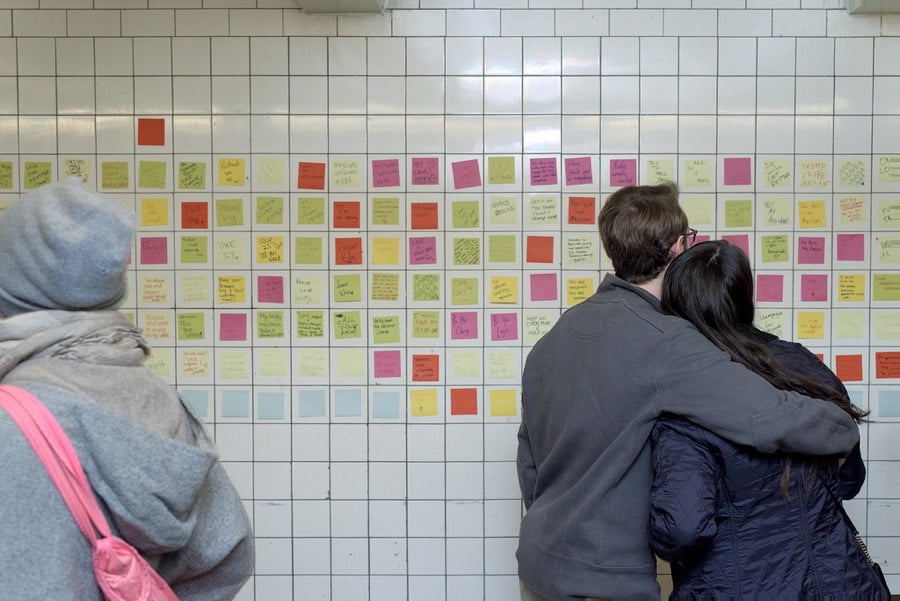
In the wake of the election, Matthew Chavez, who goes by “Levee” and is the instigator of Subway Therapy, encouraged New Yorkers to share their post-election grief on Post-it Notes stuck to the wall of the tunnel between the 6th and 7th Ave subway stations on 14th St. Joe Holmes visited the tunnel and took photos of people interacting with the wall. (All photos above by Joe Holmes.)
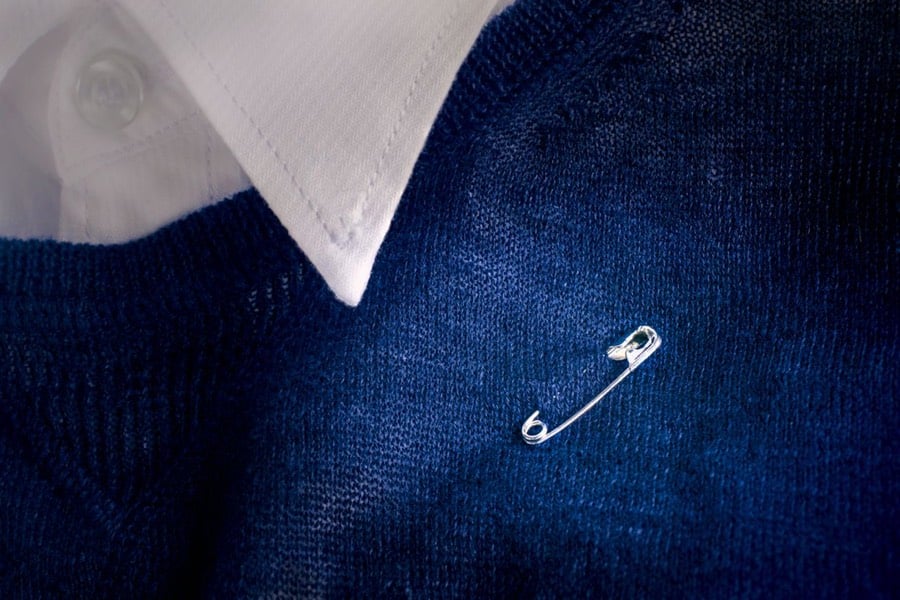
Post-Brexit, people in the UK started wearing safety pins to show their stance against racism and their solidarity with immigrants.
In response to the open environment of hatred, people across the U.K. are now wearing safety pins — and tweeting pictures of themselves wearing them — in an act of solidarity with immigrants.
In the wake of the election and reports of racism incidents across the nation, some are advocating using the safety pin strategy here too.
We need a symbol like that in the United States now. These are vicious days in America. The deplorables are emboldened. The Washington Post reports that there have already been two attacks on Muslim women on college campuses. At San Diego State University, two men ranting about Trump and Muslims robbed a student wearing hijab.
I like this idea, that a subtle marker can denote a social safe space of sorts, a signal to someone who might feel uncomfortable that an ally is nearby. That’s not to say you can put a pin on your coat and *dust off your hands, job well done* but it may help. I’m going to try it.
Update: During the Nazi occupation of Norway in World War II, Norwegians took to wearing paperclips to signal their rejection of Nazi ideology.
The people of Norway also had to deal with German soldiers day in and day out for five years. By 1945, some 400,000 German troops were operating in Norway, controlling the population of about 4 million people.
It was in the autumn of 1940 when students at Oslo University started wearing paperclips on their lapels as a non-violent symbol of resistance, unity, and national pride.
Symbols related to the royal family and state had already been banned, and they wanted a clever way of displaying their rejection of the Nazi ideology. In addition to wearing a single paperclip, paperclip bracelets and other types of jewellery were fashioned as well, symbolically binding Norwegians together in the face of such adversity.
Of course, once the Nazis got wind of this, wearing paperclips became a crime. (via @ckrub)
Update: That co-opting thing I warned against above? Seems like it’s happening.
wear safety pin to fool people into thinking you’re a safe space, trigger them
If I had to guess however, this behavior will be short lived and they’ll move on to some other genius scheme. I’m not taking my pin off. (via @_McFIy & @pattersar)
Update: There’s no safety pin emoji, but some people are adding the paperclip emoji to their Twitter usernames as a virtual world counterpart to the safety pin.
All 43 US Presidents up to this point have been men, and now our next President will also be a man. Joss Fong looks at the history of women running for President and the difficulty they face in the political arena.
Women running for office faced a double bind. They had to appear tough enough to lead but if they were too tough or too confident, they violated norms about how women were supposed to behave.
Oh, and how about that Ward Cleaver clip from Leave It To Beaver at ~2:25! [appalled emoji] I watched Leave It To Beaver all the time when I was a kid and never consciously noticed the sexism. Glad it didn’t sink in too deeply.
David Remnick, writing on the occasion of Donald Trump’s election to the Presidency of the United States.
The election of Donald Trump to the Presidency is nothing less than a tragedy for the American republic, a tragedy for the Constitution, and a triumph for the forces, at home and abroad, of nativism, authoritarianism, misogyny, and racism. Trump’s shocking victory, his ascension to the Presidency, is a sickening event in the history of the United States and liberal democracy. On January 20, 2017, we will bid farewell to the first African-American President — a man of integrity, dignity, and generous spirit — and witness the inauguration of a con who did little to spurn endorsement by forces of xenophobia and white supremacy. It is impossible to react to this moment with anything less than revulsion and profound anxiety.
I’ve had the good fortune to meet David Remnick — he calls Obama “a man of integrity, dignity, and generous spirit” because it takes one to know one — and it is remarkable to hear him write like this. At times, he sounds downright unhinged. But he’s not wrong. This is our reality now and looking for upsides right now seems like grasping at straws. Donald Trump has told us, repeatedly and proudly, who he is over the past 16 months, and it seems foolish not to take him at his word.
—
On a personal note, I am so emotionally overloaded right now I feel empty. It’s difficult to see how to move on from this, where to go from here, even as it relates to my work. Right now, I can’t access the part of me that knows kottke.org, if only in a small way, is a thing that needs doing. At its best, I hope that the site is a source of thoughtful optimism and that it celebrates the best of humanity, the spirit of curiosity, and the necessity of art, writing, photography, science, music, and other pursuits that allow people tell their stories and explore what it means to be human. I hope we’ll be able to explore those things together again soon, but not today.
Today, hug your loved ones. Connect with your friends. Be there for someone else. Yes, look for the helpers, but also take a moment to help someone out. Start small. Build. We’ll get there.

This morning, after scraping a layer of frost from the windshield, I drove to my local polling place, a small elementary school. There was no line in the school’s gymnasium and only a couple of the booths were occupied. I filled out my ballot, turned it in, got my sticker, and left. Three minutes flat. Done. Finally, after more than a year. I have done what I can.
I voted for Hillary Clinton for President, I don’t mind telling you. I’m With Her. The “Her” supposedly refers to Clinton herself, leading some critics to complain of her “all about me” campaign strategy. But I prefer to think the “Her” stands for the women of America, who gained the right to vote less than 100 years ago and have never had the opportunity to elect a woman to the highest office in the land. And not just any woman, but a woman who is among the most qualified candidates for President over the past 25 years. This is long long overdue and I’m proud to have done my tiny bit in making it happen.
Older posts





Socials & More