
Great to be included on this list from The Guardian of “50 of the weirdest, most wonderful corners of the web” with so many other great sites. Thanks, Emma Beddington!

Advertise here with Carbon Ads
This site is made possible by member support. 💞
Big thanks to Arcustech for hosting the site and offering amazing tech support.
When you buy through links on kottke.org, I may earn an affiliate commission. Thanks for supporting the site!
kottke.org. home of fine hypertext products since 1998.
Beloved by 86.47% of the web.
Entries for August 2023
Common Proverbs as Video Game Tutorials. “Distant grass will always have a greener hue. You can fine-tune the appearance of distant grass in Settings > Graphics.”
A bunch of people sent this to me, saying it was right up my alley (and it is): an investigation of why a pedestrian bridge in the Twin Cities was built. “Hold on, why do we care about this bridge so much?”
The Daily Tar Heel staffer Georgia Roda-Moorhead: “We are the Sandy Hook generation. We grew up crouching behind desks in pitch-black darkness, as our teachers barred the doors shut in case a ‘scary person’ stepped on campus.”
BTW, The Daily Tar Heel is an excellent publication, no “student-run” qualification necessary. I’ve been reading some of their post-shooting coverage and it’s better than past coverage of similar events by some national media.
Is Big Oil Turning on Big Auto? An anti-EV ad by ExxonMobil might signal an end to the partnership between oil cos. & American carmakers. “This ad illustrates the regressive shift from excessive greenwash back to blatant climate denial.”
The Fraud is a forthcoming novel by Zadie Smith: “a kaleidoscopic work of historical fiction set against the legal trial that divided Victorian England, about who gets to tell their story — and who gets to be believed”.
Doing Essential Things Makes Time For Everything Else
I found myself nodding at this short essay by Mandy Brown on the tradeoffs between work, life, time, energy, responsibility, and art, particularly this bit about what happens if you can make the leap from not having enough time for the essential things in life to having more time in your life because you’re doing the essential things.
Then one day they say fuck it all. They eat leftover pasta over the sink, drop mom off at her mahjongg game, and go sit in the park to draw. They draw for hours, until the sun goes down and they’re squinting under the street lights. And, lo and behold, the next day they plow through all those lingering to-dos. They see clearly that half of them were unnecessary when before they all seemed critical. They recognize a few others as things better handed off to their peers. They suddenly find time for attending to that one project they’d been procrastinating on for weeks. They sleep better. Their skin looks great. (Okay I might be exaggerating on that last one, but only mildly.)
It turns out, not doing their art was costing them time, was draining it away, little by little, like a slow but steady leak. They had assumed, wrongly, that there wasn’t enough time in the day to do their art, because they assumed (because we’re conditioned to assume) that every thing we do costs time. But that math doesn’t take energy into account, doesn’t grok that doing things that energize you gives you time back. By doing their art, a whole lot of time suddenly returned. Their art didn’t need more time; their time needed their art.
I don’t know if this is related or what, but a few years ago I shifted my thinking around time & energy. I noticed that when I thought or said “I don’t have time for this”, what I really meant was “I don’t have the energy for this”. Obviously I have time to do all sorts of things — I spend many hours during the week in front of the TV or on my phone watching/reading garbage — but it’s actually the energy that’s the issue. (All that TV/phone time is because I don’t have the energy to do much else.)
Brown goes on to say that this has little to do with art or drawing…each person draws energy from their own particular essential activity: spending time with family, volunteering, biking, photography, lifting, cooking, going to the movies alone and eating too much popcorn and shushing people when they get too loud — what?, taking a drive, etc. A few weeks ago in a post about the flow state, I wrote about rediscovering something that I require to make more energy in my life:
While I am not feeling particularly in the groove today, over the past several weeks I’ve been in the flow state a lot, working on a couple of projects for the site. It’s been a long time since I’ve had that feeling for more than a couple of hours every few months and booooooy does it feel good. There is almost nothing that fills me with as much joy as the “effortless engagement” of being in the flow state. I’m very glad it’s back in my life — I’d been afraid it was gone forever.
I had indeed been putting off doing this kind of work because I didn’t have the time and energy, but once I was able to make space for it in my day, it became clear that it was an essential thing that I need to do so that I can create time for everything else.
What a privilege it is to have that time/energy though, particularly in the US, with our low minimum wages, poor healthcare, and lack of a social safety net. Making time for your art so you can have more energy is not actually possible when you’re working two jobs six days a week and filling the rest of your time with childcare, housework, and (hopefully) sleep while fighting upstream against sexism, racism, classism, and the like. As a nation, I think we’d all be a whole lot happier and healthier if everyone had the chance to spend time on, as Brown puts it, “some thing that when neglected siphons time and energy away but when attended to delivers it in droves”.
“We’re over-engineering our public charging infrastructure. If we want to speed up the electric car era, we should put aside the apps, doodads, and expensive fast chargers and embrace the cheap dumb plug.”
The Pudding adds to their data clocks series: this one shows YouTube videos where the current time is mentioned.
“The Tombstone of Democracy”
Yesterday, there was yet another school shooting on a college campus, this time at the University of North Carolina at Chapel Hill. A UNC graduate student walked into a classroom building and murdered a science professor with a gun. The campus was on lockdown for hours. The front page of The Daily Tar Heel today consists of text messages sent to and from students during the lockdown:
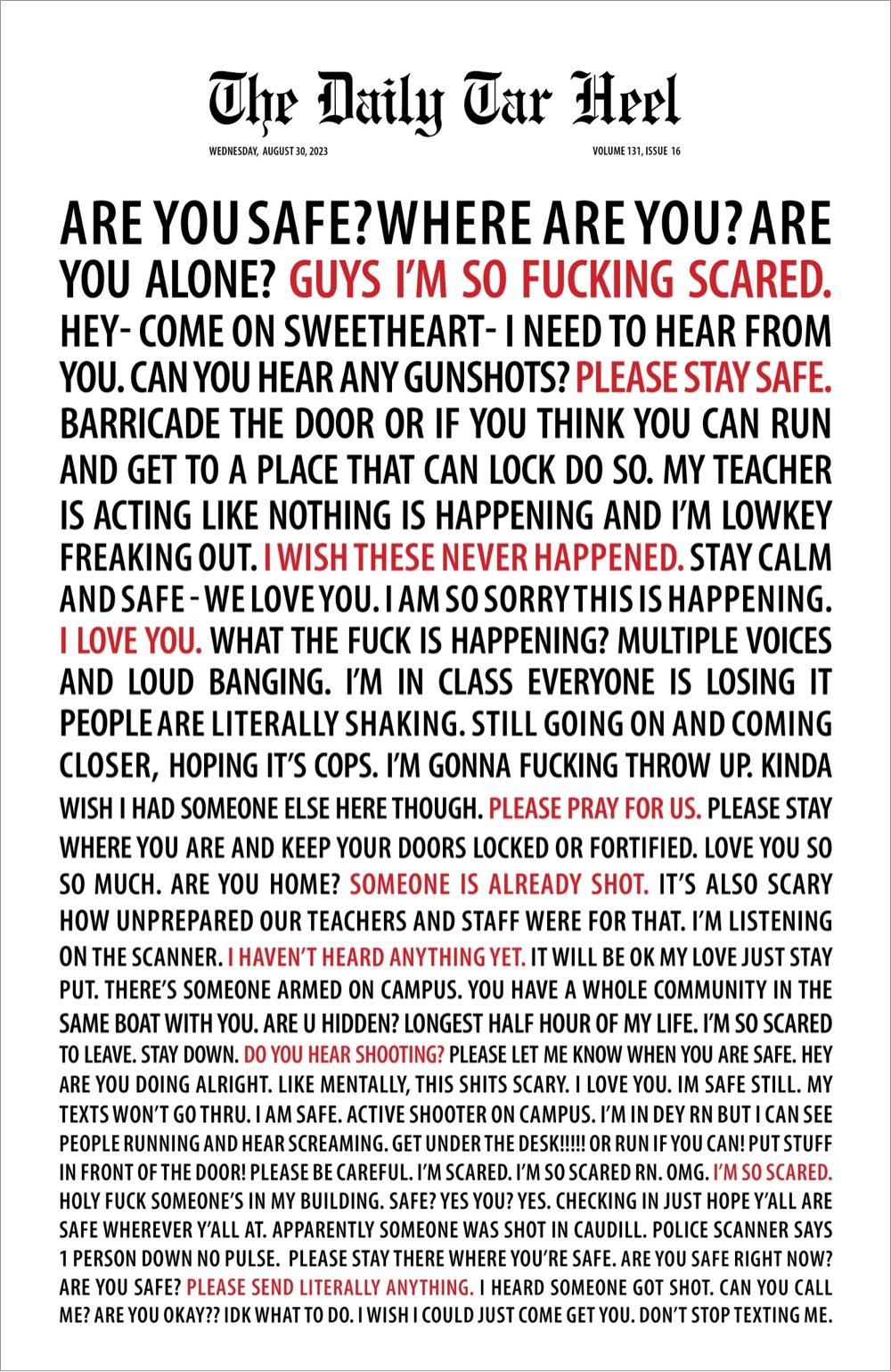
An incredible and powerful design — on Mastodon, Steve Silberman called it “the tombstone of democracy, courtesy of the NRA”. As a nation, we’ve spent more than 20 years and trillions of dollars fighting the “War on Terror” but won’t do a damn thing about the self-imposed terrorism of gun violence. The people sending and receiving those texts — they are TERRIFIED. And this happens regularly in the US, in pre-schools and on college campuses alike. We are a sick nation.
“I could offer a kind of equation for leftists and liberals crossing over to the neofascist and authoritarian right that goes something like: narcissism (grandiosity) + social media addiction + midlife crisis ÷ public shaming = rightwing meltdown.”
Where did all the cool small American cars go? “The Taliban has fresher trucks than us. The Honda Fit is dead. U can’t find a sauced-out 2-door to save your life. How did we get here??”
Journalism fails miserably at explaining what is really happening to America. “We need the media to see 2024 not as a traditional election but as an effort to mobilize a mass movement that would undo democracy…”
The air in US schools is dirty and sometime dangerous. Better ventilation is essential! “We would not accept drinking water that is full of pathogens and looks dirty. But we’ve been living with air that is full of pathogens and dirty.”
Fighting Inequality Through Softball: Maya Women Make a League of Their Own
Oh, this is delightful: a short documentary about a group of Mayan women in the tiny town of Hondzonot in the Yucatan peninsula who formed a softball team called Las Diablillas (Little Devils).
As a girl, Ay Ay loved playing sports at school. But, when she asked her parents’ permission to go out and play after school, they would say no — that only boys could do so. The custom in Hondzonot was that girls would stay busy inside, get married (some as young as twelve or thirteen), and have a family. Ay Ay always thought differently, she told me, but she had no choice but to obey her parents, and later her husband. One day, a mobile health unit came to town, and the doctor taught some local women to play softball with a wooden stick and a tennis ball, as a way to combat the risks of diabetes and hypertension. After the doctor left, the women kept playing, and the health benefits of the sport eased the community stigma. Little by little, Ay Ay asked permission from her husband to go out every day. “I felt it was necessary. I wanted to distract myself,” she told Fajardo, “from the routine at home.”
The women purposely wear the traditional huipil tunic as their uniform and play with an infectious spirit of camaraderie. Major League Baseball made their own short documentary about Las Diablillas:
“The question isn’t, ‘Who will give me permission?’ It’s, ‘Who’s going to stop me?’” says Geimi Santa Ofelia May Dzib, the team’s left fielder, in the opening scenes of MLB Originals’ latest short film, “Las Diablillas,” which explores how these women have found empowerment through sport.
The NY Times also published a piece about the team a few years ago:
“Here a woman serves the home and is not supposed to go out and play sports,” said Fabiola May Chulim, the team captain and manager of the Little Devils, known here as Las Diablillas, their name in Spanish. “When a woman marries, she’s supposed to do chores and attend to her husband and kids. We decided a few years ago that’s not going to impede us anymore from playing a sport when we want.”
Great title for this new book about calculators — Empire of the Sum: The Rise and Reign of the Pocket Calculator. Pairs well with a recent post about vintage calculators.
Teaser Trailer for David Fincher’s The Killer
Ahh, it seems like only yesterday that I read the news about David Fincher’s upcoming film The Killer. And it was. So now here’s the teaser trailer — interest piqued. What will tomorrow bring?
The Killer stars Michael Fassbender and will make its premiere at the Venice Film Festival on Sept 3, then a limited release in theaters, and then will be streaming on Netflix on Nov 10. As a refresher, here’s what Fincher has been up to lately-ish: directed Mank (2020) & Mindhunter (2017-2019), executive produced Voir and Love, Death & Robots (also directed one episode). Fun Fincher Facts: he was apparently an assistant cameraman for Return of the Jedi and did “matte photography” for Indiana Jones and the Temple of Doom.
“For two decades, Google Search was the invisible force that determined the ebb and flow of online content.” But Google’s search results are growing worse and people are looking elsewhere for information (YT, TikTok, AIs).
A Microscopic Ode to the Tiny Worlds Found in Rainwater Puddles
From the Journey to the Microcosmos YouTube channel, this is an exploration of the tiny worlds contained in rainwater puddles and their connection to the discovery of microbial organisms in the 1670s by Dutch scientist Antonie van Leeuwenhoek. What a trip that must have been, to be the first person to peer microscopically into some water and observe tiny organisms swimming around. (via @JenLucPiquant)
There’s a new David Fincher movie coming out: The Killer, starring Michael Fassbender. It’s premiering at the Venice Film Festival on Sept 3, then a limited release in theaters, and then on Netflix on Nov 10.
McDonald’s at the Movies and on TV
A McDonald’s restaurant apparently appears in season two of Loki on Disney+ and to mark the occasion, the fast food giant made a commercial featuring a number of other appearances by the brand in movies and TV, including The Office, The Fifth Element, Coming to America (“They’re McDonald’s. I’m McDowell’s.”), and Seinfeld. (Perhaps the most famous McDonald’s reference in cinema history, Jules’ Royale with Cheese bit in Pulp Fiction, is conspicuously missing.)
The ad was created to introduce their As Featured In Meal promotion, which seems to consist of 1100-calorie meals from their usual menu paired with a packet of Sweet ‘N Sour Sauce with the Loki logo on it. I thought the commercial was fun and clever but that promotion is a bit Sad Meal.
When do people in different US states eat dinner? Pennsylvania and Maine are the earliest eating states (~5:40pm on average) whereas Mississippi, Texas, and D.C. don’t start until after 7pm on average.
The Climate Crisis and the Resilience of Social Trust
The climate crisis has hit home this year for many Americans — its effects have been nearly inescapable in most parts of the country. With that, writes Bill McKibben, has come a sense of unease about the future, particularly about the places we live and will be able to live.
Drawing on his experience as a Vermonter, McKibben argues that no place is truly safe from the effects of the climate crisis, but we can find protection from it by rebuilding our sense of community and social trust. Those things can provide the resilience we’re going to need to get though this.
We’ve come through 75 years where having neighbors was essentially optional: if you had a credit card, you could get everything you needed to survive dropped off at your front door. But the next 75 years aren’t going to be like that; we’re going to need to return to the basic human experience of relying on the people around you. We’re going to need to rediscover that we’re a social species, which for Americans will be hard — at least since Reagan we’ve been told to think of ourselves first and foremost (it was his pal Margaret Thatcher who insisted ‘there is no such thing as society, only individual men and women.”) And in the Musk/Trump age we’re constantly instructed to distrust everyone and everything, a corrosion that erodes the social fabric as surely as a rampaging river erodes a highway.
Update: Here’s an example of what McKibben is talking about w/r/t Vermont’s sense of community:
Someone called Susan from Hollister Hill brought them sandwiches and brownies every day for two weeks after the flood. Bill from East Montpelier showed up and turned out to be a kind of one-man construction crew, and he’s been coming for weeks, pushing river sediment around and clearing out barns.
Over 50 people came to help. And at the end of these days, there were bonfires and pizza.
For your reference: a straightforward review of the facts about the 2020 presidential election, which unequivocally shows that Biden won the election — reviews & recounts in swing states (often by the GOP) comfortably affirmed his victory.
A Swiss Stamp Made With Concrete
Swiss Post has released a stamp that features concrete, an important material in the history of architecture. But first of all, look at the aesthetics of this thing:
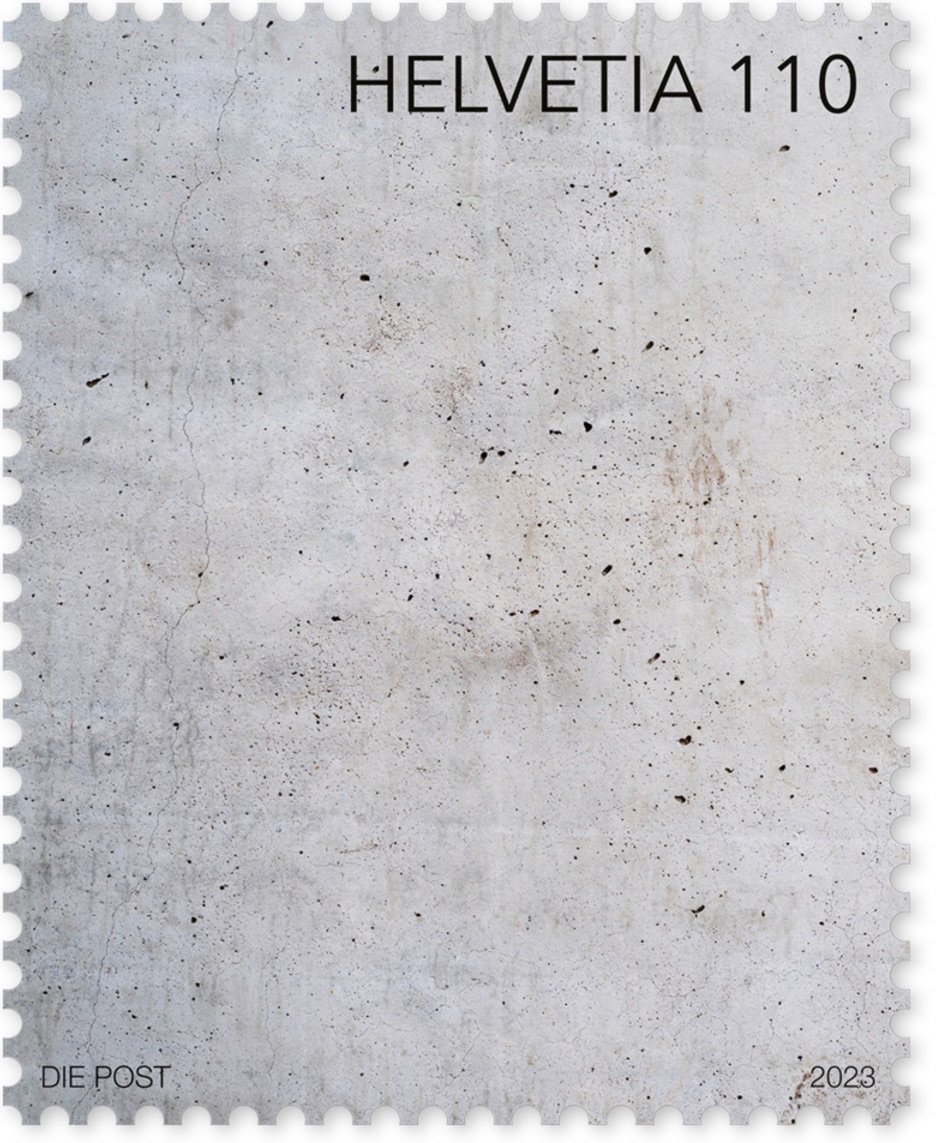
Aaahhh, it looks so nice and clean and Swiss. Love it. Even better: the stamp was designed to feel like concrete:
To give the concrete wall depicted in the design a tactile dimension, cement pigments were added to the ultra-matt finish.
In 2021, Swiss Post made a stamp out of canvas for the same series of stamps regarding art. Not quite as aesthetically pleasing as the concrete one, but still pretty cool.
You can order the concrete stamp from the Swiss Post online shop. (via greg.org)
Utopia Clicker; or, The Whale.
The Constitution Prohibits Trump From Ever Being President Again. Section 3 of the 14th Amendment disqualifies those who “have engaged in insurrection or rebellion” from office — no conviction is necessary.
Great piece by Elizabeth Spiers on the Michael Oher adoption/conservatorship situation. “The idea that Black children are automatically better off with nice white parents than their own biological parents is just white supremacy…”
Focus on the Stakes, Not the Odds
Now that the 2024 election campaigns have ramped up in earnest (absurdly & obscenely more than a year before the actual election), a good thing to keep in mind is NYU journalism professor Jay Rosen’s guidance for how journalists should cover the election:1
“Not the odds, but the stakes.”
That’s my shorthand for the organizing principle we most need from journalists covering the 2024 election. Not who has what chances of winning, but the consequences for our democracy. Not the odds, but the stakes.
Rosen first articulated this principle more than a decade ago and ever since reading about it a few years ago, I’ve all but stopped reading and linking to political horse race coverage. Who scored more “points” in the latest debate? Which candidate seems the most Presidential? Will his mugshot bolster his campaign? Come on, this isn’t the goddamned Oscars red carpet. Tell us what the candidates’ plans are and how they will affect how Americans live their lives. What experience do they have in governance? Or if not governance, in leadership? What do they believe, what actions have they taken in the past and what consequences have those actions had on actual people? What motivates them…power, money, fame, service? Many many people will not give a shit about any of this, but if we want to retain a functioning democracy with a press that’s not primarily about entertainment, voters need to know what they are getting into.
And I would argue, how they should cover many other important issues. So much of “tech” news reads like horse race coverage instead of focusing what kind of world would result if Company A or Technology B were to succeed. Journalists and outlets that cover the stakes get my attention.↩
Study: ‘Truly Being Seen’ Still Ranks Among Worst Possible Experiences In Human Existence. “Realizing somebody has managed to look past your protective façade and recognize you for who you are continues to be the most punishing…experience.”
Trump’s Prosecutions Are About Repairing Our Social Norms
From Dell Cameron and Andrew Couts in Wired, Trump’s Prosecution Is America’s Last Hope:
The Trump administration’s ever-broadening palette of ethics violations caused Americans to realize, perhaps for the first time on a national scale, that truly there are few if any laws against some of the most basic forms of corruption; that, instead, conventions and norms — an honor system, essentially — is all that stand between presidents and the gross abuse of their power.
This is a good, short piece, riffing off of the 2018 book by Steven Levitsky and Daniel Ziblatt, How Democracies Die. The Republicans, Trump, the Supreme Court, billionaires, corporations, and corporate shareholders are using America’s legal system to substantially weaken our democracy. It’s not a new thing for the powerful to place themselves above the law, but the pace and openness with which it’s happening right now is alarming.
Zach Klein and his family planted a drought-tolerant sidewalk garden outside their San Francisco home. Beautiful.
The Alaskan 4th of July Car Launch
On July 4, 2023, a couple thousand people gathered in Alaska to watch old junker cars get launched off of a 300-foot cliff and just get obliterated on impact. (The launching starts at the 8-minute mark.) It’s entertaining to watch in a Jackass sort of way, but the whole thing is a metaphor for a particular facet of America: loud, dumb, fun, and wasteful.
It Is No Longer Possible to Escape What We Have Done to Ourselves. Wildfires, floods, record temperatures, record drought, “unprecedented”, “uncharted territory”. The effects of climate change are now impossible to miss. So now what?
In a Gallup poll on the perceived safety of 16 US cities, Republicans were 29% less likely to rate cities as safe compared to Democrats. In 2006, the gap was only 2%. An entire generation of voters brainwashed by Fox News, et al.
Wes Anderson’s adaptation of Roald Dahl’s The Wonderful Story of Henry Sugar will be out on Netflix on Sept 27. It’s only 39 minutes long and stars Benedict Cumberbatch & Ralph Fiennes.
Threads now has a web interface for use on desktop/laptop computers. Here’s my account there if you’d like to follow.
Spaghetti Mayhem
Jan Hakon Erichsen does weird things with dried pasta, mostly spaghetti but also lasagna. This is goofy and fun. Check out his Instagram and YouTube for more artistic hijinks. (thx, clarke)
How Sauropod Dinosaurs Became the Biggest Land Animals Again and Again. “Sauropods evolved their record sizes a remarkable three dozen times on six landmasses over the course of 100 million years.”
Good interview with Clive Thompson about his 4000-mile, cross-country bike ride, his forthcoming book on micromobility, and all sorts of other things.
Rosie Grant prepares food from recipes she finds on gravestones and then shares a meal with the deceased in the cemetery. Others are cleaning gravestones and telling stories about the dead. 21st century death rituals.
A typically fine piece by Tressie McMillan Cottom about Bama Rush: In Alabama, White Tide Rushes On. “The power of these sororities is not sisterhood. It’s the brotherhood that desires it.” (See also…)
Ahhh, this is an amazing short film by Nikita Diakur in which an AI avatar learns how to do a backflip. So weird, so good.
Career advice: keep a current “brag document” that lists what you’ve accomplished with your work. As a one-person company, I often get too caught up in how much I’m not getting done, so this might be a worthwhile exercise for me.
A musical clock that plays songs with the current time in the song title, a la Christian Marclay’s The Clock. See also the literature clock.
“Elon Musk’s Shadow Rule”
Great, long piece from Ronan Farrow for the New Yorker on Elon Musk’s considerable influence over the US government. This doesn’t seem good:
There is little precedent for a civilian’s becoming the arbiter of a war between nations in such a granular way, or for the degree of dependency that the U.S. now has on Musk in a variety of fields, from the future of energy and transportation to the exploration of space. SpaceX is currently the sole means by which nasa transports crew from U.S. soil into space, a situation that will persist for at least another year. The government’s plan to move the auto industry toward electric cars requires increasing access to charging stations along America’s highways. But this rests on the actions of another Musk enterprise, Tesla. The automaker has seeded so much of the country with its proprietary charging stations that the Biden Administration relaxed an early push for a universal charging standard disliked by Musk. His stations are eligible for billions of dollars in subsidies, so long as Tesla makes them compatible with the other charging standard.
In the past twenty years, against a backdrop of crumbling infrastructure and declining trust in institutions, Musk has sought out business opportunities in crucial areas where, after decades of privatization, the state has receded. The government is now reliant on him, but struggles to respond to his risk-taking, brinkmanship, and caprice. Current and former officials from NASA, the Department of Defense, the Department of Transportation, the Federal Aviation Administration, and the Occupational Safety and Health Administration told me that Musk’s influence had become inescapable in their work, and several of them said that they now treat him like a sort of unelected official. One Pentagon spokesman said that he was keeping Musk apprised of my inquiries about his role in Ukraine and would grant an interview with an official about the matter only with Musk’s permission. “We’ll talk to you if Elon wants us to,” he told me.
Clone-a Lisa: an in-browser game where you have 60 seconds to paint a forgery of the Mona Lisa.
On the 20th anniversary of the release of its English translation, a look back at Marjane Satrapi’s excellent graphic novel Persepolis (now available in a new hardcover release).
This is wild…and the design of the study is interesting too: “People who enroll in genetic studies are genetically predisposed to do so.”
Socials & More