


A short piece on the process for USPS stamp design and how you can submit your artwork for consideration. “On average we allow about three years from the time we begin work on a stamp until the time it’s issued.”

Advertise here with Carbon Ads
This site is made possible by member support. 💞
Big thanks to Arcustech for hosting the site and offering amazing tech support.
When you buy through links on kottke.org, I may earn an affiliate commission. Thanks for supporting the site!
kottke.org. home of fine hypertext products since 1998.
Beloved by 86.47% of the web.
Entries for March 2023
Restoring a 100-Year-Old Animated Film
You’ve probably seen the work of animation pioneer Max Fleischer; he made the old Popeye, Superman, Betty Boop, and Koko the Clown cartoons waaaay back in the early-to-mid 20th century. Films from back then are often not well-preserved, so when a copy is discovered in a film library or private collection, great care must be exercised in restoring the film for future generations to enjoy.
This video follows the restoration process of Fleischer’s 1924 Koko the Clown film Birthday, from scanning a 35mm print from 1930 to the digital retouching. The fully restored print doesn’t seem to be online anywhere, but you can see a couple of before-and-after comparisons here and here.
These maps provide graphic evidence of how parking lots “eat” U.S. cities. “On average, parking lots gobble up 20% of prime locations in U.S. city centers.”
Most Touched, a book featuring over 1000 different kinds of door handles from around the world.
They’re doing a sequel to cult-favorite Scott Pilgrim vs the World with the original cast and it’s anime.
A new study shows that “horses were ridden and raised by [North American] Indigenous groups by the early 1600s”, much sooner than previous studies have shown and more in line with the oral histories of Indigenous tribes.
The Beautiful Skyscrapers of Early 20th Century America



Using drones, a team led by photographer Chris Hytha has been traveling around the country capturing images of the tops of some of America’s most beautiful and notable early 20th century skyscrapers.
The prosperity of early 20th century America resulted in a boom of skyscrapers that still tower over cities across the country today. Focusing on the character and craftsmanship on display at the top of these landmark buildings in a way that can’t be seen from street level, the Highrises Collection reveals fascinating details and stories of these distinctly American icons.
They’ve done almost a hundred of them so far and are planning on adding about 100 more to the tally before they are finished. Hytha recently shared some of his favorite Art Deco buildings from the project. (via @mwilkie)
“What if the “decline” of men’s ambition is just less unquestioned access to power and privilege? […] Men don’t need ambition. They have privilege. They rise unless they work hard at sucking.”
A collective of 73 natural history museums in 28 countries has created a vast inventory of the 1.1 billion objects in their collections, in order to answer questions like “how quickly species are becoming extinct and how climate change is altering the natural world”.
Donald Trump was indicted by a Manhattan grand jury today. “In the coming days, prosecutors working for the district attorney, Alvin L. Bragg, will likely ask Mr. Trump to surrender and to face arraignment.”
What if stars had phone-like battery indicators for how much hydrogen fuel they have left? The Sun is at about 50% battery while Betelgeuse is about out of juice and needs to find an outlet.
The Undeniable Street View, a site that shows before-and-after views of civilian areas in Ukrainian cities that have been devastated by the Russian invasion.
How Noiseless Props Are Made For Movies And TV Shows
Insider has been doing a whole series of videos on how movie props are made (view the entire thing here) and I found this one on how prop makers rely on noiseless props to be particularly interesting. To cut down on distracting on-set noise (so dialogue can be heard, for instance), they swap racquetball balls for pool balls, silicon chunks for ice cubes, and paper bags made out of coffee filter material for real paper bags. So weird to watch those objects in action without their usual sounds. (thx, caroline)
Tapping the Vast Renewable Energy of the Yellowstone Supervolcano

The first few sentences of the abstract for this paper from the scientific journal Renewable Energy contain a twist in the middle that’s worthy of M. Night Shyamalan:
The USA is confronted with three epic-size problems: (1) the need for production of energy on a scale that meets the current and future needs of the nation, (2) the need to confront the climate crisis head-on by only producing renewable, green energy, that is 100% emission-free, and (3) the need to forever forestall the eruption of the Yellowstone Supervolcano. This paper offers both a provable practical, novel solution, and a thought experiment, to simultaneously solve all of the above stated problems.
If you don’t know about the supervolcano lurking under Yellowstone National Park, now’s your chance to learn more. Here’s Bill Bryson from his book A Short History of Nearly Everything:
Yellowstone, it turns out, is a supervolcano. It sits on top of an enormous hot spot, a reservoir of molten rock that rises from at least 125 miles down in the Earth. The heat from the hot spot is what powers all of Yellowstone’s vents, geysers, hot springs, and popping mud pots. Beneath the surface is a magma chamber that is about forty-five miles across — roughly the same dimensions as the park — and about eight miles thick at its thickest point. Imagine a pile of TNT about the size of Rhode Island and reaching eight miles into the sky, to about the height of the highest cirrus clouds, and you have some idea of what visitors to Yellowstone are shuffling around on top of. The pressure that such a pool of magma exerts on the crust above has lifted Yellowstone and about three hundred miles of surrounding territory about 1,700 feet higher than they would otherwise be. If it blew, the cataclysm is pretty well beyond imagining. According to Professor Bill McGuire of University College London, “you wouldn’t be able to get within a thousand kilometers of it” while it was erupting. The consequences that followed would be even worse.
Back to the paper. The authors are proposing to generate massive amounts of energy from the supervolcano — “well over 11 Quadrillion Watt hours of electrical energy” per year:
Through a new copper-based engineering approach on an unprecedented scale, this paper proposes a safe means to draw up the mighty energy reserve of the Yellowstone Supervolcano from within the Earth, to superheat steam for spinning turbines at sufficient speed and on a sufficient scale, in order to power the entire USA. The proposed, single, multi-redundant facility utilizes the star topology in a grid array pattern to accomplish this. Over time, bleed-off of sufficient energy could potentially forestall this Supervolcano from ever erupting again.
I mean, this actually sounds like a great idea if it could be done safely, without ruining the park and, you know, accidentally blowing shit up. As of 2016, Iceland generated 65% of its energy from geothermal sources — the US could certainly stand to lean more on geothermal.
If you needed to write a headline summing up contemporary American culture, it might read something like this: People Who Caused Traffic Nightmare At Pretty Tree Festival Complain Of Traffic Nightmare At Pretty Tree Festival.
Not happy with the “insanely broad” language in the RESTRICT bill (aka the TikTok ban bill) - this feels like the Patriot Act all over again. Pass individual privacy protection legislation instead!
The Impressionish Painter
I have to admit that as much as I love Evan Puschak’s Nerdwriter videos, I did not have high hopes for his latest video on John Singer Sargent, a painter I didn’t know a lot about and assumed, mostly based on his name (ugh, I know), that he was some fusty 19th-century painter who was not as interesting as the Impressionists. What a pleasant surprise to discover, right from Puschak’s expertly concise show-don’t-tell opening, that I am Sargent’s newest fan.
Everywhere you look in this painting you see his supremely confident looseness, a kind of painting you maybe wouldn’t think to associate with a realistic representation of the world. And yet that’s exactly the final effect — a realism that is somehow more true than finely detailed painting.
Realism through impressionism? Sign me up. Stay curious, friends…you never know what interesting new (or old!) thing you’re going to discover next.
Pop-Up Magazine is doing three more live shows for their farewell tour: in Brooklyn, Oakland, and LA.
Happy 10th Anniversary to Kurzgesagt
This year, Kurzgesagt celebrates 10 years of making videos on YouTube and to mark the occasion, they’ve produced this video about their history, how their business works (their shop accounts for a large chunk of their revenue), and the values that guide their work.
Kurzgesagt’s foundation was laid when Philipp, our founder, dropped out of high school as a teenager. Learning seemed daft and useless and he was not interested in anything. Until a very special teacher at a school for dropouts grabbed him by the neck. The way she taught was different. She talked about connections and the big picture. She told a story. For the first time ever, Philipp wanted to learn more without being forced. It was a key life experience.
Kurzgesagt tries to recreate this experience for you. “Nothing is boring if you tell a good story, and we try to tell these stories to spark excitement and make you want to go on and learn more. Because of the one teacher that could do this, Philipp got a high school degree, studied history and design and eventually started Kurzgesagt as a passion project, inspired by Crash Course World history.
Some of you might not be interested in something that seems pretty inside baseball, but I post a lot of Kurzgesagt’s videos here and I’ve always admired the way they go about their business — their commitment to quality, painstaking research, an ability to admit when they got it wrong, non-extractive revenue streams with a heavy emphasis on direct reader support — and it was great to hear them talk about it.
The professor of food history at the University of Parma: “the recipe for carbonara is American and the only place in the world to find bona fide parmesan cheese nowadays is Wisconsin”. Spicy!
It’s Not the Bike Lane’s Fault You’re a Bad Driver. “Pay attention to the fucking road while you’re driving. It’s not too much to ask when other people’s lives are literally at stake.”
Ooh, a new book by Lauren Groff is coming out in the fall: The Vaster Wilds. I loved her previous book, Matrix.
ChatGPT Made Me Cry and Other Adventures in AI Land

[Yesterday I spent all day answering reader questions for the inaugural Kottke.org Ask Me Anything. One of them asked my opinion of the current crop of AI tools and I thought it was worth reprinting the whole thing here. -j]
Q: I would love to know your thoughts on AI, and specifically the ones that threaten us writers. I know you’ve touched on it in the past, but it seems like ChatGPT and the like really exploded while you were on sabbatical. Like, you left and the world was one way, and when you returned, it was very different. —Gregor
A: I got several questions about AI and I haven’t written anything about my experience with it on the site, so here we go. Let’s start with two facts:
- ChatGPT moved me to tears.
- I built this AMA site with the assistance of ChatGPT. (Or was it the other way around?)
Ok, the first thing. Last month, my son skied at a competition out in Montana. He’d (somewhat inexplicably) struggled earlier in the season at comps, which was tough for him to go through and for us as parents to watch. How much do we let him figure out on his own vs. how much support/guidance do we give him? This Montana comp was his last chance to get out there and show his skills. I was here in VT, so I texted him my usual “Good luck! Stomp it!” message the morning of the comp. But I happened to be futzing around with ChatGPT at the time (the GPT-3.5 model) and thought, you know, let’s punch this up a little bit. So I asked ChatGPT to write a good luck poem for a skier competing at a freeski competition at Big Sky.
In response, it wrote a perfectly serviceable 12-line poem with three couplets that was on topic, made narrative sense, and rhymed. And when I read the last line, I burst into tears. So does that make ChatGPT a soulful poet of rare ability? No. I’ve thought a lot about this and here’s what I think is going on: I was primed for an emotional response (because my son was struggling with something really important to him, because I was feeling anxious for him, because he was doing something potentially dangerous, because I haven’t seen him too much this winter) and ChatGPT used the language and methods of thousands of years of writing to deliver something a) about someone I love, and b) in the form of a poem (which is often an emotionally charged form) — both of which I had explicitly asked for. When you’re really in your feelings, even the worst movie or the cheesiest song can resonate with you and move you — just the tiniest bit of narrative and sentiment can send you over the edge. ChatGPT didn’t really make me cry…I did.
But still. Even so. It felt a little magical when it happened.
Now for the second part. I would say ChatGPT (mostly the new GPT-4 model), with a lot of hand-holding and cajoling from me, wrote 60-70% of the code (PHP, Javascript, CSS, SQL) for this AMA site. And we easily did it in a third of the time it would have taken me by myself, without having to look something up on Stack Overflow every four minutes or endlessly consulting CSS and PHP reference guides or tediously writing tests, etc. etc. etc. In fact, I never would have even embarked on building this little site-let had ChatGPT not existed…I would have done something much simpler and more manual instead. And it was a *blast*. I had so much fun and learned so much along the way.
I’ve also been using ChatGPT for some other programming projects — we whipped the Quick Links into better shape (it can write Movable Type templating code…really!) and set up direct posting of the site’s links to Facebook via the API rather than through Zapier (saving me $20/mo in the process). It has really turbo-charged my ability to get shit done around here and has me thinking about all sorts of possibilities.
I keep using the word “we” here because coding with ChatGPT — and this is where it starts to feel weird in an uncanny valley sort of way — feels like a genuine creative collaboration. It feels like there is a “someone” on the other side of that chat, a something that’s really capable but also needs a lot of hand-holding. Just. Like. Me. There’s a back and forth. We both screw up and take turns correcting each other’s mistakes. I ask it please and tell it thank you. ChatGPT lies to me; I gently and non-judgmentally guide it in a more constructive direction (as you would with a toddler). It is the fucking craziest weirdest thing and I don’t really know how to think about it.
There have only been a few occasions in my life when I’ve used or seen some new technology that felt like magic. The first time I wrote & ran a simple BASIC program on a computer. The first time I used the web. The first time using a laptop with wifi. The first time using an iPhone. Programming with ChatGPT over the past few weeks has felt like magic in the same way. While working on these projects with ChatGPT, I can’t wait to get out of bed in the morning to pick up where we left off last night (likely too late last night), a feeling I honestly have not consistently felt about work in a long time. I feel giddy. I feel POWERFUL.
That powerful feeling makes me uneasy. We shouldn’t feel so suddenly powerful without pausing to interrogate where that power comes from, who ultimately wields it, and who it will benefit and harm. The issues around these tools are complex & far-reaching and I’m still struggling to figure out what to think about it all. I’m persuaded by arguments that these tools offer an almost unprecedented opportunity for “helping humans be creative and express themselves” and that machine/human collaboration can deepen our understanding and appreciation of the world around us (as has happened with chess and go). I’m also persuaded by Ted Chiang’s assertion that our fears of AI are actually about capitalism — and we’ve got a lot to fear from capitalism when it comes to these tools, particularly given the present dysfunction of US politics. There is just so much potential power here and many people out there don’t feel uneasy about wielding it — and they will do what they want without regard for the rest of us. That’s pretty scary.
Powerful, weird, scary, uncanny, giddy — how the hell do we collectively navigate all that?
(Note: ChatGPT didn’t write any of this, nor has it written anything else on kottke.org. I used it once while writing a post a few weeks ago, basically as a smart thesaurus to suggest adjectives related to a topic. I’ll let you know if/when that changes — I expect it will not for quite some time, if ever. Even in the age of Ikea, there’s still plenty of handcrafted furniture makers around and in the same way, I suspect the future availability of cheap good-enough AI writing/curation will likely increase the demand and value for human-produced goods.)
Apple Passwords Deserve An App. Apple has a cross-platform password manager with great features but it’s hidden away behind “weird little Settings panels”.
The EU all but bans new sales of cars with internal combustion engines by 2035. “Countries in the European Union have approved a landmark law that will ensure all new cars sold from 2035 must have zero emissions.”
Fantastic interactive piece on the physics of how bicycles work. You will 100% know what forces and torque are by the end of this.
David Friedman suspects that someone used an AI chat bot to write one of the finalist captions for the New Yorker’s cartoon caption contest. “They’re not looking for the exit, they’re looking for meaning.”
Wes Anderson’s Asteroid City
The top two comments on YouTube sum this trailer for Asteroid City up pretty well: “Just when you don’t think it can get more Wes Anderson, it gets more Wes Anderson.” and “You know a Wes Anderson movie is a Wes Anderson movie, but you can’t really describe a Wes Anderson movie to someone who has never seen a Wes Anderson movie.” Here’s the synopsis:
The itinerary of a Junior Stargazer/Space Cadet convention (organized to bring together students and parents from across the country for fellowship and scholarly competition) is spectacularly disrupted by world-changing events.
Does it even matter to know this? At this point, you’re either throwing money at the screen after watching this trailer (*raises hand*) or you’re just not interested. For those in the former camp, Asteroid City opens in theaters on June 16.
Update: Asteroid City marks the first Wes Anderson movie without Bill Murray since Bottle Rocket — the actor came down with Covid-19 just before filming began and had to withdraw.
The Kottke.org Ask Me Anything
Last month, I put out a call for readers to ask me anything — “questions about the sabbatical, media diets, 25 years of blogging, membership stuff, editorial policies, my fiddle leaf fig, Mastodon, parenting, Fortnite, etc.” I meant to start answering these sooner, but I ended up getting so any questions (over 330 of them!) that I decided to go a little overboard and build a little site to host the questions and answers.
I’ll be spending the entire day today answering questions over there, so check it out now and then come back later for more. You can favorite posts to help others discover what the collective readership thinks are the best ones. Here’s one of the questions I’ve answered so far:
Q: What’s the reader profile you have in your mind when you write? Are you thinking about someone or some kind of person specifically? I’m a 37 year old lawyer who can’t even remember how I first came across your blog. I’ve read for 10+ years and have always sort of wondered if you had a sense of the breadth of people who read your blog. I don’t necessarily fit neatly within any of the topics you focus on but always learn something when I dip in. - Garo
A: The site is best when I try to write posts as if each one is an email to a curious friend who I think would be interested in the thing I’m writing about, irrespective of topic/subject/field/whatever. I know not everyone is interested in every topic (or even most topics!) but I tend to look for things that people might find intriguing even if they don’t normally collect stamps, skateboard, watch ballet, appreciate mathematics, or listen to rap. Anything is interesting if you dig deep enough, observe it from the correct angle, or talk to the right enthusiast.
Check out the full AMA for more.
How Two Jewish Kids in 1930s Cleveland Altered the Course of American Pop Culture. “The two spent the whole day — without taking a break, eating sandwiches that Joe brought in — creating Superman.”
Pemmican: History’s Power Bar
From Max Miller’s informative & entertaining YouTube channel Tasting History comes this lesson on pemmican, a mixture of meat and fat/tallow that was invented by the indigenous peoples of North America. Pemmican’s main attributes are its shelf-life (years), portability, and nutritional value, making it an ideal “power bar” to be taken on expeditions or long ship voyages.
See also Miller’s videos on hardtack. (via open culture)
Explainer on the “biggest protest movement in Israeli history”. The right-wing govt wants “full annexation of the occupied West Bank, a rollback of pro-LGBTQ+ legislation, axing laws protecting women’s rights and minority rights…”
Henri Cartier-Bresson’s Forgotten Photographs of New Jersey
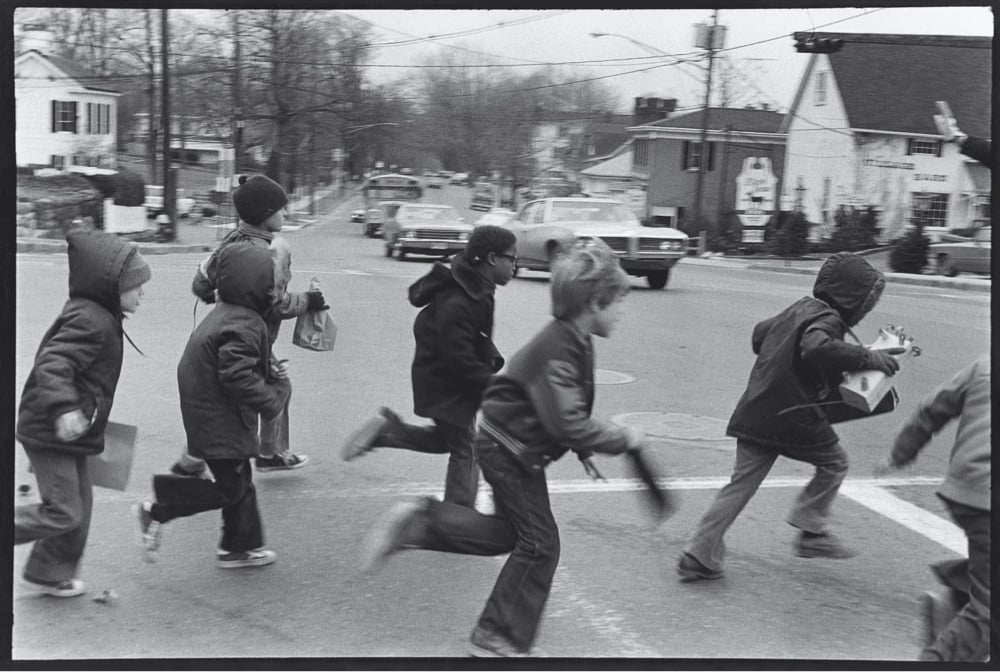

In 1975, famed French photographer Henri Cartier-Bresson traveled, at the behest of a public television station, to the US to take photographs of New Jersey.
The photographer felt that New Jersey’s anywhere-ness, its density and diversity, was “a kind of shortcut through America.” With that prompt, Evans assembled an itinerary. Cunningham picked up Cartier-Bresson in Manhattan around sunrise each day for three weeks and headed for the bridges and tunnels. They embedded with ambulance drivers in Newark and chicken farmers in West Orange. They visited suburban sprawl, horse country, pine barrens, swamps, seashore, beauty parlors, labs, nuclear facilities, jails, mansions. They once stayed overnight in a South Jersey motel, and Cartier-Bresson insisted that they flip a coin to determine who got the bed.
It was one of his final photo projects and because his photos were cropped for use on television (“a practice Cartier-Bresson viewed as sacrilege”), the project was not included in most catalogues of his work and was almost forgotten.
You can watch the resulting TV program from 1975 at the American Archive of Public Broadcasting.
“Why is every action hero named Jack, John, James, or, occasionally, Jason?”
Everything Is a Remix
Kirby Ferguson has released the final and “definitive” full-length version of his fantastic Everything is a Remix video series (transcript).
Memes are remixing. You take a photo, you repurpose it, then someone else tries it, then there’s a flood of everyone trying out combinations, including remixing other memes.
When you take something old and use it in something new, that’s remixing. It might just seem like just copying, but it’s actually something much more. Remixing can empower you be more creative.
Remixing allows us to make music without playing instruments, to create software without coding, to create bigger and more complex ideas out of smaller and simpler ideas.
You don’t need expensive tools to remix, you don’t need a distributor, you don’t even need skills or… good judgment. Everybody can remix and everybody does.
From our songs and games and movies and memes, to how we train computers to create, to the way we sense of reality, to the evolution of life itself, everything is definitely a remix.
(via matt haughey)
Fantastic edition of Jodi Ettenberg’s Curious About Everything newsletter. So happy she’s been able to keep this going while confined to bed with a spinal CSF leak.
From 2010 to 2021, the average range of electric vehicles sold globally has almost tripled (from 80 miles to 220 miles).
A Diorama of Michael Jackson on Fire
I…. Hmm. I really don’t know how to describe this video. Bobby Fingers, who seems to be a professional model maker of some sort (who can also sing and dance?), made a diorama of when Michael Jackson’s hair caught on fire during the filming of a Pepsi commercial (which, weirdly, occurred almost exactly halfway through Jackson’s life). It’s quietly and surreally hilarious — I absolutely lost it when the horse poop made an abrupt-but-relevant appearance. I don’t know what else to say…just watch it. Thank god the internet can still be weird. (thx, tim & clarke)
With three major new rules this year (“the pitch clock, a ban on the infield shift and limits on pickoff throws”), MLB hopes to speed the game up and to showcase the players’ athleticism more effectively.
This recently rediscovered and deciphered stone slab is the oldest map of Europe “for which we can identify the territory it depicts”. It’s around 4000 years old and depicts (in 3D!) an area in Brittany, France.
An old favorite link of mine: “This is my personal account of curing my asthma and hayfever by deliberately infesting myself with the intestinal parasite hookworm.”
Book Publishers Won’t Stop Until Libraries Are Dead. In our current world where all views of media must be tracked and paid for, libraries are dangerous and media companies will kill them if we let them.
The Everlasting Storm in the “Most Electric Place on Earth”
Almost 300 days out of every year, there are thunderstorms over Venezuela’s Lake Maracaibo. Called Catatumbo lightning — “Catatumbo means ‘House of Thunder’ in the language of the local Barí people” — the phenomenon is caused by the unique confluence of warm air and water from the Caribbean Sea with the cold air flowing down from the Andes, which nearly surround the lake. The result is near-nightly storms with the world’s highest density of lightning and up to 200 flashes in a minute. It sounds, literally, awe-some.
The short video above is a profile of photographer Jonas Piontek, who has captured some amazing photos and video of the Catatumbo lightning. The NY Times featured some of his photos in this piece about the lightning.
Less than half an hour after the first cloud forms, it starts to flash. It does this faster and faster - 200 flashes a minute is not uncommon. After that, the cloud becomes a giant bulb that lights up the night.
“You can read a newspaper in the middle of the night because it’s so bright,” said Jonas Pointek, a photographer who has documented the storms.
(via open culture)
From the Brennan Center for Justice, A Proposal to Reduce Unnecessary Incarceration. “The federal government must reorient its grant spending to press states to end punitive policies that fail to deliver public safety.”
The origin story of Ted Lasso - the character didn’t originate with those NBC commercials in 2013 but much earlier in an Amsterdam comedy club.
The Assassin’s Teapot
The assassin’s teapot is certainly an eye-catching name for pottery, but there’s also an interesting bit of physics going on here. The teapot in question has two separate chambers for holding liquid, and the flow out of the pot from each chamber can be controlled by covering or uncovering small holes located on the handle. So, as the legend goes, a would-be assassin could pour themselves a perfectly fine drink from one chamber and then pour a poisoned drink to their prey from the other chamber, just by discreetly covering and uncovering the proper holes with their fingers. As the video explains, the mechanism here has to do with surface tension and air pressure.
You can get your own assassin’s teapot right here.
An appreciation of the data visualization & information design of the Dark Sky weather app, esp when you compare it to the Apple Weather app.
Plastic Scrimshaw
For an exhibition entitled DEATH TO THE LIVING, Long Live Trash now on view at the Brooklyn Museum, artist Duke Riley takes trash that he’s collected on the beach and turns it into art — think mosaics made from bottle caps, bread bag clips, and tampon applicators. But his plastic scrimshaw creations are absolute genius:
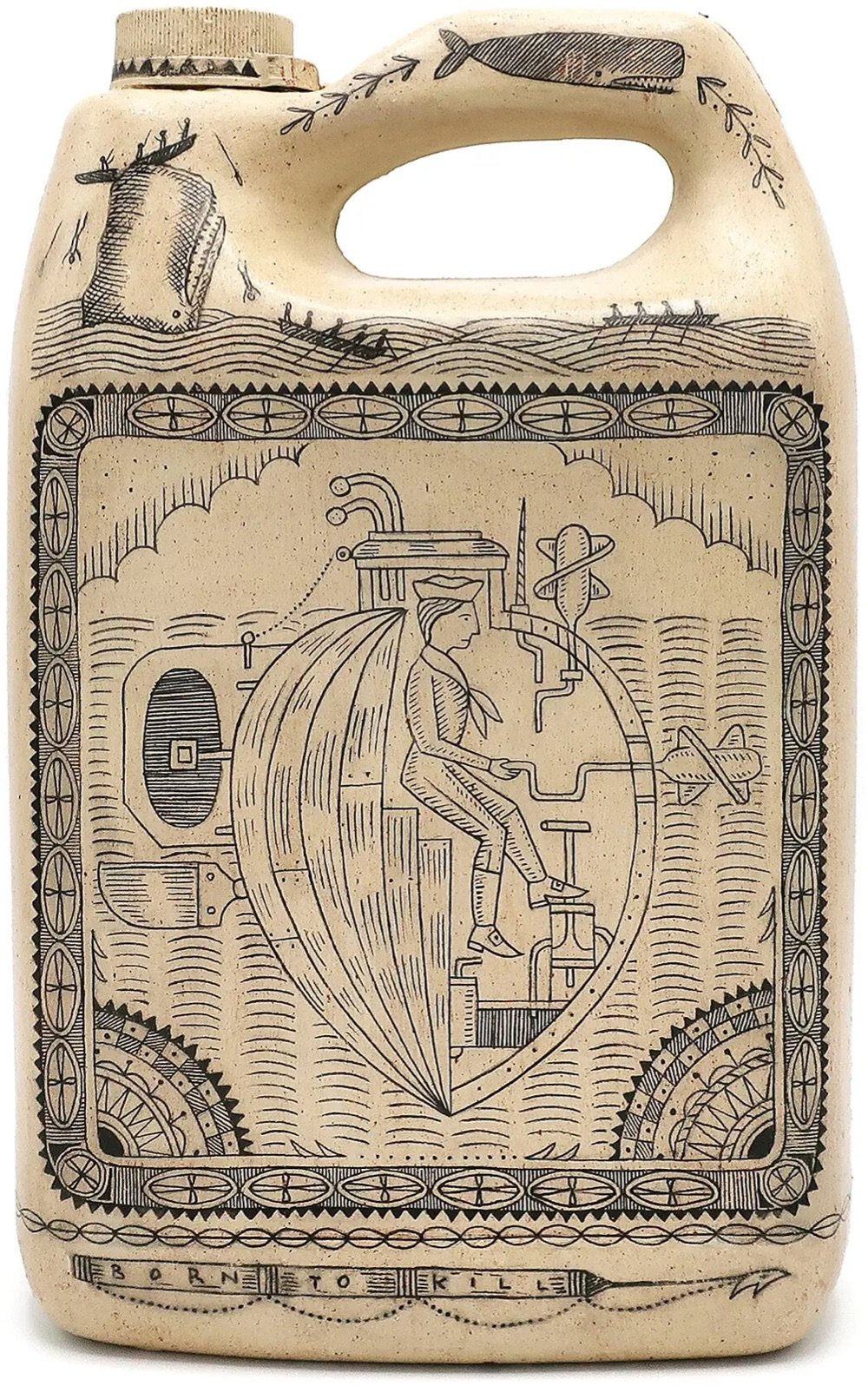

Scrimshaw art was made by whalers in the 19th century by carving designs into the teeth, bones, and baleen of whales. Riley has cleverly adopted the practice using aesthetically similar white plastics, producing a series he calls the Poly S. Tyrene Maritime Museum. The NY Times:
As whalers often depicted the leaders and profiteers of their day, Riley portrays the C.E.O.s of chemical companies, plastic industry lobbyists and others he deems responsible for producing the devastating tonnages of single-use plastics that are engulfing our oceans and threatening our ecosystems. It’s a downer, but if you look closely there’s often a Riley twist of humor, like the seagull shown relieving itself on the head of a water bottle magnate.
You can see a few more of the plastic scrimshaw objects on the Brooklyn Museum’s Tumblr,at Atlas Obscura, and in-person at the Brooklyn Museum until mid-April. (thx caroline)
Socials & More