


Flicka Da Wrist. Wok!
This is a perfect Friday video. Enjoy your weekend, everyone. (Or not, the machines are gonna take all of our jobs.) (via @dunstan)

This site is made possible by member support. 💞
Big thanks to Arcustech for hosting the site and offering amazing tech support.
When you buy through links on kottke.org, I may earn an affiliate commission. Thanks for supporting the site!
kottke.org. home of fine hypertext products since 1998.
Beloved by 86.47% of the web.
This is a perfect Friday video. Enjoy your weekend, everyone. (Or not, the machines are gonna take all of our jobs.) (via @dunstan)
Let’s all just take the rest of the day off and watch Ricky Jay effortlessly perform impossible card tricks. (via @sampotts)
Situated on the Norwegian archipelago of Svalbard, Longyearbyen is only 600 miles south of the North Pole and has a population of more than 2000, which makes it the northernmost town in the world. It is also home to a Toyota dealership, but people use snowmobiles to get around most of the time.
From the excellent collection of British Pathé videos on YouTube comes footage of a 1928 bicycle race on penny farthings aka the “boneshaker” aka those bikes with the big wheel in front. Here are a couple of contemporary penny farthing races. (via @sampotts)
Opened in 1956, Southdale Center in Edina, MN was the first fully enclosed shopping mall of its kind. Designed by Victor Gruen, it became the archetype of the typical American mall. Malcolm Gladwell’s New Yorker piece about Gruen is a great read.
Southdale Mall still exists. It is situated off I-494, south of downtown Minneapolis and west of the airport — a big concrete box in a sea of parking. The anchor tenants are now J.C. Penney and Marshall Field’s, and there is an Ann Taylor and a Sunglass Hut and a Foot Locker and just about every other chain store that you’ve ever seen in a mall. It does not seem like a historic building, which is precisely why it is one. Fifty years ago, Victor Gruen designed a fully enclosed, introverted, multitiered, double-anchor-tenant shopping complex with a garden court under a skylight — and today virtually every regional shopping center in America is a fully enclosed, introverted, multitiered, double-anchor-tenant complex with a garden court under a skylight. Victor Gruen didn’t design a building; he designed an archetype. For a decade, he gave speeches about it and wrote books and met with one developer after another and waved his hands in the air excitedly, and over the past half century that archetype has been reproduced so faithfully on so many thousands of occasions that today virtually every suburban American goes shopping or wanders around or hangs out in a Southdale facsimile at least once or twice a month. Victor Gruen may well have been the most influential architect of the twentieth century. He invented the mall.
Things were changing even as that piece was published in 2004. Sprawling shopping malls are closing and new construction has slowed dramatically. Commerce moved online and to big box stores. Southdale’s still kicking though!
Using 12 Angry Men, Psycho, The Godfather, and Gone Girl as examples, this video shows several different ways to end a movie. And so, spoilers.
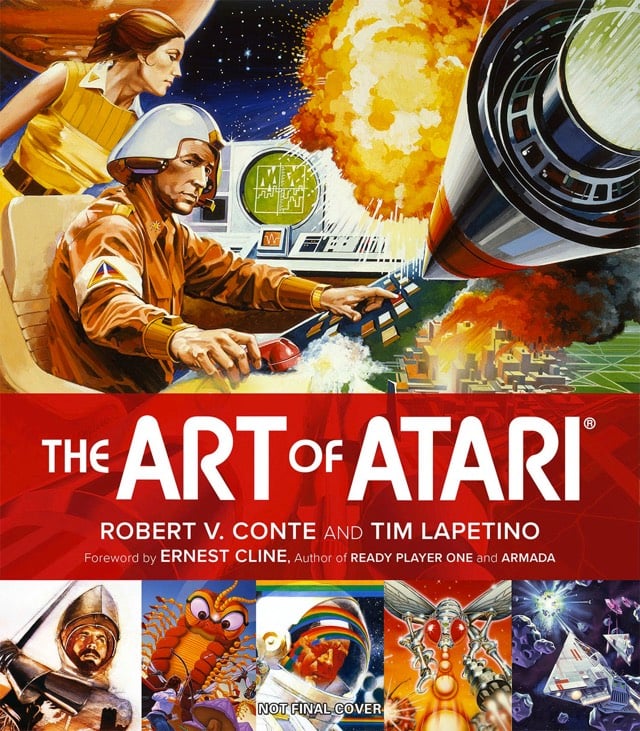
The Art of Atari showcases the design of the iconic company’s video game packaging, advertisements, catalogs, and other stuff. Judging from my reaction to just the cover, I might die of nostalgia if I were to see the inside. Might be worth the risk though.
See also season 3 of Boss Fight Books featuring books on SMB3, Mega Man 3, Katamari Damacy, and more. (via df & @robinsloan)
The traveling salesman problem is a classic in computer science. It sounds deceptively easy: given any number of cities, determine the shortest path a traveling salesman would have to travel to visit them all. This video shows how the “obvious” solution — “well, just start somewhere and always visit the next closest town!” — doesn’t hold up well against other approaches. (via @coudal)


The Misplaced Series removes notable New York buildings from their surroundings and “misplaces” them in desolate landscapes around the world. Concrete behemoths and steel-and-glass towers rise from sand dunes and rocky cliffs, inviting viewers to see them as if for the first time. Out of context, architectural forms become more pronounced and easily understood.
See all 10 buildings in their new surroundings at Misplaced New York.
Joseph Gordon-Levitt plays Edward Snowden in this film directed by Oliver Stone. I was not at all curious about seeing this, but after watching the trailer, I may give it a shot. See also Citizenfour (which was excellent).



Stitching together thousands of images, photographer Levon Biss produces huge and detailed photographs of tiny insects; prints of 10 mm bugs are 3 meters across. An exhibition of Biss’ photos will be on display at the Oxford University Museum of Natural History. All three images above are of the orchid cuckoo bee at different levels of zoom. This video shows how the photos are made:
Talkshow has launched. It’s an iOS messaging app for having conversations in public.
People text amazing things.
Talkshow is a simple messaging app that allows you to text these things in public. With Talkshow, individuals, groups of friends, entertainers, creators — anyone! — can have conversations in public, to be viewed by others in real time or after the fact. Every Talkshow can be shared outside the app and embedded into other websites.
Talkshow was built by Michael Sippey, who has recently been at Medium and Twitter and was a formative influence in my early days online, and Greg Knauss, who loves the web down to his bones and has pulled my own personal bacon out of the system administrative fire more times than I can count, so I am predisposed to like this app and also to recommend it to you.
Back in 2007, riffing on some thoughts by Marc Hedlund about turning Unix commands into startups, I suggested choosing web projects by taking something that everyone does with their friends and make it public and permanent.
Blogger, 1999. Blog posts = public email messages. Instead of “Dear Bob, Check out this movie.” it’s “Dear People I May or May Not Know Who Are Interested in Film Noir, Check out this movie and if you like it, maybe we can be friends.”
Twitter, 2006. Twitter = public IM. I don’t think it’s any coincidence that one of the people responsible for Blogger is also responsible for Twitter.
Flickr, 2004. Flickr = public photo sharing. Flickr co-founder Caterina Fake said in a recent interview: “When we started the company, there were dozens of other photosharing companies such as Shutterfly, but on those sites there was no such thing as a public photograph — it didn’t even exist as a concept — so the idea of something ‘public’ changed the whole idea of Flickr.”
YouTube, 2005. YouTube = public home videos. Bob Saget was onto something.
Talkshow, 2016. Talkshow = public text messaging.1 I am delighted to see that this approach still bearing fruit.
But, but, you cry, Twitter is public texting! Talkshow is public IM! Well, sure! Twitter does a bunch of different things now, but in the first few years, it was public IM. The big difference I see is while Twitter allows anyone to participate in any public conversation (which is both a plus and minus), with Talkshow, the membership of each group/show is limited but the output is public. And that difference will allow people to do some things better w/ Talkshow than they can with Twitter. ↩
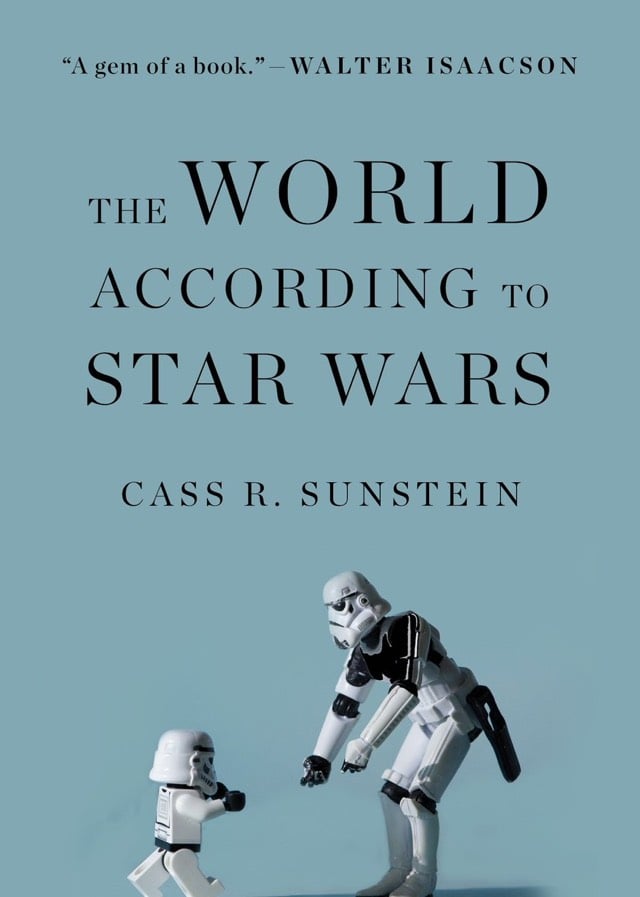
In The World According to Star Wars, Cass Sunstein explores the philosophy and life lessons of Star Wars.
In this fun, erudite and often moving book, Cass R. Sunstein explores the lessons of Star Wars as they relate to childhood, fathers, the Dark Side, rebellion, and redemption. As it turns out, Star Wars also has a lot to teach us about constitutional law, economics, and political uprisings.
Update: Sunstein, who is a professor at Harvard Law School, gave the commencement address last year at Penn Law. He starts off, dryly: “Graduates, faculty, family, friends, our topic today is Star Wars.”
(via @EmilyBrenn)



National Geographic has a selection of wonderful aerial photos from German photographer Bernhard Edmaier. His photos can also be found in two of his most recent books, Water and EarthArt.
In this Simpsons couch gag, the show pays homage to some classic Disney animation styles. Featured are Steamboat Willie, Cinderella, Snow White and the Seven Dwarfs, The Jungle Book and Fantasia. The animation was done by Eric Goldberg, who worked at Disney on films like Aladdin and Pocahontas.

This is the best thing I’ve read about Beyonce’s recently released album/film Lemonade.
*Beyoncé opens the door and Solange Knowles and Tina Lawson walk in.
Solange throws a reverse roundhouse kick that Jay Z lazily dodges.*
Solo: I’m sorry. I’m just very inspired right now.
Bey: Mommy! Solo! What a pleasant surprise! Neither of you could have had better timing
Jay: Sister-in-law. Mama Tina.
Mama T: Stereotypical Black Man
Solo: Blubberlips McSlutdick
Blue: LMAO
Bey: Baby, take your elevator to your playroom. Mommy will FaceTime you on your IPhone 8 when dinners ready.
Blue: Yes, mommy dearest
Solo: Rihanna called me to congratulate you.
Bey: She couldn’t call me?
Solo: Because you were gonna answer?
Bey: hahahahahahahahahaha
Solo: hahahahahahahahahaha
Mama T: lol omg
Bey: You may laugh
Jay: eh heh heh
Mama T: You are pathetic. The universe wasted good water creating you.
Bey: Mama. *high fives*
See also What to read after watching Beyoncé’s ‘Lemonade’.
Someone took the audio from a BBC News report on North Korean military parade held in honor of Kim Jong-un’s birthday and played it over footage of the parade held in London in honor of Queen Elizabeth’s 89th birthday.
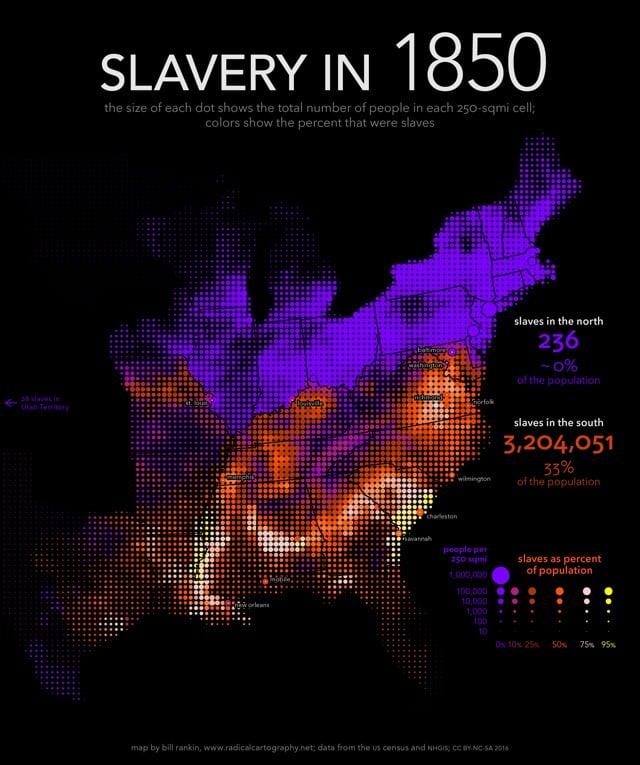
From Bill Rankin at Radical Cartography, a series of maps showing the rapid explosion of slavery in the United States from 1790-1860. Departing from previous efforts, Rankin used a uniform grid of dots to represent slave populations rather than counties.
First, I smash the visual tyranny of county boundaries by using a uniform grid of dots. The size of each dot shows the total population in each 250-sqmi cell, and the color shows the percent that were slaves. But just as important, I’ve also combined the usual county data with historical data for more than 150 cities and towns. Cities usually had fewer slaves, proportionally, than their surrounding counties, but this is invisible on standard maps.
A detail that struck me while cycling through the years was that the number of slaves as a percentage of the total population of the South stayed relatively steady at 33% from 1790 to 1860.
Blake Ross is 30 years old and he just learned something about everyone else in the world: people can visualize things in their minds. Which is like, yeah, duh. But Ross has aphantasia, which essentially means that his mind’s eye is blind, that counting sheep means nothing to him.
If you tell me to imagine a beach, I ruminate on the “concept” of a beach. I know there’s sand. I know there’s water. I know there’s a sun, maybe a lifeguard. I know facts about beaches. I know a beach when I see it, and I can do verbal gymnastics with the word itself.
But I cannot flash to beaches I’ve visited. I have no visual, audio, emotional or otherwise sensory experience. I have no capacity to create any kind of mental image of a beach, whether I close my eyes or open them, whether I’m reading the word in a book or concentrating on the idea for hours at a time — or whether I’m standing on the beach itself.
Understandably, this threw him for a bit of a loop.
—If I ask you to imagine a beach, how would you describe what happens in your mind?
—Uhh, I imagine a beach. What?
—Like, the idea of a beach. Right?
—Well, there are waves, sand. Umbrellas. It’s a relaxing picture. You okay?
—But it’s not actually a picture? There’s no visual component?
—Yes there is, in my mind. What the hell are you talking about?
—Is it in color?
—Yes…..
—How often do your thoughts have a visual element?
—A thousand times a day?
—Oh my God.
The more I read his story though, the more I started wondering if maybe I wasn’t a little aphantasic…or have become so as I get older. As far back as I can remember, I’ve been aware of the mind’s eye and visualization, but I just now tried to close my eyes and picture something but couldn’t. Ok, maybe that’s tough to do on demand. When was the last time I had pictured something? Not sure. Like Ross, I don’t dream or remember dreams (although I did when I was a kid), I’m bad with directions, my 6-year-old draws better than I do, I remember facts and ideas but not feelings so much, and when I was a designer, the conceptual stuff was always easier than the aesthetics. This bit also sounded familiar:
I’ve always felt an incomprehensible combination of stupid-smart. I missed a single question on the SATs, yet the easiest conceivable question stumps me: What was it like growing up in Miami?
I don’t know.
What were some of your favorite experiences at Facebook?
I don’t know.
What did you do today?
I don’t know. I don’t know what I did today.
Answering questions like this requires me to “do mental work,” the way you might if you’re struggling to recall what happened in the Battle of Trafalgar. If I haven’t prepared, I can’t begin to answer. But chitchat is the lubricant of everyday life. I learned early that you can’t excuse yourself from the party to focus on recalling what you did 2 hours ago.
I don’t know how much of that is the aphantasia and how much is positioning on the autistic spectrum or introversion or personality or some other kind of thing, but organizing events into narratives has never been easy for me.
What’s odd is I’ve always thought of my memory as a) pretty good, and b) primarily visual. When I took tests in college, I knew the answers because I could “see” them on the pages of the book I had read them in or in the notebook I had written them in. Not photographically exactly, but pretty close sometimes. I’m really good with faces, but not so much with names, although I’ve been improving lately with effort. I do well on visual tests, the ones where you need to pick out the same shapes that are rotated differently. Yes, I’m bad with directions, but once I’ve followed a route, I can usually muddle my way back along that same route visually. And sometimes, my feelings about past events are huge.
There’s this story I tell when the topic of celebrity sightings in New York comes up. My very first sighting happened a few months after I moved here. I was reading in a Starbucks in the West Village. Two women walk in, order, and sit in the back, maybe 25 feet away from me. At some point, I look up and I instantly recognize the woman who’s facing me: it’s Keri Russell. And in that moment, I understand celebrity. She was the most beautiful person I had ever seen in person in my life, and I’ve never even been a particular fan of hers, even though she is currently great in The Americans. It was her eyes, her crystal blue eyes. They were literally mesmerizing and I could not stop staring at them, which she noticed and I had to leave b/c I was being really weird.
So, two things about this story. Sitting here now, 13 years later, I can’t picture what she looked like, not exactly. There’s no image in my mind. She had short-ish hair and those blue eyes, but other than that, she looked…well, like Keri Russell. But when I recently told this story to a friend, he cocked his head and said, “she’s got blue eyes?” Oh yes, I told him, absolutely, those amazing lazer-blue eyes are the whole point of the story. A few days later, remembering his comment, I looked and Keri Russell’s eyes are not blue. They’re a greenish hazel!
Reader, I know memory is a weird thing and all, but what the hell is going on with me?
Full-screen this baby on the biggest high-definition screen you can find. A 5K iMac works spectacularly well.
If you’re going to watch the season 6 premiere of Game of Thrones tonight but you’ve forgotten what happened last season (tl;dr people died), watch this recap of last season’s action. I still can’t believe they made Marnie marry Desi after he missed their perfor oh wait that’s Girls.
You’re probably aware of Sinead O’Conner’s Nothing Compares 2 U but The Bangles, MC Hammer, Chaka Khan, Stevie Nicks, and others also made use of songs written by Prince.
Prince rides in on the back of a bearded man at around the 2:05 mark, yes you read that right. I had never seen this clip before and when he really gets going on stage, I started clapping and yelling in my apartment. Glorious. (via David Remnick at the New Yorker, who is almost annoyingly good at blogging)
The Founder is about the early years of McDonald’s and how Ray Kroc (played by Michael Keaton) came to gain control of the company. The official McDonald’s corporate history glosses over the events of the film in a few sentences:
In 1954, he visited a restaurant in San Bernardino, California that had purchased several Multi-mixers. There he found a small but successful restaurant run by brothers Dick and Mac McDonald, and was stunned by the effectiveness of their operation. They produced a limited menu, concentrating on just a few items-burgers, fries and beverages-which allowed them to focus on quality and quick service.
Kroc pitched his vision of creating McDonald’s restaurants all over the U.S. to the brothers. In 1955, he founded McDonald’s System, Inc., a predecessor of the McDonald’s Corporation, and six years later bought the exclusive rights to the McDonald’s name. By 1958, McDonald’s had sold its 100 millionth hamburger.
Kroc’s Wikipedia entry provides more flavor:
The agreement was a handshake with split agreement between the parties because Kroc insisted that he could not show the royalty to the investors he had lined up to capitalize his purchase. At the closing table, Kroc became annoyed that the brothers would not transfer to him the real estate and rights to the original unit. The brothers had told Kroc that they were giving the operation, property and all, to the founding employees. Kroc closed the transaction, then refused to acknowledge the royalty portion of the agreement because it wasn’t in writing. The McDonald brothers consistently told Kroc that he could make changes to things like the original blueprint (building codes were different in Illinois than in California), but despite Ray’s pleas, the brothers never sent any formal letters which legally allowed the changes in the chain. Kroc also opened a new McDonald’s restaurant near the McDonald’s (now renamed “The Big M” as they had neglected to retain rights to the name) to force it out of business.
See also some early McDonald’s menus.

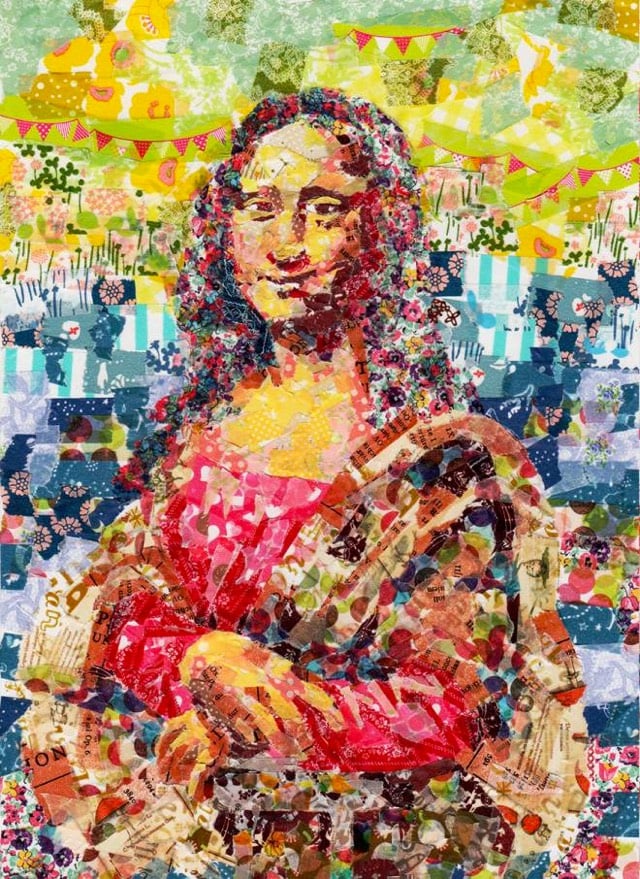
Nasa Funahara makes art out of colorful masking tape, including recreations of famous artworks.
Pele: Birth of a Legend is a biopic about the rise of Pele, the Brazilian footballer. It was written and directed by Jeff and Michael Zimbalist, who also directed The Two Escobars, an excellent 30 for 30 film about Colombian drug lord Pablo Escobar and Colombian footballer Andres Escobar. (via @ivanski)
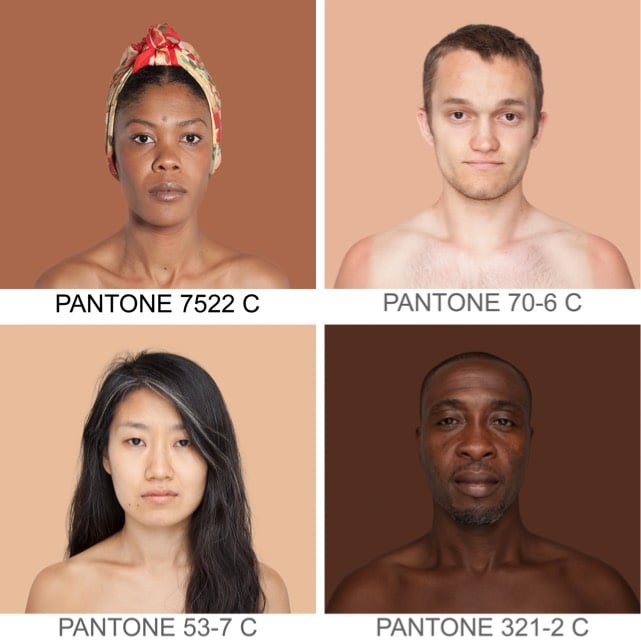
Angélica Dass’ Humanæ project matches photos of volunteer participants with the Pantone colors of their skin tones.
Update: Turns out this really cool blog you guys should be reading covered this project almost 4 years ago. (thx, @djacobs)
Idiocracy 10th anniversary screenings? Yes please.

From Neil Freeman, proprietor of the excellent Fake is the New Real, a map of the continental United States with the 50 states reorganized into concentric circles of equal population.
See also the map accompanying Parag Khanna’s recent piece, A New Map for America, which calls for the creation of seven mega-regions centered around metropolitan clusters in place of the lower 48 states: the Pacific Coast, the Inland West, the Great Plains, the Gulf Coast, the Great Lakes, the Southeast Manufacturing Belt, and the Great Northeast.
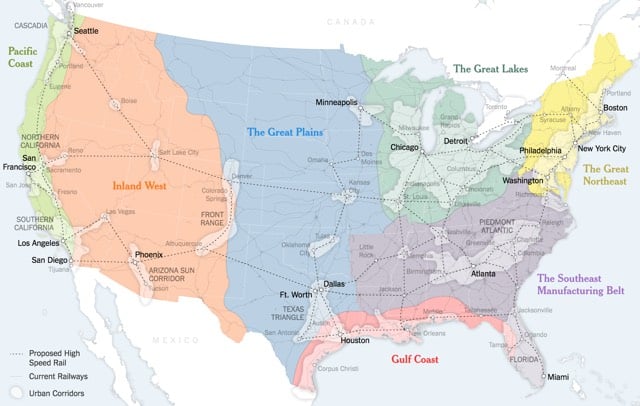
These days, in the thick of the American presidential primaries, it’s easy to see how the 50 states continue to drive the political system. But increasingly, that’s all they drive — socially and economically, America is reorganizing itself around regional infrastructure lines and metropolitan clusters that ignore state and even national borders. The problem is, the political system hasn’t caught up.
America faces a two-part problem. It’s no secret that the country has fallen behind on infrastructure spending. But it’s not just a matter of how much is spent on catching up, but how and where it is spent. Advanced economies in Western Europe and Asia are reorienting themselves around robust urban clusters of advanced industry. Unfortunately, American policy making remains wedded to an antiquated political structure of 50 distinct states.
To an extent, America is already headed toward a metropolis-first arrangement. The states aren’t about to go away, but economically and socially, the country is drifting toward looser metropolitan and regional formations, anchored by the great cities and urban archipelagos that already lead global economic circuits.
Holy shit, could you imagine? Most of America would have a fit over this.
In a video from the New Yorker, dancers from around the country demonstrate viral dance moves from the past decade, including the Dougie, Walk It Out, and Dabbing. (via @silviakillings)
Rex Sorgatz grew up in a small and isolated town (physically, culturally) in North Dakota named Napoleon.
Out on the prairie, pop culture existed only in the vaguest sense. Not only did I never hear the Talking Heads or Public Enemy or The Cure, I could never have heard of them. With a radio receiver only able to catch a couple FM stations, cranking out classic rock, AC/DC to Aerosmith, the music counterculture of the ’80s would have been a different universe to me. (The edgiest band I heard in high school was The Cars. “My Best Friend’s Girl” was my avant-garde.)
Is this portrait sufficiently remote? Perhaps one more stat: I didn’t meet a black person until I was 16, at a summer basketball camp. I didn’t meet a Jewish person until I was 18, in college.
This was the Deep Midwest in the 1980s. I was a pretty clueless kid.
He recently returned there and found that the physical isolation hasn’t changed, but thanks to the internet, the kids now have access to the full range of cultural activities and ideas from all over the world.
“Basically, this story is a controlled experiment,” I continue. “Napoleon is a place that has remained static for decades. The economics, demographics, politics, and geography are the same as when I lived here. In the past twenty-five years, only one thing has changed: technology.”
Rex is a friend and nearly every time we get together, we end up talking about our respective small town upbringings and how we both somehow managed to escape. My experience wasn’t quite as isolated as Rex’s — I lived on a farm until I was 9 but then moved to a small town of 2500 people; plus my dad flew all over the place and the Twin Cities were 90 minutes away by car — but was similar in many ways. The photo from his piece of the rusted-out orange car buried in the snow could have been taken in the backyard of the house I grew up in, where my dad still lives. Kids listened to country, top 40, or heavy metal music. I didn’t see Star Wars or Empire in a theater. No cable TV until I was 14 or 15. No AP classes until I was a senior. Aside from a few Hispanics and a family from India, everyone was white and Protestant. The FFA was huge in my school. I had no idea about rap music or modernism or design or philosophy or Andy Warhol or 70s film or atheism. I didn’t know what I didn’t know and had very little way of finding out.
I didn’t even know I should leave. But somehow I got out. I don’t know about Rex, but “escape” is how I think of it. I was lucky enough to excel at high school and got interest from schools from all over the place. My dad urged me to go to college…I was thinking about getting a job (probably farming or factory work) or joining the Navy with a friend. That’s how clueless I was…I knew so little about the world that I didn’t know who I was in relation to it. My adjacent possible just didn’t include college even though it was the best place for a kid like me.
In college in an Iowan city of 110,000, I slowly discovered what I’d been missing. Turns out, I was a city kid who just happened to grow up in a small town. I met other people from all over the country and, in time, from all over the world. My roommate sophomore year was black.1 I learned about techno music and programming and photography and art and classical music and LGBT and then the internet showed up and it was game over. I ate it all up and never got full. And like Rex:
Napoleon had no school newspaper, and minimal access to outside media, so I had no conception of “the publishing process.” Pitching an idea, assigning a story, editing and rewriting — all of that would have baffled me. I had only ever seen a couple of newspapers and a handful of magazines, and none offered a window into its production. (If asked, I would have been unsure if writers were even paid, which now seems prescient.) Without training or access, but a vague desire to participate, boredom would prove my only edge. While listlessly paging through the same few magazines over and over, I eventually discovered a semi-concealed backdoor for sneaking words onto the hallowed pages of print publications: user-generated content.
That’s the ghastly term we use (or avoid using) today for non-professional writing submitted by readers. What was once a letter to the editor has become a comment; editorials, now posts. The basic unit persists, but the quantity and facility have matured. Unlike that conspicuous “What’s on your mind?” input box atop Facebook, newspapers and magazines concealed interaction with readers, reluctant of the opinions of randos. But if you were diligent enough to find the mailing address, often sequestered deep in the back pages, you could submit letters of opinion and other ephemera.
I eventually found the desire to express myself. Using a copy of Aldus PhotoStyler I had gotten from who knows where, I designed party flyers for DJ friends’ parties. I published a one-sheet periodical for the residents of my dorm floor, to be read in the bathroom. I made meme-y posters2 which I hung around the physics department. I built a homepage that just lived on my hard drive because our school didn’t offer web hosting space and I couldn’t figure out how to get an account elsewhere.3 Well, you know how that last bit turned out, eventually.4
The fall of my senior year, he returned from a weekend at home in Chicago with a VHS tape in tow. He popped it into a friend’s VCR and said, “you’re about to see a future NBA star.” And we all watched some highlights of an 18-year-old Kevin Garnett he’d taped off the local news station.↩
One was a Beavis and Butthead sign warning people not to eat in the lab. Another was a “Jurassic Doc” poster featuring my thesis advisor who we all called “Doc”.↩
I eventually figured this out.↩
Robin Sloan is right: it’s tough to end things on the internet. Especially self-indulgent autobiographical rambling. Apologies. We now return to your regularly scheduled interestingness presented with minimal commentary.↩
Stelian Firez recently shared a really boneheaded web form for entering your phone number:

Soon afterward, several people attempted to conjure up even more cumbersome ways to ask people for phone numbers:




“Solutions” by Jeff Bonhag, Paulo Gaspar, Dan Kozikowski, and Justin. (via @ftrain)
Update: Thomas Park went old school with a rotary dial.

Worries over the slowing Chinese economy spilled out into the streets of Hebei province last weekend as two construction firms battled with bulldozers while competing for the same business. That is some end-times shit right there.
In his 1975 song Jungleland, Bruce Springsteen laments, “the poets down here don’t write nothing at all, they just stand back and let it all be.” I was reminded of that line when Springsteen canceled his North Carolina concert to protest the state’s recently passed bathroom law. In this case, the poet wrote. While it’s not unusual for musicians and other artists to use their public podiums for protest, it’s less common for corporations to do the same. At least, that used to be the case. But recently, many top CEOs are using their corporate muscle to influence social and political decisions across the country. When you wondered who would stand up for individual and equal rights in America, it’s unlikely that you thought of the The Boss and The Man. Here’s The New Yorker’s James Surowiecki with more on these unlikely alliances.

String Theory, a collection of David Foster Wallace’s writings on tennis will be out next month.1 The five pieces in the book include his NY Times’ essay on Federer and a 1991 piece from Harper’s. John Jeremiah Sullivan wrote an introduction, which was published recently in the New Yorker.
The collection is also available on the Kindle, without the Sullivan intro.
Hi, this is a footnote. Because Wallace. That’s it.↩

Socials & More