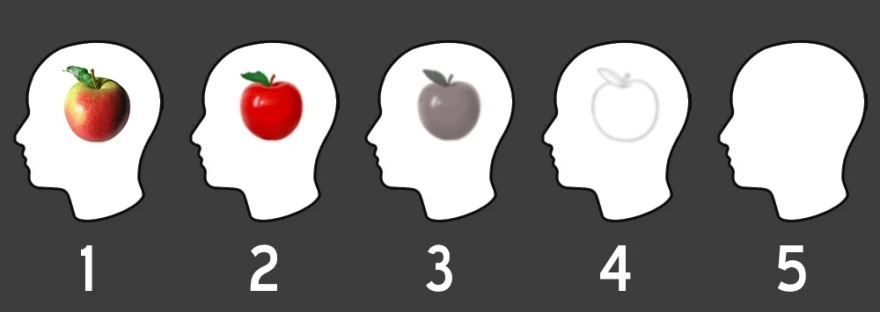
Aphantasia (the inability to visualize) is one of those things that I find endlessly fascinating; I’ve written about it a few times since 2016, most recently in response to Larissa MacFarquhar’s 2025 piece for the New Yorker: Some People Can’t See Mental Images. The Consequences Are Profound.
Many of his correspondents, he learned, had discovered their condition very recently, after reading about it or hearing it described on the radio. Their whole lives, they had heard people talk about picturing, and imagining, and counting sheep, and visualizing beaches, and seeing in the mind’s eye, and assumed that all those idioms were only metaphors or colorful hyperbole. It was amazing how profoundly people could misunderstand one another, and assume that others didn’t mean what they were saying—how minds could wrest sense out of things that made no sense.
Some said that they had a tantalizing feeling that images were somewhere in their minds, only just out of reach, like a word on the tip of their tongue. This sounded right to Zeman—the images must be stored in some way, since aphantasics were able to recognize things. In fact, it seemed that most aphantasics weren’t hampered in their everyday functioning. They had good memories for facts and tasks. But many of them said that they remembered very little about their own lives.
Psychoanalyst Jamieson Webster read the piece and realized she was aphantasic. Webster recently interviewed MacFarquhar for Cultured: What Not Having Mental Imagery Implies for Psychoanalysis, Trauma, and Our Sense of Self, which I read with a lot of head-nodding. Like:
I didn’t have a lot of memories, which I always sort of chalked up to trauma, but I got memories back over the course of analysis. I realized while reading your piece that my memories were always spatial. I would remember a space or placements of things. I was always reconstructing a landscape, but without it really being imagistic.
And this is exactly how college was for me:
When I realized I had aphantasia, I reflected on how I always thought I had a photographic memory. For example, when I took tests, I would make notes, and I could see what I wrote on the page because I knew where I had written it. But it’s not a photograph; it’s a spatial memory.
As I said last year:
The more I read about this, the more I think that for those at either end of the phantasic scale, their inability (or extreme ability) to see things in their minds is a major component of what we think of as personality. Even just thinking about myself, there are all sorts of behaviors and traits I can connect to not being able to visualize things in my head that clearly. In some ways, it might be one of the most me things about me.
(via @timoni)
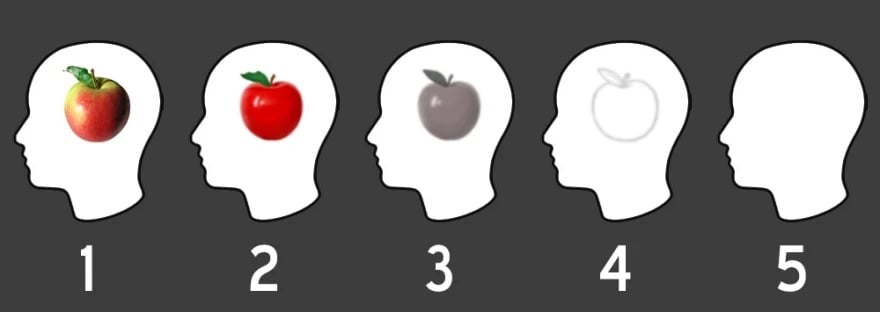
We’ve talked before about how some people can picture things in their heads quite vividly and others can’t at all. The latter group has a condition called aphantasia.
As soon as I close my eyes, what I see are not everyday objects, animals, and vehicles, but the dark underside of my eyelids. I can’t willingly form the faintest of images in my mind.
Larissa MacFarquhar wrote a fascinating article about aphantasia (and its opposite, hyperphantasia) for the New Yorker: Some People Can’t See Mental Images. The Consequences Are Profound.
Naturally, aphantasics usually had a very different experience of reading. Like most people, as they became absorbed, they stopped noticing the visual qualities of the words on the page, and, because their eyes were fully employed in reading, they also stopped noticing the visual world around them. But, because the words prompted no mental images, it was almost as if reading bypassed the visual world altogether and tunnelled directly into their minds.
Aphantasics might skip over descriptive passages in books — since description aroused no images in their minds, they found it dull — or, because of such passages, avoid fiction altogether. Some aphantasics found the movie versions of novels more compelling, since these supplied the pictures that they were unable to imagine. Of course, for people who did have imagery, seeing a book character in a movie was often unsettling — because they already had a sharp mental image of the character which didn’t look like the actor, or because their image was vague but just particular enough that the actor looked wrong, or because their image was barely there at all and the physical solidity of the actor conflicted with that amorphousness.
And also:
When aphantasics recovered from bereavement, or breakups, or trauma, more quickly than others, they worried that they were overly detached or emotionally deficient. When they didn’t see people regularly, even family, they tended not to think about them.
M.L.: “I do not miss people when they are not there. My children and grandchildren are dear to me, in a muffled way. I am fiercely protective of them but am not bothered if they don’t visit or call. … I think that leaves them feeling as if I don’t love them at all. I do, but only when they are with me, when they go away they really cease to exist, except as a ‘story.’”
The bits about hyperphantasia are just as interesting:
Hyperphantasia often seemed to function as an emotional amplifier in mental illness—heightening hypomania, worsening depression, causing intrusive traumatic imagery in P.T.S.D. to be more realistic and disturbing. Reshanne Reeder, a neuroscientist at the University of Liverpool, began interviewing hyperphantasics in 2021 and found that many of them had a fantasy world that they could enter at will. But they were also prone to what she called maladaptive daydreaming. They might become so absorbed while on a walk that they would wander, not noticing their surroundings, and get lost. It was difficult for them to control their imaginations: once they pictured something, it was hard to get rid of it. It was so easy for hyperphantasics to imagine scenes as lifelike as reality that they could later become unsure what had actually happened and what had not.
“I can imagine my hand burning, to the point where it’s painful. I’ve always been curious — if they put me in an fMRI, would that show up? That’s one of the biggest problems in my life: when I feel something, is it real?”
One hyperphantasic told a researcher that he had more than once walked into a wall because he had pictured a doorway.
The more I read about this, the more I think that for those at either end of the phantasic scale, their inability (or extreme ability) to see things in their minds is a major component of what we think of as personality. Even just thinking about myself, there are all sorts of behaviors and traits I can connect to not being able to visualize things in my head that clearly. In some ways, it might be one of the most me things about me. (thx, willy)
A few weeks ago, I shared the following image on Instagram:
It’s a scale for measuring how people visualize objects in their heads. I’m between 4 & 5, which means I have a condition called aphantasia. Marco Giancotti recently wrote about this for Nautilus; he underwent an MRI scan to test what was going on in his head:
A few seconds pass, then a synthetic female voice speaks into my ears over the electronic clamor: “top hat.” I close my eyes and I imagine a top hat. A few seconds later a beep tells me I should rate the quality of my mental picture, which I do with a controller in my hand. The voice speaks again: “fire extinguisher,” and I repeat the routine. Next is “butterfly,” then “camel,” then “snowmobile,” and so on, for about 10 minutes, while the system monitors the activation of my brain synapses.
For most people, this should be a rather simple exercise, perhaps even satisfying. For me, it’s a considerable strain, because I don’t “see” any of those things. For each and every one of the prompts, I rate my mental image “0” on a 0 to 5 scale, because as soon as I close my eyes, what I see are not everyday objects, animals, and vehicles, but the dark underside of my eyelids. I can’t willingly form the faintest of images in my mind. And, although it isn’t the subject of the current experiment, I also can’t conjure sounds, smells, or any other kind of sensory stimulation inside my head. I have what is called “aphantasia,” the absence of voluntary imagination of the senses. I know what a top hat is. I can describe its main characteristics. I can even draw an above-average impression of one on a piece of paper for you. But I can’t visualize it mentally. What’s wrong with me?
And here’s a good video explanation of it too, from an artist who has aphantasia:
Like a lot of people, I wasn’t even aware that I visualized things differently than others — I assumed that everyone saw extremely ghostly images of objects in their mind’s eye, more like the ideas of things than the things themselves. It wasn’t until I was talking to my daughter a few years ago about how the characters in a movie looked nothing like the ones she’d pictured in her head from reading the books that I realized that she’s got a vibrant, full-color movie going on in her head when she reads and I was like EXCUSE ME?
Aphantasia is sometimes described as a deficiency or even a disability, but I don’t think of it that way at all. I believe my brain works pretty well, thank you very much, even though I can’t close my eyes and see the faces of my kids. And it’s not as straightforward as the simple scale above, at least in my case.
I can’t picture what a room would look like with a different sofa or rug (I just have to buy it and cross my fingers that it looks good when it arrives) or what a sweater would look like on me without actually trying it on (making online clothes shopping difficult). But I also have a weirdly visual memory. In college, I would remember things for tests and papers based where they were written in my notebook (lower right-hand corner of the left-hand page) or appeared in the textbook (on the right-hand page, under the blue illustration). I can’t see it in my brain, but I can see the idea of it and remember what was written there. (I told my daughter this and she said she can do this too, but for her, she pictures herself sitting at her desk in biology class with her notes open in front of her and she can then recall what was written in certain places. It is fascinating to talk about this stuff with her!)
Anyway, on Insta I asked people where they are on the apple scale and the responses were super interesting, so I’m opening up the comments on this one so we can chat about it.
Blake Ross is 30 years old and he just learned something about everyone else in the world: people can visualize things in their minds. Which is like, yeah, duh. But Ross has aphantasia, which essentially means that his mind’s eye is blind, that counting sheep means nothing to him.
If you tell me to imagine a beach, I ruminate on the “concept” of a beach. I know there’s sand. I know there’s water. I know there’s a sun, maybe a lifeguard. I know facts about beaches. I know a beach when I see it, and I can do verbal gymnastics with the word itself.
But I cannot flash to beaches I’ve visited. I have no visual, audio, emotional or otherwise sensory experience. I have no capacity to create any kind of mental image of a beach, whether I close my eyes or open them, whether I’m reading the word in a book or concentrating on the idea for hours at a time — or whether I’m standing on the beach itself.
Understandably, this threw him for a bit of a loop.
—If I ask you to imagine a beach, how would you describe what happens in your mind?
—Uhh, I imagine a beach. What?
—Like, the idea of a beach. Right?
—Well, there are waves, sand. Umbrellas. It’s a relaxing picture. You okay?
—But it’s not actually a picture? There’s no visual component?
—Yes there is, in my mind. What the hell are you talking about?
—Is it in color?
—Yes…..
—How often do your thoughts have a visual element?
—A thousand times a day?
—Oh my God.
The more I read his story though, the more I started wondering if maybe I wasn’t a little aphantasic…or have become so as I get older. As far back as I can remember, I’ve been aware of the mind’s eye and visualization, but I just now tried to close my eyes and picture something but couldn’t. Ok, maybe that’s tough to do on demand. When was the last time I had pictured something? Not sure. Like Ross, I don’t dream or remember dreams (although I did when I was a kid), I’m bad with directions, my 6-year-old draws better than I do, I remember facts and ideas but not feelings so much, and when I was a designer, the conceptual stuff was always easier than the aesthetics. This bit also sounded familiar:
I’ve always felt an incomprehensible combination of stupid-smart. I missed a single question on the SATs, yet the easiest conceivable question stumps me: What was it like growing up in Miami?
I don’t know.
What were some of your favorite experiences at Facebook?
I don’t know.
What did you do today?
I don’t know. I don’t know what I did today.
Answering questions like this requires me to “do mental work,” the way you might if you’re struggling to recall what happened in the Battle of Trafalgar. If I haven’t prepared, I can’t begin to answer. But chitchat is the lubricant of everyday life. I learned early that you can’t excuse yourself from the party to focus on recalling what you did 2 hours ago.
I don’t know how much of that is the aphantasia and how much is positioning on the autistic spectrum or introversion or personality or some other kind of thing, but organizing events into narratives has never been easy for me.
What’s odd is I’ve always thought of my memory as a) pretty good, and b) primarily visual. When I took tests in college, I knew the answers because I could “see” them on the pages of the book I had read them in or in the notebook I had written them in. Not photographically exactly, but pretty close sometimes. I’m really good with faces, but not so much with names, although I’ve been improving lately with effort. I do well on visual tests, the ones where you need to pick out the same shapes that are rotated differently. Yes, I’m bad with directions, but once I’ve followed a route, I can usually muddle my way back along that same route visually. And sometimes, my feelings about past events are huge.
There’s this story I tell when the topic of celebrity sightings in New York comes up. My very first sighting happened a few months after I moved here. I was reading in a Starbucks in the West Village. Two women walk in, order, and sit in the back, maybe 25 feet away from me. At some point, I look up and I instantly recognize the woman who’s facing me: it’s Keri Russell. And in that moment, I understand celebrity. She was the most beautiful person I had ever seen in person in my life, and I’ve never even been a particular fan of hers, even though she is currently great in The Americans. It was her eyes, her crystal blue eyes. They were literally mesmerizing and I could not stop staring at them, which she noticed and I had to leave b/c I was being really weird.
So, two things about this story. Sitting here now, 13 years later, I can’t picture what she looked like, not exactly. There’s no image in my mind. She had short-ish hair and those blue eyes, but other than that, she looked…well, like Keri Russell. But when I recently told this story to a friend, he cocked his head and said, “she’s got blue eyes?” Oh yes, I told him, absolutely, those amazing lazer-blue eyes are the whole point of the story. A few days later, remembering his comment, I looked and Keri Russell’s eyes are not blue. They’re a greenish hazel!
Reader, I know memory is a weird thing and all, but what the hell is going on with me?





Socials & More