



Can You See the World When You Close Your Eyes?
Aphantasia (the inability to visualize) is one of those things that I find endlessly fascinating; I’ve written about it a few times since 2016, most recently in response to Larissa MacFarquhar’s 2025 piece for the New Yorker: Some People Can’t See Mental Images. The Consequences Are Profound.
Many of his correspondents, he learned, had discovered their condition very recently, after reading about it or hearing it described on the radio. Their whole lives, they had heard people talk about picturing, and imagining, and counting sheep, and visualizing beaches, and seeing in the mind’s eye, and assumed that all those idioms were only metaphors or colorful hyperbole. It was amazing how profoundly people could misunderstand one another, and assume that others didn’t mean what they were saying—how minds could wrest sense out of things that made no sense.
Some said that they had a tantalizing feeling that images were somewhere in their minds, only just out of reach, like a word on the tip of their tongue. This sounded right to Zeman—the images must be stored in some way, since aphantasics were able to recognize things. In fact, it seemed that most aphantasics weren’t hampered in their everyday functioning. They had good memories for facts and tasks. But many of them said that they remembered very little about their own lives.
Psychoanalyst Jamieson Webster read the piece and realized she was aphantasic. Webster recently interviewed MacFarquhar for Cultured: What Not Having Mental Imagery Implies for Psychoanalysis, Trauma, and Our Sense of Self, which I read with a lot of head-nodding. Like:
I didn’t have a lot of memories, which I always sort of chalked up to trauma, but I got memories back over the course of analysis. I realized while reading your piece that my memories were always spatial. I would remember a space or placements of things. I was always reconstructing a landscape, but without it really being imagistic.
And this is exactly how college was for me:
When I realized I had aphantasia, I reflected on how I always thought I had a photographic memory. For example, when I took tests, I would make notes, and I could see what I wrote on the page because I knew where I had written it. But it’s not a photograph; it’s a spatial memory.
As I said last year:
The more I read about this, the more I think that for those at either end of the phantasic scale, their inability (or extreme ability) to see things in their minds is a major component of what we think of as personality. Even just thinking about myself, there are all sorts of behaviors and traits I can connect to not being able to visualize things in my head that clearly. In some ways, it might be one of the most me things about me.
(via @timoni)
Comments 16
thread
latest
popular
I've been fascinated by this as long as you've been posting about it too. Now I'm really curious about the visual vs spatial memory modes. Is it possible to have both?
Do you remember dreams visually? How do you "picture" driving a familiar route?
I rarely remember dreams (like once every 3 months I'll wake up able to recall what I dreamed) and I remember them about as visually as I do anything else (which is to say, not that much). Driving route: I don't really picture it? When I'm on the route, everything looks very familiar and I can tell what might have changed. And if I've only driven it a handful of times, I have good pattern recognition skills and can generally remember where to turn. But I lean pretty heavily on Google Maps and the like for navigation these days.
I was just talking to my wife about this. I also rarely remember my dreams, maybe once or twice a year. And they will be fragments normally and just an idea of the dream. But it's never visual.
I'm really good at directions though, driving/walking/public.
I generally always know where I'm going even without Google Maps.
I have recently learned about aphantasia from Pixar founder Ed Catmull’s book “Creativity Inc.”, where he spends quite a few pages on how his aphantasia affected his approach of working with various people at Pixar – a very interesting and insightful read.
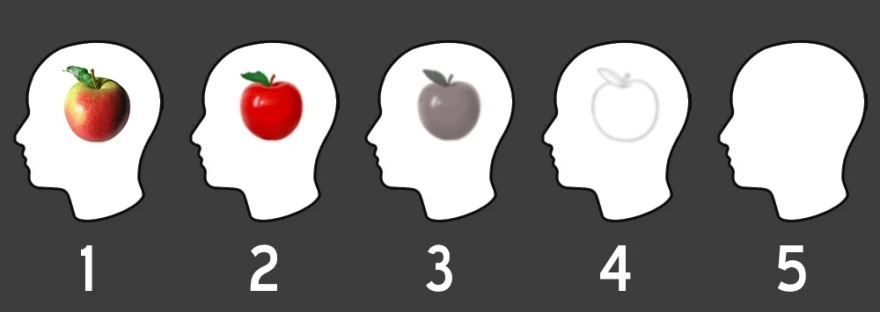
This is how literal I am. I read the headline - can you see the world when you close your eyes - and here's me staring at that image of the heads with apples inside and then closing my eyes and trying to will a mercator projection of the world as if the pic was one of those old Magic Eye prints.
I've had a lot of similar experiences, Jason, and have been questioning my parents and wife about what they see to better understand it. My wife has been amazed at how little I can remember (especially details), even from events earlier in the day. And I've always used the college test notes example when I've talked about how I'm able to recall things.
I barely remember anything about childhood, and I'm appalling with times and dates — it's always been a mystery to me how people can recall that it was "May 1987, no, 1986 when we went to France", and here I am not even knowing what month it is now.
Yeah, my memory for what's happened in my life is pretty bad. But I'm good with dates — when movies/albums came out, world events, sports stuff. I don't relate it to my timeline (e.g. "well, I was the in the 3rd grade when that came out so....") but I just remember the date. The more I read and think about aphantasia and hear other people's experiences, the more I think there are a few different axes on which people's various ways of recalling the world intersect.
I've been thinking about this more and more lately, because 1) the topic is getting increasing attention, and 2) it affects me. I've since joined the Aphantasia Network on Discord, and a bunch of relevant subreddits.
I have never had any ability to relive any sensory experience just by recall, nor do I have a verbal or heard interior dialog. And, like so many others with these characteristics, I thought that "picturing a sunset", and "mind's eye", and "internal dialog" were figurative. I've only become aware recently that people mean these things literally. Mind-blowing.
I've also become aware that these conditions are correlated with very poor autobiographical memory, and in fact one may cause the other. I also have just the barest recollections of my past, and these are devoid of movement and emotion. I can remember images of notable events, in some detail, but there is no visual element to it.
I live in the present, because that's almost all there is for me. I suspect (based on reading and reasoning) that this has a few side effects: the ability to think very effictively abstractly and about abstract things (important for my work); equanimity; kind of flat emotions.
Does anyone remember the scene in Parks and Rec where Ron Swanson attends a meditation class? And he doesn't get it because he is in a perpetual state of zen, a state that others are trying to achieve? That's me, I think.
I remember things spatially, but also often in terms of sequences: turn left here, then right, then a couple blocks later turn right again; we did A, then B, then C, and that's when I set down my gloves so that's where they still are, etc. I also "see" better in my mind with my eyes open, rather than closed, because I can actually physically see something. I find it really difficult to remember faces, and I have trouble recognizing people if they change their hair, their clothing/hats. I'm really good at recognizing voices, and I remember music/jingles, even from my childhood, really easily. Brains are fascinating.
Also, discovered when I was discussing your original post with my husband that we are both aphantasic, and both went through engineering. So I've wondered if it affects certain types of thinkers more than others, or if it tends to cause people to veer towards certain types of interests.
I’m on the opposite of the spectrum, hyperphantasia. I can see minute details in my minds eye, like small dimples, walking routes in full detail, uneven ground. I also have synesthesia, which anecdotally seems to be common thing for those with hyperphantasia
It can get confusing when tired or similar, can have moments of doubt of what is the minds eye and reality
[replied to the wrong comment]
I think i have a good visual memory for most things. But i'm a little face blind. So i can picture and recognize the faces of my family and long time friends of course. And i can even close my eyes and recall the faces of people i met last week at a party. But when my wife says 'hey, is that our server?', or 'what color hair did they have?' then i'm generally stumped. And forget about remembering names....
There are a pair of very interesting Wired articles you may appreciate. The first is from 2009 called Total Recall: The Woman Who Can’t Forget about the first person diagnosed with perfect recall, and how scientists suspect it works: as a biproduct of OCD where she’s just obsessed with thinking about her memories (and interestingly, she’s still susceptible to false memories like the rest of us).
The second is 2016’s The Strange Case of the Woman Who Can’t Remember Her Past about the first person identified with Severly Deficient Autobiographical Memory. She lacks the ability to remember past events. (On the upside, she doesn’t hold grudges)
I'm more on the aphantasic side of things visually, "seeing" only for quick flashes, but with photographic-level auditory memory, to the point where once I have heard a movie a few times it's annoying to actually watch it because of the echo of my memory superimposed over the actual sound.
The spatial piece really resonates with me; less so for words on a page and more about kinesthetic movement in 3d space and "lines". When I picture someone I don't see their face, I picture the way they stand and move.
I'm curious how all this intersects with neurodivergence, too. Maybe my autistic ass can't remember their face because faces aren't as information-rich to me because I don't always know how to interpret expressions. Maybe I can't hold a visual picture in my head because my ADHD ass kept getting distracted by all the other thoughts and details in the environment so the data is messy. Don't even bother asking me about dates or names; I can't even forget them because they never got logged in the first place!
If you feel like this comment goes against the grain of the community guidelines or is otherwise inappropriate, please let me know and I will take a look at it.
In order to comment or fave, you need to be a kottke.org member. Check out your membership options.
Note: If you are a member and tried to log in, it didn't work, and now you're stuck in a neverending login loop of death, try disabling any ad blockers or extensions. Or try logging out and then back in. Still having trouble? Email me!