He is also said to be such a fan of Zoolander, the 2001 send-up of the fashion world, that colleagues say he watches it regularly and likes to quote it. Ben Stiller, the star of the film, once dressed up in character and recorded him a special birthday video message.
motherfucker First used: 1994, Ian Frazier, “On the Floor” It sounded like a chorus of high-pitched voices shouting the word “motherfucker” through a blender.
There may also be a medical reason for the decline in crime. For decades, doctors have known that children with lots of lead in their blood are much more likely to be aggressive, violent and delinquent. In 1974, the Environmental Protection Agency required oil companies to stop putting lead in gasoline. At the same time, lead in paint was banned for any new home (though old buildings still have lead paint, which children can absorb).
Tests have shown that the amount of lead in Americans’ blood fell by four-fifths between 1975 and 1991. A 2007 study by the economist Jessica Wolpaw Reyes contended that the reduction in gasoline lead produced more than half of the decline in violent crime during the 1990s in the U.S. and might bring about greater declines in the future. Another economist, Rick Nevin, has made the same argument for other nations.
The team analysed images from satellites orbiting 700km above the earth, equipped with cameras so powerful they can pin-point objects less than 1m in diameter on the earth’s surface.
Infra-red imaging was used to highlight different materials under the surface.
Ancient Egyptians built their houses and structures out of mud brick, which is much denser than the soil that surrounds it, so the shapes of houses, temples and tombs can be seen.
Be sure to click through to see some of the satellite images…the scale and the amount of detail uncovered is amazing. (via @tomcoates)
An intimidated verbal threat of abuse in the workplace, by this thug. Never work in its satan life and this is why America is being destroyed. satan hates truth. satan is lies, hate and kills anyone that gets in its way to continue to lie to America & it’s idiot followers.
Thug…that’s some sort of code word, right? (via ★vuokko)
Using data from the ACNielsen HomeScan database, which employed bar-code scanners to track every purchase made by roughly 33,000 U.S. households in 2005, the two economists compared identical products sold in cities big and small, both at high-end grocery stores and discount retailers. In nearly every case, New York products were cheaper than in places such as Memphis, Indianapolis and Milwaukee.
The NY Times has a great video on the crossover dribble, one of the most effective moves in basketball. Includes interviews with Allen Iverson, Tim Hardaway, and Dwyane Wade. (thx, aaron)
You think you’re good at Tetris? Think again. Hell, you think you’re good at anything? Think again, again! Tetris grandmaster Jin8 shows you how it’s done:
It starts getting insane around the 3:00 mark and then, at 5 minutes in, all the blocks turn invisible and he keeps right on going! It’s like he’s playing blindfold speed chess on the hood of a stock car!! I mean, !!!!!
Tyler Cowen says that Charles Mann’s 1491 (a taste of which can be read here) is “one of my favorite books ever, in any field”, to which I add a hearty “me too”. Mann’s been hard at work at a sequel, 1493: Uncovering the New World Columbus Created, which is due out in August, just in time for some seriously awesome beach reading.
From the author of 1491 — the best-selling study of the pre-Columbian Americas — a deeply engaging new history that explores the most momentous biological event since the death of the dinosaurs.
More than 200 million years ago, geological forces split apart the continents. Isolated from each other, the two halves of the world developed totally different suites of plants and animals. Columbus’s voyages brought them back together — and marked the beginning of an extraordinary exchange of flora and fauna between Eurasia and the Americas. As Charles Mann shows, this global ecological tumult — the “Columbian Exchange” — underlies much of subsequent human history. Presenting the latest generation of research by scientists, Mann shows how the creation of this worldwide network of exchange fostered the rise of Europe, devastated imperial China, convulsed Africa, and for two centuries made Manila and Mexico City — where Asia, Europe, and the new frontier of the Americas dynamically interacted — the center of the world.
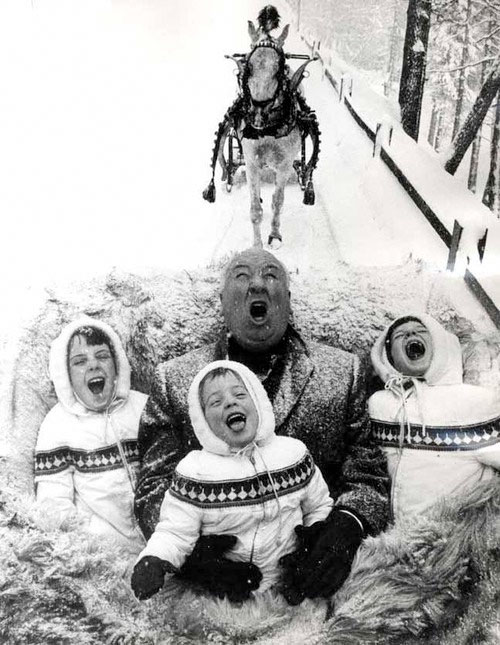
I found this photo of Alfred Hitchcock with three children here labeled “Alfred Hitchcock and his kids” but since he only had one child and looks older in the photo, I assume those are actually his three granddaughters, Mary, Tere, and Katie.
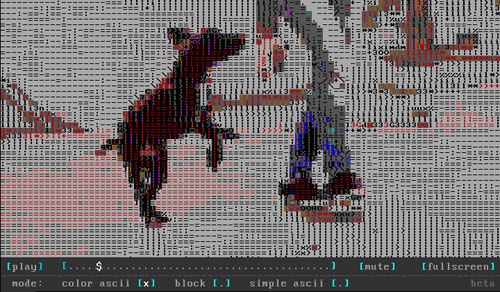
ASCIImeo takes Vimeo video and plays them as ASCII art. Here’s an example video: Dogboarding. I love that the player controls are all text as well…here’s a screenshot:
For the quarter-century that followed, Mrs. Clark lived in the apartment in near solitude, amid a profusion of dollhouses and their occupants. She ate austere lunches of crackers and sardines and watched television, most avidly “The Flintstones.” A housekeeper kept the dolls’ dresses impeccably ironed.
Not even going to try to explain this one. Ok, I’ll try a little…this is Yung Jake singing about datamoshing and making animated gifs and such.
you think it’s connection you think it’s your bandwidth but its me. i’ll steal your bitch like a bandit see me on YouTube. fucking with video find me on world star. find me on Vimeo im not on PhotoBooth. that shit’s different cuz dey told me to step out of the frame but i didnt
Olmsted believed the goal wasn’t to make viewers see his work. It was to make them unaware of it. To him, the art was to conceal art. And the way to do this was to remove distractions and demands on the conscious mind. Viewers weren’t supposed to examine or analyze parts of the scene. They were supposed to be unaware of everything that was working.
Last month, Steven Soderbergh’s list of what he’s been watching and reading told us that the director watched Raiders of the Lost Ark in black & white three times in one week, presumably to emphasize the film’s structure and cinematography. Flavorwire’s Jason Bailey wondered what other films might be better in black & white and compiled a list of ten, with video examples and commentary of each. Included are Raiders, Fargo, and A Christmas Story.
Lovely short film clip of BBC Radiophonic Workshop’s Delia Derbyshire demonstrating how to make electronic music using tape loops. Look at the beat matching!
It was Derbyshire who gave the original Doctor Who theme its distinctive sound. (via ★danielpunkass)
During the recent and overly publicized breakdown of Charlie Sheen, I was repeatedly contacted by the media and asked to comment, as it was assumed that I know a thing or two about starring on a sitcom, fighting with producers, nasty divorces, public meltdowns, and bombing through a live comedytour. I have, however, never smoked crack or taken too many drugs, unless you count alcohol as a drug (I don’t). But I do know what it’s like to be seized by bipolar thoughts that make one spout wise about Tiger Blood and brag about winning when one is actually losing.
It’s hard to tell whether one is winning or, in fact, losing once one starts to think of oneself as a commodity, or a product, or a character, or a voice for the downtrodden. It’s called losing perspective. Fame’s a bitch. It’s hard to handle and drives you nuts. Yes, it’s true that your sense of entitlement grows exponentially with every perk until it becomes too stupendous a weight to walk around under, but it’s a cutthroat business, show, and without the perks, plain ol’ fame and fortune just ain’t worth the trouble.
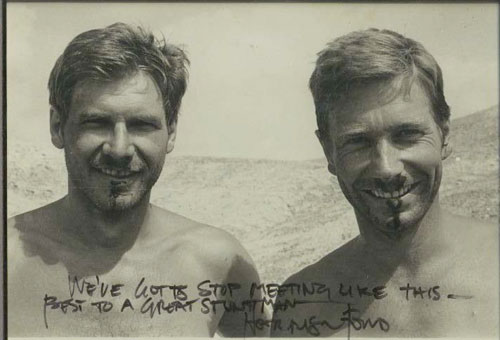
The next day we shot the fight around the plane. Harrison and Roach squared up to each other and Harrison threw a punch. “That’s great. Moving on,” said Steven. Now as a stunt co-ordinator my job is to make sure that, on film, those punches look like they’ve connected. I was standing looking right over the lens of the camera and in my opinion it was a miss. Now I was stuck between a rock and a hard place because Steven had called it good, but I thought I’d better say something. “Excuse me sir, that was actually a miss.” He went, “Oh, you again.” I said, “Yeah, sorry, it was a miss.” Steven paused briefly. “Well, I thought it was a hit.” I said, “No, I was actually looking over the lens and it was a miss, I think.” Finally Steven said, “OK, we’ll do it again.” After that take was completed Steven, sarcastically almost, turned to me and said, “How was that?” I went, “That was good. That was a hit.” And we carried on and created a great fight routine. Three days later we were all watching dailies when the shot that I’d said was a miss came on screen. Steven had printed it. The old heart started to go, but sure enough it was a miss and Steven, who was right in front of me, turned round and said, “Good call Vic.” I couldn’t do much wrong after that, it was great.
Theory: Robert Zemeckis intentionally made Back to the Future not as a contemporary film set in the present but as a period piece set in 1985.
Back To The Future is both undeniably timeless (its place in pop culture is beyond question) and incredibly dated (it’s very much a product of its time). Interestingly, it’s a period piece made in 1985 that depicts 1985 as an era as distant-seeming as its version of 1955. Of course, when Back To The Future was first released, 1985 just looked like “now.” It’s entirely possible that director Robert Zemeckis and co-writer Bob Gale referenced Ronald Reagan and Eddie Van Halen and dressed Fox’s Marty McFly up in a denim jacket and Calvin Klein underwear because they wanted Back To The Future to exist in the same universe as The Breakfast Club, Girls Just Want To Have Fun, and other teen films from 1985. But I’m going to give them way more credit than they probably deserve. I think Zemeckis and Gale knew all the timely accoutrements signifying “the present” in Back To The Future would inevitably look like 1985 within just a couple of years; in fact, they were banking on it. Zemeckis and Gale were trying to create an archetypical representation of 1985 just like they did for 1955, with its soda fountains, social repression, and subjugated black people. In this way, Back To The Future only gets better the further we get from the ’80s. Everything that defines Marty McFly-how he walks, talks, acts, and dresses-acts as instantly recognizable shorthand for the year he comes from.
There’s a rock at the main intersection of White Rock, New Mexico that’s often repainted, sometimes two or three times a day. My pal Mouser and a couple friends of his took a core sample of the rock to determine the paint thickness…turns out there was five and a half inches of paint on that rock. Here’s a composite photomicrograph of the paint layers.
My situation is blessed and I rarely let a day go by that I don’t say a silent prayer in thanks for the position in which I’ve found myself, but good gracious is this hard.
The most frustrating part is that it is difficult to get into a rhythm in your work when you have no real understanding of the next steps you need to take. There’s no opportunity for flow if both outcome and process are foreign experiences. There’s just a lot of poking around and mystery and inadvertent negligence.
Svpply has been open to the public for six months now. Our progress has been slow for a variety of reasons. We have not launched as many new features as I would expect, or even drastically improved the ones we launched with. I own these problems, they can be traced directly back to my inabilities and inexperience, sometimes directly, other times in the form of my not having anticipated or recognized situations for what they were as soon as I could have.
Delivereads is a free service that pushes curated long-form journalism to your Kindle a few times a week.
I usually send out a few delivereads a week - each one has 2-5 articles. I don’t expect everyone to want to read every article, but it’s an easy way to have some great content delivered to your favorite digital reading device with no extra work.
Great idea…it’s like a reverse Instapaper. Sadly, it doesn’t work with the iOS Kindle app (which doesn’t support email).
LeafSnap is a new iPhone app that uses facial recognition techniques to identify trees based on photos of their leaves.
Leafsnap contains beautiful high-resolution images of leaves, flowers, fruit, petiole, seeds, and bark. Leafsnap currently includes the trees of New York City and Washington, D.C., and will soon grow to include the trees of the entire continental United States.
Breaking news — a bank holdup, a bus accident, the death of FDR — was quickly featured on the storefront (NB: usually in 140 characters or less). The storefront even offered streaming multimedia of a kind: telegraph dispatches of boxing matches and baseball games were shouted out play by play through a pair of loudspeakers.
Different “layouts” were used. During World War II an outsized map of Europe loomed over the storefront. For Red Sox World Series appearances, a scaffold was built. Sports desk hacks stood on it to chalk up the scores for bowler-hatted crowds numbering in the hundreds.
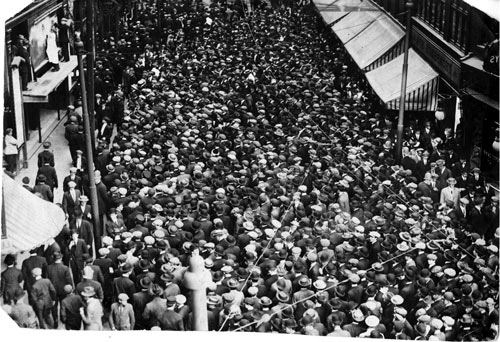
The signs even contained advertising. Here’s a photo of hundreds of people following the Red Sox in the 1912 World Series:
What is interesting about the table above is that Dirk comes in ahead of Bird, Jordan, and so many others. Does this mean Dirk is a better player than Jordan or Bird? Of course not. But it does mean that he is as efficient a scorer as those two were, if not better. Scoring efficiency only tells one part of the story on one side of the floor, which is why PPM can only be considered a small piece of the puzzle when comparing players, but it is a good way to give one of the most unique scoring talents in NBA history his due.
Later he told me it was like skiing down an avalanche chute in the mountains. He said, “You know that feeling you get when you’re going over a cornice and it’s just straight down after that?” He counted the seconds. He went, “One. Two. Three. Four!” Already it was a long drop, and the wave kept rising higher. “Five! Six! Seven! Eight!” He went, “Holy shit!,” and kept dropping. He went, “Don’t fade! Don’t even imagine it!” He got toward the base of the face, still well above the bottom, and rounded out of the drop as the surface curvature allowed. Bradshaw had never seen such wave expanses before-huge fields of sloping water to the right. He was aware of the mass gathering above and behind him. He went, “I gotta get out of here, now!” He dug his right rail in, banking the board hard against its will, and held it with all of his strength into a carving right turn. The turn was slow because the board was fast. Bradshaw kept at it, however, and went slicing up the wave face almost to the crest. He was briefly elated. Technically he had “made” the wave, but he wasn’t done with it yet. From the crest he turned again and went angling back down the face. He intended to perform a full cutback toward the break, but no sooner had he started than a roar erupted behind him as the wave formed a giant barrel. The barrel spat spray at him from its throat. There was no way into that barrel from his position, and it blocked any turn back toward the core of the wave. The ride was almost over for Bradshaw. It had lasted 30 seconds, or hardly more. He exited straight ahead and over the wave’s shoulder. He was angry with himself. He thought that he should have been in that barrel, and that he would have been if he had not shied away from the peak at the start of the ride. He did not care about having made history-and did not consider it until others began to insist on it that night. He did not even think that this had been a great run. He thought, Shit, I should have faded.
Clearly the In-N-Out burgers making their trans-continental trip by plane would be at a disadvantage to the made-fresh-in-the-same-city burgers from Five Guys and Shake Shack, so in order to compensate for this, we made the decision to handicap all three burgers by the same amount. After a careful synchronization of watches, burgers were ordered from their respective establishments at precisely 1 a.m. Greenwich Mean Time (that’s 9 p.m. EST, 6 p.m. Pacific) and not tasted until the following morning.
I used to be a big In-N-Out fan (their burger is still a great fast food burger), but the slightly more upscale Shack Burger is my favorite burger in the whole wide world…it is indeed, as the article states, “a marvel of beefy engineering”.
The page fails on a fundamental level — it’s supposed to be where you find out what’s happened on Flickr while you were away. The current design, unfortunately, encourages random clicking, not informed exploration.
The page isn’t just outdated, it’s actively hurting Flickr, as members’ social graphs on the site become increasingly out of sync with real life. Old users forget to visit the site, new sign ups are never roped in, and Flickr, who increased member sign-ups substantially in 2010, will forego months of solid work when new members don’t come back.
Many of my friends have switched their photo activities to Instagram and, more recently, Mlkshk. And Flickr’s broken “what’s new from your friends” page is to blame. Both of those sites use a plain old one-page reverse-chronological view of your friends’ photos…just scroll back through to see what’s going on. The primary advantage of that view is that it tells a story. Ok, it’s a backwards story like Memento, but that kind of backwards story is one we’re increasingly adept at understanding. The Flickr recent uploads page doesn’t tell any stories.
As long as we’re talking about what’s wrong with Flickr — and the stories thing comes in here too — the site is attempting to occupy this weird middle ground in terms of how people use it. When Flickr first started, it was a social game around publishing photos. You uploaded photos to Flickr specifically to share them with friends and get a reaction out of them. As the service grew, Flickr became less of a place to do that and more of a place to put every single one of your photos, not just the ones you wanted friends to see. Flickr has become a shoebox under the bed instead of the door of the refrigerator or workplace bulletin board. And shoeboxes under beds aren’t so good for telling stories. A straight-up reverse-chron view of your friends’ recent photos probably wouldn’t even work on Flickr at this point…you don’t want all 150 photos from your aunt’s trip to Kansas City clogging up the works. Instagram and Mlkshk don’t have this problem as much, if at all. (via @buzz)
Following on from the Kill Bill section of episode 2 of Everything is a Remix, this video contains what feels like an exhaustive look at the movies that Tarantino referenced in Kill Bill.
Three boys from the New Zealand island territory of Tokelau thought it would be good fun to steal a boat and pilot it towards the nearest island more than 50 miles away across the Pacific. They took with them very little food, even less water, and no fishing gear. They were found 51 days later, naked and nearly starved to death. This is their story.
As the afternoon wore on, they grew a little hungry. They wondered what people were saying about them back on Atafu. Eventually the sun set. “We were still in a good mood,” says Filo. “Not that hungry.” They slept again in a puddle on the bottom of the boat.
The next day, they saw an airplane. It was flying low, and they figured it was looking for them. Etueni waved, and the other two boys immediately teased him for wanting to be rescued so soon. “You’re a girl,” they said. So he stopped waving. Filo and Samu didn’t think two days was enough to seem heroic. They figured, as the plane flew away, that it would eventually be back.
Charles Schwab had a mill manager whose people weren’t producing their quota of work.
“How is it,” Schwab asked him, “that a manager as capable as you can’t make this mill turn out what it should?”
“I don’t know,” the manager replied. “I’ve coaxed the men, I’ve pushed them, I’ve sworn and cussed, I’ve threatened them with damnation and being fired. But nothing works. They just won’t produce.”
This conversation took place at the end of the day, just before the night shift came on. Schwab asked the manager for a piece of chalk, then, turning to the nearest man, asked: “How many heats did your shift make today?”
“Six.”
Without another word, Schwab chalked a big figure six on the floor, and walked away.
When the night shift came in, they saw the “6” and asked what it meant.
“The big boss was in here today,” the day people said.
“He asked us how many heats we made, and we told him six. He chalked it down on the floor.”
The next morning Schwab walked through the mill again. The night shift had rubbed out “6” and replaced it with a big “7.”
When the day shift reported for work the next morning, they saw a big “7” chalked on the floor. So the night shift thought they were better than the day shift did they? Well, they would show the night shift a thing or two. The crew pitched in with enthusiasm, and when they quit that night, they left behind them an enormous, swaggering “10.” Things were stepping up.
Shortly this mill, which had been lagging way behind in production, was turning out more work than any other mill in the plant.
The principle?
Let Charles Schwab say it in his own words: “The way to get things done,” says Schwab, “is to stimulate competition. I do not mean in a sordid, money-getting way, but in the desire to excel.”
The desire to excel! The challenge! Throwing down the gauntlet! An infallible way of appealing to people of spirit.
Oh, and please do remember that it’s xojane.com and not janexo.com…the latter is the URL for the site of Jane St. Clair, “First Class Luxury Companion, Brunette Manhattan Escort, Travel Companion, VIP Courtesan, and Exclusive Private Girlfriend”. Also xoJane.com is free and Ms. St. Clair starts at $700/hr.
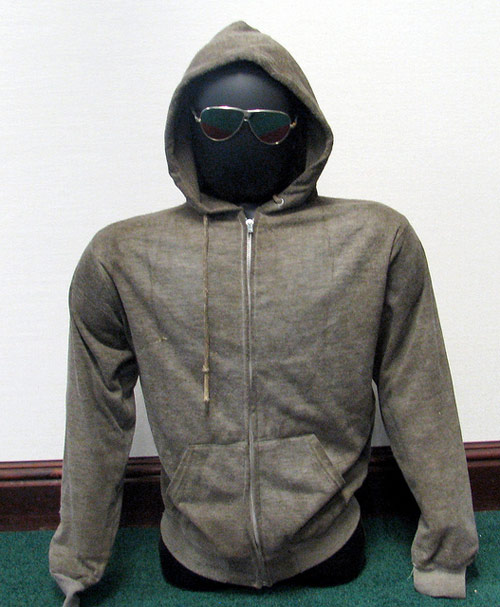
The U.S. Marshals Service is auctioning off some of the personal effects of Ted Kaczynski, aka the Unabomber. There’s a photoset up on Flickr of some of the items. This is the sweatshirt and sunglasses Kaczynski wore to one of his bombings…it inspired this famous police sketch.
“The U.S. Marshals Service has been given a unique opportunity to help the victims of Theodore Kaczynski’s horrific crimes,” said U.S. Marshal Albert Najera of the Eastern District of California. “We will use the technology that Kaczynski railed against in his various manifestos to sell artifacts of his life. The proceeds will go to his victims and, in a very small way, offset some of the hardships they have suffered.”
Produced by Peter Jackson and directed by Steven Spielberg, it looks like an all-CGI adventure. I got sort of a Polar Express vibe from the trailer though, which is not encouraging.
Synesthesia is a short film by Terri Timely that attempts in an artful way to give the viewer a sense of what synesthesia (“the blending or mixing of senses”) is like.
Cory Arcangel: Pro Tools, an exhibition of new work, revolves around the concept of “product demonstrations.” All of the works featured in the exhibition — ranging from video games, single channel video, kinetic sculpture, and prints, to pen plotter drawings — have been created by means of technological tools with an emphasis on the mixing and matching of both professional and amateur technologies, as well as the vernaculars these technologies encourage within culture at large.
In this version, Tracy Flick tries to buy a car from Mr McAllister.
I bought a box of old VHS tapes at the Farmers Market in Wilmington, DE for $5 on Mothers Day. I had no idea that this working print was included in the box when I purchased it.










Socials & More