Considering they can’t wield a knife or cleaver, dolphins make impressive butchers. Researchers in Australia recently observed a bottlenose performing a precise series of manoeuvres to kill, gut and bone a cuttlefish. The six-step procedure gets rid of the invertebrate’s unappetising ink and hard-to-swallow cuttlebone.
An A+ record is an organically conceived masterpiece that repays prolonged listening with new excitement and insight. It is unlikely to be marred by more than one merely ordinary cut.
[…]
An E- record is an organically conceived masterpiece that repays repeated listening with a sense of horror in the face of the void. It is unlikely to be marred by one listenable cut.
The only interesting way to design a demo is to make it a story. You have a protagonist, and the protagonist has a problem, and they use the software, and they… almost solve the problem, but not quite, and then everybody is in suspense, while you tell them some boring stuff that doesn’t fit anywhere else, but they’re still listening raptly because they’re waiting to hear the resolution to the suspenseful story, and then (ah!) you solve the protagonists last problem, and all is well. There is a reason people have been sitting around telling stories around campfires for the last million years or so: people like stories.
As with all advice, Spolsky’s rules should be tuned to your purposes but the ideas are solid for anyone who talks to groups of people. (via stamen)
Bruce Sterling: 2009 Will Be a Year of Panic, a summary of seven factors that we should be concerned about in 2009 and beyond.
Most people in this world have no insurance and ignore building codes. They live in “informal architecture,” i.e., slum structures. Barrios. Favelas. Squats. Overcrowded districts of this world that look like a post-Katrina situation all the time. When people are thrown out of their too-expensive, too-coded homes, this is where they will go. Unless they’re American, in which case they’ll live in their cars. But how can dispossessed Americans pay for their car insurance when they have no fixed address?
A review of 2008’s best cinematographic moments: part one, part two.
This year the challenge was of a different sort. The field was curiously thin. It wasn’t that the talent wasn’t on display. God knows, a number of the greats were lining up behind the camera this year. But the images weren’t as instantly iconic or as viscerally gripping as they were in 2007, which might have left me a bit disappointed on one hand. Then again, it just made searching for my favorites all the more involved and interesting, and I’m happy to offer my findings to you in this space, even if it meant doubling up.
The better ethnic restaurants tend to have many of their kind in a given geographic area. Single restaurant representations of a cuisine tend to disappoint. Competition increases quality and lowers prices. The presence of many restaurants of a kind in an area creates a pool of educated consumers, trained workers and chefs, and ingredient supplies - all manifestations of increasing returns to scale.
Cowen also wants against ordering ingredients-intensive dishes because of inferior American ingredients.
Avoid dishes that are “ingredients-intensive.” Raw ingredients in America - vegetables, butter, bread, meats, etc. - are below world standards. Even most underdeveloped countries have better raw ingredients than we do, at least if you have a U.S. income to spend there, and often even if one doesn’t. Ordering the plain steak in Latin America may be a great idea, but it is usually a mistake in Northern Virginia. Opt for dishes with sauces and complex mixes of ingredients. Go for dishes that are “composition-intensive.”
Pig-in-a-poke originated in the late Middle Ages, when meat was scarce, but apparently rats and cats were not. The con entails a sale of a (suckling) “pig” in a “poke” (bag). The bag ostensibly contains a live healthy little pig, but actually contains a cat (not particularly prized as a source of meat, and at any rate, quite unlikely to grow to be a large hog). If one buys a “pig in a poke” without looking in the bag (a colloquial expression in the English language, meaning “to be a sucker”), the person has bought something of less value than was assumed, and has learned firsthand the lesson caveat emptor.
A trick called the glim-dropper requires a one-eyed accomplice.
One grifter goes into a store and pretends he has lost his glass eye. Everyone looks around, but the eye cannot be found. He declares that he will pay a thousand-dollar reward for the return of his eye, leaving contact information. The next day, an accomplice enters the store and pretends to find the eye. The storekeeper (the intended griftee), thinking of the reward, offers to take it and return it to its owner. The finder insists he will return it himself, and demands the owner’s address. Thinking he will lose all chance of the reward, the storekeeper offers a hundred dollars for the eye. The finder bargains him up to $250, and departs. The one-eyed man, of course, can not be found and does not return.
A con called The Ogged contains a very specific example of its use.
A new con trick born in the age of blogs. For this scam, the con artist creates a pseudonymous internet persona and befriends a group of people online who will become his marks. Then the scammer feigns some terrible disease, such as stomach cancer. Finally, the scammer subtly pushes the idea that his online “friends” could pitch in for something to make him feel better, such as a $700 gift certificate to the French Laundry. After the boon is received, the scam artist claims a miraculous recovery or doctor error. Finally, once the gift certificate has been cashed, the con artist claims that he must “go on hiatus” or even quit blogging altogether.
I can’t find any evidence that the FL gift certificate incident ever happened or documentation of a trick called “The Ogged” anywhere aside from Wikipedia. Anyone? (via bb)
Lionel goes 5’8”, 240, and he’s got the same shirt and lei as the players, so he looks like a player, which is maybe why he’s suddenly in the middle of every hug. And that’s about when Chase Utley says to Jimmy Rollins: “Let’s go celebrate!” And Lionel says exactly what you’d think he’d say, which is, “I’m with you guys!”
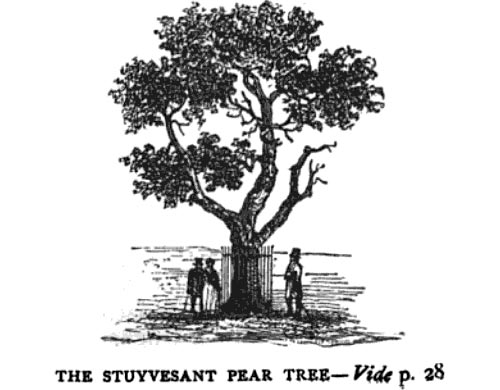
Peter Stuyvesant was the director-general of the New Netherlands colony from 1647 to 1664, when the Dutch lost it to the British and New Amsterdam became New York. When Stuyvesant arrived in New Amsterdam, he brought a pear tree with him and planted it on his farm, which encompassed much of what is now the East Village. After a trip to Amsterdam following the English takeover of the colony, Stuyvesant returned to his farm in New York, where he lived until his death in 1672.
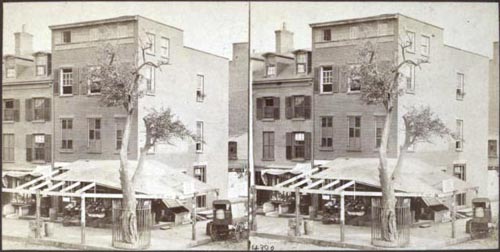
His pear tree persevered. As Manhattan’s grid sprang up around it, the tree remained bearing fruit on the corner of 13th Street and 3rd Avenue. Here’s a stereoscopic photo of the tree from the 1860s.
In 1867, over 200 years after the tree was planted, the last known living link to the Dutch rule of Manhattan was felled by a vehicle collision. The NY Times ran a short piece about the death of the tree: Untimely End of the Stuyvesant Pear-Tree.
The well-known pear-tree planted by Gov. Stuyvesant, and which has stood for two centuries, came at last to a sudden demise during the latter part of last week. This old and famous tree stood on the corner of Thirteenth-street and Third-avenue, in a circular enclosure of iron railing, erected, we believe, by Mr. Wainwright, a descendant of the old Dutch Governor. It had its traditions, though it was less renowned than the famous Charter Oak of Connecticut, but like that old tree, it had been made the subject of many a sketch. Its decay was marked year by year in the declining average of its blossoms, but it was not considered beyond bearing before the occurrence of an accident which cleft the ancient trunk in twain. The destruction of this old landmark is stated to have resulted from a collision of vehicles, one of which was thrown against the tree with sufficient force to break it down. Laborers were engaged in removing the limbs and trunk yesterday, which were proclaimed obstructions to travel.
N.B. From what I can tell from my research, the plaque may be wrong about the date that the tree was planted. It states that Stuyvesant brought the tree back with him after the English took control of New Amsterdam in 1664 whereas most other sources on the matter indicate that Stuyvesant brought the tree with him when he came to assume control of the colony in 1647.
Newcomers suddenly realize either that the city is not working for them or that they are inexorably becoming part of it, or both. They find themselves walking and talking faster.
The subway begins to make sense. Patience is whittled away; sarcasm often ensues. New friends are made, routines established, and city life begins to feel like second nature. In other words, newcomers find themselves becoming New Yorkers.
Sometimes all you need is a little text change to save your business a lot of money. Jared Spool once helped a major ecommerce site with their checkout process. The company ended up changing the text of a submit button and making the company an additional $300 million in one year.
The form, intended to make shopping easier, turned out to only help a small percentage of the customers who encountered it. (Even many of those customers weren’t helped, since it took just as much effort to update any incorrect information, such as changed addresses or new credit cards.) Instead, the form just prevented sales — a lot of sales.
37signals recently changed how they labelled charges on credit card statements and reduced chargebacks by 30%.
The notebooks function like a security blanket for me. I can’t go into a meeting unless I have my current notebook in my hand, even if I never open it. Because I carry one everywhere, I tend to misplace them a lot. Losing one makes me frantic. Everyone who works with me gets used to me asking, “Have you seen my notebook anywhere?” which I assume gets irritating after a while: sorry. I’ve left them behind in clients’ offices. On one occasion, I left one on the roof of a cab on the upper west side. I ended up walking ten blocks, retracing the taxi’s route, until I found it on Broadway at 63rd Street, intact except for some tire marks.
I’ve tried using notebooks several times over the years, but the habit has never stuck.
Scientists are still trying to figure out what’s causing CCD, or Colony Collapse Disorder, a plague that’s killing off millions of bee across the United States. Among the possible culprits are a virus, increased vulnerability to disease due to breeding, overwork (hives of bees are trucked around the country for months to pollinate crops), increased exposure to all kinds of insecticides, and perhaps even all of the above.
As the swift expansion of feral honeybees across the Americas shows, they are not especially picky about their habitat; most anything outside of parking lot or vast monoculture will do. And for native bees, habitat could be restored to suit the needs of whichever species are exceptionally good pollinators of local crops. Bumblebees, for instance, are the best pollinators of Maine blueberries, whereas blue orchard bees work well for California almonds.
Hirsh’s idea is reminiscent of Michael Pollan’s proposals for decreasing the present monoculture in American agriculture outlined in his recent books.
As promised, the redesign of this site started last week is still in motion. I’ve just made a bunch of small tweaks that should make the site more readable for some readers.
- Fonts. In response to a number of font issues (many reports of Whitney acting up, the larger type looking like absolute crap on Windows), I’ve changed how the stylesheets work. Sadly, that means no more lovely Whitney. :( Mac users will see Myriad Pro Regular backed up by Helvetica and Arial while PC users will see Arial (at a different font-size). In each case, the type is slightly smaller than it was previously. I’m frustrated that these changes need to be made…the state of typography on the web is still horrible.
- Blue zoom border. Oh, it’s staying, but it’ll work a bit differently. The blue sides will still appear on the screen at all times but the top and bottom bars will scroll with the content. I liked the omnipresent border, but the new scheme will fix the problems with hidden anchor links and hidden in-page search results and allow for more of the screen to be used for reading/scanning. It breaks on short pages (see: the 404 page) and still doesn’t work quite right on the iPhone, but those are problems for another day.
- Icons. Updated the favicon and the icon on the iPhone to match the new look/feel.
- Misc. Rounded off the corners on the red title box. Increased the space between the sidebar and the main content column.
Thanks to everyone who offered their suggestions and critiques of the new design, especially those who took the time to send in screenshots of the problems they were having. Feedback is always appreciated.
He said that public health measures like cleaning up contaminated water and food have saved the lives of countless children, but they “also eliminated exposure to many organisms that are probably good for us.” “Children raised in an ultraclean environment,” he added, “are not being exposed to organisms that help them develop appropriate immune regulatory circuits.”
One of the decisions we made even before Ollie was born was that he was going to be a dirty kid. We wash our hands often with non-antibacterial soap and water, especially after being on the subway, but otherwise don’t worry about it much. I can count on one hand how many times I’ve used the antibacterial hand sanitizer that seemingly comes bundled with toddlers these days.
As such, it is a metaphorical representation of the fundamental ideology of the United States; the past is no constraint on the future, and each individual should strive resolutely for personal advance despite whatever the past may hold. The child born in a log cabin may achieve the presidency, an immigrant boy who grows up in the slums of Brooklyn may become a real-estate magnate, an Ivy-educated scion of wealth may wind up on a bread line, and a double green will speed you to the fore. Though there are winners and losers, initial conditions are no determinant of outcome in the freedom of America.
Tom Armitage references both Johnson and Costikyan in his response, Taking Turns.
Candyland is a great first game; literally, the very first. It teaches turn-taking. It teaches the mores, the manners, the culture of playing boardgames. Later, when a child comes to a game where the rules are more complex, the turn process more intricate, the customs of gameplay are already learned; rather than focusing on learning the social interactions, they can focus on the complexity of the game itself.
During the first 30 seconds of an utterance, your light is green: your listener is probably paying attention. During the second 30 seconds, your light is yellow — your listener may be starting to wish you’d finish. After the one-minute mark, your light is red: Yes, there are rare times you should “run a red light:” when your listener is obviously fully engaged in your missive. But usually, when an utterance exceeds one minute, with each passing second, you increase the risk of boring your listener and having them think of you as a chatterbox, windbag, or blowhard.
The 50 most loathsome people in America for 2008. George W. Bush and Barack Obama both make the list but She Who Shall Not Be Named Ever Again is #1. “You” makes the list at #43 and is my favorite.
You’re hopping mad about an auto industry bailout that cost a squirt of piss compared to a Wall Street heist of galactic dimensions, due to a housing crash you somehow have blamed on minorities. It took you six years to figure out what a tool Bush is, but you think Obama will make it all better. You deem it hunky dory that we conduct national policy debates via 8-second clips from “The View.” You think God zapped humans into existence a few thousand years ago, although your appendix and wisdom teeth disagree. You like watching vicious assholes insult each other on TV. You support gun rights, because firing one gives you a chubby. You cuddle falsehoods and resent enlightenment. You think the fact that 43% of whites could stomach voting for an incredibly charismatic and eloquent light-skinned black guy who was raised by white people means racism is over. You think progressive taxation is socialism. 1 in 100 of you are in jail, and you think it should be more. You are shallow, inconsiderate, afraid, brand-conscious, sedentary, and totally self-obsessed. You are American
Exhibit A: You’re more upset by Miley Cyrus’s glamour shots than the fact that you are a grown adult who is upset about Miley Cyrus.
Two Rooms is a simple Flash game, part puzzle and part fast-twitch, in which you move items around in two adjacent rooms in order to get one of your movers to a goal. (via buzzfeed)
Telling the magazine that he was asked why he did not give “credit” to God, Attenborough added: “They always mean beautiful things like hummingbirds. I always reply by saying that I think of a little child in east Africa with a worm burrowing through his eyeball. The worm cannot live in any other way, except by burrowing through eyeballs. I find that hard to reconcile with the notion of a divine and benevolent creator.”
The Places We Live features panoramic photos of slums, narrated by the people who live there (through translators). Really really engrossing. To access the stories in the restricting Flash interface, skip the intro, click on a city, and then on one of the households in the upper left corner. There’s a book too. (via snarkmarket)
A related thing is that there was blind faith in the value of financial innovation. Wall Street dreamed up increasingly complicated things, and they were allowed to do it because it was always assumed that if the market wanted it then it made some positive contribution to society. It’s now quite clear that some of these things they dreamed up were instruments of doom and should never have been allowed in the marketplace.
Street photographer Bill Cunningham didn’t have a ticket to the Inauguration nor did he have an assignment from the NY Times to cover it; he just bought a train ticket, went down on his own, and brought back these photos. Be sure to listen to Cunningham’s wonderful narration; he even gets choked up when describing the moment of Obama’s swearing-in. I wish all journalism were this professionally personal (if that makes any sense). (via greg.org)
Eye On Springfield celebrates Simpsons moments from seasons 1-9, when the show was “still funny”. If you’re around me for more than a few minutes, it’s likely you’ll hear “freshen ya drink, govenah?” at some point.
Fun little game from Ze Frank that I hadn’t seen before: Every Second Counts. You’re challenged to hold the mouse button down for 0.2 seconds, 0.4 seconds, then 0.6, 0.8, and so on. You need to be within 0.1 seconds of the target time to advance to the next time. Because the increments get increasingly smaller in comparison to the overall times, it quickly becomes difficult to gauge how long to hold the button, i.e. 0.4 is twice as long as 0.2 but 3.2 and 3.4 are almost indistinguishable. (It’s also difficult because the button is kinda hinky.) I made it to 1.8 seconds…is it even possible to get to 4 or 5 seconds?
Update: Several readers made it to 4, 5, and even 8 seconds. Most were musicians who have strong sense of timing. I’m also reminded of a story about how Richard Feynman developed his sense of timing to the point where he could keep time in his head even while reading. (thx, everyone)
All humans are 99.9% genetically identical, so don’t even think of ending any potential relationship begun here with ‘I just don’t think we have enough in common’. Science has long since proven that I am the man for you (41, likes to be referred to as ‘Wing Commander’ in the bedroom).
Update: There’s an entire book of personals from the London Book Review called They Call Me Naughty Lola that the Guardian writer didn’t mention. (thx, rj)
I’m not big into the “moral message” interpretation of pop culture, but plenty of critics of digital games are, so just for the record: what sort of message does Candy Land send to our kids? (And I’m not just talking about all the implicit advertisements for cane sugar products.) It says you are powerless, that your destiny is entirely determined by the luck of the draw, that the only chance you have of winning the game lies in following the rules, and accepting the cards as they come. Who wants to grow up in that kind of universe?
On the other hand, games of chance allow children of all ages and abilities to play the same games together and experience both winning and losing.
He popped out that door, and when the door opened and he came through it, the look on his face was like no look I’d ever seen on George Bush’s face in my life. […] And I said, “If he wasn’t just back there behind that door crying, I don’t know what that look on his face is.” Because he just looks absolutely devastated as he comes through this door after essentially ending his eight year presidency. And it’s just really striking. He just looks absolutely devastated.
The interview with the last photographer is the least interesting because he refuses to interpret any of the photographs but his set of photographs includes at least 3 photographs that I had never seen before and that weren’t “published extensively in the United States”.
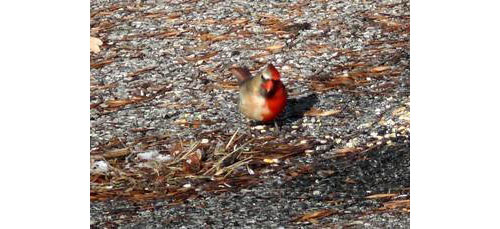
Remarkable photo of a gynandromorphic cardinal with bilateral asymmetry, meaning that the left side of the bird is male and the right side is female…a red/brown split right down the middle.
Murray Siple’s feature-length documentary follows a group of homeless men who have combined bottle picking with the extreme sport of racing shopping carts down the steep hills of North Vancouver. This subculture depicts street life as much more than the stereotypes portrayed in mainstream media. The film takes a deep look into the lives of the men who race carts, the adversity they face and the appeal of cart racing despite the risk.
BTW, this is but one film of hundreds of shorts, animated films, and documentaries that the NFB recently put online for viewing.
Every industrialized nation in the world except the United States has a national system that guarantees affordable health care for all its citizens. Nearly all have been popular and successful. But each has taken a drastically different form, and the reason has rarely been ideology. Rather, each country has built on its own history, however imperfect, unusual, and untidy.
As usual, Gawande makes a lot of sense. Whatever the solution, we should be doing all we can to avoid something like this from ever happening again:
“When I heard that I was losing my insurance, I was scared,” Darling told the Times. Her husband had been laid off from his job, too. “I remember that the bill for my son’s delivery in 2005 was about $9,000, and I knew I would never be able to pay that by myself.” So she prevailed on her midwife to induce labor while she still had insurance coverage. During labor, Darling began bleeding profusely, and needed a Cesarean section. Mother and baby pulled through. But the insurer denied Darling’s claim for coverage. The couple ended up owing more than seventeen thousand dollars.
The Printed Picture is an exhibition of physical specimens made using all the different ways that type and image can be printed on paper, metal, glass, etc, with a special emphasis on dozens of photography techniques, from albumen prints to dagguereotypes to color photography. On view at MoMA until June 1.
I know that Polaroid announced last year that they were ceasing production of their instant film and that people have begun to hoard film as it becomes more difficult to find. To NYC hoarders: there are 30-40 10-packs of Polaroid 600 film at the CVS on the corner of Nassau and Fulton. Didn’t catch the price but they’re at the photo processing counter past the registers. Or you could just wait it out.
The good news is that I don’t have to know if there’s a link. Wells had a great quote once where some critic asked him a similar question. He said, “I’m the bird, and you’re the ornithologist.” I don’t really sit down and think on a macro level how or if these things are connected. They obviously are in the sense that I wanted to make them. And so there must be something in them that I’m drawn to.
Soderbergh also talks about following your interest when choosing projects and not worrying so much about the money.
Yeah. And I’m a big believer that if there’s something you really want to do, don’t walk away because of the deal. I see it happen a lot. I see people walk away from things because they didn’t get the deal they wanted.
In The Method, Archimedes was working out a way to compute the areas and volumes of objects with curved surfaces, which was also one of the problems that motivated Newton and Leibniz. Ancient mathematicians had long struggled to “square the circle” by calculating its exact area. That problem turned out to be impossible using only a straightedge and compass, the only tools the ancient Greeks allowed themselves. Nevertheless, Archimedes worked out ways of computing the areas of many other curved regions.
Afterwards, we came to refer to certain types of accomplishments as “black triangles.” These are important accomplishments that take a lot of effort to achieve, but upon completion you don’t have much to show for it — only that more work can now proceed. It takes someone who really knows the guts of what you are doing to appreciate a black triangle.
When working on complex projects, the black triangle moment is always the high point for me; it’s when success occurs. Before you’ve got a framework built, there’s significant doubt about how the project will turn out, if can even be done. After you get that first little result through the whole maze and it’s clear how the whole thing will work, the rest becomes almost inevitable. (via migurski)
I remember one year my proudest moment was at an audition for a really slutty bar maid on a new TV show. It was written for a Pam Anderson type. I thought, “I can never pull this off. I just don’t have the sex appeal. I feel stupid. No one is going to take me seriously.” But, I committed to the role and gave the best audition I could. I didn’t get the job. I didn’t get a callback. But I conquered my rambling, fear-driven brain and went balls out on the audition anyway. That was a huge milestone for me — but hard to explain at Christmas.
To test whether I was being paranoid, I ran a little experiment. On a sunny Saturday, I spotted a woman in Golden Gate Park taking a photo with a 3G iPhone. Because iPhones embed geodata into photos that users upload to Flickr or Picasa, iPhone shots can be automatically placed on a map. At home I searched the Flickr map, and score — a shot from today. I clicked through to the user’s photostream and determined it was the woman I had seen earlier. After adjusting the settings so that only her shots appeared on the map, I saw a cluster of images in one location. Clicking on them revealed photos of an apartment interior — a bedroom, a kitchen, a filthy living room. Now I know where she lives.



Socials & More