



Mad Men recaps
Andrew Johnston has been posting great meaty Mad Men reviews over at The House Next Door after each episode. Here’s a two-fer that covers the last couple of installments. You can find the rest of the season 2 recaps here.

This site is made possible by member support. 💞
Big thanks to Arcustech for hosting the site and offering amazing tech support.
When you buy through links on kottke.org, I may earn an affiliate commission. Thanks for supporting the site!
kottke.org. home of fine hypertext products since 1998.
Beloved by 86.47% of the web.
Andrew Johnston has been posting great meaty Mad Men reviews over at The House Next Door after each episode. Here’s a two-fer that covers the last couple of installments. You can find the rest of the season 2 recaps here.
Slate has more on the restored Godfather films I told you about last week.
Luckily, the Academy of Motion Picture Arts and Sciences had a print of The Godfather that was in perfect condition. (This was the approved master print that Technicolor stored with the academy when the film was complete. It had never been shown in a theater.) So, when Harris & Co. did the digital color correction, they could use this print as a reference. They also worked side by side with Allen Daviau, a brilliant cinematographer who, in turn, consulted by phone with Willis himself. (Harris is a stickler for this sort of thing. When he restored Hitchcock’s Vertigo, he asked Jaguar to send him a color chip from the 1957 model of one of its cars — the same car that Kim Novak drove in the film — so that he could match the shade of green exactly.)
If you don’t want to buy/rent the films, Film Forum in New York is playing the restored films through next Tuesday with other theaters around the country to follow.
Fans of Desktop Tower Defense, if you’re tired of the same old boards and enemies, check out Whiteboard Tower Defense. Can you feel that? The afternoon slipping away? (via buzzfeed)
Daniel Eatock’s counterbalancing shelves.
5 pine planks (each 6 feet), 5 metal brackets, tools and materials from the gallery utility closet or found on the gallery grounds. Each of the five shelves that comprise this work is balanced on a single bracket. All maintain their level balance by the precise placement of the objects they bear.
With a little more conceptual work and product placement, he could have turned this into a piece about consumerism and the collapse of the networked global economy blah blah blah.
Director of Community Heather Champ doesn’t just guard the pool and blow the occasional whistle; it’s a far more delicate, and revealing, dance that keeps the user population here happy, healthy and growing. In addressing that question of how much to police and how much to let things be, Champ oversees an experiment that, outside some far-flung and sandy exceptions, one rarely sees in such detail. There are no IEDs or snipers in this place, but it’s hard not to conclude Flickr’s conducting a kind of nation-building.
Flickr is an inspiring example of how to run a community site in an era where other sites almost delight in taking zero responsibility for what goes on in their comments and forums.
In preparation for a panel at the New Yorker Festival, Ben Greenman put together a list of the five scariest movies of all time. I’ve never seen a horror movie (unless Blair Witch Project counts) so Silence of the Lambs would be my top pick.
While following the market yesterday, I updated my Twitter account after a particularly precipitous mid-afternoon drop in the DJIA:
The DJIA trend line just kinda disappeared off the bottom of the chart there into Here Be Monsters territory about 30 minutes ago.
I meant “here be dragons” but you get the idea. Anyway, a reader sent in this chart that captures what many were feeling after the market closed.
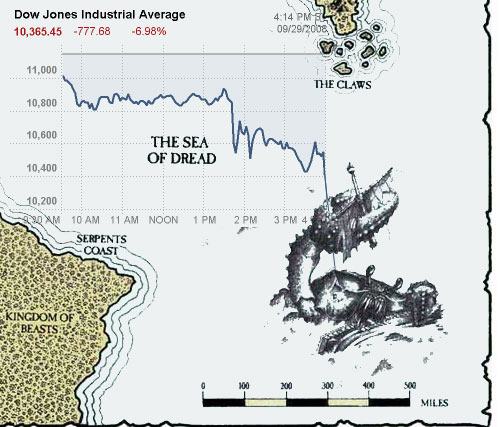
The Sea of Dread, indeed. (thx, margaret)
In an excerpt from the soon-to-be-released More Information Than You Require, John Hodgman shares how he became a famous minor television personality and how he deals with all that fame.
As a matter of fact, sometimes now, if I’m feeling tired or a little sad, I’ll go put on my UPS-man outfit and hit the subway. I’ll hope that maybe someone will recognize me. It’s very embarrassing, isn’t it? But most of the time, it doesn’t happen. No matter how crowded it is, no one says anything. They are reading, talking, thinking about where the train is taking them next. They don’t say anything to me at all. And that’s when I sit back, and look at them all, and think to myself: Don’t any of you have a television? What THE FUCK is wrong with you people? I’M SITTING RIGHT HERE!
Some of this is from a bit Hodgman did for an episode of This American Life earlier this year.
High-end prostitutes see an uptick in business — for a few months anyway — during times of financial hardship and crisis.
Their clients were coming to them for a mix of escape and encouragement. As Jean, a New Yorker and a 35-year-old former paralegal turned “corporate escort” (her description) told me, “I had about two dozen men who started doubling their visits with me. They couldn’t face their wives, who were bitching about the fact they lost income. Men want to be men. All I did was make them feel like they could go back out there with their head up.”
Indeed, forty percent of encounters between high-end prostitutes don’t involve sex…like therapy with occasional benefits.
Kent Nerburn on a cab ride he’ll never forget.
For the next two hours, we drove through the city. She showed me the building where she had once worked as an elevator operator. We drove through the neighborhood where she and her husband had lived when they were newlyweds. She had me pull up in front of a furniture warehouse that had once been a ballroom where she had gone dancing as a girl.
(via dooce)
A list of actors who deserve better careers. Quentin Tarantino should do a film starring all of these actors and raise their boats like he did with John Travolta.
On the streets of New York City, a (squirt) gun battle rages.
“I told my doorman that if he sees anyone suspicious with a water pistol, then he’s not to let them in the building,” Mr. Deane said. He shaved the beard he wore for the picture his pursuer is carrying. He is considering borrowing a wheelchair to use as part of a disguise. By Friday evening, he had logged four kills; he was one of 16 players left. “I’ve been walking around like a crazy person,” he said, “wondering when they’re going to get me.” His wife, who works promoting nightclubs, is very patient about the whole thing.
Oh, and people use umbrellas as shields! The final day of StreetWars is today. (Tried to work in a “don’t make me go all Evian on your ass” joke but failed. (Or did I?))
Five noted photographers choose films they’ve been influenced by. Blue Velvet appears on more than one list.
The Washington Post takes a stroll through Manhattan, circa the Mad Men era.
Sterling Cooper, as every fan with a pause button knows, is at 405 Madison Ave., an address that…does not exist. If it did exist, it would be where a bank of Chase ATMs is now, not the ideal spot to spend the morning, but don’t worry, soon it will be 11:30 and time for your first cocktail.
One place the article doesn’t mention is Lutèce, the fancy French place frequented by the bigwigs in the show. It closed in 2004. (thx, jake)
As part of their monster 40th anniversary celebration, New York magazine has some notes from the past four decades of food and dining in NYC. Gael Greene remembers her favorite meal as a restaurant critic and also lists the 14 most important NYC restaurants over the past 40 years. No Union Square Cafe? Meyer deserves some credit for taking the stuffiness out of NYC dining.
Legendary chef André Soltner and David Chang share a conversation about the state of food in the city. When Soltner was asked if he did interviews, he replied:
If they came to Lutèce, if they came to my kitchen, yes. I would not go out. If they asked me to go to Chicago to do a fund-raising dinner, it was, “No.” If they asked me to come to give me a prize or whatever, I said, “Only on Sundays, when I’m not in the kitchen.” I was sort of a slave to my restaurant. And my wife too. I don’t say it was right. Today, I maybe say it was wrong. Years ago, in Paris, we had no money. But when we were more comfortable, maybe twenty years later, I said, “Simone, you know, you’ve paid your dues and everything, I buy you whatever you wish.” I was thinking to buy her a ring or a necklace or something like that. “Whatever you wish, tell me.” She looked at me and said, “Take me to a movie.” For twenty years, I hadn’t taken her to a movie. I woke up. I said, “Oh my God, what did I do to my wife?”
And finally but wonderfully, a timeline of food in NYC. The first McDonald’s opened here in 1972 and Starbucks in 1994. Hanger steak was big in 1990.
As a companion to an offline article about illegal logging, the New Yorker has a video that traces illegally cut wood in Russia to distribution and manufacturing centers in China and eventually a finished toilet seat is shipped to Wal-Mart in the US.
Michael Lewis rents a mansion in New Orleans and finds in the experience a parable about the thirst of Americans for better housing than they can afford, the subprime mortgage crisis, and the ensuing financial panic.
The real moral is that when a middle-class couple buys a house they can’t afford, defaults on their mortgage, and then sits down to explain it to a reporter from the New York Times, they can be confident that he will overlook the reason for their financial distress: the peculiar willingness of Americans to risk it all for a house above their station. People who buy something they cannot afford usually hear a little voice warning them away or prodding them to feel guilty. But when the item in question is a house, all the signals in American life conspire to drown out the little voice. The tax code tells people like the Garcias that while their interest payments are now gargantuan relative to their income, they’re deductible. Their friends tell them how impressed they are-and they mean it. Their family tells them that while theirs is indeed a big house, they have worked hard, and Americans who work hard deserve to own a dream house. Their kids love them for it.
(thx, kabir)
Out of 438 incoming freshman students at Amherst College, 432 of them are on Facebook and only 5 have landlines.
6. Number of students in the class of 2012 who brought desktop computers to campus: 14.
7. Number that brought iPhones/iTouches: 93.
8. Likelihood that a student with an iPhone/iTouch is in the class of 2012: approximately 1 in 2.
Another interesting stat: 94% of all incoming email is spam. (via cd)
Molly Young of n+1 takes in some shows at New York Fashion Week.
You can tell who is destined for the tents by their appearance. It’s not that fashion people dress the same or even splashily, but rather that every one of them possesses an uncanny sartorial self-awareness. You get the sense that they have arrived at their outfits and hairstyles after painstaking analysis of personal flaws and assets cross-indexed with current trends.
(via 3qd)
The speech accent archive uniformly presents a large set of speech samples from a variety of language backgrounds. Native and non-native speakers of English read the same paragraph and are carefully transcribed. The archive is used by people who wish to compare and analyze the accents of different English speakers.
See also the International Dialects of English Archive.
The most interesting boring photos on Flickr (i.e. the “boring” tag sorted by interestingness). Got this from ni9e, although he used a slightly different technique.
Dan Lyons (né Fake Steve Jobs) explains why panels at tech conferences are so pointless.
Was at the EmTech conference at MIT today and suffered through a panel led by Robert Scoble with four geeks (Facebook, Six Apart, Plaxo, Twine) talking about the future of the Web. No prepared remarks, just totally random conversation. Basically they all just spewed whatever came into their heads, at top speed, interrupting each other and oblivious to the fact that an audience was sitting there, glazing over… It was like watching five college kids with ADHD and an eight-ball of coke trying to hold a conversation.
The irony of the post is that many of the blogs in Lyons’ list of “Things I Read” in the sidebar are like that panel, only in blog form.
Ok folks, there’s a reservation for 4 people for lunch today at Momofuku Ko that has been sitting there since last night. Snap it up, it’s yours!
Update, 10:21am: It’s still there. This is insanity!
Update, 10:46am: Still there!! The financial crisis is taking its toll…no one wants to spend $160 per person on lunch today.
Update, 11:25am: 35 minutes until lunch…looks like they might have empty seats. Walk-in? (Unless this is some sort of weird software bug.)
A checklist for landing a 747, presumably in a emergency.
1. Get on the radio, and tell whoever’s listening that you are landing a 747.
As anticipated, Muxtape was unable to maintain its original form under assault from the RIAA and slow moving legal negotiations with the labels.
The first red flag came in August. Up until then all the discussion had been about numbers, but as we closed in on an agreement the talk shifted to things like guaranteed placement and “marketing opportunities.” I was denied the possibility of releasing a mobile version of Muxtape. My flexibility was being constricted. I had been worried about Muxtape getting a fair deal, but my biggest concern all along was maintaing the integrity and experience of the site (one of the reasons I wanted to license in the first place). Now it wasn’t so simple; I had agreed to a variety of encroachments into Muxtape’s financials because I wanted to play ball, but giving up any kind of editorial or creative control was something I had a much harder time swallowing.
Instead, the site will become more of a stripped-down MySpace for bands wanting to put their music online. Disappointing because Muxtape, as originally conceived, was obviously what everyone but the “music industry” wanted. Some of that simplistic magic will likely transfer over to the new incarnation but it won’t be as cool as mix tapes for your pals. (thx, mark)
Update: For posterity, I’m pasting Justin’s whole note in here.
I love music. I believe that for people who love music, the desire to share it is innate and crucial for music itself. When we find a song we love, we beckon our friends over to the turntable, we loan them the CD, we turn up the car stereo, we put it on a mixtape. We do this because music makes us feel and we want someone else to feel it, too.
The story of Muxtape began when I had a weekly show at my university’s radio station in Oregon. In addition to keeping the station’s regular log I compiled my playlists into a web page, with each show represented by a simple block that corresponded to a cassette recording for that week. At the time, mixtapes were already well into their twilight, but long after my show ended I couldn’t stop thinking about how the playlist page served a similar purpose, and in many ways served it better. Like a mixtape, each playlist was a curated group that was greater than the sum of its parts. Unlike a mixtape, it wasn’t constrained by any physical boundaries of dissemination, but… it also didn’t contain any actual music. Someone might come across the page and smile knowingly at the songs they knew, but shifting the burden of actually compiling the mix to its intended listener defeated the purpose entirely.
Five years later, internet technology had advanced significantly. I was working on experimental user interfaces for web sites when I started thinking about that playlist page again, and ultimately set out to bring it to life. My desire to share music (in the mixtape sense) hadn’t gone anywhere, but the channels to do so were becoming extinct. Popular blogging services allow you to post audio files in an ephemeral sort of way, but it wasn’t the context I was looking for. A physical cassette tape in your hands has such an insistent aesthetic; just holding one makes you want to find a tape player to fulfill its destiny. My goal with Muxtape’s design was to translate some of that tactility into the digital world, to build a context around the music that gave it a little extra spark of life and made the holder anxious to listen.
The first version was a one-page supplement to my tumblr, and was more or less identical to what it would become later. The feedback was great, and the number one question rapidly became “can you make one for me, too?” At first I started thinking about ways I could package the source code, but the more I thought about it the more it seemed like massively wasted potential. Distributing the source would mean limiting access to the small niche of people who operate their own web server, whereas I wanted to make something that was accessible to anyone who loves music. The natural conclusion was a centralized service, which suddenly unfolded whole other dimensions of possibility for serendipitous music discovery. What seemed before like the hollow shell of a mixtape now seemed like its evolution. I knew I had to try building it. Three weeks of long nights later, I launched Muxtape.
It was successful very quickly. 8,685 users registered in the first 24 hours, 97,748 in the first month with 1.2 million unique visitors and a healthy growth rate. Lots of press. Rampant speculation. Tech rags either lauded it or declared it an instant failure. Everyone was excited. I was thrilled.
There was a popular misconception that Muxtape only survived because it was “flying under the radar,” and the moment the major labels found out about it it’d be shut down. In actuality, the labels and the RIAA read web sites like everyone else, and I heard from them both within a week or so. An RIAA notice arrived in triplicate, via email, registered mail, and FedEx overnight (with print and CD versions). They demanded that I take down six specific muxtapes they felt were infringing, so I did.
Around the same time I got a call from the VP of anti-piracy at one of the majors. After I picked up the phone his first words were, “Justin, I just have one question for you: where do I send the summons and complaint?” The conversation picked up from there. There was no summons, it was an intimidation tactic setting the tone for the business development meeting he was proposing, the true reason for the call. Around the same time another one of the big four’s business developers reached out to me, too.
I spent the next month listening. I talked to a lot of very smart lawyers and other people whose opinions on the matter I respected, trying to gain a consensus for Muxtape’s legality. The only consensus seemed to be that there was no consensus. I had two dozen slightly different opinions that ran the gamut from “Muxtape is 100% legal and you’re on solid ground,” to “Muxtape is a cesspool of piracy and I hope you’re ready for a hundred million dollar lawsuit and a stint at Riker’s.”
In the end, Muxtape’s legality was moot. I didn’t have any money to defend against a lawsuit, just or not, so the major labels had an ax over my head either way. I always told myself I’d remove any artist or label that contacted me and objected, no questions asked. Not a single one ever did. On the contrary, every artist I heard from was a fan of the site and excited about its possibilities. I got calls from the marketing departments of big labels whose corporate parents were supposed to be outraged, wanting to know how they get could their latest acts on the home page. Smaller labels wanted to feature their content in other creative ways. It seemed obvious Muxtape had value for listeners and artists alike.
In May I had my first meeting with a major label, Universal Music Group. I went alone and prepared myself for the worst, having spent the last decade toeing the indie party line that the big labels were hopelessly obstinate luddites with no idea what was good for them. I’m here to tell you now that the labels understand their business a lot better than most people suspect, although they each have their own surprisingly distinct personality when it comes to how they approach the future. The gentlemen I met at Universal were incredibly receptive and tactful; I didn’t have to sell them on why Muxtape was good for them, they knew it was cool and just wanted to get paid. I sympathized with that. I told them I needed some time to get a proposal together and we left things in limbo.
A few weeks later I had a meeting with EMI, the character of which was much different. I walked into a conference room and shook eight or nine hands, sitting down at a conference table with a phonebook-thick file labeled “Muxtape” laying on it. The people I met formed a semi-circle around me like a split brain, legal on one side and business development on the other. The meeting alternated between an intense grilling from the legal side (“you are a willful infringer and we are mere hours from shutting you down”) and an awkward discussion with the business side (“assuming we don’t shut you down, how do you see us working together?”). I asked for two weeks to make a proposal, they gave me two days.
I had to make a decision. As I saw it I had three options. The first was to just shut everything down, which I never really considered. The second was to ban major label content entirely, which might have solved the immediate crisis, but had two strong points against it. The first, most visibly, was that it would prevent people from using the majority of available music in their mixes. The second was that it did nothing to address the deeper questions surrounding ownership and usage for everyone else who wasn’t a major label: mid-size labels and independent artists who have just as fundamental a right to address how their content is used as a large corporation, even if they don’t carry quite as big a stick.
The third option was to approach a fully licensed model, which I had been edging toward since I met with Universal. I knew other licensed services so far had met with mixed success, but I also knew Muxtape was different and that it was at least worth exploring. The question about whether or not the labels saw value in it had been answered, the new question was how much it was going to cost.
It was June. I approached a Fifth Ave law firm about representing me in licensing negotiations with the major labels, and they took me on. Two weeks later I met with all four, flanked by lawyers this time, and started the slow process of working out a deal. The first round of terms were stiff and complex, but not nearly as bad as I’d imagined, and I managed to convince them that allowing Muxtape to continue to operate was in everyone’s best interest. Things were going well. I spent the next two months talking with investors, designing the next phases of the site itself, and supervising the negotiations. A big concern was getting a deal that took into consideration the fact that Muxtape wasn’t a straightforward on-demand service, and should pay accordingly less than a service that was. Another reason I liked the licensing option from the outset was that it seemed like an uncommon win-win; I didn’t want the ability to search and stream any song at any given notice, and they were reluctant to offer it (for the price, anyway). Muxtape’s unusual limitations were its strength in more ways than one.
The first red flag came in August. Up until then all the discussion had been about numbers, but as we closed in on an agreement the talk shifted to things like guaranteed placement and “marketing opportunities.” I was denied the possibility of releasing a mobile version of Muxtape. My flexibility was being constricted. I had been worried about Muxtape getting a fair deal, but my biggest concern all along was maintaing the integrity and experience of the site (one of the reasons I wanted to license in the first place). Now it wasn’t so simple; I had agreed to a variety of encroachments into Muxtape’s financials because I wanted to play ball, but giving up any kind of editorial or creative control was something I had a much harder time swallowing.
I was wrestling with this when, on August 15th, I received notice from Amazon Web Services (the platform that hosts Muxtape’s servers and files) that they had received a complaint from the RIAA. Per Amazon’s terms, I had one business day to remove an incredibly long list of songs or face having my servers shut down and data deleted. This came as a big surprise to me, as I’d been thinking that I hadn’t heard from the RIAA in a long time because I had an understanding with the labels. I had a panicked exchange of emails with Amazon, trying to explain that I was in the middle of a licensing deal, that I suspected it was a clerical error, and that I was doing everything I could to get someone to vouch for me on a summer Friday afternoon. My one business day extended over the weekend, and on Monday when I wasn’t able to produce the documentation Amazon wanted (or even get someone from the RIAA on the phone), the servers were shut down and I was locked out of the account. I moved the domain name to a new server with a short message and the very real expectation that I could get it sorted out. I still thought it was all just a big mistake. I was wrong.
Over the next week I learned a little more, mainly that the RIAA moves quite autonomously from their label parents and that the understanding I had with them didn’t necessarily carry over. I also learned that none of the labels were especially interested in helping me out, and from their perspective it had no bearing on the negotiations. I disagreed. The deals were still weeks or months away (an eternity on the internet) meaning that at best, Muxtape was going to be down until the end of year. There was also still the matter of how to pay for it; getting investment is hard enough in this volatile space even with a wildly successful and growing web site, it became an entirely different proposition with no web site at all.
And so I made one of the hardest decisions I’ve ever faced: I walked away from the licensing deals. They had become too complex for a site founded on simplicity, too restrictive and hostile to continue to innovate the way I wanted to. They’d already taken so much attention away from development that I started to question my own motivations. I didn’t get into this to build a big company as fast as I could no matter what the cost, I got into this to make something simple and beautiful for people who love music, and I plan to continue doing that. As promised, the site is coming back, but not as you’ve known. I’m taking a feature that was in development in the early stages and making it the new central focus.
Muxtape is relaunching as a service exclusively for bands, offering an extremely powerful platform with unheard-of simplicity for artists to thrive on the internet. Musicians in 2008 without access to a full time web developer have few options when it comes to establishing themselves online, but their needs often revolve around a common set of problems. The new Muxtape will allow bands to upload their own music and offer an embeddable player that works anywhere on the web, in addition to the original muxtape format. Bands will be able to assemble an attractive profile with simple modules that enable optional functionality such as a calendar, photos, comments, downloads and sales, or anything else they need. The system has been built from the ground up to be extended infinitely and is wrapped in a template system that will be open to CSS designers. There will be more details soon. The beta is still private at the moment, but that will change in the coming weeks.
I realize this is a somewhat radical shift in functionality, but Muxtape’s core goals haven’t changed. I still want to challenge the way we experience music online, and I still want to work to enable what I think is the most interesting aspect of interconnected music: discovering new stuff.
Thank to you everyone who made Muxtape the incredible place it was in its first phase, it couldn’t have happened without your mixes. The industry will catch up some day, it pretty much has to.
Justin
Blindfold chess is playing chess without a board or pieces…you’ve got to remember where everything is in your head. The world record holder played 45 games of blindfold chess simultaneously. More at Wikipedia. (via panopticist)
Google has filed a patent that might eliminate the need for mobile phone users to choose a single network. Instead, a piece of software would poll all available networks and select the most appropriate one based on price.
Devices using the system would send networks a description of their requirements — for example, a phone call or access to the internet — and receive back bids with a per-minute cost, or flat rate, at which those needs could be met. Users can either manually accept the bid that looks best to them, or have the phone choose one automatically, based on pre-programmed criteria.
Besides being a brain-dead obvious idea — nice work once again, USPTO — if a system like this were put in place, calling Mom on Mother’s Day would get a whole lot more expensive, as would calls and data usage during other peak times or locations.
Update: I’m reminded that this is just an application, not an accepted patent, so my “nice work” comment doesn’t apply. But I would imagine that patents coming from Google have little trouble getting accepted. (thx, mike)
Karen Hanrahan shares her favorite prop that she shows parents in her Healthy Choices for Children workshop: a McDonald’s hamburger purchased in 1996 that still looks like it did the day it was made.
People always ask me — what did you do to preserve it? Nothing — it preserved itself.
(via wider angle)
Update: Looks like the post got taken down for some reason? Server getting a little melty maybe? Anyway, that hamburger was amazingly preserved. Serious Eats grabbed a pic before the site went down.
Gizmodo recently paid a visit to the headquarters of the Criterion Collection as they begin the process of releasing all their movies in HD on Blu-ray.
But with that huge uptick in resolution for the consumer, Criterion is faced with a lot of problems that they didn’t have when their masters were converted to standard definition for DVD. After all, they’re often dealing with old films, created before there was fancy low-grain filmstock and digital processing. And with the technology they have today, how much restoration and processing is too much?
Really, the mission of Criterion is “trying to replicate the original experience of seeing that movie when it was first released,” according to Phillips. While they certainly have the ability to process old films until they look like they were shot on a DV cam, that’s not the goal.
It’s difficult to know if Blu-ray will actually take off as a format, given the competition from other methods of obtaining HD media (iTunes store, HD cable, etc.). It might become a niche option like the Criterion Collection itself but a welcome one all the same. We watched The Darjeeling Limited the other night on the Starz HD channel on Time Warner Cable. It was 1080p but compressed enough that if you’re paying attention, you can see artifacts, especially with fast motion. But the worst part is that Starz didn’t bother to show the film in its original aspect ratio, which, with Wes Anderson movies, is more than half of the point! They chopped off the sides to fit a 2.39:1 film into 16:9. So for fans of films that deserve to be seen as the director intended, Criterion on Blu-ray might be the only option.
David Chang, AKA Captain Fucking Pork Bun, and his food producers are growing uneasy about the breakdown of the sustainability of the “Crazy Eddie abundance of the American agricultural industry”.
The machinery that’s pumped so much meat into our lives over the last half century was never built to last, and now it’s breaking down big-time. Feed is more expensive. Gasoline is more expensive. Milk, rice, butter, corn — it’s all going through the roof. And for the foreseeable future, it’s not coming back down.
A rumination by Suzanne Vega on technology and her hit song, Tom’s Diner. The song was used as a reference when Karl-Heinz Brandenberg was working on the mp3 compression method.
So Mr. Brandenberg gets a copy of the song, and puts it through the newly created MP3. But instead of the “warm human voice” there are monstrous distortions, as though the Exorcist has somehow gotten into the system, shadowing every phrase. They spend months refining it, running “Tom’s Diner through the system over and over again with modifications, until it comes through clearly. “He wound up listening to the song thousands of times,” the article, written by Hilmar Schmundt, continued, “and the result was a code that was heard around the world. When an MP3 player compresses music by anyone from Courtney Love to Kenny G, it is replicating the way that Brandenburg heard Suzanne Vega.”
Vega once went to listen to the final mp3 version of her song. She could not agree with Brandenberg that the track sounded “exactly” like the original.
“Actually, to my ears it sounds like there is a little more high end in the MP3 version? The MP3 doesn’t sound as warm as the original, maybe a tiny bit of bottom end is lost?” I suggested.
Roger Ebert recently got a question asking why he didn’t review Disaster Movie.
Q. Yo dude, u missed out on “Disaster Movie,” a hardcore laugh-ur-@zz-off movie! Y U not review this movie!? It was funny as #ell! Prolly the funniest movie of the summer! U never review these, wat up wit dat?
- S.J. Stanczak, ChicagoA. Hey, bro, I wuz buzier than $#i+, @d they never shoed it b4 hand. I peeped in the IMDb and saw it zoomed to #1 as the low$ie$t flic of all time, wit @ lame-@zz UZer Rating of 1.3. U liked it? Wat up wit dat?
Totally pwned. He’s not completely fluent, but Ebert should write all of his reviews in l33tspeak.
Someone has turned a YouTube video into a rudimentary game using the annotation feature.
You get to the “next level” by clicking annotations, which loads the next video. If you want to cheat ahead, all of the videos are available here.
Update: Andy points out that this YouTube text adventure game predates the game above.
Deborah Solomon recently interviewed Charles Murray for the NY Times. Murray is the author of the recent book, Real Education, which argues that 80% of all college students should not be pursuing a bachelor’s degree.
Even though the interview is pretty short, Solomon shows how Murray’s scientific views don’t jibe with his political views, namely that you don’t need smart, able people running the country.
What do you make of the fact that John McCain was ranked 894 in a class of 899 when he graduated from the U.S. Naval Academy? I like to think that the reason he ranked so low is that he was out drinking beer, as opposed to just unable to learn stuff.
What do you think of Sarah Palin? I’m in love. Truly and deeply in love.
She attended five colleges in six years. So what?
Why is the McCain clan so eager to advertise its anti-intellectualism? The last thing we need are more pointy-headed intellectuals running the government. Probably the smartest president we’ve had in terms of I.Q. in the last 50 years was Jimmy Carter, and I think he is the worst president of the last 50 years.
The cognitive dissonance inside Murray’s head must be deafening.
Those plucky Mars rovers are still going. Their planned roving time was three months but now more than four years in, NASA is sending Opportunity off on a two-year trek to visit a large crater.
The mission team estimates Opportunity may be able to travel about 100m per day. But even at that pace, the journey could take two years. The rover will stop to study rocks on the way, and in winter months it cannot move because there is not enough sunlight to provide sufficient power for driving.
Video of people getting punched in the face at 1000 frames/second. Wonder no longer what Rocky would look like as filmed by Wes Anderson. (thx, kitt)
Ok, Michael Lewis *is* writing a book about the current financial situation. Sort of. It’s called Panic: The Story of Modern Financial Insanity.
When it comes to markets, the first deadly sin is greed. Michael Lewis is our jungle guide through five of the most violent and costly upheavals in recent financial history: the crash of ‘87, the Russian default (and the subsequent collapse of Long-Term Capital Management), the Asian currency crisis of 1999, the Internet bubble, and the current sub-prime mortgage disaster.
It’s out in December so I imagine that it won’t include the current Lehman/AIG/Merrill/bailout kerfuffle, but that’s what “with new material” paperbacks are for. (thx, paul)
Wired writer Sonja Zjawinski commissioned for-hire paparazzo Izaz Rony (previously) to follow her around for the day and take photos.
I leave the coffee shop with Rony trailing unobtrusively. I’m beginning to understand why celebrities go nuts, shave their heads, and bounce in and out of rehab; I would, too, if I had relentless photographers on my tail 24/7. When I stop to peruse a pair of shoes at an outdoor stall, Rony snaps away at me through a rack of dresses, startling a fellow shopper. “Sorry,” I sheepishly explain. “That’s, uh … my photographer.”
I don’t feel like a celebutante hounded by the media anymore; I feel like the lamest lame-o in Phonytown. And I’ve had enough of it. I call off the shoot.
(via fimoculous)
Why have I not heard of artist Tara Donovan before…her stuff is great.
Though Ms. Donovan’s new prints won’t be on view, her glass-shattering talents will be: she intends to recreate “Untitled (Glass),” a process-oriented sculpture that she first made in 2004. It involves stacking sheets of tempered glass into a perfect cube, then working carefully one by one from bottom to top, striking a single corner of each pane with a hammer. As with the print, Ms. Donovan will contain the glass with a wooden frame while she works. Once the mold is removed, the cube “stays in place,” she said. “You can still see the layers, but everything’s really broken into itty-bitty teeny-weeny shards.”
Donovan is one of the 2008 MacArthur genius fellows. (via delicious ghost)
Finalists for the 2008 magazine cover of the year competition. That Spitzer one always makes me laugh.
The crazy finish to the 1908 baseball season, which was decided by an obscure rule, Christy Mathewson’s dead arm, Mordecai “Three Finger” Brown’s pitching, and Fred Merkle’s decision not to run all the way to second base. Things got ugly.
“From the stands there was a steady roar of abuse,” Brown said later. “I never heard anybody or any set of men called as many foul names as the Giant fans called us that day.” Foul names might have been the least of their worries. The New York Journal reported that Cubs catcher Johnny Kling, chasing a pop foul, had to dodge “two beer bottles, a drinking glass and a derby hat.”
The box score of the first game and a bunch of other juicy details are available in the original 1908 NY Times article.
Censurable stupidity on the part of player Merkle in yesterday’s game at the Polo Grounds between the Giants and Chicago placed the New York team’s chances of winning the pennant in jeopardy. His unusual conduct in the final inning of great game perhaps deprived New York of a victory that would have been unquestionable had he not comitted a breach in baseball play that resulted in Umpire O’Day declaring the game a tie.
It’s also interesting to look at the statistics for that season. Merkle is listed as the league’s youngest player, and Honus Wagner won nearly every single batting category, the Brooklyn Superbas (no, really!) topped the league with only 28 homers (for the entire team), and Mathewson won a whopping 37 games. Here’s that NY Times article again:
Up to the climatic ninth it was the toss of a coin who would win. For here is our best-beloved Mathewson pitching as only champions pitch, striking out the power and the glory of the Cubs, numbering among his slain Schulte in the first, Pfeister in the third, Steinfeldt in the fourth, Pfeister in the fifth, Haydon in the eighth, and Evers and Schulte in the ninth — these last in one-two order. Proper pitching, and for this and other things we embrace him.
With such headings as “The Fatal Third Inning”, the 1908 Times story about the second game is worth a look as well.
The three Godfather films have been restored, remastered, retouched, unscratched, and cleaned for release on Blu-ray and DVD.
By all accounts, the original negatives of the first two films were so torn up and dirty that they could no longer be run through standard film laboratory printing equipment, and so the only option became a digital, rather than a photochemical, restoration.
The final product, which the studio is calling “The Godfather: The Coppola Restoration,” combines bits and pieces of film recovered from innumerable sources, scanned at high resolution and then retouched frame by frame to remove dirt and scratches. The color was brought back to its original values by comparing it with first-generation release prints and by extensive consultation with Gordon Willis, who shot all three films, and Allen Daviau, a cinematographer (“E.T.”) who is also a leading historian of photographic technology.
The article goes on to say that the Blu-ray version is like a “pristine 35-millimeter print projected in perfect focus” in your living room. Must get Blu-ray player. Amazon has the Blu-ray version for a whopping 50% off the retail price…it’s almost the same price as the DVD version.
Update: The author of the Times piece has two before-and-after stills from the first film on his blog. Wow.
Google has added transit directions to Google Maps. Finally.
We’ve just added comprehensive transit info for the entire New York metro region, encompassing subway, commuter rail, bus and ferry services from the Metropolitan Transit Agency (MTA), the Port Authority of New York and New Jersey, New Jersey Transit and the City of New York.
One feature I’d like: a quick at-a-glance comparison of the three travel methods (walking, subway/train, driving) to see which is going to take less time.
New studies show that prehistoric agriculture may have taken much longer to develop than previously thought.
Until recently researchers say the story of the origin of agriculture was one of a relatively sudden appearance of plant cultivation in the Near East around 10,000 years ago spreading quickly into Europe and dovetailing conveniently with ideas about how quickly language and population genes spread from the Near East to Europe. Initially, genetics appeared to support this idea but now cracks are beginning to appear in the evidence underpinning that model.
Video on how to bull your shoes (bull = put a really nice polish on them).
1000 circles! From the same series: checkmate in four moves. (via acl)
Some nice work amongst the finalists of a contest to design the book cover for a novel called The Island at the End of the World. (via book design review)
The MacArthur Foundation announced the list of their 2008 fellows today, the recipients of the $500,000 “genius grant”. Among the fellows is Alex Ross, staff writer for the New Yorker and author of The Rest is Noise (kottke.org interview).
More new work from the busy Phillip Toledano: America the Gift Shop.
If American foreign policy had a gift show, what would it sell?
I like the Cheney shredding secret documents snow globe.
Artist Mike Mitchell found a box on his doorstep. Inside was a note and an improbable object from Mitchell’s past.
As one of my photographer friends, Brett Littlehales, pointed out later, it was even amazing that the tape had lasted for 45 years. He also observed in a typically exuberant way, “the chances of this happening are…are…like winning the lottery…no!…no!…more like winning the cosmic lottery!”
(via clusterflock)
Color palettes taken from a MoMA exhibition of nighttime paintings by Vincent van Gogh. Review of the show by the NY Times.
Socials & More