kottke.org posts about video
The folks at Fred Rogers Productions have launched a YouTube channel dedicated to Mister Rogers’ Neighborhood. They plan to post compilations, clips, and full episodes, some of which haven’t been seen on PBS in years & years. One of the first complete episodes they’ve posted is the one about how crayons are made!
Other full episodes include A Visit with Officer Clemmons, The Very First Episode (from 1968), and Koko the Gorilla Meets Mister Rogers.
And there’s also this 30-minute compilation of fan-favorite factory visits.
Again, here’s the channel if you want to subscribe or explore more.
In March 1976, Talking Heads played a show at The Kitchen in NYC; you can watch the entire show recorded from two angles in this video. The band had formed the year before and was more than a year away from recording and releasing their debut album.
It’s a great insight as to what these early Talking Heads shows were like, and with it also being in color, being good quality, and having two angles for most of the show, this is a must-watch.
The band played for about 90 minutes (2 sets plus an encore), working through tracks like Psycho Killer, Thank You For Sending Me An Angel, and Love → Building On Fire. (via open culture)
Watch and listen to bardcore trio Courseval play a cover version of Daft Punk’s Veridis Quo, a track from Discovery. This is lovely. And a banger.
Courseval have covered other popular music in medieval style, including Rihanna’s Umbrella, Take On Me by A-Ha, Bad Romance by Lady Gaga, and Gloria Gaynor’s I Will Survive.
The original Star Wars movie was a mashup. George Lucas and his collaborators pulled from everywhere: westerns, samurai movies, Flash Gordon, and a 1955 war film called The Dam Busters. This video shows just how closely the attack on the Death Star mirrors a scene from The Dam Busters of a group of bombers attacking a dam. The dialogue is identical in places. From the Dam Busters Wikipedia page:
Director George Lucas hired Gilbert Taylor, responsible for special effects photography on The Dam Busters, to be the director of photography for the film Star Wars. The attack on the Death Star in the climax of Star Wars is a deliberate and acknowledged homage to the climactic sequence of The Dam Busters. In the former film, rebel pilots have to fly through a trench while evading enemy fire and fire a proton torpedo at a precise distance from the target to destroy the entire base with a single explosion; if one run fails, another run must be made by a different pilot. In addition to the similarity of the scenes, some of the dialogue is nearly identical. Star Wars also ends with an Elgarian march, like The Dam Busters.
You can also watch Star Wars footage with Dam Busters audio and Dam Busters footage with Star Wars audio to see just how closely the two scenes match.
Given modern IP concerns and stakes, it’s difficult to envision this type of homage working today. Star Wars came out just 22 years after The Dam Busters, which is a beloved & acclaimed movie in Britain…it’s not obscure. Imagine a movie released in 2026 by a young Academy Award-nominated director that lifts a scene wholesale from a 2004 film like The Notebook, The Incredibles, Eternal Sunshine of the Spotless Mind, or Million Dollar Baby — it just wouldn’t happen without a lot of lawyerly conversation. I mean, maybe Lucas had those convos with The Dam Busters filmmakers… 🤷♂️
Andor loves a good monologue. Among the best of them is Nemik’s Manifesto:
Remember this, Freedom is a pure idea. It occurs spontaneously and without instruction. Random acts of insurrection are occurring constantly throughout the galaxy.
And Kino Loy’s speech to his fellow prisoners on Narkina 5:
There is one way out. Right now, the building is ours. You need to run, climb, kill! You need to help each other. You see someone who’s confused, someone who is lost, you get them moving and you keep them moving until we put this place behind us.
In this just-released episode of Nerdwriter, Evan Puschak breaks down Luthen Rael’s “extraordinary” monologue about what he’s sacrificed for the cause.
Here’s the original scene and a transcript of the speech:
Calm. Kindness. Kinship. Love. I’ve given up all chance at inner peace. I’ve made my mind a sunless space. I share my dreams with ghosts. I wake up every day to an equation I wrote 15 years ago from which there’s only one conclusion, I’m damned for what I do. My anger, my ego, my unwillingness to yield, my eagerness to fight, they’ve set me on a path from which there is no escape. I yearned to be a savior against injustice without contemplating the cost and by the time I looked down there was no longer any ground beneath my feet. What is my — what is my sacrifice? I’m condemned to use the tools of my enemy to defeat them. I burn my decency for someone else’s future. I burn my life to make a sunrise that I know I’ll never see. And the ego that started this fight will never have a mirror or an audience or the light of gratitude. So what do I sacrifice? EVERYTHING!
The great thing about Luthen’s monologue, which Puschak doesn’t really get into, is that it makes the viewer rethink the entire basis of the show — and of Star Wars in general. Instead of Good Guys and Bad Guys, you’re asked to consider shades of gray. These blurred lines are hinted at before, mostly through individual character arcs (Han, Anakin, Lando, Rey, Kylo), but Luthen plainly lays out the moral complexity involved: revolutions and rebellions are led by and made up of flawed people who do harmful things for the right reasons…or at least, that’s what they tell themselves, what they need to tell themselves.
Luthen, Mon Mothma, Cassian — there’s no solution to their personal trolley problem, except that they somehow have to keep living after condemning others to suffering and death. Viewed through that lens, the rest of Star Wars reads quite differently.
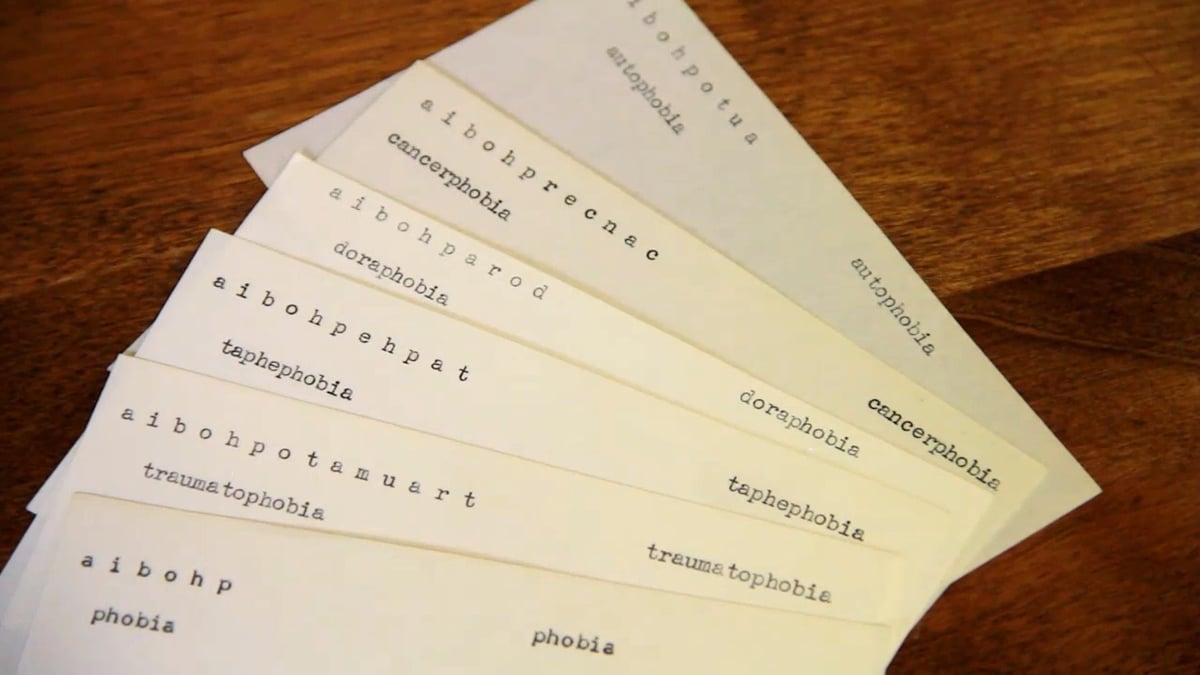
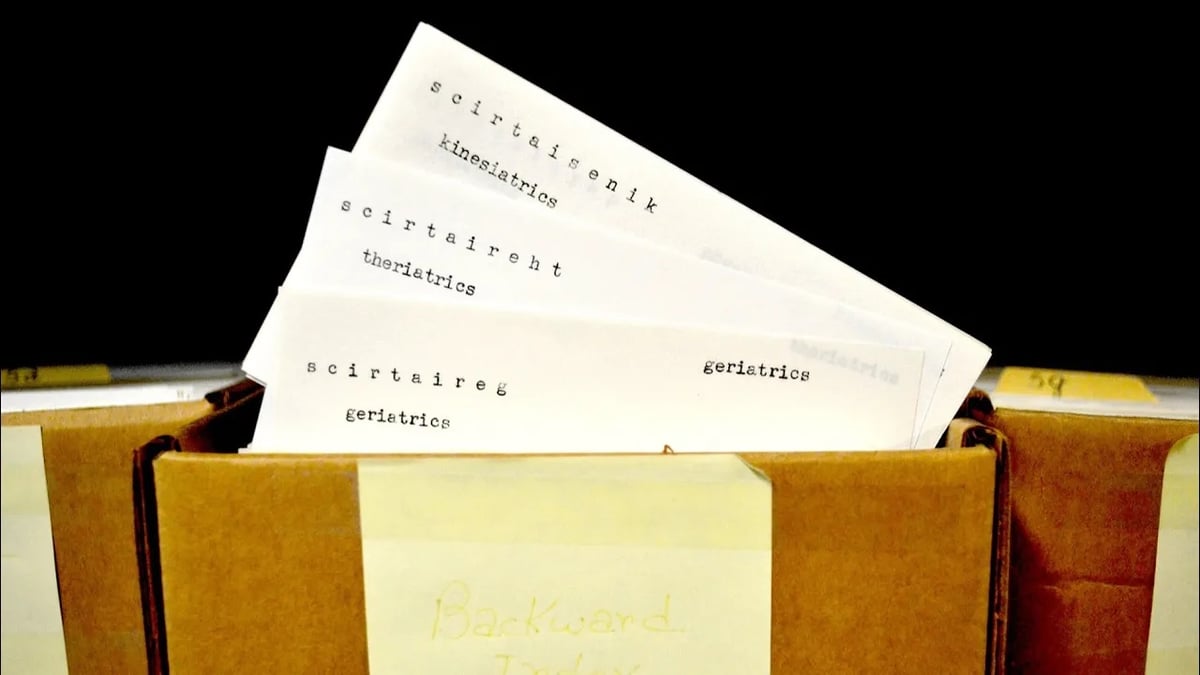
How do dictionary makers keep track of similarly suffixed words, like those ending in -ism, -graphy, -ness, or -ology? With a computer, it’s simple, but how did they do it before the computing age? Starting in the 1950s, lexicographers at Merriam-Webster typed all of the words in the dictionary out backwards and organized them alphabetically into a collection called the Backward Index.
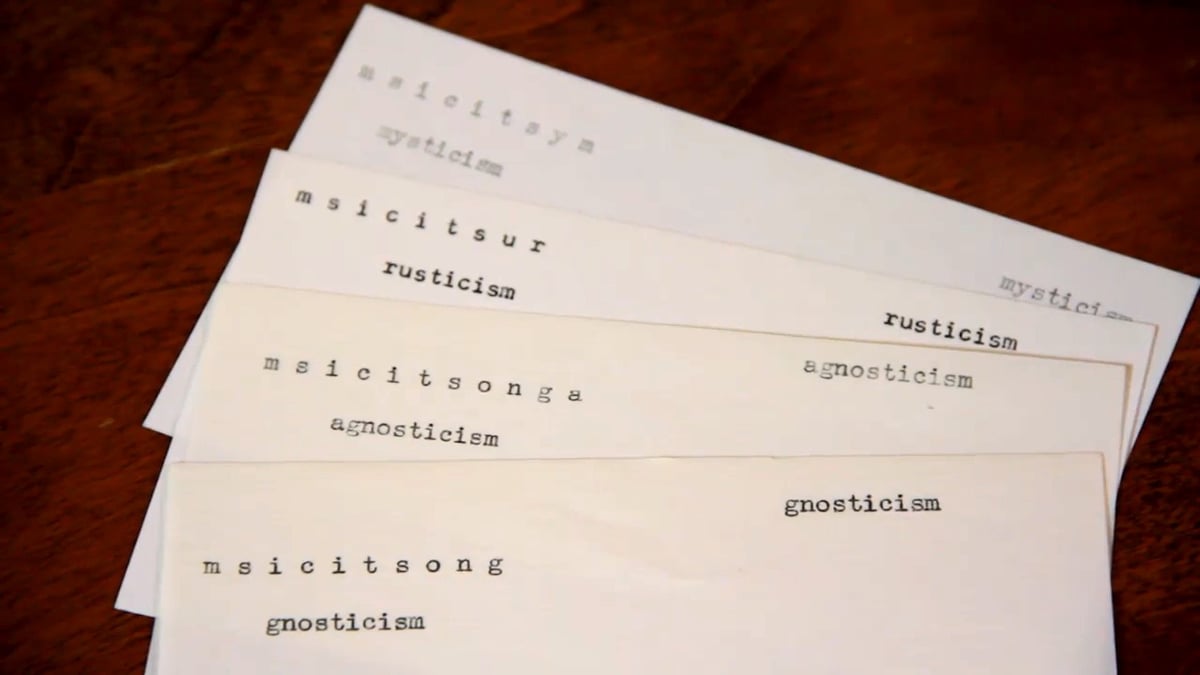
The Backward Index evidently turned out to be a useful tool in the pre-electronic age. For example, it could help identify a set of related terms that should be defined in similar ways, including open compounds (Highland pony, Shetland pony, Welsh pony), closed compounds (blocklike, clocklike, rocklike, socklike, chalklike), and morphologically related terms (phytopathological, ethological, lithological, ornithological). Thus, looking up all the diseases that end in –itis or all the doctrines and theories that end in –ism was now possible. Since rhymes depend on word endings, initial research for a rhyming dictionary also made use of the Index, where sequences such as seepy, steepy, weepy, sweepy and dorty, forty, shorty, snorty, porty, sporty, rorty, torty show up regularly.
The index of reversed words eventually grew to 315,000 entries, each one typed up by one of M-W’s many typists.
We do know a few facts. One is that they were typed up. They were typed up by the typist and I interviewed several retired Merriam-Webster employees, at least a couple of them in their 90s. And they all recall this work. They all recall the file and they say, well, that’s what the typists did when there was no manuscript for them to type. When in the process of making the Unabridged Dictionary, for example, there was an enormous amount of copy at the beginning of the project. But then as the typesetting went on, what happened was through revision and later stages of editing, there was less and less and less of the actual manuscript to type. And that left some of the typing pool available to do other projects. And their assignment was to, when they had the time, to type the headwords in the dictionary backwards.
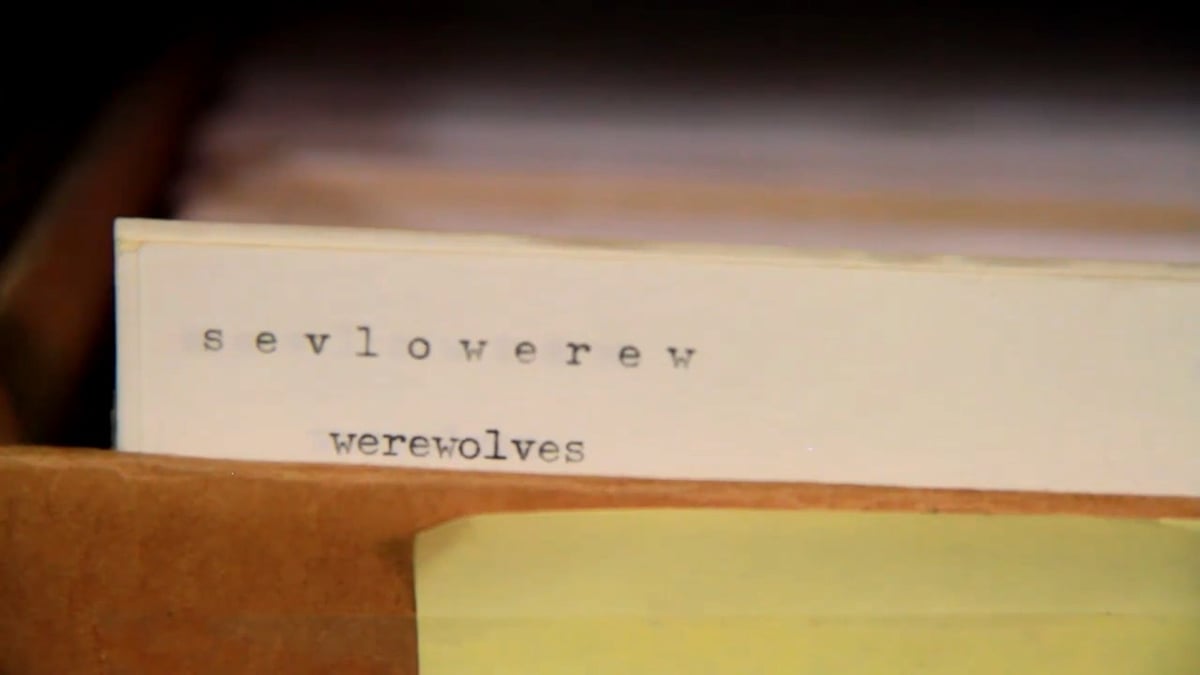
Here are some more examples of entries from the Backward Index:

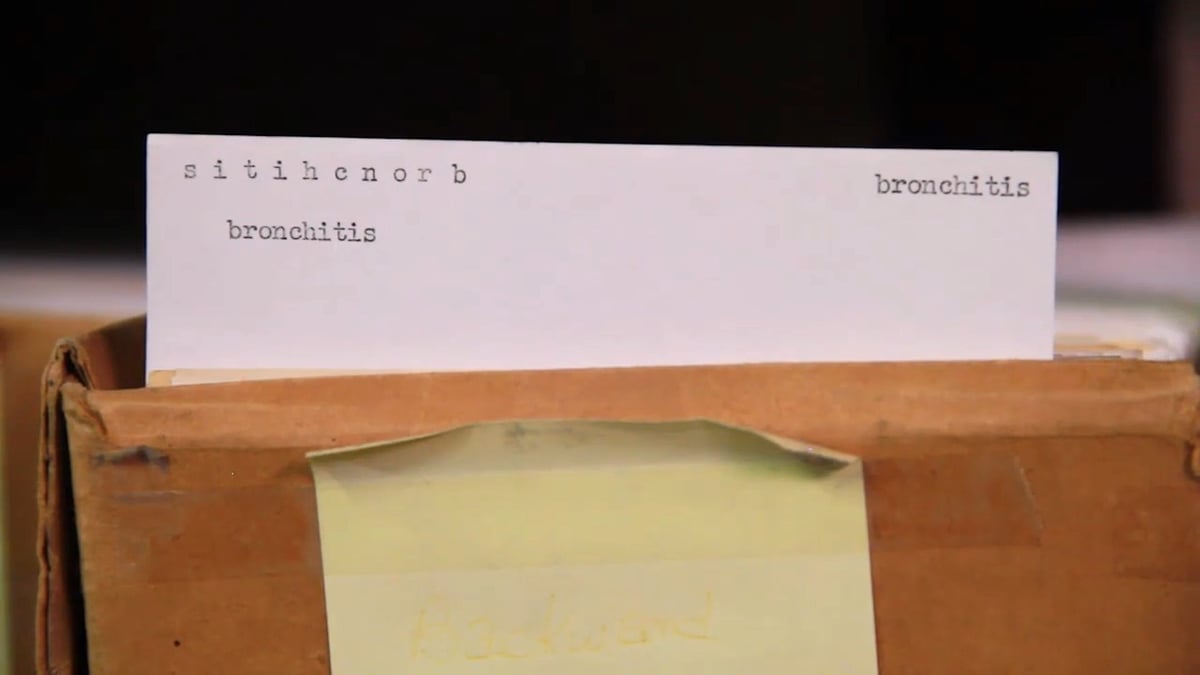
(thx, margaret)
Let’s the keep the David Attenborough love going: this is a six-hour video featuring 100 of the most iconic moments from the famed naturalist’s work. I got this via Enrique, who rightly asserts that “There’s no such thing as too much David Attenborough.”
See also Three Hours of Unbelievable Moments From Nature, Narrated by David Attenborough.
A Tube station in West London used to have a flooding problem. Instead of opting for an expensive reworking of the landscape via reservoir & levee, local officials reintroduced a family of beavers into the area.
The beavers are part of an unlikely effort to bring back a vanished species and help Britain adapt to a very modern problem: climate change.
Britain is famous for drizzle, but climate change is making rainfall heavier and more erratic. Places that didn’t used to flood are now waterlogged. So scientists have enlisted some of the animal kingdom’s best flood engineers — beavers — to help.
In West London, conservationists got a government license to resettle a family of five beavers in a 20-acre urban park near the Greenford Tube station. It used to be a golf course, with a creek running through it. Within weeks, the beavers dammed up the creek, creating a pond that holds water and stops it from spilling into the city. They also diverted the creek’s flow into smaller tributaries, creating a wetland that better absorbs heavy rainfall — mitigating the risk of flooding downstream.
“They effectively turned this site into a giant sponge that can take heavy rainfall and slowly release water back into the landscape, creating a lot more resilience for flooding,” explains Sean McCormack, a local veterinarian who started the Ealing Beaver Project, named for the London borough of Ealing, where it’s located.
The beaver-engineered landscape has attracted other animals, increasing the area’s biodiversity:
“By felling trees, they’ve also opened up the canopy, and we’ve seen an abundance of biodiversity,” McCormack says.
Freshwater shrimp have appeared in the creek, he says, plus eight new species of birds, two types of bats and rare brown hairstreak butterflies, which lay their eggs on blackthorn branches nibbled by beavers.
The moment I clicked through to the Caught In Joy YouTube channel, I knew I was going to love it. The description:
Over 80 albums designed to focus, flow and reset. Instrumental electronic music for you brain to wander.
And from the website:
Caught In Joy (Karol Pokojowczyk) is a multi-instrumentalist based in Florida, passionately dedicated to live composing, hardware synthesizers, and tape recording - a completely independent music project. I strive to create four albums and visual performances every month, entirely by myself.
I started my professional life as a software engineer and later became a serial entrepreneur, with a few successes along the way. After more than 30 years of working, I saved enough to fund my dream: building a home studio where I could finally focus fully on music.
In the past three years, he’s released 80+ albums and other performances, which are available for purchase on BandCamp. I’ve only had time to listen to bits and pieces of a few albums & videos, but I know a bunch of them are going into my Underscore collection very soon.1 (via johnny decimal)
I have a pizza oven and baked very underwhelming bread twice during the pandemic, but I’ve found it difficult to fall into a proper rabbit hole when it comes to dough-making. Focaccia might do it for me.
My daughter and I had been wanting to experiment with focaccia (and schiacciata) and so I suggested we make this Bon Appetit recipe that Alana recommended in this recent KDO recipe thread — it’s tough to resist “I am mildly famous for this focaccia. It’s bread for lazy people who love hot bread.” It’s me. I am lazy. I love hot bread.
We made it yesterday and it came out well: very delicious right out of the oven. And it was really the first time I’ve made dough where I’ve been like, “oh, I finally get why people say pizza/bread dough is a living thing”. Today we made sandwiches (mortadella, prosciutto, burrata, arugula) and they were quite good — but the focaccia crumb was pretty dense. Which sent me on a little bit of a research expedition, during which I found this video on YouTube:
Wow! Check out all those bubbles…ours didn’t look anything like that. I actually squealed when she pressed down on the bread and it sprung right back — that focaccia might be able to replace my car’s suspension. This recipe results in a more hydrated dough than the BonApp recipe does. And you work it more and it has different flour (00 instead of all-purpose). And the process looks only a little bit less lazy…manageable for me, I think. Looking forward to trying this out next!
The 250th birthday of the United States is coming up and I know many of us are having a tough time feeling celebratory because *waves hands around at everything*. To mark the occasion in a decidedly non-jingoistic manner, historian Heather Cox Richardson is producing a series of one-minute videos, each featuring one of “the many people, places, and events that have built our country and remind us of the power of each person to make history”. From the introductory video above:
From the time of our country’s founding 250 years ago, the story of America has been one of the constant efforts of Americans — from all races, ethnicities, genders, and abilities — to make real the belief that we are all created equal and have a right to have a say in our democracy.
Among the first group of videos are those about the AIDS Memorial Quilt (narrated by founder Cleve Jones), the battles of Lexington and Concord (narrated by Massachusetts governor Maura Healey), John Peter Zenger (narrated by Jelani Cobb), and the Erie Canal (narrated by Pete Buttigieg).
You can find the rest of the videos, as well as future installments, in this playlist on YouTube. Richardson wrote about the project for her newsletter:
We designed the videos to emphasize the agency of Americans—mostly everyday Americans—to change the country. Each falls into a category that defines what it means to be an American, including community, democracy, innovation, mobility, civil rights, education, conservation, and creativity.
The day after ending his run on The Late Show, Stephen Colbert hosted a show called Only in Monroe on a Michigan public access channel. His musical director for the show was Jack White, nestled onstage between a boombox and a reel-to-reel recorder. His guests included Byron Allen, Jeff Daniels, Steve Buscemi, and Eminem.
He told viewers during his final Late Show monologue that they might next find him in Monroe:
At the top of his final CBS monologue Thursday night, Colbert paused to mark the occasion: “Tonight is our final broadcast from the Ed Sullivan Theater.”
When the audience booed, Colbert waved them off.
“No, no, we were lucky enough to be here for the last 11 years, all right? Can’t take this for granted,” he said. “Though technically our first show in July of 2015 was from a public access station in Monroe, Michigan for an audience of 12 people. Show business being what it is these days, that’s probably where you’ll see me next.”
Colbert had hosted Only in Monroe once before, about two months out from starting at The Late Show. His special guest that night was Eminem.
Stephen Colbert? The man knows how to commit to the bit.
Water World, created by Seán Doran from imagery captured by a NASA/NOAA weather satellite, is a gorgeous, swirling, painterly portrait of the Earth’s dynamic atmosphere. Doran calls it “a meditative slow gaze at Earth’s atmosphere, revealing the hidden depths of activity in the water-filled skies of planet Earth”. It’s 4K, so put it on the biggest screen you can find and just sit back and watch.
One of the questions on The Colbert Questionert that Stephen Colbert would administer to his celebrity guests was “What number am I thinking of?” As you can see from this compilation, his answer was often, but not always, “no”.
A few of the guests said “42” but none ever said “69”?
So anyway, the Late Show is coming to an end tonight, a casualty of CBS’s newfound fealty to the Trump regime, and Stephen Colbert finally took the questionert himself. And yes, at last, he revealed the number that he was thinking of…to Robert De Niro no less:
Wow, BBC Earth has posted this three-hour-long video to YouTube of David Attenborough narrating Unbelievable Moments From Nature. I’ve had it on in the background for the last little while as I’m working and it’s great.
Newer posts
Older posts






Socials & More