kottke.org posts about video games
Following the examples set by PacManhattan and Nintendo Amusement Park, another popular video game is moving beyond the screen and into the real world. Enthusiasts of EA Sports’ Madden NFL 06 have been spotted in various locations around the United States playing a physical game based on the bestselling title.
DeWayne Coleman of Grand Rapids, Michigan said, “it looked so fun on the screen and we thought, ‘why can’t we go find a flat grassy area to run around, throw the ball, and punt on fourth down?’” Other “football” groups (as they like to be called) have uploaded candid photos of their activity to the Flickr photo-sharing site.
These early amateur efforts bare a crude resemblance to the gameplay in Madden, but a professional league set to begin play this fall in several major US cities will follow Madden NFL 06 much more closely. The National Football League (NFL) will employ athletes that resemble their in-game counterparts that will play for teams named after those in Madden. The teams will go through a full 16-game season, followed by a playoff and a “Super” bowl game to determine the champion. League officials plan to bring in revenue by charging for admission, selling foodstuffs during the games, and memorabilia inspired by the virtual uniforms worn by players in the game. The video game’s namesake, TV personality John Madden, will even colorfully describe the action of the games for simultaneous broadcast on network television.
Madden NFL 06 purists have criticized the NFL’s ambitious efforts, saying that ticket prices are too high and the games aren’t interactive enough. One Madden fan from Phoenix, Arizona summed up the frustrations: “I’m supposed to pay twice as much as I paid for the video game for one lousy live game, not including beer and hot dog costs, and I can’t even control what’s going on in the game? What the hell is so fun about that?”
S-s-s-omething from the inbox. Paul writes regarding the uncanny valley:
Given your recent link re: the uncanny valley, I thought this article about Sun-Maid’s redesigned icon would be worth your time. Photo.
Clearly, she’s selling grapes from a certain valley. Creeeepy.
I love the idea of Uncanny Valley being an actual geographical location (situated in California, I would assume) inhabited by creepy video game characters, digitized actors, and retooled advertising icons.
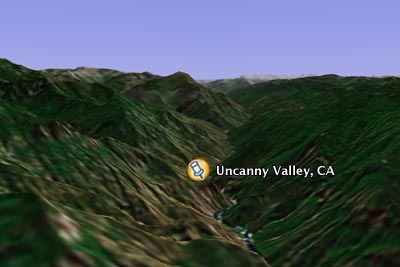
Imagine the views from neighboring hillsides! (Image courtesy of Google Earth.)
The Stev(ph)ens Dubner and Levitt report on some recent research suggesting that people who are good at things got good at them primarily through practice and not because of innate talent.
Their work, compiled in the “Cambridge Handbook of Expertise and Expert Performance,” a 900-page academic book that will be published next month, makes a rather startling assertion: the trait we commonly call talent is highly overrated. Or, put another way, expert performers — whether in memory or surgery, ballet or computer programming — are nearly always made, not born. And yes, practice does make perfect. These may be the sort of cliches that parents are fond of whispering to their children. But these particular cliches just happen to be true.
The talent myth described here seems to be distinct from that which Malcolm Gladwell talks about in relation to talented people and companies, but I’m sure parallels could be drawn. But back to the original article…I was particularly taken with the concept of “deliberate practice”:
Deliberate practice entails more than simply repeating a task — playing a C-minor scale 100 times, for instance, or hitting tennis serves until your shoulder pops out of its socket. Rather, it involves setting specific goals, obtaining immediate feedback and concentrating as much on technique as on outcome.
“Deliberate practice” reminds me of a video game a bunch of my friends are currently hooked on called Brain Age. Available for the handheld Nintendo DS, Brain Age is based on a Japanese brain training “game” developed by Dr. Ryuta Kawashima. The game measures the “age” of your brain based on your performance of simple tasks like memorizing a list of words or addition of small numbers. As you practice (deliberately), you get faster and more skilled at solving these mini-games and your brain age approaches that of a smarty-pants, twitchy-fingered teenager.
Speaking of talented teenagers, this week’s New Yorker contains an article (not online) on Ivan Lendl’s golfing daughters. In it, Lendl agrees that talent is created, not born:
“Can you create athletes, or do they just happen?” [Lendl] asked me not long ago. “I think you can create them, and I think that Tiger Woods’s father proved that. People will sometimes ask me, ‘How much talent did you have in tennis?’ I say, ‘Well, how do you measure talent?’ Yeah, sure, McEnroe had more feel for the ball. But I knew how to work, and I worked harder than he did. Is that a talent in itself? I think it is.”
Translation: there’s more than one way to be good at something. There’s something very encouraging and American about it, this idea that through hard work, you can become proficient and talented at pretty much anything.
Online TurboTax as a text adventure game. “I should write up a complete walkthrough to solve Tax Return 2006 in as few moves as possible.”
Today I’m starting (and hopefully completing) Operation Empty My Inbox and Operation Close All My Browser Tabs.1 Over the past month and a half, I’ve barely replied to any email I’ve gotten, so if you sent me something during that time period, I hope to get to it today and perhaps send you a reply. I’ve also got about 20 33 tabs open in my browser, waiting to be read, so expect some output from that as well.
Update: Ok! With the exception of 6 messages that need my attention in the next day or after I get back from my trip, my inbox is completely empty. And it only took 5 solid hours of writing, dragging, dropping, applying rules, and eye strain. Still no progress on the browser tabs glut. In fact, the inbox clear-out resulted in 6 or 8 more tabs being opened. One step forward, two steps back.
[1] I’m also starting two smaller projects, Project Learn How To Type Again (jeez, five days of almost no computer use and I’ve completely dogrhottem hiw tp typw) and Project Steal Footnote Technique From John Gruber, Who I Met At SXSW And Is Completely Delightful. Both of these are in lieu of what I really want to be doing right now, Project Save The Princess. Some friends lent us their GameCube with the Legend of Zelda Collector’s Edition, which contains the original Zelda game which is still as fun as ever. Octoroks, Tektites, and Leevers too! ↩
I can’t believe The Legend of Zelda is 20 years old. One of my proudest gaming accomplishments was beating Zelda without dying, using only the wooden sword.
David argues for more variation and serendipity in video games. “…games overcompensate for their lack of variance in game play with over-the-top psychedelic graphics and sound effects. This is not a new problem of course with Pac-man and Super Mario Brothers often held up as classic examples.”
Andy unearths an old video game by Penn and Teller called Smoke and Mirrors, which famously features a game in which you drive a bus for 16 straight hours to score a single point. See also Takeshi no Chousenjou, a similarly challenging Japanese game.
Gamers show a “similar pattern of high performance in resisting irrelevant impulses” as bilingual people. “Maybe those kids who play video games and who are also bilingual will be the best of older adults at filtering out distractions.” (via sjb)
Sorry to hit you with this on a Monday morning because the falling sand game is really addicting so you might not get any work done today. Sorry in advance.
Burgertime art. The pickle’s package is *very* disturbing to me. Yet, I cannot look away. (via nelson)
Blast from the past: influential online game SiSSYFiGHT 2000. I know a married couple that met on SiSSYFiGHT.
Averaging Gradius is a movie of 15 simultaneous games of Gradius layered on top of each other. Robin says: “So what you see, instead of a single ship going at it, is a fuzzy cloud of ships — bright where strategies overlap, faint where someone does something especially daring (or dumb).” Very cool; reminds me of Jason Salavon’s amalgamation of Playboy centerfolds.
Ian Albert collects really large digital images (100-900 megapixels) and constructs maps of video game worlds, including Super Mario Bros and The Legend of Zelda. (via lia)
Very high on the list of things that don’t need to be advertised is Tetris. Chances are you remember this Tetris commercial from the 80s anyway. “Use your thumbs, use your eyes, find yourself Tetrisized!”
More than you’d ever want to know about Tecmo Super Bowl. Still one of my all-time favorite video games…I play it on my Gameboy and still have a Sega Genesis in the closet.
Newer posts
Older posts






Socials & More