kottke.org posts about travel

Elon Musk says SpaceX is on target to send cargo to Mars in 2022 and people in 2024. The way the company will do it is by focusing its resources on a new vehicle, the Interplanetary Transport System (codename: the BFR). That vehicle will be able to travel to Mars, but can also be used to generate revenue for the company through launching satellites, resupplying the ISS, and going to the Moon.
Musk also proposed a variety of new uses for the scaled-down rocket beyond just going to Mars. Supposedly, the ITS can be used to launch satellites, take cargo to the International Space Station, and even do lunar missions to set up a Moon base. SpaceX’s current Falcon 9 fleet is used to do a few of those things already, but Musk says eventually the company will turn to the ITS to do all of its space missions.
“We can build a system that cannibalizes our own products, makes our own products redundant, then all the resources we use for Falcon Heavy and Dragon can be applied to one system,” he said at the conference. Musk says the cost of launching cargo on the ITS will be fairly cheap, too, since the rocket and spaceship will be a fully reusable system — unlike the Falcon 9, which is only 70 to 80 percent reusable.
Musk also astoundingly asserted that the same rocket system could be used for long-distance travel on Earth.
He ended his talk with a pretty incredible promise: using that same interplanetary rocket system for long distance travel on Earth. Musk showed a demonstration of the idea on stage, claiming that it will allow passengers to take “most long distance trips” in just 30 minutes, and go “anywhere on Earth in under an hour” for around the same price of an economy airline ticket.
As they say, “huge if true”. Musk is like the sci-fi Oprah here: You get a electric car! And you get a trip to Mars! And you get a self-driving car! And you get a 30-minute Hyperloop trip from SF to LA! And you get a rocket shuttle from NYC to Mumbai in 43 minutes for $1200! Beeeeeeeeees!!!!
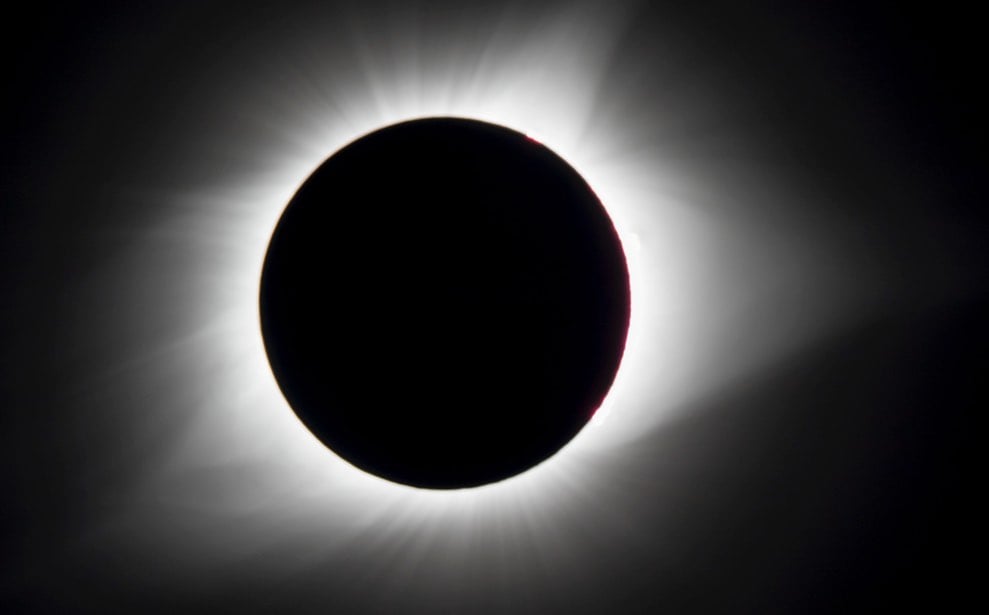
I was not prepared for how incredible the total eclipse was. It was, literally, awesome. Almost a spiritual experience. I also did not anticipate the crazy-ass, reverse storm-chasing car ride we’d need to undertake in order to see it.
I’m not a bucket list sort of person, but ever since seeing a partial eclipse back in college in the 90s (probably this one), I have wanted to witness a total solar eclipse with my own eyes. I started planning for the 2017 event three years ago…the original idea was to go to Oregon, but then some college friends suggested meeting up in Nebraska, which seemed ideal: perhaps less traffic than Oregon, better weather, and more ways to drive in case of poor weather.
Well, two of those things were true. Waking up on Monday, the cloud cover report for Lincoln didn’t look so promising. Rejecting the promise of slightly better skies to the west along I-80, we opted instead to head southeast towards St. Joseph, Missouri where the cloud cover report looked much better. Along the way, thunderstorms started popping up right where we were headed. Committed to our route and trusting this rando internet weather report with religious conviction, we pressed on. We drove through three rainstorms, our car hydroplaning because it was raining so hard, flood warnings popping up on our phones for tiny towns we were about to drive through. Morale was low and the car was pretty quiet for awhile; I Stoically resigned myself to missing the eclipse.
But on the radar, hope. The storms were headed off to the northeast and it appeared as though we might make it past them in time. The Sun appeared briefly through the clouds and from the passenger seat, I stabbed at it shining through the windshield, “There it is! There’s the Sun!” We angled back to the west slightly and, after 3.5 hours in the car, we pulled off the road near the aptly named town of Rayville with 40 minutes until totality, mostly clear skies above us. After our effort, all that was missing was a majestic choral “ahhhhhh” sound as the storm clouds parted to reveal the Sun.
My friend Mouser got his camera set up — he’d brought along the 500mm telephoto lens he uses for birding — and we spent some time looking at the partial eclipse through our glasses, binoculars (outfitted with my homemade solar filter), and phone cameras. I hadn’t seen a partial eclipse since that one back in the 90s, and it was cool seeing the Sun appear as a crescent in the sky. I took this photo through the clouds:
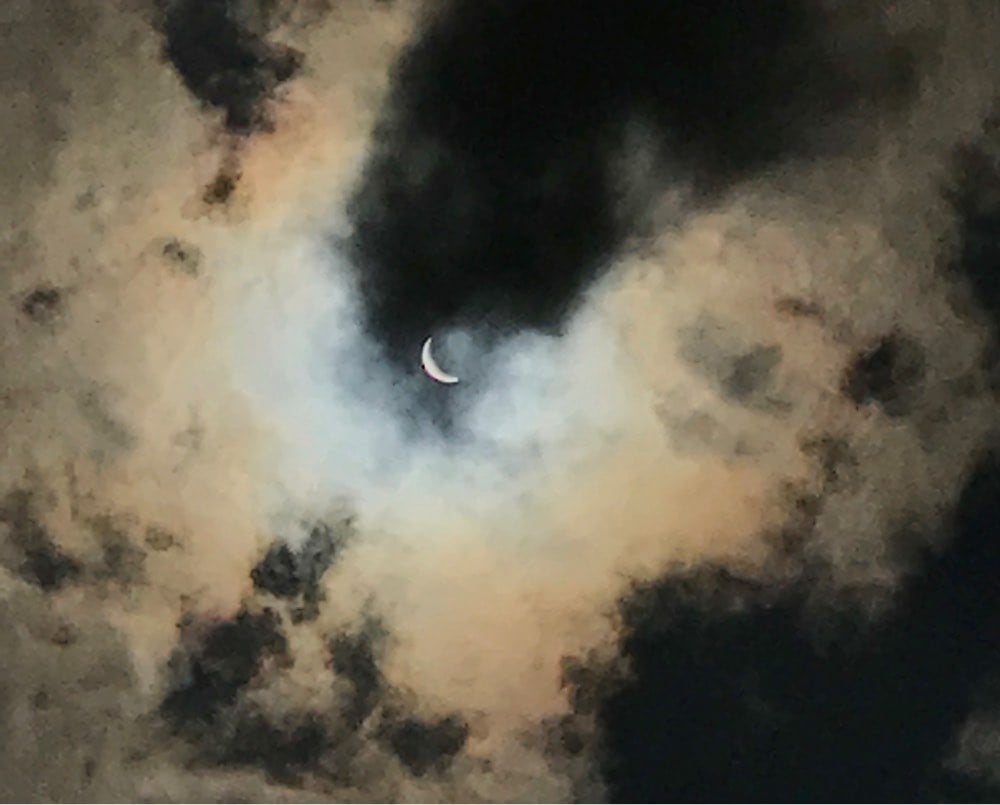
Some more substantial clouds were approaching but not quickly enough to ruin the eclipse. I pumped my fist, incredulous and thrilled that our effort was going to pay off. As totality approached, the sky got darker, our shadows sharpened, insects started making noise, and disoriented birds quieted. The air cooled and it even started to get a little foggy because of the rapid temperature change.
We saw the Baily’s beads and the diamond ring effect. And then…sorry, words are insufficient here. When the Moon finally slipped completely in front of the Sun and the sky went dark, I don’t even know how to describe it. The world stopped and time with it. During totality, Mouser took the photo at the top of the page. I’d seen photos like that before but had assumed that the beautifully wispy corona had been enhanced with filters in Photoshop. But no…that is actually what it looks like in the sky when viewing it with the naked eye (albeit smaller). Hands down, it was the most incredible natural event I’ve ever seen.
After two minutes — or was it several hours? — it was over and we struggled to talk to each other about what we had just seen. We stumbled around, dazed. I felt high, euphoric. Raza Syed put it perfectly:
It was beautiful and dramatic and overwhelming — the most thrillingly disorienting passage of time I’ve experienced since that one time I skydived. It was a complete circadian mindfuck.
After waiting for more than 20 years, I’m so glad I finally got to witness a total solar eclipse in person. What a thing. What a wondrous thing.
Update: Here are some reports from my eclipse-chasing buddies: a photo of Mouser setting up his camera rig, Nina’s sharp shadow at 99% totality, and Mouser’s slightly out-of-focus shot of the Sun at totality (with an account of our travels that day).
Over the past couple of years, Foursquare has used their location data to accurately predict iPhone sales and Chipotle’s sales figures following an E. coli outbreak. Their latest report suggests that leisure tourism to the United States was way down year-over-year over the past 6 months (relative to tourism to other countries).
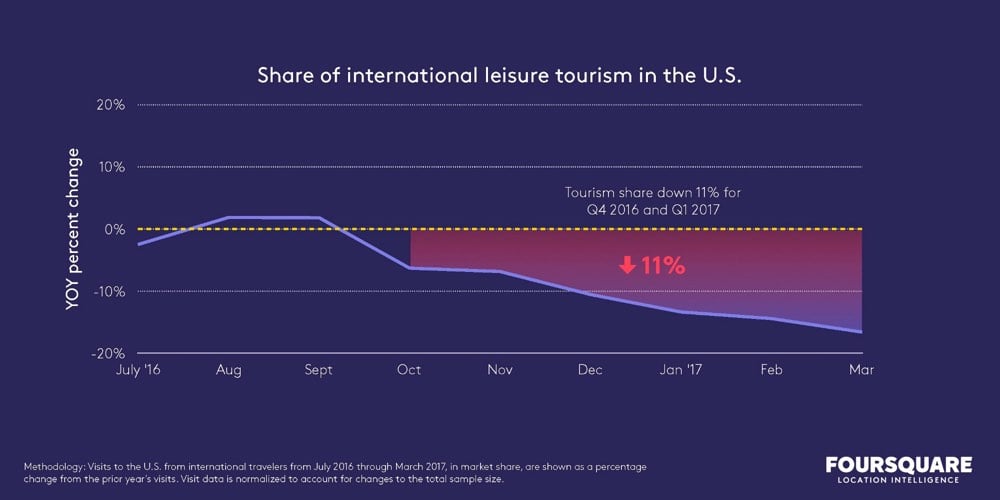
Our findings reveal that America’s ‘market share’ in international tourism started to decline in October 2016, when the U.S. tourism share fell by 6% year-over-year, and continued to decrease through March 2017, when it dropped all the way to -16%. Currently, there is no sign of recovery in the data.
And business travel to the US is suffering as well, relative to other countries:
Business trip activity is up in the U.S. by about 3% (as a share of international traveler global activity), but that trend line is not as high as elsewhere in the world, where YoY trends are closer to 10%. Relative to business travel gains globally, business travel to the U.S. is suffering.
As Foursquare notes, correlation is not causation and there are other factors at play (e.g. a stronger US dollar), but it’s not difficult to imagine that our xenophobic white nationalist administration and its travel & immigration policies have something to do with this decline.


37 years ago today, on May 18, 1980, Washington’s Mount St. Helens erupted in a blast that killed 57 people and covered a huge swath of the western US with ash and destruction. Alan Taylor, who grew up nearby and vividly remembers the eruption, shared some photos of the eruption and its aftermath at In Focus.
I was 6 when Mount St. Helens erupted and it was probably my first concrete memory of the wider world from childhood. For days and days, it was all anyone talked about at school. The next summer (or it may have been 1982), my parents, my little sister, and I embarked on a car trip west towards the Pacific from Wisconsin, which I later learned was a last hurrah family vacation before my parents divorced. We motored in a beast of a station wagon resembling The Griswold Family Truckster, and stopped at the Badlands, Mount Rushmore, Wall Drug, Rapid City, Yellowstone, and finally Seattle, where the only memory I have is of seeing the Space Needle briefly.
But the highlight of the trip was going to see Mount St. Helens. The landscape looked very much like in the second photo above, trees flattened over an ashy lunar landscape. It’s still one of the weirdest, most beautiful sights I’ve ever seen. We collected a couple of jars of ash to take home, along with some pumice stone.
Back at school in the fall, I managed a brief respite from my crippling unpopularity by showing off the ash jars and demonstrating how the pumice floated in water. A rock floating in water! But then the holes in the pumice filled with water, it slowly sank, and with it my new-found popularity. I imagine that pumice and those jars are still somewhere at my dad’s house, in a pile of something somewhere…it would be great to see them again.

This Is How We Do It is a children’s book by Matt Lamothe that follows the daily lives of seven real kids from different countries around the world (Japan, Peru, Iran, Russia, India, Italy, and Uganda).
In Japan Kei plays Freeze Tag, while in Uganda Daphine likes to jump rope. But while the way they play may differ, the shared rhythm of their days — and this one world we all share — unites them. This genuine exchange provides a window into traditions that may be different from our own as well as a mirror reflecting our common experiences.
Watch the trailer. This is exactly the sort of book I love getting for my kids: it’s What Do People Do All Day plus What I Eat: Around the World in 80 Diets.

A site called FamilyBreakFinder produced a world map with every country’s tourism slogan on it. A few of my favorite slogans:
Netherlands: The original cool
Colombia: Colombia is magical realism
El Salvador: The 45 minute country
Slovenia: I feel sLOVEnia
Cape Verde: No stress
Spain: #spainindetail
Morocco: Much mor
Bhutan: Happiness is a place
India: Incredible !ndia
Some of these countries should ask their ad agencies for their money back. (via @ftrain)
Introverts have limited reserves of energy and attention stored up for socializing with others and when they’re used up, the aftermath can feel very much like a hangover from too much drinking.
After a few hours, I couldn’t take it any more. I slipped away like a thief, skulking about the house, searching for a place where it was quiet. I came across a half-lit room and saw my future brother-in-law sitting in there, staring out the window. Knowing him to be an introvert himself, I decided this was my best option for escape and sat down across the room, wrapping my arms around my knees. I remember hoping he wouldn’t think I was intruding upon his own solitude before I allowed myself to zone out, letting my thoughts drown out the raucous laughter from downstairs, breathing deeply and feeling the tension drain away. I don’t know how long it was before my now-husband came looking for me, but I remember him laughing at finding the two introverts seeking refuge together.
This happened to me a couple of weeks ago. I travelled to a friend’s wedding but got to town a few days early to go see a show and meet up with some other friends. By the time the wedding rolled around, I had spent time with so many people in different social groups that I left after the ceremony and didn’t stay for dancing and karaoke or anything (sorry!). I didn’t even get to congratulate the bride (so so sorry!!)…I was just done. After that, I mostly just holed up in my hotel room, reading, and walked around by myself, even though there were so many other things I could have been doing with so many other people. Several years ago, I would have felt weird and horrible about this, but I know myself well enough now that I just roll with it…I read so much of a book I was enjoying that the time spent can hardly be considered a loss.
Jan Chipchase is the founder of Studio D Radiodurans, which is sort of a modern day A-Team, except with more field research and fewer guns. For example, Chipchase is the sort of person who, for vacation, does not sip pina coladas in Bali but heads for “Kyrgyzstan, Tajikistan’s GBAO region and China’s western provinces”. At the conclusion of the trip, which was actually only partially a vacation, Chipchase jotted down 61 Glimpses of the Future. A few of my favorite observations:
7. A white male travelling alone in interesting places, will always need to disprove they are a spy. Thanks Hollywood.
24. There is only one rule for driving in the GBAO: give a lift to every local that wants one, until the car is full. It’s common to travel main thoroughfares for a day and only see a couple of vehicles.
33. People wearing fake Supreme are way more interesting than those that wear the real deal.
34. An iPhone box full of fungus caterpillar in Kham Tibet sold wholesale, is worth more than a fully specced iPhone. It’s worth 10x at retail in 1st/2nd Tier China. It is a better aphrodisiac too.
38. Tibetan monks prefer iOS over Android.
53. Visitors to Tibet proper are supposed to go in a tour group and hire a local guide. With the right agent you can become a tour group of one and on arrival tell the guide you don’t need their services. It helps to look like you’re going to behave.
This is, as Tyler Cowen might say, interesting throughout. (via @themexican)
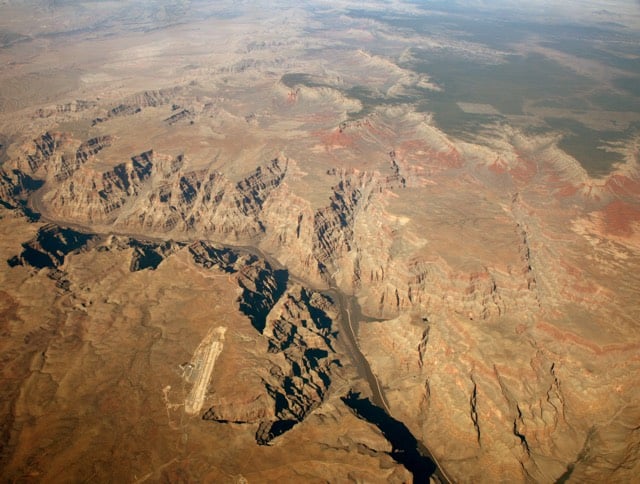
The app Flyover Country, built by a team at the University of Minnesota, uses GPS to tell you what interesting features you’re currently flying over.
Learn about the world along the path of your flight, hike, or road trip with GPS tracking. Offline geologic maps and interactive points of interest reveal the locations of fossils, core samples, and georeferenced Wikipedia articles visible from your airplane window seat, road trip, or hiking trail vista.
More on the app from Fast Company. (via @feltron whose book came out the other day!)
On Ask MetaFilter, sleepy psychonaut declares their love for spending time in temporarily deserted places that are normally crowded.
Examples include San Francisco during Burning Man weekend, Penn Station at 2pm on Christmas day, almost everywhere in the US on Easter Sunday, the Financial District in Boston on Saturdays and Sundays, many major European cities during August.
Several people offered up suggestions; these were my favorites:
Any big amusement park on a day when it’s raining. The heavier the rain, the fewer people. (Cue family flashback to an idyllic day at Disneyland when there was hardly anyone there.)
Unless there’s a special event, people don’t go to museums in the evening. Here’s what the British museum looks like if you go on such an evening.
Any Colorado ski resort town during the summer when there’s not a festival going on. The ski paths are alpine meadows full of flowers you can hike on, and the streets are pretty much empty. Also renting condos there is super cheap off-season.
For an area that gets not quite as deserted but is much nicer to visit after the end of the usual season, you have to promise not to tell anyone (because this is a secret) but the beach towns along Lake Michigan are just about empty by a week after Labor Day but the beaches are actually at the nicest they will be all season because the lake has been warming all summer. Mid-September is a really nice time of year to visit the Great Lakes if you like clean, deserted beaches, farm markets full of fresh produce, restaurants with plenty of open tables, and relaxed hospitality staff who are happy to have survived the summer.
I went to the Muse D’orsay deep off season in the days before Christmas. Being alone in a room full of Van Goghs for at least 10 minutes (well but for a security guards & cameras) is still one of the highlights of my life.
(via @mathowie)
Serena Solomon grew up in Australia and when she moved to the US, she was shocked at the number of products sold at American grocery stores. Solomon recently asked other immigrants to share their biggest surprises about American culture. From a French welder:
It is so frustrating here. Nothing is easy. Nothing is efficient. To pay rent, you have to use a check? I have never written a check. The last time I got a check was maybe 20 years ago, from my granddad. Getting an apartment takes so long as opposed to other countries I have lived in where it’s just a handshake. That’s it. I went to the post office yesterday, and I was waiting in line for maybe an hour — and there were only five people in front of me. I felt like I went from a Western country to a third-world country. People here with money have access to things. The rest of the people are just trying to survive.
Food is a big difference for some:
Food-wise, I noticed us all getting these round faces from the bad food we ate. We did not realize it, because it was the standard and you think because it’s advertised and readily available it can’t be bad for you. We were so ignorant coming from South Africa, eating home cooked food every night over there. Then, once we got here, we ate those corn dogs almost every day for lunch, little pizzas for snacks, and sugary cereals for breakfast.
Reminds me of Cup of Jo’s excellent series about how parenthood differs around the world.
A company called Studio D recently published their corporate end-of-the-year report for 2015. It is unlike most other companies’ year-end reports. Studio D, which was founded by global citizen Jan Chipchase, “specialises in sensitive research topics requiring a very discreet presence; through to working in higher risk environments”.
This year the studio was joined by two four-legged team members: Ramoosh the camel purchased from the livestock market in Hargeysa; and Neyy a goat bought on the road between Harare and Bindura. As is the local norm in a country with limited electricity and even less refrigeration, Neyy was gifted to an interviewee as a small thank-you — anything larger wouldn’t be possible to eat in one sitting and would spoil after slaughter. Both were expensed.
The company also debuted the 1M Hauly Heist, which is a ultra-durable and discreet travel pack that will carry $1 million in US $100 bills and shield electronics from RF tracking. The 1M Hauly Heist made it onto my 2015 holiday gift list.
Tom Harman recently rode an Amtrak train from NYC to San Francisco, taking little videos of the scenery outside all the while. He edited that footage into this 5-minute video.

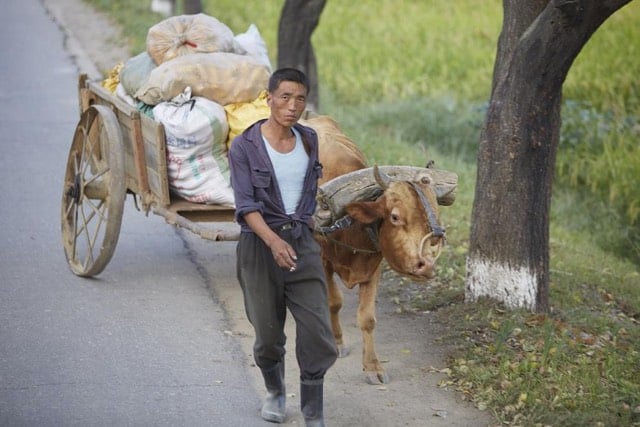
Harvard graduate student Christopher Carothers recently travelled to North Korea and, because he was an American white man who spoke Korean, he was able to talk with some everyday North Koreans. The conversations he had make for fascinating reading.
Our tour group visited a local high school in a city north of Pyongyang. The students were disappointed when none of us could name three female North Korean heroes from their revolutionary history.
I didn’t mind their patriotism, and their curiosity was refreshing. But when asked how I liked Pyongyang, what could I say? Usually I just said polite things and was rewarded with beaming faces. But was I being fair to these young adults? Doesn’t intercultural exchange require some basic honesty? I told Jong Ho that I liked Korean people and appreciated how clean and grand their capital was.
“However,” I went on gingerly, “I have to admit that Pyongyang is a poor city and out of touch with the modern age. Even a poor provincial capital in China wouldn’t be envious.”
He took this in for a minute and looked thoughtful.
“It’s okay,” he said with a smile, “I’m very glad to meet you.”
Carothers chatted with his tour guide about politics:
“Who will be the next leader of America?” she asked. I explained about our two parties and gave her my best guess.
“But even if the party switches from Democratic to what are they called, Republicans, relations with Korea are always so tense. Why? Why does a big country like America continue to provoke a small country like Korea? No one wants war. We always say we are ready for war, but no one wants war. I don’t understand politics.”
“What American provocations do you mean?” I asked, curious. “Didn’t the Great Marshal Kim Jong Un threaten to turn Seoul into a sea of flames?”
“Well, he’s responding to American military exercises. Always with the military exercises with the South.”
“I think, uh, many countries do military exercises,” I tried to explain. “Some are defensive. Honestly, many Asian countries including South Korea are concerned about China’s growth and the North getting nuclear weapons and so have asked to work with the U.S.”
“The U.S. has many nuclear weapons. Isn’t it … hypocritical?”
“Maybe. But should a country that can’t provide electricity properly in its capital really have nuclear weapons?”
“I see,” she said quietly.
The whole thing is well worth a read. Some of the photos accompanying the article were taken by Christian Petersen-Clausen, who also recently visited North Korea as a tourist. (The photos at the top of this post were taken by Petersen-Clausen as well.) Keegan Hamilton interviewed him about his photos at Vice.
He said one surprise from the trip was that many North Koreans seemed “pretty damn aware” of life in the outside world. He saw people in Pyongyang using smartphones, which are connected to the country’s propaganda-filled “intranet” and blocked from calling foreign countries, but says he was told it was relatively easy for people to procure Chinese or South Korean SIM cards. Foreign media, smuggled into the country on USB sticks, was also reportedly common.
“They watch Chinese and South Korean soap operas, they see the cars, the fashion, everything,” he said. “It’s basically rubbed in their faces how poor they are, while at the same time they can’t talk about that.”
A site called SDR Traveller sells ultralight, strong, and discreet bags for traveling to places where such things are necessary. Their most eye-catching item is the 1M Hauly Heist, a bag designed to carry US$1 million in cash that also doubles as a Faraday cage for shielding your electronics from radio frequency tracking.

From the description on the page for the 1M Hauly (which holds the million bucks without the RF shielding):
In many countries project expenses and payroll for the local crew need to be carried in cash. Whether you’re managing a team of thirty working for months at the edge of the grid, or on a solo trip to negotiate a significant cash transaction, the 1M Hauly is designed for discreet, safe carry of up to $1 Million USD in strapped, new or used $100 USD banknotes.
Designed to address the six main issues with carrying significant volume banknotes in field: risk of discovery; risk of damage (especially in high-humidity, monsoon environments); container robustness; carryability; glide; and in-field accounting.
Note that $1 million in $100 bills weights 20.4lbs. The site also sells smaller money pouches (in $10k, $100k, and $400k carrying capacities) as well as a durable duffel. All the bags are made from Cuben Fiber, a material originally used for yacht sails that’s four times stronger than Kevlar at only half the weight. (via @craigmod)
Newer posts
Older posts



Socials & More