



Danish tourism ads by Lars Von Trier
Lars Von Trier has directed a bunch of tourism ads for Denmark; here’s a sneak peek.

This site is made possible by member support. 💞
Big thanks to Arcustech for hosting the site and offering amazing tech support.
When you buy through links on kottke.org, I may earn an affiliate commission. Thanks for supporting the site!
kottke.org. home of fine hypertext products since 1998.
Beloved by 86.47% of the web.
Lars Von Trier has directed a bunch of tourism ads for Denmark; here’s a sneak peek.
The NY Times’ Frugal Traveler blog has a detailed post on how to go about searching for cheap flights online. Saving this mainly for my own information, for 10-15 years from now, when frequent travel becomes an option again.
Not sure why I’m bothering to do this list for 2009 as I didn’t really go anywhere, but here it is for posterity:
Waitsfield, VT*
New York City, NY*
Boston, MA*
Orange, MA*
Springfield, MA
Nantucket, MA
One or more nights were spent in each place. Those cities marked with an * were visited multiple times on non-consecutive days. Here are my lists for 2005, 2006, 2007, and 2008.
At least with the cheese and pudding, you were actually buying perishable non-returnable products. But hundreds of travelers recently discovered the mother of all frequent flyer schemes: buying legal-tender $1 coins from the US Mint with free shipping and paying for them with miles-offering credit cards. Take the coins to the bank, use them to pay off the credit card, and keep the miles. Brilliant.
One FlyerTalker, identified by his online moniker, Mr. Pickles, claims to have bought $800,000 in coins. […] He earned enough miles to put him over two million total at AMR Corp.’s American Airlines, giving him lifetime platinum-elite status — early availability of upgrades for life and other perks on American and its partners around the world. He also pumped miles into his account at UAL Corp.’s United Airlines and points into his Starwood Preferred Guest program account.
(via mr)
In 2000, Nick Tosches went in search of something that he was told didn’t exist anymore: the opium den.
In the early decades of the 20th century, as the drug trade was taken over by the Judeo-Christian coalition that came to control crime, Jewish and Italian names became almost as common as Chinese names in the reports of those arrested for smuggling, selling, and den-running. While the old Chinese opium smokers died off, the new drug lords actively cultivated a market for the opium derivatives, first morphine and then heroin, two 19th-century inventions that offered far greater profit margins than opium itself.
…
The last known opium den in New York was a second-floor tenement apartment at 295 Broome Street, between Forsyth and Eldridge Streets, at the northeastern edge of Chinatown. It was run by the apartment’s tenant, a Chinese immigrant named Lau, who was 57 when the joint got raided and his ass got hauled away. There were a few old pipes and lamps, 10 ounces of opium. And 40 ounces of heroin. The date was June 28, 1957. That was it. The end of the final relic of a bygone day.
Timelapse video of a trip from Denver to Singapore and back again.
I made a time lapse video of a weekend trip I did to singapore by hanging a point and shoot around my neck, taking a snapshot every couple minutes/hours.
Susan Orlean travels to Morocco to find out about donkeys for Smithsonian magazine.
The medina in Fez may well be the largest urbanized area in the world impassable to cars and trucks, where anything that a human being can’t carry or push in a handcart is conveyed by a donkey, a horse or a mule. If you need lumber and rebar to add a new room to your house in the medina, a donkey will carry it in for you. If you have a heart attack while building the new room on your house, a donkey might well serve as your ambulance and carry you out. If you realize your new room didn’t solve the overcrowding in your house and you decide to move to a bigger house, donkeys will carry your belongings and furniture from your old house to your new one. Your garbage is picked up by donkeys; your food supplies are delivered to the medina’s stores and restaurants by mule; when you decide to decamp from the tangle of the medina, donkeys might carry your luggage out or carry it back in when you decide to return. In Fez, it has always been thus, and so it will always be. No car is small enough or nimble enough to squeeze through the medina’s byways; most motorbikes cannot make it up the steep, slippery alleys. The medina is now a World Heritage site. Its roads can never be widened, and they will never be changed; the donkeys might carry in computers and flat-screen televisions and satellite dishes and video equipment, but they will never be replaced.
This is probably the most interesting thing you’ll ever read about donkeys.
The Geek Atlas is a travel guide for those interested in science, math, and technology.
The history of science is all around us, if you know where to look. With this unique traveler’s guide, you’ll learn about 128 destinations around the world where discoveries in science, mathematics, or technology occurred or is happening now. Travel to Munich to see the world’s largest science museum, watch Foucault’s pendulum swinging in Paris, ponder a descendant of Newton’s apple tree at Trinity College, Cambridge, and more.
Sounds interesting. It’s selling surprisingly well at Amazon right now.
It might surprise you that introverts travel differently than extroverts, particularly because most travel magazines, guidebooks, and TV shows are produced by and for extroverts.
I don’t seek people out, I am terrible at striking up conversations with strangers and I am happy exploring a strange city alone. I don’t seek out political discourse with opinionated cab drivers or boozy bonding with locals over beers into the wee hours. By the time the hours get wee, I’m usually in bed in my hotel room, appreciating local color TV. (So sue me, but I contend that television is a valid reflection of a society.)
I almost broke my neck extensively nodding in agreement while reading this article. The author also has some tips for the introverted traveler. And if you haven’t read it, Jonathan Rauch’s Caring for Your Introvert remains one of my favorite things that I’ve ever featured on kottke.org.
David Sedaris finds lust, love, and laughter on long train trips.
Not that Johnny was bad company-it’s just that the things we had in common were all so depressing. Unemployment, for instance. My last job had been as an elf at Macy’s.
“Personal assistant” was how I phrased it, hoping he wouldn’t ask for whom.
“Uh-Santa?”
If you’ve been following his work/life at all, the last paragraph will probably make you smile.
Amalfitano had some rather idiosyncratic ideas about jet lag. They weren’t consistent, so it might be an exaggeration to call them ideas. They were feelings. Make-believe ideas. As if he were looking out the window and forcing himself to see an extraterrestrial landscape He believed (or rather like to think he believed) that when a person was in Barcelona, the people living and present in Buenos Aires and Mexico City didn’t exist. The time difference only masked their nonexistence. And so if you suddenly traveled to cities that, according to this theory, didn’t exist or hadn’t yet had time to put themselves together, the result was the phenomenon known as jet lag, which arose not from your exhaustion but from the exhaustion of the people who would still have been asleep if you hadn’t traveled. This was something he’d probably read in some science fiction novel or story and that he’d forgotten having read.
2666 by Roberto Bolaño, page 189.
Update: From this post and its comments, it seems likely that the “science fiction novel or story and that he’d forgotten having read” was William Gibson’s Pattern Recognition or Brian Fawcett’s Soul Walker. From Pattern Recognition:
She knows, now, absolutely, hearing the white noise that is London, that Damien’s theory of jet lag is correct: that her mortal soul is leagues behind her, being reeled in on some ghostly umbilical down the vanished wake of the plane that brought her here, hundreds of thousands of feet above the Atlantic. Souls can’t move that quickly, and are left behind, and must be awaited, upon arrival, like lost luggage.
(thx, thessaly & michael)
From the YesButNoButYes Guide to Dutch Women:
Yfke Sturm - It must have been hard for Yfke growing up. With a name that sounds like it came from Return of the Jedi, she was probably the subject of ridicule and name-calling. I too had those evils done to me, and I’d be happy to console her.
Educational.
The BBC did a flight simulation of US Airways flight 1549 that shows what the water approach looked like from the cockpit. (thx, david)
I’m still fascinated by the water landing of US Airways flight 1549 on the Hudson River late last week. Here are a few more things I’ve seen related to it over the last couple of days.
First the videos. Someone visiting the Bronx Zoo caught the plane on video, flying low in the sky just after the bird strike. A Coast Guard video monitoring station got a shot of the plane just after it splashed down…you can see the spray from the impact flying in from the left of the video just after the 2:00 mark.
Soon after the plane hits, the camera zooms in and you can see just how quickly people get out and onto the wings. And then this video shows it most clearly:
Look how low and level and steady Sully guided that thing in! Amazing!
The NY Times has a couple of good pieces in their extensive crash coverage. I loved reading what various passengers had to say about the crash, lots of little moments of heroism in there.
The life raft attached to the plane was upside down in the river, just out of reach. Mr. Wentzell turned and found another passenger, Carl Bazarian, an investment banker from Florida who, at 62, was twice his age. Mr. Wentzell grabbed the wrist of Mr. Bazarian, who grabbed a third man who held onto the plane. Mr. Wentzell then leaned out to flip the raft. “Carl was Iron Man that day,” Mr. Wentzell said. “We got the raft stabilized and we got on.” A man went into the water, and the door salesman and the banker hauled him aboard. He curled in a fetal position, freezing.
The Times also comes through with the 3-D flight graphic I asked for the other day but they upped the ante with a seating chart of the plane where you can click on certain passengers’ seats to read their thoughts. Mark Hood in seat 2A described the landing:
When we touched down, it was like a log ride at Six Flags. It was that smooth.
The whole thing is still so amazing. Looking at the underside of the plane as they lifted it from the water last night, you can see the damage to the bottom of the plane and just how close they all were to being flung all over the place or sinking quickly or a number of other different outcomes.
Dopplr is doing 2008 personal annual reports for all their users that shows “data, visualisations and factoids” about their 2008 travel. They’ve also done one for Barack Obama on his behalf that you can download for free. Obama took a whopping 234 trips in 2008 and traveled 92% of the distance to the moon!
Jauntsetter does a useful weekly roundup of travels deals specifically for New Yorkers. This week’s selection includes cheap fares to Cancun and Europe.
For the fourth year in a row, a list of all the places I visited in 2008.
Waitsfield, VT*
New York City, NY*
Boston, MA*
Orange, MA*
Springfield, MA
London, UK
Paris, France
Buffalo, NY
Binghamton, NY
Cedar Rapids, IA
Nantucket, MA
Las Vegas, NV
Washington DC
One or more nights were spent in each place. Those cities marked with an * were visited multiple times on non-consecutive days. Note: We didn’t actually spend the night in Paris, but we were there all day so I threw it in there. Here are the lists for 2005, 2006, and 2007.
I’ve been reading this site called I Keep a Diary for I don’t know how long, six years at least. The site is a hand-crafted throwback to an earlier web era, a series of annotated photo galleries that document the life, times, adventures, and friends of Brian Battjer Jr. Like its proprietor, the site is funny, enthusiastic, and good-natured, and that’s what keeps me coming back for more. I even visit the splash page each time I go because I like the quote that appears on it so much:
i feel nostalgia for things i’ve never known
IKAD is one of my favorite things on the web and the most recent entry is so truly magical that I had to share. Brian is more than a year behind in documenting his adventures so he’s just now getting around to telling the story of his July 2007 trip to Thailand and the United Arab Emirates with his girlfriend, Meredith. After telling his boss that he’s taking a month off of work, subletting his apartment, and arranging to stay with a friend in Dubai, he and Meredith speed off to the airport.
At this point, I urge you to just go read the story — it’s great and Brian tells it *way* better than I could — because I’m going to ruin a lot of it. If you need more convincing of this story’s wonderfulness, read on.
Anyway, off they go to JFK for their flight to Dubai. The woman at the Emirates check-in desk has no record of their tickets…becaue they got to the airport a whole day late. After some nervous moments, the woman finds them some seats on the plane.
Fast forward 12 hours or so: they land and deplane. Meredith discovers that she lost her passport and she swears that the thing is still on the plane. Emirates won’t let her get back on the plane to look for it but they send an employee to look for it. No dice. They then spent several hours trying to find somone to let them on the plane to search. No luck. Intense panic sets in; the plane is scheduled to leave for NYC in an hour or two.
At this point, Brian phones his friend in Dubai, Bernadette, whom he has never met in person, and explains to her the situation. She says, “I’m on the way to the airport now…I’ll see what I can do.” It turns out that Bernadette’s boss is a sheikh, one of the richest men in the world, and one of the most powerful men in Dubai. Bernadette arrives and tells them that her boss has dispatched his “fixer”, his Mr. Wolf. “You ain’t got no problems, Brian. I’m on the motherfucker. Chill out and wait for Mahmoun, who should be comin’ directly.”
“Shit Negro, that’s all you had to say.”
Sure enough, about ten minutes later a very large, serious-looking Emirati man walked up to the armed guards at immigration and with a nod, they let the dude through! We were like “Whoa.” Mahmoun came over to us, and asked us to tell him the problem (and he even whipped out a little pad to take notes just like Mr. Wolf!). After we’d finished explaining to him that we were almost 100% sure that the passport was still on the plane, he was like “Meredith you come with me. Bernadette and Brian, you wait here.”
He came back like two minutes later with ten airline employees in tow and said something like “This airplane is supposed to fly back to New York in forty-five minutes, but it’s not going anywhere until the passport that’s on there is found. So let’s go find it.”
Did Meredith recover the passport? Does Mahmoun go medieval on anyone’s ass? Oh, you’ll have to find out for yourself.
I don’t know if this is sadly hilarious or hilariously sad. Jeffrey Goldberg took all sorts of crazy stuff through airport security — “al-Qaeda T-shirts, Islamic Jihad flags, Hezbollah videotapes, inflatable Yasir Arafat dolls (really), pocketknives, matches from hotels in Beirut and Peshawar, dust masks, lengths of rope, cigarette lighters, nail clippers, eight-ounce tubes of toothpaste (in my front pocket), bottles of Fiji Water (which is foreign), and, of course, box cutters” — and almost nothing was ever taken away from him or was a source of concern for airport security personnel.
We took our shoes off and placed our laptops in bins. Schneier took from his bag a 12-ounce container labeled “saline solution.”
“It’s allowed,” he said. Medical supplies, such as saline solution for contact-lens cleaning, don’t fall under the TSA’s three-ounce rule.
“What’s allowed?” I asked. “Saline solution, or bottles labeled saline solution?”
“Bottles labeled saline solution. They won’t check what’s in it, trust me.”
They did not check. As we gathered our belongings, Schneier held up the bottle and said to the nearest security officer, “This is okay, right?” “Yep,” the officer said. “Just have to put it in the tray.”
“Maybe if you lit it on fire, he’d pay attention,” I said, risking arrest for making a joke at airport security. (Later, Schneier would carry two bottles labeled saline solution-24 ounces in total-through security. An officer asked him why he needed two bottles. “Two eyes,” he said. He was allowed to keep the bottles.)
So hard to pick just one excerpt from this one…it’s full of ridiculousness. I don’t care how many blogs the TSA launches, this is a farce. (thx, anthony)
Photos from two Arctic expeditions, one in 1854 and the other in 1875-6.
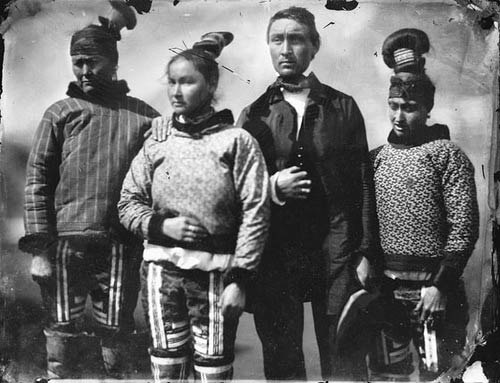
This photo is part of the National Maritime Museum’s contribution to Flickr’s Commons project.
Another story of traveling by cargo ship.
The stevedores, or as we call them in the states, longshoremen, are becoming the latest group of tradespeople to be put out of their jobs by robots. The ships already practically steer themselves, that’s why I’m staying in the pilot’s cabin, “there is no pilot”. The course of the ship is plotted in advance as a series of vectors with turns at key points. The ship’s computer lets the officer on duty know when it’s time to make a turn, and corrects itself with GPS as a reference during the straight runs. The origin of word “cybernetic” is “kybernetes” — ‘steersman’ in Greek. So the arrangement of cargo and the logistics of operations are already optimized by software, the next step will be to link that software directly to the hardware of cranes and harvesters and turn them into robots. They will have a set of broad goals and priorities (the strategy), and the kind of basic decision making processes (the tactics) that the ship uses to stay on course autonomously: avoidance and correction.
People who travel by container ship also seem to be able to write well about the experience. Previously. Even more previously.
Good Magazine has a nice little map feature on some of the world’s greatest journeys, including Magellan’s circumnavigation, the old Silk Road, and Around the World in 80 Days. (via justin blanton)
Nathan Myhrvold, billionaire polymath, recently wrote a series of three posts for the Freakonomics blog about his trips to Iceland and Greenland.
I’d like to say that global warming was evident during my visit, but that is not really the case. Indeed, [my guide] Salik tells me that he and most Greenlanders are pretty skeptical about it. The local fishing industry used to be based on arctic prawns, but the sea temperature has changed just enough that the prawns are much further north, so now they fish for cod.
But, as Salik points out, this cycle has happened several times in living memory. The same with the glaciers: yes they are retreating, but at least in his area, they have yet to reach the limits that the locals remember them. Objective measurements do show that climate change is happening. Nevertheless I was amused that the locals don’t seem to think it is such a big deal.
The photos are worth a look by themselves.
I mentioned passenger travel on cargo ships the other day. Dorothy Gambrell and her companion went on an around-the-world trip a couple of years ago, traveling mostly by boat and train. To get from North America to Asia, they booked passage on a cargo ship leaving from Oakland and bound for Taiwan. You can read about their adventures online…start here and use the “next entries” link at the bottom of the page to keep reading.
They warned us. They warned us about the food. The freighter agency literature mentions several times that the food may not be what Americans are accustomed to — for example, it says, “there may not be dessert.” The first morning’s breakfast is called “Hunter’s Toast,” which turns out to be toast smothered in something like liverwurst and topped by a fried egg. Breakfast is usually one part egg, one part meat, and one part toast except when it is sausage and a puddle of tomato sauce. Breakfast is served from 7:30 to 8:00am, which means arrive at 7:30 and leave at eight. One pot of coffee and one pot of hot water sit on the table next to the basket of tea bags and peanut gallery of condiments.
What a great adventure wonderfully told. (thx, matt)
Booking passage on a cargo ship is an easy and unusual way to travel.
Most of the major global shipping lines CMA-CGM, Canada Maritime, and Bank Line offer paying passengers to hop on one of their lines. As a paying passenger you are accommodated in guest cabins and have access to most areas of the ship.
Captains and crew spend a lot of time on the water, and they are usually happy to have a fresh face walking around their workplace, meaning that they may even invite you to eat with them, give you tours of the ship and maybe even have you over for an Officer’s happy hour.
You’d think it would be cheap but tickets can run you more than airfare…$80-140 per day, meals & lodging included.
See if this makes any sense out of context: hay hotels in the Lederhosen belt.
The hay is from the second harvest rather than the first — it’s softer — and it gets changed once or twice a year. Meanwhile there’s strictly no smoking and there isn’t a hospital corner in sight: making the bed means fluffing up the hay with a pitchfork.
Read on if you’re still confused.
A cross-country Amtrak travelogue. The trip is not without its charms but overall sounds like torture.
A raspy-voiced woman in her 40s, one of the engineers, calls down from the cab and invites a few of us to come take a look. Without hesitation we clamber up. She tells us that they’re off duty, as her partner, a mustachioed, red-faced man with faded tattoos, nods. When engineers hit their driving quota, apparently, they’re done. It’s an unbendable rule. “They knew, though,” the woman says, speaking of Amtrak. “They should have had someone here.” So this could’ve been prevented? “Oh yeah,” the man says, “but leave it to them and they’ll fuck it up.” And so we wait, in the middle of nowhere, for new engineers. After a couple of hours a truck pulls up with the new drivers.
Almost everything on David Owen’s airline costs $50.
Laughing out loud at anything in any movie, whether it is playing on the cabin system or on your own DVD player, is fifty dollars per incident. Asking me to turn off my reading light so that you can see the screen better: also fifty dollars.
If you and your spouse are dressed almost identically, or if you are carrying your passport in a thing around your neck, or if you are wearing any form of footwear or pants that you clearly purchased specifically to wear on airplanes, or if you make it obvious (by repeatedly turning around and talking to passengers in seats not adjacent to yours) that you are travelling with a group, the charge is fifty dollars.
From an article on jet lag, the story of Sarah Krasnoff’s fatal jet setting:
One day in 1971, a woman called Sarah Krasnoff made off with her 14-year-old grandson, who was caught up in an unseemly custody dispute, and took him into the sky. In a plane, she knew, they were subject to no laws, and if they never stopped moving, the law could never catch up with them. They flew from New York to Amsterdam. When they arrived, they turned around and flew from Amsterdam to New York. Then they flew from New York to Amsterdam again, and from Amsterdam to New York, again and again and again, month after month.
They took about 160 flights in all, one after the other, according to the stage piece “Jet Lag.” They saw 22 movies an average of seven times each. They ate lunch again and again and turned their watches six hours forward, then six hours back. The whole fugitive enterprise ended when Krasnoff, 74, finally collapsed and died, the victim, doctors could only suppose, of terminal jet lag.
(via things magazine)
Socials & More