Advertise here with Carbon Ads

This site is made possible by member support. 💞

Big thanks to Arcustech for hosting the site and offering amazing tech support.

When you buy through links on kottke.org, I may earn an affiliate commission. Thanks for supporting the site!

kottke.org. home of fine hypertext products since 1998.

Beloved by 86.47% of the web.

🍔  💀  📸  😭  🕳️  🤠  🎬  🥔

kottke.org posts about telephony

Your phone is not at Wayne Dobson’s house

If a cellphone GPS system can’t get a specific read on a device, the system will return a general location. For Sprint users in North Las Vegas, the general location returned is the home of Wayne Dobson, and over the last couple years, several people have knocked on his door looking for their phone with the Find My Phone feature. These situations are generally diffused when Dobson calls the police, and he’s even invited people in to wait for the police to show up.

It’s a more serious issue, though, because 911 dispatchers have also sent police to his house for domestic disputes when an address isn’t given and his address shows up via GPS. Chilling to think of what would have happened to Dobson if he had confronted officers with a gun.

About two weeks later he was awakened at 4 a.m. by a person prowling along the side of his house. Dobson followed a flashlight beam to his bathroom window. When he looked out, the person flashed the light in his face.

“I screamed at him, ‘Who are you? Get out of my yard!’?” Dobson said. “And he said, ‘We’re the police, open the door.’?”

North Las Vegas cops had received a 911 call from a woman on a cellphone who was arguing with a man. The argument was escalating, but dispatchers weren’t able to get a location from the woman.

They looked at the location of the phone and sent officers, who arrived minutes later at Dobson’s house. He was taken outside to his front yard and searched. When officers realized the mistake, they apologized.

Dobson said he is grateful that he didn’t confront the officers with a weapon.

“I would have been on the losing end, and it would have been because of that issue,” he said.

(via @davidfg)

Fave · 0

Your phone knows where you’ll be tomorrow

A team of researchers in the UK have developed a method of predicting where people will be in 24 hours using tracking data from mobile phones.

Studies have shown that most people follow fairly consistent patterns over time, but traditional prediction algorithms have no way of accounting for breaks in the routine.

The researchers solved that problem by combining tracking data from individual participants’ phones with tracking data from their friends — i.e., other people in their mobile phonebooks. By looking at how an individual’s movements correlate with those of people they know, the team’s algorithm is able to guess when she might be headed, say, downtown for a show on a Sunday afternoon rather than staying uptown for lunch as usual.

Fave · 0

11 things about phantom vibrations

Feel it, feel it, feel the vibration? Ever have that feeling that something is vibrating in your pocket but when you reach for your phone, nothing is there? If you have experienced such bad vibes, you’re by no means alone. From The Atlantic, here are 11 things you need to know about phantom vibrations. Even if the vibrations are imagined, your carrier will still probably figure out a way to charge you for the call.

89 percent of the undergrad participants in this current study had felt phantom vibrations. In the two other studies on this in the literature — a 2007 doctoral thesis, which surveyed the general population, and a 2010 survey of staff at a Massachusetts hospital — majorities of participants experienced phantom vibrations.

Fave · 0

Short term mobile phone storage for NYC students

Cell phone check truck

Mobile phones are banned in NYC public schools so a company called Pure Loyalty parks trucks outside of several schools so that students can check their phones, iPods, and other devices for the duration of the school day.

Pure Loyalty LLC is the originator in electronic device storage. We put student safety first and work together with school safety to make sure that phones are checked in and out in a timely fashion for students to go straight to class and then home after school.

Each student is given a security card to ensure that their device is only returned to them!!!! If a student with a security card loses their ticket, not to worry. We have a system in place that secures their phone. Each student is given a FREE security card. Replacement cards are $1.

(photo by Jesse Chan-Norris)

Fave · 0

Texters

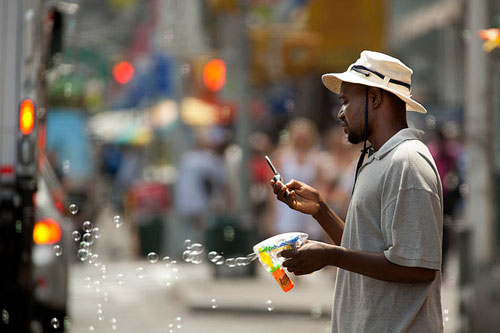
From Joe Holmes, Texters, a photo series of people texting.

Joe Holmes Texters

Fave · 0

Mark Twain on the telephone

From the June 1880 issue of The Atlantic Monthly, Mark Twain writes about the telephone, then a relatively recent invention. Or rather, he writes about hearing other people use the telephone:

Then followed that queerest of all the queer things in this world, — a conversation with only one end to it. You hear questions asked; you don’t hear the answer. You hear invitations given; you hear no thanks in return. You have listening pauses of dead silence, followed by apparently irrelevant and unjustifiable exclamations of glad surprise, or sorrow, or dismay. You can’t make head or tail of the talk, because you never hear anything that the person at the other end of the wire says.

Fave · 0

No one uses the phone anymore

They text, they email, they IM, but increasingly the phone call is too intrusive of a communication option for many.

“I literally never use the phone,” Jonathan Adler, the interior designer, told me. (Alas, by phone, but it had to be.) “Sometimes I call my mother on the way to work because she’ll be happy to chitty chat. But I just can’t think of anyone else who’d want to talk to me.” Then again, he doesn’t want to be called, either. “I’ve learned not to press ‘ignore’ on my cellphone because then people know that you’re there.”

“I remember when I was growing up, the rule was, ‘Don’t call anyone after 10 p.m.,’” Mr. Adler said. “Now the rule is, ‘Don’t call anyone. Ever.’”

As a long-time hater of the phone call, this is good news.

Fave · 0

Trend: multiple mobile phone numbers

People around the world are starting to use two or more mobile phone numbers on a regular basis for a variety of reasons (and using a variety of techniques, including special 2-in-1 SIM cards).

Another motivation to have more than one number is for the user to control how one is contacted and contactable. Naturally users typically have a strategy on handing out the right number to the right person for future contactability. Our research participants most commonly report separating private and business contacts by having separate numbers. Being able to switch one number completely offline is a way of switching the mental mode, such as “I am turning my work phone off as I am not working anymore”. Small business owners and those who deal with a large number of people can identify the type of contacts easily by differentiating which phone number they use. One Chinese electronic shop owner gave out one of his mobile phone number for his best customers, ensuring that he is always reachable for them. The ease of having another mobile phone number also provides the exclusive communication channel for some, like those in early or secret relationships.

Part two of the piece is here. (via @antimega)

Fave · 0

How the phone book changed the world

Greg Beato on how the seemingly humble phone book “signaled the coming shift from an industrial economy to an information-based one”.

The phone itself was a pretty big deal, of course, helping intimacy transcend proximity. But phone books provided a crucial element to the system: intrusiveness. In the beginning of 1880, Shea writes, there were 30,000 telephone subscribers in the U.S. At the end of the year, that number had grown to 50,000, and because of phone books, each one of them was exposed to the others as never before. While many American cities had been compiling databases of their inhabitants well before the phone was invented, listing names, occupations, and addresses, individuals remained fairly insulated from each other. Contacting someone might require a letter of introduction, a facility for charming butlers or secretaries, a long walk.

Phone books eroded these barriers. They were the first step in our long journey toward the pandemic self-surveillance of Facebook. “Hey strangers!” anyone who appeared in their pages ordained. “Here’s how to reach me whenever you feel like it, even though I have no idea who you are.”

Fave · 0

Woz and Jobs: phone phreaks

Steve Wozniak and Steve Jobs talk about their short career building illegal telephone equipment, aka blue boxes.

Interesting how their two stories differ…the engineer and the marketer.

Fave · 0

Esquire phone phreaking article from 1971

From the October 1971 issue of Esquire, Secrets of the Little Blue Box, an early mainstream piece on phone phreaking.

About eleven o’clock two nights later Fraser Lucey has a blue box in the palm of his left hand and a phone in the palm of his right. He is standing inside a phone booth next to an isolated shut-down motel off Highway 1. I am standing outside the phone booth.

Fraser likes to show off his blue box for people. Until a few weeks ago when Pacific Telephone made a few arrests in his city, Fraser Lucey liked to bring his blue box to parties. It never failed: a few cheeps from his device and Fraser became the center of attention at the very hippest of gatherings, playing phone tricks and doing request numbers for hours. He began to take orders for his manufacturer in Mexico. He became a dealer.

Fraser is cautious now about where he shows off his blue box. But he never gets tired of playing with it. “It’s like the first time every time,” he tells me.

Fraser puts a dime in the slot. He listens for a tone and holds the receiver up to my ear. I hear the tone.

Fraser begins describing, with a certain practiced air, what he does while he does it.

“I’m dialing an 800 number now. Any 800 number will do. It’s toll free. Tonight I think I’ll use the ——- [he names a well-know rent-a-car company] 800 number. Listen, It’s ringing. Here, you hear it? Now watch.”

He places the blue box over the mouthpiece of the phone so that the one silver and twelve black push buttons are facing up toward me. He presses the silver button - the one at the top - and I hear that high-pitched beep.

“That’s 2600 cycles per second to be exact,” says Lucey. “Now, quick. listen.”

He shoves the earpiece at me. The ringing has vanished. The line gives a slight hiccough, there is a sharp buzz, and then nothing but soft white noise.

“We’re home free now,” Lucey tells me, taking back the phone and applying the blue box to its mouthpiece once again. “We’re up on a tandem, into a long-lines trunk. Once you’re up on a tandem, you can send yourself anywhere you want to go.” He decides to check out London first. He chooses a certain pay phone located in Waterloo Station. This particular pay phone is popular with the phone-phreaks network because there are usually people walking by at all hours who will pick it up and talk for a while.

He presses the lower left-hand corner button which is marked “KP” on the face of the box.

“That’s Key Pulse. It tells the tandem we’re ready to give it instructions. First I’ll punch out KP 182 START, which will slide us into the overseas sender in White Plains.” I hear a neat clunk-cheep. “I think we’ll head over to England by satellite. Cable is actually faster and the connection is somewhat better, but I like going by satellite. So I just punch out KP Zero 44. The Zero is supposed to guarantee a satellite connection and 44 is the country code for England. Okay… we’re there. In Liverpool actually. Now all I have to do is punch out the London area code which is 1, and dial up the pay phone. Here, listen, I’ve got a ring now.”

I hear the soft quick purr-purr of a London ring. Then someone picks up the phone. “Hello,” says the London voice.

“Hello. Who’s this?” Fraser asks.

“Hello. There’s actually nobody here. I just picked this up while I was passing by. This is a public phone. There’s no one here to answer actually.”

“Hello. Don’t hang up. I’m calling from the United States.”

“Oh. What is the purpose of the call? This is a public phone you know.”

“Oh. You know. To check out, uh, to find out what’s going on in London. How is it there?”

“Its five o’clock in the morning. It’s raining now.”

“Oh. Who are you?”

The London passerby turns out to be an R.A.F. enlistee on his way back to the base in Lincolnshire, with a terrible hangover after a thirty-six-hour pass. He and Fraser talk about the rain. They agree that it’s nicer when it’s not raining. They say good-bye and Fraser hangs up. His dime returns with a nice clink.

“Isn’t that far out,” he says grinning at me. “London. Like that.”

Interestingly, a number of the early phone phreaks were blind kids, including Joe Engressia, who could whistle a perfect 2600 hertz tone.

Fave · 0

Phone etiquette and the end of the individual

Peggy Nelson argues that everyone being on their mobile phones all the time — even while at a dinner for two — isn’t rude, it signals a shift from our society’s emphasis on the individual to the networked “flow”.

We’ve moved from the etiquette of the individual to the etiquette of the flow.

This is not mob rule, nor is it the fearsome hive mind, the sound of six billion vuvuzelas buzzing. This is not individuals giving up their autonomy or their rational agency. This is individuals choosing to be in touch with each other constantly, exchanging stories and striving for greater connection. The network does not replace the individual, but augments it. We have become individuals-plus-networks, and our ideas immediately have somewhere to go. As a result we’re always having all of our conversations now, flexible geometries of nodes and strands, with links and laughing and gossip and facts flying back and forth. But the real message is movement.

But au contraire, mon frere.

My new standard of cool: when I’m hanging out with you, I never see your phone ever ever ever.

If we’re hanging out and you pull out your iPhone to water your Farmville crops, we can no longer be friends. It’s not me, it’s you.

(via @tcarmody)

Fave · 0

Pre-paid plan options for smartphone travellers

If you’re going on an overseas trip and want to use your phone (with data) while you’re there, check out this new wiki on what plans are available in several countries. I hope this develops into a solid resource…I never know where to look for this stuff before I go. (via dj)

Fave · 0

David Foster Wallace on iPhone 4’s FaceTime

The recently announced iPhone 4 includes a feature called FaceTime; it’s wifi videophone functionality. In Infinite Jest, David Foster Wallace wrote that within the reality of the book, videophones enjoyed enormous initial popularity but then after a few months, most people gave it up. Why the switch back to voice?

The answer, in a kind of trivalent nutshell, is: (1) emotional stress, (2) physical vanity, and (3) a certain queer kind of self-obliterating logic in the microeconomics of consumer high-tech.

First, the stress:

Good old traditional audio-only phone conversations allowed you to presume that the person on the other end was paying complete attention to you while also permitting you not to have to pay anything even close to complete attention to her. A traditional aural-only conversation […] let you enter a kind of highway-hypnotic semi-attentive fugue: while conversing, you could look around the room, doodle, fine-groom, peel tiny bits of dead skin away from your cuticles, compose phone-pad haiku, stir things on the stove; you could even carry on a whole separate additional sign-language-and-exaggerated-facial-expression type of conversation with people right there in the room with you, all while seeming to be right there attending closely to the voice on the phone. And yet — and this was the retrospectively marvelous part — even as you were dividing your attention between the phone call and all sorts of other idle little fuguelike activities, you were somehow never haunted by the suspicion that the person on the other end’s attention might be similarly divided.

[…] Video telephony rendered the fantasy insupportable. Callers now found they had to compose the same sort of earnest, slightly overintense listener’s expression they had to compose for in-person exchanges. Those caller who out of unconscious habit succumbed to fuguelike doodling or pants-crease-adjustment now came off looking extra rude, absentminded, or childishly self-absorbed. Callers who even more unconsciously blemish-scanned or nostril explored looked up to find horrified expressions on the video-faces at the other end. All of which resulted in videophonic stress.

And then vanity:

And the videophonic stress was even worse if you were at all vain. I.e. if you worried at all about how you looked. As in to other people. Which all kidding aside who doesn’t. Good old aural telephone calls could be fielded without makeup, toupee, surgical prostheses, etc. Even without clothes, if that sort of thing rattled your saber. But for the image-conscious, there was of course no answer-as-you-are informality about visual-video telephone calls, which consumers began to see were less like having the good old phone ring than having the doorbell ring and having to throw on clothes and attach prostheses and do hair-checks in the foyer mirror before answering the door.

Those are only excerpts…you can read more on pp. 144-151 of Infinite Jest. Eventually, in the world of the book, people began wearing “form-fitting polybutylene masks” when talking on the videophone before even that became too much.

Fave · 0

10 reasons to avoid talking on the phone

This comic on The Oatmeal pretty much nails why I hate talking on the phone.

If you’re like me, you can’t relax on the phone because you’re constantly looking for an opportunity to say goodbye.

Fave · 0